
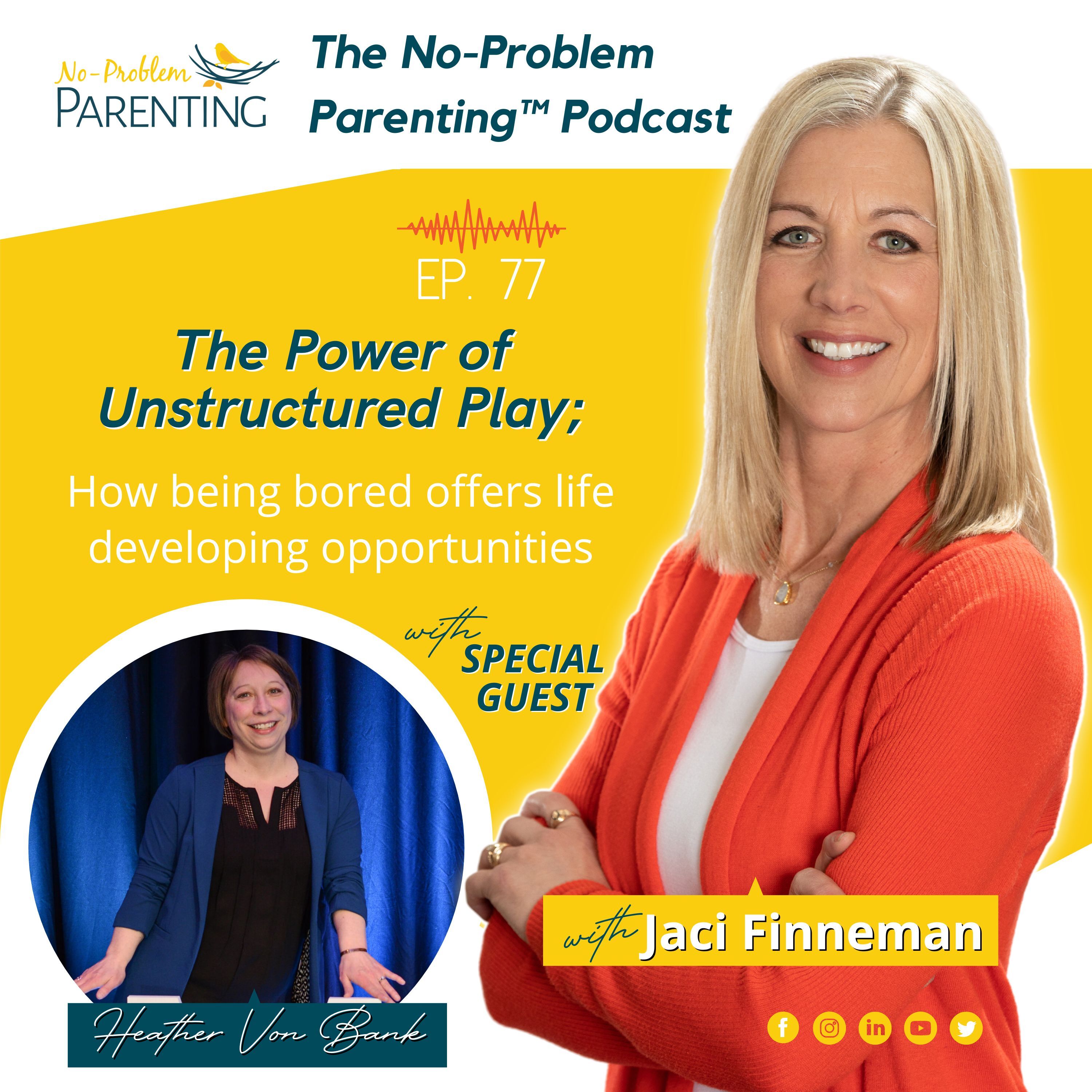
The Power of Unstructured Play; How being bored offers life developing opportunities with Special Guest Heather Von Bank
About this episode
Welcome Back No-Problem Parents!
Today's guest Dr. Heather Von Bank shares the importance of play for children, families, adults, and pretty much all humans! She's particularly interested in promoting recess, and other unstructured play opportunities for children at school. In today's episode, Dr. Heather talks about play and its importance in supporting children's mental health.
Become a No Problem Parent Today!
Full transcript
Hey, hey, No Problem Parents. Before we get into today's episode, I want to make sure you're doing a few things so that you're staying current and up to date with all things happening at No Problem Parenting. So the first thing I want you to do, if you haven't already, head over to our website, noproblemparents.com.
You're going to scroll down, enter your name and your email address, and get signed up to receive our free newsletter. You're also going to receive the free Make It Right technique just for signing up. So you want to head on over to noproblemparents.com and get registered today.
Absolutely free. The next thing is, are you following us on social media? We're on Facebook, Instagram, and LinkedIn. Those are probably our top three.
Search at No Problem Parents. Follow us. And then be sure to share your favorite posts on your story or with your community of family and friends. All right.
And then the last thing I want to make sure that you're doing is following this podcast. make sure that you are following subscribing liking you know whatever you need to do to make sure that you get updated when the next episode comes out because in the month of august not only will we have a guest that we'll be interviewing we're also going to have an additional episode on a specific topic with some tips and tools and strategies that you can use right away in your home with your kiddos so the three things get signed up for the newsletter at noproblemparents.com Make sure to follow us on Facebook, Instagram, or LinkedIn at No Problem Parents.
And be sure that you have clicked the little button to follow this podcast so that you're notified right away when the next episode comes out. All right, let's get into today's episode, which is all about play. So fun. Welcome to the No Problem Parenting Podcast.
Turn behavior problems into no problem with Jackie Fineman. Are you ready to become the confident leader your kids crave you to be? Do you want to learn how to make parenting easier and more fulfilling? Whether you are at your wits end or you want to have more fun as a parent, you're definitely in the right place.
Now, here's your host, Jackie Fineman. Hey, welcome back, No Problem Parents. Ooh, this is going to be a fun episode. Today, we're talking all things play and the power of playful learning.
And my guest today is another presenter or speaker that I met at the TEDx Talk in Mankato, Minnesota earlier this year. And so I'd like you to meet Dr. Heather Von Bank. She is a professor and department chair of family consumer science at Minnesota State University, Mankato.
She teaches courses on parenting education, lifespan development, and the role of play in development. In 2013, she co-authored her first book, The Power of Playful Learning, the green edition. Her most recent publication, though, is an online textbook titled Lifespan Development, Telling the Human Story. She's presented on the topic of play and development at local, regional, national, and international conferences and loves to talk about play, risky play, and the importance of play to support children's mental health.
So welcome to the show, Heather. Thank you so much. I'm so glad we were able to connect for sure. You have this awesome TEDx talk that's out and it's called Why Kids Need to Take Risks. And we're going to have a link in the show notes so people can go and check out your talk. But before we get into too much about the play, let's just hear a little bit from you and your background and why this is of such interest to you. I am an associate professor at Minnesota State Mankato. We're about an hour and a half south of Minneapolis is kind of geographically where I say we're located. I have been in the Department of Family Consumer Science for about 13 years.
Family Consumer Science is modern day home ec. So all of those home ec classes that you maybe took in high school, whether that was child development or cooking and sewing, like that's us. And we are the only program in the state of Minnesota that puts out or that creates, right, educates future family consumer science educators. I teach in the area of child development and family studies.
And it's always it's been my passion to work and think about play and the importance of play for children and also within families. It's just one of those things that once you start talking about play, people's eyes light up and their excitement for sharing their own experiences of play is just easy and natural. And when I started my job at MSU Mankato, I had a different sort of research track. But a colleague, she really got me started thinking about play.
And so I taught a class at MSU and I continued to teach that class on play and child development. And I teach it every summer and there's a play day that's involved in the class so the students create play activities for families and community members. It's the most fun. I get through the whole academic year so that we can spend five weeks talking about play and bringing in experts from across the country to just talk about how it shapes our brains and our bodies and why we need it.
I absolutely love this so much. So what was the drive behind doing a TEDx talk or how did that even come to be? Yeah, I push myself to try to do scary things, things that challenge us. And back in 2019, the university was able to get the rights to a TEDx. And there was a call throughout the university and throughout the larger community for people to apply and submit a video, right, to do a TEDx.
it's one of those things that, like I said, scares you, but also if you don't take advantage of this opportunity, right? Like you're going to, going to kick yourself. So I put a video in and it was accepted and the, the, the rainbows came out and all the excitement and then the pandemic hit. so uh we were supposed to do the TEDx in 2020 right so um that was canceled I figured it was done I said well you know that was fine we got a chance I was selected cool and then um in 2022 they said let's let's do this again let's try and so began the process of coming up with the script I mean I knew what I wanted to talk about but just coming up with the script is a whole other thing it's it's your your life's work in 10 minutes yeah right and and and there's so many accomplished examples of people you can see online and that's just super intimidating but I knew that I just had to put my voice out there and I just wanted to be my authentic self and what you saw what you see in the TEDx is me that's me in my classroom that's me with my family that's me with my friends. So I'm, I'm pretty, I'm pretty proud of being able to do it and,
and, and still being able to talk about my, my research and, and my, my passion for play. That's going to continue long after the TEDx. Oh, that's so cool. And I had the honor of sitting just a couple of rows behind your family as you were presenting the TEDx. So I got to, I put two and two together as I was watching. And, and then especially after you'd come off stage and went and joined them, I was like, uh-huh. I knew those were her boys. So how fun is that, that your kids got to see you do this scary thing and stretch yourself. I just think that's, that's super amazing. What were their thoughts about it afterwards? Well, they had heard my talk about a hundred times before they were my, they were my audience and, and, and really they're my inspiration for thinking about the ways that we, we can stretch and do the scary things, do the risky things, right? We take risks every day. Like I say, in my Ted talk, just by getting out of bed and a TED Talk might not be a risk that you would be willing to do, but we take those risks every day and we put ourselves out there and my kids were super supportive. And it was such a great experience. And the audience was so wonderful too. You don't see the flubs. Everybody should know that in the TEDx, people have to pause, people have to gather themselves up. And I had to do that a couple of times. And the audience was like right there with me and they cheered me on. And
I think I even said something like, this is really hard. Yes, I remember that. And I was just like, yeah, go get them. You got this. You did a phenomenal job. You were absolutely outstanding.
It was fun. You were engaging. You were easy to listen to. And I just wanted to hear more and more. And obviously then it came up and approached you afterwards, this random lady, like, Hey, you gotta be on my podcast. So fast forward a few months and here we are. So let's get into this play stuff. So why do children need opportunities for unstructured play in your research and in all that you've done? Why do you find that that's so important? You know, we, we have done a lot of really wonderful things for children. You know, we, we make sure that they have safe places to be in school. We make sure they have safe places to be after school. We've created extracurricular opportunities to help their social, emotional, physical development. We've done so many things for kids, but in doing all those things, we've almost not allowed them to have their own time for boredom and their own time to find a sense of autonomy and a way to figure out what to do on their own and unstructured play, or what I like to say, you know, chances to be bored are, are life developing opportunities because the world doesn't hand you opportunities.
You have to find those things, right? So in, in our fast paced world of get the kids to soccer practice and then bring them home and then make sure they have Taekwondo. And, and I'm not, again, All of those opportunities are things that we've helped. We wanted to help our children. We want to be part of their lives and create these wonderful opportunities.
Um, but, and we need to also think about downtime and time for children to just, to just play. Um, what, what we're seeing is that children between the ages of basically zero to six, most of their time should be spent in unstructured play opportunities. And we're just seeing more of that extracurricular, um, younger ages, though, those programmatic things starting up at earlier ages at the cost sometimes of these um unstructured play and i say unstructured but we're just talking about play we're just talking about kids running around outside um on their on their own i mean maybe not as however however safe your neighborhood and and space is but letting them um we'd like to say child-led play opportunities you know parents sometimes need to just be quiet and just observe and just let the children play. That that's so and you know, so after the TED talk, I was getting lunch, and people kept coming up to me and saying,
Oh, I did so many risky play things when I was a kid, when I was a kid, and these are older adults telling me these things. What what are our children going to be talking about later? Are they are they going to be talking about when they had a chance to go on bike rides or explore a forest or is it I went to this camp and I went to this camp and I went to this camp and again those are fine but we're just really talking about a different way in which we are seeing our children in developmental ways and how important unstructured play is for young children it just it comes out You can see it in, in individuals' lives. Yeah. So the differences, and I remember this back in the early two thousands, when I was fortunate enough to help create a mental health program within Head Start communities, Head Start schools for those younger kids, they just three to five.
And I didn't know this prior to, they are, they have to have so many hours a day or so many minutes probably because they're, you know, usually the kids are there for maybe three or four hours at a time, but of unstructured play, meaning there's not an activity where they're sitting at the table. There's not a specific activity where it's teacher led. It's just free time and they can take out a bin of toys or they can go play at the kitchen, you know, set, or they can, you know, whatever it is, but they, they get to figure out what is it that they want to play with. And then there's no teacher direction on how to do anything. So that was my first introduction to the meaning of unstructured play, I guess. And the other thing I wanted to mention is boredom. And I did, I think I posted on social media about this before or something, but I actually help, I teach families about how to allow your kids to be bored. You know,
oh, my kids are constantly coming to me and saying, I'm bored. I'm bored. That is a great problem to have. And you can do things like create board bags, I call them. So take a paper grocery bag and fill it with random stuff, little trinkets or paper cups and the forbidden tape, right? Parents don't like their kids to have tape because they tape stuff everywhere.
But tinfoil, I mean, just random things that you're putting in a bag. And so when the kids come to you and say they're bored, you can say, oh, go grab a board bag, see what you can create, you know, show me, I'll be so excited to see it when it's done. And then you take a picture of it And maybe you actually print the picture and put it on the refrigerator and look at this cool creation that my kid made. And also just being bored, letting them spend time sitting there thinking about what else can I do?
What can I, what can I do? That's not turning the TV on or being on a screen and kids are so creative. They'll figure it out or they'll just be bored and have some downtime and rest. Absolutely.
I love when my children were much smaller, we had, I couldn't even see the carpet in our house because it was always littered like with those sort of like loose part items. Anytime I would like run at the end of a cardboard toilet paper tube or like a, yeah, those tubes would be lying all over the place and they would be taping things and they would be gluing things. And I'm good with mess. And I know that not all parents are good with mess. I know that they will wash off. I know that the thing will wash off that might be stained for a bit. But I know that they have that opportunity for them to do that lasts a lot longer than the annoyance of cleaning up some tape on the floor, right?
so um again I'm a developmentalist I can think about things in like a long-term thing so you know kids are gonna think more about oh remember that board bag when I had to grab those things out and and I don't remember what I made but I remember making lots of things and I really enjoyed that as opposed to I played with this game that I got for a birthday for for hours like kids don't remember that they remember the the feelings of of of play even if they don't remember what they made they have so much more um feel good memories I guess of opportunities where they just hung out and did a thing absolutely I'm wondering too do you think that kids growing up today have more or less opportunities for unstructured play than previous generations I mean like you talked about the organized sports, organized sports, there's lots more of that, I think now than ever,
which is a great thing. So kids are active and it's more than that. Yeah. I mean, research has documented that children just have less time to spend playing without adults telling them what to do. It's, it's documented and we don't know what that means, right? We're, we're kind of in a different, in a different stage of understanding what that's going to look like later. You know, I work with college students and they are telling me right now how sad they are to see young children not having unstructured play. And that's not even, they're not that far out of their young years, right? To recognize that young children today are getting far less time to climb trees, to go hiking in the forest, to lay on the grass and make, you know,
weed headbands or whatever, you know, like they're, they recognize that. We're not sure what to do about it, except talk about it with parents and just really emphasize that unstructured play is opportunities for learning and it's opportunities for helping children become the people that they're meant to be. And especially with risky play, that's what makes parents really nervous, right? They don't want to see their children climbing trees.
They don't want to see them going down hills really fast. It's scary. But when we ask those parents, what were your favorite things to do as kids? Those were the things, right?
Right, exactly. I think now more than ever with the use of technology, and I'm not anti-technology, I'm not anti-screen time for kids, but I do think that even when we're like at a doctor's appointment or we're grocery shopping and the kid's in the cart or we put them inside the cart, not even the sitting part with their little legs through the holes of the front of the cart, if they're too big. We throw them in the sitting cart and then in the seat or in the basket of the cart.
And then we're handing them our phone or something to keep them occupied rather than just letting them sit in there and look around and wonder about, you know, the items in the store or noticing the other people in the doctor's office as they're just having to sit patiently and look around and be bored and wait. We're putting a screen in front of them to quote unquote, keep them busy or keep them occupied. And, uh, you're just making me think about that right now, how it's, you know, or maybe they're at their sibling sporting event and they're having to sit on the bleachers next to you and they want to be on an iPad or something so that they're not, you know, but then they're not engaging. They're not learning anything, you know, from, from those surroundings. So, uh, I think it's just become sort of habit to hand them the screen. Right.
I totally agree. Yeah. No, and I think those observations are, are not new, but we certainly are aware that because children in public, if they are loud or boisterous are often looked at as being a problem. Right. So parents I think are like overcompensating they don't want their child to be a problem they don't want their child to be whatever it is.
I I think that's I think we should have boisterous children and I think children should be able to be themselves um when we go to the grocery store I I've never given my children my cell phone because because I want them involved in all the wonderful displays that the grocery store has to offer colors words sensations um and I I like to think about it as like a missed opportunity right like there's so many opportunities for children to learn why would you take away this miss this opportunity for them to um reading the cereal boxes or knowing that when we turn this corner we're going to be in the freezer department it's going to get real cold so being able to do predictions and anticipation and and expectations about what are we going to get today now we know we can only get one bag of cookies right like we have these others we went to the parade last week and we got a bunch of candy at home right so working through a dialogue in in in a grocery store setting is a wonderful place for us to practice self-regulation and self-control right it's just another place it's just another environment and we're so focused on just going to get this done. Just got to get the grocery shopping done as opposed to thinking of it as an opportunity, a chance, a way to practice being a civilized person in a grocery store. Right.
Right. One of the things that I remember from my, my older sister, her youngest, when she would go into the, to the store, like say it's a department store or a big chain store Target or something like that. And, and she'd say that, you know, of course the kids get past the toy aisle or even near the toy aisle, or even just in the, in the checkout lane. And there's all those temptations there. She taught her daughter to say, and I just loved this. She would say that would be nice to have. So instead of, you know, the kid, I want that. I want that, which all kids are going to do that at some point, right? I want that. I want that. And instead teaching them to say, well, that would be nice to have. And then you can have a conversation about,
well, what would, how much money does that cost? And what would you, what could you do to earn the money, you know, to be able to, to buy that or save your birthday money or something like that, to be able to get that toy or to make a list. And so I just, that kind of stuff, it's like, how cool is that? So I remember taking my niece somewhere at one point and she would say that, oh, that would be nice to have. And I thought, how cool is that? That's a transferable skill.
as an adult when we're walking around Target, that would be nice to have. Yeah, right. Not right now, but maybe later. Yeah, exactly. So let's think about that with adults. Tell me about some ways that you've promoted unstructured play in your work at the university and in the community.
What I love about my job is that I get to work with young adults who are going to become a play advocates. And those students are working directly with children and families. And they, in my classes, they'll tell me, oh, we have this kiddo. And I say, well, let's, let's put that kiddo in context. This kiddo is living in the middle of a pandemic. This kiddo has X, Y, or Z.
This kiddo has parents who love them. I try to help them think about context and parenting is just another context in which children are living in and are exploring. The cool thing is that I get to work with these young people. They work with the parents and the kids. And then I get a chance to sort of create those connections through the play days that we do in the community.
So I would love to be able to do more throughout the year, but our very demanding academic schedule keeps things pretty tight. But I've been able to do a number of them. And parents who get what our play days are about get it. At the play day, we brought different things that you might not see at a park.
We brought a kitty-sized pool filled with bubble solution. And we had fly swatters in there so the kids could make bubbles in a different way instead of blowing, right? We had a bunch of boxes and blankets and rope to tie those things together and tape, of course. Those are chances for the kids to play.
And it wasn't my students' responsibility for them to watch their children. It's kind of like when you go to a party and you provide the food, you provide the conditions, and then the parents and the children decide what to do and what not to do. And it's so important for me that my students get a chance to just observe during that period of time. And I get a chance to talk with the parents. And in doing that, the children just get to play.
and it might, it's often the only time in which parents maybe get a chance to talk to adults during the day. And it's also maybe the only times that the children get to play without parents directing their, their actions. Yeah. That's so cool. That is so cool. All right. The last thing I subject that I wanted to touch on before we wrap up is this idea of risky play. And what do you think I'm curious to know from you and your experience, what makes parents so nervous about risky play? And then also how can parents get a better handle on how to support kids that need to take risks in their play? Some kids literally do need to take risks. It feeds them, right?
So the original title for my TEDx was basically why kids need risky play or something about risky play. And there's something about putting risky and play together that makes people real nervous, or there's like a double entendre, right? Like I was like, oh, maybe we should untie that, right? Some people refer to risky play as like adventurous play, or just active play or physical play.
And however we want to define it, it's letting kids push their limits. And some kids' limits are a lot firmer than others and some are a lot looser than others um I I always provide the example of climbing trees mostly because that is like one of the things that I feel like my kiddos do we have this really great scarlet maple tree and it's just like a fixture in our yard and it's the plate it's it's a beautiful tree but it's it's got these wonderful climbing branches it just it just does and i have seen my children fall out of that tree i have seen things fall out of that tree and and they keep going back because there's a need that it it there's a niche that it fits their need and they they don't do flips they don't do a lot of other like rollerblading or but but that's their thing um for other kids it might be you know getting on a bicycle and going to a top of the hill and just feeling the wind in their face and the if i don't get this right i could die kind of feeling. We need to face that feeling. It actually helps us to overcome our fears by facing them because we've overcome them, right? We need, and it's the same reason why people, adults like watching horror movies and scary movies, like, oh, that was terrible, but I got through it, right?
It's a way that we actually are becoming antiphobic by doing scary things, right? So getting on a TEDx stage, or maybe just going up and talking to a romantic partner, or going on a blind date, like all of those are scary things. It's sort of my theory, it's like an evolving theory, Jackie. I'm not ready to publish any papers yet. There have been some papers published, but when children get these risky opportunities, they actually are less likely to be risky teenagers because they've practiced right making decisions right so potentially those kids who have been wrapped in in cotton or you know bubble wrap they they haven't had a chance to practice and that's what risky play does um i'm again i'm not i'm not publishing any papers yet. I need to do some longitudinal studies on this, but it's, it's my evolving theory that it's,
it's good for long-term development because it helps us to be better thinkers. Yeah, for sure. And not just rely on our parents or our, the other adults in our life to know whether something we should do something or not, you know, kids often they need to have their own experiences. And I know a lot of times parents will say they want to teach their kids a lesson, right? They want to tell them all the risks. They want to verbally tell kids what could happen.
And it's okay to have conversations about that as long as you are really kind of, what's the word, not monotone, but matter of fact, as long as you're being matter of fact about that, this could happen or that could happen and being curious about, so what do you think, Or how do you think that would work out versus, oh, no, don't do that because blah, blah, blah, blah. And you're kind of instilling a fear in them. Let them experience that process, that figure it out a little bit on their own and come up with their because when it's internalized like that, the odds that they will make a better decision later will happen.
So as much as we want our kids to have maybe an easier life than we had, I often ask parents why. Maybe some of the tough stuff in your life or the risky things that didn't work out for you were exactly what you needed to be as successful and as well-rounded as you are in adulthood now. And why would we want to rob our kids of that opportunity? That's so good.
I really like that. I know that we've created these little beings. We want them to survive. We want them to be okay.
so we tell them about all the scary things that can happen um but but scary things happen all the time what can we do in that moment to help them be aware of their situation so in my TEDx I say you know um as opposed to yelling at your kid get down from there you're gonna fall right talk to them about look around what what's nearby if you're afraid of water don't don't put your fear of water on them but help them be aware of you know you're getting into deeper water how do you feel about that would you like me to come closer would you like to come closer um you know when when children are running as one is want to do um as opposed to saying slow down we or stop running i can't even like undo some of those things because it's so ingrained in what I do. So I say walking feet, walking feet. And, and when we help them be aware of what it is that's around them, we can help them be better planners, right?
Yeah, I just absolutely love that. And everything about you and this topic, and I'm so grateful that you joined me today. Parents, make sure that you go check out Heather's TEDx, Why Kids Need to Take risks. And you also co-authored a book called The Power of Playful Learning, the green edition. So I'm going to put a link in the show notes for that as well. Heather, any last thoughts or anything to summarize all of this that you have for us today? It's summer. And the, the inclination is to do all the big things, right? Go to Yellowstone and go to wherever you're going to go. But I just encourage parents to just go outside and play with your kids. Let them take the lead, show, let them show you all the things that they're interested in. And, um, the, the best thing I think we can do is just be observant and just listen to our kids do, do small things. The small things matter too. Thank you so much for being with me today. It was an absolute pleasure. I I really enjoyed this.
Thank you for tuning in to the No Problem Parenting podcast. Join Jackie next time for more tips, tools, and resources that will help you become the confident leader your kids crave you to be. Who do you know that we could support on their parenting journey? Like this podcast, subscribe, share, or leave a review of the show.
Your support of the No Problem Parenting podcast pays it forward and helps us help more families. Thank you.
Become the confident leader your kids crave
The method, the community, monthly live Q&A with Jaci, and Celia — your AI guide in the moment.
Start your 14-day free trial Get it on iPhone or sign up on the web