
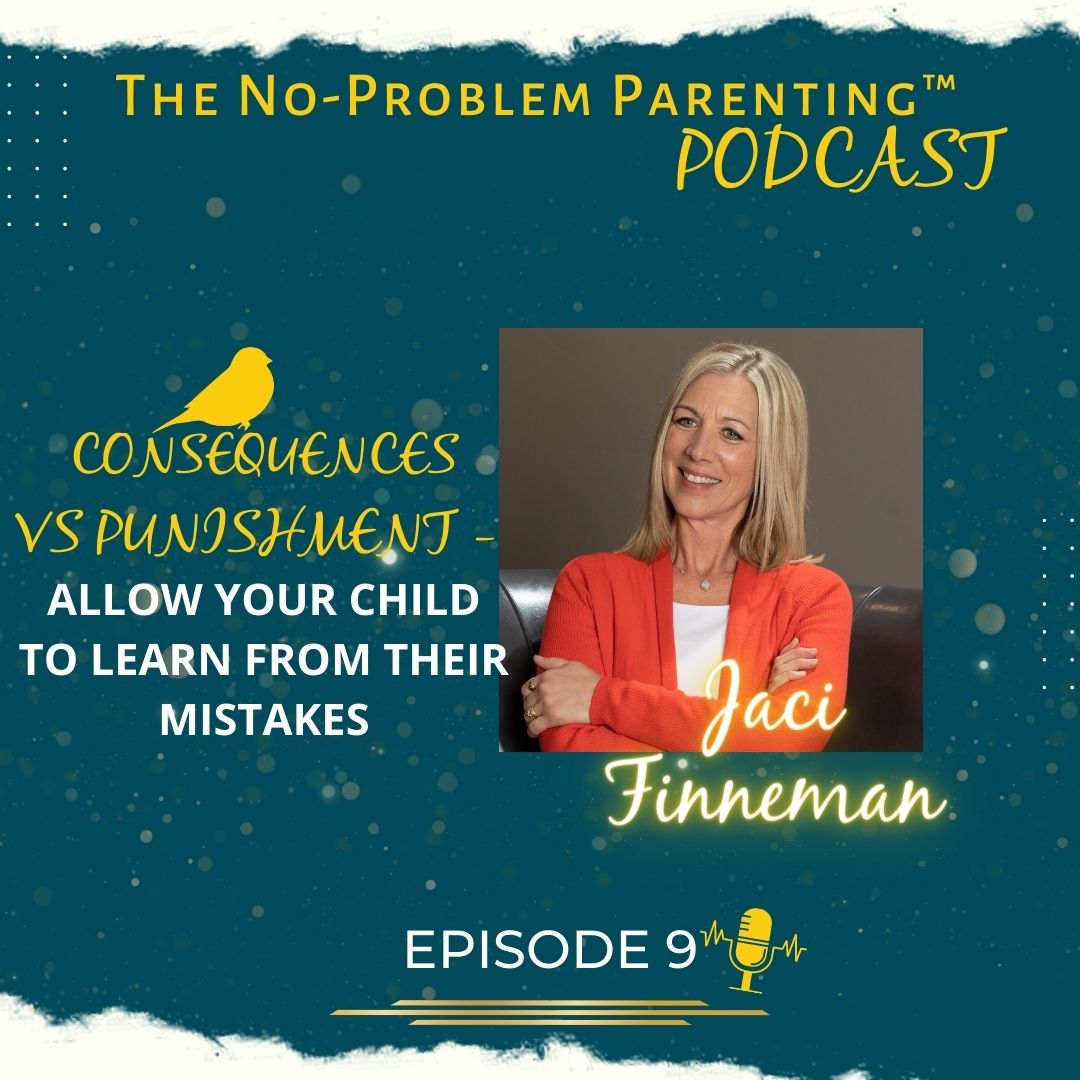
Consequences vs Punishment - Allow your child to learn from their mistakes
About this episode
When your child says “I’m sorry,” but nothing changes — it’s time for The Make It Right Technique.This simple, practical approach helps your kids take real responsibility for their actions and repair relationships through action, not empty apologies.
👉 Listen now to learn how to use the Make It Right Technique at home — featured in Episodes 9 and 23 of the No Problem Parenting™ Podcast.
📘 Download the Make It Right Guide for ParentsGet scripts, age-appropriate examples, and step-by-step instructions to help your kids make things right.🔗 noproblemparents.com/makeitright
Full transcript
Welcome back, parents. Hey, today we're going to talk about all things consequences versus punishment. One of the most common calls I get from parents is, my kids just don't seem to care about consequences. I take things away, they don't care. I take their technology away, they don't care. I ground them, I yell, I even ignore them, or I give in and I say, hey, this is the last time I'm going to give in and nothing seems to work. Now often when traditional consequences don't work we resort to punishment because we're so frustrated and then we get more frustrated when it seems like our kids don't care and then we get tougher and stricter and we do things we regret or can't take back. Listen in parents this is super common and I'm going to give you some insight and tools for how and when to consequence your kids without resorting to punishment.
Hey there, parents. Welcome back to the No Problem Parenting Podcast. I'm your host, Jackie Finneman, the founder of No Problem Parenting and noproblemparents.com.
I believe any parenting problem can be turned into a no problem, and it all begins with a shift in mindset. We tackle real parenting challenges, and we provide practical solutions at work. If you're dealing with behavior issues, setting boundaries, or you're just feeling stuck, No Problem Parenting is here for you. And today, I'm excited to announce our new network.
It's called The Nest. whether you're in that nesting phase ready to welcome your child home or you're ready to launch your child out of the nest and you're becoming an empty nester the nest is for you head over to no problem parents.com grab your free download of the 60 ways to respond to your kids without losing your cool and get on our email list where we share more about exclusive access to our monthly power hour calls which includes hands-on resources and we're bringing experts in on a variety of topics. Join our growing network of confident, empowered parents. Visit NoProblemParents.com and get started today. Hey parents, now are you unclear about the difference between consequences and punishment? If so, that's very likely the reason your efforts to discipline your kiddo aren't working. Often when I ask parents what the difference between consequences and punishment are,
they say, well, it's pretty much the same thing. It's just that punishment is more about spanking or hurting your kids physically. And yeah, that's true, but it's more than that. A consequence is the effect, the result, or the outcome of something occurring earlier. So similar to cause and effect, or I liken it to cause and effect, cause and effect is a relationship between events or things.
It's a combination of action and reaction. Something happens, the cause, that leads to an effect. But the problem with cause and effect and consequences in regards to parenting our kids' negative behaviors is that we often get more upset about the behavior or the misbehavior than the child. In other words, we as the parent put more effort into the problem and resolving the problem than our kids do. The goal for giving consequences is to teach a lesson that leads the child to make better choices and decisions. The goal is to encourage your child to accept responsibility for their actions, to understand their role in the poor decision that they made and how it may have affected another person or themselves, and the ability to learn from their mistake and the development of an inner voice of self-control. Consequences give your child the message that they are capable of taking responsibility for the problems they cause and that they can handle it. And I talk a lot about how consequences should fit the crime.
We don't need to be making up consequences that don't even have anything to do with the issue at hand or the problem at hand. But what do we do? Well, often we initially get mad or maybe it's that we get sad or scared of the misbehavior or what our child did and what the result of their misbehavior or poor decision will create for them or for us or for other people. And then sometimes we take it even further and personalize the misbehavior as a reflection of ourselves or our parenting or our beliefs. And if that happens, we either end up taking care of the problem ourselves or when consequences don't work, we get stricter and stricter and we end up punishing. So let's talk about what is punishment. Well, punishment, according to the Merriam-Webster dictionary, is suffering, pain, or loss that serves as retribution. The goal of punishment is to inflict physical or emotional hurt or pain, and here's the key. The goal of punishment is to get even or make the other person pay for the misbehavior. Now, I'm kind of from the school of thought where consequences should fit the crime. And once a child has made right what they've done wrong, there's no need to rub salt in the wound and make them pay. Now, while many people will say that punishment works and it has worked for years, and if you were raised in a family where you were punished,
that might seem true if you turned out quote unquote okay. If your goal is to get your kids to listen to you in order to make you feel better, well then you might be right. You might be the type a person that feels better when people do as you say. However, punishment can cause resentment and it rarely teaches kids what we want them to learn. It can be damaging to your child's self-esteem for sure or their self-worth and it most definitely doesn't create a secure connection between you and your kids. Think about this. If your child suffers a natural consequence for their misbehavior, isn't that enough? Is there really a need to rub salt in their wounds by adding more consequences? Does reminding them why they did what they did was wrong? Does teaching them a lesson about it come with a long verbal dialogue and does that really change their behavior?
Does lecturing or saying I told you so work for you? Adding on consequences that don't fit the crime but make us feel like we're in charge and we're justified sometimes work on getting our kids to do what we want them to do, but it rarely helps the relationship. Instead, can you be happy that they made right what they did wrong and completed or fulfilled the natural consequence? Isn't that good enough? Now the reason punishment often doesn't work is because it's almost always delivered with anger. And using anger, as most of us have discovered or found out in our own homes, isn't usually effective. And also punishment is temporary. It teaches kids to respond out of fear that they'll get in trouble for something or that you'll be mad at them or that you'll hurt them rather than out of the desire to do the right thing. There's no long-lasting development of an inner compass that occurs with punishment and it certainly doesn't lead to self-control or self-discipline. Often if you have a child that has been you know experimenting using drugs or goes out with his friends and drinks and you punish them, typically the result is not that they're going to stop doing the unwelcome behavior. It's often that they're going to get better at hiding it from you. And then when they are out with their friends, if they're using or drinking or something, they'll think to themselves, hey, if my parents only knew what I was doing, they'd be
so freaked out. And punishment also reinforces a kid's negative view of themselves. You know, if they're already thinking that they're bad or they're undeserving of love or that they've made a big mistake and they're not going to be able to recoup from it, they're not going to be able to put it behind them. Mom and dad are always going to bring up that misbehavior or that mistake.
They believe they deserve to be punished. And if you believe you're bad and you deserve punishment, you're going to continue to act badly. When you act poorly, you become angrier, you feel worse about yourself and your oppositional behavior escalates. This vicious cycle provokes additional punishment and you're just both of you, parent and child, are in this never-ending kind of battle or tug of war. Each punitive experience reinforces to the child that they're not worthy. It increases their negative self-esteem and it creates an expectation by the child and others of additional bad behavior. Like you're just always going to be bad. You just can't make decisions on your own, make good decisions on your own. And the other thing that punishment can do for some kids is provoke revenge. Consequences teach kids that when they make a choice, they set into motion a set of circumstances for which they're responsible and accountable.
With punishment, children are too busy being mad at you to even think about what they did wrong. punishment makes kids feel angry and resentful and when defiant kids get angry they get even now it used to be that I would coach parents for let's take timeouts for instance for your younger kids and you'd send your child to timeout you'd set a timer for one minute per age of life that they are so if they are seven years old you're going to set the timer for seven minutes well really what ends up happening for lots of kids is that they calm down fairly quickly, but they're still angry or they're still upset that they had to do the timeout. They didn't want to be in there. And so if they're calmed down within a couple of minutes,
now they've got the last five minutes or six minutes or whatever to sit and stew and to think of ways that they can get back at you or get even with you. So we don't want to do that. I use a couple of different techniques for this for the younger kids. There's the sit in the chair technique which all we're asking for is 30 seconds of calm sitting in that chair and that's for the younger kids under five or the make it right technique. Punishment creates wounds that make kids fearful of trusting and loving other people. Punishment actually breaks the connection you have with your kids. It creates wounds that make kids fearful of trusting others and loving others. They must maintain this emotional distance in order to protect themselves from you, the parent,
from that possibility that they're going to get in trouble or something bad is going to happen to them. It takes the focus off the problem and it actually puts the defenses up. And so it reinforces this me against you mentality. Now the goal of disciplining your kids is to get them to stop doing something or to start doing something, right? Once that's achieved, I mean, like that's success. That's what you're looking for. We don't need to have this wedge put in our relationship with our kids. So what I often use is a technique called the make it right technique. Now you should only use this technique after you and your child are calm and the behavior problem is basically like over. It's not in the moment because if you're disciplining in the moment and you're upset by something the child did, you're most likely to be reacting versus responding. So when we react,
we're in our fight or flight mode. When we're responding, we're in our prefrontal cortex or our logic mode, right? So be sure that neither of you are in that fight or flight mode when you use the make it right technique. Now, if you or the child become upset while having the conversation for make it right, then you need to stop and try again later. You need to say something like, you know what, I don't think you're ready to have this conversation or I'm not ready to have this conversation. We're going to, I'm going to get back to you. We'll try this again later. And, you know, for little kids, you can wait, you know, a couple hours. For the older kids, you can wait a day or two. Life can still go on in the meanwhile. So it doesn't mean that if you put the consequence off or the discussion off, it doesn't mean your child's getting away with anything. When we catch our kids doing something they're not supposed to be doing, or when we learn about a problem that they've created for themselves or others. Often we think we have to handle it like right now. And that's a lot of pressure because number one, if you're really upset or disappointed in your child, you know, chances are you're in that fight or flight mode. And that's not the best time to be having a conversation. So delay the consequence. There's nothing wrong with delaying the consequence. And I'll be talking more about that in, you know, other episodes,
or reach out and tell me the problem that you're having with your child. And then we can work together to come up with the natural consequence. But delaying the consequence is super important so that when we do address it, we're not in that fight or freeze part of our brain. We're more in the logical part of the brain. The consequence fits the crime. It's either natural or logical. And then we get to, we can keep moving. So with make it right, the goal is for the child to make right what they did wrong and make it up to you or whoever else that they harmed, but not to punish them. You're teaching that when we make a mistake or cause a problem for others, we can correct the mistake and make it up to the people that were involved or affected.
Now this can be used with any person that your child's behavior causes a problem for, including siblings, teachers, classmates, coaches, you as the parent, or others. In step one, after the behavior has happened, you want to go to your child and look at them and say, hey, what happened? For example, I hit my brother or I stayed out past curfew. Step two, whatever the child did, as long as when they tell you what they did, it was honest, they're being honest about what they said, you can say, step two, good job being honest or good job telling the truth. Now having eye contact is great when you do this. And also, you know, for some kids having your hands on their shoulders or holding a hand of theirs, or you're not, your shoulders aren't all puffed up like,
what happened? You know, and you're all upset with them. So step one, what happened? You want them to say it in their words, what happened? And then step two is good job being honest or good job telling the truth. If they're not being honest or telling the truth, you can say, you know what, it sounds like you're not really ready to talk about what happened. Why don't you come back and check in with me later on, you know, after dinner, for instance. Now, step three is what are you going to do to make it right? You ask them. What are you going to do to make it right?
If they hit their brother, what are they going to do to make it right? You know, oftentimes as parents, we say, go say sorry. You go say sorry. Well, if the kid really isn't sorry and they're still really upset by whatever the other person or the other kid did to upset them, chances are if they go say sorry, they're only doing it to please you or get out of something, but they're not honestly sorry. And so now the kid that's been hit has not only been hit, but they've also been lied to. Saying sorry is icing on the cake. And I have a whole lesson about how to do that appropriately with an I'm sorry and a will you forgive me? Not just sorry, but when you do say I'm sorry, it's I'm sorry for hitting you, or I'm sorry for staying out past curfew and causing you to worry and stay up late or not get enough sleep, etc. What are you going to do to make it right?
Now, you're going to be curious when you say this, not angry. So yeah, you're right, you did hit your brother, or you did stay out past curfew. What are you going to do to make it right? And the child might say, I don't know. And they don't care. Well, you know, would you like some ideas?
No. All right. Well, I want you to take some time to think about it and you can get back to me and let me know what you're, what, what you came up with. When you wait during step three, when you wait, life still goes on. There's really no need. I mean, you might be upset about what happened, but you don't have to like let that fester and feed the rest of your interactions for the day or the evening or the weekend. Life can still move on. And again, you might think, oh my kid's gonna think they're getting away with it no they're not when they ask to do something special in the meanwhile you can say oh you know what just as soon as we finish our conversation about how you're gonna make it right I'd be happy to take you to your friend's house I'd be happy to play a game with you I'd be happy to watch that show with you I'd be happy to let you on your technology whatever so in the meanwhile you're just waiting for them to address this right? They're going to be mad. That's okay. They can be mad. We don't have to be mad that they're mad. We can wait. But if the child, when you say in step three, what are you going to do to make it right? And they say, I don't know. You say, would you like some ideas? If they say yes,
give them two to three ideas for what they can do, something nice they could do for the person that they caused a problem for or hurt. You know, maybe they're going to clear their siblings' dinner dishes from the table, pick up their toys or make their bed or carry their backpack to school or read them a story. I mean, it all just is age dependent. Something nice but simple. This is not punishment. It's teaching the kids the act of when I've done something wrong or hurtful to somebody, I'm going to make it up to them and make it right. It's helpful to have a list of things that include certain chores or acts of kindness that your kid can do to fill up your tank or other people's tanks or to cheer them up, something they can do to make it up to the person that they harmed.
Now, when you're done with that, when the child says, oh, I'm going to do this, or your teenager says, you know what, I'm going to, you know, I'm going to wash the car for you, or I'm going to do a chore for you, mom or dad, because you spent all night worrying about me when I was late for curfew. Then step five, get this people, step five is either a hug or a high five to their child and you say, hey, sounds like a good plan. Good job making it right.
And then life goes on. Now, if the same behavior happens again, rinse and repeat. There's really no need to get angry. You're teaching your kids a valuable natural lesson that they can learn from.
And remember, sometimes it takes a kid making the same mistake several times before they decide it's not worth the consequence. If you think the technique or this response, this make it right response isn't working because your kids keep doing the same behavior over and over and over, well some kids do the same behavior as if to test you to see if you're going to follow through the same way the next time. You know sometimes when we change up our parenting techniques, the kids get really confused and that's kind of a good thing. Having a kid be a little confused puts them in the curious part of their brain, which is the logical part of their brain.
When they're curious about what we're going to do next, they're less likely to be fight or flight mode, right? And be scheming or conning the next, you know, misbehavior or trying to get us to get mad, which when we get mad, we shift the focus from the problem, the actual initial misbehavior a problem, the focus shifts to like our needs and we own the problem more than the kid. And now the kid can kind of sit back and be like, well, hey, if you're going to handle this or take care of it and you're going to put all the emotional energy into it, I guess I don't really have to.
So staying calm and helping your child understand that this is their problem to own without saying that actually teaches the child how to handle their misbehavior, right? how to make something right that they've done wrong. And it also gives them the self-esteem or the self-worth that, you know what, when I do mess up, when I do make a mistake, I'm capable of making it right. I'm capable of doing the right thing.
And I don't need mom or dad to tell me how to do it. I can come up with that on my own. So be prepared for the same problem to happen again. Be prepared to have to use this technique several times before you actually feel like it's successfully working.
There's more information on this in the Becoming a No Problem Parent online course. If you want more information about it, feel free to schedule a call. Remember, the goal for giving consequences is to teach a lesson that leads to positive choices, not to enforce or inflict a punishment that makes a child do something just so you can feel better. Consequences encourage self-examination, teach our kids how to accept responsibility for their own actions, how to learn from their mistakes and develop that inner voice of self-control.
All right, that's it for today. Join me next time for more tips, tools, and resources so that you can become the confident leader your kids crave you to be. And if you like what you just heard, help me spread the word. Subscribing or leaving a quick review of this podcast helps me to reach more parents.
And if you or someone you know want to simplify your parenting with real-life, in-the-moment strategies, we need to talk. Join my parenting community so that you can feel good about your interactions with your kids and they can feel good about their relationship with you. All right, parents, that's it for today. Thanks for listening to the No Problem Parenting Podcast.
Remember, with the right tools and a confident mindset, every parenting challenge, every parenting problem can be turned into a no problem. If you're ready to lead your family with clarity and confidence, consider joining us in the nest. Learn more at NoProblemParents.com and let's keep building that confident, no problem parenting mindset one step at a time.
Become the confident leader your kids crave
The method, the community, monthly live Q&A with Jaci, and Celia — your AI guide in the moment.
Start your 14-day free trial Get it on iPhone or sign up on the web