
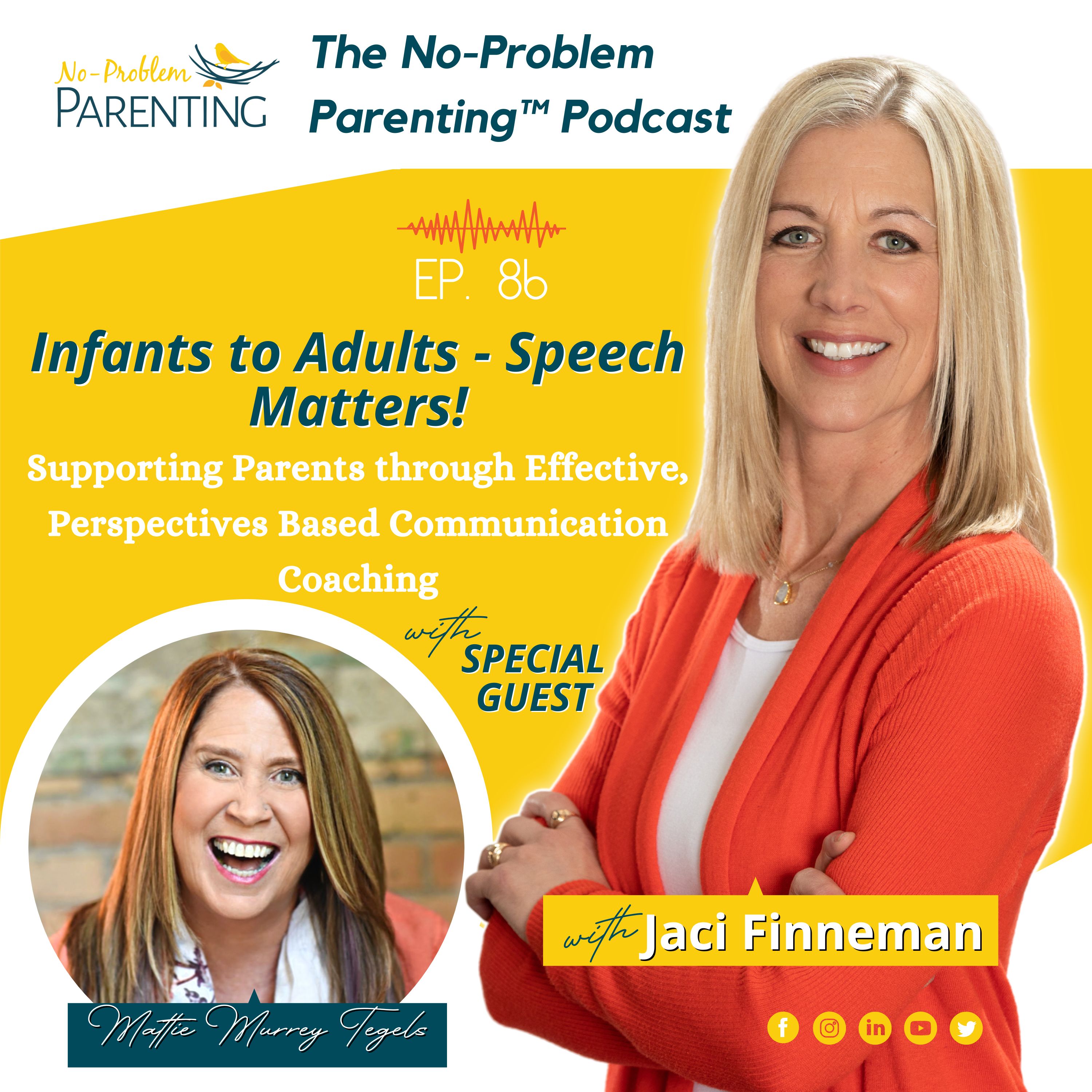
Infants to Adults - Speech Matters! Supporting Parents through Effective, Perspectives Based Communication Coaching with Special Guest Mattie Murrey Tegels
About this episode
Do you have an infant, toddler, or child that struggles with feeding or eating?
Are they shy and do you worry their speech is delayed?
Today's guest gives parents tips, tools and resources that will validate your intuition and support you in helping your child.
Become a No Problem Parent Today!
Full transcript
Hey, welcome back, No Problem Parents, to the No Problem Parenting podcast, where we choose to deal with and overcome the emotional and behavioral challenges within our home. And oh my gosh, you guys, it is September 2022, and it is an exciting month here at No Problem Parenting because our first ever book compilation is launching in just a few days. next week, September 20th, we are going to have an event, a four-hour event that is going to introduce you to all of the authors, the 21 authors, 22 including myself, where you're going to have a chance to meet them and to hear a little bit about their chapter. Then on that day, on September 20th, you're going to be able to purchase the book. Well, I shouldn't even say purchase.
You'll get the book absolutely free one day only on September 20th. Make sure you head over to noproblemparents.com for more information on that. Get signed up for our newsletter or you can find a link in the show notes to get yourself registered for the book launch event. You don't have to attend the entire four hours but you can just kind of pop in and come and go as as you have time or as you're able and you'll have an opportunity to meet those authors. Well guess what? Today's guest on the show, Miss Maddie Marie Tegels, is one of our authors. She is the founder of You Got This speech therapy and coaching. And Maddie's been in the trenches. I mean, she as a medical SLP, she has served parents and people around the world for over 25 years. And she is currently an assistant professor for the past four years. She is thrilled now to be doing her dream job of offering speech therapy and coaching for individuals with communication challenges and voice disorders. Maddie's a national speaker in her field. She's a published author and will be again, right, with our new compilation book. She's a speaker for National Alliance of Mental Illness, and she has her own successful podcast, The Missing Link for SLPs podcast. I wouldn't have guessed this, but Maddie is a huge introvert, and when she's not actively working as an SLP,
she's almost always reading, writing, or listening to amazing Chicago blues bands. That's her favorite. She is just, she's just so calming and fun to be around. So do you have an infant or a toddler or a child that's struggling with feeding or eating issues, do you know that can be related to speech and language? Are they shy? And do you worry that their speech is delayed or that there's something more going on even though maybe your doctor's saying, oh no, your kid is fine, it's just all kids develop differently? Well, Maddie's going to give us some tips, tools, and resources that are going to validate your intuition as a parent and support you in helping your child. So let's get into it. All right. So welcome to the show, Maddie. I am thrilled to have you here. And I almost think that this is going to be one of maybe two or three or four episodes that we do just with you as a guest. I love talking about what I do. Well, thank you so much for being with me today. Let's get right into it. I just was talking with you before we started recording something's going on with my vocal cords because I have the scratchiest throat today. I've already done one episode recording and I know I'm going to have to do a lot of editing because I'm clearing my throat constantly, even though I'm drinking my honey tea and all that. So there's so much more to speech and language pathology than what I even knew. And I worked, you know, I worked with
kids and special needs kids early on in my career and really thought I kind of knew what speech and language therapist did and what it was all about, but there's, you're teaching me so much more and I'm just so excited to have you on. Well, thanks for having me on. I am a, maybe why you don't know as much as speech pathology is, is we branch into two different primary areas. We have the medically based speech language pathologists and we work with, you know, anywhere in the medical setting along that journey, outpatient clinics, private practice clinics. We cover a wide continuum along the age range and disorder range. And then there's school-based SLPs who are probably what most people think of when they hear the term speech language pathologist or speech therapist.
And they work primarily in a school setting with school-aged children with usually speech language, social language disorders and things like that. So I've had a phenomenal career, have done so many things. It's just, it's a great career. Happy to be talking about it with you today.
Well, so you started out in private practice as an SLP, right? You did that for like 20 some years. And then now you are a professor. I am. I started off, I started off working around the world in a variety of medical settings. And then I shifted over and started my own private practice where I saw children and adults. And then I was private practice for 24 years, absolutely loved the autonomy that I was able to have as a private practice clinician. And then my first husband died and I found myself a single parent of a handful of children and I needed the stability.
So I went back into a more formal hospital setting and now my children are grown and they're doing great and I'm ready to begin stepping back into just the exciting world of private practice again. And parent coaching, I've picked up parent coaching because as a speech pathologist, we can do all we want to in that room, standing on our heads and, and, and I don't know, engaging with the children, but the moment they walk out of that door, research shows us that only 20% maybe stays with what we worked on in that room. And so I have found that by the, the, the, the website that I have is you got this speech therapy and parent coaching. And it really has a whole approach to speech therapy and involving parent coaching as well and pulls the parent in as a strong team member. Yeah, I absolutely love that. I think it's one of the reasons why I left my 20 year career as a family counselor is, you know,
when we had to have kids present as I was coaching or guiding the parents, that can be good unless the parents super frustrated or really doesn't know what to say or what to do. And, and I didn't want to be coaching them in front of the kiddos. Right. I didn't, I didn't want them to, you know, I leave and if they had a really defiant kid and the parent tried to do something, I suggested the kid would say, that's not how Jackie said to say it, you know, or something like that. Right. And also it can be very frustrating for parents when they feel like They have good skills and, you know, they're successful people, but they aren't able to communicate with their kid.
And they didn't want to look like they don't know anything in front of their kids. So it's really nice to be able to have that time to coach parents without kids present. And that's really why I started and absolutely love the parent coaching field. Let's get into that a little bit. The difference between there is a difference between speech and language.
there is pathology and I didn't really I mean not that I didn't know it but I didn't really I don't think I've acknowledged that really and really know enough about that so most people don't speech is how clearly a child or adult articulates what they're wanting to say language is how they use their words to say what they want to say so language is like the popcorn and the cherry on the Christmas tree strand? How do you string those things together to create utterances to express your basic wants and needs? The speech is how accurate are you with placing that popcorn and that cranberry? And so a child can have only a speech difficulty and only a language difficulty, or they can have them both combined. If we break language down further,
we can break language into three main areas in the child's area. We can have receptive language difficulties, meaning do they understand what we're saying to them, such as can they follow a two-step command, go wash your hands and then get your shoes. A three-step command would be wash your hands, get your shoes, and meet me in the car. Where is that breakdown happening and is it happening? A child can have auditory processing problems, which means that there's a lesion on the eighth cranial nerve. Typical receptive language. See, now I'm nerding out because I teach anatomy and physiology at the graduate level. It depends on where the neural synapses are not being completed in the brain. And so that's receptive language. How well do they understand yes, no questions? How well do they understand those commands? Expressive language is how are they able to say what they want to say? Can they do pre-social skills such as waving hello and saying goodbye? Can they request? Can they deny? Can they reject? And then how long are their utterances? Maybe it's one word, maybe it's two words, maybe it's five words. Pragmatic language is how do they use the language in a social setting? And kiddos along the autism spectrum can have some challenges in this area. How are they with eye contact isn't a big thing for me because research has shown that eye contact is not indicative of communication.
It's not necessarily correlated, but it's more of that interaction with the environment and how do they use those language skills in a social setting. Interesting. I also cover voice work, and which is why you were commenting before. In fact, that is one of my specialty areas. I work with kiddos with vocal nodules. A speech pathologist will also work with fluency, or another word for that is stuttering. And another love of mine is, I love working with kiddos with eating and feeding problems, meaning that they are typically labeled as picky eaters and problem feeders, meaning that when they just, they reject a lot of the foods for a variety of reasons. And old school is like, just eat your food. I'm not going to fix you anything else until you eat your food. And then we see a lot of parent-child power struggles that come into our clinic or in my case, private practice. So it's a great field. And there's just so much more to it. And I'm learning and I am excited, especially to talk about the eating and feeding,
I think is if we can just jump right into that one. And I've got plenty of questions for, for some of the other things that you've already mentioned, but oftentimes I think we think that eating and feeding is like you said, picky eaters. Mm-hmm. How do we know, or how do we, how, how would a parent think, oh, maybe my child's had, has an issue with speech or with language or with processing? How would we even know that?
I think as parents, we have this innate sense of something might be wrong. And we get these little red flags and we can reach out to friends and family and pediatricians. And they're like, oh, just wait, just, you know, it's not a problem. Just wait, they'll outgrow it.
And sometimes yes, and sometimes no. But there's this window of opportunity for children with speech language and feeding that if that window, if you bump up on the other end of it, especially with feeding, it's kind of like learning the language. You know how you can learn a language as an infant and toddler and youngster without any problems. But if you learn it as a 40-year-old, it's way harder.
And it's the same with speech language and eating. These windows are the developmental windows. So if you as a parent have questions, pay attention to those questions. Write those things down.
Keep a journal of your questions. Keep and observe your child. And when it begins to cross over and when you're like, okay, this is a little bit more of a problem is when you see a few things. One of them is when you see consistent problems.
Another one is when family members outside or of your immediate family begin to know. A third one is when it really begins to create ripples or problems in activities of daily living, whether that's at home or at daycare or out in social settings. And those, for me, are three primary benchmarks where I would say, let's take a closer look at this. Can you talk about maybe some things that you might notice as early as infancy?
yes infancy infancy skills um very important in in tracking um sound so you want to make sure that the the infant is able to hear that's one of the reasons uh children are delayed they can't hear another one is eye gaze and eye tracking that's that connecting with that environment a third one is are they able to imitate facial expressions and facial sounds so when you have an infant, you're going to want to be teaching that infant some of the most basic sounds. Ah, open your mouth wide. Your child can see that and can imitate that. Then choose another easy one.
Mama, mama. Super easy to see, super easy to hear, and it's constant vowel, constant vowel structure. Easy to begin moving from an open vowel to a constant vowel, ma, to constant vowel. So So do the imitation.
And can they do turn taking with you? Just like on this podcast, you ask a question, I answer. I make a comment, you answer. Those are pre-language skills.
Can your child do some of these things? And do they initiate when they want something? Or when they do something clever, will they point? My little grandson is here and he crawled to the door, this army crawling, he shuts the door and then he points to the door and jabbers something.
are their communication attempts. Children who can be suspected to be along the autism spectrum may not have those, they'll have communication or babbling, but it's to themselves. And it's not attempting to interact with anything else. And so much of their world is about stimming themselves with hands, with voice, with movement, with anything like that.
And so those important things, those neurological pathways are really important to begin targeting or just learning and playing with when they're infants. You mentioned the eye contact just a little while ago, but I do think it's really important when you have your baby and you're not setting them up in your arms, like facing outward and then trying to feed the bottle. Like breastfeeding, that's usually not an issue because the baby is obviously to be able to suck on your breast.
They have to be facing towards you. But when we're bottle feeding, which is totally fine to do, even our son and I, I could breastfeed for five months or five weeks. That was it. And I thought I'd breastfeed for, you know, it was like, I'm the attachment coach, right?
You know, like I was totally going to breastfeed for as long as I could. Nope. That wasn't in the cards for, for me and my boy. But so bottle feeding had to start as early as four weeks, kind of weaning and doing both.
But make sure you're bringing that baby into you so that there is that eye contact as they're feeding versus propping them up, facing outward, bonding with Lord knows what. I do believe that eye contact can be very important in the beginning, especially. You're picking up on something that's so important. And that is the three senses that the children absorb things from us.
And that is the tactile, the holding. That is the visual, which is the eye gaze. And the audio is the humming and the talking. You know, some kids have different learning systems.
I worked with a mother who had a child who just the intake was not good at all. And when she walked into my little treatment room, she put her child in a car seat on one corner of the treatment room and she went to the far other corner of the treatment room and she said my baby's not eating what do I do what's the problem and you know as a clinician we start gathering information the moment we even see you in the waiting room those first conversations and and I taught that mom how to how to bond how to be comfortable holding her baby that she wasn't going to hurt. The baby had been a preemie and, you know, was a little fragile. And so it's, it's all of those things to help that parent and that child support, whatever they're,
you know, they're working on, whatever they're working on, whatever they're going through. So another thing, so if we move from infancy, I'm just, I think of, and I'm, these, these are experiences that I've had, I guess, for the last 30 years. And some, some kids are popping into my head or some situation. So I'm just going to ask because I hadn't thought about speech and language being maybe a solution for them. And, and so I'm thinking about a toddler, a couple of toddlers that were just really, they, they appear to be the shy kid, not, not verbal because they're shy that they could talk and parents could say, yes, they talk. You know, I used to work in headstart programs. And so, you know, the parent, they would be really shy. The parents would say,
well, they talk to us, not a lot, but they, we know they're, they're communicating, but they're super shy around other people. And I'm just wondering the correlation with that. Those kiddos, if I'm thinking of it correctly, had feeding issues as well. They didn't want to eat around the other kids. So I'm just like, what would you say to something like that?
I would say that there's a social component to the communication setting. And my approach that I use with feeding is called the SOS approach. And it's where you begin with areas, whether it's feeding or language, where the child is really comfortable. and then you begin it's almost like you know a venn diagram's art so you begin adding on layers of this venn diagram circle so you develop where the child is comfortable with their communication attempts and then you begin adding those other circles such as with grandma and grandpa such as out at McDonald's or a daycare setting.
And so that child, for some reason, has communication. I may use the term delay just means that there's nothing disordered about it. It's just a delayed start versus a disorder where there's a language disorder. Um, and so that would be the common denominator is, is in those settings, working with the parents and the child to increase their communication success and confidence.
Right. What are some of the things that you, that you begin with there? It's such a broad topic. There are so many places you can take this or ways you can, you can treat or support parents.
So are there some common things, no matter where your child is on the speech and language spectrum? Yeah, there are. I pull in heavy on the parent coaching because the communication problem is not just the child's or the eating problem is not just the child's problem. It's a family problem. It affects and has ripples throughout the family.
A child who has these difficulties, it changes the whole family dynamics. They might not go out to dinner nearly as often because of the problems that they have. A child may not be accepted or stay in daycare because of the communication problems resulting in temper tantrums and meltdowns and things like that. One of the first things that I do is I help the parents see things from the child's perspective, understand the challenges that your child is having.
and not from your perspective, not from the hardships or the frustrations you have, but from your child's perspective, because for you to be the most effective and for me to be the most effective in anybody you work with, we have to enter the child's world. I'll often call the child when they enter, oh, you're my guest of honor today. So understand things from that child's perspective and make notes about it. What are their communication challenges?
what are their strategies that they do really well with and their successes where are what impacts their communication and feeding challenges and what are their strengths that you can tap into so make a list of the challenges and their strengths so understand from your child's perspective what is going on. The second step is to prepare for when the challenges are really going to flare up. And you're going to know this as a parent, they might be really big challenges, they might be small challenges. So you're understanding your child's communication difficulties. And then you're preparing for when you're really going to have those challenges that flare up because you want to be negating the challenges and supporting the positive.
And then the third step in the third approach is engage and carry over. So when you've identified things that you want your child to be improving upon, maybe it's social greetings, right? Maybe it's requesting things. I want this instead of pointing and grunting. Maybe it's labeling emotions saying I'm sad, I'm tired, I'm hungry, which would be a language thing. Identify what you want to work in and then broaden that out into the different settings. So perspective, preparing, and then engaging and carrying over. And you really just laid that all out so beautifully. It follows parallel with no problem parenting. Seek first to understand, you know, why is my child behaving the way they are? And let's really take a look at that. Sometimes the behavior, the outward behavior is not the problem. It's something underneath what's causing that. We got to get down to that, get to the root of that and then prepare for the worst. You know, it can be hard as a parent, especially if you're, if you've got a really picky eater or a kiddo who's super shy and you go to, you know, a birthday party and they cling to you and they don't want to communicate with anyone that can be really hard. People can be judgy. We know we shouldn't care about that. We still, especially as a new mama, we care. Yeah. The third thing is changing the conversation or engaging. How do you communicate and how are you conversing with
your kids and learning from really taking a look at their view of what's happening and coming from their perspective? I just, I love all of this so much. Do you notice any, another kid popped into my head, actually a couple of them. Sometimes kids are just delayed in talking. Sometimes they, they just don't talk right away. I mean, I, I have a niece that didn't cute as a bug as a little, as a little kiddo. And, uh, she just wasn't ready to talk until she got a little bit older and got more comfortable. Right. Right. Um, but there are kids that get really stressed out and we see that, um, in isolation or some self-soothing things, they might be finger sucking or they might, you know, their heads down a lot, but I've also seen some kids who are doing hair pulling,
they're pulling out chunks of their hair. Is that related to the speech and language or can it be? I mean, I know there's lots of other reasons why kids pull their hair out, but that, that seems to be one that stumps me sometimes in my coaching as well. That's an excellent, excellent question.
It is tangential to that. It's not the core problem, but when you don't have the communication skills or the language skills to say, to control your environment and say, I don't like this. I'm scared. I'm frightened.
I'm upset. I'm whatever. If you can't get those words out in those feelings out, they have to come out some way, shape or form. And kids will develop like a secondary way of coping with the anxiety and the stress.
And that will be by picking sores on their face by pulling their hair out. And neuroplasticity is when, so think of a highway and we have these synapses, these neural impulses that travel along through our brain, right? If we consistently travel down one highway, then that is the path of least resistance. Those neural pathways, that child will shoot those neural pathways down.
So when they have an environmental or an internal struggle, and they're not able to process it through communicating, through play, through art, through music, through talk therapy, through play, whatever it is, the negative neural pathways can be reinforced and lead to some of those secondary things, such as the hair pulling, such as the picking and things like that. So it's a tangential feature, but not the primary feature.
Does that make sense? Yeah, makes perfect sense. And so what we do with children who have challenges like that, we work on building their emotional vocabulary. I wrote a chapter for you in your upcoming book.
And when I start working with children, I view them as butterflies. And they're sitting in the cusp of our hand because they need the extra help, the extra whatever to fill their wings. And then through, in my case, therapy and coaching. So, so, so important.
We're able to watch these butterflies just take off in flight. And I'm not a creeper. I mean, but I would so love to see what some of the kiddos that I worked with are doing. I just so love 20 years down the road. Do you remember me? Do you remember how, you know what I mean? And some of these kids there, I just love every one of them.
There's even the ones where I have a police officer in the next room because of the behaviors the child is exhibiting. Even that one, if you get to why they're exhibiting the behaviors they are and address the communication aspect of it, in my room, my time is a very safe place for those children. And so it's absolutely just, it gives me goosebumps, the things that we can do. Yeah, absolutely.
I love that. And in my room, which is usually these days a virtual room, I've been doing Zoom sessions with families for five or six years. It's a safe place for the parents because sometimes you're just protecting yourself. You don't feel so alone.
You feel like you're messing everything up. You feel like, how come other people can do this so well? I can bring my kid to therapy or to, and they're doing well at school or they're doing well with the speech pathologist or whatever. but why am I struggling so much? And so what am I doing wrong? What am I doing wrong? And why can't I get it? And especially the families I work with that have kids who are adopted. And then they say, I've had moms and dads say to me things like, see, we shouldn't have had kids. God just didn't want us to have kids. We don't know what we're doing. And it's just like, oh, pains me. But it's really learning. We can't know everything as parents. So finding the practitioners, the coaches, the the counselors and you're bringing your concerns to your doctor and your doctor says,
Oh, all babies have tummy aches. Oh, all some kids start talking late and it doesn't sit well with you. And that doesn't make you feel good. And it's people like you, Maddie, that I really believe that even for doctors, when they say that stuff, have a list of resources, just in case, let the parents figure that out, right? Reach out. And I just love that we have this, this additional tool with the speech and language pathologists out there that can can help us not worry about it or fear it but just the what ifs answer some of the what ifs yeah and validate when a when a medical professional says oh you know don't worry about anything yet the parent has this um just this this feeling when somebody says oh it's nothing to worry about that just invalidates them and not everything is something we have to worry about right however it's so wonderful when we can say this really is something not to worry about and here's why and to release some of the shame and the guilt and and all the feelings of inadequacy that a parent can have when they have a child who has communication or feeding challenges right so what does that look like when a family comes to you? They come to me for, in the clinic setting,
the clinic really dictates the time and what we have to do. So in the clinic setting, we have one, typically one hour for an evaluation. We do a quick intake, then we do a formalized assessment and that qualifies the child for the services. The insurance is going to be paying for and covering that service. So we have to have numbers that say, yep, this is why you need it.
Sometimes children don't qualify because their errors or sound errors or language is not delayed enough. And so we just have to say, oh, no, here's some resources to go on your own. In the school-based setting, SLPs will pull the child out for a much, much shorter point in time and do evaluation and then evaluations and then come up with an individualized educational program and IEP targeting those goals. so either course we do our formalized assessment we get our input from you the parent and then we create our long and short-term goals and then the therapy settings sessions begin right away where we begin implementing and targeting those goals each session will have a small like literally two or three minutes for talking with the parent on what we did in the session and and here's your homework. So maybe up to five minutes, but that, you know, it depends in the private practice.
I love being able to take the time and explain and learn. And it's more a sense of curiosity. What can this child do? Where are their weaknesses? Where can we support them?
And mom and dad, what do you think? So it's curiosity and exploring along with, you know, the formal and then really building in that, that coaching piece where, you know, it's just, it's, it's a coach. It's we, we coach you. Yeah. So that way you have a question about how you handled something or how you should handle something or wish you, you know, a situation could go different, whether it's at the dinner table or it's on play dates or it's snuggle time or it's bedtime or it's whatever is going on with the kiddo as it relates to their speech and language and you actually get to coach the parents on and they get to share this is what worked and what didn't work so the private coaching offers a lot more time for the parents whereas the in clinic were bound by so much of the the um the rules of the system and and the medical model right and so it's more it's more the the clinician and the child in those settings but parents i I can't tell you enough, get yourself a coach one way that doesn't have to be me, especially if it's SLP related, it can't be me. I'm going to refer you to Maddie, or, or, or another practitioner but but really get yourself some coaching because I, you know, no problem parenting is all about creating the confident leader that I say your kids crave you to be we don't have to know it all.
No, but we also shouldn't just be sending our kiddos to services and, and thinking that that other adult is going to fix everything. Right. Knowledge is power. It's key. Knowledge is relationship and safe safety, knowledge of safety with our kids. So when we can at least say, oh, this is why you're doing that. We get it. We are going to still bring you to that SLP therapist because they're going to our clinician clinician, because they're, they're, they're going to know how to help you. And I'm going to learn right along with you, kiddo. I just think there's so, there's so much strength in that and kids feel safer when they know their parents get it kind of understand and can be empathetic. So this is just so great. And no matter, no matter, I think the biggest shift that I have seen in my field is before it used to be the adults that would dictate the child's intentions and the child's perspective and through the coaching piece and through the changes that we've seen and in my approach with you've got this speech therapy and coaching it's more of a very real look from the child's perspective at where the difficulties are because we can have doctors and parents and grandparents well intentioned say there's no problem but there really is. And so it's, it's validating that voice and that parent coaching is, is the crucial piece.
Right. And helping us figure out what, how to communicate with our kids and, and how to help them in the day in, day out, you know, everyday life outside of the therapy office or the clinician's office. But it's really oftentimes those behaviors you're seeing are just the cry for help or the call for help. They're not the actual root source, right? So you've got this speech therapy and parent coaching. Yes. How do we get ahold of you? How do my listeners get in touch with you if they have questions? Visit the website, www.yougotthisspeechtherapy.com.
Easy enough. And I'm going to put a link in that show notes. In the show notes for that, you also have a podcast i do i do the missing link for slps as a graduate professor i um i come in strong i really believe in paying it forward and so my podcast and parents are welcome to listen to it it's oh my gosh it's it's a great it's climbing the charts and it's very very very basic entry level what does a speech language pathologist do we're just finishing up a series right now called the Speechless SLP. And it's a school SLP who ended up with sudden onset Guillain-Barre syndrome. So she was in the intensive care unit and she was speechless. And so what's it like laying in the bed when you can't communicate? And so that whole series is what is it like being the patient in the bed for the medical SLP team? So for any SLPs listening to this episode,
So go check out The Missing Link for SLP's podcast. I've listened in just to learn a little bit more about it. I think it's fascinating. And yes, you mentioned, referenced a little bit ago that you've written a chapter in the compilation book that's coming out in a couple of weeks with 21 authors on a variety of subjects.
Maddie, you've joined that book with us. I'm excited for people to read your chapter. Do you want to tell us a little bit about that? Sure.
We unpack how to most effectively and lovingly and intuitively support your child in their communication and feeding problems. So good. It's so good. I'm excited for it to come out.
Make sure if you haven't already go to no problem, parents.com sign up for our newsletter so that you are in the know the minute that we are the first to know the minute the book launches. The book is called No Problem Parenting, Raising Your Kiddos with More Confidence and Less Fear. Maddie, thank you so much for being here. I'm so excited to partner with you. I know we'll be talking again and we'll get even more specific on some of the feeding issues or just speech and language issues that parents are helping their kiddos work through. So thank you for having me.
It was great. We could unpack some case studies and really have some fun. I am all for it. All right, you guys, thanks so much for joining us today. Make sure you check out the link so you can learn more about working with Maddie. And you can also get registered for that book launch date, or at least sign up for the newsletter at noproblemeparents.com. You'll get a free make it right technique just for signing up for the newsletter. And then you're also going to get the alerts about the book launch and making sure that you sign in to Amazon on the day of the book launch, September 20th, so that you can get your free copy of Raising Your Kiddos with More Confidence and Less Fear.
Thank you for tuning in to the No Problem Parenting Podcast. Join Jackie next time for more tips, tools, and resources that will help you become the confident leader your kids crave you to be. Who do you know that we could support on their parenting journey? Like this podcast, subscribe, share, or leave a review of the show.
Your support of the No Problem Parenting podcast pays it forward and helps us help more families. Thank you.
Become the confident leader your kids crave
The method, the community, monthly live Q&A with Jaci, and Celia — your AI guide in the moment.
Start your 14-day free trial Get it on iPhone or sign up on the web