
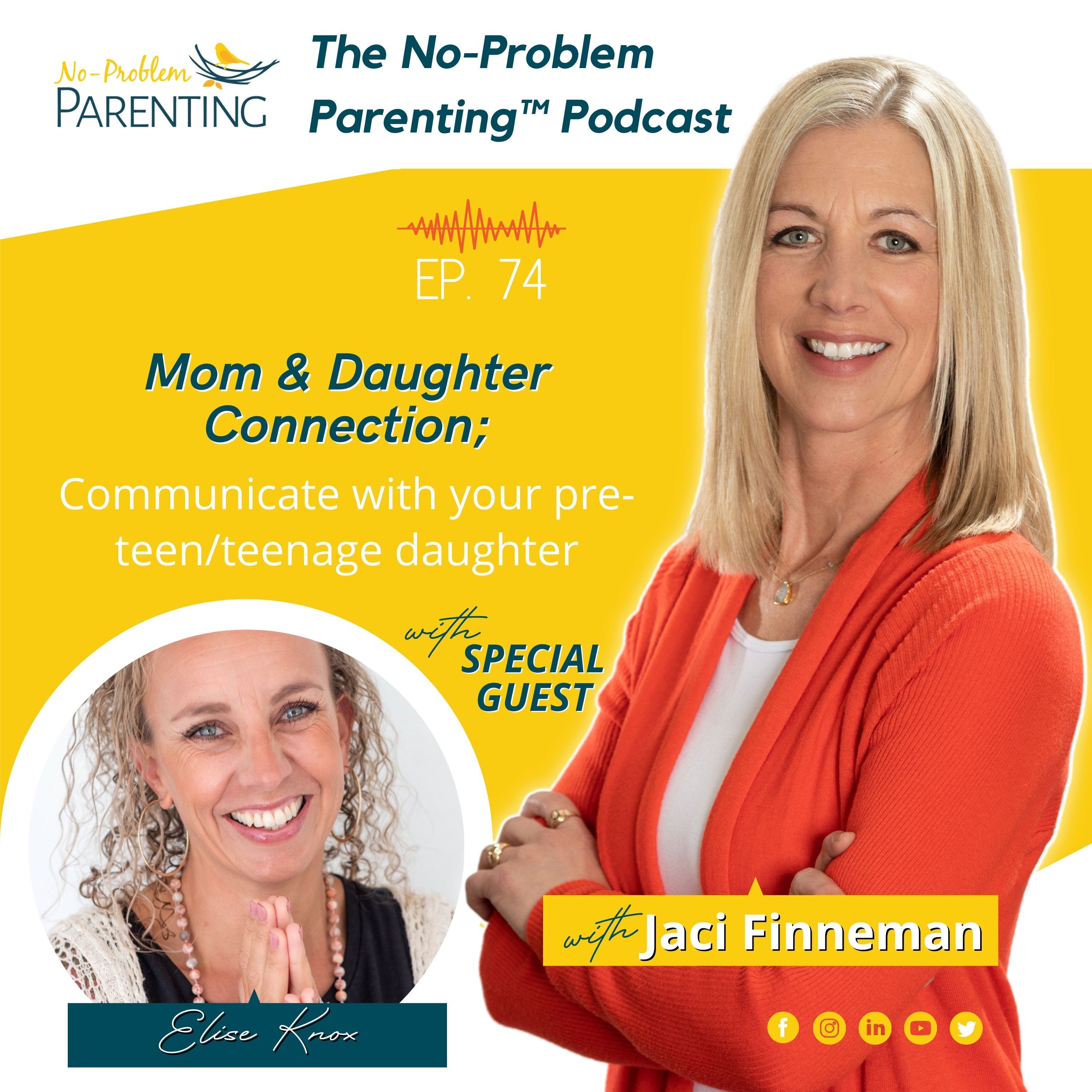
Mom & Daughter Connection; Communicate with your pre-teen/teenage daughter with ease with Special Guest Elise Knox
About this episode
Welcome Back No-Problem Parents!
Are you struggling to communicate with your teen? In today's episode my guest is going to share;
The 3 steps to listening to your teen without judgment.
Important things to do with younger kids to make the teenage years smoother.
How to get clarity around your needs and feel confident expressing them, so you don’t get burned out and feel resentful.
Become a No Problem Parent Today!
Full transcript
Welcome to the No Problem Parenting Podcast. Turn behavior problems into no problem with Jackie Fineman. Are you ready to become the confident leader your kids crave you to be? Do you want to learn how to make parenting easier and more fulfilling?
Whether you are at your wits end or you want to have more fun as a parent, you're definitely in the right place. Now here's your host, Jackie Fineman. Welcome back parents to the No Problem Parenting Podcast, where we choose to deal with and overcome the emotional and behavioral challenges within our homes. And today my guest is coming on to help us with communicating with our teens. So welcome to the show, Elise.
Thank you for having me. I'm excited to be here. Let's just get started with a little bit of your background and how you went from being a middle school teacher to a parenting coach for parents and teens. yeah so I was a middle school special ed teacher and it was I was exactly where I wanted to be and then I got pregnant with my older daughter and realized I really actually wanted to spend the majority of my time raising her and then my next daughter who came along so I left teaching and I really never I never anticipated going back to working with that age group um I didn't know where I was going, but I didn't see myself going back to teaching. And I have had some autoimmune like health problems. And so I found, I became a yoga instructor and then I found health coaching and got a certificate in health coaching and loved it and found myself back in a middle school and high school working with that population. Again, this listing popped up as a, to work as a health coach in a middle school and high school, like a homeschool hybrid near where I lived. And I applied and I got an interview. And I think because of my teaching experience, I was a great fit because I understood how the school worked and I understood the teacher's perspectives. And I loved it because one of the challenges with teaching for me was managing so many students at once.
also in special ed that was a little bit more challenging. My students were reading at a first and second grade level in sixth and seventh grade and so I was creating curriculum so that they could access the information and so it was a lot of work outside of teaching. So I loved teaching but I was like I can't parent and create curriculum and teach at the same time. This position I was working one-on-one with students. I got to support them with education though. Mostly it wasn't really like, I felt pretty quickly. Like I wanted to expand my coaching to support the students because they weren't coming to me with like functional medicine, health coaching issues.
Right. I did another life coaching certificate. And then I really felt like I could hold space for the students in whatever they were coming to me with. So it wasn't just about mental health needs specific to health coaching. You kind of could do whatever they needed.
Yeah. I mean, I coached, I was in that position through COVID. So the challenges for teens have been pretty, pretty big, you know, over the last few years and yeah, I wanted to be able to really support them in all of the ways that they needed. And then school started back in session and you were doing more in session time with the students, but you still had a desire to do, be able to work with both the kiddos and their parents to support more of the family. So tell us a little bit about that. Yeah. So oftentimes when I was in the school, the teachers would be like, Hey, you know, this student is really struggling either academically or socially or emotionally and then I would come in and parents would usually sign a waiver and that was it and I had a few parents that like wanted to meet me and wanted to have a conversation with me and were more involved but the majority was just me and the student and I was actually during my life coach training program I said to one of my master coaches you know like I'm coaching these kids a lot of their issues are coming from home as a coach I know environment really matters like you can't really change and and teenagers don't have as much control over their environment because they're still living with their parents and she she said to me I remember very clearly like it would be it will be hard for you to really make the change with the teens that you
want to make if you don't have any parents support. And it was kind of a turning point for me. I was getting towards the end of the school year and I was like, yeah, I think I want to go out on my own because I also know that a lot of times the parents need support just as much as the teens. Right. And that would have been outside of my scope of practice as a coach for teenagers in for students of the school. So now you're coaching parents and teens together and or separate, but then you're able to communicate with both. How does your, what does your coaching look like now? I have teen centered coaching package and a mom centered coaching package.
And with my teen centered package, well, I always have like a call with the parent first, because they reach out to me and then a call with the teen to see if we're a good fit. And then the coaching starts. And then once the rapport is built with the teen, we can kind of decide decide if they believe it would be good to pull a parent in for a call, either with just me and the parent or all three of us. Right. Got it. Cool. Yeah. All right. Well, that's awesome. It is helpful to know, uh, for parents listening out there today, how does coaching work? What does it look like? I'm a coach that works only really with parents. And so I can meet the kids. Sometimes I do meet the kids, but oftentimes I want to coach the parent to do the work with the kids, but I do get a lot of requests for, you know, from parents for me to meet solely with the teenager, which I will sometimes do, but I'm so happy to meet you at least because now I can refer those people on to you because that's more, you know, your wheelhouse. I, like I said, I can do it, but really my niche or my, my goal is to, is to be able to help the parents. So I was so glad that when you reached out to be on the podcast and like, yes, I got to know you because it is there.
You've got some great ideas about communication. And so we're going to, we'll dive right into that. You say that communication obviously starts with listening, right? And there are three steps to listening without judgment.
So tell us about those. Yeah. So one of the things that comes up a lot when I either am working with a parent or a parent calls me and is having challenges with their teen, they say things like, how do I listen to that? How do I listen openly without judgment to them when they're telling me things that are either really triggering to me or I think are completely crazy or all of those things.
And as we know with teen like brain development, there are so many changes happening in their brain that is making them do things that for parents and adults, it looks and sounds crazy. Right. And so I like to bring brain development in just because it's like, it is part of the process of becoming a like successful, healthy adult. And it can be very uncomfortable for the parents and the adult caregivers. Right. To experience. So the first thing I like to do is, or I like to help parents with, and I, I also do this with in my own life as a parent is to get clarity around what your teen would like from you. Parents have been giving advice and help and all of these things through the really like young years where that's what your kid really needed from you. It's like, mom, I need help. That's what my kids are six and nine. So my nine-year-old is getting out of that phase my six-year-old was still very much in it um and then so but teens are coming to us mostly because they just like want us to listen to them right and but we're in our advice they don't want to be heard they just want to be heard and so it can feel a little clunky but like just ask them how do you want me to show up for you right now do you want advice do you want me to just listen. Like, what do you want from this? And then they can say like, Oh, like it,
a, it'll make them think about it. It'll help them to see that you're trying. Hopefully they'll be able to say, I just want you to listen, or I really want your advice right now, mom. You know, I love that. I love that. Anytime we can get our kids to think that means they're in the curious part of their brain, which is that prefrontal cortex, right? Their thinking cap and not in that defensive reactionary, you know, back part of their brain where the, it's like game on fight, flight or freeze.
Right. Yes. Yeah. And that like is so important because anytime you can ask a question so that you have some time to compose yourself, if it's something that is triggering and it does put the ball back in their court to use their thinking brain and they're like, oh my gosh, she's like not just coming at me with something. She's, she's asking me questions. Let me think about that.
That's so helpful for both, both sides. Right. Yeah. So like, tell me more is another question.
That's just really, if you're really caught off guard, tell me more always works. That is a good one. That's a good habit to get into. Yeah. Tell me more. Tell me more. So the first one is clarify. And then the second one is to take a breath. So the nervous system is also part of my training and my coaching and something that I use for myself often and breathing is the easiest way I think, and the most like without showing what you're doing the best way to calm your nervous system. So it is inexpensive and it's at our disposal and it's like literally one of the easiest, or I should say most simple things. And yet sometimes can be so hard when you're triggered or caught off guard. Yes. Yes. And what breathe, like taking a deep intentional breath does is it like, Oh, you know, with intention can open you to, cause you just got clarity.
they said I just want you to listen so then taking a deep breath and really like thinking to yourself okay I'm going to be open to them because if they say I want you to listen and we're like okay fine you know and you're all tensed and clenched up and like hurry it up and you know yeah yeah yeah so really like taking a breath so the second one is breath with the intention of being open. And you're, you want to be curious too. You want to put your thinking brain on. I think it's, it's important to know that teenagers in this time, their brains are like, they're able to think about things in a new way. And so they're going to have ideas that are different than maybe the ideas that you instilled in them. And they're going to start testing things out. And the more you can listen, you don't have to like say yes to everything, but the more you can listen with open curiosity to their ideas, the more they're going to want to come to you,
which is I think what we all want. Yeah, exactly. And so that last step is to accept their process. That means that you like, just what I said, you don't have to say, oh yes, you can go to that party or yes, I think it's a great idea to take a trip with your friend, but you can really accept that that's what they think and be okay with it. That's what they think right now. Yeah. And what that's their idea. And you don't have to be like, Oh no, that can never work. Or you can't go, or you just pause, let them, Oh, that's an idea or, Oh, that's a thought. And tell me more.
Tell me more. I love it. Gain clarity, take a breath and accept their process. That will calm a lot of things down. I love that you say that. I mean, they really don't want our advice. We want to give it so bad. We can predict. They'll tell us something that they're going to do or what, and we can predict what's going to happen.
and they don't know yet. And we want to save them from the hassle or the pain or the discomfort of the outcome that we can probably predict. If there is a negative outcome, we can predict that, you know, what it, we can predict what it is or what it might be. And so we want to rescue them from that or save them for that. And that is one of the like worst things we can do unless it's a true safety concern, but we have to be careful not to twist it into that. It's a true safety concern, right? Yeah, 100%. And I think that like prediction is based on our experience and that's not always their experience. And so what I see with moms, especially moms who have had really challenging, you know, either traumatic experiences or just really deep wounding from the time of life that their child is in, their prediction is what happened to them.
And it's not necessarily what's going to happen to their child. Right. And even if it does, you know, a lot of times parents will say to me, well, I just don't want my kids to have to go through what I went through. My response to that is almost always, why not? Because if you look at where the parents at now and all they've learned, all they've been through, the reason they make the good decisions they make now, the reason they're in a healthy position that they're in now is because of those experiences and, or what, how they know right from wrong. Now I get it when some parents are like, well, I put myself in dangerous situations and I made some pretty horrible or pretty risky mistakes. I get that you want to share that with your kiddos and you can actually share them, but instead of it being a no to the kid,
just say, Hey, I had a, I have a fear or I have a worry and I want to rescue you from this, but I don't want you to think you need rescuing. So can I just tell you about my experience or someday, maybe it's not going to be that day. Cause there'll be two like, Oh, great. Here we go. You're going to give me your advice. And I'm, you know, but you know, maybe on Sunday after church or on Saturday before you go to the movies, can I tell you about my experience?
And we don't have to always get it in right in the moment. Right. Yeah. Yeah. Yeah. Yeah. I know.
I mean, I was a wild, wild teenager, so I have, I, I, you know, I'm like prepping myself and I see that as part of my work to be able to connect with teens really well. And part of my work to be able to support parents when their teens are doing these things because I did them all. And I am, I turned out great, you know, and it was, I came from a wonderful family and super supportive, all of the things and I rebelled. And so it can feel in the moment, like this is the rest of our life they will never change but like the teen years are so tumultuous and they change they can be you know it goes back and forth flips and flops so much that the more when I've been supporting parents the more that I can like support them and I'm sure you know this too in your work in giving themselves the support that they need so that they can be really strong and clear and confident and taken care of. Yes. And feel like they are being a good parent and it's okay to let your kids try some things that other parents would be like, you're never going to let her go there. You would never. And it's like, yes, I am actually. We used to say this to our kiddo quite a bit. Um, especially when he would hang around some of the kids that they were, they were good kids, but they were making poor decisions. And rather than saying you can't hang out with them,
I would just say, I hope some of you rubs up on them because I didn't want him to think just cause you're hanging around those kids that I didn't want him picking up those behaviors and do it. But why would I think that of him? I knew he was a good kid. I knew he had a good head on his shoulders. He might've tried some things. I am not around him all the time. I can't be there.
Right. And so that's the fear in me that says, Oh my gosh, please don't, you know, do whatever they're doing. Yeah. But, um, but I wanted to send him the message that I believe that he'll make the best decision for him. And what is that giving him, you know, like you having confidence in yourself as a parent and confidence that you've taught your kid, like you, that they have a really strong foundation gives them the confidence, which is, I think what we all want our teens to have. And something that I work with when I'm working with teens a lot is their confidence like and parents modeling that is the first step to the teen experiencing that for themselves yeah I agree I totally agree and the other thing is he is a real our son is a really good kid he's got a great head on his shoulders and he's still a teenager and so there is not like I think there's that fear in every parent to some level and it can get away on us if we allow it, if we, if we continue to obsess about it or, you know, think about it,
but there's going to be times he's going to make mistakes and I have no idea what those are. And he has no idea what that is right now for himself. So, uh, you can have a really good kid and something really tough or bad can happen. And, um, and I think it's just really important for parents to not go down that idea or thought that something bad is going to happen. We just kind of have to, I don't want to say wait and see, but what are your thoughts on that? A couple of different things. One is yes, a hundred percent. And it's not like, I think a lot of times parents are like, oh, it's a reflection on me that I didn't parent well, that I wasn't as controlling or, you know, like I didn't have enough control. So I let them do this thing and something happened or it's like a character fault. So, and really it's like, they're a teenager, you know, I,
I have some, I usually it's young girl, you know, like 12 to 15 year old girls that I coach. And, um, you know, they're really butting heads with their moms. And when I meet with the team on their own, they're kind of amazing. Like they're doing so much, like they're, they're doing well in school. They care about school. They have intrinsic motivation, you know, so many amazing things. And they're a teenager who's, trying to get their autonomy and their mom is driving them crazy and all of the things.
And so it's not that they're going down the wrong path or that they're, you know, it's just, they're literally a teenager. Right. Give, give them a break and give ourselves a break. And I love that you said that about a reflection of us as parents, because of course we're all going to, we want our kids to do well and we want them to behave and we want them to be respectful. And you know, you can be out in public and people are looking at you and they're when, you know, you're like talk, bringing up your kid or talking about how wonderful stuff is. And meanwhile, your daughter is in the same group as these other girls. And, and one of the moms heard something horrible that your daughter said or did while with these girls. And so then they were like,
well, actually your kid's not all, you know, you think they are, and that can be super embarrassing. So then we go home and we talk to the kid and we're like, what did you do? What did you say? And it creates this big problem.
Yeah. Which that's such a good point. And I think it's so important to remember, like socially what's happening for teens is they're trying so hard to fit in. And so what your teen may do in their friend circle and how they may act.
And I know this was like 100% the case for me is not who the person that you know them to be. And if you experience them in that situation or stories about them, it can feel so confronting. And that is part of teen development is there's trying so hard because that social like fitting in is, is so much of what's happening during teen years. and it's a necessary part to become a functioning social adult. Right. To learn how to do that, but it's clunky and it's, it, it doesn't like it's, it can be very confronting for the parent.
Like, wait, this isn't the, this isn't the human that I, that I know. Yeah. And then it can be all those other things that we get into, like being embarrassed or, um, and just really wanting, wanting to make sure our kid never does that again or never says that again. And it's like, that is way too much pressure for them. What can we do if your child makes a mistake, or even if you as the parent makes a mistake, what can, what kind of a conversation can you have, or how do you have that conversation with them? When something like that happens, we want to control because another thing that happens in teen years, and you were kind of speaking to this before we pressed record but teen years can be very isolating as a parent because when they're little you can talk about sleeping and potty training and tantrums and it doesn't feel like it's a personal attack on you as a parent you know you're like this is the stage they're going through but with teens it feels personal a lot of the time as like a your teenager probably doesn't want you to share and so you'd be breaking their trust and then b there's some shame around the way that they're acting because you're you're like I didn't raise them to act this way so it can be really isolating and when we feel isolated and then our teen does something and we feel judged by other people, we want to control the situation so that it doesn't happen again, which is of
course, like, of course, that's what we want to do, you know? Right. And trying to control your teenager is not, not going, it's not a great idea. It's not going to work very well. And so really connecting with them and talking to them about the situation in a way that is not blaming or shaming of them can be really, really helpful and supportive of both of your guys' relationship. Yeah, I totally agree. And so you have examples of that. You even have a free download on communication, right? Tell us about that. I do. So I have studied nonviolent communication for a while. And the thing that I love about nonviolent communication is that it really starts with like yourself connecting to yourself, which is something that I think is so important. I think Brene Brown says you can only be as connected to others as you are to yourself.
And so with nonviolent communication, before you ever speak, you kind of take yourself through this process of what was my observation of what happened? How do I feel about it? What is my need? And what is my request?
non-violent communication done properly is opening the window or the bringing down the wall of communication between the two of you rather than a lot of times when we communicate with other people we rather than making an observation we're making a judgment of what we think happened and then like a little wall starts to build and then rather than saying like what it made us feel we kind of make an accusation or say something about what they did. And then the wall comes up a little bit more. And the interesting thing is when you go through this process on your own, even like myself, who's read books and studied this and like teaches it without being really intentional. I do these things too. Yeah. It's very much human nature. And it's part of our language too the way that we use words often like like we I say I feel like this you know just for a silly example like I feel like this dress doesn't really isn't flattering on me or something like that which isn't a feeling yeah right right like and so we use feel in there in the wrong way and so when we can really get like clear on our language and like a feeling is something that happens inside of our bodies and doesn't have anything to do with anyone else.
Yeah. Like Sam and, and, and a lot of us have emotions or feelings that we kind of go to more often. And so I just love like looking through feeling words and looking through like, what are my needs? Like sometimes I don't know. And if I'm going to communicate with someone without knowing how I'm feeling or what I need, the chances of getting my needs met are very low.
Right. Oh, I love that. I had Dr. JJ Kelly on the podcast and she helps, she supports teens as well. But the two of you have, I think similar messages, but different approaches. And I think that's fantastic. She talks about that too, that a lot of times we're saying, how do you feel? And it's really, or this is how I feel, but it's really not how you feel. It's what you think. Yes. All the time. Yeah. And so we're creating anxiety in kids that really otherwise wouldn't be there. Let's stop. Not that we don't want kids to feel.
I mean, we're kind of like getting to the point where feelings are, are good and share your feelings and all that, but maybe the pendulum has swung a little too far sometimes. And it's more about what do you think about that? I think it could be looked at from both sides. One side is like some things are just thoughts. And one side is, can you, can you like get to the feeling?
Because if you can get to the feeling and understand it, then like there's something to work with. But if you're just stuck in the thinking and like people have said about that thinking, then you don't know how you're feeling. You're just kind of stuck in this weird in between space. And so I think it's really important to keep digging underneath and not into the like thinking ruminating part about the feeling, but like put your hand on your chest and your hand on your belly? Like, what do you feel? And here's a list of feelings that you might be feeling, look through them and identify it. And then you can address it. And then that way you can move on from it and it doesn't have to stay kind of harbored in your body. In non-violent communication under every uncomfortable, icky feeling is a need not being met. So if you can get clear on what the feeling is, then you can like look at your needs list and say, what is making me feel that way?
oh, I need to be heard. A lot of times for teens, that's what it is, you know? Right. And then you can ask and hopefully you have someone in your life, whether that's a friend or a parent or a coach or a therapist who can hear that and do that for you. So once you've identified the need, that's super awesome, right? We can get to the need. What do I actually need? And it doesn't have to be defensive then. And it doesn't have to be about control or any of that stuff. But then how do you differentiate between a need and a strategy? So the strategy is the way that you're getting your need met. You know, a personal example as a mom, I have been doing like, I've been in the muck all day. I've made lunch. I've made dinner. I've done this. I've watched all the dishes. I need to go to a yoga class, deal with the kids. So the yoga class is the strategy that I use to get my need for like peace and calm and quiet and space.
And as the person on the receiving end, A, I've just listed all the reasons why I deserve a yoga class, which I don't need to give. Like, I don't need to say all the things that I've done to deserve a yoga class. I just like, I did a real good class, you know, so there's that. And then if I can say to my husband or my teen, if I'm talking to my teen, uh, I have a need for peace, quiet, and calm needs are universal. So people can understand you on a needs level, the strategy, like my husband likes to run.
and so his strategy when he needs those things is to go for a run and so like my husband and I communicate well so I know that's what he like you know I know that about him and he knows that about me but if I could just say my true need he would just understand because he knows like what those he has needs like that sometimes too I like that so so it's um instead of saying I need to go to yoga, it's, I need some peace, quiet and calm. And so I'm going to yoga. So you're saying the need and then the strategy. So with teens, it can be, I need to feel accepted, included, or that I belong, or I'm a part of something. Yeah. And my strategy for that mom is I need to go to my friend's house. Yes. And mom's going to be like, well, I can do all those things for you.
You can get that right here. You know, it was like, mom, my strategy is that my friends being with my friends is going to help me meet that need. Yeah. So it's funny. My daughter, my nine year old is really entering into, you know, pre-adolescence, I guess. And this summer it's all about friends rather than being like, Oh my gosh, like she doesn't like, I don't give her what she needs anymore. That's like, so, or, you know, being grumpy that all she wants to do, but she's always talking about them and all of the, and she's like starting to pull away from her little sister. I'm like, Ooh, you know, her needs are really changing right now. And I want to support that and have clear boundaries. And like, I'm not, yes. Anytime you want to go to a friend's, but I'm like, Oh, how can we make this happen? A healthy amount for her and her friends this summer. And not take it personally and not put a bunch of stipulations on how she's,
what she's all got to do to be able to get that need. And what I like about this too, is it's, it's the need for the kid, but it's also the need for the parent. And a lot of times I'm coaching parents on what are you doing in your life outside of being a parent? 100% because your kids are going to grow and they are going to leave at some point. So any tips you talk about your daughter kind of going through that pre-adolescence, any tips for what we can, other parents who are not quite at the teenage years, but how, what kinds of things can they do?
can they implement so that the teenage years go more smoothly? Yeah. So starting the three steps of listening without judgment when your kid is like two is a great idea, you know, and the, the caveat to that kind of, so when they're younger, like you don't have to be as worried about your, like, you want to ask them what they would like from the situation, even when they're little so that you can get in the habit, but your facial expression, when a little one comes up to you can be surprised, you know, when you're, when they're teens, you want to really be aware of your facial expression and your energy because they pick up on that a lot quicker.
But all of the things that we've talked about are things that you can start implementing when they're little so that, because if you haven't done these things and been really intentional, the teenage and then all of a sudden when they're like starting to push push push you start to implement these new things it's it's going to be harder and so it doesn't like all of the the importance of listening to them the importance of apologizing and making repair when you've lost your temper all those things are so important so that when they get to the teen years they know they can come to you because they know you listen to them you ask them questions and you're curious you don't shut them down. They've watched you model repair so that they can do that with you and you, and they know that you will do that with them. If, when not, if, when you lose your temper,
when something big happens. So I feel like all the things that I talk about with parenting teens are really good to start as early as possible. Awesome. I love that. All right. So how can we go get your free download. Yeah. So it's, um, Elise knox.com slash communication. All right.
I'm going to put that one in the show notes and then how can people reach out to you to, to learn more about you and to see if, um, their teen is a good fit to work with you and if they are. Yeah. So I am on Instagram at Elise Knox connection coach, and then my website is Elise knox.com and you can just do like a 30 minute connection call to see if we're a good fit and see like what, what I'm all about on those two places. By now, my listeners are catching on to this coaching gig. So a lot of times, if you're not sure your child needs therapy and you're like, Hmm, is it therapy or a coach? One of the really cool things that with coaching is you, almost every coach will give you a 30 minute free call to get to know you. Whereas with therapy, you get on a waiting list and I'm not downing therapy. Therapy is great. Or if you are on a waiting list,
reach out to a coach first, get the process started. And we're not going to do therapy with you as coaches, but we're going to give you some great ideas for how to have those trusting relationships or better relationships in your home with your kids while you're waiting for that therapy process. Coaching is different than therapy, but I just really recommend that when you are offered a 30 minute free session with a coach, check them out. And my process with teens, I know sometimes I'm like, wow, this is, you know, when I talk to coaches who just work with adults, I'm like, that sounds easy because I will have a call with the parent and it's like a great fit.
But then the teen, either they talk to the teen and the teen's not ready or they, I get on a call with the teen and we just don't have like the, you know, it's not perfect. And the teen it's just not flowing. And so then that doesn't happen right then because it's not the right time and it might happen later. And so for me this summer, I have some teens that I work with who school is really stressful for them. So in the middle of my package, it was summertime. And I was like, you know what, let's like, I had a call with them over the summer. They were doing great. The stress was gone.
I was like, let's just take a break and come back at the end of summer, right before school starts to have like a, okay, like a pep talk kind of a coaching session. Because like my goal is to support the teens and the families in whatever way works for them, you know? Yes. You can take breaks when you're in a coaching program, even if it says three months or five months, typically coaches offer like, Hey, things are going well. Why, why use the time right now? Let's postpone that till another time. So that's awesome too. So I didn't even know we'd get into all of that, but that it is sometimes people ask me, you know, like, well, what do you do?
You know, what is parent coaching and how does that work? And another exciting thing for at no problem parents, and you can go to at no problem parents.com. Our resource page is launching.
And so parents can go onto there and you'll see Elise. She will, because she's been on the podcast, we'll have her resource up on our website. And then you'll see a host of other people. So if you do reach out to Elise and you love her, but your kids are like, we're not a good fit or any of the other coaches that I've listed on my website, you know, take a gander, go around.
You can do a bunch of 30 minute free calls with people and get a whole lot of advice there. So anyway, I appreciate you reaching out, Elise. I'm so glad to have made the connection. I look forward to doing more with you and staying in connection and collaboration.
Yeah. Thank you so much for having me. It was wonderful to chat with you today. thank you for tuning in to the no problem parenting podcast join jackie next time for more tips tools and resources that will help you become the confident leader your kids crave you to be who do you know that we could support on their parenting journey like this podcast subscribe share or leave a review of the show your support of the no problem parenting podcast pays it forward and helps us help more families Thank you.
Become the confident leader your kids crave
The method, the community, monthly live Q&A with Jaci, and Celia — your AI guide in the moment.
Start your 14-day free trial Get it on iPhone or sign up on the web