
Child: You Say the Divorce Isn’t My Fault; Why am I the one in therapy? Myths about blended and step-family’s with Special Guest Edina Adler
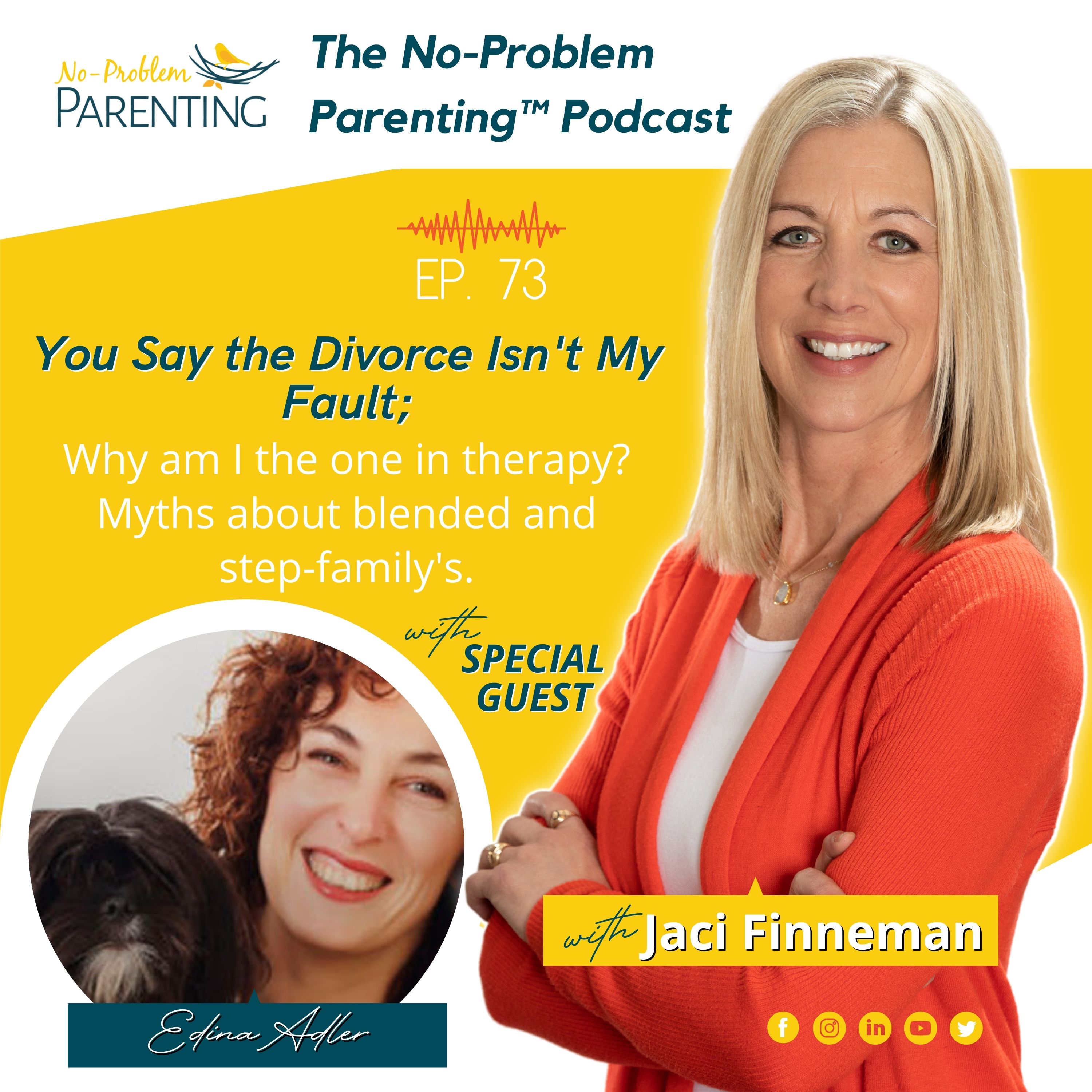
About this episode
Welcome Back No-Problem Parents!
Are you experiencing a lack of respect, mistrust, or rejection as the step-parent of a child? Are you concerned for your kids and how they're coping with your divorce? Do you wonder whether or not you should bring them to a therapist?
In today's episode my special guest is going to share some common myths of step-parenting and blended family's. She stresses the importance of connection before correction and how to name the problem before you try to tame the problem.
Become a No Problem Parent Today!
Full transcript
Welcome to the No Problem Parenting Podcast. Turn behavior problems into no problem with Jackie Fineman. Are you ready to become the confident leader your kids crave you to be? Do you want to learn how to make parenting easier and more fulfilling?
Whether you are at your wits end or you want to have more fun as a parent, you're definitely in the right place. Now here's your host, Jackie Fineman. Welcome back parents to the No Problem Parenting Podcast where we choose to deal with and overcome the emotional and behavioral challenges within our home. And today my special guest is Adina Adler.
She is here to help us talk to our kids and help our kids through divorce and remarriage to support their mental health. Welcome to the show, Adina. Thank you. It's good to be here and thank you for inviting me. Yeah, I'm so happy to have you on. I have a number of families who are either going through the process of divorce or they're remarrying. They're in the process of remarrying.
They're blended family issues. Parents are wondering how to talk to their new stepchildren, maybe not so new, but that, you know, they're living together now. And so how do you blend the families? How do you build a relationship with your stepchildren? And just how do you talk to your kids about divorce in general. So tell us a little bit about your background, how you got to the point of really niching in and specializing in helping families go through divorce and remarriage.
Well, first I will say I didn't start out with that topic as my focus. I was a social worker. I was working in schools actually for a long time before I became a social worker and working in schools on the East Coast. New York was my main central location, but I did conflict resolution training in the classroom and bullying prevention and that kind of thing. And I found a lot of the kids, you know, there were a lot of kids with acting out behaviors is what they were called and behavior problems. And we were trying to get them integrated, you know, get the classroom to work in spite of those kinds of behaviors. And I found that it was really challenging to teach kids how to cooperate when they were dealing with a lot of internal stuff. And at the time,
I didn't understand all of that internal stuff. It's what led me to go back to graduate school and study psychology more in depth because I was an education major before that and learn about the inner workings of the psyche and childhood trauma and things like that. And then when I became a social worker and worked for CPS, so I've been working with kids and families now for over 25 years, but the last nine or 10 have been as a therapist in a therapist role. Then fast forward, CPS was a pretty amazing educational experience, very difficult job, really challenging kids and families. And I saw a lot of bad parenting going on in that job. And also when I worked in the schools, just a lot of terrible things that kids were telling me about what went on in their households. And when I got to California, I moved from New York to New Mexico and started a nonprofit for at-risk youth there, which I ran for five years. I'll skip over that part of my life because that was a whole different thing. But I was teaching conflict resolution and bias,
bullying and prevention and cultural sensitivity. And it was really an interesting time, those five years in New Mexico. Then I decided to go back to school to be a social worker. In New Mexico, I'd worked with a lot of foster youth. That was my job job there, supporting myself. And I realized that, again, the inner conflicts of these kids were not independent of what was going on with their parenting. And I just started to really want to understand that better. And especially what happens to foster kids is they get a lot of really bad parenting, not just from their biological parents who are having whatever mental health addiction issues, but also from the foster parents who aren't really trained to deal with kids with attachment problems. And, you know,
they have all these ideas that, oh, I'll just, I'll just love them and be good to them. And, you know, and it's very similar to the myths that step-parents have about their stepchildren, as it turns out. So finally I met a guy here in California and he had two adorable little children and being a social worker and dealing with CPS and all this conflict and stuff. I thought, oh, I could handle anything. No problem. Right. This'll be a piece of cake. He had an ex-wife who was, who had mental health issues. And I was like, oh, I'm just going to befriend her. And you know, it didn't exactly work out that way. She wanted no part of me, but I just, there were conflicts from the very start with the ex and conflicts with the kids in,
in the state of mind that they were in when they came back from being with her. And it was at that point that I decided, you know, I really need to learn more about step parenting because I was going cuckoo. I had a lot of pressure on me as a social worker in that job at CPS. And I just felt this pressure to be like the perfect parent and the perfect, you know, second wife and all of these things I was trying to be perfect at. And it was just a lot.
So I went through this training with a step parent coach in New York who wrote a bunch of books and learned all of these myths about, you know, blended families that people enter into second marriages with. And I realized I had some of those mindsets and I needed some extra tools. Oh, I'm excited to get into those today. And I think it's, you know, it's great that you have some real life experience. I mean, we can all, I worked with child protection. I was an family counselor for 20 years. Yep. And did supervised visits with families who had, Wow. Whose children had been removed. And then, you know, the whole thing. Yeah.
Yes. And reintegration, you know, getting kids, parents to the point where they could have their kids back home and, and, and, or making that decision being not, I didn't make the decision, but helping the judge, you know, writing reports and things to, to determine whether or not the family could right. The kids could stay with their parents. And then also my specialties in reactive attachment disorder. I learned that way back in 1992, when I thought I was going to go to college to be a special education teacher. And turned out I met a family with a girl, a 10 year old girl who was diagnosed with reactive attachment disorder. I was like reactive, a what, you know, like I mental health was not on my radar at that point. I ended up being super curious about how could this beautiful little girl be so mistrustful, resentful and reject her step-mom's love. Yeah. And, and yet appear to everybody else as this beautiful, cute, smart,
you know, little girl. So I went all in back in 1992 with reactive attachment disorder and actually left college to learn more from the specialists, the therapists and the foster parents that were raising these kids. So yeah, you and I have a lot to talk about. We do.
But I do often feel like the best experience is the experiences that we actually can relate to and that we've had in our own life. So I'd love to learn more about these myths as far as step parenting and what that looks like. So why don't we start there? What are some of those key myths?
Well, first of all, I love this saying by Dr. Patricia Papper now. She's like the world expert on step families and blending families. And she says, becoming a step family is a process, not an event.
so it's not like you're suddenly a family because you met you found the second love and married them and you know now you're parenting their kids part or full time it's really an it's really a process that takes time and one of the biggest myths is that of the brady bunch the instant love one happy family we're all going to just get along and you know uh what is it that uh the oh gosh what's her name, the woman who was like the, the maid. Oh, Flo. Flo, Flo, yes. She says, there are no steps in this family. And it's like, yes, there are. You know, you have to acknowledge that this is not like a biological family. It's a very different structure. And most people don't know this. So they come into it with these false expectations of, oh, we're just going to blend. It's more like a salad that you toss together than a blended family. And there isn't this just one big happy family instantly. What instead tends to happen is these unrealistic expectations of that lead to a lot of resentment when the kids don't instantly accept the new partner and are not happy for their parent and don't want this new parent and don't want to be parented by this person. And all of these things then lead the the parents to feel like their partner is not being nice enough to their kids or vice versa the parent is not being strict enough not sticking up for them not defending them when their kids are rude to them and it just escalates to the point where 67 percent
of second marriages with kids involved end in divorce oh wow i didn't know that most people don't know that i didn't know that either and i was determined not to be one of those statistics 12 years ago. But it turns out that kids are the reason for a lot of these families splitting up after like two years. It's very, very difficult if you don't know what you're getting into and you don't know about these, I call them minefields of the pitfalls of step families. If you don't know them and you're not, you don't see it coming, you get blindsided and then you blame your partner or the kids for what's going on instead of blaming the situation of the step family, because that has very particular characteristics, which most people don't understand. So like most people think, oh, second marriage, I'll get it right this time.
You know, I learned so much the first time around, I'm not going to repeat my mistakes, but even if you don't repeat any of your mistakes, you still don't know the mistakes you're going to make in a step family. They're all brand new. Right. That makes perfect sense. That makes perfect sense. So that's myth number one. It's not like a biologically intact family. First of all, there are all these new players involved and there's exes and there's extended families and there's conflicts of loyalties that kids have. And then that the parent has as well between their kids and their new partner. And they're constantly being pulled. Dr. Paperno calls it the insider outsider dilemma that, you know, the new person feels like an outsider. The insiders have their own established rituals and behaviors and ways of getting along and rules. And all of a sudden,
this new person comes in and doesn't feel like they belong. And it's just a very, it can get very complicated if people don't understand that there's going to be challenges and you really need to have your toolkit ready because otherwise you're going to be just thrown completely for a loop. So the other thing is the conflict of loyalties is real. And then the guilt, the unresolved guilt and loss and grief that both, you know, parents and kids have, but especially kids, it takes them at least a year, you know, second marriages are harder for kids to adjust to than the divorce itself. The divorce is painful, but the second marriage is even more painful because now they're being asked to accept this person that they don't love.
You know, they never asked for this person in their life. And they're being asked to get used to a bunch of new rules and expectations and to not even talk about the other parent. You know, they're still carrying around a lot of sadness and grief and possibly anger. And parents, especially the parents, but also the step parents need to learn some tools to help the kids process all of that so that they're not just in reactive, you know, dysregulated mode all the time. Right. So the parent's job is to help their kid through that transition and give them time. The step-parent's job is to not try and parent that child too soon because that really backfires. That's like another myth is that they should accept me as their parent now because I'm doing the job of a parent. I'm taking care of them. I'm sacrificing for them.
I'm loving them and they should just treat me like a parent, but that's not going to happen for the first, probably two, two, three years. Right. So it's, it's about beginning with the relationship, right? Building and forming a relationship with the children before you think that because consequences work input, feedback, advice, all that works when there's a trusting relationship between the parent and the child, right? Exactly. If you don't have trust, it's like throw all the consequences you want at me. I don't care. Yep. So what? You can't make me do it.
You know, you're not my mom. You're not my mom. You're not my dad pile on the consequences. Who cares? What are you going to do about it? Exactly. Right. And they're still thinking, who the hell are you telling me what, what to do? Right. So you have to, like you said, you have to focus on building a connection with the, with the stepchild and the, the phrase that Dr. Pappernow uses is connect versus correct. For the first at least year, don't even focus on correcting their behavior, even though they do something wrong. Let the parent do the disciplining.
Let the parent, the biological parent, set the rules. You can say, you know, you could talk with them privately and say, you know, I think it'd be a good idea if we did it this way or this way. But ultimately, the biological parent has an established way of relating to their child, and that's not going to change overnight. Right. Absolutely. So we've got the myths, not, it's not a blended family. It's more like a salad, tossed salad, right? Conflict loyalty is real, right? Then that we didn't really go into that much, but conflict loyalty described that. And I'm interpreting that as loyalty conflict. It's loyalty conflict. And that is real, you know, feeling like you can't connect with the step-mom or the step-dad because you're abandoning then your birth mom or your birth dad. Especially that is heightened when the exes, the ex and the parent are fighting and having a high conflict relationship, then it makes it much worse for the kid, like much, much, much. In fact, 45% of kids of divorce when it's mishandled in a way that the parents are not trying to keep things calm and, you know, friendly and cooperative when they're not doing that. 45% of the kids wind up with depression, anxiety, or anxiety disorders.
So it has a real effect on the kids when their parents and their, the ex don't handle things well with each other. And I think I find in a lot, I've had several, several families who have I've gone through this where the step-mom does have a relationship with the child and they, they do actually do quite well. But then when the child goes to visit birth mom and comes back, there's this behavior and this, and it's like, they're irritable or they're angry and they're kind of pushing the step-mom away. And, you know, it's so important for parents to just recognize that there's an internal struggle that sometimes the kids either can't verbalize or they don't want to because they don't want to hurt the step-mom's feelings. Right. Right. Right. So I wish that, I mean, there's supposed to be a court ordered co-parenting course, right?
In some States it is court ordered, but in a lot of States it's not. And there really should be, because there are some guidelines for co-parenting that I also like to share with people to help help kids cope with divorce and remarriage that are, I think, really important to emphasize here since I have a minute. Yes, absolutely. So the first thing is both of the parents have to agree to talk about the divorce in a way that's not putting the other parent down because that is extremely damaging. In fact, there are judges parenting orders for high conflict couples, which I think we have here in Alameda County, which I think are really useful that are, I'll just hit on a few of them, that each parent shall encourage a positive relationship between the children and the other parent, as well as the step-parent. The parents are prohibited from allowing others or themselves making negative verbal comments about the other parent and the other parent's past or present relationships within hearing distance of the child, because there's studies about this now that show this creates a lot of internal comfort for kids,
a lot of anxiety. It affects their performance in school, their ability to concentrate because they're churning in their heads about it. It affects their digestion. Yeah. It affects their stress level, which affects digestion, their anxiety and all of that. And so then we start kids are getting, you know, sick saying they're sick and they don't feel good. And it's really very much anxiety and stress related. Absolutely. Both parents are prohibited from showing documents related to the case. The idea is you want to protect your kids from the conflict.
You don't want to suck them into it and get them to take sides, which unfortunately some people do because they're still angry at the other parent. And they use their kids as grenades to lob at each other and the kids feel like they are, they're being weaponized. You know, I've had kids say to their parents, well, you said the divorce is not my fault. So why am I the one in therapy?
Oh, yes. That, that is an interesting, that is a good question. Actually, really the parents should also be in therapy. And oftentimes I think we're putting our kids in therapy because we know this is hard on them. We know the divorce is very hard. And even if If you're not divorced, you're separated, right?
So we know that's going to be hard on them. And we don't know what to say or what to do. No problem. Parenting is all about helping you become the confident leader that I say your kids crave you to be.
And this is a perfect example of that. They don't need you to know all the answers. They do need you to just talk about what you're thinking, what you're feeling, what you're wondering about how they're doing and all of that. And so one of the first things I ask parents who have gone through divorce when they are willing to co-parent and they come together to meet with me virtually. So it's nice. They can be in their own homes, but I'll say to them, have you apologized to the children for the divorce?
And nine times out of 10, they say, no, they just feel very guilty about it. And then they try to do things like more like they're trying to be their friend and their parent, because they're, they're trying to, they don't want to make them upset in any way. And it's, it's not exactly a disengaged form of parenting. It's more like parenting through giving gifts, through pleasing them, through accommodating them, through never standing up to them. You know, all, all of this kind of like a divorced person would be likely to do because they're afraid they're going to lose their kid, especially if they're not the primary caretaker, especially if they just have visitation.
Like they want to make sure that the kid likes them because, you know, then they have this kind of upper hand. They don't have to feel, feel as much guilt. They have more blame. They can project when they are the most liked parent and really isn't about that. Now the myth is the myth is the happy family, instant happy family, tidy bunch myth. And then there is sadness, grief, and anger. And we do need to acknowledge the grief. Yes, absolutely. Many times the behaviors we're seeing in our kids, it's grief and grief comes out in a number of ways. And I cannot iterate this enough, whether it's a divorce or a separation or an adoption or, you know, whatever with that child, there is grief and they don't know often how to verbalize what they're feeling.
So it comes out in behaviors and symptoms of, you know, ailments and often anxiety, depression, and not just grief, but anger, confusion, right? There's a lack of certainty about where do they stand now? You know, are they, are they still important because there's diminished parenting? That's the term I was looking for diminished parenting. The parent is focusing on their new partner more than they were focusing on their old partner, probably because it's a new relationship.
They're still, you know, in love and feeling all those chemicals and everything in a new relationship. And the child will feel a little neglected and they're going to feel this parent is not giving them the same amount of attention and affection because part of it is now being taken by this new person. So there'll be a little resentment mixed in there, you know, along with the feelings of, am I still important, you know, to my parents? It's like kids can't help but think that. So there needs to be a lot of reassurance and a lot of one-on-one time, which is another myth that we should all spend time together to bond as a new family. That is not the case. It's actually more important to spend one-on-one time. That was another key tip that I wanted to get across. It's important for the step-parent to try and build a relationship with their step-child. And it's harder to do that when the biological parents are around.
It's harder to do that when the whole family's together, because that kid will naturally go towards the people that are familiar to them. They're not going to want to hang out with the step-parent. So they have to find ways to do something together that either they have something in common, or even if they don't, maybe the step-parent will take the kids somewhere that they like, you know, that the kid will enjoy and the kid will be like, Ooh, you know, it's not so bad. They have to work on connecting and bonding and building a relationship with one-on-one. And then the parent has to spend one-on-one time with their kid to reassure them. Don't worry. I'm not going to stop loving you or, you know, I still love you just as much. And that feeling of being valued is something that goes down in kids when they enter into a blended or step family. Um,
especially if the other parent is bad mouthing that parent, right. That's just absolutely cannot happen. I say that to parents too. Those are adult conversations. It's a right to be super frustrated with the step-parent, with the ex, you know, with, depending on who it is. Cause I I'll have, I'll have parents talk with me about the step-parent and they're so frustrated. And of course the resenting the ex because they didn't treat them the way they're treating this new person maybe. Right. And so it can be really tricky, but those are conversations to be having with your therapist, with a parent coach, with, you know, a friend, somebody else, and not just to vent, but at some point venting, venting is, is good. And, and typically it really doesn't get you anywhere. It just keeps you in the cycle of hostility. Yes. Bad feelings, hostilities.
The other thing is, you know, I've had couples come to me where the step-parent has, before they met me, has called up the adult child of the parent of their partner, called up the adult child to tell them how awful their mom was like, what, where are you thinking? How did you think that was going to result in something good? Like, how did, how did you think that was going to turn out? You know, like that's, that should be illegal. You know, you should not be allowed to call the children unless you have a really solid loving relationship with them. That should not happen.
Right. And you know, it's not that she was a bad person. She was well-meaning. She wanted to let the kid know that her, her partner, the kid's dad did not abandon the mom. The mom abandoned him.
It was like, wow, you know, that that'll never go well. Right. Yeah, absolutely. And it's unfortunate because sometimes the kids, whether they're young, they're teenagers or they're adults, they will land blast that step parent and give them no opportunity, no matter how nice they are, how much they're trying to build a former relationship. They give you no benefit of the doubt and you still are the adult. You are still, you are still the adult, the step parents. So it does, even that doesn't justify defensiveness and resistance with the, with the other parent, or even with the child, you know, and being, giving it back to them. Well, they're rejecting me. Well, they're resenting me. So I'm going to control. I'm going to, I'm going, I'm going to consequence more. I'm going to, you know, I have to win. And it's like, no, you just don't get that right. And that's part of the deal that you signed up for. And part of that, yeah. And part of that is trying to win the kid over to your side by that's part of what I think she was doing is,
you know, trying to win the kid over to her side by saying, look, I'm not the other woman who stole your dad away. And those are keeping the kid out of the conflict is so crucial in co-parenting and in step parenting you just want to protect the kid they have a lot of healing to do to begin with and if if anything as a as a step parent or a biological parent you want to validate your kids feelings and you know help them feel seen and understood and felt like help them feel felt like you get it you know i know this must be hard for you honey you know that's that's the kind of think they should be saying not, you know, I didn't leave your mom. She left me. Right. So let's talk about that. What are, you have some things that parents should never say to their kiddos after a divorce? What are, what are, I think you said there's even three key things,
right? There's, there's a couple of things. First of all, the kid needs to feel like both parents are going to continue to love them and be there for them. So blaming one parent for the split or trying to make the kid feel bad about the other parent is like criticizing the child themselves because the child is connected to that parent.
They're biologically wired to be bonded to that parent and they see themselves as part of that parent. So if the parent is bad, that means they're bad. There's some part of them that's bad and it really affects their self-esteem if you start bad mouthing the other parent or criticizing them or trying to set them straight on the other parents. I hear that a lot.
Like, I just want to set them straight. You know, well, what you were doing was causing a lot more loyalty conflicts and inner turmoil for your kid by setting them straight. So validating and encouraging your kids' feelings. The flip side of that is not telling them not to feel sad or hurt, or like they don't really want to spend time with the new parents, with the step-parent rather, validating and saying things like, you know, I know it's really hard for you to spend time with so-and-so or even though I'm excited about this relationship, I know you're not as excited about it as I am.
And I know it's going to take time and that's okay. Making them feel okay instead of not okay about having their feelings so that the kid can feel like it's all right to share my feelings rather than bottling them up, which as you know, leads to a lot of other problems. Absolutely. We never want to have that expectation that they must form a relationship with this person and or that there's immediately. Yeah, that there's some sort of time limit on it. I mean, I often find that when I say to a kid, you don't ever have to want to have a relationship.
and the bummer is your other parent does. And so we need to figure out how that's going to work so that there's at least some respect that you can live under the same roof without, but we can put some, we can put some boundaries and some guidelines up there, but disrespect, regardless of the painful situation or the unfortunate situation that the child has been put into, which is the adults making that decision, right? We still want to empower our kids to figure out how to, how to cope through that and how to live with that. And that disrespect is not something we're going to be okay with. Another thing is that, you know, along with accepting your child's feelings of loyalty towards both parents is, and the step-parent needs to do that too, is don't ask ever, this is another don't do, don't ever ask kids to make a decision about visiting a parent because that puts them in a bind. It makes them have to choose and it makes them feel like, you know, guilty and, you know, just very conflicted. It's really the adult's decision. They've already made an agreement about it and they should stick to that agreement,
even if the kid doesn't feel like it. It's all right to say, I know you don't feel like going, or I know you don't have the greatest time because they don't have a yard or whatever, but you know what we agreed to this is what we agreed to and you know it's important that we keep our agreement because if you put the kid in the position then they're they're suddenly being asked to turn on the other parent and to say they don't want to be with them right and it's it's not a good thing to do to a child yeah and another thing i've seen with that is especially with teenagers uh they say they don't want to go i don't want to go to dads and so unless there's a legitimate reason. Like you, you want to ask them like, well, so tell me about that. What is it that, you know, what is it that makes you feel so strongly about that? And maybe there is a legitimate reason. And then you need to address that with the other parent. Right. But sometimes what I'm, my, my point with that is that sometimes because there isn't a, there isn't a safety risk,
there isn't a, you know, dad and mom are, are basically co-parenting and not talking bad about each other or any of that. But the, the child decides, well, I didn't like dad's rules about technology or I didn't, I don't like that. I'm not going to be able to go to my friend's house because he lives too far away or, you know, those types of things and the parents feel guilty. So they allow the child to not go to dad's, but then that starts to create this power for the child that they get to make decisions. And they can, they sometimes then end up fabricating stories of why they don't want to go. And then that just creates a bunch of, so it's like, you know, I know you don't want to go and thanks for going anyway. Yeah. And it just is,
it's important for you to spend time with your other parents, you know? Yeah. Right. And maybe we can find a way to get you rides to your friend's house or, you know, right. Another thing that comes up for parents that have called me, uh, worked with me is that they come like, sometimes a parent has been MIA for several years and now they're back in the picture and they're deciding they want to do visits and that is so great. And so terrible, right? Yeah. Yeah. And so kids will go, but then oftentimes when they come back, their behavior is irritable or downright aggressive or assertive, defiant, all of those things. And what we tend to do then is we address the behavior as the problem. We think, well, that's the problem. And really we got to get,
Yeah, we got to get to the root of why the kid is behaving the way they are. And I know that for some kids, it's really that they felt awkward being with that parent who they hadn't seen in a long time or don't see very often. So they're uncomfortable, they feel awkward, there may be a little embarrassed, they're unsure, there's all these things that I don't even know how to act around this person. that's my parent who I have been wanting to be with for years. And now I'm here and I don't know how to act. They come home. They sort of have to get those feelings out of their system. They don't know how to verbalize it. So they misbehave or they act out. And that's where parents need to learn a skill called emotion coaching, which is attunement. It's basically attunement and helping coach a kid through difficult feelings instead of like trying to pretend everything's fine. And you know, not really wanting to get into it. There's this other myth that, you know,
we shouldn't talk about these disturbing things because it'll just stir them up again. No, actually you should talk about them because that's helped them. It helps them process their feelings, helps them calm it down. Questioning a kid about all the things that they did at the other parent's house is also counterproductive. It's like giving them the third degree, you know, and they don't always want to talk about all the things they did at the parent's house. For one thing, they will talk about it if they want to, but it's more important to say something like, hey, you know, did you have a good time? What was the best thing about it? What was difficult? Was there anything difficult about it? But keep it kind of open-ended so they don't feel like you're interrogating them.
And going back to protecting the kids from the conflict between you and the ex, if there is the conflict, but even if there isn't, the kids don't need to know about adult things. You know, they really need to, they're still the kid, you know? Yeah. And sometimes the adults try to bring them into the adult situation or. Exactly. And so for the kiddos that have come back and they're irritable, they're misbehaving, they're defiant. I typically coach the parents to not engage in that moment. Don't address the negative behavior in that moment. Don't try to consequence them for it. Fix it. It's one of two things. It's either, you know what, I see you're upset, pop off to your room, get it out of your system, you know, throw off at whatever you need to do, not sarcastically, but literally like, I get it. You've got, you're upset. You can feel,
you know, pop off to your room, go outside, whatever it is. If the child is defiant enough and they won't, and they, then you exit stage left and you say, you know what? I love you too much to argue. I don't know that anything's going to work right now that I say to you. So I'm just going to, I'm going to go for a walk. I'm going to pop off to my room. I'm going to get it. We'll, you know, we'll talk about it later, or you don't even have to say that time and time again, when I coach parents to do this the next day or later that evening or whatever, the kids will come back and the parents will report, well, they were kind of shy or sheepish or just didn't really have much to say. And oftentimes it's because they're feeling sad or guilty that they lost their cool. Yeah. They didn't mean to lose their cool. Yeah. They didn't want to fly off the handle. Sometimes they don't even know why they did. Right. Right. So it's really just about naming that for the kids and talking about that without it being, Hey, let's talk about our feelings. Sometimes kids don't even know how they feel. Right. And sometimes it's just a thought that they're having, or they're just kind of feeling awkward about it. And so, you know,
a lot of times I'll just say, I suggest to parents that you say things like I noticed, right. And I wonder rather than you really flew off the handle. You were better, you know, right when they get home or even the next day, when you talk about it later, kids don't want to talk later to their parents because they know what's going to happen. So start the conversation up with, you know what, you're not in trouble. That's a good one. Diffuse their resistance, right? Right. That's, that's a key point that the naming it, you know, the saying, you name it, you tame it. It's part of the mindfulness practice actually, which is one of the tools that I teach parents and also teach them to teach their kids is helping them name their feelings so that they can calm them down. But like you said, it's not always the time to talk about it in that moment.
Sometimes you just need to self-soothe and you're teaching your kid actually to regulate themselves by saying, you know, I know you can calm yourself down, go do that. And then then we could talk later. You know, sometimes, you know, sometimes the other thing I just remembered I was going to say about what you brought up is that generally speaking, it's a good idea if a parent comes back into the picture. just like with a step parent to do take it slow like not suddenly send them for an overnight but you know have a two-hour visit at a cafe or restaurant start slow because kids have difficulty with big transitions if they're too quick so that's one of the things that one of the principles behind successful step parenting and successful remarriage is allow the kids slowly to transition into any new situation like that.
Yep, absolutely. So what is one of the critical things to keep in mind as a parent and a step-parent? Empathy for what the kid is going through and working on yourself at the same time because a lot of parents come into a second marriage with probably two years. It takes about two years for that anger to even subside from a divorce that didn't go well, right?
There's a lot of unresolved feelings that the parents should deal with and work on. They should be in therapy when they go through a divorce. A lot of the time they need therapy. Not always, but a lot of the time it's a difficult thing.
It's not something you expected. It's a big change and it brings a lot of other changes with it. And even if you've met somebody and you're just totally in love with them, there's still going to be difficult transitions ahead if you have kids. So the parents need to learn some skills of managing conflict and managing their own emotions, learning how to cope with their own feelings in a constructive way, not in a reactive way. That toolkit is really going to help them in their next relationship. I always say that if you're a parent who is angry a lot, frustrated a lot, or very like defensive and, or your ego is really high.
Like you didn't do anything wrong and the divorce isn't your fault. And it's this other person, nine times out of 10, there is a grief and loss that is underneath all of that. And you're trying to put on this facade that you're fine and everything's okay. It's a great idea to reach out to a therapist to get some ideas for how you can go. You don't have to go all the way back to your childhood. If you don't want to talk about your, you know, mommy and daddy issues, but you do need to acknowledge your own grief and loss that the marriage failed. Um, you know, guilt.
Yes. Yes. There's a lot of guilt just gets buried. And so those are, those are two main things that we're going to have to end, I guess, pretty much. Um, you have a number of therapeutic options that you use to work with families. You provide so many different services. You have 10 do's and don'ts of raising a stepchild. And so how can we learn more about how can parents reach out? Where can they find you? Well, they can find me at stepbystepfamilycoaching.com. You can email me at morelovinghomeatyahoo.com. And I would be happy to send you my 10 do's and don'ts if you are interested. And so you provide one-on-one coaching for families?
Most of them for the couples or the individual parents or step-parents. Yeah. Helping to coach the parents through on how to say things, what to say. You are the go-to for all things related step families and divorce and separation, Adina. So I'm so thankful for your time today that you joined me on the show and I look forward to connecting with you more. And we're going to put all the links in the show notes for people to reach out to you.
I also have five tips to help kids cope with divorce and remarriage. Some of which I mentioned on your program and co-parenting tips as well. Oh, that's excellent. We started a new resource page on the website so that anyone that any of the guests that have been on the podcast are going to be uploaded into there. So there's another avenue for parents to reach out. Thanks again so much for being on the show today.
Thank you so much for helping get the word out to parents and step parents. There is help. There is hope. And more people need to know that there are challenges of step families that if you're prepared, you will sail through them more smoothly.
That is absolutely right, Adina. Thank you so much for being on the show. Be sure to check out Adina's resource links in the show notes and the No Problem Parents resource page has launched. So go to NoProblemParents.com and find over 50 resources that are going to help you become the confident leader your kids crave you to be.
Thank you for tuning in to the No Problem Parenting podcast. Join Jackie next time for more tips, tools, and resources that will help you become the confident leader your kids crave you to be. Who do you know that we could support on their parenting journey? Like this podcast, subscribe, share, or leave a review of the show. Your support of the No Problem Parenting podcast pays it forward and helps us help more families.
Thank you.
Become the confident leader your kids crave
The method, the community, monthly live Q&A with Jaci, and Celia — your AI guide in the moment.
Start your 14-day free trial Get it on iPhone or sign up on the web