
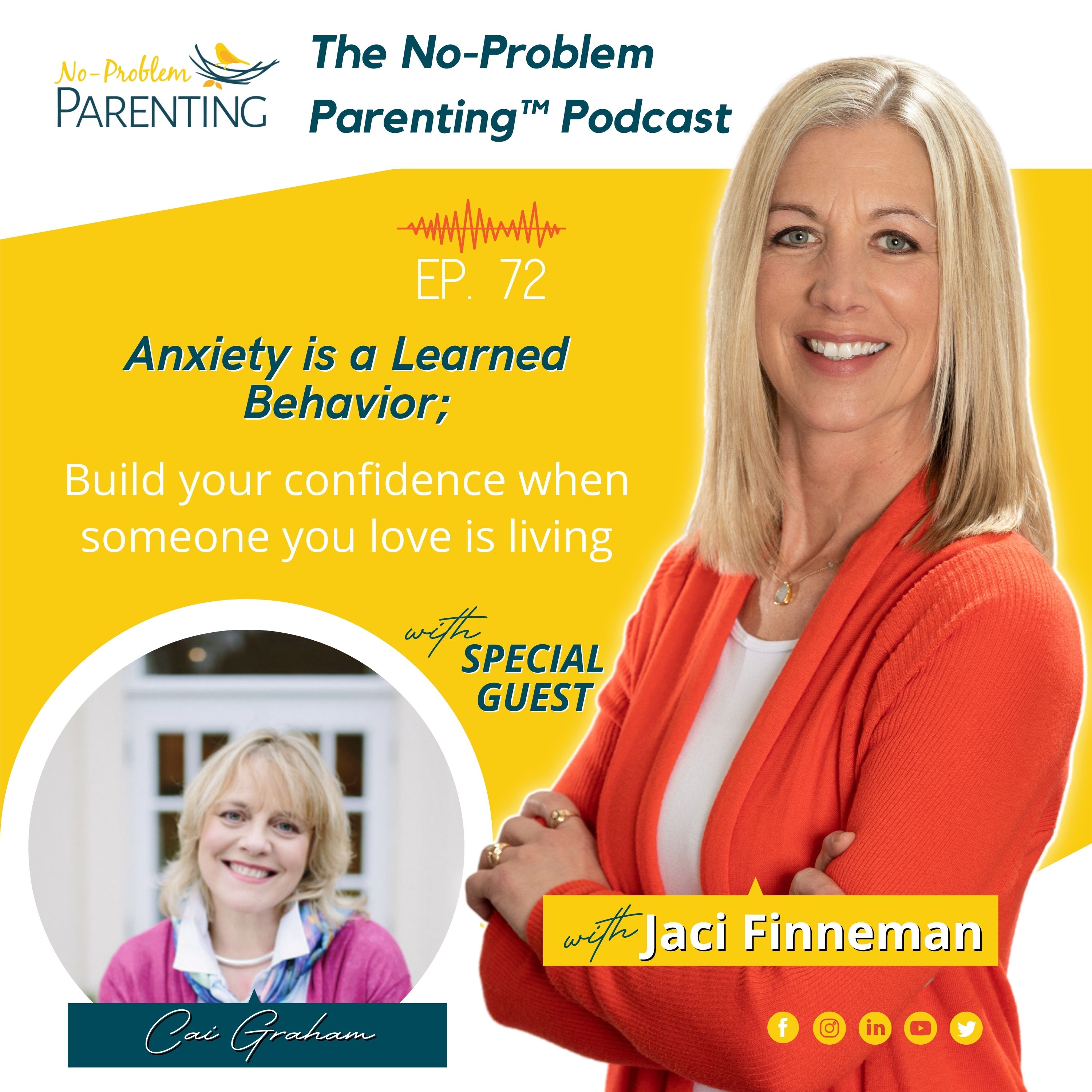
Anxiety is a Learned Behavior; Build your confidence when someone you love is living with anxiety with Special Guest Cai Graham
About this episode
Welcome Back No-Problem Parents!
Are you or your child struggling with Anxiety? Did you know that Anxiety is a learned behavior?
My guest today is going to give us the KEY to managing anxiety which is to first UNDERSTAND what anxiety is!
She'll share how to find the triggers, and some tips to beat anxiety for yourself and your children and teens!
Become a No Problem Parent Today!
Full transcript
Hey parents, before we get into today's episode, I wanted to announce that our resource page has launched. Go to noproblemparents.com. We are super excited to announce that this parent resources page is now live as of June 28, 2022.
There are more than 50 resources on a variety of topics for kids of all ages. And we're going to continue updating and adding to this page and letting you know when we do that, if you are a part of our No Problem Parenting Updates newsletter. So make sure that if you're not, go subscribe, go to our homepage, noproblemparents.com and be sure to subscribe to our newsletter.
And then you're going to hear about these resources on a variety of topics that we have either vetted ourselves or our clients have recommended them. Many of the owners of these companies have been on the No Problem Parenting podcast already. Their link is next to their resource on the resources page. So you can actually tune in to their episode and learn a little bit more about them.
For your convenience, we're including a link in the show notes for this episode so that you can access it right away without having to enter the NoProblemParents.com in your browser. Let us know what is your favorite resource. What topic would you like more information about?
or maybe what resource do you have to share with us that you'd like to see highlighted in the No Problem Parent community? Share it in a comment. Send us an email at admin at helloworldmn.com.
Let us know. Be sure to like, follow, subscribe. Guys, we are just getting started. And get this, one last little tidbit.
The No Problem Parenting podcast is now in the top 10% of global podcasts. Woo-hoo, we're super excited. Thank you so much for your support in helping us to help more parents. Welcome to the No Problem Parenting Podcast.
Turn behavior problems into no problem with Jackie Fineman. Are you ready to become the confident leader your kids crave you to be? Do you want to learn how to make parenting easier and more fulfilling? Whether you are at your wit's end or you want to have more fun as a parent, you're definitely in the right place. Now here's your host, Jackie Fineman.
Hey, welcome back, No Problem Parents. Today's episode is all about anxiety. I just don't think we can talk about anxiety enough. I think there's lots of approaches and different ways to help our kiddos deal with anxiety, but also within ourselves. And so I brought on a very special guest today. Her name is Kai Graham. And Kai actually talks about how anxiety is a learned behavior. Wait till you hear more about that. It's really kind of fascinating. And she's just a hoot and a holler to have on the show.
Kai actually stumbled across the No Problem Parenting podcast and reached out and said, hey, I think I have something to offer your parents. And so we met and we kind of ran over on time. And so this is a little bit longer episode and it wraps up really abruptly. But it was just such a fun conversation.
We just it was hard to stop. Anyway, let me tell you about Kai. Kai Graham is a parenting and teen mentor. She's a podcaster, international speaker, and an Amazon number one best-selling author of The Teen Toolbox.
Her mission is to help parents to support their children so that together we can build a mentally healthier and happier generation of young people. Kai is a mom of two adorable young adults, so she's been deep in the parenting trenches. She has blended nearly three decades of motherhood with her background as a master practitioner in NLP, hypnotherapy, and coaching. Together with her experience as a child line counselor and Home Start volunteer, Kai created her Teen Toolbox series, which provides parents and teenagers with the tools to successfully navigate the vital and sometimes rocky stages of adolescence.
So welcome to the show, Kai. Jackie, I am so thrilled to be here. Thank you for the opportunity. And let's see if we can help some of those anxious parents, anxious kids out there.
Yeah, that sounds awesome. And I love it. You're joining us all the way from Ireland. And I was just mentioning, I have a cousin living in Ireland. It's a dream of mine to be able to go and eat at his lobster restaurant. So hopefully one day I'll get to do that. But let's jump in with that. How you came to specialize in anxiety. Give us a little bit of your background and, and then what you're doing now to help kids and parents.
um i i i'm a sort of a bit of a chameleon i sort of started off as a computer programmer in the olden days and then i was a stay-at-home mum and then i was a wedding and portrait photographer and then i sort of became a life coach for um mums where i was um also sidelining i was sort of volunteering for childline which is the uk's biggest sort of free child counselling service online so kids of all ages you know sort of contact child line and look for support um and sort of whilst I was trying to help the mums many of them did that listen listen I know I need help I know I need help but will you help my child will you help my child and so it was you know to begin with it was a lot of can you help them with time management can you help them with their sort of you know their grades aren't so great they're not sitting down at the homework table But more and more recently, and especially since COVID, you know, anxiety has been the big thing.
And anxiety comes in many, many shapes or forms. You know, there are lots of school refusal, lots of physical aspects of anxiety where kids are literally making themselves ill. But there's also eating disorders and self-harm. And a lot of this is all stemming from kids just being very anxious and very overwhelmed with what, you know, the challenges that they're facing.
And so this is why I, you know, I have decided just to focus on anxiety itself and how how we can help our kids develop good, healthy coping strategies. But, you know, it does sort of come in all shapes and sizes. So, you know, some parents might just go, no, no, no, I don't think my kid, my child has anxiety. And then they, oh, yeah, but they always make excuses and they won't go out with their friends.
Or, yeah, they always, you know, they're dragging their feet when they're, you know, sort of asked to do something. And actually, there is often that underlying sort of anxiousness or worry about sort of having to do something. So this is why I just sort of thought, that's it. This is this is something that in many instances, Jackie, is really easy to solve as long as we have a little bit of understanding on what's going on behind the scenes.
Yeah, that well, and that's good news that it can be easy to solve. It doesn't have to be sort of a life sentence that you're just going to have to deal with this your entire life. Right. And you're you have a couple of different approaches with helping to treat anxiety or to, I don't know, help manage the challenges.
and that's causing the upheaval at the minute. Yeah. Right. And so one of those is the NLP neuro-linguistic programming and then hypnotherapy and you have a teen toolbox.
So tell us kind of a little bit about each of those. To be fair, I've shoved the whole lot under one umbrella and I am a master practitioner in all of the things that you have mentioned through neuro-linguistic programming, which is basically anyone that doesn't know what NLP is. It's sort of sorting out what's going on in your head. Trying to find out the stuff that is working and the stuff that isn't working and let's find a more positive result.
That's basically what we're trying to do. And a bit of hypnotherapy as well. Sort of thrown in. But I'm also a master coach and whatnot.
I mean, you know, I won't dwell on that too much. But the point is, is what I have learned is that if I am teaching or coaching young people, they don't want to hear the buzzwords. They don't want to hear all the jargon. They just want to know exactly, you know, come on, Kai, what do I do?
How do I sort this out? Because it's crippling me at the moment. So I have lots of different ways of sort of tackling it. But it's very much on a sort of straightforward, down to earth sort of matter of fact way.
And it's directed sort of specifically to the kids. It's called the Teen Toolbox. I wrote a book on it just because it rolls off the tongue. And what I want to do is I want to give kids a toolbox of strategies and techniques and whatever that they can use.
So if they are sitting in a lunch queue and they are struggling, then they can go, all right, what did she say? All right, I'll try that. Or if they're on a school bus and they feel like someone's giving them a bit of a hard time, what can they do? or if they're sitting in an exam hall or if they just don't want to go to school or if that's sort of sitting there with a plate of spaghetti and they just really can't you know sort of face eating it whatever it is whatever's going on it's going hang on a minute she told me to do oh yes I'm going to try that because I know it works so it's just helping kids what I tend to do is say you know it's I that they're like that when they struggle from anxiety they feel that everything's broken and their life's a mess and I liken it to having a car with with a flat um you know it's everything just feels wonky when you've got a flat tire everything just feels wonky and it just you know everything's just is it just feels out of kilter no you're not going to throw the car in on the scrap heap you're not going to get rid of it because the the sound system's working the alternator alternator's working the the windscreen sort of wipers are working everything's fine apart from the flat. So what we want to do is just fix the one thing, get that sorted, and then you're over the hump and you're just, you can go on your merry way. So I'm very much of the mind of not
everything is broken. So, you know, but we need to just focus on the little things that are giving you grief at that specific time. Yes, this is awesome. And so let's, let's start with the parents. Let's start with what do parents need to know, or what do you maybe wish that parents would ask you about anxiety to understand anxiety a little bit better? Understanding anxiety is actually the key for parents and for kids. What we, the very first thing I want to say is that anxiety is wait for it a learned behavior when you were born you didn't have anxiety you weren't born with anxiety so somehow along the lines you've learned how to do it and what tends to happen is your the the brain in the brain there's sort of the the there's a little gland called the amygdala and it's basically the fight or flight and what the amygdala is trying to do it's its sole purpose is to keep you safe it's not interested in anything else there's not interested in an a grade in biology it's not interested in the home run the amygdala is here to keep you alive and safe so that's fine so what it's doing is it's looking and keeping its eye out for any saber-toothed tigers and the thing is is that sometimes when anxiety comes in the amygdala has got its knickers in a twist and it thinks that everything is a saber-toothed tiger and it's going And you might have heard of the fight or flight sort of comment, where basically, you know, so when our brain is trying to protect us from any sort of imminent danger.
And so it's the fight is that, you know, I'm going to stand and confront it and I could shout at it or I could hit it or whatever. And the flight is sort of legging it and getting away from what's going on. And this is absolutely exhausting. And anxiety can be absolutely exhausting because your brain is permanently on the lookout for stuff like this.
And what we want to say is stop. Stop. You've learned how to do this. Your brain has got its knickers in a twist and it's just it just thinks that everything is a threat and it's not.
So we're going to educate it. We're going to take a breath. We're going to allow your brain time to calm down. And we're going to give you the space with various techniques and various strategies. So you go, all right, you know what, that over there, that's not a saber tooth tiger. I'm okay. That over there. No, actually, I'm okay. It's not a threat.
oh hang on a minute there's something over there right yeah i need to keep a lookout on this so really what we're doing is we're retraining the brain again because all the wiring's got all muddled up and what we're saying is thank you to the amygdala thank you for keeping keeping me safe you've done a really really good job because i'm still here but actually i'm going to give you time to have a little bit of a rest because when our kids anyone who has anxiety they are on high alert the whole time. They're absolutely exhausted. And understandably, they're going to have a short temper. Understandably, they're going to kick off. Understandably, they're going to be knackered.
And so we need to go, all right, this is what happens when anxiety is left unchecked. So we're just going to actually press pause and we're going to do something about it. So your brain has learned how to do it. And now it's going to unlearn how to do it. And that is, That really helps for a lot of people to realize, okay, it's not doom and gloom forever.
And we don't have to live with anxiety and we don't have to feel like this for the rest of our lives because that really is quite exhausting. Yeah, absolutely. And I love that you're bringing up the amygdala. I heard it years ago and I still say it to this day that the amygdala is like the smoke detector in our brain, right?
It's like warning, warning, warning, incoming danger. And I love that you say that sometimes just, you know, it's either modeled to us the things that we need to be fearful of or worried about or afraid of, cautious over, right? Or just learned, experienced, right? Where we have that trigger of, oh, I got to protect myself.
So I do think it's great to thank the amygdala for showing up and keeping us safe. You know, otherwise we'd be, didn't have one, we'd be running into fires and running off of cliffs and, you know, things like that, right? But we also sometimes can trick our amygdala into thinking there is danger where there's not. So instead of us, you know, smelling smoke and thinking, okay, wait a second, is it the pizza burning in the oven?
Or is it the house on fire? You know, sometimes we're kind of leaning towards that it's the house on fire every time and it's really not. So you're going to teach us some ideas or some ways that we can retrain our amygdala to be like, nope, you're good. It's just the pizza burning.
I can go grab it out and, and we're all right. So I love, I love that you're bringing up the amygdala and that you've got some tips and tools for us. What are some maybe triggers that you're seeing with the teens that, that that's causing the anxiety and how do you, what kinds of things do you do help them to, to cope with it? You know, there's, there's so much going on and, And, you know, it can be cyclical. It can be just out of the blue.
I mean, if you look at what we've been going through for the last two and a bit years when we refer to the pandemic, basically, we have been telling our children for the last two years, it's a really, really bad, scary world out there. You've got to stay inside. You're not allowed to go out because of the big, bad, bad virus that's going to kill everyone. So you've got to stay inside. And we have been scaremongers, rightly so, to some extent.
And, you know, so we've all got to say, sorry, but it's homeschooling. Sorry, but you're not seeing your mates. Sorry that you know you don't you can't go to birthday parties. You can't go to graduations because it's really scary out there.
So the amygdala is going, holy moly, we've got we've got stuff out there. Right. OK, but that's going to threaten me. So I'm on fight or flight. I'm on high alert.
and then suddenly everything changes and we turn around and go right you've got to go out to school now just put a mask on you'll be grand and the kids are going no hang on a minute my amygdala is telling me that this is a really scary place what are you doing what why are you sending me out because actually it hasn't gone away you've just told me it's still there but i've still got to go out anyway and the amygdala's going uh-uh we're not having any of this thank you very much and so the kids are stuck between a rock and a hard place they're trying to listen to what their inner compass is telling them the smoke detector which is saying no no don't you know just stay put but then the the children's sort of leaders be it school leaders parents you know youth group whatever are saying no no your government you've got to go out now and and yet the the head is going but this just isn't right so this we are seeing a lot of social anxiety where kids are really struggling with integrating back into the big wide world dare I say it so it's trying to encourage our kids to get out there and understand that actually things have changed over the last two years and it's not as bad as we said that it was because there's the vaccines and whatever and it's it's but what we need to do is still validate what's going on in their head because there's nothing worse for kids, whatever age they are, youngsters or teenagers, when their thoughts
are dismissed, because it's just, you know, and I think this is sort of one of your pillars of understand, of your sort of philosophy, is that we need to understand what's going on. And we need to understand what our kids are going through. And we need to understand what they're feeling. So the big thing here is to start talking the big thing is to say i get it let's talk about it how can we do things to make you feel comfortable how can we make things you know so that you are better sort of set for coping with reintegrating into the big wide world because this is the big one and some kids don't want to go back to school now i you know forget about the pandemic for a minute you guys you know we we are sort of um sort of watching you in the news with what's recently happened in texas so it's you know and there are for for so many kids out there there is that extra worry of um you know it says is my school the safe place to be statistically yes um but you know it's they still have the amygdala going hang on a minute i've just been seeing all over social media that something bad's going down so I think the thing is is it's supporting our kids and giving them this space and the air time for them to tell us what's going on in their head because the worst thing about anxiety is when we put our fingers in our ears and try and ignore it what we need to do you know the brain is a problem solving sort of organism our organ and it needs to work out
what's going on. And rather than, you know, if you ignore stuff, these things just get bigger in your head. So the best thing to do is start talking and sort of finding out what's going on and what's behind it. Yeah. And I love that you say that because it is true. I think for years with my own anxiety battles, and especially when I left my 20 year career to start my own company, you know, a month later, I was like, well, I need some panic pills here. What in the world did I just do it. That was really, that was really exciting and scary at the same time. So I love that you bring that up. It's not about ignoring it, welcome it, talk to it, acknowledge it so that your amygdala can relearn what is to be feared and what is not. You know, years ago,
I read an article from a woman. I wish I had it still to this day so I could reference this, this amazing woman, but she talked about how, when her anxiety shows up, she actually named it, She gave it a name and she would say, thank you for showing up and letting me know that there's something I need to pay attention to, to be aware of, to protect, possibly protect myself from, but acknowledging it. So I call mine Agnes.
She sits on my little left shoulder. I've shared this on other episodes. And when she shows up, then I can ask her, you know, what is it that I should be cautioned for, right? That you're trying to warn me of.
And is this something that's legitimate that I really do need to be fearful or worried about? Or can I decide that? No, I'm actually okay. I'll be all right. And then I also say, Hey, how long are you going to be here today? Cause sometimes I do know, and I'd like you to talk a little bit about this. Anxiety can be just overwhelming. And as much as we try to stop it and rationalize with it and be logical about it, it just overwhelms our entire central nervous system and we're stuck in it. And so I will often say to Agnes, you're going to be here five minutes is a half a day, a full day, you know, and she shows up maybe just a couple times a year now, but it's like, then if she is going to be hanging out for a full day and I just need to rest, or I need to check out or zone out or sleep or whatever it is, I, I give myself permission to do that so that later I don't beat myself up for having wasted a day. And I think the thing is,
I you have Agnes I sort of say to the kids any any kids that sort of know Harry Potter I refer to this little voice is the moaning mirthful the one that sort of goes oh my god and this is is just sort of sitting there and moaning and just you know because anxiety doesn't always have to be full-blown panic anxiety can be that inner critic that inner voice that keeps going watch out what if oh my gosh you know and and keep a lookout and it's that just it's that incessant voice that's going on so yes as you say it's sort of sitting there and sort of acknowledging what's going on and going thank you oh my gosh you've drawn my attention to this but the first question moaning myrtle is is this actually true because i think what happens is you know and if we use something like um public speaking for example because that's you know that that's a big fear that many sort of people have is you know sort of moaning myrtle sitting on the shoulder going you can't do this you can't you can't just go and do some public speaking you can't set up on stage Everyone will laugh at you and you'll make a fool of yourself. And you go, hang on, Moaning Myrtle. Thank you. Right. OK.
Now, is this true? And what and it's a matter of unpacking where where does this fear come from? And you might just find, oh, yeah, right. Well, when you were five years old, you stood up in class.
You wanted to talk about your favorite guinea pig. But then something happened and it bit your finger and ran away and everyone laughed at you. And Moaning Myrtle doesn't want people to laugh at you like they did then, because what happens is our brain stores every memory and everything that goes on in the past so that it can use it as a point of reference. So Moaning Myrtle's sitting there going, but public speaking, when you did that the last time, you felt really, really bad and I don't want you to feel really bad.
So we're not going to do this. And if we don't listen, then Moaning Myrtle shouts a bit louder. And if we don't listen, then that's when the panic starts coming. That's when the physicals sort of starts happening.
when we start shaking, when we start getting nausea, when we start sort of, you know, when we get an upset stomach, when we start shaking and, you know, sort of hyperventilating. Whereas if we had sat down and go, oh, OK, come on, where's this coming from? Oh, I understand that you don't want me to feel as silly as I did when I was five. But you know what? Will you trust me here? We've got this. You can rest.
Thank you, because actually I need it. But you know what? I'm well prepared for this. I know what I'm doing. I'm standing up maybe in a class with my friends. So we've practiced this. We know what we're doing, because what we now need to do is teach Moaning Myrtle. It's not the same as show and tell when they were five years old. But this is something slightly different. And we, you know, and you will deliver your talk or whatever it is, and the sky hasn't fallen in.
Simone Myrtle learns, oh, public speaking isn't as I remembered it. And so this is why we are unlearning and teaching something different. So as you rightly say, it's a matter of teaching and being aware and giving the space of it might take a little bit longer. I mean, some kids can't stand exams and I appreciate that.
But it's a matter of, you know, we've got techniques. Thank you. I need to get this exam done. Panicking is just going to cloud my brain. So I'll tell you what, I'm just going to park that there. We'll have a panic after the exam. How's that? So in the meantime, let's just practice this little technique and that will get me over that stumbling block.
Yes. Yes. That's awesome. And so a couple of things there, one, we can put the panic on hold and get back to it later. And also the fact that at five, you can now as a 15, 25, 45 year old person, you can say, and the reason the kids laughed was because it was kind of a funny story or they were nervous and they, you know, so it wasn't about me being laughed at. They were laughing about the story and I'm old enough now where I can realize that. So if it happens again, when I'm giving a speech and somebody's laughing, you know, or rolling their eyes or doing whatever they're doing. I don't have to take that in and own that. That's not about me. And I do love the, that's, that's another thing with Agnes. I'll say, Hey, I don't have time for you right now.
Thank you for alerting me. And after I'm done with my day, I will get back to you. And then making sure you go back to thinking about what was that, that triggered the anxiety or the need for, for Myrtle or Agnes or whoever to show up and say, you need to pay attention to this. So yeah.
I think from a scientific point of view, it's worth sort of, you know, sort of remembering the amygdala is telling you that there is a saber tooth tiger out there. The amygdala is therefore shouting merry hell and it's preparing you to fight or flight. And so your body is naturally going to be pumped with adrenaline. What we have to remember is actually that cycle only takes two to three minutes, okay, two minutes usually. And so what we need to do is just say stop, right, hang on a minute, what's going on here? Oh, right, okay, I'm actually going through that phase of something is threatening me, right, first of all, is it true? But knowing that actually, but hang on a minute, my body is telling me that this is really important and I need to pay attention yeah that's fine but this is only going to last two minutes your body will soon be it'll be flooded with adrenaline and then it may stop if you allow it to now if you if you sort of then exacerbate and buy into this fear and buy into this panic then more adrenaline is going to come and it's going to keep you because it's thinking right come on we need to this could be a really big saber-toothed tiger because we really really need to run so the point is is to say do you know what, this actually, if I give it permission, and acknowledge it, and know that this is going on,
this can be over in two minutes. Oh, okay. Right. So what am I going to do in the meantime? Well, in the meantime, we can do a bit of breathing. In the meantime, we can do a little bit of positive thinking. As in, oh, hang on a minute, where's this coming from? Oh, yeah, it was the guinea pig story. Actually, that was quite funny. Oh, right. It's nothing really to be scared about now.
um right i've got this because i'm prepared so it's it's doing the and we'll talk about breath work in a minute but it's just finding that coping strategy for the two minutes whilst the adrenaline is pumping around the body and then the amygdala is going well are we running it no love we don't have to it's actually okay we've got this are you sure yeah we're okay and then the body stops using the adrenaline and the panic will subside now sometimes if we're in a real funk as you say yeah agnes is going listen i've just had enough can we not just have a duvet day and we need that and and thankfully i don't know about you guys but over here we are acknowledging that actually a mental health day is not a bad thing to to reward well not maybe not reward yourself but to offer yourself you know sometimes we just need to pull up the drawbridge and go i'm not playing ball today, but in other times, like if you're going into a, doing public speaking,
or if you're going into an exam or you're about to sort of, you know, go into the playoffs or whatever it is you're doing, sometimes you can't run. Sometimes you're going to have to face it. And the best thing to do is go, okay, these nerves are showing I care, but it's only going to last two minutes if I get a hold of this now, and then it doesn't run away with you. So this is really, this is great because I didn't know that about it's going to last two minutes. I think maybe I've heard something about that before. Usually two to three minutes to do some breathing and you can actually calm yourself down.
Now, tell us, how do you do that, especially if it is more of a panic situation and you're just spiraling? There is you're you're trying. You're just not able to even catch that breath or take that breath. And then your mind is racing and telling you this isn't going to work. This isn't going to work. This isn't going to work.
Have you ever tried to tell a screaming toddler to calm down? It's going to be OK. it it doesn't work does it because the red list has come down because the amygdala is going yeah and what what invariably happens with a toddler who's screaming rather than sort of you know going nose to nose with them and telling them to come on make sense this is rubbish it's just giving them a hug and sitting with them until the time is passed and that's really what you're doing to the amygdala what you want to do is give it a hug and the way we do that the amygdala is part of the reptilian brain it is the most primitive part of the brain it does not understand language a bit like the toddler it doesn't understand now calm down you're being irrational here it was absolutely fine no it doesn't understand that the only language or the the only sort of thing that the the amygdala understands is breathing breath work because it is physical so what we need to do is we need to breathe in and there are a number of techniques and I can share them with you is is so that when we're breathing in, we are regulating what our body is doing.
We are regulating, you know, we're not even trying to the cognitive aspects are out the window because the red mist and the panic and the fear and that, you know, the hissy fit is just it's just gone into overdrive. So you're literally by doing breath work, you are speaking to the amygdala directly. It doesn't understand Japanese. It doesn't understand English. It doesn't understand Spanish.
So there's no point even trying to talk to it. But you just go, hang on a minute. Stop. Stop. Right. What do I do? I breathe.
You've seen people who are coming in, you know, sort of maybe who are any of the athletes that are in the Olympics are doing their breath work when they're coming up to the blocks. They're just shaking it all down and they are deep breathing and they are focusing the mind into just calm. When people are coming on stage, they sit there and they are breathing and they are just taking it slowly. when people you know anyone that is struggling breath work is the best thing to do because it is speaking indirectly in a physical way to the amygdala to say it's hugging the amygdala and saying i've got this so the fastest way and i i and you know so that there are so many different breath work techniques but i basically sort of say let's think about box breathing think of a box or a square okay and that's all you've got to think about and what I want you to do you see I'm calming down already because my brain goes oh it's box breathing she just said the word we know what to do here it's muscle memory and I'm calming down already so you think of the box and you breathe in for four along the top of the box and you pause and you breathe out for four down the side of the box and you pause and you breathe in along the bottom of the box for four and then you breathe out at the other side of the box for four and it's basically breathe in for four pause breathe out for four pause and you keep doing this and it takes about a minute two minutes
for your mind to go oh okay it's just feeling a little bit calmer the great thing about box breathing and it is it'll take about a couple of minutes and then you'll just feel okay I've got this it's invisible this technique you could be sitting on a bus and someone's laughing at you and they don't know that you're doing box breathing you're sitting on the side of the stage and no one knows you're doing box breathing you're about to write an email or or deliver a home run or whatever it is and you can just practice box breathing and no one knows what they're doing what you're doing no one knows oh my gosh look at her she's she's panicking and no one oh look what they're doing oh they're obviously having trouble over there no one can see it because it's invisible so you can sit in the exam hall and you go box breathing in for four out for four and you just keep doing that until you feel a bit calmer i love that box breathing that's one i haven't heard yet so that's i'm calmer just as you were doing that nobody can see us my my podcast is still not not uh videos audio only but you were holding up you you had your fingers both hands in the shape of an l yeah and you were forming a box by putting your pointer to your thumb and your other pointer to your other thumb shaping a box and then you were outlining that the top part of the box and you know for breathing in and the and the sides your
thumb for breathing out I think that's that's awesome one of the you know you might you could be sitting there with a pen a pad of paper and a pen and you can just draw the box as a doodle as you're doing that and that's an easy way to remember that's a really good idea too yeah and No problem parenting. One of the first things in the introduction of the course, we talk about remembering the pause and, um, and as you were talking before you mentioned the box technique, you kept putting your hand on your chest. And I don't know if the other hand was on your stomach or if you were doing both, but we teach that too. That's even just six seconds of hand on your chest, hand on your stomach and a six second breath will help you initiate to be able to calm down.
the first time I tried that when I was really tense because of stress, uh, I couldn't catch a good breath. Yes. And the thing you say, hang, hang on chest and on, on belly, because what tends to happen is when you sort of say do box breathing. So people go, Oh, right. Okay. I know this.
And the thing is you don't want to hyperventilate. They have to be deep breaths. So they have to go deep into the body and deep into into the belly so it's just sort of slow and steady and you know shallow breathing doesn't help but but there's another one also Jackie that helps is a lot of kids who are quite visual and I sort of say come on what's going on here where's the tension and they could sort of go oh oh it's in my head or oh it's in my throat or you know I my stomach's feeling right okay that's where it is give it a color and they go oh it's sludgy or it's black or it's red or it's right okay right okay we're going to get rid of that what what is going to make you feel calm and it could be I don't know white or it could be sort of sky blue or you know one child so I want sprinkle you know some sprinkles and lovely rainbow right have that and so the point is as you find out let's say you've you know so maybe someone's got I've got that sort of awful tightness and it's shouting at me in my head and it's bright red right okay I want you to breathe in and then breathe out the red.
And what were you going to have as the nice color? Oh, I wanted yellow to make me feel happy. Okay, breathe in the yellow. And breathe out the red.
And what happens is the yellow soon replaces the red. And keep breathing until you've breathed out all the red and there's nothing left. And then keep breathing in the yellow. So you're feeling calm.
So you're feeling confident. So you're feeling whatever. Relax. how you have that yellow represents for you and once you've got rid of all that color that you didn't want and replace it with the color that you do want that is going to make you feel how you want to feel not how you were feeling I call it color me beautiful but you can call it whatever you like and it's just replacing you're sort of nearly physically getting rid of some people just do black and white oh I've got black in my throat right well let's just put some white in there breathe out the black and breathe in the white and that is a great way for kids to sort of visualize what they're doing and can you still see any of the red yeah it's still there right we'll keep going deeply breathe it and breathe in the good stuff and breathe out the bad stuff so that helps as well yeah that's great we've got a visual way a kinesthetic way of drawing the box and also uh hand on your heart or chest and hand on your stomach i like to tell parents to do this before they respond to their kiddos when they're frustrated or irritated or annoyed or whatever,
because it almost physically helps to like giving that hug, right. Push you back. So you don't go forcefully towards your kids and say something you're later going to regret, right. Or start an argument you're going to regret. I love that. You know, speaking of stress, I was mentioning that a bit ago. What are some common stress instigators for teens that you've seen recently, you know, sort of in your professional opinion, why are tweens and teens just feeling so stressed and anxious these days? I think now more than ever, even pre-pandemic. Yeah. Yeah. And I, a lot of it, I'm afraid to say, I'm finding over here is our academic system. And so there's the expectation of high grades and um you know the need to do the SATs or the need to do you know sort of all the exams and the achievement and what are you going to do when you grow up and you know it's all that need to achieve the whole time where we are not giving um our kids the space just to I mean the thing is this is you know we were talking about duvet days but our kids are feeling that need to achieve the whole time um and it is just putting unnecessary pressure on them and to be honest 95 of the kids that i see who are really really struggling who are maybe the older teenagers are going i just don't know what i want to do and that's giving me untold stress you know sort of you know what subjects have you chosen and where are you going and what college
you're going to and it's listen i don't know this is the right choice i don't know if i'm doing the right thing and everyone's will say well but your future depends on it and it's going oh for flip sake well how I I don't even know where I'm heading and so I my you know so my future's doomed then if if I I don't know where I'm heading and actually what we I mean I personally have done you know as I said I'm a chameleon I have done so many U-turns in my career my kids are 29 and 27 and they've probably done three U-turns each so far. And you know what? The sky hasn't fallen in. It's okay.
And I think what we have to sort of try and tell our kids is we need you to be happy. We need you to be healthy. We need you to be driven in what drives you. Not be a medic because great aunt Maude says so. Or not, you know, to do the things that drive you. Follow the beliefs and the values that drive you. And when that happens, when you find when your kids find, it might be ballet, it might be setting up a band, it might be helping with climate change, it might be wanting to sort of, you know, become next president, who, whatever it is they want to do, when they find what their desires and passions are, that's what's going to get them up on a wet Wednesday and have less of a need for duvet days because they are keen to get up and to get out so I think I think us adults are very well meaning in our oh well listen do this and and you know apply to this college and do these subjects because we want the very best for our kids and yet sometimes many of us don't listen to the fact that our kids might not want to do it or having a clue what they want to do so we really need to take our foot off the pedal which actually for parents is really scary because if we don't lead them through you know the the ways of the world then how on earth are they going to find their way and I will have failed them as a parent that's not so really I mean my phrase is you are only as happy as your saddest child. And as a parent, we literally, we do just want our
kids to be happy. And yet we do as parents feel driven and have to compete against what all other people's kids are doing. And it's just that relentless hamster wheel of needing to achieve. And I think that's the big thing that's causing a lot of kids a lot of hassles.
well and I I appreciate that you that you say that that's a great example the school the achievement whether it's school sports even even a subject that they they do or an activity that they do love and they do enjoy um I think sometimes as parents when we do when we're thinking of that saddest kid or that most anxious or stressed out kid we're thinking we need to convince them that they're better than what they feel like in the moment we need to pour on that positive praise and encouragement. And really, again, the step three and change the conversation of no problem parenting. It's not about convincing our kids they're good. It's not about giving them all of that unconditional praise. They need to feel it on from the inside. So I really appreciate that you say we need to be listening to them and letting them have, you know, hearing their voice and what's going on with them. And then sometimes the patience, you know, as a kid is working through that and they're not going to college or they don't have a job or they're sitting at home and not doing a whole heck of a lot. And it's so hard sometimes for parents to wait that out or ride that out. And I think the thing is we, we, we, we learn to do this as parents, when kids are so tiny, you know, your, your child falls down and sort of just before they even open their mouth to sort of scream in the pain, we go, no, no, no, you're absolutely fine. Come here. No, you kiss
it better now you're fine no it doesn't hurt and we're telling our child your knee doesn't hurt sweetheart and they're going hang on a minute it does it hurts like you know and so we are trivializing the pain that they're going through in a really really well-meaning way and so this is sort of what we are teaching our kids is the fact that no no listen we we mustn't acknowledge the pain that's that's going on and actually what we need to do it's a bit like speaking to myrtle again or agnes we do need to validate what's going on so if your child is struggling it's yeah i get that this really sucks i mean you know they've just come out of two years of being deprived of all the sort of you know the fun that teenagers through and young kids have been used to and you know we need to go i get that that it's really hard to deal with so how can we make how can i as a parent support you to make this better not you'll be fine you'll be fine shut up and keep going. It's how, what do you need from me to make it better? Because the thing is what our kids,
when they realize that we've got their back rather than being on their back, that's when the magic happens. Oh, I love that. When we've got their back rather than being on their back. We need to walk beside them and we need to support them. And if they are struggling with anxiety, or if they are struggling with lack of self-confidence or if they, you know, whatever it is, it's, it's acknowledging because I think nowadays we look at Instagram and we look at social media and everything's technicolor and fantastic and wonderful and we're trying to say no you're not allowed to have bad feelings yes you are life is full of ups and downs it's not a bowl of cherries but the point is is that if you're in a funk now don't worry it's not gonna last you're gonna have the fun times quite soon but let's just we don't want to dwell on it but we also don't want to ignore and trivialize as well and I think we need to allow our kids the space to go could you just stop here I'm hurting and for us to go yeah I get that that's just not fun is it what do you need from me and I mean my kids used to come in from school really crotchety really tired and I just I learned not to open my mouth and I just used to sort of say hot chocolate and toast here you are you look tired rather than how was your day and what do you tell me all about it why did you get an effing maths and they're not interested and it's just I hear you and it's meeting someone
where they're at and they might be struggling and they might be having a hard time I mean I don't know about you but if I'm sort of feeling down I don't want someone to sort of you know try and play the class clown I want someone just to go shall I just sit with you shall I and you know and as you say ask Agnes do you want a day here do you want half a day do you want an hour what do you need and that's what we need to do with our kids we don't have to problem solve the whole time. Sometimes it's just a matter of I'm with you here. I've got your back. Yes, absolutely.
That is, I just gives me all the feels when you even say that just, it isn't about problem solving all the time. Sometimes the best way to problem solve is to not try to solve the problem and just acknowledge it and validate our kiddos. Well, Kai, this has been fun, super fun. And you have, I'm going to put all your links in the show notes. You have 10 tips to support your anxious child that is a really nice download that parents can just log in and get or enter their email address and get these tips from you. Absolutely complimentary. And, and then you also have that teen toolbox, which is for teens. Parents can read it, but teens can read it, right? It's like a little guidebook for them. It's geared towards, you know, the, the, the first half is sort of geared towards parenting. And then the second half is, is geared towards, you know,
all the troubles that kids are going through. So they can look at that as well. But what I will do I've got a handout for seven breathing exercises. So I'll send you the link for that.
And that will help with different ways of trying to give your amygdala that hug. So that's- Yeah, that is awesome. Thank you for that. I look forward to collaborating with you on other events and other things in the future, Kai.
Absolutely, lovely. I'm so happy to have met you. Thanks for being on the show. Thank you so much, Jackie.
Thank you for tuning in to the No Problem Parenting Podcast. Join Jackie next time for more tips, tools, and resources that will help you become the confident leader your kids crave you to be. Who do you know that we could support on their parenting journey? Like this podcast, subscribe, share, or leave a review of the show.
Your support of the No Problem Parenting podcast pays it forward and helps us help more families. Thank you.
Become the confident leader your kids crave
The method, the community, monthly live Q&A with Jaci, and Celia — your AI guide in the moment.
Start your 14-day free trial Get it on iPhone or sign up on the web