
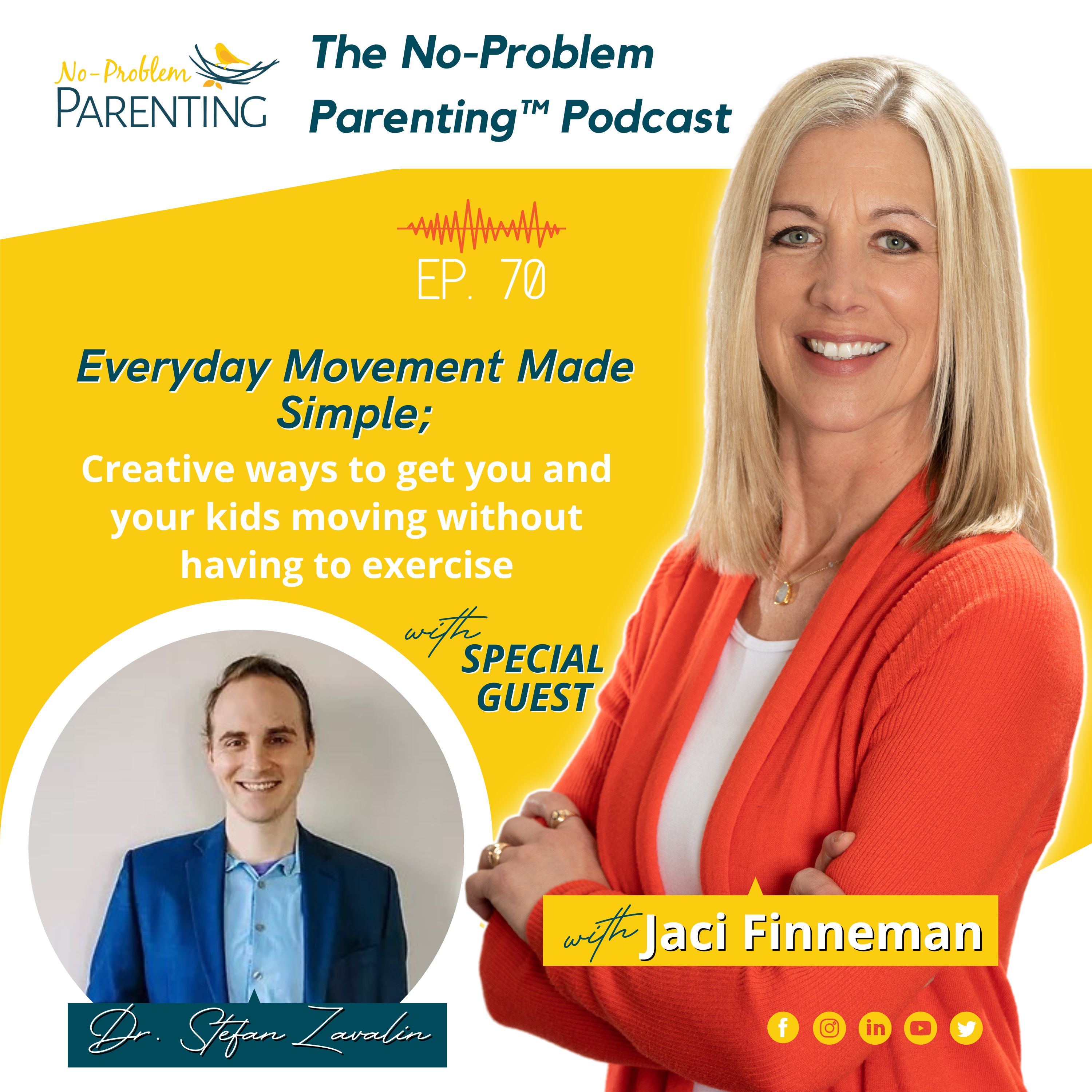
Everyday Movement Made Simple; Creative ways to get you and your kids moving without having to exercise with Special Guest Dr. Stefan Zavalin
About this episode
Welcome Back No-Problem Parents!
Today's guest is going to talk about the difference between movement and exercise and give us some practical and realistic ideas for how to get ourselves and our kids moving in our everyday life.
Become a No Problem Parent Today!
Full transcript
Hey there, welcome back No Problem Parents. Hey, today's episode is all about movement and the difference between movement and exercise. Movement isn't just exercising and, you know, doing one hour workouts, but movement is very important. And so for those of you who are working at a desk all day long, you're doing a lot of sitting, this episode is for you. And parents, for those of you worried about your kids being on video games all day long and sitting and just kind of not getting any activity, this episode is one that you're not going to want to miss. Such great ideas for how to get ourselves and our kids moving. So meet Dr. Stephan Zavalin. Stephan is a movement mentor driven to change desk work culture and get our families moving. Despite losing his vision in graduate school, he started a company called Love to Move, where he mentors organizations on adapting company culture to improve productivity and health. The dream? To evolve the current work model so people no longer have to choose between work and health. Stefan aims to make virtual services accessible to all to help this cultural shift. Since starting on his mission, Stefan has written a book called Sit Less and given a TEDx talk on the same subject. In his free time, he likes to write songs on piano and guitar, critique a good cup of coffee, and play board games with his wife and friends. You are not going to want to miss the great ideas that Stefan has in today's episode
for getting us to move. So let's get moving. Jackie Finneman is a 30-year family counselor turned parenting coach with more than 40,000 hours of working with children and families. She is thrilled to share behavioral strategies, supportive resources, and parenting stories from her own real-life personal and professional experiences. Parenting is a roller coaster, not a merry-go-round. We can deal with and overcome the behavior challenges within our home and set ourselves and our kids up for a successful ride. Has your roller coaster derailed? No problem.
Listen in to get you and your family back on track. All right, so welcome to the show, Stefan. I am really happy to have you here because summer is coming and I think there's a lot of parents out there wondering while I'm at work, what are my kids going to be doing? Stuck on video games all the time. So today we're going to talk about creating healthy movement habits in the house for our family, the entire family. So welcome to the show. Thank you so much for having me. I love talking about movement. We're recording this bright and early and even I'm still, I'm standing up and I'm ready to go and talk about movement. So I live it and I love it. So I'm here. Yeah, we just recently met on Michael Whitehouse's Lunch Power Hour and I think all of us at the end of that were like, we should be standing because Stefan is standing as we're recording this. And I do have a stand up desk. Like I, I do stand for a lot of the day. And I have my bouncy ball chair. And you know, because when you're working from home, there's a lot of sitting,
right? But I don't think do you ever sit during the day? I do. Contrary to popular belief, I do sometimes sit. I sit a good portion of the day, honestly, from from everything that I look at the ideal like time, as long as you're getting around eight hours, and you're not exceeding eight hours too much. That's incredible in terms of sitting. So yeah, but the standing, I don't really work at a standing desk. I don't have a standing desk. I'm jealous of all the people that have it. I use a nice pile of textbooks. It's my old physical therapy textbooks. Don't tell my professors, but they're my makeshift standup desk. And then I use that for calls or whatever else it might be and find just ways to sit less throughout the day. Well, so before we get into all the tips and tools and tricks that you have for us parents. Tell us a little bit about your background and how you got into this world of movement. Sure. The semi-short and semi-sweet version of this entire story is, so I liked movement pretty much all throughout my childhood. And I found that as a kid in fifth grade, I hated gym. I hated gym class only exclusively because they didn't have any structure. Not that I needed structure, but then I couldn't play any of the sports. Our teacher would just haul out a giant box full of various balls and rackets and cones and jump ropes and then just leave it to all the kids. And I wanted to play soccer and most people didn't care for it.
And so we ended up having to play football or kickball or something else. And so I said, I'm kind of done with this. I like movement, but this is not fun. So I joined orchestra because the loophole was, if you were an orchestra, you didn't have to be in gym class. The irony of it all was that even though I got more and more into music during high school and everything, nevertheless, I went to undergrad for music initially. I switched to kinesiology, which is the science of the motion of the human body. So movement came back into my life regardless.
And then I went to physical therapy school afterwards as I was sort of voluntold to find a passion because my parents said, we want a grad school. We don't care what it is, but you figure it out. And I was like, I don't even know what to do with a kinesiology degree. Found physical therapy. Could not believe that you could get paid to do something like this. Thought it was incredible and amazing and loved it. And the first semester of physical therapy school, got a little bit of a pain in one of my eyes. Long story short, I got misdiagnosed for a while.
Turns out I had a parasite that I got in my eye. This was just in Philadelphia. People always go, maybe it was an exotic location. No, just Philadelphia.
Unless for some, that might be an exotic location. That's fair. Maybe for us in the Midwest. Maybe so.
Fair enough. But nevertheless, there were a lot of complications, surgeries, what have you, had to take a year off, but I finished off. I got my doctorate. Wonderful.
But I was already starting to really lose my vision at that point because of it all. I went into the clinic and in the clinic, I sort of realized, I love this. This is good. I am helping people, but the people keep coming back. So they come in, I give them exercises. And then a year later, they come back to see me, even though they got better. And the problem was that throughout our day, throughout our lifestyle, we're just putting in a lot of inactivity or not effective activity, which is causing so much of sort of this damage to us. So then finally, right around the COVID times, I actually got COVID myself. And that was the final kick out of the clinic that I needed. It was almost like the universe saying, okay, you can do more. And I left the clinic and I said, okay, I need to interact in a different way. And so I started my company. And I also got the final diagnosis of being legally blind at that point. So it was very interesting combination of everything. And I started a company basically consulting with organizations, but also with individuals about how we can reduce the amount that we're sitting.
And the biggest thing that I tell people is I'm not here to tell you that you need to exercise more or necessarily that you should go for lunchtime walks, because that's the mindset of, I need to move more and do more and burnout is headed that way. I more try to tell people that let's find ways to do the same things you've been doing, but doing them while you're sitting less so that it's kind of a seamless transition of reducing the amount that we're sitting.
And so that's resulted in me writing a book called Sit Less, not surprising, as well as doing a TED talk, which is called Move More, Sit Less, where we talk about the difference between those two things. And then I've just been continuously talking to people about how to reduce sitting and not just think about increasing movement, because I think we're hit over the head with that quite a bit. And so that's sort of my story up to this point. Well, and when we were on Michael's power hour, lunch power hour, that's one of the things that struck me right away was that you were like, it's not really about exercising, you know, three times a week and then taking, it's really just incorporating exercise or movement into your every everyday life.
It is. I'm really glad the way that you said it, by the way, because this is the way that people also say it. The other thing that I like to talk about is the difference when people say move more, a lot of us in our heads go, oh, exercise. They mean I should go exercise more, but movement is so much more encompassing than exercise. And so you're absolutely right.
We can find different ways. Chores, by the way, are a beautiful way for us to move more that still count, but we don't view them as exercise, but they very much move the body. Well, and I'm one of those people that digs my heel in about exercise. Not that I don't want to exercise per se. I'm just not a runner. It's like, unless you have, you know, something, some kind of carrot hanging out there, that's going to make me run. I'm one of those people.
That's like, if there's not an emergency, I'm not running. Now, if there's mud, I do like to do a good mud, mud run. Uh, that's more exciting. There's obstacles, there's different things to do. It's not just a, you know, running a five, five K kind of thing, but going to the gym, it's just not my thing plus the time to it takes me I'm 20 miles or 20 minutes out of town by the time I get to the gym then you do your hour workout then you come home from the gym I mean it's like a good two two and a half hours out of my day just to quote unquote exercise so I am all about you know incorporating other ways into my day to be able to do this you know right from my home, how much should we be moving? That's a great question. So the guidelines for general kind of U.S., the government guidelines for the health thing says 150 minutes of moderate activity per week. Moderate activity is when you're walking a little bit faster, where you're getting a little out of breath, but not much. That's activity above that is pretty much most of the time we're not walking it. So 150 minutes per week, that's half an hour a day, and you can have the weekends off.
But 80% of people don't necessarily meet that. There's also some where we need to get resistance training activities. But again, many of those things, yes, that's what we view as doing that. But nobody says, okay, you have to do, if it's 150 minutes, you have to do half an hour without stopping.
No, it's throughout the day. So we're just not moving vigorously enough and actively enough as we're doing various things because laundry is tough. Carrying a basket of laundry up the stairs actually is a lot of activity. The problem is we do it for a minute and a half, maybe if you have the longest staircase in the world.
Usually it's 30 seconds and you're up and you're kind of done. You're finding ways to sit down and do it. So if you find those ways to bring in more movement just throughout it, you can find those 150 minutes pretty easy throughout the week. And I argue we should probably be doing a little bit more.
That's the bare minimum. OK, got it. So what sorts of movements and exercise should we as parents be like prioritizing? Of course, there's chores and there's laundry and there's, you know, things like that.
But what kinds of movements and exercise should we prioritize? Sure. For anybody on a busy schedule, the biggest thing is called like a whole body movement and like complex compound movements are the other things that's more exercise, the compound exercises that you might hear around. What that really means is it's exercises that really, those are the ones we actually don't like doing because they use their whole body because they're hard. It's tough. It's the squats, the deadlifts. In terms of exercise that we don't want to do, it's difficult, but it's difficult because it's using most of our body. That also means that it's the kind of chores that use all of our bodies. So as opposed to, you know, sitting down or leaning yourself against the counter when you're doing dishes, you have to be, you know, standing back, washing them by hand and not kind of lackadaisically, but actually actively doing something like that. Being aware of like how you're standing and how your, how your body is moving as you're doing this, right? Not just slouching. You're actually making an intentional like point to stand straight up or to, I don't know, flex your muscles while you're doing it. It's true. And most of us, the reason that we kind of lean up is because we're not usually flexing our abs and our glutes or our butt muscles,
which your abs and your glutes are the two things everybody wants for the summer so there you go you can you can have that getting better as you're doing dishes or even you know brushing your teeth whatever else it might be so and that's the hardest part because we do that we lean up against the counter or you know we we sit down to do a chore because well it's easier why we already have a stressful life that things are already overwhelming why am i trying to do this let me have a little bit of a reprieve, Stefan, why are you forcing me to move? Stop doing this. And I get that. And that's the thing where people go, okay, I'm going to completely shift my whole life and I'm going to just move all of the time. As we're talking through these little tips,
you start off very slowly. It could literally be as I'm going to be more intentional about doing the dishes for this week. That's it. That is the only thing you're adding for this whole week.
And until you're consistent with that, we're not adding anything else extra. So I just, I always want to say that because people think, oh my goodness, he said 150 minutes, and then I'm going to be doing all these other things on top of it. Nope. You've gotten into a habit of sitting or whatever else it might be over decades and decades of doing things.
You're not going to get out of it in a month. It's not going to happen. It's going to take a little time, but we just take it slowly. So yes, kind of the bigger movements, the bigger compound movements, running, running can be great, but also walking is fantastic. And I think in your case, what I'm hearing is you like play. And I think play is very much missing. So the fun of there's an obstacle, there's something to get around, um, if there is a game. So instead of thinking cardio can only be done on a treadmill, if you want to play something with your kids, I loved four square personally, but depending on whatever else you might have.
I remember that. We used to play that as kids all the time. I forgot about four square. There you go. Or we play dodgeball. That's what our family plays.
It's questionable in schools, but you can always, if you want to play it at home, whatever it might be. There are games that require a lot of movement, not a lot of space necessarily. And there you go. It's still exercise because your body doesn't know the difference.
So in your case, it's play. You just have to find those ways to put play into everyday life. maybe even making chores a little bit more fun and putting play into them. That's kind of the whole like gamification side of things.
Do you get points for doing various chores and what do you get to do with that? That can make things a little bit more fun. I love that. And let's start with the parents and then we'll move into getting our kids to move.
But just let's talk about that eight hour workday or maybe for some people it's six hours or 10 or 12 hours. And if you're mostly sedentary during that workday, what are some like ways that you can get movement into your day without it being a half an hour at a time. I'm one of those people that's not going to probably do a half an hour at a time. Sure. So I usually like to give two things for people to get started with because you can very easily scale those things and then add add on more if you like, as long as you have these two kind of working for you. So the first part is breaking up the sitting. And this can be done not only during your work time, but you could work ways in at home afterwards as well to break up the sitting. So the first issue is that if we're sitting for a long period of time, that has effects on our health, even within just a matter of one to two hours. In terms of work, there are some really interesting statistics in terms of like the back stiffening up, especially for men. And then finally for women at one hour for men,
the low back stiffens up around two hours, roughly it is for women. And then our error, the amount of creative errors that we make goes up about 50% right around that one and a half to two hour mark of sitting. So this is talking about, okay, if we're sitting for a long period of time, it's going to be affecting not only your health, it's also going to be affecting your output. So we need to break that up. Now, the absolute ideal, if you had to ask me, all the research, all the impacts on the physiology, 20 to 30 minutes is the absolute that ideal. Just like before, when I said that we shouldn't start with all of the habit changes all at once, you should not start with 20 or 30 minutes of getting up every single time. It's going to interrupt workflow. It's going to be a pointless thing for anybody to do. If you're somebody who sits for one and a half to two hours straight, start with an hour and 15 minutes,
maybe an hour, because then all you're saying is you're saying, I'm just being a little bit more mindful of when I am taking a break. And when I say take a break, you can still be doing something productive. You could be going to get the glass of water that you need to get. You could be standing up to go and get something from the printer, whatever else it might be. It's having something coupled in with it. So if you have a list of, I like doing exercises, it doesn't have to be an exercise. It could be a chore. If you're working from home, it could be something else that you might need to do that's not sitting during the work time. So that's one piece. Go ahead.
So I was just thinking about this. I was reading the book Atomic Habits in my book club that I'm in, and we were talking about changing different habits, even just like working from home. I have a bathroom on the main floor. My office is on the main floor. Instead of going to the bathroom on the main floor, when I go to the bathroom, go upstairs to the bedroom bathroom. And maybe while I'm at it, when I hit the top of the stairs, let's do five stair pushups, creating a new habit of that's what I do when I, and again, that's not getting in, you know, 30 minutes in a row of exercise, but it is helping me move. After I heard you talk about how sitting compacts your body, like smushes your organs or something like that. Tell us a little bit more about that health risk. Sure. So in terms of short term kind of, kind of stuff in general, when, when we're squishing things, when things aren't moving immediately, the biggest thing that you come through is blood flow. How is the blood getting all around the body if it's not overall moving?
So very quick anatomy lesson for those who may not know. You may be aware we have arteries and we have veins. Arteries have tiny little muscles throughout the actual part that help blood move along. Veins do not. They have little valves that stop backflow, but they don't have little muscles to help the blood get back to the heart.
We actually use our own, the big muscles that we use to lift and carry things. Those are the muscles that as they move, they sort of help get the blood back to a large degree. So when you're moving less, the blood flow and everything is getting kind of less, not that it's not moving at all, but there's less of it. So that's where sometimes people get swelling in their legs.
There might be just that pooling an edema, whatever it might be, because they're not moving. So the blood is not gonna be pumping quite as much. very similar thing for the lymph. The reason I say that is right around that 30 minute mark, we have less blood flowing to our brain. So immediately as you're sitting more than 30 minutes, you're now reducing the amount of blood flowing to the brain. So now your productivity is probably going to be lacking and decision-making is starting to go down. We talked about the error and the increase that we have at one and a half hours as well. So you have that increase. Then you've got fat metabolism that drops for some people, even up to 90% at around that 30 minute mark, uh, which is pretty big, but all that means is that your body's just going, Oh, we're not really moving. We don't need that much energy. We can place this on a little bit of a hold. Um,
and then the final, and this is, this is kind of an interesting one in terms of our whole physiology. So as we're sitting at around 20 minutes of sitting, we have gene expression that starts basically muscle breakdown. Now your muscles do not begin to break down. It's more along the lines of your body starts to think about maybe breaking down muscle. And all that really means is you're inactive for a longer period of time. And so your body's starting to go, oh, okay. All right. So we're not quite as much using these muscles. Now that doesn't mean, oh no, I'm freaking out. I have to move every 20 minutes. Not at all. We can definitely sit for longer than that and muscles not broken down. It's just saying that as soon as you move, as soon as you activate those muscles in any way, even just getting up for a cup of coffee, your body goes, oh, great. We're using these. We're ready to move. I like it. So it's understanding that when you're sitting, it's not as if you're doing nothing to your body because sometimes we think, oh, well, I'm not doing anything bad, you're always giving some kind of input in. So we just have to be respectful of that,
that then when we stand up, we're giving the input of movement and of using those muscles. Awesome. Makes perfect sense. So we were talking about the two tips for people to grab and go for work. So the first part is, yes, you can break up your sitting, but that can become kind of stressful because you, maybe you use a timer or always tell yourself, as soon as I'm done with this task. I'm going to go stand up and do something else. So the second part, it takes a little bit longer, but this is the part that really cuts down on the amount that you're sitting.
And that's adapting various things that you do at work to sit less while you're doing them. Perfect example is any kind of Zoom call or video calls. Put your laptop or whatever might be up, and then you're standing up for it. Now, not only are you breaking up the sitting because you're sitting before and after the Zoom call, now you're having that whole time that you're on the call reduced sitting as well. It could be that, okay, just for 15 minutes in the mornings, you answer emails when you put your laptop on a counter standing up. It could be that you take your first phone call walking around, or maybe just the first five minutes of a meeting are done standing, and then they're done standing for sort of for everybody. And so everybody on the meeting gets the benefits. Whatever it might be, it's finding the ways that you can adapt your specific work to reduce the sitting. As I said before, I still sit. So by no means does this mean you never get to sit. Absolute ideal. See if you can do four hours standing, four hours sitting in the coming one to two years. Remember, we're not trying to make this change in one month. If you try to do four hours of standing in one month, when you used to do an hour, maybe of getting up moving, your back's going to be tight and tired. Your legs are going to be fatigued. And if that's how you're feeling, you're doing too much. You have to back up and really take it slow and progress
yourself from there. But those are the two big tips is make sure that you break up the sitting and then adapt your work so that you're sitting less while you're doing it. Well, and I love that. It's not like a, it's just, you know, switch gears and start standing for four hours a day that this is a progression in one to two years. I mean, okay, we can do that. We can into this. This is manageable. And stand-up meetings are super productive. And now I'm figuring out why. I just thought it was like everybody would get impatient and we want to leave. But creativity flows better when you're in a stand-up meeting. Absolutely. The fun fact, and this is if anybody ever wants statistics to get a standing desk at work, you can, well, one,
you can just send them my TED talk. But the other part is standing work is 46% more productive than sitting work. Hour for hour, if you were to stand, it's 46% more productive, which if you're not somebody who works in HR and productivity, 46% is a huge bump in productivity. Now, understandably, it doesn't mean that, again, you're not going to stand for all eight hours.
your whole productivity isn't going to shoot up 46%. But yes, we're definitely more productive standing than we are sitting. Well, and then, so let's transition into the kiddos then, because here's the deal. School settings, man, they're sitting a lot. And I can just imagine their creativity is being stifled just because of the sitting, right? Talk to us about what are some of the things that we can do to be getting kids moving during the classroom day or the school day? Sure. So the interesting thing with kids right around majority of schools around fifth grade, which is very ironic because that's exactly the time that my gym story happened with me, but recess becomes no longer mandatory for most schools right around fifth grade. And that's where we're seeing the biggest dip in activity levels and inactivity starts to rise right around that that age, partially because of schools, because as much as I want to say, oh, it's not,
they're not allowed to recess. Kids sit in school the entire time, pretty much. They're not really allowed to get up. They're not. And as they go into middle and high school, less and less disruptions, more and more sitting, more homework. So that's more and more sitting at home.
Little that we can actually, as parents, change in the school, realistically speaking, where we we can't come in and say hey make sure my kid is getting up every 20 minutes and and moving around that's going to disrupt the class especially for some of the older kids so at least you can control what they do before school and what they do after school a lot of it is going to come from you we talked about if if you are the parent the boss it comes from you being the leader and you kind of of taking the initiative. Instead of saying, this is what we're doing now, you have to start doing the action first and then having them follow it. So for example, if you want the family to start walking in the mornings, I'm going to walk in the morning. Hey, everybody, I'm going for my morning walk. They may join you. They may start to become curious. Okay. And then they'll join you as opposed to you saying, okay, kids, everybody out of the house, we're going for a 10 minute walk in the morning before you go to school, every single morning, no matter what. That's not good leadership,
and you can also take that to any kind of workplace. So finding those ways that you can be a leader through the action. And then we talked about play. You talked about in terms of sports.
Sports are a great way. Don't be the kind of parent that gets in the way of sports, meaning that you're just there for the prestige of the sport, and that might be there for the kid having fun and moving and being excited about it. And maybe start to participate in some of the sports. Maybe start just practicing the throwing or just getting them more excited about it by asking them about it and talking about it.
Your interaction with the kids does not only have to be, hey, go move. I'm telling you now you need to go move. So those are kind of the two things. I'd love to hear if you have any specific challenges so that we can address them because that might be more helpful.
Well, you're making, yeah, you're just making me think of things like creating that new habit almost of, okay, I'm going to whatever it is, whether you're watching your kiddos, you know, piano lessons or they're doing sports or instead of thinking, oh, I've got all this time to sit and what can I do while I'm sitting? Change that conversation to how can I move when I'm at this event? Absolutely. And I think to give you grace with it and to give most all parents grace with it, a lot of times we are so busy and we're so frazzled, finally going, oh, I've got 20 minutes of quiet where I can read my emails. I can read this book that I haven't been getting to. That's also understandable. There is a huge aspect of the mental health component there that you need. You need to sit in that peace and quiet and you need to take the time. The question is, what are the benefits that you're getting as well? So if that is your absolute only 20 minutes to sit down and have a little peace and quiet, don't get up. I give you permission, take that time. But if the intention is, okay, I know I'm going to be sitting and I might read the book later on today. I might have other times to check my emails during work. I'm just a bit of a workaholic as I personally am.
And I'll check my email at any time of the day or night randomly. But maybe this 20 minutes, my intention is I'm going to interact with some of the other moms. I'm going to talk to some of the dads, we are going to go for a little bit of a walk because that's going to be good for my kind of networking group of friends and other parents and also good for my health because that's the intention. If the intention is I just need to find some semblance of life and read this book right now, perfectly fine. So just finding what the intention is for that specific 20 minutes or that activity. Right. I love it because you're kind of you're you're going down the lines of stop shitting on yourself. One of the things I talk about is that we need to stop shitting on ourselves as parents, I should do this, I should do that. Sometimes we just need to, you know, to sit and take a break. So don't be too hard on yourself. If you are taking time to just chill, because we often don't get a lot of that time as parents. I was also thinking, for teachers, you know,
they could start their lesson with a, you know, kids standing up for the first five minutes of the lesson. And often, our kids are moving between classes, which is a whole nother topic, because it's a bit distracting and it's a lot to, to a lot for young kiddos, but, but even just standing up for the first five minutes of a lesson would be helping to boost that creativity, right? And keep the, get the blood flowing. Absolutely. Usually lessons, most of the time classes are right around that hour mark. If there is a way that this is, this is the problem that teachers would have is by the time you calm kids down 10 or 15 minutes into the class, if I said, okay, you should do a break 30 minutes into the class, I'm taking away the vast majority, probably half of the entire time, because then, okay, they do a little break, then they have to do another 10 or 15 minutes of calming everybody down. That's understandable, though, you could do it because part of the lesson plans could be that, okay, you're doing something active, that, okay, talk amongst yourselves, but you have to do it standing up or whatever else it might be. I want to address something very interesting that I think it starts in school, and parents might contribute to this.
Some do, some don't. And this is fidgeting. Fidgeting is an interesting topic because I think we predominantly hear it in schools of, hey, stop fidgeting, sit still. Why won't you sit still?
You're not paying attention to me. There's two bits around it. The first bit is the physiology of fidgeting. Very interesting. Apparently, the more calories that we consume, we have an increased amount of those kinds of movements of fidgets that we might have because our body, if it's not moving a lot, is trying to get rid of excess energy. Some, and these were studies that were done in women, some women burned up to even 800 calories extra per day just because of the amount of fidgeting that they were necessarily doing. This is probably like a leg fidgets. This is not like your little hand moving back and forth kind of fidget, which is smaller, not as many.
The point is that if then we're suppressing the fidgets, that's your body saying, hey, I want to move. I need to move. And then it's not being allowed to move. And so we're stopping that.
On a complete side note, more on the mental health side of things, in terms of we're seeing more and more things like ADHD. And so in terms of ADHD, fidgeting helps focus. So even though we may think, oh, that kid's not listening to me because they're hitting their pen on the desk, actually that specific thing may be helping them focus better if they have ADHD. That's of course not necessarily everybody. So I'm thinking that we need to start redirecting fidgets as opposed to stopping fidgets. So if it's a disruptive fidget, that's maybe too loud in the classroom, what are the ways that you can tell the child, hey, can you do this instead? So it's not as disruptive, but you can still move and do what you need to do to help yourself either focus or just get that energy out that your body's trying to get out. Sometimes kids they're staring off, sometimes they're wiggling their, their fingers, you know, twirling their fingers around or doing something that is, that seems like they're just being disruptive, but they're not paying attention. But as long as it's truly not disruptive, let them do it because they,
so that's exactly what you're saying. Even kids that stare off. So even kids that are staring off and you think they're not paying attention, they're not looking at you. There's a statistic out there, but how those kids are actually paying more attention than the child that's just strictly staring at the teacher or the whiteboard and looking as if they are, you know, hyper-focused.
How about our kiddos that are playing video games? And this summer, there's many parents out there that are going to be at work. Their kids are old enough to stay home alone. And they're just, they're concerned about all that screen time. Sure. In this specific question, I combine, I combine the scientific literature and then also just the human nature around it all.
from the science sure there if you're sitting too long we kind of talked about some of the physiology of it and the effects that it has on our body sure the sitting is is not great for you the reality is if your kids are already playing a lot of video games they're going to continue playing video games the way that our the society is going and technology is progressing we have to be on the internet so so much of business and so much of work is now on the internet and on computers. And as more and more things around robotics and automation happen, desk jobs are just going to become more and more prevalent as sort of that norm. That's the reality. And we can't sort of get away from it and say, well, you're never going to use those skills on that computer. Why are you using that computer? I think that's becoming more and more antiquated.
They're going to use the skills of the computer. That's going to happen. And I think it's a little bit too much to say that's it you get an hour of screen time if we think about we as parents if we're constantly working on on computers and we're on our phones how many hours of screen times do we get and is it fair to say okay you as a child only get 10 or whatever it might be so just that's that's more of of parenting and for you to decide yourself but just that part of understanding screen time has to be present because it's a skill that has to be learned eventually now that that puts us to the point of the skill. If it's mindless video gaming to the point of they're not necessarily gaining anything out of it. Because sometimes we think they're playing again with their friends. Oh, they're playing with their friends. So they're actually, they're bonding and they're creating friendship. It's not just necessarily maybe mindless video games in that sense. I was talking to a friend the other week about this, that, you know, when we were younger,
our parents were like, remember the Walkmans? I don't know. I'm probably much older than you, but you know, like we had the headphones on all the time and they'd be like, get those headphones off. You know, you're always on that thing. It's so funny to think of that now, you know?
And we would record our shows on, you know, VCR tapes and, and come home and then binge watch, you know, on a weekend, watch our shows or whatever. It's, it's the same and it's different. It just seems it is a lot more access. We have a lot more access to it, but I think We need to be changing the conversation around, let's not be disciplining so much and pulling our kids off the screen time. Again, this is dependent on your child and their behavior and, you know, all of that. They're going to be using the technology as they get older. So let's help them get ahead of the game and incorporate some positive skills in the process of movement and self limits, you know, timing limits and all of that.
Let them figure out how much do they need to, how many times do they need to take a break? Right. And so the pieces that I would add to it is one, I think kind of like you said, we have to lead by example in terms of if you're asking them to take those limiters, you can't say, okay, you need to get off your stuff while you're staring at a phone. And then you're just sitting on the couch staring at your phone while you're telling them to get off the screen.
You can't keep doing that over and over and over if that's sort of that reality. The other piece, of course, is play. Most likely, if you just say, yeah, just go play outside, there's no structure to that. You're doing the same thing as when I had one in the gym class where they just pulled over, just do stuff.
If you're going to give it a little bit more structure of maybe we do something together. Understandably, if you're busy, but you want the child to get more movements, okay, what are the things that they enjoy? Make it really accessible for them to be able to go and do that. because as much as kids play video games, I constantly see kids in our neighborhoods as I walk around out playing basketball and soccer at all hours of the day when they're not in school.
So it's not as if kids are just, that's it. Every single child is glued to the TV. It's what's accessible, what's available, how can they do these various things? And finding our ways to make that a little bit more accessible to them and then being the leader and saying, okay, I am also going to be doing this.
I get a lot of questions about some of those sort of movement-based games, so virtual reality or some like the Wii Fit, all that kind of stuff. Great. It works if you actually use it. Personally, I find that they sometimes aren't as effective.
Some families absolutely love them. And let me tell you, even though Wii Bowling might be dated at this point, some kids absolutely enjoy Wii Bowling. Great. maybe there's just a weekly night where you play that and then because they're not as good you kind of egg them on to get better throughout the throughout the week and now they're moving a little bit more even though they're having screen time so we can get more involved in our kids video games if they are playing some video games and i love that you just there's a little caveat in there that maybe we shouldn't skip over you said play together the kiddo isn't as good don't let the kid win every time, right? Have them get better at it during the week. So it's almost like you're giving your kid permission to play the Wii bowling or whatever it is, because you want,
you're going to take them on again next Saturday or next Sunday, and you're going to see how much they've improved. You see, hopefully parents are hearing that shift in there. So we're changing the conversation around. I don't want you playing every hour of every day on, you know, structuring that the screen time as if it's something negative. Instead, you're turning it around.
That gets our kids curious about, wait a minute, did mom and dad just say I could play? You know, I could practice half an hour a day of my bowling so that I get better so that hopefully I can beat them. But, you know, there's a challenge there. And then that just literally changes the conversation around the video games and it makes them not crave it so much just to do something that they think we don't want them to do. I love that. Tell the kids, kids are smart.
tell them about this after 20 to 30 minutes, what happens to their blood flow and all that, teach them about their bodies. It's not that you don't want them playing longer than 20, 30, 30 minutes at a time, because it's a discipline thing, you know, it's a health thing. And so let's teach them from the inside out, right. And get them curious about their own bodies.
I just want to add one extra thing, because sometimes it's a little bit harder because kids are so involved into the video game and all of a sudden, and this is human nature. It's not of in just kid nature. We get so wrapped up in all these tasks and we're like, oh, and then I'm going to do this next one and this next one and this next level or this next match. If you're just playing over and over, it's like Fortnite or something. And then, oh, it's been three hours.
I haven't gotten up from the couch or whatever it might be. So then that's where you can implement the idea of how do you couple that habit with some sort of a task? So maybe every time they beat a level, every time that they play a match, that's 15, 30 minutes, however it might be, they do some sort of an action. Maybe they run and they put a little marker on their board, whether they won or lost, but the board is in the kitchen. And so now all of a sudden they have to get there and back and it doesn't have to be just a timer. You can find those ways to make it more fun and to make it accepting. Because I think we put a lot of taboos on it. It's like, oh no, it's the bad thing I'm not allowed to do. But if you're saying, no, you're very much allowed to do it, we're encouraging you to do this. And then having those ways to work with the kids so that we're not kind of shaming them for, for screen time and all that. Oh my gosh. I love this. That's such a great idea. So in between when parents are at work or working from home, whatever it is,
and you're, you're beating yourself up because kids on screen time, have them take a break, get a whiteboard or something, put it on a different level of the house or other end of the house or whatever. So that's genius. They go and they write that they passed this level. And then they put the time that would be even better, right? The time of day, right? But the time of day that they beat that level. And then that evening, or, you know, whenever you have a few minutes to spend with your kiddo, now you've got something to talk about too. Yeah. And you can celebrate. How much time did it take you to beat that level? And you know, how much, what happened and what did you have to do to beat that, you know, to pass that level or do whatever. And now you've got, you've got some interaction going to, Ooh, I love that. That's fun. I just love this whole topic about reframing movement so that it's not just about exercise and sticking to an exercise plan stuff. And this is like really good stuff on how to get kids active and not be so sedentary,
but even us as parents and making it fun, not like a chore, not like a, you know, Oh man, I made a new year's resolution and now I've got to stick to this many times a week. And it's so mundane and boring. I mean, some people just love that exercise routine. And if that's you, Hey, high fives, that's great. This has been super fun. And I'm going to put the link in the show notes for your book, Sit Less, and then also for your TED Talk, which is a quick, I think, less than 15 minute TED Talk, right? Yeah, it's 12 minutes. Easy. So we'll have the link in the show notes for all of those and any parting thoughts for us. I love it. All right. So parents go to stephanzavalin.com. You're also on Instagram and LinkedIn. And like I said,
you have your book. Oh, and you have a podcast. Yes, I have the Love to Move podcast, where we We talk about all sorts of interesting things. It's basically all the words, all the definitions of the words move and then why we, why we love it.
And so we've got people talking about addiction, people talking about travel, people talking about physical fitness. It's the spectrum. Awesome. Well, thank you so much for being with me today.
I look forward to partnering with you on other events and things in the future so we can get our families moving. Thank you for having me. Thank you for tuning in to the No Problem Parenting Podcast. Join Jackie next time for more tips, tools, and resources that will help you become the confident leader your kids crave you to be.
Who do you know that we could support on their parenting journey? Like this podcast, subscribe, share, or leave a review of the show. Your support of the No Problem Parenting podcast pays it forward and helps us help more families. Thank you.
Become the confident leader your kids crave
The method, the community, monthly live Q&A with Jaci, and Celia — your AI guide in the moment.
Start your 14-day free trial Get it on iPhone or sign up on the web