
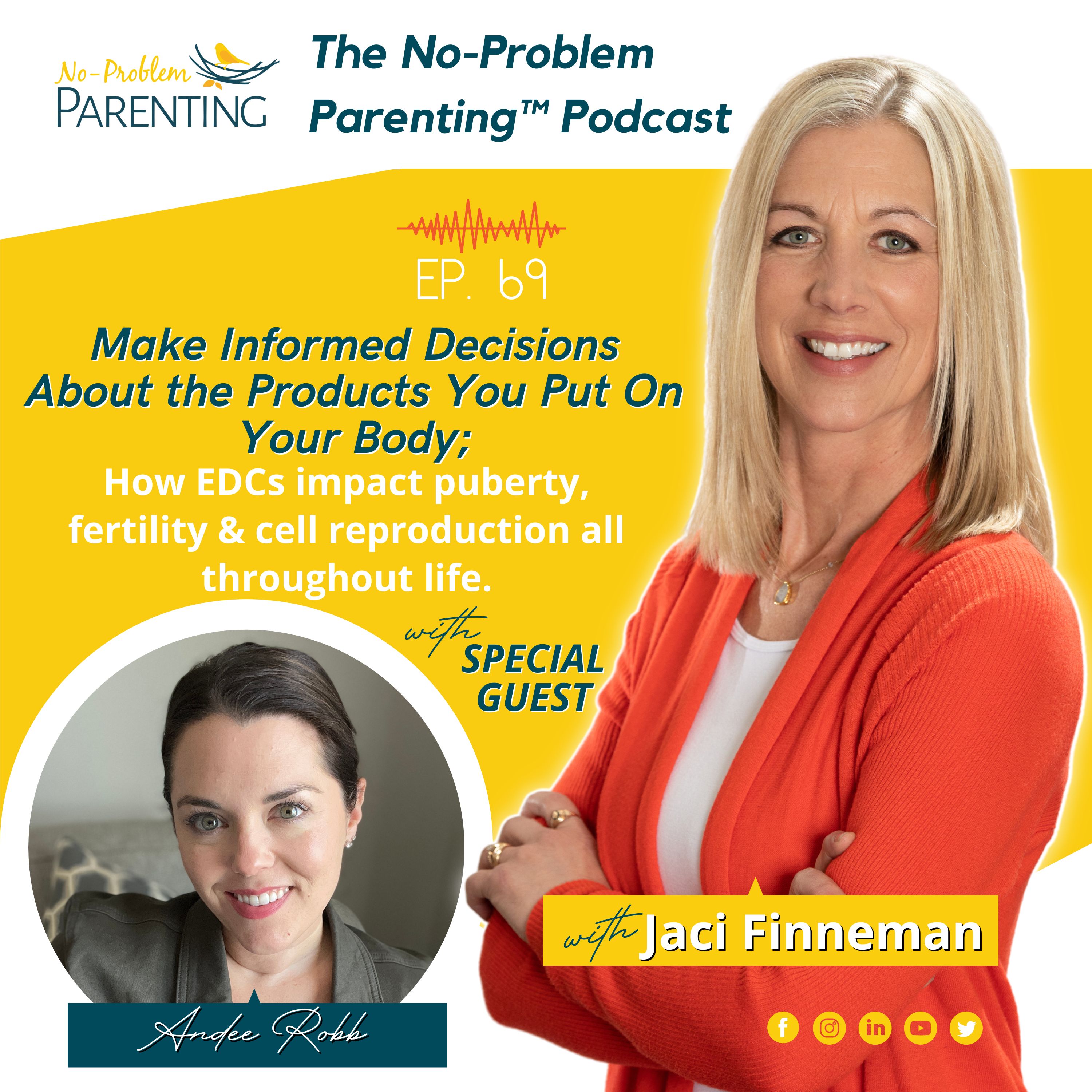
Make Informed Decisions About the Products You Put On Your Body; How EDCs impact puberty, fertility & cell reproduction all throughout life with Special Guest Andee Robb
About this episode
Welcome Back No-Problem Parents!
It can be exhausting and frustrating trying to find toxin-free, safe products like sunscreen, deodorant, cleaning products, and laundry detergents that are safe for our kids and family.
As parents, we want the best for our kids and we prefer to buy organic or toxin-free foods and products but it can be expensive and labels are sometimes misleading.
Today's guest shares;
How endocrine disrupting chemicals (EDCs) impact puberty, fertility and cell reproduction all throughout life
Ways to have comfortable and honest conversations with your children about personal hygiene (and what products to use / avoid based up on their impact to human health)
How today's beauty standards affect the mental health of young adults and,
Third-party resources and tools you can use to make informed decisions about the products you put on your body and use in your home.
Become a No Problem Parent Today!
Full transcript
Hello, No Problem Parents. Hey, I got to tell you, today's episode is a bit longer than normal. And actually, I was going to make it into a two-part episode, but I decided to just kind of merge the conversation together. The two conversations that I had with my special guest today were talking about how to provide safer, cleaner products, how to bring safer and cleaner products into our home.
And my special guest today is Andy Robb. Andy is a senior level executive at Jones Lang LaSalle with nearly 20 years of corporate real estate experience. Based in the Twin Cities, Andy's an advisor to national retailers across the U.S. and Canada.
Chances are, if you filled a prescription, gotten your hair cut, bought gym shoes, ordered a frappuccino, or eaten a giant burrito, then you've met some of Andy's top clients. Her career began in the professional salon industry at the corporate level, and after the Safer Salon Bill was passed in 2018, Andi became a brand advocate with a Santa Monica-based retailer called Beauty Counter. Since then, she has educated hundreds of families on the health impacts of exposure to harmful ingredients in their personal care products and their home environments.
In April of 2022, just this year, Andi represented the state of Minnesota during Beauty Counter's National Lobbying Day in Washington, D.C., where she brought several pieces of legislation before Congress that would place more health protective laws over the personal care industry. Andi's originally from Duluth, Minnesota, where she met her husband, and together they are frazzled and exhausted parents of two tweenage girls.
And I mean, seriously, this woman is a wealth of information, determination, and inspiration. So I'm so excited to have her joining us today. Put your earbuds in, go for a nice long walk, and enjoy this episode. Make sure you check out the show notes for all the links to the resources that Andy's going to share with us today.
Welcome to the No Problem Parenting Podcast. Turn behavior problems into no problem with Jackie Fineman. Are you ready to become the confident leader your kids crave you to be? Do you want to learn how to make parenting easier and more fulfilling?
Whether you are at your wits end or you want to have more fun as a parent, you're definitely in the right place. Now here's your host, Jackie Fineman. Welcome to the show, Andy. I'm super excited to have you here to talk today about how to have comfortable and honest conversations with our kiddos about personal hygiene and their health. So thanks for being here. Thanks for having me, Jackie. I'm excited. Before we get into too much, I do have to ask the question that maybe after reading your bio, others are thinking you've worked in the commercial real estate industry. How many years now? Almost 20 years, almost 20 years. And so what made you take this like sharp left and begin advocacy work with Beauty Counter? So I work, this is a great story.
And this is why I tell this story all the time. So in my twenties, my first job out of college, I had the absolute dream job of working for the largest hair salon operator in the world at that time. It was headquartered here in Minnesota, and I would have the time of my life getting to test and try brand new hair products. I would get my hair styled by the Paul Mitchell staff, the Redken team. It was a dream, dream job. And so I worked as an in-house retailer for 11 years and I got to see the insides and the outsides of the beauty industry. And it wasn't until I learned in 2018 about the safer salon bill that was passed that I learned about how virtually unregulated the beauty industry is. And once I learned about that, I couldn't unknow what I had learned. And that's how I took a sharp left and began this advocacy work with Beauty Counter.
So just to explain a little bit more about what virtually unregulated means, because I think it's good for us to set the scope and where we sit in comparison to the rest of the world. In the United Kingdom or in the EU, I should say, there is a list of over 1400 chemicals that they have deemed harmful or unsafe for human use. And when we say the word chemical, that means an ingredient that could be synthetic or natural. Chemical is something, water is a chemical, okay? So we have to be really careful. Water is not harmful. But the EU has 1400 ingredients that they will never allow to be sold for human use. In Canada, they restrict 600 ingredients that are not safe for human use and the United States only restricts 30, three zero, right? So that is how,
when I worked in house with a salon operator, where we created our own proprietary formulas, I saw that we had to create three separate formulas for shampoo, one for the U S one for Canada and one for the EU. And that is simply because the regular, we are so, so far behind in our regulations and safety regulations in the personal care product industry, there hasn't been a major law passed since 1938 that says what can go into our bubble bath, our deodorant, our sunscreen, or shave gel. So those are things that take a long time, a long time to change. And decades and decades of research have proven that ongoing exposure to some of these ingredients that we'll talk about in a little bit have long lasting health impacts.
And so, like I said, I needed to be part of the solution after what I felt may have been part of the problem. So we're talking about the Food, Drug and Cosmetic Act of 1938. There's currently 85,000 chemicals that go into personal care products. So you know that those were not the same 85,000 ingredients that they were talking about.
States like California and Florida are leading the efforts to create safer products and to prohibit ingredients like mercury and lead from going into personal care products. Lead is just something that you know you can't put that on the walls in your house. In 1978, this is where my real estate background comes in, in 1978, we banned lead from household paints, but it's still used as a pigmentation in color cosmetics today.
Had no idea. Had no idea. So just this last April, you represented the state of Minnesota during Beauty Counter's National Lobbying Day in Washington. So what kinds of legislature did you bring or put before Congress that would place more health protective laws over the personal care industry?
So that's a great question. So every two years or every other year, we are asked, we are asked by Congress to come out and educate Congress, their staff, help them get up to date and up to speed on the current pieces of legislator that are put before them. So when we went out there, we had a package of over eight pieces of legislation that needed to be brought forth under the safer beauty package. Really the first and foremost, what we were asking was for complete cosmetic reform and overhaul.
And what you need to do is break that down into separate packages. And how do you get that forward as you find a co-sponsor? So there are the representatives from the state of Illinois have initially sponsored co-sponsored acts like the Cosmetic Fragrance and Flavor Ingredient Right to Know Act. I'm not just talking about lipstick here. I'm talking about what are the ingredients that go into your kids' sports drinks and soft drinks. Those are all flavors that are artificial, just like artificial fragrances. So the Toxic Free Beauty Act was another bill that we were talking about. We were talking about, and I talked about this a little bit earlier with you, Jackie, the Cosmetic Safety for Community of Colors and Professional Salon Workers Act. I'm naming all of these pieces of legislature, which might go in and out of your ear. But the truth is that it only takes 200 phone calls or emails to your state and local representatives before they have to take this issue forward and consider it. So it's important that as advocates or even as constituents of our states, we are making those asks of our congressmen and our state representatives. Otherwise, it's not really their fiduciary responsibility to take them seriously and consider them.
So what that lobbying day looked like was there was over 200 representatives and one or two, up to four from each state who would go out there. I met directly with our state senators' offices. I met with the senators' offices from Wisconsin, Michigan, and Illinois as well. We would go through and we would have a very clear discussion of what we needed the support on. And again, And some of them knew these bills.
They were actually stalled in the House and needed to move forward in the Senate. So that's what's fascinating about this is that this is a bipartisan issue. This is about human health and safety. It's not a political issue whatsoever.
It's just about helping make our collective voices louder so that they get the backing to bring these issues forward and hopefully pass them. Over the last nine years, Beauty Counter has helped pass over 10 health protective laws. So that means that we are being heard. Our voices are being heard, but we are only 50,000 strong.
And that's why we say Beauty Counter's mission is to bring safer products into the hands of everyone. It is not to bring Beauty Counter products into the hands of everyone. It's to make an equal playing field so that all products are clean and all products are safe. You look at rural America and they probably have one big box store.
They're shopping from Amazon. They do not have access to safer products because products need to be made inexpensively and they need to be made in mass, mass quantities. And so until federal law changes, that bar can't be brought down to offer equity to all communities and all populations. And so that is why we start at the federal level.
So the state of California has a huge vested interest, certainly the coastal states. We talk a lot about the harmful effects on human health, but aquatic health is also a very, very big concern. When we look at the coral reefs, if you follow the news about sunscreen in the last year, there have been many, many brands who have had to stop making certain formulas that contain oxybenzone. So benzone is a derivative of petroleum.
It is not only harmful to humans, but it's harmful to aquatic life. And so everyone who goes out for spring break in Florida and California, especially even in Hawaii, those products are rolling right off their bodies and into the oceans and they're killing the coral reefs. And you might say, well, I don't have coral reefs in my backyard. Why do I, you know, why do I need to worry about that?
But again, we are a conscious consumer and we're looking at how the effects of the oceans impact our daily life on a day-to-day basis. And so if it's not safe for the fish, it's not safe for me. It's the same thing that I say about personal care products. As a mom, I'm a mom of two tween girls and when I was pregnant with them, you know, we always talk about this.
I wasn't eating hot dogs. I was switching out my skincare. I was using different products on me for the first time because I was worried about my baby. I wasn't thinking about me.
I was thinking about how this would affect my child. And then as soon as those kiddos were born, I went right back to my old habits. And so we think about that, how would we talk about endocrine disrupting chemicals? That's a subject that I'm very, very passionate about, especially as I think about my teen and tween daughters.
Adolescence is such a huge entry point for personal care products. The average teen uses between 16 to 18 personal care products every single day. And a lot of those products are, think about girls specifically, they are targeted not just for beauty and aesthetic, but for fragrance. So fragrance has a very, very, I mean, think about all the olfactory senses and everything that's tied into your self-esteem and wellbeing based upon how you smell. So fragrance is a loophole ingredient. Fragrance, if I want to talk about my days in the beauty industry, it's a trade secret. It is simply a label. You never have to disclose to the FDA what is inside your fragrance recipe, so to speak.
it's kind of like the Coca-Cola secret. Okay. So even if a product says it's, you know, a dermatologist recommended it's vegan, it's leaping bunny certified, et cetera, et cetera, but it has the word fragrance or perfume in it. That is kind of your red flag word to say, okay, I need to dive a little bit deeper. So getting back to the word fragrance, that is always the one thing that I ask my mom friends to look for. Um, because especially, like I said, that entry pointing to adolescence, kids are just absolutely using anything and everything. They're trying things for the first time. And there's such a period of rapid growth, especially in brain development during the ages between 14, all the way up to 25. So we're not out of the woods yet.
Once we get into those, those, you know, college years, all the way up to 25, you're looking all of that rapid, rapid development. So exposure to phthalates, exposure to, to parabens, to triclosan or musk, as I was saying, that's inside of a fragrance product. All of those are endocrine disruptors, which are throwing off all of your body hormones as you grow up all the way, you know, from adolescence through puberty, all the way through your fertility years and menopause.
So as women, especially, we want to make sure that we are not using ingredients or products with those ingredients in it. And we have to be that educated consumer. And if we're not, we need to rely on more health protective laws in the personal care industry to do that work for us. it's frustrating to me that this is not regulated. And I'm so grateful that I met you and was introduced to you so that I could learn more about this. There's actually an app that helps.
And I know we're going to, we're going to talk about that a little bit later in the, in the episode, but the impact on puberty and fertility and cell reproduction all the way through life, really. And it does start in those teenage years when kids are like wanting to smell good when they go to school, right? They're starting to use deodorant. So how do we teach our kids and have those conversations with them about personal hygiene specific to what products to use or which ones to avoid and why that matters. A Berkeley study in 2019 actually went through this, this process with 20 teenage girls by absolutely reducing and eliminating exposure to parabens, phthalates, triclosan for just three days, the level of endocrine disrupting chemicals in their body dropped anywhere between 25 to 45%. So I'm telling you that to say that there is a direct correlation and evidence has shown this, right? Evidence has shown that there's a direct correlation.
So by making small changes every day, it becomes more of a sustainable habit. And so that's the one thing I say, especially with teens and tweens, they are going to see everything on YouTube and Instagram and Snapchat of what they want to try, it doesn't mean everything's bad, right? We live by the 80-20 rule as parents. We want to do our best, but we need to let them explore and feel independent. So you had mentioned an app, and this is more for parents. I don't know if kids love this app as much as I do, but there's a great third-party resource called the Environmental Working Group. The Environmental Working Group has a database called the Skin Deep Database that actually scores and tests the safety rating for humans of personal care products and cleaning products. They have a fabulous sunscreen directory as well, but this is something that is not a web crawler. Brands have to submit and be transparent. So brands have to submit their ingredient list to the environmental working group so they can conduct their own tests. So we always say the gold seal is EWG verified, but if you download this app, you can go to EWG.org slash skin deep,
all one word. If you're in your favorite app store, it's called the healthy living app. So if you go into this app, you can scan barcodes, you can search for the products that you're currently using every day, and it will give you safety rating one through 10. So we look at that and we say it's a guideline. It is not the golden rule. It is a guideline. And if you can give your kids a guideline, they're more likely to follow it. So one through three, good for me, three or more, it's out the door is what we say in our house. Okay. So that's a good golden rule for your family or for your kids as well. But getting back to how do we talk to them about this? I think the last thing that any kid wants to hear is that, oh, I'm worried about you. If you do this,
than that. If you use this, you will get sick. That is not what anybody is saying. What we are saying is that you can make safer choices every single day and here's how. So I like to just keep it simple and keep it science-based. I have probably heard the stat before that we all scroll the length of the Statue of Liberty every day in social media. So the next generation is growing up with that three second attention span.
If something doesn't catch them within those three seconds, they're scrolling on to the next thing. So when your kids ask you a question, they want the quick soundbite and they wanna move on. Okay, so I always use the example, you probably do this, had this happen to you in your house, deodorant. Okay, let's talk about the deodorant debate.
Kids go through that stinky phase where their bodies are changing, their hormones are not balanced. Um, and all of a sudden they're the stinky kid in class and they're aware of it and they know, okay, so how do we normalize sweat? You know, that is a great, that is a great example. We don't walk up to our kids and say, ew, you smell. Yeah. Right. Their friends do, but they don't, they don't. Right. So I always keep it simple and fact-based. And even if you're shopping and you're in your shop, say you're shopping together in your favorite big box store and you're walking down the aisle and you're, you're trying to say, okay, I don't want to look for fragrance. I don't want to look for parabens. Don't go into the ingredients. Start with the explanation of a deodorant versus an antiperspirant. Keep it very simple. A deodorant is there to neutralize odor and to allow your body to sweat. An antiperspirant stops you from sweating, clogs your pores,
and prevents you from that natural toxin and virus expulsion from your body. Sweat is not bad. Your body needs to sweat. Sweat is clear. Sweat is not actually yellow. It's when you have that sticky paste under your arms that it creates that bacteria and that residue. So I say, again, you can have a really helpful, easy conversation and guide them down a path of safer ingredients and safer products just by keeping it very factual and do not overwhelm them with information.
Well, and I'm thinking, I would think that kids actually would like the app. I think it's super easy. And I think, again, it's, it shows independence. And I say, this is that you might see this too. I say target is the new mall. So when I grew up, he would go, he would go and you go walk around the mall and you go to movie and you know, you'd go to the Mr. Bulky candy store or whatever. Um, but now it's, they're getting the Starbucks and they're shopping through target. And I think, again, you put that app in their hands and on their smartphone and they're able to take whatever they're in is in their hands and score it. And it leaves no room for negotiation or questioning. They can just move on to the next product.
Yeah. I think it's great. I've, I've used it several times since you clued me in on it and some of the products that I thought were safe or that I thought were okay, we're scoring, you know, four or five, six on the scale. So yeah, let's get in a little bit deeper with these or a little more tangible with the endocrine disrupting chemicals.
So endocrine disrupting chemicals are chemicals that are in everyday products. Traditionally, they're oftentimes a preservative, a synthetic preservative that's put in a product, any product that is liquid based, be it a lotion, be it a shampoo, be it a soap, you must put some type of preservative in it to prevent mold and bacteria from growing. So with the best of intentions, the best or the most common example that you might know of or hear of is the word paraben. So a paraben is a class of preservatives that are commonly used to prevent the growth of mold and bacteria simply put, but they are endocrine disruptors. And what we mean by that is that it can actually alter the important hormones in our bodies. And specifically for women,
it will mimic estrogen. So when we think about estrogen, we think about estrogen as kind of being a lock and key. There are two components that make up estrogen and a paraben will come in and synthetically act like that other key component, telling your body you're either making too much estrogen or not enough estrogen. So for women, especially, but for men as well, you want to make sure that you avoid parabens all throughout your development and life cycle so that you do not interfere with puberty, fertility, menopause, et cetera. So where are we most commonly finding parabens? Because you're going to see it as a buzzword and a marketing word. This is when we talk about greenwashing. That's another industry term. You can market paraben-free, phthalate-free, everything free until you're blue in the face, but you have to also back it up on your ingredient label. So where are you going to find parabens? Let's talk about something that a product that everyone uses every single day, deodorant. So whether you use an antiperspirant or deodorant, everybody sweats. Your body must sweat. You need to sweat. That is how your body gets rid of all of the toxins and viruses in your body inside and out. So your lymph nodes, your underarms are the largest lymph nodes in your body. So every day when you're applying antiperspirant or deodorant, you are directly having access to your endocrine system. So you
want to look for in your deodorant, I'll give you a couple of ingredients to look for in addition to parabens. So not only are parabens, are they linked to early puberty in children or increased risk of hormonal cancers. Parabens are also linked to birth defects and organ toxicity. So a whole list of things, and this is what we referenced earlier, the EWG Healthy Living app will help you identify parabens first and foremost, like a big red flag. So there's no question. Usually that word starts with methyl or ethyl followed by the word paraben. So other ingredients in your deodorant that you want to look out for, I had mentioned are phthalates. Phthalates are a plasticizer. Phthalates are often found in perfumes. All it is is something that is going to make one thing stick to another. So your deodorant, how does it stick to your arms? It uses phthalates.
That again, a phthalate is going to be another ingredient that will increase the likelihood of cell mutation. So what does cell mutation do? Again, that is linked to accelerated growth of lesions, tumors, any type of overgrowth of cell in your body can be impacted by phthalates. So again, these are ingredients that are commonly used every single day. You're not going to see the word phthalate on your label. You're going to see the abbreviations in these letters, so you can write them down if you want, but you're going to see things called DBP, DEHP, and DEP. Those are just letters strung together that mean phthalate. But again, this is how the conscious consumer has to educate themselves to look for those keywords. I'll switch over to, let's talk about aluminum for one second, because I feel like aluminum gets a bad rap when we talk about antiperspirants versus deodorants. So I think it's important to set the stage and help everyone understand that if you are considering making a switch from antiperspirant to deodorant, here is what you're going to get,
here's what you're not going to get. So an antiperspirant prevents your body from sweating. Simply put, that's its purpose. It will use a paste or a material that will clog the pores and clog your sweat glands so that you do not secrete sweat.
So anyone who likes to stay dry and fresh all day long, you're going for an antiperspirant. Makes sense. A deodorant is there to deodorize the odor under your arms. Now, what a deodorant does not do, it does not plug your glands.
It allows your body to freely sweat out the toxins and viruses in your body. Now, the important differentiator is that what an antiperspirant uses is aluminum salts. So aluminum salts are not actually aluminum. Aluminum is one of the most common chemicals found in the ground in the earth.
So it's not actually aluminum, but it's aluminum salts. And those aluminum salts mimic parabens, which mimic estrogen. So when we think about applying aluminum salt product to your underarms, for women specifically, right near the breast tissue, this is where we are seeing cells multiply, divide, and how we have found that there have been links from aluminum salts to breast cancer. So there is no direct correlation between using antiperspirant and breast cancer. I want to make that very, very clear, but there are direct links to aluminum salts resulting in cell mutation and accelerated growth of lesions and tumors.
So that is a whole lot of science about deodorant, but I'm sharing this because parents can have that conversation with their kids and say, this is a product you use every single day. And by making just small, tiny changes throughout your life, you are going to see long lasting benefits. Thanks for clearing that up because I've heard that a lot. Like there's aluminum in deodorant and that's not really, that's not the full story.
It's not actually aluminum. Yeah. The marketing spin will say this is aluminum free. Great.
That is a great first step. Now the loophole in that is the word fragrance. So if you have the word fragrance or perfume, that is a loophole word. It is just a label. It actually doesn't mean anything. Fragrance is a cocktail of up to 4,000 chemicals that never have to be disclosed to the FDA. So the reason why you want to search for a deodorant, so say you're going down the clean path and you're saying, I'm going to switch from an antiperspirant to a deodorant, and you find a deodorant that you know and love on that back of that label, if it says fragrance or parfum, that is something that again is, there could be dozens and dozens of ingredients. There could be the phthalates, there could be the aluminum salts, there could be all of the things that we just spoke about tucked inside of that label. So a truly, truly clean and transparent brand will list the essential oils or the natural, the natural scents that are included to make their products smell nice. So this is important. Sweat is not yellow. So I think a lot of times we won't,
we want the antiperspirant because we don't want to sweat. We don't want wet pit stains, right on our clothes or whatever. We don't want sweat running down our, you know, sides during a meeting, a meeting that we might be stressed out to have or something. But so we're thinking that the antiperspirant, we want that so that it can stop us from sweating. But, and also we don't want those sweat stains, which often like turn yellow. Right. And then we have stains on our clothes and we're trying to get those out. But you said you shared, I did not sweat.
Sweat is clear. The body that your body produces a clear liquid, which is what makes the human body so amazing. It produces a clear liquid that is taking everything out of your body that you don't need. Your liver does a great job of doing that as well, but really truly your sweat glands are working overtime 24 seven to do that for you. It is a clear liquid. So the reason why it turns yellow is because you've applied a paste or other products that have now trapped that moisture and have now allowed that bacteria to grow underneath your arms. It sounds really gross. We're talking about armpits, so let's just go for it. But that is why it turns. That is why your shirts turn yellow is because it's the, it's the bacteria from the moisture that is stuck under your arms.
So truly clean sweat, not only is it clear, but it dries extremely fast. So you actually might feel dampness under your arms, but it's for a very short amount of time. And that is part of that detox process that we talked about. If you are switching from an antiperspirant to a deodorant, it might take a few weeks for your body to actually shed the years and years of aluminum salts and parabens that you've been applying since you were a teen or since you were a tween.
It takes time, but stick with it. you will notice over time, not only are you not sweating from your back and you're under, you know, all over the place on your body, but that you will notice that your shirts are not yellow. Um, and there is no stigma around it. I think that's one thing that, you know, our kids are concerned about is I don't want to be the sweaty kid, or I don't want to have those stains on me.
If I wear a crunchy, clean, natural deodorant, you just need to get through that detox period. And so for example, my teens and tweens, they've never used an antiperspirant. They've started out with a deodorant since day one. Um, and so they've never had that shame or that embarrassment of, of like, what if I stink or what if this shows up and what if this looks this way?
So start your kids out, you know, with something clean. If they make that choice for themselves when they're in high school or college to switch to something else, that's fine. But you've at least given them the building blocks and you've shown and shared with them the potential effects that they can avoid by choosing a deodorant over an antiperspirant. And beauty counter has a line of antiperspirant or not deodorants, a line of deodorants. I'm going to see it's even hard to, it is hard. It is hard. Yep. So it's called the clean Dio and the clean Dio is one of a kind in the sense that there are many clean deodorants on the market and clean has almost become a dirty word. Um, this is a safer Dio that not only is safe for parents, teens, tweens, men, and women,
but it is also recyclable and refillable. So what makes us a really, really great story is it's not only good for your body, but it's good for the earth. And instead of ordering a new product or a new case, every time that you run out, which probably is once every four months, you're ordering a simple refill. And we're actually reducing our carbon footprint by 47% as a brand by using a refillable insert rather than a one-time use plastic. So everything with Beauty Counter comes with a story and is part of our mission of reducing our carbon footprint. We are well on our way to being carbon neutral in 2030. And we will be compostable, refillable or recyclable by 2025. That's amazing. So wait a minute, four months for a deodorant. It see, this is the other beauty part of it without, without synthetic fillers or any of those other artificial ingredients that are there to boost a product up. Think of like a bag of popcorn when you buy it on the shelf and at the store, half of it, 80% of it is air, right? That's kind of what you're getting in your average everyday products because of the artificial synthetics that are in there. So when you have a truly clean product with ingredients that are long lasting, you need one swipe of DO and that is it, Jackie. We are all trained just like lipstick and lip gloss.
We're trained to go over and over and over on our underarms and you really don't need that. It's one swipe to deodorize your underarms and it lasts. I say the clinical claim is eight hours. I say it's a full 12, if not longer. If you're filling it, say four or five times a year, max, I guarantee you, you probably purchased 10 or 12 DOs of your natural, you know, or an antiperspirant, um, just for this one product. So that is so cool. All right, let's segue. We've talked a little bit about fragrance. Is there any more we need to know about that? We talked about fragrance as being a loophole. There's not really anything more that I want people to know other than just, if you see fragrance, please investigate further. Um, the other thing that I think we should talk about, we've talked a lot about cancers. We've talked, we've touched a little bit about endocrine disruption. Let's talk a little bit about allergens because at this time of year, allergens,
you know, everyone's got these allergy symptoms and maybe they're seasonal, but maybe you experience them year round. Allergens are actually very, the, the allergens are actually starting inside of your home long before spring and summer come. So you want to take a look. There's a couple ingredients that I want to talk about. Something that everyone uses every single day, especially during these last two and a half years is going to be hand soap and laundry detergent. So the main ingredients that you want to look out for on your hand soap or laundry detergent is sodium lauryl sulfate or sodium lauryl sulfate. We call that SLS or SLES. And all those ingredients are our surfactants. They make the bubbles, right? We want to see our hands sudsy and foamy. That's how we know that's our visual cue that we are clean is because we see bubbles, right? So actually what those can do is they can truly, truly cause skin irritation and trigger allergies. You are going to see that not only is it never, it's not going to say, you know, sodium lauryl sulfate, watch out,
this is an allergen. You're going to actually find another ingredient that's linked with it, which is actually 1,4-dioxane, dioxane. And I will help you spell this out. We'll link it before I'll put a, I'll put a never list ingredient fact sheet on your page for you as well.
But 1,4-Dioxane is another ingredient that is going to be paired with SLS to create these wonderful, wonderful bubbles. And this is again, something that is intended to make your clothing soft and to coat your clothing, to make it more, I don't know, squishy, lovable, all of those things. But what it truly is, is it's an allergen trigger. And so we think about how we wash our kids' clothing in laundry soap every day, or when they come home from the hospital, we are given this white bottle with a pink cap from the labor and delivery room. And they say, take this home. And not only is it filled with fragrance, but it's also made with SLS. And you're putting that right on your baby from day one. And you're wondering why they have these red rashes on their skin, or you wonder why as they're three and four and five years old, they always have the watery eyes and we can't figure it out. It's because the clothes that we have washed that we've taken out that smell clean are actually what is on their body all day and triggering this for them. So especially in my family, not only have we noticed that by removing allergics, excuse me, by removing fragrance and SLS from our laundry soaps,
it also has reduced and almost stopped the migraines that my husband and my daughter experience. Really? Yes. And so that's the thing too. It's just, you have to try one thing at a time, one clean swap at a time. And sometimes we unintended consequences happen. It's just part of our environment. I grew up using the most beautifully scented blue laundry detergent that we all know and love. But I couldn't use it once I got married because my husband had suffered from chronic migraines. Well, all of us experienced the benefits of clear head, clear nose, clear eyes by not using that product. And it's just, again, doesn't mean that it's bad. It doesn't mean that it doesn't do its job. It does a great job of doing what it does, but my body reacts differently. My child's body reacts differently. My husband's body reacts differently.
So is it in the app that we can find suggestions for what kind of detergent to use or do you have some suggestions for us or how do we do that? Oh, absolutely. I'm guessing beauty counter isn't doing detergent yet, right? You don't do all of the, and that's the whole thing. Again, our mission is to get safer products into the hands of everyone, which is why I love talking about hand soap and laundry detergent. We do not offer a laundry detergent, but there are so many clean brands out there that I highly recommend. Molly's suds, um, is my favorite, favorite brand to recommend. Um, it comes in a powder formula with an oxygen whitener. So you can ditch bleach once and for all, and you can use an oxygen whitener. Um, they also have a liquid sport watch wash, which gets through all of our karate clothes and make sure that they are ready for the next match. Um, so Molly says is a great one. Also seventh generation, seventh generation,
which you can find at target is also a B corp like beauty counter. Um, they offer a variety of products, but they do offer easy dose laundry detergent, which is EWG verified and meets all of the health and safety standards. It does not include SLS or fragrance or any optical whiteners. And I can imagine that these, all these different allergens will help help with the kiddos who I've asthma or people who have asthma in general? People who have asthma. And again, you just think of what you're putting, if you're putting a shirt over your head and you're breathing in from your chest every single day, something that is going to trigger those allergens, you're, you're going to, you're going to go to every doc in town. You're going to have every test run,
but start by changing your laundry detergent to see if that helps. I just honestly apply the same logic, look for the F word. And I always say that with my kids, look for the F word and that's it. Look for fragrance.
And truly you will find we, you can, again, I use the word greenwashing or green sheen marketing is a, is a great and amazing thing, especially when it comes to self-esteem and how we deem ourselves to be clean and beautiful. And so we'll make sure that if you are looking at a brand that says we are, you know, vegan and we are paraben free and we are all of these things, just look for the fragrance label on the back.
I guarantee you, and you might know me a little bit by now and know that if I see that word on a brand that is claiming to be clean, and I will get on the phone or I will email them. Everyone has every clean brand wants to be contacted. Let me tell you that. If you're truly clean, you're truly transparent, you want to be contacted. Go to their website, click the contact us link, and just simply ask them what is in your fragrance formulation.
I have allergies. I have sensitivities. I just want to make sure that what I'm using is safe and a clean brilliant brand will respond right back to you and tell you exactly what is in their fragrance label because they're proud of it, right? They're proud of it. Some of them just say, Hey, I want to save space on the label. And here you go. This is what's inside of it. Um, I use a brand of hand soap called puracy, um, also founded at target and you will see fragrance founded, found at target. You will see fragrance on their label, but I hopped right onto their chat. And I asked the question, they got back to me instantaneously and said, yes, this is grapeseed oil. This is lemon oil. This is what's in there. We simply wanted to save space. Um, this is what our fragrance formula is. So I have no problem with that. Yeah. So that's interesting. So it,
just because it says fragrance doesn't mean don't use it. It means chicken. It doesn't mean it just means to look into it. Okay. I misunderstood that. Cause I was thinking it was like, if it says fragrance digit, don't even use it. So, and it's also food, right? It food as well. Yep. And so again, Jackie, when we're talking about safe, we're looking for safer. And I think that's the biggest part of this is that, you know, we are growing up in a generation where we have access to information that was not available when we were growing up. It doesn't mean that our parents didn't know or did the wrong thing. They just didn't know any better. And so now that we have access to resources that will help guide us, we should follow them or we should explore it. Right.
And so it scores food as well. So talking about food additives, talking about, you know, there's, I think go back 10 years ago. And there was a thought and a worry and a concern about artificial dyes because there was ideas and hypotheses about what it could cause. A decade later, we know exactly the impacts of artificial flavoring and artificial colorants. And there are so many brands out there who are making delicious, wonderful foods for kids that are not crunchy and green. And, and there's, you know, but we're, but what happened in the food, the FDA, let's pause right there. The FDA has far more regulation over the food portion of the food and drug industry, much less in the cosmetic industry. And again, be very clear that cosmetic means sunscreen, deodorant, shampoo, conditioner, shaving cream. It doesn't, I'm not just talking about lipstick. So while they can say, Hey, there is this ingredient, there is this artificial red dye or this artificial blue dye that is directly linked to hormone disruption or cognitive dysfunction, they can restrict that and they can put those warning labels on the products.
They cannot do that on the personal care side. In fact, the FDA has no pre-market approval of the personal care products that go on the shelves every day. They have to actually have a product report harm or illness for them to investigate. And at that point, they can recommend that a manufacturer recall it, but they cannot actually recall the product themselves.
So again, getting back to just being a conscious consumer, knowing what to look for, looking for made safe seals, looking for EWG verified products. There are a lot of certifications out there that'll help guide you. You just need to know what to look for. to look for, right? So there's the physical repercussions of a lot of these chemicals and that we're putting in our system unknowingly oftentimes. There's also the mental health side of it. And so how does today's beauty standards affect the mental health of young adults? So what we have seen and what we know, let's talk about social media platforms. Social media platforms create, we've talked about this before, an imposter syndrome where you will,
you will, we curate what we want to see on social media. So if we want to see beautiful, aspirational women and moms and happy lives and all of that, we will create that because that's what social media is. It's our escape and it's where we go to unplug from the real world. But the consequence and the reverberation and teens and tweens is that that is what their new aesthetic is and what they expect that they themselves should look like. So instantly they are told if I don't, it doesn't have to be the biggest beauty influencer out there, but I don't look like what I am consuming every day in social media. And therefore I am less, therefore I do not meet the standards, but they're doing it themselves. It's this whole cycle of how, what they consume on social is then what they believe. So again, how is it affecting the mental health? It's creating a really unparalleled standard that we've never seen before in adolescence, this belief and perception that you must achieve the highest beauty standard out there through all these artificial means. I'm really encouraged. I will just say, I'm really encouraged to see this no makeup makeup trend sticking around because I will say as a beauty enthusiast, it takes a lot of makeup to have a no makeup makeup look. But for our teens and tweens who are growing up,
they're seeing true natural beauty for the first time in a very, very long time. And I really hope that that sticks around and that stays, it just allows us as parents to have a more thoughtful conversation with them about how they should strive for whole body health and not just physical health. Right. Absolutely. So you've said that decades of research have directly linked illnesses such as infertility, certain cancers and asthma back to environmental exposure to toxins. So are there any studies on how today's world of Instagram filters and, you know, high beauty standards affect the mental health of teens and tweens? So a great resource that I have been looking through and that you can find is the Child Mind Institute. There is incredible tomes of information out there that are reached, that are actually saying that we, especially as we go as young as preschoolers, they're picking up new social and cognitive skills at a stunning pace. So we go back to how I use the example of my, my children. I was the, I was that mom of no screen time until you're two years old, because that's what my pediatrician told me. Well, fast forward to preschool and, um, and kindergarten and an iPad was placed in their hands and it was a requirement for their schoolwork. So we really can't control what they consume, but we need to know how quickly they are, that they are picking it up. So we see, you know, again, how a three-year-old playing with
their dad's iPhone is actually informing those ways, informing those ideas of how they should perceive anxiety and teenage life and all of that at a very, very young age, as young as three years old. So part of this is saying, how does it affect mental health? It started long ago. It started long ago and probably earlier than you think. It's growing. Indirect communication is probably one of the other skills that is not just a mental health skill, but it's really lacking. So the ability to actually communicate verbally and face-to-face as we know is lost, but how does that affect mental health? You have a lot of teens and tweens who are shy is not a bad thing. Shy is not a bad thing, but it's also not giving them the confidence that they once had to have face-to-face communication interaction because they're just not, they're not required to have it in today's world. So a lot of this, as you say, what does mental health look like? It's about the confidence piece. It's about how do they grow into young adults who are able to communicate if they feel like they cannot look someone in the eye because they never had to. That's not their fault. It's just, we have to help them grow into young adults and young men and women who can communicate verbally and have more confident conversations other than what they've been used to in their whole life. You'll go through, and like I said, I had mentioned the Child Mind Institute. The Big Disconnect is another
resource that I love, Catherine Steiner Adair. She is a clinical psychologist and she wrote a really great piece about social skills and basically talking about how we have disabled non-verbal context with our kids. And all of a sudden we, as parents need to jumpstart that a little bit. We need to help them. Being the parent of teens, right? It feel, it can feel like a tug of war. Like you're, there's a lot of no mom, no, no mom. What are some of your best suggestions for talking to our young adults as they approach puberty and need to begin learning about their personal hygiene habits? So you have an athlete in your family. They go to practice three days a week.
They probably drink a lot of water while they're at practice. They probably drink a lot of water while they're playing their game. They probably stretch before and after. We take a lot of care of our body as athletes to grow muscles and to treat our body that way. But you think about the foods that you eat when you're training to be an athlete, or when you're a young adult, you carb load, you do all of those things. So we, we think about that as an athlete that as young athletes that we are training for something very, very important. What we often forget about is that our skin is the largest organ of our bodies. That is that shield and the vessel for all of your organs inside your lungs that are training so hard for that game, your gut health,
everything, this is your shield. And so you need to actually place that equal focus on top of that as well. So again, go back to sunscreen. If your kid's out there this summer and they're playing soccer every single day and they're not wearing sunscreen, let's talk about what that could mean for them. Probably not the immediate sunburn that they're, that they're going to see and feel for the next few days. It's about 10 years from now and 20 years from now, when actually they start seeing the melanin in their skin change, because that has actually had, it takes about 10 years to see those lesions grow in your body after that sun exposure happens. So those are things that they're not thinking about. And that's kind of where I was going back to how do we have these conversations? They're not thinking about what happens today. If I'm exposed to parabens that mimic estrogen and tell my body to stop producing estrogen because it already has enough. They're not thinking about that now, but the effects of endocrine disruption, that is actually transgenerational. So if you come to your kid and you'd say, this could affect my grandchildren,
stop using this. They're going to tune it out. So how do you talk to your teens? I take social cues from them all the time. If they, if I catch them watching something on YouTube, or if I see them making a funny face and I see that they have questions about it, I do, I ask that question. I just truly say, do you have any questions about that? Are you worried about something? I always start and open it up with a question and they probably giggle is probably the first, the first part of it. I hear something inappropriate on YouTube. Let's use that example. Do you have questions about what you just heard? Cause you're giggling about that. Um, and I, I make it so that It's not me saying, come to me and ask me if you have a question, I'm going to ask you if you have a question first.
So let's talk about young teens and tweens. Let's talk about as they go through puberty and adolescence, and they're expecting their first period. How do they have that conversation with you? How do you talk to them about the different types of feminine hygiene products that maybe they learned about in school, or maybe that they've seen at home?
One example of that and how you relate it back to ingredient safety is you could talk about something that is very common. I didn't mention it all today. PFAS, forever chemicals. So forever chemicals are an ingredient that are used to create a slip or a nonstick. So you might know about that from Teflon in your pants. It's also a common ingredient used in period underwear for teens and tweens. Now, the reason why you don't want to be exposed to PFAS or forever chemicals is because they actually stay in your body.
They never leave. They are throwing off your endocrine system and also your cognitive ability your whole entire life. They're also reducing your immunities from other viruses and outside toxins and harmful effects to your body. So you're not actually having a conversation with your child about PFAS.
They don't care about PFAS, but they wanna know what brand would be safer and which one you would recommend. And I think, again, just making it silly and making it fun and saying, Hey, that was kind of, you know, that was a weird commercial. Do you have any questions about that? Or, um, I just heard that and you were laughing. You want to talk about it? I think always just opening up the door first and letting them laugh about it a little bit as always, and then keep it simple and keep it fact-based and let them move on and let them come back to you. If you have a question later. I think that's great advice. And I also encourage parents oftentimes to sit next to their child while they're scrolling social or while they're watching things on YouTube or playing a certain video game or, you know, whatever it is sit next to them. I know it can be grueling because you have no interest in the type of music or show or a video or Tik TOK thing or whatever they're watching, but it can be very enlightening for you. Kids want to share. Oftentimes they want to share the certain things that they're interested in and looking at, and we have no idea. So spend some time sitting next to them. That's a great way, Andy, for them to, for you to be able to say, do you have any questions about that one? Or what are you, what are your thoughts on this? Here's this app on my phone. Can I show you this app? How cool is this? That's the part where I just say from what I've
learned is you find those, you find that downtime and that downtime for my kids at their age who are turning 10 and 13 is usually before they go to bed or it's when we're driving in the car to go to school. And that is their time where they don't have the outside. They're either, they're probably tired, Jackie, let's be honest. They're going to school or going to bed. That's when they're tired.
Their defenses are down a little bit and they want to know that consistently I'm checking in on them in a positive way. It's not to tell them to clean their room. It's not to tell them that they've done something wrong or that they need to do something more. It's me checking in when they're, when their defenses are down just a little bit. And usually that's the time when they're scrolling and I can ask those questions. Um, and again, just being curious myself makes it a little bit more comfortable for them to be curious with me. And by just having five bits of information about what to look for and why and how I, you know, use their peers as an example. There are so many social media influencers out there who are doing the right thing and trying to clean up their acts. Um, so there's ways that you can make it relevant, but again, be curious. And I think they will be curious back. Yep. I absolutely love that. All right. Before we wrap up today,
I want to make sure that we talk a little bit more about beauty counter because you know, I, when I was first introduced to you through a mutual friend, I saw the products, I looked through them. I tried them and I was like, these are literally the, just the skincare. Let's talk about that even for a minute, literally not only the softest, but I know it's healthy. I know I'm not putting any harmful chemicals in, in my system. It literally is the softest lotions and stuff I've ever used in my life. And I'm only a few months into it, but tell, tell us a little bit more about beauty counter. Sure. So beauty counter was founded in 2013 by a woman named Greg Renfrew.
It's a Santa Monica based female founded organization, which is what I love first and foremost. Greg started this brand because she could not find a safe and clean product that was high performing. And so she had famously watched an inconvenient truth. And once she learned what she had learned, she was on this quest to find something that was safer and cleaner and healthier for her family.
And nothing met her very, very high standards. So when I talk about high standards, what does that mean? I mentioned earlier that the EU bans over 1,400 harmful or questionable ingredients from personal care products. Beauty Counter restricts over 1,800.
And you will hear many beauty brands out there restricting and claiming and doing all of that. What I think I want to make everyone know and help you understand is that all brands are trying to do the right thing. All brands are trying to clean up. Beauty Counter was the pioneer and the first to do this.
We have a science advisory panel made up of the seven top leading professionals who specialize in infertility, cancers, and asthma across the U.S. We partner with MIT and Tufts University. Our research and safety standards are unparalleled so that we can be advocates in Washington and show Washington and show Congress how businesses can thrive under these restrictions.
Beauty Counter was just valued at a $1 billion business. We have brick and mortar stores in New York, LA, Denver. You can shop online without a consultant, or you can work with a beauty counter brand advocate like myself, who will have these super fun, awkward conversations with you about ingredient safety with your teens. I always say, call me up.
I'll have that birds and the bees and D.O. talk with your kids. But that's why this is an exceptional, exceptional brand and an exceptional time to partner with the leader in clean.
We are always innovating. We are always finding the top beauty products. Jackie, you talked about the softest facial cream that you've ever tried. We took probably the top, top French brand.
I'm not going to say the name. And we cleaned up their formula. And that is what you're using. And it's just to prove that you can have department store and runway worthy cosmetics that are safe and that truly, truly perform.
Yeah, it's really incredible. I'm happy to be partnering with you. And I absolutely am so thankful for your voice as a representative in the state of Minnesota. So thank you very much for partnering with us and being part of our mission.
I'm excited that you're going to be sharing this opportunity on your resources page. Yeah. So we're no problem. Parenting has a new resource page.
In fact, we have a new website link. We went from hello world, mn.com to now switching to no problem. Parents.com.
So no problem. Parents.com backslash resources. And that is where we're putting all kinds of healthy recommended products, resources, services that I'm vetting, right?
I'm trying all these things that I'm putting on, on the resource page or having conversations with those of you whose mission is to get safer products and services into, into our homes. And so, yes, we're going to have a beauty counter link directly in the resources page for everybody to go and find and look into on their own, but definitely give Andy a call when you have questions about all of this stuff. I always, I am an ingredient safety nerd through and through, and I'm happy to have all those awkward conversations, look at labels for you and help you find a safer choice.
It's not going to be nine times out of 10. If beauty counter doesn't have it, I will find something or someone who can be a resource to you because again, that is truly our mission. It's to make one clean swap at a time. And so if you find a product that you're currently running low on, get out your healthy living app, scan it, scan the barcode, look it up.
If you find that it rates a higher than three, it's time to make a clean swap. and let's find a safer alternative for you and for your family. I love that. And I love that you guys are so you're not saying, okay, just go wipe out your cabinets and your cupboards and everything else and throw it all away.
You're just saying, as you're running low on things, start replacing it with the healthier version. And that's the best way to make those kinds of baby steps, right? It is. Yep.
And that's the point, Jackie, you and I are having this great conversation. We're not here to cause fear and send anyone running to the Hills. I'm going through all this to explain to you. Don't throw away a full bottle of product and toss it into the landfill.
You know, it's about making clean swaps over time. Use up what's left of it. Recycle your product and move on to something safer. And Beauty Counter is a certified B Corp.
So that is part of our mission too. We put equal focus on people, planet, and profit. Our peers are Patagonia, Ben & Jerry's Ice Cream, Athleta. The point of me bringing up our B Corp status, which we just in 2021 received our highest B Corp status rating ever, is that we are not wasteful.
We do put people in planet over profit. So part of our mission to be carbon neutral by 2030 meant that everything, all of our products have to be recyclable, compostable, or refillable by 2025. I bet anyone who's listening to this right now, you're going to go into your bathroom. You're going to look under your cupboard and you're going to say, everything I use has fragrance in it. What am I going to do? That's not what we're here to do. We're just here to help give you a couple of tools and resources, a couple of keywords to look for. This is a long journey. You have a whole lifetime to work toward cleaning up your routine. But if you start these conversations early with your kiddos, they know what to look for from day one. Thank you so much for sharing all of this with our mamas and daddies out there so that we can start cleaning up our homes and helping our kids to be interested in doing the same thing as they grow up. Like literally from the inside out,
my hope is that as parents, we can bring this information to our kids, but that they will then not as a, here's what you have to do, but you know, here's the information and let them be like curious and interested just naturally on their own. So thanks so much for being with me today. You're welcome. It was a pleasure. Thank you for tuning into the No Problem Parenting Podcast. Join Jackie next time for more tips, tools, and resources that will help you become the confident leader your kids crave you to be. Who do you know that we could support on their parenting journey? Like this podcast, subscribe, share, or leave a review of the show. Your support of the No Problem Parenting podcast pays it forward and helps us help more families.
Thank you.
Become the confident leader your kids crave
The method, the community, monthly live Q&A with Jaci, and Celia — your AI guide in the moment.
Start your 14-day free trial Get it on iPhone or sign up on the web