
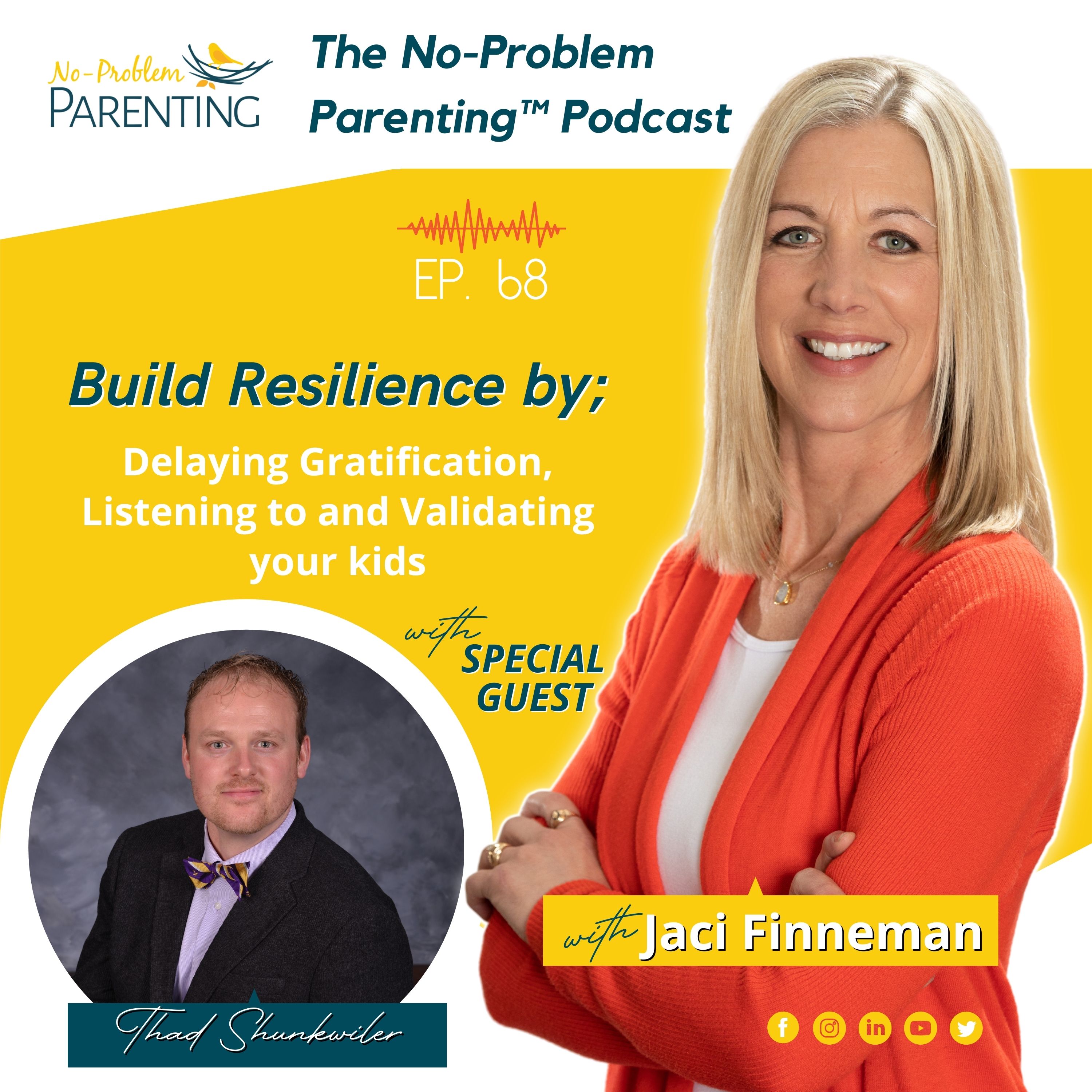
Build Resilience by; Delaying Gratification, Listening to and Validating your kids. with Special Guest Thad Shunkwiler
About this episode
Welcome Back No-Problem Parents!
Resilience isn't about strength or being stronger than others.
My guest today describes resilience as rubber-not steel. Our ability to overcome and bounce back when bad things happen.
He shares the importance of delaying gratification, listening to our kids more than telling them what you want them to do, and validating their ideas, efforts, and resilience.
Become a No Problem Parent Today!
Full transcript
Welcome to the No Problem Parenting Podcast. Turn behavior problems into no problem with Jackie Fineman. Are you ready to become the confident leader your kids crave you to be? Do you want to learn how to make parenting easier and more fulfilling?
Whether you are at your wits end or you want to have more fun as a parent, you're definitely in the right place. Now here's your host, Jackie Fineman. Hey, welcome back to the No Problem Parenting Podcast, where we choose to deal with and overcome the emotional and behavioral challenges within our home. Today, guys, we're talking all about resilience and what does it mean to be resilient?
What is it? How do we help our kids become more resilient? Today, we have Thad Schunkweiler with us. I met Thad back in March when I went down to a TEDx in Mankato, Minnesota, and I was just like blown away by his talk on resilience. So he's here with us today. Welcome to the show, Thad. Thank you. Thank you for having me. Yeah, this is, I'm really excited about this because I love the topic of resilience. And a lot of times I think the term is thrown around like, oh, you're so resilient. Well, what does that mean? How did you come to wanting to do a talk about resilience? Let's just talk about why that was on your radar and why you decided to do a TEDx talk about resilience? Yeah, I think you're exactly right about how resilience is this kind of new buzzword that we throw it around quite a bit. And that even just four or five years ago, we didn't talk about resilience in the way that we are now. But resilience has been something I've been interested in now for about 15 years. And it really all started back in my military service and coming back from an overseas deployment. And at that point in time, there really wasn't a lot of information about how service members reintegrate back into society. And they really focused on like the resilience of those service members. And so I spent literally hours, if not days of my life in the military talking about what resilience is and, and how it's built. And I really got captivated
then about that subject. And really, really, as I pursued my professional endeavors and went into behavioral health care, I really wanted to focus my work on, you know, understanding resilience, How do we better build resilience in people? And so that's kind of how I got started in the whole resilience sphere of behavioral health. And then, you know, along comes TEDx.
And they call and they say, hey, Thad, we've heard you speak. We've heard you present, you know, and we're interested. You should really apply. That had to be like out of the blue.
Absolutely. When an organization like TED reaches out to you and says they're a fan of your work, you're immediately starstruck. You're immediately humbled. like, oh my goodness, who have I done a favor for that to have this land on my lap. And so when Ted approached me and said, we'd like you to talk a little bit about some of the work that you've done in this area. I was really excited. And at the time in which I was invited, my goal was to talk about how resilience could really be a preventative measure in mental health and behavioral health, because, you know, the life expectancy of Americans has been on a steady decline. And this was even before COVID. And the reason why was this phenomenon known as the deaths of despair, which were suicide rates, drug overdoses, and cirrhosis of the liver caused by alcoholism. And so we were able to pinpoint, or researchers were able to pinpoint, those were the reasons why life expectancy had started to decline year after year. And when you think about how you solve a problem like that, you have to think much more than just treatment, and you have to talk about prevention. And when you're talking about prevention in the world of behavioral health,
you're talking about building resilience, the ability to kind of bounce back when bad things happen. So that is resilience, the ability to bounce back when bad things happen. Think at a very basic elementary way. I think you could, you could look up whole research papers on the term resilience and what it actually means. But I think at the nuts and bolts at the very bottom of it, it's an ability to kind of overcome and literally bounce back when something in life happens. How can you overcome that issue or that phenomenon? So how is it built? How do we do that with our kids? How do we build resilience in our kids? Where does that start? It really starts with parents. And so that's why I'm so glad to be on your podcast. I think one thing that has been paramount in all of the work that I've done as a mental health professional and in treating,
you know, individuals and children with mental health issues is this saying that parents are their children's best teacher. And so if you show me a set of resilient parents, I will likely show you a resilient child. And if you show me parents who lack some of that resilience to be able to push through those tough times, I will show you a child who also has that. So when I think of how resilience is built, it starts and ends with parents. It's not me as a therapist and educator who's going to do that for you. It is really going to start with parents. And for me, and kind of how it's built, there's lots of different ways we can kind of teach that skill. But it's important to also note that it's an active process. Because I'll give you an example, if I may, just for a moment. What I've heard a lot recently, I've heard that the pandemic has been so challenging that all of these kids going through this will end up more resilient on the other side. And I think that's a bit of a misnomer because I think that just implies that once you go through something bad,
you'll be better at it later. And that's not resilience. Resilience is an active process. And so, yes, it may benefit someone to go through that challenging time, but it's not enough just to go through it. You have to then process it. You have to discuss it. You have to look at kind of how you were able to navigate through those ways as a way to kind of integrate that into your toolbox. And what I always tell people is you want to start this early in a child's life, because if you think about the challenges that your first grader and second grader face, right?
And you think about those things in our lives are very minuscule. They wouldn't even be a blimp on our radar if their friend, you know, if your friend didn't talk back to you in a class one day, it wouldn't, you know, it wouldn't be the worst thing that happened in our lives, but kids have to learn to navigate those challenging times. So that way, when they become adults, that when those really stressful and challenging things happen, like a divorce or a job loss or a global pandemic, that those skills have already been built and integrated to move through. Because I'm often asked, like, how did we get to this place where the overdose rate is where it's at, right? And if you're unfamiliar with that, we have just set a new record in 2021 with over 100,000 drug overdoses. And people are quick to blame the drug, people are quick to blame the lack of treatment, but I'm here to blame that those individuals likely didn't have the skills to navigate those difficult times. And when things got hard, they searched out for something to help.
And in many too, in too many instances, it's drugs. And so what the, my hypothesis is that we've just become less resilient as a population and have more of those difficulties navigating those, those tough times. Yeah, I think you're absolutely spot on. And so it's how do we build that resilience in kids? How do parents begin? What kinds of conversations are they having?
And, you know, how do they know that they're doing enough? Two things. I want to start first with parents have this, like this, and the research shows this. And I spent a number of years working at the University of Minnesota and the Institute of Child Development and Family Social Science.
And we conducted lots of research. And the one thing that I think I like to remind parents is that if you're participating in a podcast like this, or you're going to parenting programs or participating, the research is very clear. You're probably already doing a good enough job, right? Like if you care enough to spend your own time to learn more about being a good parent, you're probably already a good enough parent. It's kind of a bit of a misnomer not to say stop listening to this podcast because there's still going to be lots of great things. But it's one of those things where I think parental efficacy or like our feelings about, are we doing a good enough job?
We often, we often don't believe in ourselves enough as parents. And I like to remind people that you're doing a good enough job. Now, what that looks like, you ask the question, like, how do you do that? And it isn't as a prescriptive as like do X, Y, and Z, and your child becomes more resilient, right? Because there's so much more than just like a skill that is taught or a mechanism in which it's communicated. It really has to incorporate the entire family culture and the family values. And so it's hard for me to give you like a specific actionable item that people need to do because it's different for different kids. What helps build that resilience?
But ultimately, if you were to pinpoint me onto one thing, it starts with communication. It starts with listening to your children. It starts with involving them in those conversations, talking about those times in which your friend Jenny isn't talking to you, taking some time to listen to your child about, okay, that sounds difficult. That sounds stressful. What is one way that you're going to work through that? And so you're building those communication patterns at a young age that hopefully will replicate when it's a much more serious issue, like Jenny's offering me drugs, or my partner is breaking up with me, mom or dad. And so you're starting to build those small things, planting those small seeds so they can grow later. For me,
it was different than what my kids are going through. And it really is that kind of family driven. But I want to come back to my main point of parents do a good enough job. The research is very clear in that. We often think we don't. But our kids, if you're involved, parental involvement, if you're involved, you're doing a good job. It may not always feel that way. And there's going to be ups and downs, but I like to remind people you're good enough when it comes to parenting.
I love that. One of my favorite quotes is that on particularly rough days, when you feel like you can't possibly endure, and I think of parenting when I'm reading this, right? Remember that your track record for getting through those days so far is a hundred percent. And that's like pretty darn good. So that's one of my, one of my favorite quotes, because even though it can feel like the world is falling apart because your child is, you know, exhibiting severe behaviors or actually using drugs, maybe they're in treatment right now. Maybe, you know, there's some really significant, serious stuff going on. You are still getting through those days. So reaching out to resources and supports is another way that parents, like you said, listening to podcasts, reading books,
just whatever you're doing, as long as you're involved and you're still learning, you're still, you're still thriving to be the best parent that you can be. Also nurturing your own mental health, your own needs, your own desires, right? And outside of parenting, separate from parenting, helps model that behavior in kiddos and confidence in kiddos. Talk a little bit with us about your TEDx. I don't want you to give it all away because I'm going to put a link in the show notes, but summarize it maybe a little bit and what inspired you to speak on resilience.
Yeah, no, I appreciate that very much. And so when I thought about what the idea that I wanted to share, right, because that's the whole focus of TED is to share an idea in a small consumable amount of time. And so what I what I really my big idea for my TED talk was essentially, if we are going to overcome the psychological adversities that we continue to face and have worsened throughout this pandemic, it's going to start with building and fostering resilience.
And the TED Talk talks about resilience kind of globally about what it is and what it's not, right? I talk about in my TED Talk that there is this myth that resilience is more about strength. And I think it's a common misconception that we think when people are resilient, it means that they're just strong people. And it's very different because when you think of strong, you think of steel.
And when I think of resilience, I think of rubber. And we don't often confuse those two products, right, steel and rubber. But, you know, I think about resilience, it's that bounce back like a tennis ball. And so in my TED talk, I give the example of what resilience is. And I'm holding an egg and a tennis ball. And I say something bad happens to us and one of two outcomes happen. And so I throw an egg down and you can imagine what happens then. And then I throw my tennis ball and it bounces back up into my hand.
And so for me, kind of like what I alluded to earlier in my answer about how the pathway to resilience is not a prescriptive A plus B always equals C, that it really just involves a lot of those family dynamics. For me, it was having to learn the art of delayed gratification. Now, most of your listeners understand delayed gratification, right? The ability to wait for a result, for a better result later.
And when I thought about what I was going to talk about in my TED Talk, I wanted to do something that nobody else had done yet. I didn't want to regurgitate something that another great academic had already said. So I went through all of the TED Talks on resilience and delayed gratification, and nobody, as of today, had linked those two concepts together in the way that I did. And for me, learning delayed gratification made me more resilient.
And so in my TED Talk, I talk about kind of my path in becoming more resilient and not giving too much away because I want people to listen to it. But I failed the eighth grade. And I failed the eighth grade because I didn't have delayed gratification. I wanted things right now.
And so I needed to learn that. And where I learned that was on our family farm. And so after I failed the eighth grade, my mom moved us hundreds of miles away to live on our family farm. And on that farm, I learned the value of delaying gratification through baling hay and fixing fences.
And I basically was growing up with that message about the importance of working hard today for tomorrow, that when things got hard today, you had to remember that it was always building for something tomorrow. And so when I think about resilience, and it's not for everybody, right? So that isn't going to be everyone who's listening to this. That's not going to be the answer for you and your children. But for me, I had to learn that. And once I did, once I learned that psychological concept of that, I can live with some uncomfortableness.
I can live in some sad places. I can live in some depressed places because I always knew that what I was doing was building for something better, something bigger down the road. And that made me more like that tennis ball. So when bad things were happening to me, and several things did throughout my military career and coming home and I got a divorce and working through that was always about kind of pushing myself to that next level.
It is literally one of my favorite TEDx talks that I've ever seen. And I'm so excited that it came out, I think, just yesterday, did you say from last week? Yeah, it's been out just a week. And I've been getting lots of comments and emails from people saying, hey, that the way you described that it really made sense. And that was always my goal was, how do I take this idea of we have to become more resilient as a population?
How do I take that idea and help people do that? And I think by sharing our own stories, I mean, I'm an academic, but, you know, that's what I do. I'm a professor at a university and I could have stood up there and cited statistics and all of these academic, you know, language, but I knew that wasn't going to help anyone. And so for me, I thought if somebody could relate to my story of how I went through these tough, difficult times, and this is how I persevered, it's not going to be how you do, But it's that kind of give people hope as well as like remind them this is another avenue.
And so for me and my kids, which I have three, two toddler twins, delay gratification is something that I'm trying to implement into my house. And having those conversations about why we don't get candy every time we go to the store, because candy tastes so much better if you don't have it every day. And, you know, really kind of focusing on those mechanisms and skills, because for me, that's what made me more resilient.
Right, right. It's just absolutely amazing. And it's good parenting. It's just downright good parenting, Thad. I love it.
Yeah, kids oftentimes we're giving in or we're giving them things right away when they ask because we don't want to hurt their feelings. We, maybe they had a bad day. Maybe they've been going through some tough stuff. So we're giving in to their demands or their requests to make them feel better.
We don't want them to hurt. We don't want them to be in pain. We don't want them to be upset with us. Right.
And we're actually not, that's not, that's not helping. It's actually harming more than anything. I just had a lady on the podcast a few weeks ago that was talking about how that's creating more anxiety, more uncertainty, and, you know, decreasing our kids' self-esteem rather than building up their confidence and their resilience. So absolutely love it. Let's talk a little bit about what ways the pandemic has impacted the mental health and wellbeing of kids and parents.
I mean, talk about delayed gratification. Kids that, I mean, there was no option to be able to get what you wanted, when you wanted, go where you want, when you want, because the pandemic really shut everything down. So what have you noticed? What do you have to share about how the how the pandemic has affected resilience. Yeah, absolutely. And so I want to kind of preface it with it. It seems kind of doom and gloom up front, right? And I don't want to scare people away because I think some of the, the answer to this question is a pretty scary answer, but at the same time, it really fits into my whole approach about it's a process and that we do have to work through this. But when I think about the psychological consequences of COVID-19,
I think they are going to cause far more damage than the physical health consequences to our communities. And I don't say that lightly. I mean, we all understand the physical toll that COVID-19 has had on our friends and family and community. But the difference is, is we have vaccines and we have treatments for those effects.
And with these psychological impacts, it is going to take years for us to unpack some of the damage that has been caused. And so if you think about specifically kind of what has happened to kids and families, it really comes back to the isolation piece. piece. I mean, if you, if you wanted to meet a pinpoint, like one specific, like risk factor for developing emotional distress, it would be isolation. We are just innately drawn to connect with one another. And really connection is the best remedy to almost every single mental, you know, emotional distress, right? Other than those serious mental illnesses. But it's that ability to connect with one another and to share that meaning. And so if you take away that and also then further isolate people, it's no surprise that people's anxiety and depression is at literally all-time highs, that there's not a single measure that I've ever seen that suggests that our emotional well-being has ever been at a worse place than it is right now. And for me,
in my hypothesis, it's about that isolation, that we spent this time disconnected from one another. And if you think about children and their development, that social connection is just as important as reading and writing, right? I'm not trying to downplay the great work that elementary school teachers do. Obviously, our kids need to learn how to read and write.
But we also have to ensure that we are teaching them how to socialize. because socialized children, for me, the skill they're really learning is empathy and understanding another child and how they're feeling. And when we have children isolated and not building that empathy, that's a really scary future because empathy is what keeps us doing the right thing. And so that's why I said, I don't wanna scare everybody that, oh, we're about to have this rash of violence.
But ultimately, when I think about what's most scary for me is how disconnected our children have been and that we are going to have to take a very concerted effort to reconnect those children and to learn some of those things that they didn't learn or were unable to learn when they were over you know the computer and and over the phone and facetiming that just it's not the same now I say all that with the understanding we had to do what we had to do right we just had to this is not me saying we shouldn't have done the way things that we've done. It's me saying we have to now pivot and we have to focus on our children's emotional well-being. And it starts with our parents. It starts with the people listening to this podcast.
It's not the kids. We have to start with parents. When we think about how do we treat children's mental health issues, we really have to start with parents and making parents, you know, the best they can be. Yeah, absolutely. And that's what No Problem Parenting is all about. I mean, we're here to create the confident leader that I say your kids crave you to be. It doesn't always feel like that. I was just on another person's podcast a couple of days ago and they said, wait a minute, wait a minute. What do you mean they crave you to be like, they crave you to tell them and they can't do something. They crave you to, you know, consequence them. They, do they crave you to say no? And I said, yeah, they absolutely do. They need us to set limits and to set boundaries and a structure and without getting mad and flying off the handle and, you know, joining in on the battle, but creating that confidence. We seek first to understand why is my child behaving the way they are. Step two is prepare for the worst. You're actually doing,
that's what you're talking about is we need to be prepared. I, step three has changed the conversation, which is, is all of this fits so well with that. I, I don't like the fear-based messaging. So I totally hear you when you say this is not to cause fear. It is just reality though. We need to take a look at, we don't want to skirt and push it aside and pretend everything's going to be okay. We need to name it and say, Hey, we've got the next couple of years here.
We've got, we've got a lot of work to do. So step two is prepare for the worst. Let's prepare for the quote unquote worse. And what are some things that we can do to help our kiddos when they're isolating in their rooms now, because they had for how long, and they don't have the social skills to to connect and engage with their peers. So, you know, then we freak out and we aren't having the conversations that we need to be having with the kids. What do we do? What are some ideas that you have for parents? Listen, I feel like that is such a basic answer to this, but you are right in that children are looking for parents to be the leader, to set those limits. But one thing that I think we've done less of or a less good job of, particularly as technology has evolved, is just listening to our children and not listening to solve the problem, right? I mean, I think we're all, back to your point about like when my kid comes to me and is uncomfortable, I'm listening in a way that how can I make this more comfortable for them? I'm solution oriented. I'm trying to solve that problem. And really what we need to do is just listen and validate those experiences and say, this has been hard. It's been hard on me, right? This has been hard on me as your dad. This has been hard on me as your mom or your step-parent. And so I'm here for you. This has been a family challenge and we are working through this, but it starts with listening and less talking. Now,
obviously the age of your child plays a big role in some of that. But when I'm just fascinated in the work that I've done with parents and, you know, through therapy and trying to figure out kind of what the issue is, how often it really comes down to like, when's the last time you actually listened to what your, you know, spouse was saying or your child was saying? And it's, it just seems so obvious, but because it's so obvious, I think that's why it's so challenging is that it's like, what you're telling me if I just slowed down and listened and not texted the answer, but really just listened to what's going on. I'm telling you, it, that's where it starts.
There's not a, there's not a pharmaceutical that's going to solve this problem. There's not a vaccine that's going to solve this problem. It is not that simple. It's going to take some time and we got to get back to some of those basics. I feel like we've, we've lost. And I think a lot of parents are saying, but my kid won't talk to me. You know, I try to talk to him. I ask them about their day.
I ask them what's going on and they won't talk to me. And so one of the, the, the best things that I know how to do to get your kid to talk to you is actually show an interest in what they're interested in. So this is hard because if they're only interested in video games right now, they're only interested in some, you know, show that you have no interest in whatever it is, sit with them and just watch them play their video games for a while. You'll learn so much. They will actually start opening up to you and start talking about other things just because they're, you know, kind of focused on the screen at that point. And then slowly it's kind of baby steps. They, they start to talk about other things. You can get them in the car and you can ask about the funniest thing that happened to them today, you know, or something like that, rather than,
you know, how are your grades? What'd you do at school? What'd you have for lunch? You know, all those things. I don't know. I don't care. I could tell you what I've never played Minecraft, but I feel like I could build the greatest Minecraft village ever because I do exactly what you say about, yeah, if I sat down with my oldest son and had him rehash everything that happened at school, it'd go nowhere. But if I sit down and say, look, it's your screen time, I'm going to sit with you. Tell me what you're doing. Help me understand what it is that you're trying to build here. It's amazing. Yeah. You're connecting with them at a level that they understand. And that, that, like you said, that interest piece, it's forms and supports that relationship. It's hard. I mean, I don't want to sit there and watch big city greens. Yeah.
I'd much rather be doing something else, but that 20 minutes right there, even if nothing is said, it, it, it, it roll, it kind of role plays, or it kind of shows kids like what it means to be connected. And that's, if you're talking about reconnecting your kids to society, you have to reconnect them in your home first. And that requires parents to do that effort. It's on us to be able to, to make that effort. They're never going to sit down with me and watch the nightly news. I'd love for that to be the case, but I'm going to have to make that effort as the parent.
And so that, that connection. So when you have that kid who's not talking to you or not communicating the way you want to communicate, well then ask yourself, how do they want to communicate and try to meet them there or at least halfway, maybe there's somewhere in the middle, if you're not willing to play Minecraft and watch big city greens. Yeah, absolutely. And I think another, another good idea is to, um, ask your kids what they would do.
So rather than it just be you, you telling them what, what you would do, you know, let's say it's their sporting event and you're trying to coach them, parent coach them, you know, on their sports and what they could have done different during the game or something like that. Instead, what's the problem that you're going through? I mean, again, this is age dependent, but you can do this really young. You can ask four and five-year-olds about a problem that you're having. Maybe it's a conversation that you didn't think you had, you don't think you handled well. Maybe it's, you know, you keep being late for work, you know, ask your kids, what should I do? I just don't know what to do about how to get out of the door, you know,
faster or on time. It's kind of reversing it around, right? Instead of telling them, Hey guys, we're always late. We got to get out of the door, ask, ask them and see what they come up with.
And when kids can contribute and feel like they're contributing and offering you something that increases their worth, their value, they feel important, you know, and, and that can, that can be a game changer as well. And talk about a skill that will benefit them the rest of their lives, right? I mean, to go all the way back to the beginning of our talk, it's what we do now is really setting them up for the future. And so yeah, having those problem solving skills, encouraging them to participate in those family discussions, showing our children that we're human. I think that's another big piece of this. Like, you know, we're not perfect parents.
And so like, how do we share our own challenges and, you know, conversations I have with my oldest, not my youngest, it doesn't make sense to do that with toddlers, but with my oldest, talking about the stress that I have at work and what that means and how like, okay, work is work and home is home and really trying to role model some of that behavior. And do I do it great? No. Do I do it well? I hope so. But, you know, it's, so it's just, you have to start somewhere and parents are their children's best teacher. And so if you can kind of come back to that, that's where it starts. And you talk about building more resilient kids.
That's what you got to do. It doesn't seem like watching big city greens with my, you know, junior high student is going to make them more resilient, but it's all part of the recipe. It's all part of that plan. And the relationship and the communication and all those things that are so important just for connection. So we, I love that.
You say teaching connection starts at home, you know, then they can branch out with their social connections and that, and all of that. Let's summarize it, wrap it up. delayed gratification is really the key key one of the key things to to building resilience that is that is your message and I so appreciate it it makes sense it resonates with me and I think that as parents it's not our job to tell our kids what to do and how to do it it's not although sometimes we need to do that right but that's not the overarching like we need to delay some gratification give them some opportunities to make mistakes fall on their face and be there to support them as we, and help them back up. What are your kind of final words or parting words for us today, Thad?
Yeah, you know, oftentimes when people are looking for that parenting support, it's typically kind of at the end of their rope, or oftentimes I talk about rock bottom, and so the things to think about is, you know, the most resilient population by every measure, by every academic measure, our children. And so when you think about like, this is so bad for our kids, keep in mind that this is the population that has the best ability to bounce back. It's not just going to happen because they're children. It takes an effort, but that, you know, you're good enough that you as a parent, you need to keep working with your children to kind of help mold them so that they can be more like a tennis ball and less like an egg, but you're enough. That's the, that's the kind of key thing I want to make sure people understand is parents, I think we are our biggest critics of what we do. And I just think it's important to remind people that it's hard work.
But back to your quote about your 100% success rate, I think that's important to keep in mind. Yeah, absolutely. Well, I can't thank you enough. I was, you know, I'm this awkward lady at the TEDx that, you know, comes in, hunts you down afterwards and says, Hey, Thad, would you be on my podcast? I love the message. And, and you were like, who are you crazy ladies talking to me?
So I really appreciate you being a guest on the show today and sharing your message. And we're going to make sure to have the links for the TEDx and the show notes. Thank you for being here today. Well, thank you for having me. And thank you for all the work that you're doing in supporting parents. It's the world's toughest job. And to have some some some help along the way, I think it benefits everyone. And so thank you for both having me and the great work that you do with your organization. Thank you for tuning into the No Problem Parenting podcast.
Join Jackie next time for more tips, tools, and resources that will help you become the confident leader your kids crave you to be. Who do you know that we could support on their parenting journey? Like this podcast, subscribe, share, or leave a review of the show. Your support of the No Problem Parenting Podcast pays it forward and helps us help more families.
Thank you.
Become the confident leader your kids crave
The method, the community, monthly live Q&A with Jaci, and Celia — your AI guide in the moment.
Start your 14-day free trial Get it on iPhone or sign up on the web