
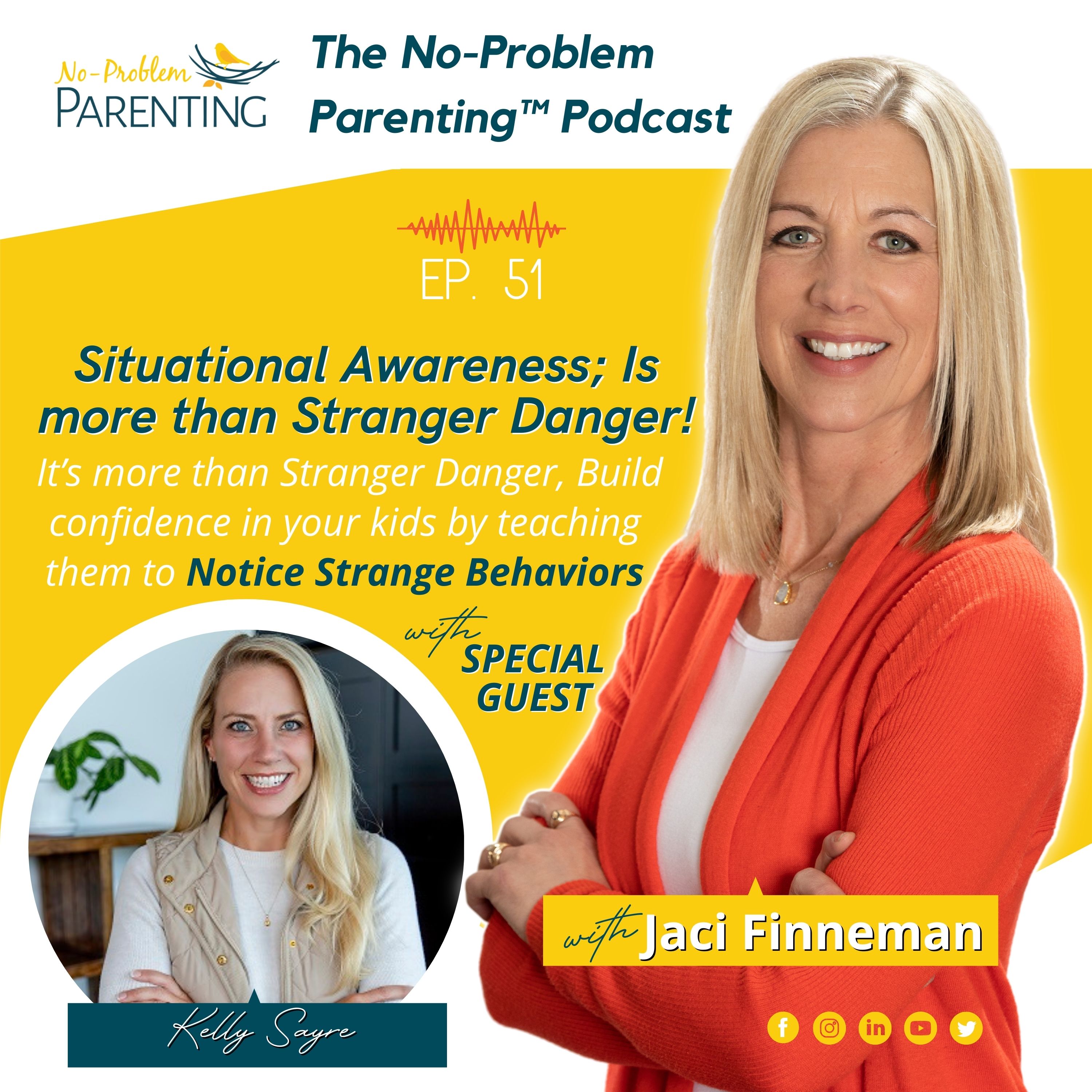
Situational Awareness; It’s more than Stranger Danger, Build confidence in your kids by teaching them to Notice Strange Behaviors with Special Guest Kelly Sayre
About this episode
Welcome Back, Parents! Remember being told to keep your head down and to not look at or talk to strangers? Well, that's not the best advice anymore. In today's world, it's less about Stranger Danger and more about teaching our kids to be aware of and notice Strange Behaviors.
Become a No Problem Parent Today!
Full transcript
But it's teaching them how to read nonverbals. It's teaching them how to read because we say, you know, don't talk to strangers. I was just thinking that. But what it is, is we need to understand that it's not strangers.
It's strange behaviors. And once we start talking about behaviors and nonverbals, then that helps us overcome any unconscious bias that we might have when it comes to sexism or racism or ageism or ableism, any of those things, you start focusing on behaviors and non-verbals, then it's a lot easier to articulate later. I could not love this more. I didn't even know we were going to go here today, but that whole thing about curiosity leading to you saying it's not strangers, it's strange behaviors that I love that. And I wish I would have known that so much sooner.
I'm using that, stealing that from you. You go right ahead. Directing people right to you. I'm sure I stole it from someone else. I'm not reinventing the wheel here. Welcome to the No Problem Parenting Podcast. Turn behavior problems into no problem with Jackie Fineman.
Are you ready to become the confident leader your kids crave you to be? Do you want to learn how to make parenting easier and more fulfilling? Whether you are at your wits end or you want to have more fun as a parent, you're definitely in the right place. Now here's your host, Jackie Fineman.
Hey, welcome back parents. Today we're going to talk all things situational awareness. And guess what? As you heard in the intro, it's more than stranger danger. Let's build confidence in our kids by teaching them to notice strange behaviors, to wonder and to be curious. And so I've brought on a special guest today. Her name is Kelly Sayre. Kelly empowers women with realistic tactics and tools to help them live life safely and on their own terms. With a grounded approach and high energy, Kelly works with law enforcement, non-profits, corporate, and youth organizations on emergency preparedness, situational awareness training, and personal safety. Do you remember growing up where we were taught to keep our head down and look away, don't make eye contact with strangers? Well, that's not the best advice anymore. Listen in as Kelly shares with us how our presentation and how we hold ourselves with confidence can make a big difference when we're met with scary or uncertain situations. So welcome to the show, Kelly. Thanks so much for being here.
Thanks for having me, Jackie. I'm excited to be here. Well, we have like a lot to cover. We were just talking, you know, pre-show, like there's so many things we can cover around personal safety with kids and families and moms and all those things.
Tell us a little bit about the Diamond Arrow Group and how that even came to be and your interest in this subject. Sure. So the Diamond Arrow Group, I'll start off with that because I get that question a lot. Why do you call your company the Diamond Arrow Group? I had read a quote years ago that an arrow can only be shot, and this is not verbatim, but an arrow can only to be shot forward by being pulled back. So when you feel like life is pulling you back with difficulties, keep aiming because it's about to launch you into something great. And I loved that perspective shift for me when I'm going through hard times or when I'm struggling or when it just feels like obstacle after obstacle, like, okay, this is part of that growth. This is part of the launch you could say. So I always loved arrows. And when I started my company, I knew I wanted to incorporate an arrow somehow. And in researching symbolism of arrows, an arrow through a diamond symbolizes courage or confidence moving forward, and a solitary arrow means protection from harm.
So it was the perfect fit for what I wanted to teach women, but just the everyday person is having that confidence in their own personal safety skills so that they could live life on their own terms, traveling, you know, starting a different job, being able to enjoy going outside. If we let fear stop us from doing the things that we love because we're scared of getting hurt or injured or something bad happening, well, that's not the way to live. And so that's why I really love Diamond Arrow because I wanted anyone to realize that they have the skills already.
they just don't know what they don't know. And how I even discovered that situational awareness was a thing is I took my first official women's self-defense class and it was four hours on a Saturday. I had spent the whole time, you know, it's this room full of women and we're yelling, no, and get back and hitting the pads and kicking the pads and doing all these great things. And it was awesome. I've always been an athletic person. And so I love the physicality of it. And as we're sitting to cool down at the end of the four hours, one of the instructors said, but the last thing you want to do is get into a physical fight. You need to be more situationally aware so you can avoid getting into an altercation. And then he was like, bye, see ya. And my brain did the whole,
like ran into a brick wall. Wait, whoa, whoa, whoa. Yeah. What do you mean? We just spent four hours working on skills that I'm supposed to avoid using at all as much as possible. And the thing that I'm supposed to use or the skills I'm supposed to practice all the time, we didn't talk about it all. And so my curiosity went into hyper, what, what, what is situational awareness? What does that mean? What am I looking for? How do I know if I'm looking for the right thing? And if I see something, then what do I do? And it really started this waterfall of a journey of learning.
And the more that I went out trying to find answers for my questions on what situational awareness was, the less I could find answers. And I went to people that were in, you know, that if they had any sort of self-defense or executive protection or risk management or self-defense. And I went to those people and said, okay, you know, situational awareness. And they're like, yeah, there's situational awareness training for the military.
There's situational awareness training for law enforcement because they're going into high threat, very dangerous situations. They're running to the danger. And I said, oh, okay, where's for civilians, especially as women, we're the ones who are getting attacked. We're the ones to deal with micro threats, whether at work, at home, at school, while we're out in public from strangers. And they were like, yeah, that's a really good idea, but I don't know of anything.
And so I couldn't, nobody could point me in a direction of where I could get information or training for myself. The benefit to, or the unique perspective I have, or the lucky card that I have is that I'm married to law enforcement, that he had a military background, but I had a little bit of military background. So I could understand the acronyms. I could understand the lingo. And then I said, as a woman who came more from a business or corporate background, I could find the bridge, kind of be the translator. We've all heard the seven second rule, a first impression that you only get so many seconds and one opportunity to make a first impression on someone else. And so how you carry yourself, if you carry yourself with confidence,
if you carry yourself with, I am not someone to be messed with. We've heard the saying, she's a hundred pounds soaking wet, but I would not mess with her. It's that attitude, how you carry yourself. And that's the same that goes in for soldiers, for, for law enforcement officers, how you carry yourself is very important because here's the thing. And anybody who's a hunter, anyone who's out there that, that does any sort of hunting, think of it from that perspective.
When you see your, whatever you're hunting, your prey, you watch it for a while and you watch to see if it notices you. Are you upwind? Does it smell you? Does it hear you? Is it aware that you're there? And if it, if it does become aware of you, it'll take off. And then you're watching for your next prey as a hunter. And, or as a hunter, if you see that, then you're not automatically shooting. You're waiting for the best shot. You're waiting for the right opportunity.
Well, that's the same way the human individuals with ill intent, whether they're looking to steal your purse, whether they're looking to steal your phone, whether they're looking to steal your car or to cause damage to you or something else, they're looking to see, are you aware? Do you, do you hear them coming? Do you see them coming? And so that, that mentality of realizing, oh, if I just carry myself in a way that I'm aware of my surroundings, that's going to anyone who's watching for their next target is going to say, nope, not picking her. I'll wait for the next target. And so you don't know if you avoid a situation, you know, we don't talk about, well, I walked down the street safe today. Kudos to me. We don't know. So we don't give validation that we're doing the right things, but there's that way of walking down the street that still,
that instills that self-confidence, which again leads to, okay, I feel comfortable going to a big city at a conference and walking across the street to the restaurant by myself, or, or going to meet up at some event because of how I carry myself. I don't look like a easy target. I don't look like a good target. And then the more I dug into it, unfortunately, females specifically, we face violence or threats from more than likely it's someone we know. Like depending on the study, you read 75 to even 90% of the attacks against women come from someone we know, whether that's acquaintance level or whether that's intimate partner, you know, domestic violence situations.
and those situations don't start at a high escalation. They don't start physical. They start with control tactics within, with testing our boundaries with, with seeing how we're going to respond to certain stimulus from them. Like they're testing us. And so my biggest thing was, well, wait a minute. Most of the scenarios that self-defense experts talk about, or, you know, even outside of martial arts, you know, risk assessment, they're thinking stranger danger.
They're thinking from that mentality. But what if you live with your, you know, abuser? What if you have to go to work? There's a lot more financial, social, emotional, psychological implications to that.
It's not as easy as, well, I'm just going to walk away from that stranger and never see them again. And it's, well, that coworker is harassing me and I can't afford to not have a job. And they're not taking it serious. They're blowing me off.
They're saying I'm reading too much into it or, oh, they're always that friendly with everyone. And so it just becomes this big, sticky mess that's really hard because there's no straight answer. And that's where I found my, but if we're going to solve a problem, then we have to be real with what it looks like. We don't know what we don't know. And as I started putting information out there, because so many women have experienced some traumatic event of some sort, whether that was a really awful, horrible, worst thing you can imagine situation, or whether it was, I got out of a controlling relationship when I was in high school, and that was the scariest thing to me psychologically.
they've they've had some of that experience and what's interesting is they come to me because they get what I'm trying to do and they say I need you to teach my kids because I would never want this to happen to my kids so they come because they understand what I do but they think they're past the danger zone or they think you know maybe it's too late for me or I'm old nobody would want to you know kidnap me or whatever the case may be and but I want you to talk to my teenage daughter, my college student daughter. And I even tell them, you know, boys too. I have two boys. And understanding healthy relationships is just as important for boys to know as it is for girls. Because the mixed messaging that gets put out there, that gets glamorized, that gets romanticized in Hollywood, in society in general, some old way of thinking, we need to change that conversation for our boys because they're getting the message like, well, no, if I'm persistent,
that's romantic. Even if my female that I want to ask to the fall dance, she says, no, well, then I'll just escalate. I'll get her flowers or I'll show up at her door or I'll do this. And persistence is not romantic. It's stalking. And if we're not giving that message to our boys, then they won't recognize when their behaviors are inappropriate.
That's so good. So you just literally summed up the three steps of my no problem parenting program. And I think we talked about this on a previous conversation. But really, you're, you're doing all three. So get to the root of the problem. Step one, seek first to understand in my book, you know, it's why is my child behaving the way they're behaving? Or why am I responding as the parent, the way I'm responding. And that's what you're saying is get to the root of this problem. Like, okay, there's this, there's these options out there for how to help me, you know, shake off a predator or, you know, like notice that I might be in a dark area that I should be paying more attention to, but you're like, nope, it goes beyond that. It's not just that you really have to, you know, get to the root of the problem, seeking first understand getting to the root of the problem, then preparing for the worst, we need to be prepared. And it's not just about learning how to physically defend ourselves, right. But it's also being mindful,
and how we're appearing to others and how confident we're appearing. And then also changing the conversation. So you just like literally summed that all up and creating confident parents is my jam. So you are creating confident parents as well, confident people, confident kids, and helping parents to teach that to their kids. But it really does start with the parent. Oftentimes it's not just, Hey, go take this course from Kelly kiddo, you know, and you're going to learn all these things. That's mom's going to learn it. And dad's going to learn it too. And then we're going to model that. So I absolutely love all of this.
kids are actually naturally well all kids are naturally curious but kids haven't quite been impacted or quite they haven't they're not at the stage they're trying to figure out who they are so they're still kind of pushing the envelope they're still trying to test and figure out who they are independent of their parents whereas parents or as adults we tend to have been molded already oh not to the fact that it's too late but we tend those social contracts those social mores well, this is just how my life is. Like I'm middle-aged now. I'm not going to change all that much. Whereas kids are, well, I don't know what I want to be when I grow up, or I don't know where I want to live or places I want to see things I want to do. And so they tend to be actually very in tune with their intuition. Maybe they can't articulate it, but they know if something doesn't feel right. And as parents, we're, we're maybe so almost numb to it. It's become subconscious. We're used to, you know, oh, well, this job isn't very fulfilling, but it pays the bills. So I'm my intuition telling me that it's not where I'm supposed to be. It's not my sweet spot. We're like, but it is, I have a mortgage. I need to put food on the table. It is what it is.
Whereas kids have a lot more flexibility in exploring their intuition. And so it's not so and as parents, you know, we want to do things right by our kids and there's no perfect answer for anything. And our kids may be very different than we are. You know, I think about my mom and myself, we grew up very differently, had different, just where I grew up and the environment, you know, and the, my mom's experience from her mom, you know, and this would be probably back into your, your, um, wheelhouse, but I grew up different. And my mom used to joke, Oh, she, I don't know who, who bloodlines are running today, but it's not mine. And so I was, I can't wait to get out.
I can't wait to go explore the world. And that really scared my mom. And so a lot of things that I wanted to do were influenced by her fears, her projecting her fears onto me, which then colored and informed my perspective because I was like, well, this is my mom. She knows what she's talking about. She, you know, but yet it doesn't feel right to me. Yeah. And so I had to kind of explore that. As you get older, right? I mean, you kind of know it when you're a kid, but then you don't really know what to do with that. And it's like, well, I just need to do it this way because that's my mom. But as you get older, you're like, but I want to go explore this and I want to go try that. And, you know, and I want to take some risks and you still have mom in the background going, no, no, no, be careful. And our society is so fear-based. Yes. I don't want to live by fear.
I don't want to live by worry, but being able to take some risks, knowing that I'm good in, you know, I'm, I, I'm aware of my surroundings. I'm aware of what I'm getting into. I'm prepared, you know, and, and I'm feeling good about myself. So one of my favorite quotes around fear is fear does not stop death. It stops life. Like fear is, you know, if you, depending on your beliefs and your faith, there's a plan it's going to happen. So, but if you live in fear, then you get smaller, you shrink. And guess what that outwardly tells the world is that you are scared that you're submissive, that you're, you're, you're timid. You're going to shrink versus having some confidence. And then it's like, Oh, I don't know what she's, you know, what shoes she's got on today or whatever. She's, she's sassy. I don't know if I'm going to, that's not going to be easy.
Like we talk about it as raise the risk. You want to raise your cost. If somebody is going to attempt to try and push your boundaries, if somebody is going to attempt to make you uncomfortable, that's not so smart. And another thing is the difference between worry and a true intuition signal or true message, whether that's a fear tingle up your spine or a gut feeling or just something tells you your intuition is sending a message, something's not right.
So we have to understand intuition is important in two specific ways. Gavin DeBecker in Gift of Fear talks about intuition is always in response to something and it always has our best interest in mind. So when we get really good and we practice listening to our intuition, then we can trust that it's responding to something. It's not a prankster. It's not testing our ability to respond or react. It's saying I either smelled, heard, saw, felt.
But I use the example of food, taste. It's one of our senses. Before you can consciously say this milk is bad, this milk is expired, you're already spitting it out. Your body is already trying to regurgitate it out. It doesn't want you to get sick. You didn't even have a time to consciously think that this is spoiled. Your body is like, I don't want you to be sick. Your intuition is saying, get it out, get it out.
and worry is manufactured. So whereas that intuition is going to be in response to something and it has your basic survival instinct embedded in it, worry is that manufactured. We worry about things happening to us. We worry about our kids. And what we have to realize is that's our head making stuff up. It's trying to foresee into the future. It's trying to fortune tell.
And I'm not saying I walk around without any worry. I'm not saying that there's such a thing as perfection, because there really isn't situational awareness is not perfect. You need to sleep at some point. And we naturally all can't be 24 seven. I mean, that would be just too much.
We have to trust our filter, our subconscious filter, which military terms is the OODA loop, observe, orient, decide, act. And orient is the filter, is what I say. And this is where your past history, any traumatic events as a child, you know, ACEs, or how you were raised, if you were in the country, if you were in an urban environment, any religious impact. everything gets filtered to that orient phase this is how my perspective might be different than yours on a situation if you know somebody who grew up in the country well if i if you put them in a city environment all of the noise and the chaos and the car you know people hollering at each other and horns honking that could be like overwhelming and scary and i don't know what to think because their orient filters not used to all the noise, but you take that city person,
put them in the country, and now they hear animal sounds and there's nobody around and they're thinking, you know, scary movies and, you know, children of the corn type thing. And that's freaky to them. And so again, it's not wrong or right. It's just different perspective. And so having those understandings. And when I break it down, especially for parents is, oh, well, as a mom, I have great intuition with my kids. The minute they walk in the door, I know if they've had a good day or a bad day. The minute, you know, before they were verbal, I knew that they wanted their chicken nuggets cut a certain way. You better give them the blue cup, not the red cup.
And they wanted their truck spoon and they couldn't verbalize with me, but I knew it by their cries, by their, their grunts and non-verbals are the hardest communication to fake. So I tell moms and parents all the time, you have these skills. It is a natural skill that you've had, but no one's ever explained you how to use it in regards to your personal safety. And so it's become a big light bulb moment when I work with people is they say, oh, well, this doesn't seem so hard. You know, I don't have to take 20 years of martial arts to get five black belts to be able to hurt someone physically defend myself. I don't need a psychology degree to understand human behavior. You're living it every single day. And I would argue that feminine intuition is beyond a superpower, but we need to know how to harness that superpower. We need to know how to articulate. Well, the reason why he gives me the creeps is because he's always side eyeing me, or he hugs a little too tight, or he always finds a way to be right next to me when I'm at work at the copier, whatever it is. And then recognizing that if you say that out loud,
somebody say, oh, he just doesn't have any personal space. He doesn't, his bubble is small. And it's like, that doesn't fine, but that makes me uncomfortable. And so it's not brushing off your instincts, your intuition saying something's not right. And those people that tend are very good at manipulating, and then they might be everybody else's best friend because they want to isolate you from people that will believe you that's part of the gaslighting. So it's, it's just this really interesting conversation that every time I talk, I have a woman or a man even come up to me and say, this happened to me one time and I didn't see it coming or I didn't realize it because everyone told me I was overreacting. And the more that I can get out and talk and talk to parents, healthy relationships. I just listened to a webinar yesterday on teen dating violence and really talking to our teenagers about what healthy relationships are, because there is this,
when we say teen dating relationships, what I hear most often from parents is they worry about intimacy, you know, intimate relationships. And what I loved about this presentation is it said, talk about healthy relationships with their friends. You know, what do you need in a friend, you need trust, you need respect, you need loyalty, you need to be able to communicate, you need to have same similar interests. Well, if you have that foundation in a dating type situation, that's a good thing, but a controlling, you wouldn't want a controlling friend who doesn't want you to have any other friends. Well, you don't want that in a, you know, dating relationship either. Right. And so there's a lot of it where when we let that fear, that worry voice, oh,
I'm worried that's going to happen to my kids is getting down to the basics, the foundations of what is a healthy relationship. And, you know, I talk about the bullying message and I get that. I get that. We want our kids to be kind, that we want them to include people, but we also need to talk about when it's okay, not to be somebody's friend when, you know, because that's a tactic.
well then I know you want to be my friend and you don't want to be mean to me or ostracize me from the group so I'm going to play to that and I'm going to make you feel guilty if you say I'm not comfortable hanging out with you I'm not comfortable being friends with you then they can play on that and then all that messaging of the anti-bullying is in the kids's head saying oh yeah I don't want to be a bully and it's like well no are those behaviors making you feel uncomfortable your boundaries are important. Yeah. I love this Kelly. And I, okay. So I got to back up because you said a whole bunch of stuff there. What are some just easy, quick takeaways that you could give the parents listening today on how to start building that confidence, whether it's in themselves or in their kids? Like what are some ways, some things that maybe you start with just how you present yourself? What are some just key things that you can start to do right today about holding yourself in a place of don't mess with me without being like, you know, without feeling like you need to turn into like GI Jane or something. I don't have time. I, you know, I'm going to, uh,
an event and I'm going to be in a dark parking lot and I don't have time to go get my black belt before I go do that. And I want to go to the event. So what can I do like fast action right now? That's just going to up the odds that I'm going to be safer. Uh, get curious, get curious about yourself. If again, if we're listening to our body, what our body is telling us, or if we're tense, if our guts, all of a sudden we're like, why do I feel really nauseous right now? I'm nervous about something. My anxiety is up. What's why, what, what, what in my environment is causing me to have these very gut reactions, these very human subconscious reactions, um, as an adult and with your kids, if your kids are quite get curious with them. And it's not about looking for bad, you know, getting curious does not mean looking for the bad, looking for the negative,
looking for the scary thing. I would say situational awareness is about using all of your senses to understand when something is off in your environment, because that initial off thing might not be the bad thing. It might not be the end threat, but it could be a clue. I play a video at the beginning of all my trainings where this elderly couple, it's like a ring doorbell type, you know, vantage point of their front door. And so there's this patio and you see a baby bear cub walking onto this patio, grandma and grandpa walk out of their apartment. Grandpa turns back to lock the door. Then he turns back and they start walking out to their car. And that bear cub is on their patio the whole time frozen, like a statue going, don't look, oh my gosh, it's humans.
you know, and I said, you know, when people laugh and they, and I go, this is what I'm talking about is really that bear cub. Yes. Well, it could pose a threat to grandma and grandma. That's not the threat, but here's what happened is if we get stuck in our heads, looking for a specific thing, like we're looking for the boogeyman in the bushes, we might be looking eye level. We might be looking, you know, for the, you know, the movie hooded dark corner, you know, all these things. And then what it is, is a bear cub. And we're like, Oh, wait a minute where there's a bear cub, there's usually a mama bear. And now I just locked myself out of my apartment and I'm probably walking to a locked car. And so it's, it's getting curious about our environment. I was leaving. You talk about parking lot. And I think of this story is I was presenting to college female sports teams. And after we were done,
I was presenting on the campus. And after I was leaving and I was walking out with one of the coaches who was also female, eight o'clock at night, you know, there were streetlights, but I noticed because I was looking, I scanned my environment. Is there anything off? Is there anything that I need to pay more attention to? Anything I should get curious about?
and there was a gentleman or a young man changing the tire in his truck. Like I couldn't see exactly because he was in a darker area. And again, we don't pick when we get flat tires, we don't always get to pick that we're in a wallet area. But I was like, while I was a far distance away, I was like, Hey, do you need any help now? Could I have really helped him change a tire?
Probably, but I was not dressed for it. But what it did is it said, I'm going to say, I know you're there. Do you see me? I see you. And because I said it so loud, anyone in the area is like, oh, somebody's got a flat tire. What's going on? And so it draws attention. And then he, you know, chuckled. He's like, no, I've got it. I'm fine. Like, okay, great. And that was it.
And instead of me going, oh, I'm scared. He's got a tire iron. Oh, scared. As I called it out, And I got curious while I was a distance away, if he would have made any nonverbal or verbal movement or comment that made me uncomfortable.
Okay. I'm going back to the facility. Right. Was that getting curious?
Oh, how are you? Because a lot of times we want to be kind. So my big thing is get curious, be kind, be bold. It doesn't mean that you're a pushover.
It doesn't mean that you're aggressive. It doesn't mean anything negative. Like if you're taking control of what you can control, then that puts you in a more competent spot. And then as you're walking down the street, or as you're parking your car, there's absolutely nothing wrong with being curious with people.
Somebody's standing or somebody's, you think someone's following you into the parking lot while they're a ways away, go, are you following me? And you can say it kind of in a joking way, because if they're not, what are they going to do? They're going to go, Oh no, my car's parked right next to yours. Sorry. And they're going to laugh. But if they are following you with ill intent now, all of a sudden they're like, Oh, they're aware of me. They're situationally aware.
And I, and they're not afraid to say it out loud. Right. They're not afraid to draw attention. they're not afraid to to confront like again you don't have to yell and be like no get back right you can lead with curiosity and then see and then make your decisions there but then you're present you're mindful and you're in charge of the situation you're taking control of the situation i can see how that would just automatically make you in your body feel more empowered and strong it's good to breathe you're talking you're breathing and we want that blood to keep flowing Yeah, no, that's a really good point. And I've noticed myself doing that more since I first learned about this, you know, a few years ago, but even in a parking lot to make sure I'm parking by, you know, well lit area if I can, if that's a possibility, but even passing people by, because they can just walk by, you know, and, and make eye contact, if at all possible, and then say, say hello.
Like sometimes just saying hello, I just like, they look at people look at you like you're weird when you do that. Cause you're friendly. Cause you're friendly. It's like, wait, I'm just, but I'm doing it in a way that says, you know, I'm, I'm aware you're there and I have to walk by you. I really don't want to, cause you look like a creeper. Sorry. No offense. But I mean, those kinds of things have happened.
How do we do that with our kids? So that kids have that natural curiosity. And so again, this is so age dependent because you know, development happens. There's so much brain and physical development in those first 18 years of life that it can get very specific.
But I remind parents is, you know, your kids best. Yeah. Being into that curiosity. Younger kids.
I have Andy from the secure dad when his kids were little, like kindergarten, the first kid, when they're very curious about the world, you can ask questions. Well, how many doors are in the place? Count the doors. And what that does is that's not scary.
I'm learning to count. I'm being observant, but it's also helping me figure out where the exits are in that environment. And if we're building that sort of a routine that subconsciously, as those kids get older, they're always going to look for doors when they walk into a place without even thinking about it. And so there's always, oh, there's a door. There's a door.
There's a door. Another gentleman that I know, Jason from safest family on the block, they would say, you know, okay, describe the car that we parked next to. And so they would practice describing the car and what kind of car was it, colors it was, all these things. And it just helped build their curiosity about their environment and the things around them.
Which, when you're going back to your car, oh, is that same car still there? Is there somebody sitting in that car now? What does that car tell you about that person? You can make it more of a game.
and then yes people are like yeah but i have a teenager they're not going to play some like i spy game yep i get it so then say well what do you think that person's thinking what kind of mood are they in what kind of job do they have what kind of car do you think they drive start it's almost like building a picture of like but it's teaching them how to read non-verbals it's teaching them how to read because we say you know don't talk to strangers i was just thinking that. But what it is, is we need to understand that it's not strangers. It's strange behaviors.
And once we start talking about behaviors and non-verbals, then that helps us overcome any unconscious bias that we might have when it comes to sexism or racism or ageism or ableism, any of those things, you start focusing on behaviors and non-verbals, then it's a lot easier to articulate later. I could not love this more. I didn't even know we were going to go here today, but that whole thing about curiosity leading to you saying it's not strangers, it's strange behaviors that I love that. And I wish I would have known that so much sooner.
I'm using that, stealing that from you. You go right ahead. People right to you. I'm sure I stole it from someone else. I'm not reinventing the wheel here. I'm just putting my spin on it.
So I know it, but it's just like, because kids kind of, you know, sometimes we're saying, don't talk to strangers. No, but it's like, we want kids to be curious about other people. We don't want them to be afraid all the time of everybody. Our whole life is about meeting people and networking, and you're going to kick them out of the house and kick them out of the nest.
And they need to know how to read strange behaviors. We want them to interact with strangers. they need to know how to trust the right people on college campuses so and guess what ted bundy was described as charming and handsome yeah so if you're constantly talking about the boogeyman in the bushes and the scary man or you know whatever your depiction is in your head of what a threat might look like right instead of the behaviors that are inappropriate because the smoothest con men aren't doing it, you know, it's, it's that whole, oh, well, he couldn't be, he doesn't look like a rapist. He doesn't look like a violent criminal. And it's like, it's the behaviors.
And that helps us when we're so that we don't narrow our world. Like I want my kids to go out and meet people of all different cultures and all different backgrounds, because that's going to expand their views of the world and give them greater opportunities, in my opinion, to really learn cool things. But having to understand cultures, you know, in my book, I talk about Romania and Argentina and, you know, personal space in one country is like four feet and personal space in the other country is two feet. So if you're an exchange student visiting the opposite country, you're going to either think people are rude for getting in your space or you're, they're rude for not for standing too far away. And so, but it's that curiosity again, it's like,
well, you know, that, you know, the people of Romania are so rude. Well, no, it's just a behavior. So if you're curious about, well, why is everyone standing? So do I have bad breath?
Yeah. Right. To brush my teeth. Right. And then you get curious. Well, why is that?
And if you're curious about it, then it comes from a place of seeking to understand a different person versus judgment versus denial or, or shutting down the opportunity to learn from someone new. Right. And then here we're trusting people that are put together well, or appear their appearance as well, because they're safe or they're trusting. Oh no, Ted Bundy wasn't.
And then we're fearing people with different abilities that look different than us. Actually did a whole chapter in my book of situational awareness in kids, because that, again, parents have that fear. A lot of times that fear comes from experiences in their past. So they're projecting their fears on their kids and they don't know how to articulate and talk about it in a way that empowers their kids versus scaring them.
Again, that fear mongering. And I'm very anti fear mongering in everything I teach. And in fact, I try and bring humor in. I try and bring sarcasm because this is a very heavy topic.
This is a very heavy subject. And if we do, if we come from that, in my opinion, if you're strictly coming from a fear, the brain's shutting down. It's not learning. It's not absorbing. It's not feeling empowered. It's not feeling like, oh, I kind of grew in my confidence there.
right and when we build our self-confidence that naturally spills over into other things well oh I've got this well then I could do this and then again goes back to we carry ourselves differently you know I've been told at this conference last week um that I was attending there was a lot of law enforcement there was a lot of government alphabet agencies there was a lot of psychologists. These are all people who are very, very into reading non-verbals, very into assessment of individuals. It was a threat assessment. So basically how to prevent acts of violence, very aware people, very aware people. And it was hilarious because the group that I ended up hanging out with the most, they were laughing. They're like, you look law enforcement. You look, you know, I'm not going to mess with you. You scare me. And even though I was, it was my first social in-person events professionally wise for my company. You know,
I knew no one else. So I'm going by myself. Like I was shaking in my boots internally, but I knew like, I don't have to like be loud and I don't have to like make friends with everyone. But if I have a quiet confidence, that's going to deter the people who I don't want to interact. Yeah.
So that's a good point too, because it's not necessarily about being, you know, well, if you're extroverted, you'll be fine. And if you're introverted, you'll be, you know, mugged. It's not about that, right? You don't have to, a lot of this is nonverbal.
It's just in how you present yourself. Oh my gosh. There's so many good things. So let's talk about the book.
We got to wrap it up. I am so excited to have this. It's coming out called sharp women. Yes.
So it is, it is now out it. you can go on Amazon and buy it either in ebook format, paperback format, or hardcover. But it really, it breaks down. And I will, this is kind of a trigger warning for people as the first chapter talks about a domestic violence situation. And it wasn't, it was never physical.
It was all controlling behaviors and manipulation. So there is just be aware, like if you're going to buy this for your teenage daughter, I highly suggest, or your teenage son that you, you read it first and then decide, you know, your comfort level. But then basically what I did is I said, you know, what is the real threat that we're dealing with here? It's not men. It's not the boogeyman in the bushes. It's actually the social mores and the contracts that we were raised in that, that we feel like, well, I need as a woman, I need to be kind. I need to be curious. I need to think about everybody else before myself. And, oh, I don't want to be rude.
Nope. Nope. Here's let's, let's talk about this. And then each chapter breaks down a certain, excuse me, a certain scenario. Like, are you being followed? What's your obligation? You know, so often if someone's nice to us, oh, let me buy you a drink, you know, at the bar. It's like, well, if you're out with your girlfriends and you're married, you, you no interest in talking to someone, if they buy you a drink and they insist, great, but you are still under no obligation to let them pull a chair up to your table and talk to you.
And so it's understanding, or if somebody interrupts you, a stranger on the street to start a conversation, you're still under no obligation to talk to them. No means no. You don't have to yell it. You don't have to be mean, but you can be firm and you can be direct.
And so then each chapter I talked about vehicle safety. I talked about travel safety, situational awareness and kids. So basically it's like, hey, here's where to start. Here's some daily habits at the end of each chapter. Here's what you could practice working on today. And just be aware of this. Get curious about your environment.
I love it. I hope everybody goes out and buys your book. And I want to just kind of end this with, I think my biggest takeaway from it is yes, we were raised, don't talk to strangers, kind of head down, don't make eye contact, look away and just keep walking or get to your destination. And that is absolutely the opposite of what we should be doing. And I love how this more of a heads up approach. It's not just about defending yourself from strangers or strange behaviors as I should learn today, but it's just in general, building confidence in our kids and in ourselves. It's just an overall confidence booster or builder. So, and I do want to one quick thing I want to point out is the mindfulness. Cause that's really big right now is mindfulness. Be mindful, be present. Well, that's what this is. Situational awareness is being mindful. It's being present. So when you are meeting someone for coffee and you get there early, do your best to not go on your phone right away. Like sit down, look at everyone in the,
in the coffee shop. And this is one thing that if people are like trying to get over a fear, I don't want to look like I have my head on the swivel as I'm like, when you're paying attention, you might see someone who could just use a smile, who could use you saying hello. And so think of it is like, you could see someone who could just need that smile from you and make their day, you know, like you can come at it from that kindness and actually improve the world around you. So it's not, again, it's not always about scary and fear and I don't want to get whatever it's, it's a lot of times it's that, no, if, if we're looking out for each other and being curious about who's in our space and what's in our space, we may have the opportunity to really be a bright light in someone's day. I envision a coffee shop full of people who have read your book and everyone's looking up and around waiting for their friend to show up for the meeting or I love it. Let's go with it. Yeah. That's like, they don't even have the book in their hands,
but we all know she read sharp women. I love it. Thanks so much for everything today for joining me today, Kelly. I really appreciate you going to make sure to have links for your website and everything in the show notes and how people can follow you on social, but parents go to the diamond arrow group.com for more information. You can learn everything about Kelly and get that new book, sharp women. Let's make it a bestseller.
Woo. I like that. And then I'm on Instagram and Facebook. I like to point that out as the diamond arrow group, because I take timely articles or situations that happen and I'll share a little, Hey, okay. Carjackings are up. So here's how to be aware when you're in your car, here's your, you know, things to think about kind of little reminders and tips and tools and things just free on my social media. I don't show scary things. Like I don't believe that I'm going to show you a scary thing. So you never want that to happen to you again. Right? Well, you're not something you could, you could tell your, your teenagers to follow Kelly's page because she put stuff out there. And I constantly hear from people, you know, Oh, I've, I've learned so much from just following your page. And I look differently at my world, which is biggest compliment for me. Wow. Yeah, that is the goal. So that's, that's super awesome. Well, Kelly, thank you so much for being a guest on the show today. Uh, we had a little bit of tech difficulty towards the end there, but I appreciate you being here. Make sure parents, you go to the diamond arrow group.com and check Kelly out. You can order Sharp Women, which is her brand new book that was just released and find her on all your favorite social media apps at the Diamond Arrow Group. For now,
hugs and high fives, parents. Thank you for tuning into the No Problem Parenting Podcast. Join Jackie next time for more tips, tools, and resources that will help you become the confident leader your kids crave you to be. Who do you know that we could support on their parenting journey. Like this podcast, subscribe, share, or leave a review of the show. Your support of the No Problem Parenting podcast pays it forward and helps us help more families.
Thank you.
Become the confident leader your kids crave
The method, the community, monthly live Q&A with Jaci, and Celia — your AI guide in the moment.
Start your 14-day free trial Get it on iPhone or sign up on the web