
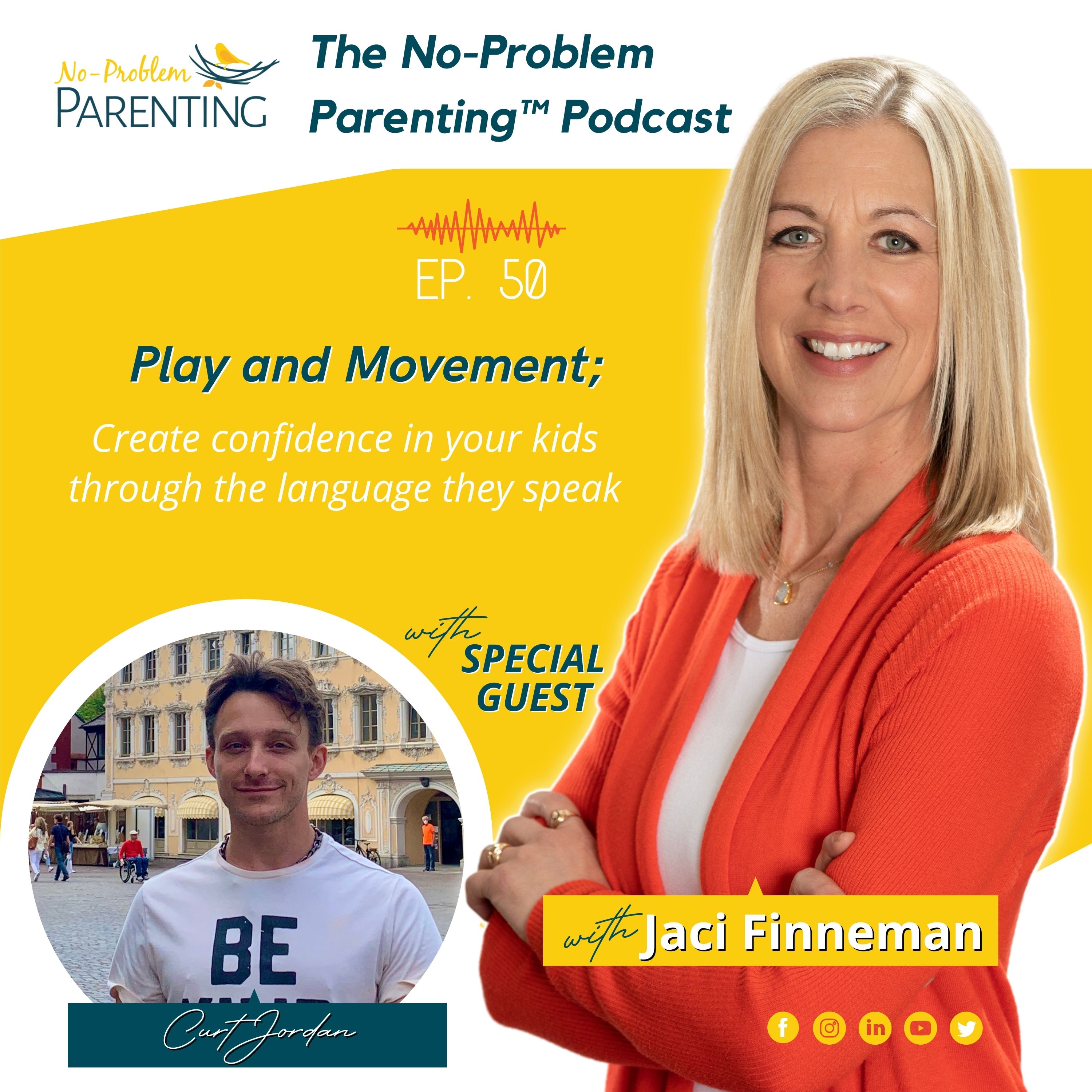
Play and Movement; Create confidence in your kids through the language they speak with Special Guest Curt Jordan of Kong Academy
About this episode
Welcome Back, Parents! Today's episode is about creating confidence in your kids by speaking their language through play and movement!
We talk about the importance of asking questions vs giving answers, preparing our kids rather than protecting them from hard experiences, and 3 Key things that all kids need:
to be self-aware
others aware
responsible decision makers
Become a No Problem Parent Today!
Full transcript
Now in their brain, they have to envision themselves falling and getting hurt, and they're more likely to fall and get hurt. What's better is to say, did you notice, and then whatever it is that you're afraid of. If you say, did you notice that those tree branches are getting really thin? Well, then they're going to be paying attention to the tree branches a little bit more.
You're directing their awareness, right? And then you can say that to them, if you are feeling uncomfortable, hey, I'm feeling uncomfortable, please come down. because that's different than you are going to get hurt. Right. Right. And that's a big difference because what you were doing is we're shutting their ability to grow down. And that's, and that's what we don't want to do because ultimately we have two scales that we can adjust. You can either prepare your kid for the world, or you can protect them from the world and everything you protect them from, you do not prepare them for and vice versa. I love that.
Welcome to the No Problem Parenting Podcast. Turn behavior problems into no problem with Jackie Fineman. Are you ready to become the confident leader your kids crave you to be? Do you want to learn how to make parenting easier and more fulfilling?
Whether you are at your wits end or you want to have more fun as a parent, You're definitely in the right place. Now here's your host, Jackie Finnaman. Hey, welcome back parents. Today's episode is all about creating confidence in your kids through the language they speak, which is play and movement. So we're going to cover things today, like how we should be asking questions of our kids, as opposed to just giving answers, how we can prepare our kids rather than just protecting them all the time. And we're going to cover three key things that kids need to be self-aware, others aware, and be responsible decision makers. The simplest thing you can do when you're upset as a child or as an adult is to say how you feel and ask for what you need. We're going to cover all of these things today with my special guest, Kurt Jordan of Kong Academy. In 2016, after teaching kids for 15 years,
Kurt used all his savings to buy a van and parkour equipment and started his quest to empower kids to become physically and emotionally stronger. Kurt is the founder and chief visionary at Kong Academy. He's a monkey and he loves to play. He's been trained and worked as a physical therapy assistant, a paramedic, personal trainer, lifeguard, parkour instructor, and as a special education teacher.
He started working with kids when he was 13 and he is passionate about helping people improve their minds, bodies, and spirit. Kurt connects with kids at their level and he speaks their language of play and movement. That's why his teaching is so impactful. It's meaningful and relevant to kids' lives.
So welcome to the show, Kurt. Thank you very much. Yeah, so Kong Academy, K-O-N-G in case people are listening and not quite sure what the syllables were. so Kong Academy is a program that is developed social and emotional skills for kids. And we do so through play and movement. And the reason why we do that is because that is the language that kids speak. That is how kids want to be taught. That's what they want to do in their off times.
That's what they, that's what all mammals do at a young age is that they play to learn, right? It doesn't matter if you are a dog, a mouse, a kid, mammals learn through play, because it is not just you interacting with your physical environment. You're also learning how to act socially in a group, which people need. Communication and connection is something that human needs. So and this is way that kids get it, but they also get to explore and build their bodies. And they get to understand tools, and they get to understand, you know, all these different So there's so many layers developed in play and that kids love it. So we use what kids love in order to teach them something that's meaningful and impactful in their lives. And that being social and emotional development.
parkour is an activity uh sport discipline however you want to frame it the way i view it is a discipline of overcoming obstacles um so instead of i mean i'm assuming you've seen ninja warrior right yes okay what you do is uh you take take those specialized courses uh that ninja warrior builds and then put those into the real world except instead of there being a giant scaffolding set where you can swing on these specialized bars, that's just a rail outside. And instead of using it for my hand to walk up, I'm actually going to stand on it and I'm going to walk up it. And then I'm going to jump from one rail to the other rail and can I hold my balance, right? So it's reclaiming your environment, right? The world is your playground and you get to play. But can you do so with a responsible decision-making process? Because parkour, yes, can be dangerous. But just like any tool, it is not inherently dangerous. You are the thing that makes it dangerous or not.
Right. And then, and the nice thing about it is just, just because I gave the example of standing on top of a rail, walking across it and jumping from one to another, that's like, oh man, I would get hurt. And that's usually the frame that people come at it as, as they look at it and they go, that's crazy. You are going to get hurt. That's not true. You would get hurt if you did it because you have not prepared a skill, right? And so we train people to be physically competent by starting on the ground, building their skills up and being able to move with confidence and an actual built skill. So then that way, those are things that are not questions, right? It's just, no, I can absolutely do it. And if I fail, I know how to fall. So I fail safely, right? And that's,
and that's the whole confidence builder, because if you really want to, and this is, this is universal. I don't care if you do parkour. I don't care if you do whatever activity, people become confident and more capable as they build a skill. Right. And that's, and that's where confidence comes from. That's where they learn persistence. That's where they're learning all these things. That's what we really teach them. Parkour is the, is the fun how it is not the what it's not the meat and potatoes. It's the, you know, how we do it is through parkour, But what we teach is social and emotional development.
And we do so in the fun way that kids actually want to participate in. So I love that because I can just envision now kids at a playground, elementary kids, age kids, or even younger at a playground and their parents saying, don't go too high, you know, be careful. And so this is sort of like the opposite of that. And not like you just throw your kids out there and allow them to get hurt, but you're actually going to train them.
Yeah. Yeah. And there's parents in development. Like we even have a course for parents to be able to do the, um, uh, how do they engage in risk play? Cause what you're speaking into is that risk play. And that's a large part of what parkour is, is that it's a form of risk play. And, um, when, when a parent says, don't go up there with, or what they're really saying is I'm scared, you're going to get hurt. Right. And I'm responsible for your life. So you don't do, you know, so as opposed to finding a, and having a communication between you and your kid to be able to say, um, climb up this high X amount of times. And then as I perceive you climbing and you, and you display confidence and competence, uh, then maybe we can go up another two feet,
or maybe we can go up another four feet because what, instead of just saying no, what, what was really happening is they're shutting down the growth there's an out of their fear. And, and it's, and I'm not saying that you should just let your kid jump off a bridge if they feel like it, it's the, it is a responsible decision-making is a process. It is a learnable process and it is one that needs to be developed gradually, but you shouldn't say no instead, actually, I'm just going to give a couple of tips if I can. So one of the best things parents can do is ask questions as opposed to give answers in those situations. So if you say to your kid, get down from there, you're going to get hurt. Now in their brain, they have to envision themselves falling and getting hurt. And they're more likely to fall and get hurt. What's better is to say, did you notice?
And then whatever it is that you're afraid of, if you say, did you notice that the, that, you know, those tree branches are getting really thin. Well, then they're going to be paying attention to the tree branches a little bit more. You're directing their awareness, right? And then you can say that to them, if you are feeling uncomfortable, hey, I'm feeling uncomfortable, please come down.
Because that's different than you are gonna get hurt, right? And that's a big difference because what we're doing is we're shutting their ability to grow down. And that's what we don't wanna do because ultimately we have two scales that we can adjust. You can either prepare your kid for the world or you can protect them from the world and everything you protect them from, you do not prepare them for and vice versa. I love that. So I'm like over here clapping, you know, just super excited about all this because it fits so well into what I teach with no problem parenting, which is saying notice number one, you know, did you notice? And also as a parent, me saying to my kid, Hey, I noticed. So we're noticing our kids. I noticed this behavior or I noticed this thing that you did. And it teaches curiosity and it helps us become curious rather than afraid.
Yeah. Yeah. If you, if you install your fear into your kids, then you're going to have it, you're going to have them be as fearful and we want them to improve the quality of their lives. Right. Right. And so, yeah, we don't want knowledge and not so much caution. Yeah. Yeah.
We're in a very fear-based society right now. Very. Yeah, absolutely. With pandemic and all these things that are going on, you know, right and left. It doesn't matter. It's like, we're, it's almost like we're trying to fight each other. Right. But we're on the same team. So.
Yeah. Yeah. You talk about some skills that kids need to not just make it, but to actually thrive in the world, you know, to actually do really well, not just kind of get by what are, what are some of those skills? So there's three primary skills that people need in order to be able to make it in the world. And I'm not talking about any other domain other than the self and the personal growth. So yes, do people need to be financially literate? Absolutely. Do they need to know how to read and write? Absolutely. Those are not the subjects that I'm talking about. I'm talking about the self. I'm talking about a person, you know, and how they navigate choices and how they navigate social situations and for themselves, because those decisions and knowing how to do that,
which is not being taught, right? And if it is, it's taught so poorly and off the way that kids want to learn that it has the opposite effect of what the intention is. So this is what I'm talking about is social emotional development. So in this world, you have three main things that we are trying to teach kids that are needed skills. And that is focusing on self, others, and a responsible decision-making process. If I am so, if I am self-aware and self-controlled of how I feel, what I need, you know, those, those types of, of skills become invaluable. Like if I'm able to obtain a growth mindset, if I'm able to understand what my strengths and limitations are, if I'm able to know that I can control my emotions and I can set and achieve goals. And I understand a process to do that. And I learned to become persistent.
There is not one parent listening to this that doesn't want that for their kids. Right. Right. And that all becomes so universal in anything they do.
Exactly. So that's why it doesn't matter if that's why I'm talking. That's why I don't really need to talk about other subjects because this is applicable to all subjects because they're the ones showing up to learn. Right. So if this is what they, so this is what Kong Academy develops.
and we so we focus on those three primary things the self others and then responsible decision making so the self is self-control and self-awareness but others is social awareness and relationship skills whereas where it was the self it's self-aware and being able to control myself for here it's can i be socially aware and develop good relationship skills so how do you play that game? Right. For example, like how do you communicate? Do you appreciate others? Do you respect others? If I asked, if I asked your kid, you know, who might be six years old or eight years old or whatever, what does respect me? Most kids do not know how to answer that. Right.
They can give identifiers the behavior, but they don't know what that means. Right. So there's all these different things that are not being taught that have that that account for so much of our lives that we really have an opportunity to change the course of how they show up in their futures so self-awareness social awareness and then finally the responsible decision making process which is how what what system do you use to make uh good and safe choices so that's where we were even talking about in risk play right is you know do the kids do a self check-in right do they you know do they do these things and can we teach them the answer is yes we can teach them this that's what we do but um but this is a thing that all humans can learn because when your kid goes away you want them to have practiced how to make responsible decisions, which is also another reason why risk play is such an important piece, because if they become 18 and they had no practice becoming independent, they did not flip a switch and go to college and become independent.
Right. And that's, and, you know, and we talked about, you know, fear culture and, you know, and I'm sure that you've dealt with this in your, your work history where you've had to, uh, um, you've probably heard from parents that had to call their college professors because they overslept, right? Things like that, right? Just ridiculous stuff that, you know, just removes away from developing personal responsibility because we want to protect them instead of prepare them.
And that is those, those are those scales that I, that I'm speaking to because ultimately that's where it usually leads back to. And can we prepare them to manage themselves, be able to coexist with others and make responsible decisions. Yeah. I just absolutely love all of this.
What can parents do to help develop that respectfulness and responsibility? So the first thing I would ask in trying to craft respect and responsibility is do you have rules for the house? Right. And if no, why not? Do you have consequences for those rules being broken?
And that is where you get the opportunity to teach responsibility and respect, because we want to be able to have kids develop their understanding, their moral awareness around the rights and wrongs of decision making. So if I behave this way, this is the effect. It's not a it's not I'm going to be disciplined. It's not that I'm going to be a tyrannical parent.
it's not that I'm going to you know I'm I'm in trouble like as the kid oh I'm if I do that I'm going to get in trouble that drives me crazy it's because there's just going to be an effect for it yeah because it has nothing to do with it's it's nothing to do with making them feel bad it has everything to do with teaching them the hows and whys of good decision making this is how you make a good decision this is why we make good decisions and then there's consequences for when you don't, and you let those consequences do the work for you. If you don't have rules and consequences, please make some, right? And, and that's going to be a huge thing because that creates a lot of stability for kids, because that's going to be a big thing. And most parents,
and usually when I talk to parents, I say, so, so I'm just curious what, what the rules are for your house. And they were like, well, you know, the kids know to take off their shoes when they get home and then they're supposed to do their homework. And I'm like, no, no, no, I didn't ask a schedule. I don't want to know what your schedule is or your procedures. I'm wondering what the rules are. Like for, for example, in our house, the first rule is be responsible for your own actions. That is the first rule of our home, right? As they're just our personal rule. But what that does is that immediately stops all. Yeah, but that's so great. You are from the Midwest. I know you're in Seattle now, but you're, you're when you, when you hear a yeah, but I'm extremely proud to be from where, uh, from Grand Rapids, Michigan, but yeah. So, uh, yeah.
So if we're going to teach kids responsibility and respect, um, we, we teach responsibility and I'm mostly speaking into responsibility first is we, we need to kind of outlay that this is how things go, right. We need to be able to say, and this is what happens when they don't. And it's removing yourself from having to be the arbiter of judgment and you're letting the consequences do the work for you. I like to use the make the punishment fit the crime. And usually it can form into one of three things, a loss of privilege, a loss of time or a break it, fix it policy.
And those and that's a simple bucket system that I like to use, because that usually kind of encompasses most things, right? Like, right, you know, it's losing privileges, losing time, or, or, you know, if you broke something, then what are you going to do to replace it or fix it? Right? So, you know, and maybe they're three years old, and they break a window, are they going to replace it or fix it. No, but they could help you do it learning how and why, because that is, so it's to the threshold of their capacity, right? It's not that, you know, if, if, if an eight-year-old breaks a television, I'm not going to say, okay, well, you know, that's 900 bucks. So are you going to give me 900 bucks? And it's like, no, however, maybe I have them do some chores to help offset the cost, or maybe they go with me to the store to help carry, you know, we, you know, there's labor that can be associated with it. Right. Right. Right. And speaking of time, a lot of times parents don't want to take the time to do that because it's like, it's going to be a lot of work and to have a three-year-old help when you're putting in a new window, the three-year-old's not really helping a whole lot, right? It's just more of a, it's more of a hassle to have the three-year-old there. However, if you go through that instance and you take the time, the odds are increased that the child is not going to be as disrespectful or irresponsible as they were.
Sometimes it takes kids two or three times of doing the same misbehavior. And that tolerance. Yeah, exactly. So if we want to teach responsible kids, we have to hold them accountable and that's, and then, but also we need to give them the opportunities to fail and try again. Right. Because that's another thing that most parents don't do is they don't, they're like, yeah, I had a hard time. And this is where parents have a hard time because they, because if you have a pre-setup system of rules and consequences, what that does for you is that also removes your, like you having to figure out on the spot, how you're going to react to a situation and control your emotions. And usually that's overloading to parents. So then they just are like, you know what, we're not doing this anymore. And it's a reactionary frustrated experience that then shuts down something like, you know what, you guys don't appreciate it. I'm taking away your Kindles and your Xbox. Yeah. Right. Like that'll make me feel better. And then it's like,
yeah, but there's no learning opportunity there. It was just, you got frustrated and you didn't know what to do. And that's not a, you know, a lot of parents do this and that's, and that's okay because you know, they don't know that it's like, Hey, if you set up and yes, it isn't more work. Absolutely. But it's a critical upfront time investment for you to do that because it pays dividends off in the future.
Right. Right. The earlier you start, the better, because it's taking that taking those gaming devices away. I always just say, oh, I'm going to have a moment of silence for those parents, because really what that does is now the child's not even or teenager or whatever is not even thinking about the problem they created.
They're thinking about how mad they are at you because you took away the gaming device. So we've totally shifted and created another problem. Now we're on, you know, two or three or four more problems. And it's just this hamster wheel of problems. So that's why we say at No Problem Parenting, turn problems into a no problem, get to the root of it. And because that's like, my only guarantee is you're going to have problems raising your kids. But we personalize the problems as an attack on because it's causing more work for us, or, you know, it's disrespectful to us.
And so we're personalizing that. And then when we parent out of defense, then we create this battle and the kids are just in trouble. Yeah. We're always going to have conflicts. I guess it's up to you, to the meaning that you choose to give those conflicts, whether you see them as problems or opportunities. Right. And so, and, and that quick reframe, if you have the tools to which, you know, we, we do being in what we do, then it becomes something solvable. And that's another problem that people are a lot of things that parents get stuck in is they think their problem is unsolvable or insurmountable. My kid is just this way and I have to deal with it. And it's like, he doesn't know that's not true.
Actually, you and I can both guarantee that there's a solution for the, your kids' behavior problems. Let's get into movement because really you're coming from like how you can help create respect and responsibility and confidence in kids is through movement. So let's talk about what that looks like. Yeah. So we rotate through a lot of different quarters. I mentioned the three different ways of kids that can grow like in self and with others and responsible decision-making.
Our curriculum actually rotates through those cycles. So kids get practice in each developing area. So then that way they have those skills being built. And so the way that movement plays a big part into this is that let's say I'm going to use an in-person program example and then an online person example because we do both in an in-person program let's talk about um self-awareness or uh so yeah self-control so we're talking about the self where a kid comes to an in-person class and I'm going to have you pick a station that you'd like to practice at and or I'm going to have you practice doing a jump and let's say it's your first class and you're you know let's say you're six years old, I might just have you on the ground, or I might have you come up after you feel confident to jump off the ground at about like three feet high. And so I've got three, two,
three feet high boxes, and they're going to try to jump from one to the other. And there's some distance in between. Now, it doesn't take much height for the gap and the distance and the negative space in between to go, oh, man, that's pretty far. I don't know if I can do that. That That is a direct focus on identifying your skills, identifying your strengths and limitations.
And then you have an emotional response to that experience. So if you're standing up high, let's say at 10 feet, right? And I had you say, all right, I want you to jump from this box to this box. And it's, you know, let's say it's a six foot distance.
So it's not nothing, right? But it's, and it's 10 feet high and you're looking down and you're scared. Well, great. We have an opportunity to practice what is a responsible thing you can do and what is a way that you can control your emotion to make a good choice, right?
So, because that is where self-control comes in. That's where your self-awareness comes in. And then we get to make a responsible decision. And it's not that I let kids just jump willy-nilly free, right?
Like this is a supervised class. It is, they, all those kids are spotted. So if they jump and they don't make it, they're caught or whatever it is that they're, they're, they're protected. We use soft blocks, things like that as a way to keep it safer.
And we start it low on the ground. But the whole point is that you give them an experience. That's the key. You give them an experience that makes it the learning that you're trying to teach them a need.
So if I have you jump at something that is way too far and you look at me and say, hey, and I'll tell this to my class and say, hey, if you guys need help, all you have to do is say, hey, could you help me, please? right or or I'll say um tell me how you feel and ask for what you need those are this this line is gold yes say how you feel ask for what you need this is something I have it on a drawstring on my back and Elka is laughing at me in the other room because she still uses this and we all do because let's say you're arguing with your spouse, right?
Right, like, hey, I'm upset right now and I just need a few minutes before we have this conversation. How would that change your relationship? And it's simple and it's elementary because these are emotional behaviors and emotional behaviors don't go away because you got older. Then that's where the thing that is ridiculous is that adults think they've mastered it because they've gotten older, right?
Yet how many adults do you know that are still potentially throwing temper tantrums because there is some emotional imbalance that they need to address, whether it is a self-awareness or self-control issue, a relationship skill, a responsible decision-making skill. These things are human. That's why these are so important. And to give them a physical experience where they get to understand the actual practical need because gravity doesn't care if you think you can make it and you can't, right? Or, you know, like there's things that are outside of our control.
So playing with those unseeable forces that exist, right? Like that we have to honor or we're going to get hurt. Kids are not dumb. Kids have very strong self-preservation and parents don't usually give them credit for that. Right. A kid does not climb on the roof and then think, I mean, you may have a daredevil at home. Right. But kids, even daredevils do not want to dodge.
Right. Like even though they don't have a full concept of what that might fully mean, they know hurt. They know pain. They know babies don't crawl off edges. Yeah. Right. Like you don't haven't, you haven't taught a baby anything. We're born with two fears, fear of falling and fear of loud noises. Right. You don't have to teach someone to be afraid of falling. So I don't need to, uh, yeah. So we use that to our advantage when we're doing our in-person programming.
So then they have to do that, um, in order to progress in the program and be able to, you know, master their skills and which is all things of why kids join activities in the first place. Um, no, you're, when you're saying that daredevil thing too, I just, the daredevils are like my favorite kiddos. I don't know. I think that, and I'm just thinking about this. So it just popped up it's because of their confidence I think it's truly like I admire kiddos who are daredevils and that just that that confidence uh so much a few years ago we were at a fourth of July uh outdoor fourth of July venue and a friend of ours some friends of ours were there and and uh here their kid is like I don't remember how old he was maybe seven or eight but he's climbing up the basketball hoop you know the metal basketball hoop like literally just he he climbed that thing like it was nothing and then hanging from the basketball net and then just dropped himself down you know and those are what six eight feet I don't know how tall a basketball net is outdoors you know yeah yeah tar below him and he's just this climber and his mom's like oh man he's like gonna give me a heart attack on any given day but I was like this is fascinating which I'm sure if you're a parent of one of those kids it becomes a little much sometimes oh yeah because they're You can ask my mom. That was, uh, Oh God. Yes. I mean, I'm a, I, I have a education company where
we get to do, you know, risk play and parkour and rough and tumble play. Like that was a hundred percent of me. Yeah. I was on top of this. You knew what parkour was or any of that. That was way before, right? Yeah. This was just the thing I did. Right. Uh, grow up with it. No, I gave my mom most of her gray hair. Thank you. Uh, but what do you say to those parents? And that's where the responsible decision-making process comes in and that's where I would highly recommend, you know, I mean, we do have a program for wrist plate training and I, you know, um, but I would, uh, um, and, and that's where I'm just going to give you guys a couple of tips is that, you know, asking, did you notice is such a powerful tool for, for those kids? Um, because you're not saying no, you're giving a redirect. And if there is something that is an absolute no-go, you can stop the activity, bring them over, explain why, and then redirect them to an activity.
So stop and explaining, then redirecting. Stop, explain, redirect is a much better way than saying no and stopping it because they have the need. Otherwise, they wouldn't have done it in the first place. So those kids that are daredevils, they have this desire to be able to go and play, move and they they they want to defy gravity and they want to experience these you know different stimulus which is great that's part of their character that's part of their virtue but how do we channel it if there's something that is absolutely no-go absolutely unsafe stop them bring them over explain to them what the concern is redirect them to something similar that still gives them the same benefit, but is something that is acceptable within your limit. And this is a good way to actually develop trust with you and your kid. And I know that you guys probably trust each other, but chances are in this situation, you don't really, right? And that's a really good point too. And I love that, that trust factor in there, because I think a lot of times kids won't, they'll do risk-taking things and more and more when they're not in the comfort of our care, right? As they get older, just thinking, oh, my mom or dad would be freaked out if they only knew I was doing this or that. But when you're having that interaction with them and you're not saying no, you're just saying, hey, I noticed and helping them think this through and
then giving them another option of something else to try that helps them know that they can come to you and that it's not just going to be no, because really their brain muscle is most likely flexed to think, I better not tell them I'm going to do that because they'll just say no, they won't let me. Yeah. Kids, kids hear the kids hear the word no, like 300 times a day. Right. Like I was looking at the, I was looking at this, uh, recent like polling and it was like 300, like almost 300 times a day. I was like, man, if someone kept saying no to you, like, how would you feel after all that time? Right. It's like, this is a need you have. And so instead it's redirecting them to an activity. Like, let's say your kid really likes to climb trees and they really like to go really high. And you're like, Hey, uh, you know, I'm, Hey, if you could stop, you know, it's been raining, you know, I'm worried that you're going to slip. I'm not saying you are. I'm just concerned about it. Right. So instead, would you mind climbing across this wall or would you mind instead of vertical height? Can you can you climb out for distance right to where the height doesn't change, but they're still climbing and they're still getting that need met. Right. It's basically you're teaching kids to climb walls, which I think is amazing. Absolutely. Yeah. I mean, yeah.
yeah I'm gonna have the links for everything in here go watch some videos people this is fantastic stuff I've I've stocked you a little bit on there it's amazing thank you um things that you're teaching the kiddos yeah and it's and it's but it's not done but also just one caveat to that is even though they're climbing walls we're teaching them about social awareness and relationship skills so you know what walls are appropriate to climb what ones are not um you You know, when someone said, exactly.
No, because it's true though, because this is a great opportunity because let's say you're climbing at a, you know, at a public park and a park official comes over and says, Hey, you know, I think what you're doing is unsafe. I'd like you to come down, please. Okay. No problem.
Because literally this can be done anywhere. And so, um, yeah, so, so it's not like I needed that one specific thing. It's like, no, there's tons of stuff and this can be done on the playground. This can even be done in the living room, which is, I've told you I would go into like a little bit of the online stuff just because I know that a lot of parents are at home.
So, you know, you asked me, okay, but what if my kid's not in a class, right? What would I, what would I do for, like, how would they engage? How do they develop social awareness at home with this online program? Right. Because you're in Seattle and I'm in Minnesota and I've served people all around the world and they need to be watching and hearing this. So there is some benefit to your online programs.
absolutely yeah so the the goal there is um we still provide them the same activities and the same outlets but we do that inside your living room which at first is like what are you kidding me no they're not going to smash and tear up my living room which is true they're not because even in the first class we talked about how do they develop social awareness we teach them responsibility right away we teach them responsible decision making by what can you use what can you not use? What do you have permission to use? What do you not? You know, there's, we are responsible for putting away our things afterwards. All of those things are actually integrated in the program.
And so you were asking about how do you teach responsibility? How do you teach respect? Teaching kids at home to respect their environment, right? To respect their couches, their coffee tables, the things that their parents have provided them for and to get, you know, these are, these are not, these are big deals. These are not like things that kids hear often or, uh, or from people that are maybe outside of their units. Right. So, so you have trainings online, you have training for parents as well. You have your thriving kids parenting, right?
That's right. Yeah. So we're going to have a link in there for that as well. And that helps you to be able to teach the parents to do what you would normally say or do. So parkour is, uh, um, you can absolutely train. We've got some videos and things that you can, you can jump on. Um, I'd be cautious about using generic YouTube channels and things because most park, like you're going to see a lot of parkour professionals, and then you're going to see fail videos and you're going to see a lot of things that don't necessarily take you through the steps. So my ultimate advice would be to play outside safe and in a way you feel safe and comfortable, right? Challenge yourself in your jumping and in your balance and your, you know, the things that you feel comfortable and confident in, we can give you extra support, but there is no substitute for experience. And so I can tell you advice all day long, but if you don't go outside or you don't do something, then that's nice that I said something, but you know, they're not really going to get the stimulus that's going to make a change. So if they're going to make a positive change, they should go outside and play,
or they should, you know, engage in one of our videos or they can, you know, um, but I would just be cautious about generic YouTube, uh, parkour tutorial videos, just because that can be very, very high level very quickly. And so, and that's where the, that's where it's not really designed necessarily for kids. And that's what we focus on. So good. So let's talk about how people can get in touch with you. How can they connect and reach out? Yeah. So we're on social media.
um it's kong academy k-o-n-g uh we have facebook instagram um we have our own website kongacademy.org um and we have our uh online program as well as if you're in seattle we have an in-person program um and then you can always email us at uh info info at kongacademy.org um and we check that like a monster. So, you know, if, if, yeah. So, and, and we're also assigning, we also have launched our thriving kids parenting. But if you want to jump on, we have a member vault you should find on our, on our website. So we have an online program called the con kids worldwide program.
And, but in there, that's like, we have our risk play stuff. We have a bunch of resources that I would absolutely encourage using because it makes a difference. We've heard from a lot of parents that it makes a difference. So if I promote anything, it's like, go to our website, join our online program. It is absolutely a hundred times worth what you pay for. Definitely going to make sure to get all the links in there. I just really strongly encourage parents to reach out to you guys and learn more about how to get our kids moving and developing their social and emotional skills than ever. So thank you so much, Kurt, for being on the show. Thank you so much for having me. I really enjoyed talking to you. Thank you. Thank you for tuning into the No Problem Parenting Podcast. Join Jackie next time for more tips, tools, and resources that will help you become the confident leader your kids crave you to be. Who do you know that we could support on their parenting journey? Like this podcast, subscribe, share, or leave a review of the show.
Your support of the No Problem Parenting Podcast pays it forward and helps us help more families. Thank you.
Become the confident leader your kids crave
The method, the community, monthly live Q&A with Jaci, and Celia — your AI guide in the moment.
Start your 14-day free trial Get it on iPhone or sign up on the web