
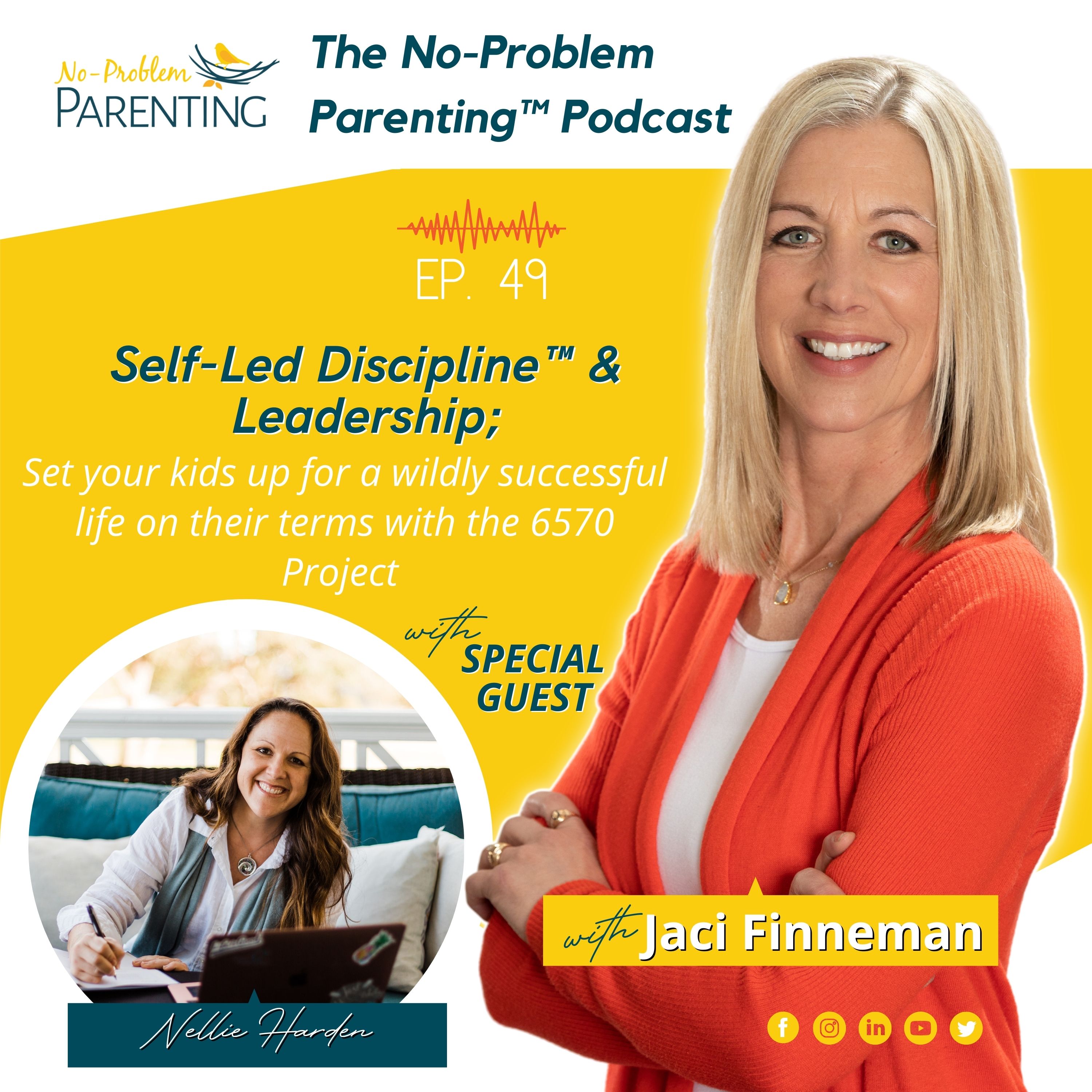
Self-Led Discipline™ & Leadership; Set your kids up for a wildly successful life on their terms with the 6570 Project with Special Guest Nellie Harden
About this episode
Welcome Back, Parents! We have 6,570 days to raise our kiddos to adulthood! Listen in as my guest shares how the "problem" that you're faced with is almost always not what it appears, and how "letting go of the rope and pulling up a chair" can help you raise a confident, self-led leader!
Become a No Problem Parent Today!
Full transcript
Welcome to the No Problem Parenting Podcast. Turn behavior problems into no problem with Jackie Finneman. Are you ready to become the confident leader your kids crave you to be? Do you want to learn how to make parenting easier and more fulfilling?
Whether you are at your wit's end or you want to have more fun as a parent, you're definitely in the right place. Now, here's your host, Jackie Finneman. Hey, welcome back, parents. You know, No Problem Parenting is all about helping you become the confident leader that your kids crave you to be.
And when we're confident, our kids just do better. We can help them become confident. And I brought a special guest on today to help us do exactly that, to help us raise confident kids. I'd like to introduce you to Nellie Harden.
She is a wife and a mom to four daughters, teens and tweens. She's a dreamer, an adventurer, a servant, a multi-preneur, a forever student, and a devoted teacher. But her, as she calls it, ride-or-die passion is her work as a family life and leadership coach. Her work and her passions exist in the realms of family and parent mentorship because she believes that a family filled with creativity, with fun, laughter, challenge, adventure, problem-solving, hugs, good food, and learning can not only change a person's life, but it's really the best chance at positively changing the world.
She helps families build self-led discipline and leadership into their homes in order to set their children up for a wildly successful life on their terms and elevate the family experience with big joy, palpable peace, and everyday growth. She started the 65-70 Project, which 65-70 is the actual amount of days that we have from when a child is born until they're 18 years old to find clarity on how to show up for our kids, to learn how to communicate with our kids, to master time, discipline, and create some of the best memories of all of your lives so that there's nothing but gratitude between you and even the years later. So 65, 70, 6,570 days to do that.
Her Family Leadership Academy is a unique one-of-a-kind, once-in-a-parenthood experience designed to unlock the greatness of your child as you move from parent-disciplined leadership to self-discipline leadership so that you can leave the regret, the frustration, and wasted time behind and fully embrace every moment in joy, peace, success, and growth. So without further ado, welcome to the show, Nellie. Thank you so much for having me on here. We were talking a little bit beforehand. I think we're definitely cut from the same cloth, so I love it. My name is Nellie Harden. Let's see, quick bio, I live on the coast of the United States over in North Carolina, four kids, married for a couple decades plus at this point. And I am a family life and leadership coach. And really where I have a long birth story to not long, I'm not going to keep you forever, but I have a interesting birth story to this work for me. Just from the fact that when I was super young,
I lost my dad when I was super young. He passed away when I was one and a half. And so I always had this very idea of life is very precious. Life is very fast. If you are going to do something, do it today. Very carpe diem, you know? And so I was going along, you know, you have this life plan. I was going into, I was a Michigan kid, middle of the country, and somehow I had salt in my veins and wanted to be out in the ocean. And I went into marine mammology. And of course, in my life plan, I was like, okay, I do this, this, and this meet the husband at like 28, 30, and then have kids, you know, well, you know, lo and behold, I meet the husband at 18 and we get married four years later and, um, all of these things. But, uh, we were, uh, going along, we started wanting to have a family and we went through infertility for a while, which was devastating and very difficult, but then we had four kids in four years. And so that was not devastating, but very difficult. Yes. You have a set of twins in there, right? Yes. My middle two are twins and they're all girls. And so now today they're 16, 14, 14, and 12. Um, but yes. And so when you have all of that turmoil happening and, um, we had a major life event with my, uh, with my husband, um, happening in there, he went into, in his early thirties, he went into cardiac failure and then he's still here today. Still good. But he did go into cardiac failure. And for two years,
it was hospitals and it was medications and it was self injections and it was procedures and all of the things. Meanwhile, I'm pregnant with my fourth and he can't even go up and downstairs. So it was, I mean, if you can imagine a tumultuous time, it was a tumultuous time. And in around circa April, 2010, I'm sitting in a waiting room, a hospital waiting room.
My husband's in a experimental heart surgery. That was our last effort. Like we had exhausted everything else. And I have four kids at this point, then four kids, four and under, and he's in surgery.
And it is a very eyeopening moment. And I all of a sudden had all of those feelings and understandings of life is fleeting. we have to take care of what we want to take care of today, today. Right. And, um, not to say, you know, blow everything and go to Greece, which some days I want to do, but, um, you know, I was just saying, whatever you want to do, do and plan your life accordingly. And then just five weeks later, uh, one of my daughters, uh, who was two, one of the twins, she actually had a non-fatal drowning accident in my in-laws pool. And that those two events, just five weeks apart from one another and she's okay today, but we had to watch her for about a year for neural signs. We brought her back with CPR. It was, it was, it was big. So 2010 really was just a wake up moment, like a really hard wake up moment. And we started asking ourselves, hold on a second. We are not guaranteed any time. We have a very limited time with our kids at home. In fact, we have 6,570 days. That's where that number comes from. It's how many days are in 18 years. And yes, it's not exact, you know, we don't boot them on their 18th birthday or anything. But that's approximately what we have when we are in the highest influence and highest impact zone for them. And so what do we actually want them to get out of this childhood experience? We didn't want to just go at it haphazard. We didn't want to just hope for the best. We didn't want to just go with the herd
and be like, okay, well, I'm checking all the boxes along the way, but we wanted a destination. And if we had a destination, we could build a map to get there. And that's exactly what we really started planning for our kids' childhood, for my husband and I's parenthood, right? This is 18 years of our lives too. And also for our lives in general. And it was really a beautiful thing to have our kids be able to grow up with that sort of mentality of, okay, I am actually physically and planning my life. And it's been a beautiful thing ever since. And I just started documenting and doing things and working with families in 2012. I started working with families and I've been doing it ever since in different capacities. But it always, always, always came back to building in them the leader that they can be that self-led leader, because you need it for everything in life. I remember when I first started, I did polls and I was like, is there anything, is there anything that you can do without having that self-led leader inside of you?
And the answer was no. And so that's what I decided to go all in on. And it was really my calling to help families do that when the kids are still at home so they can launch into their lives equipped for their greatness. Wow. And you just said so much in there. I like just your, your survival story, should we call it? Like, I mean, my goodness felt like that some days.
Yes, for sure. And the resilience that you have to have to be able to get through all of the fear that you've been through, um, you know, especially in those early years of your, of your marriage. I'm just happy to hear that things have all really turned out. Yes. And gone well in the long run for you. And I love that you say building leaders and kids, because I do feel like as a parent of my own child and in all the work that I've done with other families, like when our kids can be confident leaders, they, it just, it prevents so many problems. It helps them build resilience of their own. And really after leaving 20 years of being a counselor, my mission, my goal is to help parents become confident leaders for their kids, right? It increases the odds. Now you can be a really sucky parent and you can just mess up completely. And those kids, believe it or not,
there are plenty of kids that are going to turn out great despite your worst parenting moment. It's just, it just fills me up to help talk parents off a ledge and get you to feel like that confident leader that I say your kids crave you to be. So I think that's why we're kind of like sisters from another mister or something with, with our message and the kind of coaching support that we offer to parents and families. You really offer it to the whole family.
What does the family leadership coaching look like? Well, there's different levels. And I just want to meet people where they are at. And I do, I love working with the whole family and I really leave it up to the family because I work with all ages. So if the kids are younger, then they're there for some of the time or not some of the time, but if they're older, then they're there a little bit more often. And it really is all about establishing a foundation of communication within the family, right? I always look at it like an arrow, um, more like a ray in geometry, I guess, but there's the dot that's connection, but connection is just a, it's a point, right? You can't keep going with connection if you don't have communication with that. So connection is your point. Communication keeps it going.
And then clarity to know where you're going is the arrow so that when we are literally launching them into life, uh, later on, I mean, this is a 6,570 day runway, right? So when we're launching them into life, they have that direction and they have all three pieces of that. And so when I work with families, I am going through core beliefs. I am going through how to, um, how it is, uh, to discipline, right? Consequence discipline and growth discipline. We are talking about the inevitable impacts that are happening along, happening along the way. Like you said, you saw, you know, parents are going to screw up. I am not a perfect parent by any means. And so we are going to screw up along the way and it is going to impact, but how are we going to shape that impact?
You can screw up and not say anything and it makes an impact and you can screw up and say something and discuss it and it makes another impact. Right. Um, so anyway, we talk all about those things, really spend a lot of time in communication, how we take in information, how we put out information, body language, right? All of these different things, because our families are our training zone for the world later on. And so if we can launch these kids into their lives, having cemented into their core beliefs and their, their perspectives, their worldviews, we can cement in there how to actually have a productive conversation, how to have that resilience, that vision, that vulnerability, that discipline, and all of those things that are encompassed in that leadership, if we can go into life that way, when we're 18, 19 years old, then we can accomplish so much more than what we're doing. And I'm not talking about success and, you know, the way that the world might view it or what have you. I remember one person told me when I was discussing my work with him, he's an older gentleman. And, and he said, not, not everyone wants to be a CEO.
And I was like, oh, and amen for that, right? Absolutely not everyone wants to be a CEO, but leadership is not reserved for CEOs, right? Leadership is for employees, right? You, as a business owner, you want your employees to have that self-ignition within them to be able to go and see a problem and go through the motions to fix it and be diligent and get to an accomplishment on the other side, right?
You need leadership to lead a family. You need leadership to just wake up in the morning and lead yourself throughout the day in the conversations that you have and all of this. So I think that's something that I find interesting today is that a lot of, a lot of people do feel like this leadership is associated with and reserved for the business sector. And that's not true at all.
Everyone needs that leadership within them. I absolutely agree. And I think parenting wise, we often don't think of ourselves as leaders. We think of ourselves as like, we have to teach lessons, you know, and parenting.
It's our job to teach kids a lesson. It's our job to warn them, you know, what to be careful for, to watch out for this or that, or to tell them right from wrong or to do. And it's like, well, yeah, kind of. But when your typical form of communication is just kind of like telling your kids what to do, how to do it, how to jump and how high and, you know, what to not do and warning them and all that you're really, really off track. And kids start to resent their parents. If you have a very compliant kid, they'll go along with it until, you know, a certain point or a certain age, and then maybe they'll start to rebel. But if you have a strong willed kid, or if you have just a strong leader, necessarily strong willed, but they're just a natural born leader, they're going to buck your system and they're going to challenge you nonstop. And so today that's what We're going to talk a little bit about the power struggle stuff and the communication and how to have some leadership communication with our kids.
What is a power struggle at its core? Yeah. I mean, it really is. It's a control issue, right?
It's a control issue of I, it's not, I want to be right necessarily. It is, I am in charge of me and I need to be able to grasp onto something because if, if you're telling me everything that I'm doing is wrong, then that means I have no foundation to stand on. And you see this in two-year-olds, even younger, you see it in, you know, 50-year-olds. But these power struggles, they go back and forth. And I really look at them as like a tug of war, like, no, I want it. I want it. And what's interesting is recently I actually took my, I, we have two dogs that are rescues and, and mind you, my whole background, my first 10 years of my career were animals. My second 10 years and going on plus have now been humans. So I see all of these correlations and it's kind of funny, but we took, uh, two of our dogs who are rescues to training the other day because they're kind of crazy. And the trainer that was there, she took a rope in her hand and she said, uh, she, or she put it in our hand and she said, okay, I'm going to do this. What is your first reaction? So she pulled it. What is your first reaction to do? If something is pulled, if someone is pulling something out of your hand, it's back, pull back.
Yes, exactly. And so sometimes that's exactly what a power struggle is. Sometimes people don't even care, right? What the topic is. It's just that someone is pulling their rope. And so they're going to pull harder. It could be whether to have wheat bread or ciabatta bread for dinner. I don't know. You know, it could be something totally inane. Doesn't matter. No one actually has an opinion on it. It's just that you are pulling on their strength. You are pulling on their control.
And so they're going to try and take that control back. And that's really where it, where it comes from. And so coming, stepping back and understanding, wait a second, are we actually having a power struggle over something that matters right now? Or are we both being irritable and just pulling each other's, you know, rope back and forth in this tug of war game. It's amazing to see what happens when your child is starting the tug of war, maybe right.
They're, they're not wanting to get their shoes on or they're not wanting to get ready for school or they're not or bed or whatever it is. And parents join in on the battle. So how can we prepare for, I mean, and it is kind of silly if you think about that with a, you know, an adult playing tug of war with a toddler or even a teenager over something that doesn't really matter. Is this just an effort to win a battle and just to feel like I'm in charge? We both want to feel like we're in charge, right? How do we prevent a power struggle? How, what kinds of things can we do to prepare if we know a battle might be coming or even if we're caught off guard?
Right. Well, I think power struggles too. It is very, very, very rarely that the power struggle is about whatever the power struggle is verbally about, right? If you are leaving the house and your kiddo is trying to put his shoes on and you're like, we got to go, we got to go, we got to go. And then there's like, I'm doing the best I can. And then they start being defiant and all the things. Well, that really, let's take a few steps back. Right. And we didn't set up for success very well. And I can say this because I'm guilty, so guilty of this, right? Maybe we didn't give ourself enough time to get ready. Right. And so now we're rushing and our anxiety is high. We're worried about what, whoever's going to think or whatever, where we're going. And we didn't set ourselves or our kid up for success and giving ourselves enough time. So we're having this power struggle with our, you know, our kid about tying their shoes, which they're obviously trying. Um,
or even if they're not, maybe they're not trying because they're mad at their sister for taking a toy 30 minutes earlier, you know? And so I think the best way to prevent power struggles is to plan for success, meaning setting up for success by giving yourself enough time, walking through, calming down it within the, within the situation that you're in. Right. And for the kiddos, just look at them and understand that they are trying. Now there's going to be some times that they are not. And they are just being totally defiant and, you know, rude to you, but it's not because of whatever is on the surface. There's something else happening. So sitting down, I always say, drop the rope, pull up a chair. That's, uh, for power struggles. You want to drop the rope and pull up a chair and you just want to get on their eye level, right? You're not towering above them. You want to get on their eye level and just be like, so tell me what's going on. And they're like, I just can't tie my shoes. And they're like, okay, I get that.
But why are you so frustrated about this? What's really going on? And I am telling you, even a two-year-old can vocalize this. I have been having real conversations with my kids, not, you know, not the goo-goo-ga-ga, right?
Or like real conversations with my kids, their entire lives. I mean, we were faced with, like I was saying earlier, I was in a hospital with four kids that were between four and little, little, um, when we didn't know if their dad was going to make it, we had to have conversations, right? And they are so willing and able to actually communicate with you and give you their thoughts. If you give them the space to do that, kids are miraculous. They really have a lot of amazing ideas in there and just sitting and giving them room to give their opinion. You don't have to take their opinion, but giving them space to give their opinion, it, I mean, it's, it just changes the, it turns the page. So avoiding power struggles is setting up for success. Right. And I, I love that you say that because oftentimes it's not that they don't want to put their shoes on. It's not that they don't want to get their stuff together and get to school and they want to have this big battle or whatever. There's something underneath it all, right? There's something underneath it all. It's the seek first to understand what is this power struggle about? And they just need, it can be 30 seconds of you,
even just empathetically, which goes into step three about changing the conversation to say, Hey, I know you don't want to be this upset. You know, I know you don't want to be struggling right now. What's going on rather than buying into the fact that this is a personalized power struggle that they just want to be defiant and be mean to you for some reason, right? We are the adults, we're the leaders, we should be able to identify that. So let's get into the tweens and the teens. And like I mentioned, step three of changing the conversation, you know, I think oftentimes they hit their, our kids hit those tween years and we start to kind of feel like we're losing them. We don't know who they are, their behavior's changing. We sometimes don't even understand them, you know, or what they're talking about, or we don't have the same interests that they're into or that sort of thing.
And so how do we break through the walls they might be putting up so that we can really have a good conversation, get to know them again, almost, right? And connect with them. What are some ideas for us? My number one idea for sure.
What do you do if you meet somebody as an adult and you're like, oh, I'd like to get them to know them more, right? You date them. That is what I suggest you do with your kids. Now I have four kids.
That's a lot of kiddos to date per se, but, um, having one-on-one time and keep in mind, I have all tweens and teens right now for, uh, 12, 14, 16. And, and all teenage girls. That's fantastic. Yeah.
You're earning your halos every day, right? It gets interesting. Sometimes I gotta say, um, and the world outside of our house, I mean, it's, it's crazy out there and the virtual, uh, social world. It is crazy out there. So being able to stay connected, remember I said earlier, connection is a point, and then you have to have communication to keep it going, right. And then have the conversation to have clarity. And it's so vital. So having that one-on-one time every week is, is what we do. So we date our kids, um, every Tuesday and Thursday night at nine o'clock, I go to one kid's room. My husband goes to another one. And then on Thursday, my husband goes to one kid's room and I go to another one. And so every week my kids know that they are going to have, and we have family time every single night, six to nine is family time. And then Sundays are our family day and all of this stuff, but it's different to have that one-on-one time, right? Because their siblings aren't around. We aren't talking about what's happening during the day. It's literally sitting on their bed or going for a walk or doing whatever.
and it's, Hey, so what's going on with you? How are things going? Um, and it's just your eyeballs and their eyeballs looking at each other. And there's a lot of truth, a lot of honesty, a lot of trust that is built during that time. And they know that every week they're going to have a parent in their room with one-on-one time talking to them. Right. And sometimes we play games and sometimes we have, you know, life serious conversations and it's just whatever the relationship, whatever they need that day, that's what we do. But I think that's the most vital thing that you want to do. You knew them when they were young because you were their whole world, right? But as they're going into tween and teens, they're having an entire world outside of your world. And so in order to stay connected, you have to keep that communication going and having that one-on-one time, that date time is, is a great way to do that. Yeah, that's absolutely fantastic.
And I think we schedule so much these days, our calendars are full and they're booked and then we can't wait to binge watch, you know, our favorite show and just veg out. But usually the reason we feel like we do need to binge watch our favorite show or, you know, something like that is because we're stressed or overwhelmed by everything. I think this is just a real schedule in that time with the kids so that you're not dreading, right? The behaviors that are coming up or, you know, the things you've missed out on or overthinking the conversation that you should be having with your kids. I think it is important. You know, some parents will say, well, I could never do that.
Well, yes, you can. You actually really can. It takes a little work. If you can schedule sports and extracurricular activities and piano lessons and, you know, whatever else it is, you can schedule some time with your tween or your teen, and it will prove super valuable in the long run.
Right. And it's not coming up only when there's a problem. Right. Exactly. You're preempting it.
And for parents out there too, that are like, I could never do this with my kid. We just sit there and stare at each other. And I'm like, okay, then sit there and stare at each other or like just paint something together or do a puzzle together, or it's okay to sit in silence with your kid. And at the beginning of this, as you're learning how to be in one another's company, because sometimes that is just step one. You've over time, you've kind of forgotten how to be in just one another's company, right? I think about like empty nesters after all the kids go and the, and the husband and wife need to like relearn who each other are, you know? Um, but that can happen in even a parent child relationship. So just get to know each other, be comfortable in one another's company. And maybe on the third time that you're doing it, uh, maybe 20 minutes in there, like, so this thing happened at school and you're like, oh yeah. So tell me more about that,
you know, and you can just start having the conversation much more naturally. You don't have to go in there and be like, so we need to talk about these, you know, nine things. Right. Yeah. Not this pressure thing where your kid feels like you're in a business meeting or something. Right. Yeah. That's a really good point though. And I think, you know, social media is a big or gaming is a big quote unquote issue for parents these days, but really one of the easiest ways to make it a non-issue is to actually watch your kids while they're gaming, watch them while they're on Tik TOK, scrolling through Instagram, doing whatever, be interested and be curious about what they're into, like what they're looking at. And it is so hard. Take it from me, mom of a teenage boy, I am definitely not into a lot of the things that he's into, but the best conversations come when you're just sitting next to them and actually interested in, you know, it doesn't have to be technology. It can be whatever it is, what playing they're painting, they're doing Legos,
they're, you know, creating something, they're playing their Barbie dolls, whatever it is, but literally just being and sitting there. And even if nothing great comes out of the first time that you do it or the second time or the third time watching Minecraft years ago with my son, I would get dizzy from watching him build and create, you know, I didn't really, I wasn't keeping up with what was going on, but it was so interesting and fascinating to hear about his creations and, or why he was doing what he was doing and to just learn. And then all of a sudden, just like you said, a conversation would come up about something a kid did at school that day.
That was really funny. I really, really love the idea of scheduling, scheduling time and just doing it no matter what. Yep. They've come to just rely on it and they love that time. They're like, Oh, we got to turn off our, you know, usually between eight and nine, we watch a family show together or whatever. They're like, Oh, only a couple more minutes. It's one-on-one time tonight.
You know, Oh, that is absolutely fantastic. All right. Well, we have to get running here, but, um, tell us a little bit about how people can get in touch with you and they can learn more about your family architects club and also your family leadership masterclass. Yes, absolutely. So I am a, I keep to the KISS principle, right? Keep it super simple.
I am not a complicated person. So I like the one-stop shop and that is my website. You can connect to everything through nellyharden.com. That's N-E-L-L-I-E-H-A-R-D-E-N.com. And the family architects club is my online community. I call parents architects because we are literally designing, planning, and building the beginning of someone else's life, which is no small feat.
And if we are architects, then our greatest project is the 65, 70 family project. And that is getting them through their training into adulthood with a whole lot of laughs and kitchen dance parties and fun and also building intentional building. And so, um, yep, you can find everything, including a masterclass that I do on there called Ignite Their Inner Leader. And all of it is open to you just directly from the website.
That is fantastic. All right. And you're new to podcasting as well. And so they can find you at the 6570 Family Project Podcast.
Yes, absolutely. Well, thank you so much, Nellie, for being with me today. Of course. This was so fun.
I look forward to staying connected and partnering up even, I think, on a few different projects. This will be fun. I'm so glad to have met you. Oh, you too.
Thank you. Thank you for tuning in to the No Problem Parenting Podcast. Join Jackie next time for more tips, tools, and resources that will help you become the confident leader your kids crave you to be. Who do you know that we could support on their parenting journey?
Like this podcast, subscribe, share, or leave a review of the show. Your support of the No Problem Parenting podcast pays it forward and helps us help more families. Thank you.
Become the confident leader your kids crave
The method, the community, monthly live Q&A with Jaci, and Celia — your AI guide in the moment.
Start your 14-day free trial Get it on iPhone or sign up on the web