
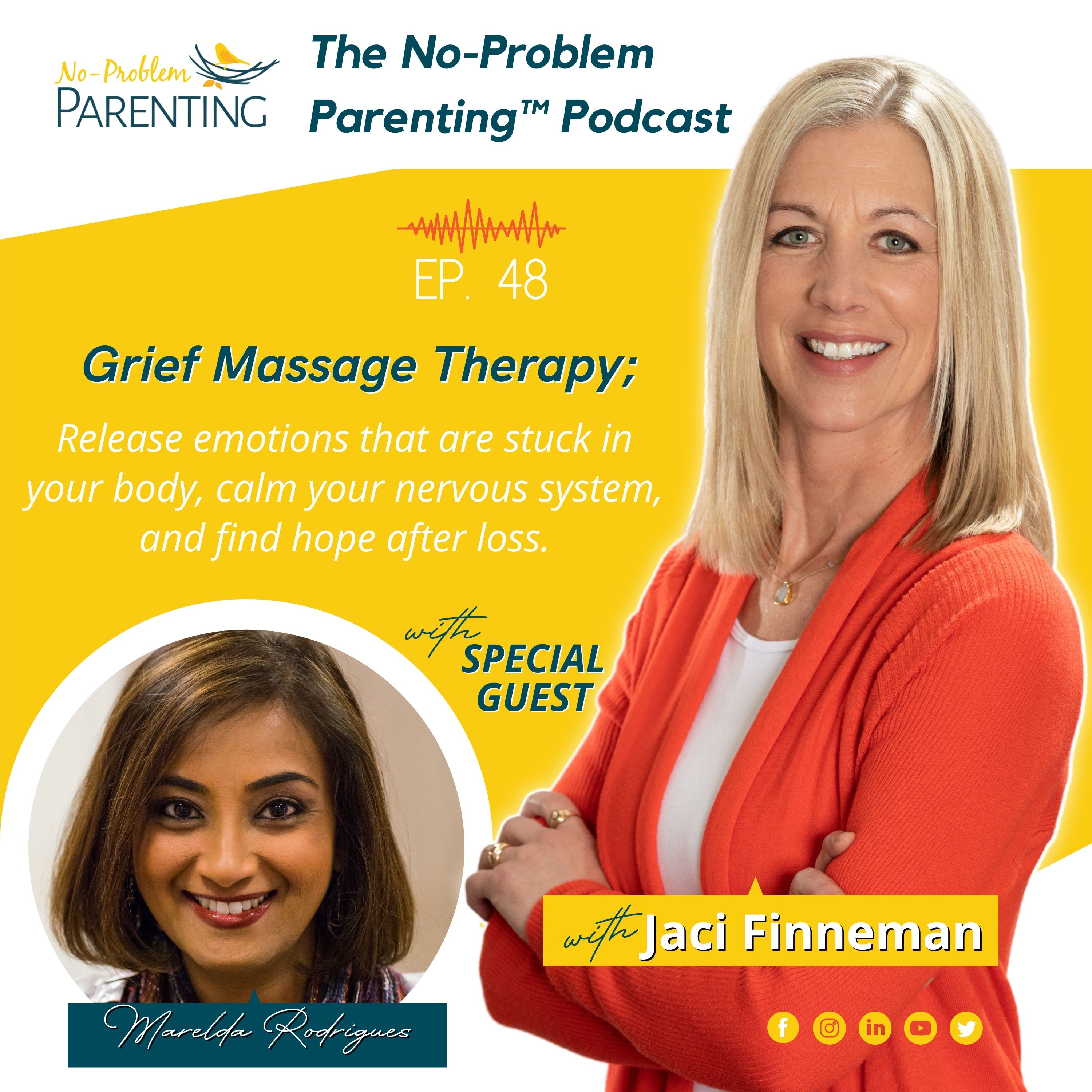
Grief Massage Therapy; Release emotions that are stuck in your body, calm your nervous system, and find hope after loss. with Special Guest Marelda Rodrigues
About this episode
Welcome Back, Parents! Today's episode is about how grief and emotions are harbored in our bodies.
We discuss simple yet effective ways to take care of and support the "injury" that
grief causes both physically and emotionally.
Become a No Problem Parent Today!
Full transcript
Welcome to the No Problem Parenting Podcast. Turn behavior problems into no problem with Jackie Finneman. Are you ready to become the confident leader your kids crave you to be? Do you want to learn how to make parenting easier and more fulfilling?
Whether you are at your wit's end or you want to have more fun as a parent, you're definitely in the right place. Now here's your host, Jackie Finneman. Welcome back everybody to the No Problem Parenting podcast where we choose to deal with and overcome the behavioral and emotional challenges within our homes. I'd like to introduce you to Mirelda Rodriguez today.
Mirelda is an expert when it comes to feeling emotions through touch and helping clients move through the ones that are stuck in their bodies, thereby creating disease. Her unique approach combining science and intuition has helped numerous clients experience freedom from pain. Merelda believes that dealing with emotions constructively and confidently, I love that, is the key to authenticity and keeps us in the highest state of well-being.
Being inauthentic is a sure path to illness. She learned this the hard way and wrote a book about it, Thriving Authentically. Merelda is going to teach us why grief massage and wellness must become additional go-to paths to healing, to end suffering, and to emerge confidently to lead meaningful lives. Thank you for being here today, Merelda, and welcome.
Thank you, Jackie. It's lovely to be here. Let's clarify for my listeners, what is it that you actually do and maybe what you don't do? Maybe we can start there.
Yeah. So what I do is massage therapy and being a functional medicine health coach. I work with grief as a grief massage therapist and a grief wellness coach. What I do is pretty unique. And most people are used to either hearing the term grief counselor or grief coach of which I am neither. So I am a grief wellness coach and I am a grief massage therapist. Tell us more about that. What's the difference? So with a grief therapist, that would be somebody who is credentialed as a mental health professional. So if you say grief therapist, you use grief counselor, they're sort of interchangeable, but they imply a mental health professional who is credentialed. What I do is I'm a credentialed health coach. And so I specifically work with people's health when they are in their grief space, because grief creates physiological changes in the body. And that could be either muscular changes or skeletal changes. So like structural,
right? You have the structure of your body. So as a massage therapist, I work with the, the muscles in terms of health coaching. I work with nutrition and lifestyle. So people, when they're grieving struggle with what to eat, cause your appetite isn't the greatest.
So emotion is all over the place. Um, sleep probably non-existent movement, probably also non-existent and connecting with people becomes a struggle. So these are things that when your body is not working efficiently, it is going to show up as these outcomes of poor sleep, nutritional disturbances, relationship disturbances. So these are the outcomes of the body not being in a place of good health. Bessel van der Kolk, one of my favorite books is The Body keeps the score. And so I know we harbor a lot more than just the emotions as if the emotions weren't enough. Why do you say grief wellness is the most essential part of healing from loss?
From what I've seen, it is the missing piece, usually. And this is worldwide. This isn't just in America, right? So worldwide, when someone says grief, traditionally, the first instinct was, oh, you need to go to a grief support group. You need to go to grief therapy, right? And what that does is it puts the person, maybe they're physically in a chair in a group, but what they're addressing is the mental aspect of grief. So they're intellectualizing it, but grief is actually a feeling because emotions reside in the body. So you cannot leave the body out of grief resolution. You have to include it somewhere. So when I teach grief, I help people understand that while grief therapy has a really good place from a neuroscience perspective, the brain is going to do two things. And I'm going to put this very, very simply. It's going to do two things. It's going to recall, meaning you have a memory of something and you can relate back, or it's going to predict, which means it's going to go into the future and it's going to say, this could happen.
But because of our survival mechanisms, it's going to have the worst possible, oh my God, this is going to happen, right? So that's how the brain thinks. Unless it is well nurtured on a daily basis, which is called grief skills, which a lot of people don't have. If you are prepared, just like anything else, and you have the skill, like if you have driving skills, you can drive any car. It doesn't have to be a certain car. So if you have grief skills, you are far more capable. You know when to go into your head and when to come into your body.
But because that is not taught to us, my goal is to help people understand that grief happens in the body as an emotion. We have a whole nervous system in our gut that deals with emotion. And addressing emotion needs to happen in the body so that you can have a collaborative effort in resolving grief from the body and the mind. My most recent experience with grief massage, which I do in my office in Chicago, was having an 80-year-old man who was referred to me.
He mentioned how he had lost his dad at age two. His brother was murdered when he was a teen, and his mom could not deal with those losses, so she would go visit funeral homes and take him with her. And he was struggling with all that and nightmares from that. What was interesting is his grief began at two when he lost his father, and he carried that through him and had multiple gut issues.
Just want to make a slight differentiation between grief and trauma. Really important to do that, just so that people know which lane they're in. So trauma is an experience that is overwhelming. it's the experience of an event that put the nervous system in overwhelm that it was beyond the capabilities of coping or knowledge of coping with something so that puts it in trauma grief on the other hand is a loss of attachment and it is a normal response to the loss of attachment of a person, pet, possession, lifestyle, identity, or any of those and beyond, right? But it is that loss of attachment. It's an emotional response to that loss. So there are two different things. And the reason I like to differentiate that is because there is going to be an element of grief in resolving trauma, however that process works,
out, but not all grief has trauma associated with it. I had time with my mom. We knew she was dying. We knew her body was, was failing and there was nothing more doctors, naturopaths, anyone could do for her. So we were prepared that she was going to pass. So I don't necessarily see that as something traumatic that happened in my life. Right. That said, I have had relatives and dear friends that we have lost suddenly that have just, it's, it's, you know, a heart attack, an accident, something very suddenly out of the blue, no warning, no preparation. And I often, and maybe I'm wrong about this. I often feel like that's both grief and trauma.
I won't discount it. It's your experience, right? So it's the experience of overwhelm. So the key word here is overwhelm. When you overwhelm the nervous system and it is now stuck. Grief, on the other hand, is an emotion. It's an emotional response. Got it. So that's why they're two different things and they often end up being over, they may have overlaps, but I want to be really clear about the fact that grief doesn't always involve trauma.
Right. And I can understand that. Yep. Definitely in my situation with my experience with my mom versus my experience with an uncle that we lost suddenly, you know, a cousin that we lost suddenly that kind of thing. Okay. And I do that because my expertise is in the grief lane. When I know there's trauma, I make sure I have my trauma resource people on speed dial. When you are confronted with grief, you are going to feel fight or flight. We as humans do not like pain, so we will do whatever we can. However, we may not always know our resources to move away from the pain to where? Understanding the first step of what is going to feel safe.
What is going to feel safe? So it can be very simple. And it is so simple that people are probably going to roll their eyes. Feeling safe can be as simple as go find your dog or cat and go pet them. It's the comfort. It's the sort of like, okay, I know this dog or cat's not going to hurt me. So I'm going to go spend time. The other thing could be journaling. You can start pouring out that might be a behavior people have that journal every day that it comes easy for them.
Other people are like, I don't even know what to say, pen to paper, right? But so you got to have multiple resources. So pet, journaling. I am a huge fan of creating a sanctuary, a safe place in your house is it your favorite chair is it maybe down in the basement you have a little window that you love to sit by when you are not feeling the best and looking out at nature what is your sanctuary the very word sanctuary is a calming word because sanctuary is everywhere and it doesn't have to be anything grandiose it can be like just your favorite chair with your favorite pillow or blanket or whatever. I love teas. There are so many lovely herbal teas. Lavender is great. Chamomile tea is great. These are very calming teas, just the warmth, right? The warmth of a cup in your hand, very calming to the nervous system. Your brain loves warmth. That's why like when you go get a massage, you know, you want to feel cocooned and you want the heating pad on.
And so we're, you know, when we're freezing outside in snow weather, what do we do? We come take a hot shower, anything that revolves around warmth. So pets, journaling, creating a sanctuary, things that are warm. And if you have a favorite person, call your favorite person. I have curated my go-to people that take me through anything that is disturbing my nervous system. And I can call them, I can text them, I can voice text them, I can email them, whatever it is, like, however I can communicate in the moment. Sometimes they're available, sometimes they're not, but they'll make some time because they know that there's a bit of a need. So curating your go-tos is so important. Yeah. So those are some of my ideas for immediate bringing that nervous system from fight or flight to some sort of neutrality. If you're not feeling hopeful, you can just feel fatigued. So how can we improve our energy? So this is the interesting thing, right? When we fall down, let's say I fall down and I really bruised my knee and I can't really bend it or straighten it. It's like painful. So what do I do? I rest it, right? I don't try to get up and run around to see if it's working. I rested just because you can't see an emotional wound or injury does not mean you don't need rest. And this is something people don't really think about or maybe not tuned into. It is not really talked about, but these are my personal observations
from understanding injuries that I can't see because I've resolved a lot of muscle problems without being able to see them. So the body just needs a little bit of help on every level. If you can give it its resources, it is magic in terms of recovery, unless something, you know, like a broken bone twisted needs surgery. But then once again, you know, surgery then helps it go back to whatever its best resolution is. So when you have an emotional injury, which is loss, the reason people are so non-energized is because it is an injury it needs the rest and because we're humans and we can't see it and you know the serve the society is like go go go you should have this and you should do this and you should I call it being how do you want to be with your injury you don't have to do with your injury so when you're in loss and you're in grief It is okay to rest.
It's okay to just never want to get out of bed for a few days. That's just rest. Now, if that happens over a long period of time, we do want to look at that. It doesn't matter the loss.
I don't want to look at your loss and rate it on a scale of one to 10, because I'm not you. What you might rate as a eight out of 10 for loss, I'd be like, oh my God, really? That's a five. I mean, that is so disempowering.
it really, we have to look and see what it is that person's emotional injury warrants, just like the knee injury. I don't put ice all the time. Every time there's a time for ice, there's a time for warmth. There's a time for movement. There's a time for physical therapy, you know, so everything has a step and emotional injuries are the same way.
Sometimes people feel like the person grieving needs to get out more or needs to do more or needs to be around people or, and I'm pretty cautious, maybe because I've experienced it myself and everyone's different. Some people do prefer to be around people to be, you know, almost as a distraction from their pain or their grief or their thoughts. Others, that's the worst thing that they could be doing is being around more people because it is too painful, and it's just sort of prolonging the grief in some ways right so we really have to follow the lead of the person who's grieving.
Do you have suggestions about that. I do. And I do this really from, you know, my observation, my experience, personal experience of grief, my experience of working with people in grief. You know, it really depends on what is the situation and, and how the person normally like minus this big event or something that has toppled them.
how do they normally deal with good news, bad news? Who are they when they get bad news? Are they someone that yells and screams and like blasts and outbursts? And, you know, is it that person, or is it someone who says, you know what, I'm really struggling in this bad news situation.
I just want to be around. Can we go for a walk? Meaning can I have some company or, or is it the person that says, I'm really struggling. I need to be with my thoughts for now. I'll call you back when I feel better. If you know that pattern about that person, that's the same pattern they're in my observation, they're going to use. So I don't have any deep science that says this, but I've observed, and I know myself, for example, when my dad passed away a couple of years ago, I didn't necessarily want to be, I have a big family and I didn't necessarily want to be around all the family. I appreciated the moments, you know, like the funeral moments and then the, the sort of like the gathering time afterwards, but I was happy to be at home by myself because I'm an introvert and I like to just be in my thoughts and my internal world, but then I'll come out and I'll go be with people when I feel I can handle external stimulation.
So what happens when you're around somebody that is experiencing, whether it's a big loss, whatever loss that, you know, small loss doesn't matter, however they define it, instead of bringing the person out where they're going to feel threatened, once again, it's all about feeling threatened, right? What if we went to them and said, hey, I'm just going to sit here with you? You know, what if we just went for a walk around the block? Nothing, nothing, we don't have to have 50 people, we don't have to go where, you know, it's a busy street, no mall walking, It's just, what if we went in nature?
The other thing too is leveraging nature is one of the best things you can do when you're struggling emotionally, whether it's anger, fear, regret, sadness, doesn't matter. But nature is an amazing healer. Just the color green, the color green from traditional Chinese medicine corresponds to liver energy where a lot of like anger subsides. And so just that putting someone in nature, even if they have plants in the house, even if they have a screensaver, that's a forest, the brain doesn't know the difference. So you could have plant pictures or actual plants around the place and staring at that helps the brain think it's in nature, which brings it some calm. So getting, you know, look at how a person normally works with good news and bad news and follow that pattern because that's their way of staying safe.
Great advice, especially for those of us who are supporting others right now who have, who are going through grief and loss that we remember it's not what we would want. Often our best resources, it's our own experiences, but our experiences aren't necessarily going to be helpful to the person who's grieving. We really need to see them and for who they are and what they need, not necessarily our own. So I think that's some of the greatest advice.
And I also think, I just remember, and I feel like I should share this today. I remember when my mom died, but the following day I went to town to, you know, find an outfit for her funeral. And I was driving into town and I was on, you know, a 55 mile an hour road coming up to a stop sign, you know, it slows down to 45. And then I'm at the stop sign, you know, the car's going through it. They're going about 35 miles an hour because now I'm in town. And I remember, I can vividly remember the intersection I was at holding onto the steering wheel and thinking, why is everybody going so fast? Don't they know my mom died? You know, that how could, how can this, how can life still be moving and going? And like, cause my world had literally stopped. And even though I was prepared that her death was, was coming, it still was like,
what in the world is happening? Like, doesn't anybody know my mom died? I remember feeling like having people around was very helpful to me remembering and celebrating mom. And I know other siblings of mine or family members of mine had a different, you know, they, they didn't like that.
They didn't want that. How could we celebrate? She's died. Really?
It helped me get through those first few, few days, especially, but I also remember sometimes like the people surrounding me. it's like everybody was just having fun. And then I would, I would drift off. I would just have a thought and I would like almost zone out or check out. And sometimes it would be guilt that I was grieving or guilt that I was celebrating or guilt that I was having fun.
And then people would say, Oh, you know, everybody should go home. And it's like, no, I don't want that either. I just want to be able to be where I am. And if I zone out for a while or a minute or have a feeling or an emotion, I want that to be okay. Don't try to make it okay for me just be okay like you're saying somebody comes and visits and just sits with you that can feel uncomfortable for the supporter but doesn't have to be it's if that's what the person needs that's grieving that's that's an amazing thing for a friend to do to just come and sit and be and it's okay to have a moment of laughter it's okay to have a moment of sadness it's okay to you know have a moment of venting or being ticked off and just all those things so in me the Orders to, you know, it. So to your point, if someone says, I'll just come sit with you and they're really uncomfortable with grief in their own skin, then don't do that because you're going to be preoccupied with how uncomfortable you are because your nervous system is going to be in fight or flight.
And you're going to be zero help to the person you're trying to support. So find something that feels less fight or flight for you. So for example, if you want to take a walk around the block, I just need company around me so I can know another human energy is here. So that's important too, because if you're as a supporter coming in and you've got this agenda or your discomfort or all this other stuff that is keeping you sort of like in a preoccupied state, you're literally no help. You're just not any help.
So that's just something to think about just because you did the task does not mean you support it. And I think that's important to understand. Yes, that's a really good point. And I can actually admit with a friend many years ago after her father passed and I went with her to look at some things that she wanted to get for the bathroom that they had redone at her parents' home. And, and we spent hours on a beautiful sunny day in the store looking for these things. And I was being, I was impatient. I was like, this is taking too long. We should be outside. She should be in the sun. We should be doing some, but what she needed was to be there.
And I really hurt her feelings when I tried to get her to do something else. And thankfully we were good enough friends that she could tell me that, but yes, it is important when you're the supporter, don't volunteer, don't offer if you're really uncomfortable with it or not willing to take the person's lead on what they need, you know, to get through their own grief that day. Any last minute thoughts on sleep? I know we didn't cover that a whole lot other than the fact that people need rest when they're grieving because their nervous system is really injured and drained and tired. So any other sleep tips before we wrap up?
it's really would be around forcing sleep. Your times may be off. The duration may be off. You may not follow the old sleep habits that you had. And I think everything's okay.
Especially if it's something new, right? Because your body's still trying to adjust. And I think people need to give themselves. I'm one of those people. I am very tuned into my body. If I know my normal way of dealing things, dealing with things. And then something says, you know what, Moraldo, you're just now today, you just need to be like horizontal on the bed. I don't argue with myself. I just go there. Because the faster I go there, the faster I can. And it's not a race.
But you know, the faster I get there, the simpler it becomes. And there are too many other you know, this is the time I think when you can just first start with what you want from within before you allow the others in too many people, you know, and, and let me tell you, everyone becomes an advisor sometimes very inappropriately because they don't know, they just want to be helpful. So nothing wrong with them wanting to be helpful, but know your boundaries, know, you know, your experience. And this is one of the things as I teach other massage therapists is to be really mindful of the fact that what you want out of something is not what they need. Your needs are different. And sometimes just as we said,
it can set people back. That's why some people avoid a lot of people while they're grieving, because they just can't handle the additional stimulation. So if you feel shut out from somebody, just honor that shut out for a while. Right. Because sometimes when you're grieving, you don't know what other people expect of you. You know, you don't want to go out because you know, they're uncomfortable. Yeah. You're having a hard enough time and it should be about you and it should be okay for you, but it's like, that's added pressure to go out into, you know, your old a group of friends or your normal group of friends or whatever, because you don't know what they expect of you. And that can be very uncomfortable. One of the things that grief brings in is a lot of conflict, not outward conflict with people, but like an inner conflict and people in grief will speak to this and say, I felt I couldn't do this because they wanted me to do that. I felt I couldn't be by myself or do this other thing with my child because they felt I should be doing that with my child. And so there's a lot of times people in grief don't even give themselves the grace because they feel conflicted and they give up their power to the conflict. And this is so important because it is a real place that really sets people back.
And this conflict, and this is why grief skills are so important because grief skills are the swords to this conflict. So how do we find the right support network? I strongly believe and teach people how to curate. I am a very firm believer in curating your support network because too many people I have seen, I have experienced, too many people rely on either family members because they're the closest they know or their friend circle because they're the closest they know. But I have been fortunate enough to see and experience what curating your support network is. And so what that means is I have a lot of friends. I have a lot of family, but I have distilled down two to three people that can help me keep things neutral,
that can help me no matter what, because they have grief skills. So they don't swing by emotion. I believe in looking at people and evaluating them as to whether they are emotionally adequate. Because if they're struggling and are avoidant of their own issues, they are not going to be able to hold the space for you. That's just what it boils down to.
So I could have my sister that I just have the bestest relationship for shopping and tasting wines and, you know, around the Thanksgiving table or whatever it is. But if this person has struggles emotionally that they're not working with, there's no way I can lean on them in the time that I may need that support. So I believe in curating, you know, it's just like having an applicant pool for a job. It's exactly like that. And I look at people, I look at how they, you know, how they work through certain things. I listen to how they speak about grief. I listen to, I look at what do they do when they need to comfort themselves.
And so now I know this person is whole by themselves. And so now they can hold space for me. So that's what I mean by having the right support network. You can have a huge friendship group and a big family and just kind of narrow it down to your two or three people that are your people.
Yes. How can people get in touch with you? I know you're in Chicago, but you do travel. So you're, you're, you're mobile as well as available online. So share with us the best way to get ahold of you.
If anybody wants to get ahold of me, they can go to my website, the moreldarodriguez.com. I also have a Facebook page called Decide to Heal. excellent and I'm going to make sure to put all the links in the show notes thank you so much Marilda for all the tips and the pointers and you're sharing your experience and what you've learned thank you so much Jackie this was such a great opportunity thank you so much thank you for tuning in to the no problem parenting podcast join Jackie next time for more tips tools and resources that will help you become the confident leader your kids crave you to be Who do you know that we could support on their parenting journey?
Like this podcast, subscribe, share, or leave a review of the show. Your support of the No Problem Parenting podcast pays it forward and helps us help more families. Thank you.
Become the confident leader your kids crave
The method, the community, monthly live Q&A with Jaci, and Celia — your AI guide in the moment.
Start your 14-day free trial Get it on iPhone or sign up on the web