
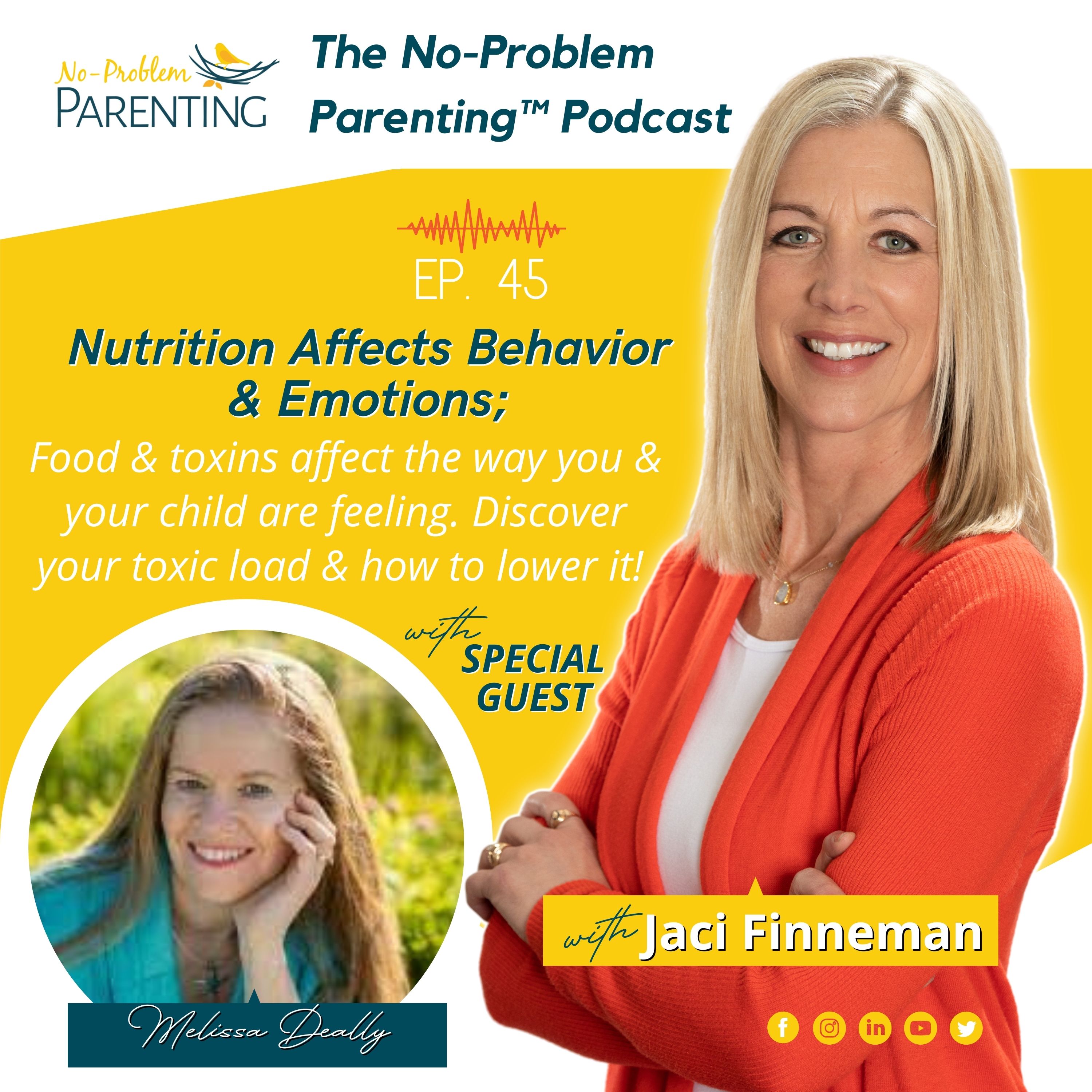
Nutrition Affects Behavior & Emotions; Food & toxins affect the way you & your child are feeling. Discover your toxic load & how to lower it! with Special Guest Melissa Deally
About this episode
Welcome back, Parents! This is a MUST LISTEN to EPISODE if you are parenting a child who;
is irritable, anxious, has tummy aches, headaches, sleepless nights, constipation, or other unexplained emotional or behavioral struggles.
Listen in as Melissa Deally teaches us how to;
1) Discover you and your child's toxic load and lower it2) Discover your body’s imbalances and support them with natural supplements and herbs so the body can come back into balance, at which point it will heal itself. This is done through the use of Functional Medicine lab tests, mailed to your home!
Melissa Deally of Your Guided Health Journey is an Integrative Health Practitioner & Registered Health Coach, dedicated to helping her clients get to the root cause of their health issue and truly heal. Melissa’s business is 100% virtual, and she works with the entire English speaking world. She offers a very high level of support, to ensure her clients’ success, as we navigate the path bringing the body back into balance, while creating new lifestyle habits to ensure lasting results.
Become a No Problem Parent Today!
Full transcript
Welcome to the No Problem Parenting Podcast. Turn behavior problems into no problem with Jackie Finneman. Are you ready to become the confident leader your kids crave you to be? Do you want to learn how to make parenting easier and more fulfilling?
Whether you are at your wit's end or you want to have more fun as a parent, you're definitely in the right place. Now here's your host, Jackie Finneman. All right, welcome back, No Problem Parents. Today, we're going to talk all things nutrition and your kids, how to love on your kids with nutrition, and the connection between food and behavior, how nutritional deficiencies can affect behavior and learning. And I have a special guest and friend with me today, Melissa Dealy. And so before we get started, well, I should say, welcome to the show, Melissa. Thank you. I'm excited to be here, Jackie. I am literally so excited to have you here because you are now my health coach and I've completed the 21 day health detox that you have. And we're going to get into all that in a little bit, but first let me introduce you and share a little bit about you with the listeners. So Melissa is an integrative health practitioner and registered health coach. She's dedicated to helping her clients get to the root cause of their health issue and truly heal. I am testament to that. Melissa's business is a hundred percent virtual and she works with the entire English speaking world. You use a two-prong approach, Melissa. Number one, discover your toxic load and lower it. Number two, discover your body's imbalances and support them with natural supplements and herbs so the body can come back into balance, at which point it will heal itself. And this is done through the use of functional
medicine lab tests that are mailed directly to your home. Melissa offers a very high level of support to ensure her client's success as we navigate the path, bringing the body back into balance while creating new lifestyle habits to ensure lasting results. Melissa is the winner of the 2021 Quality Care Award by Businesses from the Heart, and she's been featured in Pursuit 365 and Fresh Magazine featuring 365 Canadian women who lead by example in the everyday pursuit of success, happiness, and achievement. This is my favorite part. Melissa is also the host of the Don't Wait for Your Wake Up Call podcast, a podcast offering practical education around health, which ranked in the top 5% of global podcasts by ListenNotes in just the first three months of launching. You guys, it's a really good podcast. I'm going to have a link in the show notes for that. Now, when not serving her clients, Melissa can be found on her paddleboard or back country hiking and camping with her daughters or downhill skiing or cross country skiing or planning her next trip for her girl guides, Girl Scout Unit, or working on her passion project, which is Girls Matter, helping to keep girls in school in Uganda, breaking the poverty cycle, one girl, one family,
one village at a time. There is so much here. My podcast is not near long enough, Melissa, for us to learn all the things that you're involved in, but I just highly recommend you. And I am very, very grateful that you're joining me today. Well, I'm super excited to be here because this is such an important topic for me. It was something that even before I was a health coach and when my kids were young, they had food intolerances that led to learning issues at school. And I am eternally grateful to the grade two teacher of my oldest daughter who said to me at the end of the school year, you know, her handwriting has regressed this year and she's no longer focusing the way she used to. And at the time I'm a busy corporate mom,
you know, and happened to be at the school that day, got, you know, left work early and was picking up my daughter. And I heard this and I kind of went, okay. And in my head, I'm thinking, what do I do about this? Like, how does handwriting regress? And I have no idea how to support this.
And so I turned back to the teacher and said, I don't even know where to start. What do I do? Like, how do I support this and she said you know it could be food and I went really like how does food affect handwriting you know and I said okay and she said you know I'm working with a naturopathic doctor and they can test for this and I went oh okay because I was already working with a naturopathic doctor myself for my own hormonal imbalances running the very same labs then that I now run for other women today. So I emailed her and said, Hey, this is what the teacher told me. Is this something you can help with? And I was still kind of doubtful, didn't get the connection. And she said, yes, absolutely. Bring her in. Let's, you know, book a session.
Let's do a food sensitivity lab test. And we did. And I found out that she was highly sensitive to sugar and yeast. And so I took those out of her diet and it was amazing. The difference, because what I love is when we create the environment for our body to heal, it responds really quickly, right? You experienced that in your three week detox, you notice the profound difference in your energy levels, et cetera. So in a very short amount of time, I noticed the difference in my daughter, not at school because school had ended, but the biggest difference that I noticed was she was about seven years old, right? And she would have regular meltdowns at various times and be crying and saying to me, I don't know why I'm crying,
mommy, I just am. And she was my oldest and my second's personality was really different. I didn't question that that not knowing why I'm crying was indicating that something was going on inside her body that she didn't have control over. I just thought it was normal, right? And I accepted it. So I didn't look into it. But what happened when we removed the sugar and we removed the yeast that her body couldn't cope with, those meltdowns stopped happening because she was no longer on this sugar roller coaster with the highs of super high energy and then the crash and the crash would be when she was crying not knowing why she was crying and then she'd eat something else that would lift her back up and so we got her off this roller coaster and the great thing was is she went back to school in September and went into the same classroom for the first week with that teacher while they figured out all the new students in the school and who went where and the teacher said it's night and day. Like she's, she, her writing is beautiful and she can sit and she can focus.
Like I can really tell that you've changed her diet and it's night and day. And so that was my first insight to how food can impact a child's behavior and their learning. But in my journey to becoming an integrative health practitioner and health coach, I needed to be hit over the head with a two by four. So my second daughter, when she was in grade one, I got another very strong signal about this connection. And she was putting her head down on her desk every day after lunch, after spring break at the end of grade one. And I happened to be in the classroom volunteering one day and I saw this and I'm like, why aren't you doing anything? You're supposed to like sit up, pay attention. Why are you the one with your head on your desk when I'm in the classroom volunteering, right? And then afterwards, the teacher said to me, you know, she's been doing that all week. And I went, okay. And I at home, she'd been complaining of tummy aches. But you know, we were busy and I tummy aches a tummy ache, and I didn't really do anything about it. But now when I was seeing, okay, this tummy ache is preventing her from being able to function all afternoon at school. Maybe there's something more to this, right? So I take her to the doctor.
and the doctor said, oh, all little girls get tummy aches. So I didn't really get any answers from the doctors. I was told she would grow out of it. But for me, I wasn't willing to wait because the doctor also couldn't tell me how long that was gonna take, right?
So I decided, well, I'm gonna check in with that naturopath again and explain the symptoms and see if she thinks she can help. And sure enough, she said, yep, let's bring her in. Let's do that food sensitivity test. Again, the very same one that I offered today.
found out she is intolerant to dairy and wheat. And within the dairy categories, she was actually intolerant to the protein casein, which is in cow's milk and all dairy. And what was happening is her body couldn't process it. So it was lining her intestinal pathways and effectively narrowing them because the body wasn't able to process it and remove it from the body quickly enough for the amount she was taking in, right?
Because I was feeding her milk. Right. And so it had built up enough by age six that she couldn't process it. And now anything she ate caused pain because her intestinal pathways were so narrow. Not to mention, I was feeding her wheat and gluten because I didn't know she had an intolerance. So once we figured that out again, I was able to change her diet, remove the dairy, remove the wheat, and she bounced back very quickly.
She went from the child that was putting her head down on her desk after lunch for the rest of the day, not functioning at school and not interested in playdates, even though she was a highly social kid, to in just a couple of weeks, bouncing back and getting back to her soccer, which was her true love, and then playdates, et cetera, and functioning all day through school. And then the next piece of that one though, another learning for me that I share with all of my clients was that as I changed her diet, and that was hard because this was back in like 2007, 2008.
So it was before gluten-free was the norm. So I had to figure out what to feed her for breakfast for starters, because it used to be cereal and fruit or toast and fruit, right? And now the toast and cereal were out. So what was I going to give her with the fruit?
Well, I decided eggs would be a good thing to feed her because they're healthy and there's some protein and they're quick. And that's a good way to feed her before we all had to get out the door in the morning. So I start feeding her eggs after about a week. She said, I don't want eggs, mommy.
And I'm thinking she's just being difficult and I'm busy and I'm trying to get us all out the door. So I'm like, I don't know what else to feed you. So just eat the egg. It's a healthy way to start your day.
Eat the egg. When we went back to retest for her food intolerances to see how they'd adjusted as we'd taken these things out of her diet. Now she's highly intolerant to eggs. And I just felt wonderful.
I did. I just got to hit my head and went, Oh no, she's been trying to tell me this. Right. And I wasn't listening. And part of it is because at that age, they don't have the vocabulary and the communication skills to tell you exactly what's going on. Right. Unless you stop and ask some deeper questions. And so I don't want eggs wasn't telling me that they were causing her pain or anything else. It was just, I just thought she was being difficult and I was struggling to figure out what to feed her. Then when I saw that and we removed the eggs, then again, had to figure out other things for her for breakfast, but we did. And from then on, like to this day, she's 20 years old now. She has eggs. I would say maybe, maybe once a month. Cause in our house, we actually do omelets every weekend. My husband makes delicious omelets to order. Like we can't eat in a restaurant because they're so to order here, but she will only do that once a month when she's home. And she's only home for a couple of months of the year, right? She likes them, but she knows she can't have them very often. Dairy, she rarely has. Gluten, she actually can do now because she doesn't have the dairy. So that's not squeezing or narrowing her intestinal walls.
Her body's better able to tolerate the gluten, but she doesn't do that three times a day, seven days a week either, like many, many people do. So she's got this awareness around what she can eat and how her body feels. And our kids innately have that. The unfortunate thing is, is that we as parents so often overrule it for convenience, for time saving, right? And in my generation, like I grew up listening to parents say, eat everything on your plate because there's kids in Africa starving. And so there's a lot of other people that heard that as well, right?
And then we tend to parent the way we were parented. So that comes out of our mouth towards our children. But really, now that we have so much more knowledge around our microbiomes, and how every single microbiome is different, we need to be asking questions of our children, because they can't necessarily eat exactly the same thing that we eat, because their microbiome is different. Yeah, there's this is really, this is so informative, and so good. And often, parenting is, of course, hard, and we're busy and tight schedules, and you know, chasing kids around, picking them up from school, daycare, there's all the things.
And if we can just sort of get a plan and get on track with some things, it takes a little bit of extra work, you know, in the beginning, but we can get, we can develop new habits and new behaviors and new systems so that it isn't so hard to eat healthier. And we can learn how to have those conversations with our kids to really find out, you know, what's going on with them. But also So there are other ways that we can find out how our kids, if our kids are deficient in certain nutrients, for instance, or they have intolerances.
So talk a little bit about how we do that. Definitely. And I want to come back to that planning piece too, because that is so important for people's success in habit change. But yes, coming back to the microbiome as well, our microbiome starts being developed the moment we come out of the birth canal. We get all of mom's microbes and the baby has throughout the pregnancy has been getting whatever mom has to share. So if mom is deficient in zinc or magnesium or whatever, guess what? Baby's going to be born deficient. And that is happening more and more these days because it goes back to our deficient soil systems. For instance, if you were to take an orange today versus an orange from the 1940s and measure the nutrients out of each of these oranges, you would need to have nine oranges today to get the equivalent nutrient content from the one back in the 1940s. If the nutrients aren't in the soil, they don't get into the food, they don't get into our body, right? And so as a result, babies are being born deficient and unfortunately toxic because we do live in a toxic world and those toxins also go through the placenta.
And then baby's microbiome is developed through breast milk and through what, you know, after we wean them, et cetera, through whatever food we're feeding them, et cetera, et cetera. Right. But breast milk has a lot of prebiotics in it to feed the bacteria that are in our little gut. so everybody is different and it's very hard to know exactly where we're at and as a young child they have no understanding of how they should feel they just feel what they feel right and so they don't know if they're deficient and the parent doesn't know if they're deficient because it's all happening on the inside and so we have these really powerful functional medicine labs that as you mentioned earlier, get mailed to your home. And the ones that I love to use with kids is it's just a hair clipping from the nape of your neck. And it will show all of the key electrolytes and minerals that the body needs to function at an optimal level. And it will show whether they're deficient or not, and whether they're imbalanced or not, because we need magnesium and calcium to be imbalanced. We need zinc and copper to be imbalanced. We need sodium,
potassium to be in balance, et cetera. So the body always wants to be in balance. And so this lab provides a lot of information. It also provides metal toxicities. And as I said, babies can be born toxic today too, so that we understand that. And once we have this information, then we know how to provide, you know, exactly what that child needs, take away the toxins, give them the goodness of the minerals that they need so that they can fully thrive, right? Our minerals are so critical for our body's ability to thrive. And when we're coming from that depleted state, it's really hard for kids to be at their best. And then there's another lab that we can run that looks at what's going on inside their gut. Is there bacterial or candida overgrowth? Is there mold or fungus. You know, I worked with a child who's about 10 years old now, and we ran that lab and he had mold and his sister didn't. And so I was kind of confused by that. And I asked the mom and it turns out when he was born, they lived in a different house and it was a duplex and the house,
the other side of the duplex had a flood and his wall, his bedroom wall and his crib was against the bedroom wall of the house that had the flood. And so she suspects that as a little baby, there was mold in that wall and they didn't know it. And then he gets the mold in his body. And so now we're removing the mold from his body because that was causing behavioral issues at school.
And that's night, you know, again, night and day difference as we get the mold out of his body. Wow. That is just absolutely amazing. And you know, we're not paying attention to this. It is so true. We're not, we're our society, our world has really, you know, there's like the pendulum has swung and I think a lot of attention gets paid to mental health, which is good. I mean, I was a 20 year counselor and I definitely think we need to be paying attention to mental health And so much of our mental health can be healed by paying attention to our nutrition and getting rid of the toxins that are in our body.
So it may not be the end all be all answer, but it is certainly a piece of the puzzle that we shouldn't be ignoring. Would you say that's correct? I would say that's 100% correct. And ideally, I would love to see anytime a child is struggling.
I would love to look at nutrition first. We all have different tolerances, intolerance, or sensitivities to things. You know, like I told my story about my daughter and sugar, right? The quickest way to depression in an adult is to just go and eat a whole bunch of sugar, eat that tub of ice cream, emotional eating. And then do you really feel better afterwards? No, you feel better in the moment, but afterwards, how do you feel, right? Sugar is toxic to our body and yet it's in everything right and it's addictive and so kids want more of it and so looking at what are they actually eating what's triggering the way that they're feeling and that feeling those emotions are coming out in mental health of anxiety and depression right and then omega-3s omega-6 imbalances very very common because again omega-6s are in everything and omega-3s are much harder to get in our diet and particularly into a child's diet because the best source of omega-3s is wild fatty fish, anchovies, sardines, mackerel, salmon. Like how many kids are eating that four times a week? They're not. So therefore they're relative to the omega-6s that are in everything. Their body becomes deficient in omega-3s. Well, omega-3s are the anti-inflammatory essential fatty acid and omega-6s are the inflammatory. So right away,
now their body's becoming a little bit inflamed as a young child, rather than the, you know, because we don't have that countering anti-inflammatory to bring it down, but omega-3s are so important for brain health and heart health and cellular regeneration and nail and joint health, et cetera, et cetera. And so a big part of that is that brain health, right? And a lot of kids get put on Ritalin for ADD, ADHD. I'd rather see them, let's remove the sugar. Let's take a look at gluten because gluten can be a real problem. And let's look at what their omega-3, omega-6 levels are, and let's boost that up. And again, that's another lab that I can run and we can boost it up with supplements, right? If the kids don't want to eat fish, let's make sure they're getting it right. Yes. You can also get it through plant-based foods as well, but the body has to do an extra conversion to do that. And so you get less, you'd have to eat a whole lot of the plant-based foods like chia seeds, et cetera, hemp seeds to get it. And so again, for many,
it's just easier to supplement and then you need a good quality supplement, right? Right. So let's talk gluten quickly too, because it too is in so many products, right? And I want to talk North American gluten because European wheat is different. In North America, the seed is different because they were trying to make a seed that was more drought resistant. But in that process, it ended up having a protein called gliadin in it. And that gliadin, when it's broken down inside our body is broken down into various amino acids. One of those is glutamate. Glutamate is also known as MSG. A lot of people know what MSG is and they avoid it. They know it doesn't make them feel good, et cetera, et cetera, right? What they don't realize is that gluten inside their body can be ending up as glutamate and then the body has a hard time getting rid of it.
well glutamate is an excitatory neurotransmitter so it hops us up right and we all know what kids are like when they get hopped up right and again they don't know why it's in the food they've eaten and it also at the same time as hopping us up it blocks our natural anti-anxiety neurotransmitters that help us calm so it's a double whammy on getting us more excited And so that excitement, right, ends up in tantrums or acting out and, you know, unable to sit still and unable to focus. Right. And then it ends up in a label of ADD, ADHD and potentially prescription drugs.
yes and that's a lot of times unfortunately parents i mean it's so hard because you're you think you're doing you are doing everything you know to do you're reaching out you're trying searching for all the different resources or answers to your child's behavior what are common nutritional deficiencies in kids that can cause learning or behavioral issues um you're already saying sugar which a lot of us know that but you're not saying all sugar either right a processed sugar and but also a diet high in simple sugars like white rice white pasta potatoes and things so white flours etc the body treats that as sugar right so it's quick energy and then we crash as opposed to eating foods that are more nutrient dense that take us longer to digest and leave us satiated for longer so even if we're eating sugar that's going to be quick if we eat that with some good quality fat, if we eat that with some good protein, right, the protein, the fat, the fiber that we have with it will help slow down digestion and flatten the curve, which is a saying we've all come to know really well. And I want to flatten that insulin curve, right? And not have those big rollercoaster rides for people and have it flatten out more. But other minerals that kids are often deficient in one of them is magnesium. 68% of Americans are deficient in magnesium, which is needed in over 300 cellular functions within our body. And one of them is helping calm the body,
right? But deficiency can cause hyperkinetic behavior, anxiety, irritability, and irregular our heartbeat. And we want, uh, when we have enough, the body can naturally calm. So it's something that I recommend to all of my clients, not just kids, but adults too, because of this high level of deficiency. And there's a lot of adults that are stressed out and anxious, right?
And so using magnesium to get our levels back to where they should be can naturally help calm the body. And a really easy way to do that with kids is to put some Epsom bath salts in their bath every night. Don't use the bubble bath anymore. Use Epsom bath salts because there's magnesium in those. And you can put one cup in the bath and have them in the bath for 20 minutes. The skin absorbs it really well. And then if they're open to it, depending on the age of the child, they could take a magnesium supplement in the morning as well. And magnesium is one of those things that you can't really overdose on because if you have too much, it's just going to give you loose stool.
so for people that are actually constipated i recommend it to help to loosen their bowels to release the constipation so it's not something that you know you can overdo or you have to be too concerned about but starting off with the epsom bath salts is a great way to start out um that's uh the the magnesium is similar then to vitamin c because you really can't overdose on vitamin c either right you just start to get a loose stool and then you'll know better wiener wean off of that a little bit. Exactly. And vitamin C, I absolutely love for everyone, something that you can take all year round because we all know it's good for the immune system, but it is a powerful antioxidant nutrient. So it's, you know, removing the oxidation that happens in our body through toxic load. It's antiviral, it's antibacterial, it's antipyretic,
which means it lowers fevers naturally. So instead of going for the Tylenol or the Advil to bring a child's fever down, if that fever is at a dangerous level that needs to come down, we can use vitamin C, right? We want that fever to run a little bit because that's the body's way of fighting what it's fighting. If it starts to get too high, then we can be using vitamin C to bring it down.
It's also a great antidepressant as well, and an antitoxin. So, so much goodness in it, and it's really easy for kids to take. Again, we need to be taking good quality one, not the orange flavored sugar loaded one. Right. Right. Well, and so, I mean, we could go on and on about this, but actually you have a workshop coming up called Heal Kids with Food on February 23rd. And this episode is going to air today's episode or recording is going to air on the 11th or 12th, I think. So there should be enough time for the listeners today to get over to register to become part of that workshop. Tell us a little bit more about that. Yeah, so I'm really excited to do that workshop. It's being sponsored by Blissful Parenting. And I will be diving into some stats as to kind of, you know, where we're at today with some of these diagnoses or labels that kids have,
right? Because it's really quite shocking if we look at where we were 50 years ago to where we're at now. And, you know, yes, you can say, okay, there's more diagnosis or more testing happening. But when we also look at what's happened to our food since then, you can see that correlation, right? The unfortunate thing is, is that today we are in a state where the food industry doesn't care about our health and our health industry doesn't care about our food. And what I mean by that is the health industry, our doctors are just not trained in nutrition at medical school. If they want to study nutrition, they have to do that on their own after medical school. And so nutrition is never the first thing they go to because it's typically not their training, right? I'm not trained in surgery, so I don't do surgery. I'm trained in nutrition. And so that's my go-to because I understand the importance of it. And so seeing where we've come in the last 50 years kind of gives people a little bit of that. Aha, I get it now. And we dive into in more depth into other minerals and vitamins that were typically depleted in we dive into toxicities, we finish up with going through more of the lab testing and showing people what those labs look like and how they can access them, etc. That's so great. And I've got a link that's going to be in the show notes where parents, you can register to attend that workshop on February 23rd,
9 a.m. Pacific time. You can register for a dollar. It's normally $37, but the link is going to give you access for $1 to attend this and get all this information on, you know, how to manage behavior issues with your kids by helping out the nutrition part of things. Right. So that is so cool. And before we wrap up, Melissa, I also wanted to share with the listeners for the parents, because I did the 21 day detox. I just finished it up a couple of days ago here now, and I cannot, it is the best I've done detoxes before. It is the best one I've ever done. I, you know, lost some of the inflammation weight I needed to lose, which was amazing and awesome. Uh, but my energy levels, I'm not getting the up and down sugar highs and lows that I think insulin levels, whatever that you were, you know, I've never been diagnosed with any issues with that, but I could just feel it, you know, by two o'clock or after lunch, I'm dropping down and it's really leveled those out for me. And I'm not having cravings for certain things that I was having before I did the 21 day detox. And you're offering another class on that, another 21 day detox coming up on March 1st. So if you could just tell people a little bit about that, get some more parents into that group. Yeah. So I love this program and it is my mission in 2022 to touch the lives of thousand people. I truly believe that if we can all start detoxing, we will get rid of the chronic
illness in the world today. Okay. Our bodies are toxic and I have a toxic quiz that people can do to find out their score, but we've had 144,000 man-made chemicals introduced to our world since world war II. And they're getting inside our bodies through our skin, our airways, our waterways, our food, et cetera, et cetera. And the human body doesn't adapt that quickly. And it was never designed to deal with this level of toxicity. And so it's bogging down our liver, which then can't do its job properly. And then what happens is that starts to cause inflammation. It starts to cause gut health imbalances. It starts to cause hormonal imbalances in our sex hormones, but that can affect the thyroid that can affect our insulin levels because we are all interconnected. When we remove those toxins and we lower the inflammation, we're also creating a body that is inhospitable to disease because we know now through the science of epigenetics that 90 to 95% of all disease starts in the gut. And we also know that only 5 to 10% of diseases are truly genetic and the other 90 to 95% are triggered by lifestyle factors and the environment you create inside your body.
So if you're creating a toxic environment inside your body, then that triggers cells to turn on disease. It explains a lot where people are getting breast cancer when there's no history in their family of breast cancer, or people are, you know, just a wide variety of, of things. And they're saying, well, that's not even in my family. There is no heart disease in my family. Why am I having heart issues, you know, and it really is our environment. And there is heart disease in the family. And then one person doesn't get it because that one person has actually lived a really clean lifestyle versus siblings that may not have. And then people like, well, how come I got the heart disease and you didn't, right? It's not just the genetics. It is absolutely the lifestyle you create inside your body. And so what I do in this program is I set you up for success on the detox,
make sure you understand how to do it know that you're supported go through all everything so that you can be successful and when you have support you can be successful let's face it it's really easy to give up on ourselves anybody can just go buy the detox and do it and then how many people fall off after day two because it's too hard and their brains telling them it's too hard right when you have support that doesn't happen and then week two we dive in into nutrition and the right way to eat for your body and we talk about nutritional myths. We talk about supplementation and why we need supplements in this day and age. Week three, we dive into digestion because it's not just about what you eat. It's about what you absorb.
And then week four, we dive into sugar and sugar alternatives and where sugar sneaking into your diet. And then I finished it off with a how not to retox after your detox, because this isn't just once. And then you're good for life. The toxins are always coming in. So we want to make it a lifestyle. So every quarter I recommend a seven day detox. And by the time you get to the end of the 21 day detox, you're going to love how you're feeling and you're going to want to keep doing it. And seven days is way easier than even 21 days. You just keep up that habit.
And I'm sure it's different for everybody, but I had a couple of days during that 21 days that it was tough. You can still eat on this detox. So it's you're, you're just eating clean. And the other thing I want to say is, so you're not starving yourself throughout this process.
The other thing I wanted to say about it is that you say there's toxins in our food. So the whole point of this is to be able to get rid of the toxins every so often, right? Just kind of cleanse your body and then be able to still eat those certain things that you just love to eat that you don't want to have to give up. It's like this cleanse, this detox does not prevent you from ever eating the foods that you really enjoy.
it's just helping you to eat better on a regular basis and then not feel bad or beat yourself up. If you have the cheesecake, you know, or the eggs that your body doesn't like, doesn't want you to have all the time. So it's just a really, to me, a really realistic type of a cleanse, uh, and detox that is doable and actually produces some pretty good results. So that was my experience. Anyway, I'm going to make sure to put the link for more information on that in the show notes, all your links are going to be in there, Melissa. I think the best way to get ahold of you and to learn about all the things you offer is to go to your website.
Yes. Okay. So that's yourguidedhealthjourney.com. I just want to thank you. I know our time is up today. Thank you so much for being here. We will definitely be doing more collaborating on future events together. But I really, really appreciate your time today. Well, thank you so much for having me and just helping me share this message. Because as you said earlier, parents are just doing the best they can. And they don't know what's available to them. So getting that message out so that they know there's other options is powerful. And I appreciate the opportunity to do that. Thank you for tuning in to the No Problem Parenting podcast. Join Jackie next time for more tips, tools and resources that will help you become the confident leader your kids crave you to be. Who do you know that we could support on their parenting journey? Like this podcast,
subscribe, share, or leave a review of the show. Your support of the No Problem Parenting podcast pays it forward and helps us help more families. Thank you.
Become the confident leader your kids crave
The method, the community, monthly live Q&A with Jaci, and Celia — your AI guide in the moment.
Start your 14-day free trial Get it on iPhone or sign up on the web