
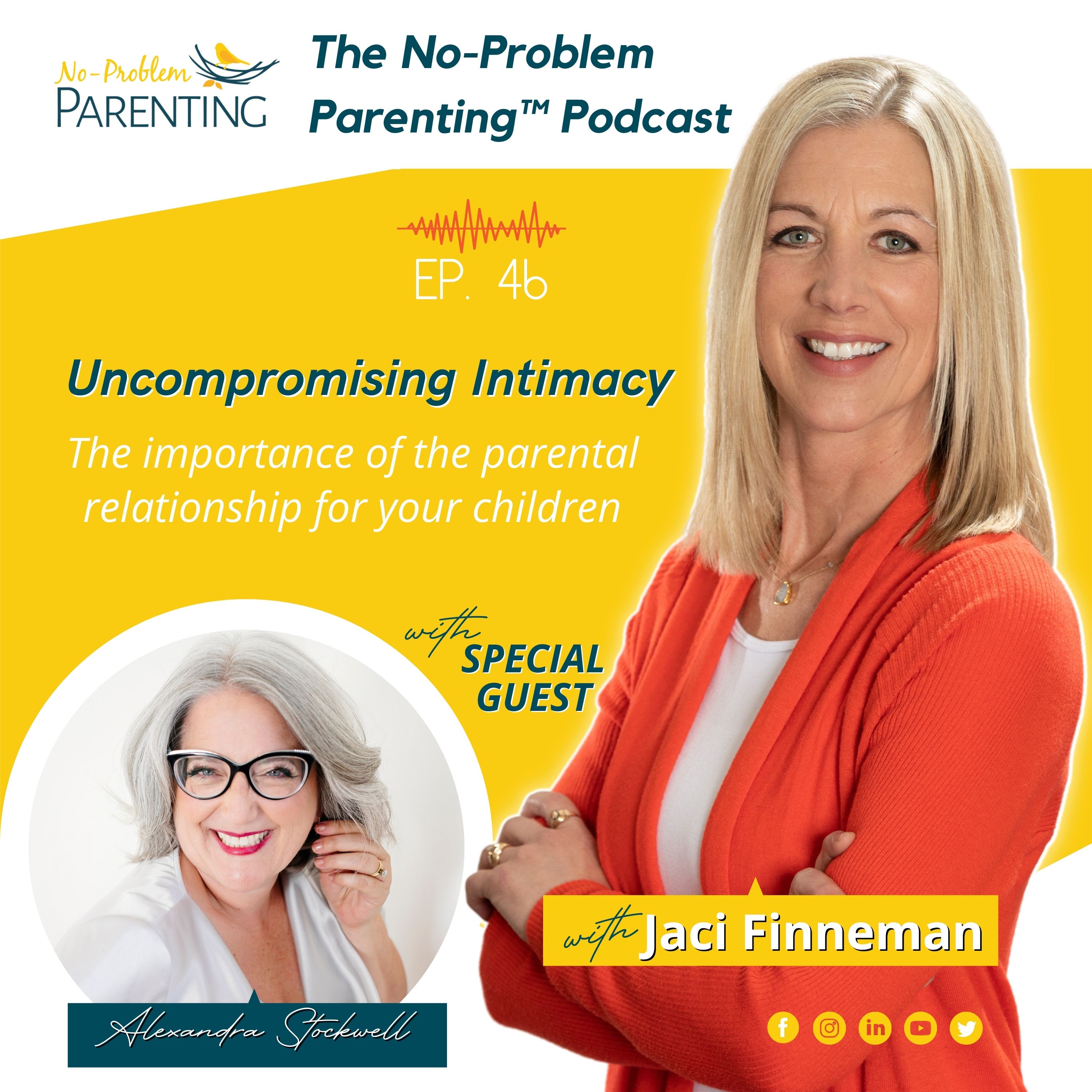
Uncompromising Intimacy - The importance of the parental relationship for your children with Special Guest Alexandra Stockwell
About this episode
Welcome back, Parents!
Today's special guest is going to share with us the importance of nurturing our adult relationships by cultivating curiosity with your partner throughout your relationship.
Become a No Problem Parent Today!
Full transcript
Welcome to the No Problem Parenting Podcast. Turn behavior problems into no problem with Jackie Fineman. Are you ready to become the confident leader your kids crave you to be? Do you want to learn how to make parenting easier and more fulfilling?
Whether you are at your wit's end or you want to have more fun as a parent, you're definitely in the right place. Now here's your host, Jackie Fineman. Hey, welcome back parents. Today is Valentine's Day. Happy Valentine's Day.
Are you the type of couple that celebrates Valentine's Day with a card or flowers, chocolate, maybe go out to dinner? Or are you raising littles and no one's around to babysit so you're feeding them a heart-shaped pancake breakfast for dinner and off to early bed so you can share some time alone together? Whatever it is that you do, I wish you a happy Valentine's Day. And we have a special guest on today talking to us all about how to cultivate intimacy and doing that with curiosity.
So cultivating curiosity with your partner throughout your relationship from when you first met through raising children and how to treat each other as peers and lovers, not as children. You know, we get busy with our to-do lists and our tasks and we don't want to be harping on our spouse, treating them like a child. Guilty as charged. I have done that myself and so I learned a lot from this episode today. I want to introduce you to Alexandra Stockwell. Alexandra Stockwell, MD, is a luxury love and intimacy mentor known as the Intimacy Doctor. She specializes in showing couples how to build beautiful, long-lasting, passionate relationships. She's the best-selling author of Uncompromising Intimacy and the host of the highly acclaimed The Marriage Podcast.
For over 20 years, Alexandra has shown men and women how to bring pleasure and purpose into all aspects of life, from the daily grind of running a household to clear and intimate communication to ecstatic experiences in the bedroom. A wife of 25 years and mother of four, Alexandra believes the key to passion and fulfillment, intimacy and success isn't compromise. It's being unwilling to compromise. because when both people feel free to be themselves and know how to love and be loved for exactly who they are, the relationship is juicy, nourishing, and deeply satisfying. She helps build happy and connected families by facilitating healing and transformation for couples. Alexandra's been featured in the Huffington Post, Rolling Stone, USA Today, Cosmopolitan, Business Insider, Thrive Global, Fox News, and many other publications. So listen in, Alexandra's going to give you some tips on how you can make your Valentine's Day extra special. So welcome to the show, Alexandra.
I am really excited to have you here today to talk all things connection and reconnecting in our marriages and with our partners. And so before we begin, why don't you just tell us a little bit about what we should know about you. Okay, thank you. I'm really glad to be here, Jackie.
I am a physician and an intimate marriage expert. I've been married for 25 years and I have four children. And actually, maybe this is relevant. This is my 14th year of homeschooling, although my older two started in school and then at fourth and sixth grade, we started homeschooling.
one went all the way through and graduated is now in graduate school another went to a spiffy prep school for high school my third just started public school this year so I have a very eclectic background in terms of education and we've lived in a few different places so I actually feel that one of the things I bring to the table is a very diverse life experience and conventional and unconventional training to our conversation. We're going to talk about the importance of the parental relationship for one, but also the importance of that for our kids, right?
Communication for our kids and how to communicate with our spouses and with our kids. But let me jump right in. One of the first questions I have to ask you and learn from you is why do parents often have such a hard time reconnecting intimately after their children are born or a child is born? Really important question. And there are not enough people asking it. It is really a universal phenomenon, whether it's for two weeks or 10 years after that first baby, everything changes and it really takes attention to find the way back and how the way back is found.
So let me be more concrete, but also just tell you that. So my husband and I are both physicians. We met in medical school and we got married and had children. I had my first child after, just after my third year of medical school, my second, just before my internship.
And the reason that I'm telling you this is that really for the first 10 years of our relationship, we had an exam. We had either just had an exam, we were working hard for an exam, or we were changing diapers. Like basically that's the reality. And so in terms of not emotional intimacy, but sensual, sexual intimacy, in terms of time in the bedroom, that's just like it typically was more important that we went to sleep.
That's just the honest truth that we needed to get up and be extremely functioning. People's lives were impacted explicitly, our kids. And so, I mean, we made babies. We weren't celibate, but it really wasn't a big focus of our relationship.
It couldn't be. There wasn't time for it. But we both assumed that once we had time, everything would be a lot more romantic, a lot more delicious and all the yummy ways. And once we did have more time, that wasn't actually the case. And that surprised me. And it of course gets to your question, like, why don't people reconnect? And so actually, we took a long time deciding whether or not to have our fourth child, and we had decided not to, but then I just had this inspiration, this vision. I was like, I actually think we, there's a fourth child for us. And so we gave it one try and we were both 43 and he was born when we were, I was 44. However, I'm telling this because I was determined not to lose what we had already gained in terms of rekindling our affection and our intimacy.
And I didn't know if it was possible because really everyone I knew and myself after the baby's born, there's that dip in connection. But I did crack the code, so to speak. I don't remember exactly how long from when the baby was born to when we were explicitly intimate, but there was never that drop in the feeling of erotic connection. So I know you're asking me a question more about when children are heading to high school or heading to college, but the foundation for this is really laid much earlier. In fact, so often people pay attention to how they interact in the first year of a marriage or the first year of living together. That's going to set the foundation and establish the habits of interaction for the rest of the relationship.
Well, actually, it's when the child is born that that is at least as true. So to actually answer your question, that's all context, is when we become parents, it's this beautiful opportunity and requirement that we really shift our identity. It is very different to go from not being a parent to being a parent, to being a mother, to being a father. and in our culture in terms of what's modeled we go way too far in the new identity and don't really bring with us the juicy erotically responsive woman and the potent manly man and I don't mean to be so old fashioned with the genders. That's not my point. I just mean to convey that there's a part of us that whether it's six months or six years or 16 years later,
we wonder, but what about who I was? What happened to her? So that I think is really why it's a very simple concept, but transforming it is a very complex endeavor. And this is where uncompromising intimacy comes in. That's the name of my book.
It's one of my core teachings because so often we are taught that the way to have a great relationship is to learn to compromise. In order to be happy in your marriage, you have to be good at compromising. And a companion teaching is, at least in Western culture, is to prioritize the children. That you love your children.
like if you had to ever choose between your spouse and your children you're going to choose your children and I'm not saying I don't have an opinion about that in this context I'm just saying that we initially we do need to focus on the children make sure they are fed and healthy and all of those things but in the process we really do sacrifice a part of ourself which goes dormant and does not just naturally rejuvenate once there's space for it.
I really love that you're bringing this up because I think, like you said a little bit earlier here, I mean, we kind of go all in once we have kids and everything is really surrounds or revolves around the child or the children. and um and then and in my teaching as a parent coach what you know oftentimes we we like if there is a problem with your child and their behavior or their emotions you know or something's going on we like it's like oh we got to fix that problem and we're all in and in the meanwhile and both parents are doing that right and then we kind of lose touch of our our relationship with each other? Are we on the same page with how we're going to, you know, interact and communicate with our children or handle or tackle or resolve this problem or this issue that they're having? And so I really like that you're saying, you know, we need to cultivate the relationship and that is actually helping the child, right? When they can see that mom and dad are communicating and are in love with each other, right? And are paying attention to each other, that does wonders for your child's self-esteem, self-regard and behavior, I believe. So why, why don't we know how to communicate more successfully once the kids are involved, like in our relationship? Why don't we know how to communicate in a way that is still romantic or still, you know, showing interest in,
in your partner? There are a lot of different ways. And let me just say very clearly, I have such a deep appreciation for the work that you do. It is so important. It is so needed. And I'm motivated by something quite similar. I really do want to serve children. And for me, the very best way that I can serve children and contribute to a better future for our society is by teaching parents how to have a fantastic relationship. For me, that is the most impactful thing I can do for any child. And the reason for that, it's like your question is really kind of a chicken and the egg and a self-fulfilling prophecy kind of a question because we learn how to be in relationship, how to have relationships, how to be healthy in honoring our own boundaries and our own sensibilities and still being profoundly connected to someone else. We learn that at home from our parents. And the reality is that most people do not have role models that are worth emulating. If you want to be a great teacher or there's, there's a, I'm sure all of us have had really inspiring teachers or even to be a great golf player, you know, Tiger Woods or basketball,
Kobe Bryant, like this is true if you want to be an aerospace engineer, like no matter what it is that you aspire to, even parenting, there are a lot of great parents that we can see and be inspired by. But when it comes to intimate, turned on, juicy, collaborative, passionate, long-lasting relationship, we really profoundly lack role models in an area that we mostly learn through imitation, like mammals learn through imitation when it comes to relationships and that applies to us. So actually that's another motivator for me. I used to be such a private person and I tell all kinds of stories about my own marriage, because I want people to know what is possible so that any gratification, collaboration, and goodness in the parental relationship is something that's going to come easily for our children. It's actually a much more significant legacy than any kind of material legacy we might create. And we are leaving that legacy to our children, like it or not. So this is something so important to put attention on. And the question really is, well, how do we do that? And why don't we do that? Which you've asked. So I want to respond to that as well and say that with our children, with our work, with all kinds of situations, things become urgent and extremely important. If our child isn't sleeping,
it becomes very important to make sure that they get sleep for their sake and ours. But when it comes to the parental relationship, if there's intense conflict, then it really gets our attention too. But if things are okay, good enough, while we're on the same page, we're aligning in how we parent, we're focused on all of our major financial goals, there's nothing about the intimate realm which will just grab our attention and need to happen before the house is cleaned.
That has to be a completely voluntary choice if you're going to give attention to it and enjoy it before things are really intense. And when I'm using the word intimacy, I'm talking about intimacy in the bedroom, but I'm also talking about vulnerable conversations and revealing things that need space and safety to share with one another, how you feel and what your dreams are. It's all of that. Yeah, so you really let's let's get into some of those ways that we can cultivate the couple relationship in the midst of parenting and our work responsibilities and all of those kinds of things.
And I know you're going to be giving us a free download about nine simple ways. We love that word here at No Problem Parenting, nine simple ways to spice up your relationship. So let's get into some of those. I want to I want to hear all this juicy stuff.
Watch out. You know, the first thing, which isn't one of the nine, and those are all simple, but some of them are easy and some of them aren't, but they're all simple. But what I think is absolutely the starting place, and it will sound so basic, but I have seen again and again how impactful it is, is to cultivate curiosity. Because one of the qualities of the relationship before the children are born, when you feel so in love is curiosity. Like where did you get that scar? And what was your favorite vegetable when you were in kindergarten? And what are your favorite books?
And, you know, what did you dream of when you were a child? And like, do you like the beach or the mountains? Like we just can't get enough of knowing who is this person. And then one of the things which happens is we know one another and we get comfortable and that is beautiful.
The safety and familiarity and companionship are, it's one of the profoundly appealing elements of being in a committed relationship. But the problem is when we let go of that curiosity, which is so pronounced at the beginning, and it is easy to bring that back. Depending on the relationship, you can ask questions that are whimsical, like if you could be president of any country, which one would it be and which policies would you implement? Or if you could have dinner with any celebrity, alive or dead, who would it be and what would you ask them?
Things that are completely not confronting, but you probably haven't had that conversation before. Or you might ask spiritual questions or questions about sexual fantasies or really just deep questions instead of, hey, how was your day? Fine. you know, that you can say things like, what was the most challenging part of the week for you?
And what are you hoping to accomplish next at work? You know, there's a way to just go a level deeper. And with that, you only ask a question you actually want the answer to. and then your partner starts opening up and sharing things that you haven't known and whether or not they ask you go ahead and reveal your answers too and there's something that happens when we go a level deeper with the emotional sharing and the curiosity and the likelihood that that evening's going to end with making out is much higher than if you're watching Netflix or discussing logistics, there's this crazy statistic that the average couple in North America spends less than four minutes a day talking about anything besides logistics and kids.
And I'm sure pets are included in that too. It takes people farther than you might imagine. I've had people hear me talk about curiosity on a podcast or in a lecture and go home and ask a few questions to their spouse of 15 years, 35 years, and the next day reach out and say, it felt so good. It felt different than it's felt in years, just from asking some questions, because that is putting attention on the other person, not for their function as a provider, as a parent, but just to get to know them better, honoring that every one of us grows and evolves and we have new answers to some old questions, if we just ask them.
so what would you say if if if a couple is in the middle of this right now and they're not having curiosity kind of questions and they're not really paying attention or showing interest in anything other than logistics and you know and the kids and that sort of thing how do you how do you how does one or the other or do both have to be on board with this you know uh to to be able to spark some curiosity and actually have those conversations you know if you're really stressed out you're not kind of probably want to talk about if you were president of another country.
It really depends how much disconnection there is in terms of how difficult it is to kind of pivot and re-engage and look at one another again. So I'll just like give a buffet and any listener for whom this is relevant, pick the thing or let what something I say inspire you to do what's right in your relationship. So one option is just to say, you know what, for date night, I have this idea I heard on a podcast. Let's just try it. I think it's going to be fun. And then you just go for it. That's like the simplest. If you have someone who is a more quiet person who, when you ask questions, gives minimal answers and doesn't really engage, then you can say, you know, I, I miss you. And I have, I heard about this way that we can connect with no judgment, no conflict, just getting to know one another better. In fact, I shared this with a woman who had, I think her kids were four and six at the time.
And they lived in the mountains in Wyoming or Idaho, someplace, Montana, I don't remember. And her husband bought a motorcycle and she was so angry about this. Like it was her worst fear. She knew the statistics about accidents and he didn't consult her.
He just did it. And they were at an impasse and couldn't discuss this at all. And we're just more disconnected, even in things that had nothing to do with the motorcycle. So she was like, I don't think he's going to want to talk because she had been in her desperation and devotion had been very critical and judgmental. And so he just stopped talking.
And so I guided her and she set it up that they were just going to ask questions without any kind of response, any kind of judgment, really just listening. And when she told him that And after having initially said no, he said yes. And they had the most amazing conversation where she just said to him, what do you love about having a motorcycle? She had never asked that.
She had been focused exclusively on the safety considerations and how inconsiderate it was to buy the motorcycle without speaking with her first. But she said, what do you love about it? And he knew that all she was doing was listening. And he told her and she told me after this 15 minute conversation, two things happened.
One is that she understood why he bought that motorcycle and could see how perfect it was for him to feel the freedom and all the different reasons that he just felt more alive in his life. and she could understand that his buying a motorcycle was not just an act of hurting her that it was really feeding something important and the other thing is that after that 15 minute conversation they were more affectionate the whole way that things had been disconnected or a little bit prickly between them was immediately smoothed over and conversations about child pickup and what time dinner was were so much more harmonious just because they had had that conversation.
Okay. So the point with that is to set it up. So everybody knows it's just listening. You can choose what is going to feel better for you. If you want to be explicit with your partner and say, let's try this. Like, I want to feel more connected. Let's try this or just start asking the questions. And sometimes if you ask the question, your spouse will just answer and you're all set. And other times it will take a little while because this is really changing the culture of your marriage and culture change sometimes happens more easily, but often it doesn't happen so easily. And so in that case, just keep asking because he or she will believe you're interested.
If you not in a nagging way, when I say keep asking, I don't mean all in the same morning, just ask. And if you don't get an answer beyond fine, then go ahead and share what your answer is in the next day, ask again. And then another option is non-sexual physical touch is one of the most helpful ways to reconnect because in them, I mean, we have obviously loads of non-sexual physical touch with our children, sometimes with our friends, sometimes not. And in the pandemic, of course, all bets are off, but with our spouse, it can get to where any kind of real connection physically implies more, implies moving into the bedroom. And so then we have less affection in our marriages. And if there's disconnection or a lack of curiosity,
or you really want to spice it up, just the oxytocin flows, the bonding happens, the relationship harmonizes from non-sexual physical touch, meaning hugging, spooning that doesn't go anywhere, back rubs, foot rubs. That is also extremely helpful to smooth the way for curiosity. Well, even a kiss, hello, a kiss, goodbye, or a kiss while you're cooking dinner, or just, you know, a hug or a hand on a shoulder or something that just doesn't have to mean anything else. It's just, it's like you're noticing each other. And I was going to lead into that curiosity touch, but also just noticing, right. And being able to say, thank you, or, or I appreciate you for the captain obvious things that we sometimes take for granted or just don't even think would matter. It is so easy, especially for us women to say things like,
I'm so glad you took out the garbage and I didn't even have to ask you. But there's a way in which that ends up being a put down. What really after children are born, what really kind of dampens, dials way down passion is when we have a parental relationship with our romantic partner. and when we are used to taking care of business at work especially if we have any kind of managerial role and then we come home and we're taking care of business at home and we're managing our children most of us slip into speaking to our husbands in a way that we don't even notice that it in a kind of sneaky way puts us in the parenting role. Like I think one of the worst jokes is to refer to your husband as an additional child, because the thing that will kill erotic energy more than, well, I don't know about more than anything else, but it definitely will kill erotic energy is having a parent child dynamic with our spouse. So it's a totally different thing I'm so glad you took out the trash without my needing to ask you.
That is a parental kind of communication as opposed to, I love that you took out the trash. Thank you. Like let the woman in you be the one making these appreciative statements, not the mom keeping track of things and moving down the to-do list and saying something appreciative. Yeah, that is a really good point. It's a very good point. I guess I'm going along the lines of just noticing, observing, acknowledging your partner for things that maybe wouldn't seem like such a big deal or like they'd even care if you said it.
And maybe women appreciate that more than men. I don't know. In your experience, what have you found? I think men absolutely appreciate it, but they don't indicate it in the way that makes it super gratifying for the person who said it. So if I say something like, I do sometimes turn to my husband and just say, I am so grateful for how you've provided for us all these years. I've had different, I now make more than he does, but I've had times where I haven't brought in any revenue.
Like we've had a lot of different situations and he has just been rock solid in the way that he has provided for our family. And I will say something like that. And he doesn't get all gooey and mushy and say, oh, I'm so glad you said that to me. He doesn't do that, but he just says, thank you.
And I've come to understand that that thank you means my acknowledgement is, is going to be so nourishing. he will draw on feeling seen and appreciated for days. So we really need to do it just so that they have that experience, not because of the feedback we get, although it is also true that where you put your attention influences how you feel. So if you are making a point of saying things which are appreciating your spouse, you will enjoy your spouse more. It is a way to shift the energy in you as well as giving your spouse this gift. Yeah. I think that's very important to what we, uh, how does that phrase go? We attract what we give the most attention to.
Is that what, how you were saying it? Yeah. Where, um, where attention goes, energy flows. Energy flows there. Yep. That's the one. Yes. Yeah. So I definitely think that's important.
We could, it's much easier to list all the negatives, all the frustrations, all the things that were upset that are happening the way they're happening in the moment. And when we think about gratitude and writing your three things you're grateful for each day, you know, we can get in a pattern of, of our three favorite things or three things that we're grateful for. But if you really think a little bit, a little bit harder, a little bit more in depth. Think about those things that if your spouse wasn't there, if your partner wasn't there, and even if you're in, if you are divorced, you're co-parenting with your kids, what are those three things you're grateful for, even though, you know, the two of you aren't together. So I think that's really good too. And then before we wrap up, I do want to talk just a bit about how should, what should we do,
especially in front of our kids, you know, like the communication in front of our kids without them even notice, even knowing, like not making it Captain Obvious, right? Just some of that subtle stuff that we can do that our kids will notice. And then maybe some of the conversations we should be having in private and not around. Yeah, great question.
And one of the things that I want to say is that, of course, I mean, this is like a really obvious thing to say in this podcast, but your relationship with your children is so, so important. And the fact is that if you have a great relationship with your children, that doesn't necessarily translate to an improved relationship with your children's parent at all. But if you have a fantastic relationship with your spouse or your children's other parent, that always improves the relationship with the children, both because that relationship is good and because the skills that come from having a fantastic relationship translate.
So some of my favorite testimonials are from actually this woman who has two step-sons, and she had a very complicated relationship with them. And she started using the communication tools that I teach for spouses to use with one another, but she used it with these complicated step-sons and the whole relationship transformed. Because yes, if you learn to be curious with your spouse and you feel in love again, that is so wonderful, but you are likely to ask your children and other people in your life more questions, not because then the romantic feelings flow, but the closeness flows and you learn to give attention in a way that feels really good. So that's the thing I want to say, that this is a really important thing to invest in for your parenting, even if that's the thing that motivates you. And in terms of privacy, it's a very interesting question that I think needs to be decided uniquely, there is a real benefit to children, just like with ambient attention in the background to hear parents have some conflict. I don't mean violence or intensity, but real disagreement and work it through. Not because it's important for them to hear the content of that disagreement, but it is really a gift for children to experience the normal adult cycle of a difference of opinion that both people care about. And so there's some tension and frustration. And then to get to the other side to where it's harmonious and collaborative, letting children experience that
is a real gift because otherwise if they just see the sparks fly and then it moves into private or the sparks never fly, both of those end up being internally destabilizing when they get to adulthood and don't know what to do with the feelings that will arise when you are living with another person. So I'm not someone who thinks things should be kept separate, but I am really devoted to not burdening our children with our own concerns.
So I don't think there's any reason to discuss bedroom challenges in front of children, but it really depends how intense the issue is in terms of the kind of cultivation of curiosity that we've talked about today, whether it's non-physical touch or asking these questions, it's totally fine for the children to be present as long as that's not going to distract you from bringing your full attention to your spouse. So probably what I would recommend is you do it in private first so that you can really connect with one another without having attention diverted to the children. And once that's a familiar thing to do, by all means, let your children experience that they are going to benefit. And that is a lesson they won't have to learn themselves in the future. Yeah, I really like that, especially since, you know, sometimes we think we should keep all conflict separated and kids are sponges, they know they can feel it, they can sense it. So yeah, we don't need to have our, you know, all out brawling matches in front of them.
And it's okay to have disagreements and to show the kids when we do come to an agreement or we come to an understanding of why, you know, one person felt so strongly about whatever. And then the apology can happen in front of the kids too. because I do think that that helps them feel more secure and they get it then it's like they've seen if they only ever see you argue and they never see you make up and I'm not talking intimately making up and you know but they never see you make up there's still that like is everything okay and they don't know and so it's okay to share that that making up includes a kind of a softening and an openness, less rigidity on your position.
And it always includes whether or not someone would talk about it this way, a shift of prioritizing the relationship and the connection over whatever the particular content is. And that's something very beautiful for children to learn. I would agree. I would agree.
All right. So what our listeners can do today right away to improve their communication and connection and intimacy with their spouse. First thing, be curious, start being curious. Make sure you're doing some touch, getting those touch needs met, right?
Non-sexual physical touch. And then anything else you want to leave us with today before we wrap up? Yeah, you'll have the link in the show notes for the nine simple ways to spice up your relationship. And I think it would be interesting to include that there are three sections in that. Three are the things you do for yourself to spice up your relationship. Three are the things you do for your partner. And three are the things you do for your relationship. And I think we've, in this conversation, talked about things we do for our partner and things we do for our relationship. And the thing that I want to add as a kind of parting note is that often we think of self-care as something that's for us. It's indulgent as a mother. It takes courage to actually do self-care. But the thing I really want to say is that self-care, taking a long bath, taking a walk, doing a yoga class, like whatever it is that has you feel reconnected with yourself, that is one of the best things that you can do for your relationship. Because we do our partners a favor to be a spouse that is well nourished.
And then we're not looking to our spouse to provide something that really is ours to provide. So one of the top things that you can do to spice up your relationship is self-care and take some time to feel your feelings and reconnect with yourself. And do something that you enjoy and you don't have to have your spouse along, especially if they don't like it. Yes.
That's only going to make it worse, right? So go do that. Go to that concert or go out dancing or, you know, go shopping or do whatever. Yeah.
Come back and be generous with how good you feel. Just because they don't go with you to the activity doesn't mean they shouldn't have access to how good you feel because you went. Yeah, that's so great. Awesome.
Well, thank you so much for these tips, Alexandra, for being with me today. It's been great to meet you and everything will be in the show notes. I encourage my parents, my no problem parents to reach out and connect with you. And if they need a little extra, sometimes we just need that extra support.
So, and to learn, it sometimes can seem really simple, but we get off track and we just need sort of a reset. And so I encourage them to reach out to you. Yes, actually, I want to sneak in one more thing, if I may, because one of my favorite testimonials from my program called the aligned in hot marriage is from a woman who said when she became a mother, she had no idea how much love she could feel for her children.
And after doing my program, it was similarly astonishing to realize how much connection there could be in her marriage. That is awesome. And who wouldn't want to be a part of a program called the Aligned and Hot Marriage? I mean, come on.
That's just like, yes, exactly. Let's all get to it. Yeah. My husband and I have been married for 25 years. We've been together 30 and you know, in our tough times, we would always say we're too cheap to get a divorce and too lazy because it would take too much time. So sometimes that's the only thing that held us together. And, and, uh, but yeah, as our kiddo grows and there's plenty of empty nesters or soon to be empty nester people out there. Uh, if you've kind of gotten off track, get in touch with Alexandra and, and she'll help you get back on track.
And for all the new mamas out there, uh, you know, do this now. I think some of us would say, do this, do this early, earlier rather than later. Don't let the marriage get so far off tracks. Keep that intimacy going, even with kids. It can just be such, such a gift and such a blessing. So thanks again for being with me today. Thank you so much. Thank you for tuning into the No Problem Parenting Podcast. Join Jackie next time for more tips, tools, and resources that will help you become the confident leader your kids crave you to be. Who do you know that we could support on their parenting journey? Like this podcast, subscribe, share, or leave a review of the show. Your support of the No Problem Parenting Podcast pays it forward and helps us help more families.
Thank you.
Become the confident leader your kids crave
The method, the community, monthly live Q&A with Jaci, and Celia — your AI guide in the moment.
Start your 14-day free trial Get it on iPhone or sign up on the web