
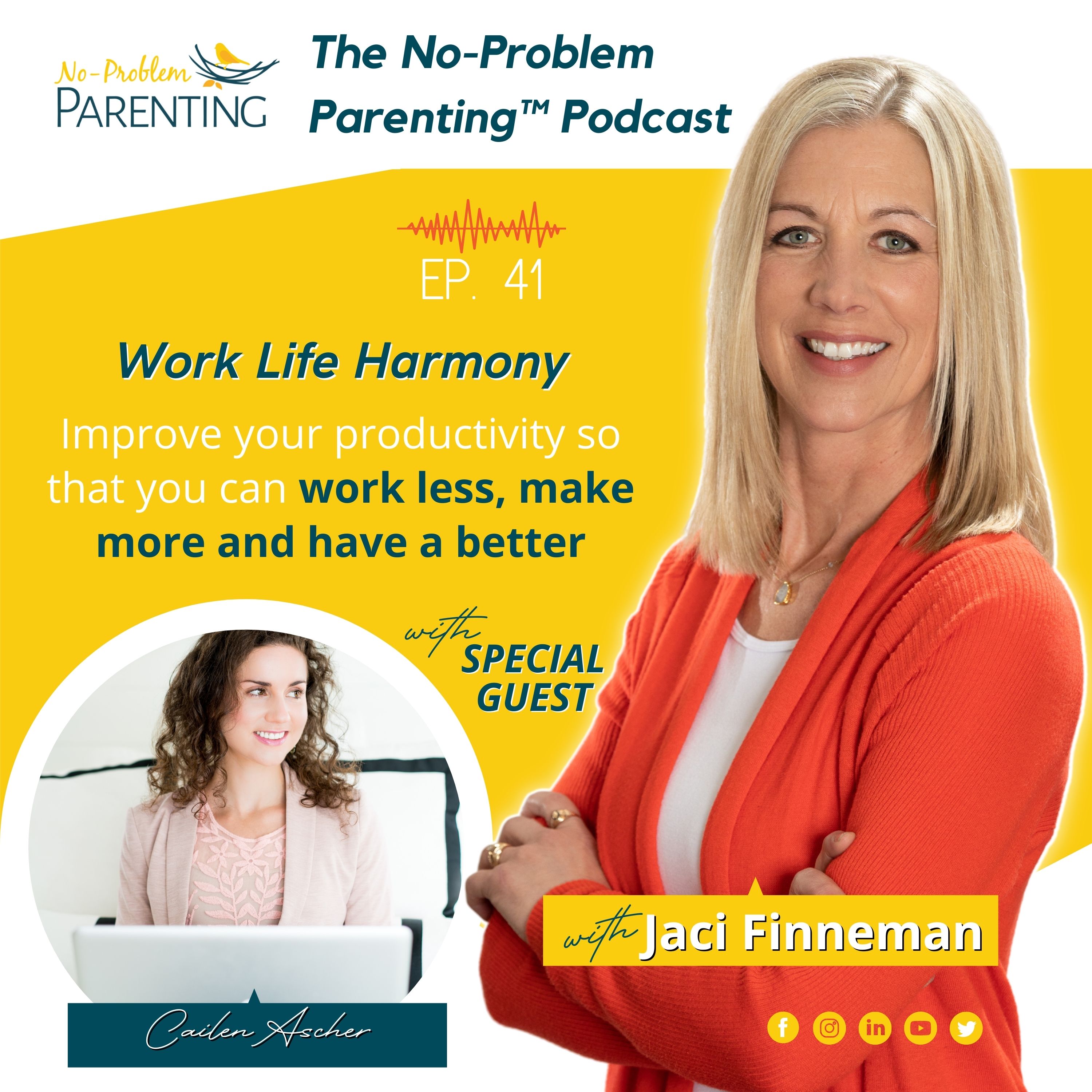
Work Life Harmony - Improve your productivity so that you can work less, make more and have a better life with Special Guest Cailen Asher
About this episode
Welcome Back Parents! Today's topic is about how to acheive Work-Life Harmony!
Let's be real. Work-Life balance is a bit of a myth. Listen in as our special guest Cailen Ascher shares her 3 day work week reality.
Become a No Problem Parent Today!
Full transcript
Welcome to the No Problem Parenting Podcast. Turn behavior problems into no problem with Jackie Fineman. Are you ready to become the confident leader your kids crave you to be? Do you want to learn how to make parenting easier and more fulfilling?
Whether you are at your wits end or you want to have more fun as a parent, you're definitely in the right place. Now here's your host, Jackie Fineman. Hey, welcome back everybody. Today we're going to talk all about, get this, work-life harmony.
There is really no such thing as work-life balance. We got to get rid of that balance idea. It's just not, it's just not real life, right? So today we're going to talk about how to improve your productivity so that you can work less, make more, and live better. My guest today is Kaylin Asher. She's an award-winning business and mindset coach with a three-day work week.
She's a mom to two little girls and the creator of Scale Up, which gives mompreneurs a clear roadmap to six-figure years while working just three days a week. Kaylin has been featured in Business Insider, Huffington Post, and Inspired Coach magazine. She's also the host of The Soulful Business Show, which airs weekly, so you'll want to check her out on her own podcast. Her programs have helped thousands of women transform their lives and businesses with her proven strategies for working less, making more, and living better.
Kaylin lives in Bucks County, Pennsylvania with her husband, her two small daughters, and a spunky dog named Olive. For an inside look at Kaylin's schedule to see how she works just three days a week and runs a six-figure business, you can visit her at kaylinasher.com backslash three-day workweek schedule. So welcome to the show. I'm so excited to have you here today and super curious about this work-life balance being a myth. So thanks for joining me today. Thanks for having me on, Jackie. I'm really excited to be here. Kind of tell us a little bit about your story and how you came to that conclusion. Absolutely. So I'm a mom. I've got two little girls, a seven-year-old and a four-year-old, and I also have my own business. I'm a business coach for women coaches and online service providers. And I realized as I was starting my business and running my business that it's really easy to let the work, especially when you're doing it by yourself in the beginning,
to take over aspects of your life that you in the beginning didn't want to sacrifice. And so something that became a top priority for me from the get-go, because I had my first daughter at the time was to have a three-day work week with my business. And it honestly began as sort of an experiment. I didn't know if I could make it all work, but the idea, the concept of working just three days and having four-day weekends with my new little baby just sounded too good not to give it a try. And so that was back in 2014, 2015 when she was born.
And ever since then, I have been growing my business while working just three days a week. And the reason why I think work-life balance is a myth is because balance is static. You know, it's like you've got to find that perfect place where everything's just so and nothing can be out of place because then the balance gets thrown off. And so what I really strive to do is to create work-life harmony, something that can ebb and flow with the seasons of life.
My work schedule and my work days look different now than they did when my daughters were younger, when they were babies, and I had to take breaks for breastfeeding and nap times and all of that stuff. And now they're more on a school schedule. And I mean, there's just so many factors that can play into it. And so I think looking for that balance, which is honestly just an illusion of, and it's perfection that we're striving for and we never get there, but rather having something that really honors you, your work, your lifestyle, your family's needs.
That's what we need to aim for. And that's what I attempt to do in my own life and my own business and also support my clients with when I have someone who's coming to me and kind of feeling maxed out from all the work that they're doing and they want to reclaim their time and set those healthy boundaries and find that harmony. It's just, I think it's absolutely wonderful. It's a great idea and you've proven it can work. And so we're going to get into some of the ways that you've made that happen. I agree when I left my 20 year career to become a parenting coach, part of the reason I did that, a big part of the reason is so that I would be working less or at least not traveling as much. And I could be there. Our son was eight at the time that I made my leap into becoming an entrepreneur. And even though I'm working from home, it can feel like I'm never not working unless I'm with other people or at his sporting events or, you know, something like that.
But otherwise it's like the business is always on my mind. I myself am super curious about this three-day work week and how you pull that off. So, so you've told us how it came about and you told us why that work-life balance is a myth, which I mean, that makes perfect sense. The balance just isn't possible. It can get thrown off so easy. And I love that work-life harmony, the ebb and flow, and we have to be able to go with the ebb and flow. So let's get into some of the tips that you have for mompreneurs who are running a business and want to be a present mom too. So how do we do this three-day workweek thing? Yes. The three-day workweek, right? It's like this mythical unicorn of a work schedule. And I think one of the key pieces that we really have to get comfortable with is setting those healthy boundaries, setting those limits around our time.
And honestly, when we do that, we often make higher and better use of our time when we know that it can't just spill over into all the white space on our calendar. When we really know, Like for me, for example, my work days are Tuesdays, Wednesdays, and Thursdays. And during those days, it's pretty much school hours. It's like nine to three.
So I've got 18 hours a week to do my work and get things done. And so that enables me to make those right decisions, what to say yes to, what to say no to, what to prioritize. And I know not everyone listening has their own business, but we still can make those decisions to put, put away the phone after 6 PM and be present at the dinner table. And, you know, maybe if you have to check it, maybe set a time when you'll do that. I know my, my girls now, they start calling us out. Me and my husband, when we're on our phones, they're like, put down your phone. Like, you know, it's not phone time. And it's funny because they don't even have phones that were, you know, recommending that they put their phones down, but they're starting to notice and want that undivided attention.
And I also know for me, just noticing my own energy, if I have a day where I've gone, worked really hard and then maybe we're in a launch or something, some like promotional period in the business. And so I'm working slightly longer hours. I'm on social media a lot more. I feel so drained and burnt out that I recognize that I've let my boundaries be compromised.
And so just taking a look at what, what hours are you actually giving to the things that matter to you? And often when we're working, we think we're working, you know, nine to five or whatever it is. But then when we really look at it, it's like, oh yeah, well, I checked my email first thing when I woke up. And then I checked it again before I got in the car to drive to work. And then when I got home, there was something I had to finish up. So I was on the computer for a half hour and those work days, they can just, they seep into the family time. And there's so little that to begin with, especially as our kids get older and things get filled up on our schedule with sports and social stuff. And I think it's so important that we, that we think about what we really, really want.
And I think that's a fun activity to say in an ideal situation, granted, maybe it's, we can't quit our jobs or something like that, but what would we like our schedule to look like? What would that look like? Would it mean having a quiet morning where you don't check your email until you get into the office? Does it mean having a cup of coffee with your partner or peddling on the couch with your kiddos? Or what does that look like? And are you building elements of that in now? Or is that something that you're just, are you just rushing through the time trying to get to the next thing?
Yeah, it makes perfect sense. The first thing I think about is discipline and how you must have to be super disciplined to work 18 hours a week and have that be enough to sustain your career and you're, you know, like, like that's enough time for you. And so do you time block? Do you have like, like, how does that, how does that work during those 18 hours? How does that look for you?
Well, I've gotten to know my rhythms really well. And so I know that I am my most creative and I have my most energy in the mornings. And so I do my very best to have the first two, three hours of the day uninterrupted so that I know from nine to 11 or nine to noon, I am able to really make headway on any big projects or things that need my creative focus. and then I always take a lunch break. I think that's really important. Even though my workdays are short, I never just power through to the end of the day and then like grumpy and hungry.
I always take at least a half hour for lunch. And then my afternoons, that's when I usually have my calls. Maybe I'll have one call right before lunch and then a call after lunch. If I'm doing interviews like this or leading a group call for one of my programs or meeting with my team, I find those afternoon hours are better because the energy of the call sustains me, where in the morning I've just got my own energy, and I can go headlong into that and so honoring that and then scheduling and yes batching around those energy flows have been has been really helpful for me so I know that, you know, this morning I'm going to spend three hours writing content for emails that are upcoming for this promotion.
that's happening. And then the next day I'm batching Instagram, social media content, and it just, it helps having a focus and a theme because every time we switch our focus, I read a study somewhere, I'm not sure where to credit this, but every time we switch focus, we lose about 20% of our efficiency because we have to switch the task we're doing, switch, you know, what we're thinking about, what we're focusing on, the, you know, the flow that we're in, all of that has, you know, a stop and then a start when we're switching and we lose about 20% of that efficiency. That is a really good point. And it drives me crazy because I know that like that you have those, those moments you're doing something and you're like so invested in it and so involved. And then you look at the time and it's like, Oh shoot, I've got a client appointment or I have to run my son to a sporting event. So what's another tip on how to, how to get to that point? How did it, how to get to that three, three day work? I was going to say three hour. There is a book, the four hour work week, right? Something that I found really useful that I did in the very beginning when I was thinking about how do I make this work? How do I condense all the hours I was working over five days into three days? I did a time inventory and I did it very simply. I just had a pad of paper next to my, my computer at my desk, set an hour timer on my
phone. And every time the timer went off, I jotted down what I could remember at least that I did during that previous hour. And I very quickly began to see all of my bad habits. You know, it's like I would hop onto Facebook to do a post that was business related and then click on somebody's vacation picture and go down the rabbit hole. You know, all those, all those little things that suck our time away or an alert would pop up on my phone and I would check it. And then it would remind me that I have to do something else, maybe for my kids or my husband. And I find myself in another room folding laundry, like it would be all this stuff that would carry me away.
And when I began to recognize all the things that I was doing that were basically just a distraction. And then also the things I was doing that I didn't particularly enjoy, or I wasn't good at, I saw if I was able to focus my time, my energy during those three days on those tasks that I'm really good at, that I really enjoy, that I don't mind staying focused on, I could make so much progress and be, you know, have a totally different business and a totally different experience of my business. And so that was a really powerful wake-up call when I saw that.
And I also saw where I could batch like, oh, okay, well, I did this for 30 minutes in the morning and then 15 minutes midday and another 30 minutes at the end of the day. If I put that all together, it probably wouldn't have taken me 75 minutes. It might have taken me 60 minutes or 50 minutes because I could have just gotten through that. And so that was really helpful. And then when it came time to hire, because I have two team members at this point, I looked at that list and I looked at what am I not good at? What do I not enjoy? And that basically became the job description for that person that I needed because I wanted someone who balanced my strengths with the things that they brought to the table.
yeah that's cool and I as you're talking I mean I know this is about you being an entrepreneur and having your own company and probably have a lot of listeners out there that are working eight to five jobs they're working corporate but really this could benefit those people as well the idea behind you know figuring out what your distractions are doing a time inventory and I'm sure a lot of employers would love for their employees to take a look at this and really notice what they could, I mean, some things are out of your control when you're working for someone else, right? You have certain meetings, but I think that time inventory is something that we really could, anyone can do to figure out how to be more productive in their day. And then also that has to help in your family life. So talk about that a little bit. Let's transition into how does that make you just a better mom, a more in tune or available mom?
Yeah. So I think one of the things that having a three-day work week has really enabled me to do is, is put those hard stops around my work hours so that it becomes fewer and farther between that. I'm, my kids are seeing me super distracted on my phone, trying to do work while they're trying to spend time with me. And so that has been, and I still struggle with that. I'm not perfect by any means. Like there's, there's moments when I'm like, I just want to like get this email sent or whatever. And they're, you know, trying to get my attention too. And so I, I, but I'm more self-aware of it and I know how to bring myself back from it. And I'm more, much more clear on what serves my energy and what depletes my energy so that I'm able to make those decisions.
And something that I've found really, really helpful, both on the home front and the business front, is recognizing what I call real time versus ideal time. And ideal time is the time we think or wish something would take us. Ideally, it will take me 20 minutes to get my kids to school, drop them off, and get home. Ideally, it's going to take me 30 minutes to write this email.
But then there's the real time that it takes. The real time is you're trying to get out the door and the one kid can't find their shoe and they can't wear any other shoes. They just need that pair and the one's missing. And suddenly that 20 minute turnaround becomes 30, 45 minutes because there's construction or whatever as you're trying to make that happen.
And so immediately you're entering your day and you feel like you're already running behind. You've already lost time. And this happens on the business front, right? You set 30 minutes to write that email, but then you realize, oh, you know what?
I have to do a little bit of research before I, you know, put all these bullet points in here. I need to make sure I'm really clear on this. Suddenly that becomes an hour. And again, now you're 30 minutes, you've lost, lost, air quotes there, another 30 minutes.
And so something that I've tried to get better at in this recognition of how much I was scheduling around ideal time. Ideal time means like I can do 30 minutes and then 30 minutes like back to back. Real time is 30 minutes and then a 10 or 15 minute break and then another 30 minutes, right? Like you can put a little breathing space into your schedule.
And that has enabled me to, when I get to the end of the day, look back. And even though maybe I had, I got fewer things accomplished than I thought I would have. Otherwise I feel better. I feel more accomplished because instead of putting 10 things on my list, I put three and I got all three of them done instead of putting 10 and only getting three done.
And you feel like you're at a deficit. And so I think that's a really powerful shift to consider because otherwise we're rushing through our life and that hurried, rushed, anxious feeling is so uncomfortable and it doesn't help us be more productive or more focused or more present. And so if you can keep that in mind and just put a little buffer time around each activity or the ones you can that are in your control, it will alleviate some of that rush and hurry feeling and you'll be more present and more productive.
And honestly, you're going to feel more accomplished, too, by the time you get to the end of that workday. Yep, that makes perfect sense. I love that about the put three things on your list instead of 10. I mean, all 10 things can be there, but each day it's like, what three things do I want to get done?
I think you're right. It does change the psychology and the mindset a little bit, right? And the energy around it. I'm more energized when I can say I checked off those three things that I said I was going to do.
So, and again, whether you're an entrepreneur, you have your own company or you're working for someone else. I think there's a couple of things that come into play when it comes to like, I, you're making me think of like guilt feeling like, um, or maybe you're the supervisor at your company and you've got a lot of people working under you. And, um, but you're still feeling like there's certain things you're not getting done that you should be doing.
And so you should on yourself, which I talk about in my no problem parenting course, how parents should not should on themselves. Right. But, but we do, we feel guilty if we don't perform enough or if we didn't work super hard that day, or we weren't feeling stressed out because it must mean we're being kind of lackadaisical about it or lazy. And then also that fear of missing out. Like if I don't look at my emails, what if somebody emailed me and really needs me or has something that they need me to get back to them on right away? How could I not check my email on Friday or Monday?
And how do I get over that? Like, Oh, I, you know, I didn't perform or I didn't help that person when I could have. Yes, I know. And those are honestly still feelings that come up from time to time.
I'm much more settled in my schedule. I mean, I've been doing this a long time now, like six years, I think I've had this schedule. But I think also recognizing that maybe where you're starting with it isn't where you'll end up with it. Because when I was first starting my three-day work week, I was working all on my own in my business. And so I did have to check emails during nap times on Mondays and Fridays, just to make sure that there wasn't this huge gap in, in support for my clients.
And, you know, I didn't want things to fall, fall, fall through the cracks that made people feel like they couldn't rely on me or trust me as, as the person that they had hired to help them with their business. But now that I've built my team and built my business and we're out at this certain level, I have support that enables me to take a fully unplugged vacation without checking my email every day or really enjoy that four-day weekend without having to think about all the pieces in my business. But I wouldn't have gotten there had I not started with my version of what I could make happen at that time. Instead of thinking, well, it's either all or nothing. And it's, you know, like we said, it's a harmony. We're working for that ebb and flow and there's going to be different periods, different seasons of your life or your work that need different things from you.
Maybe, maybe you're dealing with a sick parent and you need to back off from the work stuff and focus more on the family, or maybe there's a really big project at work and you need some extra hours and extra support. And so you have to lean on your partner or, you know, babysitters or whatever school aftercare in order to make that happen. And so I think honoring where you're at in this now moment and knowing that you have the opportunity to, to shift in any direction that feels better for you looking for those 1%, 5% upgrades, instead of thinking, okay, it has to be a hundred percent, a three-day work week or not at all. And I'll just scrap the idea altogether.
Maybe there'd be small ways to incorporate it where, you know, you get, think about how do you get your Friday afternoons off like could you talk to your boss and say, Hey, like the way my work schedules been going I've been really productive, and it would really serve me to have this kind of schedule and just see if we don't ask I've actually had a lot of people in there working with me over the years who were starting businesses, and they talked to their employers and negotiated a four day work week.
So they had a full day for their business and things like that. But if we don't, we don't lean into it and see what's available, we'll never know. Yeah, that's a really good point. And kids throw curveballs all the time, right?
So they either get sick or they have a school function or something that, you know, we need to attend or be at. So I like that it's not work-life balance because you're right. There's, that's no such thing. Like the pendulum is going to swing one way or the other at any given point.
And instead of feeling guilty or bad about that, you have this more of a work-life harmony. And so it allows you to forgive yourself. So you don't have to feel like you're in trouble if you're off track or off of your air quotes schedule, right? Do you have any other tips for us before we wrap up today about how to make that transition from the five day a week to three day work week?
Yeah, I think we kind of hit on them, but to sum it up, I think one of the best things you could do if you're excited by this conversation, it's waking something up in you and you'd love to shift in the direction of a more streamlined work week or just rebalancing the way you're working is to put it down on paper. What would that ideal schedule look like for you? Would it be Friday afternoons off? Would it be ending the workday hard stop at 5 p.m. and not looking at your phone again? What would you like to be available for? Do you want to be able to get to your kids games on, you know, the Wednesday afternoon game that they have every week, or be able to get them on and off the bus, write down that wishlist. And then without beating yourself up or feeling guilty, if you can't make it happen right now, choose one or two things that you can lean into, figure out some, some version of that, even if it's like a small little bite-sized piece of it that you could begin incorporating. So a lot of the women that I work with who have their own businesses and they want a three-day work week, I ask them, how much are you working now? And if they say, well, I'm working probably 60 hours a week. If I tried to cut them down to a 20-hour work week, their business would fall apart. They wouldn't know what to do with all that time,
but they know they're working more than they want to. So we look at all the hours they're working and we start massaging it into a better schedule? How do we get them to 45 to 50 hours? And how do we get them to 35 hours?
How do we step them incrementally over time towards what they really want? And so I would just encourage all of you to start where you're at, honor where you're at and make those small incremental upgrades that make it feel better because that's kind of the point of it all. Yeah, I think that's great. And part of the reason why I bring on a variety of guests like you to the show, Kaylin, is because the more support moms and dads have in their work life, the better they perform at home in their family life. And so I absolutely love your model. And I know there are people out there that can benefit from it. You have a podcast called The Soulful Business Show. So talk about what you share on that. Absolutely. Yeah. The Soulful business show. I've had my podcast for a few years now, and every week I share a tip or a strategy,
sometimes something very, very clear and business oriented. Other times it's more energetic or mindset, but it's really geared towards online service providers and coaches finding that harmony with the work that they do. And specifically what I'm often talking about, which would probably only apply to a small segment of you, but I'll mention it just in case, is helping those people who are in a one-to-one service model shift towards a group program so that they're not taking up all their available time with client calls and one-off client work, but rather they have a group container in which they support their clients that gives them back their time and their energy. And so we do a lot of pieces on that specifically for people in that transition. Yeah. So check out the soulful business show to learn more about that, but also listeners can go to Kaylin, C-A-I-L-E-N Asher, A-S-C-H-E-R, kaylinasher.com. And I'm going to have that link in the show notes as well as like your Instagram and for people to get in touch with you. But tell us a little bit about the freebie that you have for us today, because I have a feeling that this is going to actually help anyone that is working. Yes, I hope so. So I have a free download. It's called the three-day workweek schedule. And it shows you on paper,
my schedule. I know sometimes when you're talking about scheduling and time blocking and time management, it's nice to have a visual. And so that will give it to you. You'll see my schedule.
It's filled with tips about how to get the most out of your time, make the most of your work hours, and hopefully will inspire you to make some of those incremental upgrades we were talking about. So I hope all of you who enjoyed this episode, go and grab it. And it's, um, it's been a resource that we've been sharing for a while and it stood the test of time. So I hope it serves you too.
And it's actually adaptable to, you know, other areas of your life. It's just a really good kind of framework or picture or idea of how to, how to create this for yourself. So I think that's, that's pretty awesome. And I think any parent could even adapt it into and start to think about even like the homeschooling moms out there.
and, um, and, uh, and parents out there that, you know, it's, it's, or during your time with your kids, when you actually do, it's like, you don't have to schedule everything, but there are certain things that we know we want to get done as parents every week. And so let's be intentional about that and make sure that those things happen. So, um, we can enjoy the off time or the downtime or the things when, you know, that the other times when things don't have to be so scheduled.
So, well, this has just been super great. Thanks for being on the show today, Kaylin. My pleasure, Jackie. Thank you for having me.
All right, parents, go grab that link in the show notes for Kaylin's three-day workweek schedule. So you can take a look at that and adjust it to meet your needs and maybe start planning so that you can go from a five or six-day workweek to a three-day workweek. And also, have you heard about our webinar coming up? Turn behavior problems into no problem.
This is a webinar that's coming up. It's absolutely free for all of you. It's on Friday, February 11th at 1 p.m. Central Time.
I'm going to talk to you all about what no problem parenting is and how you can become a no problem parent. So make sure you check out that link in the show notes. You can go to meetup.com backslash no problem parenting backslash events.
All right, we'll see you all there on February 11th. For now, hugs and high fives. You got this, parents. Thank you for tuning in to the No Problem Parenting Podcast.
Join Jackie next time for more tips, tools, and resources that will help you become the confident leader your kids crave you to be. Who do you know that we could support on their parenting journey? Like this podcast, subscribe, share, or leave a review of the show. Your support of the No Problem Parenting Podcast pays it forward and helps us help more families.
Become the confident leader your kids crave
The method, the community, monthly live Q&A with Jaci, and Celia — your AI guide in the moment.
Start your 14-day free trial Get it on iPhone or sign up on the web