
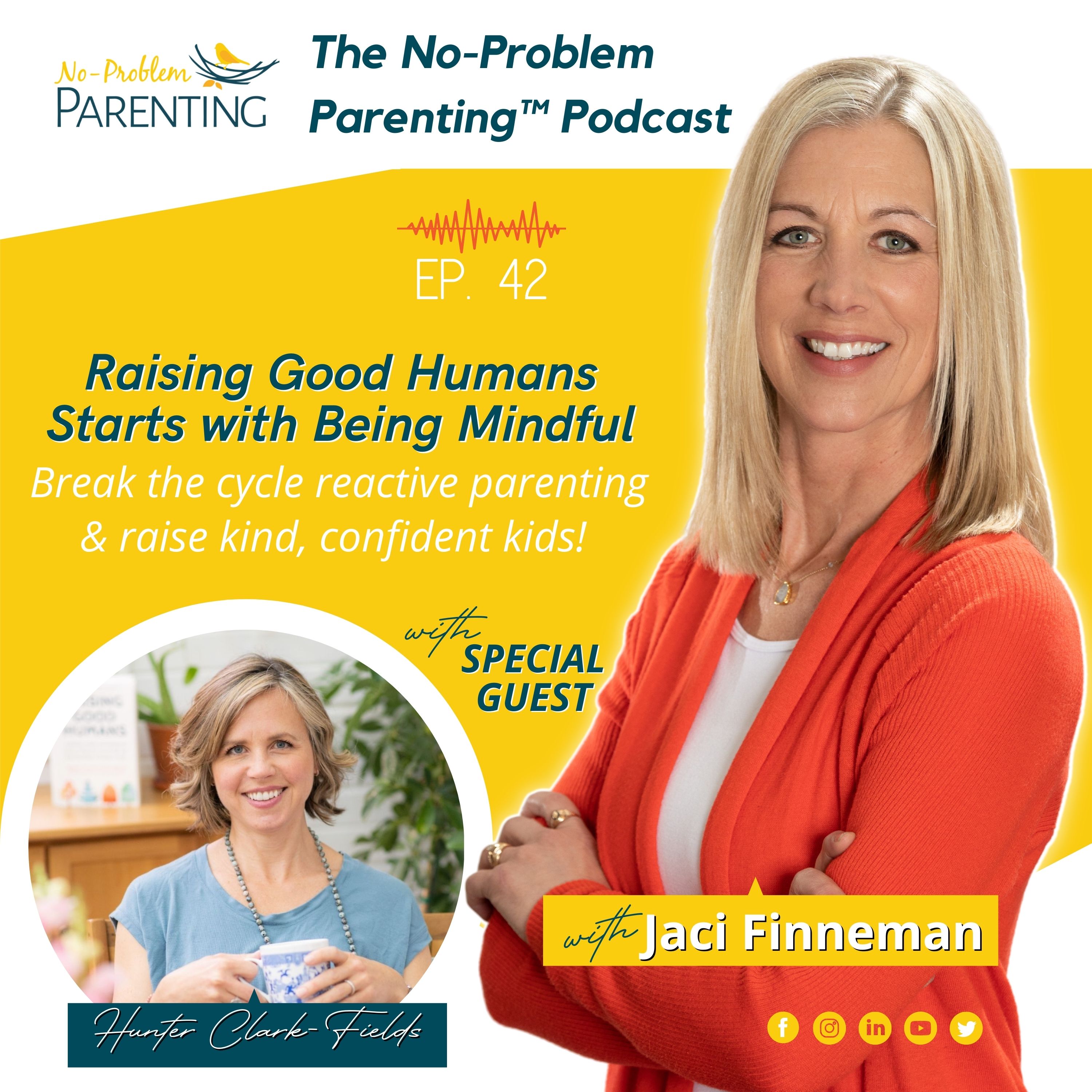
Raising Good Humans Starts with Being Mindful - with Special Guest Hunter Clark-Fields
About this episode
Welcome Back Parents! Today's topic is how to become a mindful parent with special guest
Hunter Clarke-Fields, MSAE, RYT, the widely-followed author of "Raising Good Humans: A Mindful Guide to Breaking the Cycle of Reactive Parenting and Raising Kind, Confident Kids." She helps parents bring more calm and peace into their daily lives.
Become a No Problem Parent Today!
Full transcript
Welcome to the No Problem Parenting Podcast. Turn behavior problems into no problem with Jackie Fineman. Are you ready to become the confident leader your kids crave you to be? Do you want to learn how to make parenting easier and more fulfilling?
Whether you are at your wits end or you want to have more fun as a parent, you're definitely in the right place. Now here's your host, Jackie Fineman. Hey, we're back. today with episode 42 and today we're going to talk about being mindful. Are you finding yourself more reactive with your kids lately? Are you kind of losing your cool and maybe yelling a lot or just irritated or annoyed or maybe you're noticing that in your kids? January tends to be a pretty long month. I don't care where you live, it can be kind of a long month and definitely here in the Midwest, it has been frigid, super cold. So that just adds to the tension and the stress on all of us parents and the kiddos too, having to get up and go out in minus 20 below. Weather is never fun and makes those bleary-eyed morning wake-ups even harder. So today we're going to talk about being mindful and how you can break the cycle of reactive parenting so that you can raise good humans,
help them to become kind confident kids and so today my guest is hunter clark fields she is the creator of the mindful parenting course she's the host of the mindful mama podcast and widely followed author of raising good humans a mindful guide to breaking the cycle of reactive parenting and raising kind confident kids hunter helps parents bring more calm and peace into their daily lives. She has over 20 years of experience in meditation practices, and she's taught mindfulness to thousands of people worldwide. She lives in Delaware with her husband and two daughters who challenge her every day to hone her craft. So listen in as we talk today about why losing it is not your fault and how mindfulness can really help us as parents. And then Hunter's also going to share with us the Mindful Parenting Roadmap, which is a quick and easy guide. And she also includes a quick video link with that as well. So I'll put all that in the show notes, but for now,
welcome to the show Hunter. I'm glad to be here. Thank you. Let's just get right into it. I love the topic of mindfulness and a lot of people, I think parents I work with and stuff sometimes are like, Oh, is that that like floofy stuff? Like I'm supposed to sit and meditate. And I don't have time for that, Jackie. Like, what do you mean by being mindful? And, and you have some, some mindfulness myths. I think maybe let's start with those. Well, I mean, to me, for me, mindfulness is at the foundation of everything that I do in mindful parenting and raising good humans. And for really good reason, because it's that, you know, we, we talk about how we want to choose how we want to parent our kids, right? We want to be able to choose how we want to parent. We want of be able to choose to make smart, thoughtful choices. And we have this like crazy belief,
you know, that we have this belief that like we can choose in any moment, but the truth is, is that we're really very much, we have all, we're very reactive. This just part of being a human being and part of being a, you know, the human species, homo sapien species is that we're pretty reactive, we have a stress response. We have a nervous system that causes us to be reactive. And when we are reactive, we're not accessing all of our brain. Um, we're just accessing the parts that, you know, the, the, the, that's that fight, flight, or freeze part, right? So we can, we, we can lash out and we are at, we react in ways that are conditioned by our society, by our parents, even, you know, genetically. So, you know, I found myself in this position when I was parenting my daughter, who's two, when she was two, she's 14 now. And I found myself like getting so frustrated and she would push back at me and I would yell and I could see,
I scared her like, and I was the yelling at her. I felt so terrible about it because this is exactly what I didn't want. You know, my father had a big temper. I could see, I could see this is my father's temper, like coming right out at me. Then this is exactly what I didn't want.
But because I, it wasn't like I had, it wasn't something I chose. Right. And that's the thing is like, when we yell, when we're reactive, when we do things that we don't aren't proud of as parents, these often aren't conscious choices. Like no one says, I think I'm going to just lose it. My child today is two 30, you know, like no one does that, but we don't, we don't, we, you know, we don't have this ability to stop that reactivity. And that's what, that's what mindfulness really gives us. It builds this non-reactivity muscle where we're able to, and it's really one of the only things that really does that. It's like research proven, you know, experience proven for thousands and thousands of years, but then now recently research proven, you know, through many,
many studies to be able to build that ability for parents to, um, of impulse control, which is so, so huge because that's, that's when we're at our worst when we're parenting, right? Is when we're, when we're reactive, when we're lashing out, when we're saying maybe the unskillful things our parents said. And a lot of people will say like, well, oh, you know, just tell you how to respond, like respond this way. But it's very frustrating sometimes to get that, that advice when you're losing it because you can't implement it because you literally can't access the verbal and empathetic and problem-solving parts of your brain when your nervous system is having this stress response. So mindfulness helps us to really lower that stress response, lower that reactivity and build it up as a muscle. It's not like it's a, it's a practice, you know, it's not something we can talk about. It's something we have to practice in our lives. And, and that is, so it,
to me, I think it's the, the ultra it's the ultimate foundational thing that we need as parents. Yeah. And so we can actually flex that muscle in our brain, right. But yeah, teaching it to be mindful and to, to come from a place of calm. But I absolutely completely agree with you that when you're in that fight or flight stress, part of your brain stress response, part of your brain, there is no reasoning, right. With yourself, much less your child. And so I love that you teaching. It's not about, oh, here's what you say and how to say it. It's about when you say it, right? Lots of times parents know what to say. It's just in that, in those moments when they're in that fight or flight part of the brain, they're, you're literally not able to, right?
Yeah. Yeah. You literally can't access those parts of the brain. And then you, we blame ourselves. We're really hard on ourselves. You know, we're very judgmental about ourselves. And the truth is like, you wouldn't send your kid to, I don't know, like the little league world series, right? Like I kind of difficult moments with our kids. I kind of think of them as like the little league world series. And like, you know, you wouldn't send your, your eight-year-old to like the little league world series without them ever having gone to a practice without gotten, getting some coaching, without practicing, getting some muscle memory for the swing, any of that stuff. And they, we expect ourselves erroneously to be in these difficult, challenging moments with our kids and just be able to choose how we want to respond.
And the truth is it, it doesn't, how's that working out for you? You know? Yeah, right. Exactly. And why are we continuously beating ourselves up for the fact that it isn't working out for us? Right. Why don't we, we learned some new skills. So let's talk about how do we get in that, how do we practice mindfulness then? What are some ideas or some actionable tools I should say? Yeah. Yeah. And I mean, I want to share those actionable tools, but I also want to just share that. Like it really does change the brain. Just it's so cool. And I just want to share this part.
It's so neat that the, the, you know, that fight, flight, or freeze centers of the brain, they're called the amygdala. And they, after research has shown MRI studies show that, that it actually shrinks that part of the brain. It actually makes it smaller. And it actually, a practice of mindfulness meditation actually increase, it actually makes denser the gray matter in your prefrontal cortex, the area behind your forehead, which is like the, the empathetic problem-solving verbal ability part of the brain. It's pretty amazing. So it is, it may feel like, oh, it's just this woo thing, but it's actually like, it's actually a, a shift in your attention.
So a lot of people say like, oh, you can be mindful while you're like playing basketball or whatever. And, and the truth is like, I find a more, a formal practice is much, much more effective. You can't really, I don't know, you know, practice playing basketball while you're eating dinner, right? Like it's good to focus on one thing and, and a mindfulness meditation practice really is the gold standard for doing that.
And it doesn't have to take a lot of time. They're teaching it to people in very like a highly incredibly busy, high stress jobs, like, like soldiers on the front line. Right. Like, and they're finding that it's really saving their, saving their lives and saving their attention and saving their stress.
And it can do the same for parents. You know, if we, if we have a, if we, you know, if we've got five minutes for social media, we've got, we can take five minutes and, and practice. And so when we, when I say practice, yeah, you might sit down, do a sitting meditation or a walking meditation, but you can sit. And as you sit, you, you know, I recommend people start with a, you know, with the teacher, use a guided meditation, sit and hear the instruction of, you know, take something that is in the present moment to anchor you.
Because what happens when we sit is that it's not like, you know, beautiful rainbow sparkles shoot out of our ears and we're suddenly blissful. It's that, it's that you sit and you're like, oh, I have to do this and I got to do this. And what about that email? And I should have said this and all these things come up and because, and that's just how the brain works, right? The brain thinks just like the ears here and the eyes see, it's not something we're going to turn off, but we're gonna, what we're doing is we're creating a better relationship with our attention where we're saying, okay, you know, when I notice I'm lost in that thought, when I'm noticed I'm, I'm in that virtual reality, I'm going to bring myself back to actual reality. So I might be like,
what do I, can I feel the feeling of the air coming in my nose? Can I feel the feeling of the air coming out of my nose? Can I feel if I put one hand on in the palm of the other, Can I feel the feeling of those hands touching or the thumbs touching? And as you breathe in and you breathe out and you sit with that, and then, and as you sit, you notice like your brain is like a muddy pool of water.
Someone stomped through and all the mud is churned up and there's nothing to do in some ways to make that water clear again, or except just be still. And as we, as we're still, as we refocus our attention, you know, 10 times, 20 times, 50 times, 500 times back in the feeling of the touch or the feeling of the breath. It's, it's this weird kind of brain hack. I think of it as, it's not like it's super, super boring at first.
It's super not fun at first, but it's this crazy brain hack where. as you do this practice, you develop this muscle of non-reactivity. And so you can, so for me, what happened is I started this practice. I sat for 10 minutes a day, like six days a week. And after a couple of months, I thought this is BS. This isn't working.
I just sit here thinking the whole time I'm crap at this. What am I even doing? But then I looked back at the rest of my life. And for that, at that point, I was 27 years old. And at that point for my whole life, I been a highly sensitive person. I would like fall into like, you know, I would be on this roller coaster emotionally. And I would fall into these pits like every week, every couple of weeks, like it was just regular in my life. And so when I, I had that meditation moment. I looked back at my life and I looked back and I saw I had not fallen into any of those pits at all in my life. It had just given me this equanimity. And that's what we look at. We look at how is it affecting the rest of your life? And what I see in mindful parenting is people are like,
oh, my partner is saying I'm so much calmer. It's really interesting how it happens. That is really cool. And so even though you went on, you know, 10 minutes a day, six days a week for a couple of months and you're thinking, okay, this isn't really working.
It actually was. Exactly. Yeah. It's not like we are in this meditation session and we say, oh, okay, now I'm a good meditator. I'm winning. No, it's not about becoming a good meditator.
It's just about creating a tool to shift your lens. And what it does is like, you know, we process everything through our minds, everything, like every sense, everything goes through our senses, goes through our brain, everything in our whole lives. And what's happened for most of us is that our, for all of us is that the lens has become foggy. We have conditioned responses. We have all this like baggage and it's like this lens that we're looking through has become foggy and cluttered. And what meditation does, it helps you see, it starts to clear the lens and you can see more clearly and you can say, Oh, I'm starting down that path of this with my child. Oh, I'm starting to see that my child is needing this right now. Oh, I'm starting to, it's builds awareness.
And that is the superpower we really need. You know, like we can't have any idea of what's going on with our kids. If we're not aware, if we're looking through this foggy lens, if we're, we're, we're looking and we just see like judgments and we're not seeing who they really are right now. Right. We're, we're seeing our, like, you know, things we decided three years ago about our kids or how kids should be, or how I should be, you know, this awareness is clearing our lens is really, really essential. I really like that. I in no problem parenting, I teach that we need to seek first to understand where is the, you know, where, why is our child behaving the way they're behaving. And I think as parents, sometimes we have, we're predicting the future for our kids, you know, and like how they're going to turn out or, or the path they should take or the things, you know, they should be involved in or not involved in or whatever.
And we're, we're a little bit too thought out when it comes to some of that stuff and it gets us overthinking maybe. And then if things don't work out the way that we think they should, or that our children don't behave the way we think they should, right. Then we start focusing on all these problems and the negativeness with that. So I like the thought of being mindful in the moments, right. But also to just kind of get perspective about our child and not overthink like their behavior or the path they should take or, but really to kind of take the pressure off of us as parents a little bit. And that our kids are like this direct reflection of us. So if they misbehave, there's something wrong with us. And if we're being overreactive in our parenting,
and then we beat ourselves up for being overreactive, I can just see, I guess, how the mindfulness would really kind of help take it down a few notches, right? Get things into perspective. It cuts through the, all that BS, right? Because basically all the, that you described, those are all thoughts that we have, right? And thoughts are just stories we're telling in our heads. They're not reality, right? So we are telling all of these stories and all of these stories, these, these made up stories in our head are affecting how we behave with our kids. And then we beat ourselves up. And that's also a story we're telling in our heads and what it does, it adds all these layers of distance between really being there. You know, Dr. Dan Siegel has said a number of times, like the, the number one best predictor, you know, for a child's being is like your ability to actually just be present with them. And when we're, when we're constantly in that predicting mind, when we're not there, and really the truth is that attentionally 50% of the time, we're just not there. We're, we're, we're, you know, and it's okay for us to like, not, we don't have to be with our kids every second, but the truth is like a lot of times,
even when we're physically there with them, we can't rest. We can't really see them. We can't really hear them. We can't, we don't bring a curiosity and an open mind and an acceptance to them because we're so cluttered up with what you said, like our brain is predicting and our fears and all of this stuff. And we've got to, and what mindfulness helps us do is to clear all that away and create a foundation of clear seeing and of like steadying our hearts and minds and nervous system. So then we can actually be there. I have a teacher of mindfulness that I follow, who's an amazing person and the Zen master Thich Nhat Hanh, many amazing books and, you know, was nominated for Nobel peace prize by Dr. Martin Luther King jr. In the seventies. And he says,
when you love someone, the best thing you can offer is your presence. how can you love if you are not there oh that's good right how can you love if you are not there and and so we we have all these layers of bs layered on to our parenting the role the fears the blah blah blah and we can cut through all that and say ah who are you right now my child how can i really be with you can i really connect with my love and to be we the only time we're really able to do that is in the present moment. It's not in all the thoughts and fears and worries.
I love that you also say that losing it when we do have those moments and we lose it as a parent, it's not our fault. Yeah. I mean, yeah. Like I said, it's not like, it's not a choice we made.
It's not a choice we made. I mean, I would even argue that, you know, for my father and his rage and his temper, it wasn't like he was so driven by, you know, the, his stress response. It wasn't really a conscious, it wasn't a choice he made. Like, and for a lot of us now, like none of us are going to choose to, to scream at our kids. No, no one wants to choose to do any of those things.
We want to have a good relationship with our kids, but kids are like, inevitably, like their, their, their behaviors are like annoy us, disturb us. They're frustrating. They're messy. They, you know, all this stuff, like kids are by definition immature. And, and so, you know, the old, you know, when you talked to, you talked about our self-care and taking that hot minute and we put this pressure on ourselves and we put this pressure on our kids and we put our, all of us in this, you know, and part of it is just societally, we put ourselves in this pressure box of like, Oh, it all has to be mom. And, and, you know, I have to be this certain person for my kids. And, and the idea of saying, I'm going to take a break. I'm taking time for myself. I'm,
I'm putting a boundary on, you know, Hey, you can't come in here for this 15 minutes. Cause I'm going to sit in quiet for 15 minutes or five minutes or 10 minutes. It's it. We don't, we, we, we have this like martyrdom idea that we think we can't do that, but it's so harmful. It's so harmful for ourselves. It's so harmful for our kids because, you know, when we, when we, when we don't do that, like we, we have the, we have these layers of stress that just add up when we, and we add up and add up and then takes the tiniest little thing for our kids to push us over the edge in our stress response. Honestly, taking care of our, our stress and our wellbeing, getting enough sleep at night, maybe the number one best thing you could do to stop yelling at your kids, right.
Is to value yourself and value your own wellbeing. And that is like the number one best thing you could probably do for your kids, because then when you're with your kids, you can really be with them and you're not going to resent them. And you're not going to hopefully scream at them, you know, as you practice some, some alternative responses and you practice that, that ability to slow down that stress response. yeah for sure and and that's exactly what I mean it's it's like taking care of ourself is is really step one we hear it all the time right put your oxygen mask on before you put it on your child if you know the airplane's going down or whatever and it might sound cliche but it truly is taking care of yourself otherwise we are losing it with our kids and we're yelling and then we're feeling guilty later you know and beating ourselves up but some of the things we do that are problematic as far as when we move now into like, you know, we've, we've talked about that as internal,
right? Like all this internal work, it helps us to be really, you know, to steady our hearts, our minds, our nervous system, take care of ourselves. So that then we can respond skillfully on the external side, right? That communication, that's the external piece. And, and then when we get to that, like, well, some of the things we do, that's just, we're just conditioned by society and by our own parents, we, um, we bark orders constantly. I don't know if you ever hear, um, you know, we don't hear ourselves do it because it's literally, it's like we're fish and it's the water that we swim in, but put on your shoes, get in the car, brush your teeth, put that down, pick that up, get in your chair. You know, um, it's, we, we order kids around all the time.
And honestly, nobody, even if you're two, likes to be ordered around. Nobody likes to be told what to do. And so that's one of the simplest shifts that we can start to make as parents is to start to check our language around that. Like, I invite you, listener, to listen to yourself for a week talking to your child and notice if that's how you talk to your child.
You probably don't even know at this point. And then when we notice it, we can say, oh, okay, well, if, I don't know, if Jackie and Hunter were here and we had to put on our shoes to go outside, how would I say it to them? How would I say it if my mom had to get in the car? How would I say it to somebody I respected?
And that's really the key to teaching kids respectful communication is using respectful communication. It's, it's really very simple. We are going to have to repeat ourselves with our kids endlessly. Like nobody learned something the first time we're going to have to repeat ourselves.
So we might as well be repeating skillful, respectful communication rather than orders and threats and other things like that. So you have something that's called the mindful parenting method that can kind of help us to be more mindful when we're responding. So let's talk about that a little bit. Sure.
It fits into the acronym CLEAR, which is very nice. But the first step is calm, that C. And that really encompasses a lot of the work that we do in mindful parenting. So we first work to calm our reactivity.
So we do that through habits, mindfulness meditation and other practices and tools that steady the heart, the mind, and the nervous system, right? So we can stop being so reactive. We also do that by understanding and taking care of our triggers. You know, we may have things from our childhood, you know, some baggage that's making us have an outsized reaction to certain behaviors from our kids.
And then the calm step also includes self-compassion and caring for our difficult feelings. And because these are really all this foundation that we need to be able to calm our reactivity because self-compassion is there because, you know, if we're hard and, uh, and harsh mean to ourselves, when we are inevitably human and make a mistake, we're not going to try new things anymore. We're going to stay in our little, little comfort zone, right? We need to be able to, to give ourselves a soft landing when we, when we are inevitably human, right? So we calm, calm that reactivity is that first step. And then the L is listen, listening reflectively, listening to create connection. You know, we often think as parents about talking,
we're like, right? Like we're like this child, we talk too much and we need to listen more, so we can understand what's happening with our kids. And that really creates that connection, which is the fruit, which is the reason why our kids want to cooperate with us is because they care and we have that connection. And then the E stands for express, expressing ourselves honestly and effectively. And a lot of times, like, you know, because we are in a culture and a world and we grew up in a family where there was a lot of unskillful communication, right? Maybe orders and threats, right? For me, threats are like the thing when I'm stressed out, like that's the thing that pops up in, you know, in my head instantly is like a threat. It's so funny because it's so conditioned in me. Right. But when we, we can learn to express ourselves more honestly and effectively. And so we, we teach that, how do we do that? How do we like set boundaries,
et cetera. And then a is attend just being present, right. Practicing to really be there to, to to not be lost to to not be in our in our story world not in our virtual reality and come back to real reality and then the last is r and it means it stands for resolve resolving problems based on needs so rather than using um rather than using unskillful old school methods we can say if we have a conflict what is it that you're needing what is it that i'm needing how can we resolve this problem based on needs. So that's the, uh, the clear method. All right. And you're going to give us a freebie today too. I'm going to put a link in the show notes, uh, mindful mama mentor.com backslash stop yelling. So, um, you want to tell us a little bit about your stop yelling in 10 seconds. Sure. How to stop yelling in 10 seconds. So it's a quick five minute video that walks you through like the, my top two mind body tools to help you to, to stop yelling in as, as fast as you possibly can. I love that. So we're definitely sharing that link and just, it takes five minutes to learn it and 10 seconds to stop, right? Yes. Perfect. I love it. Well, anything else you want to share with us today? Um, no, I mean, I just, I want to say that, you know, none of us is good.
None of us is going to do it perfectly and we don't have to, right. There was a, there was a study that, um, there studied, uh, parent child interactions and parent, uh, kids bids for attention, right. They, they, they, um, you know, how are you seeing me? Are you hearing me, et cetera.
And, and in this study, like the best parents, like the, the, the best parents that were and that, that were there, they had these, they had, you know, skillful, great interactions with their kids 30% of the time. So it's not, we don't have to be perfect. We don't have to do it perfectly. But, you know, I think, you know, we, we can all cut ourselves a bunch of slack, you know, and, and say, and, and focus on the places that really do make a difference, right? Like focus on those things, like when you are reactive, you know, like you're saying like, and then, and that, um, that can make all the difference in the world. Um, and to have like a positive lifelong relationship. And I really think it, it, it really impacts not only you, it impacts your family, it impacts your community impacts the world. I think when, as we start to make these shifts. Oh, I absolutely love that. And I love that you say that mindful parenting is going to teach you. Mindful parenting is going to teach us all how to lower our reactivity, right? Which will then help create cooperation with our kids, which is then going to help solve problems mindfully. And Hunter, you are there to help parents out every step of the way to get started.
If they're new to mindfulness and really, really want to make it work, you are there for them. So reach out to parents. And thanks again, Hunter, for being on the show today. Thank you so much. And thank you for what you're doing and how you're sharing this work and your voice and reaching out to parents in the way you are. I really appreciate that. And I appreciate how you have me on. Well, thank you, Hunter. I really do appreciate that. And, you know, one of my favorite things to do is to connect parents with resources that they didn't even know existed. I am not a one-stop shop parenting program. My three-step no problem parenting is really a foundational kind of guide to get you on your way to be able to utilize and implement the resources and other programs that are specifically helpful to your particular needs or your child's needs and your family. So that is why I created the no problem parenting membership community. In the community, you get my online course and you get access to workshops,
roundtable discussions, and connections to resources such as the ones that I air on my podcast. So if you're interested in learning more about that and becoming a No Problem Parent, I have a free webinar coming up on February 11th at 1 p.m. Central Time. You're going to want to go to meetup.com forward slash No Problem Parenting forward slash events. You can join my meetup group and you can also register for that event. All right, for now, parents, hugs and high fives.
You got this. Thank you for tuning in to the No Problem Parenting Podcast. Join Jackie next time for more tips, tools, and resources that will help you become the confident leader your kids crave you to be. Who do you know that we could support on their parenting journey? Like this podcast, subscribe, share, or leave a review of the show. Your support of the No Problem Parenting podcast pays it forward and helps us help more families.
Become the confident leader your kids crave
The method, the community, monthly live Q&A with Jaci, and Celia — your AI guide in the moment.
Start your 14-day free trial Get it on iPhone or sign up on the web