
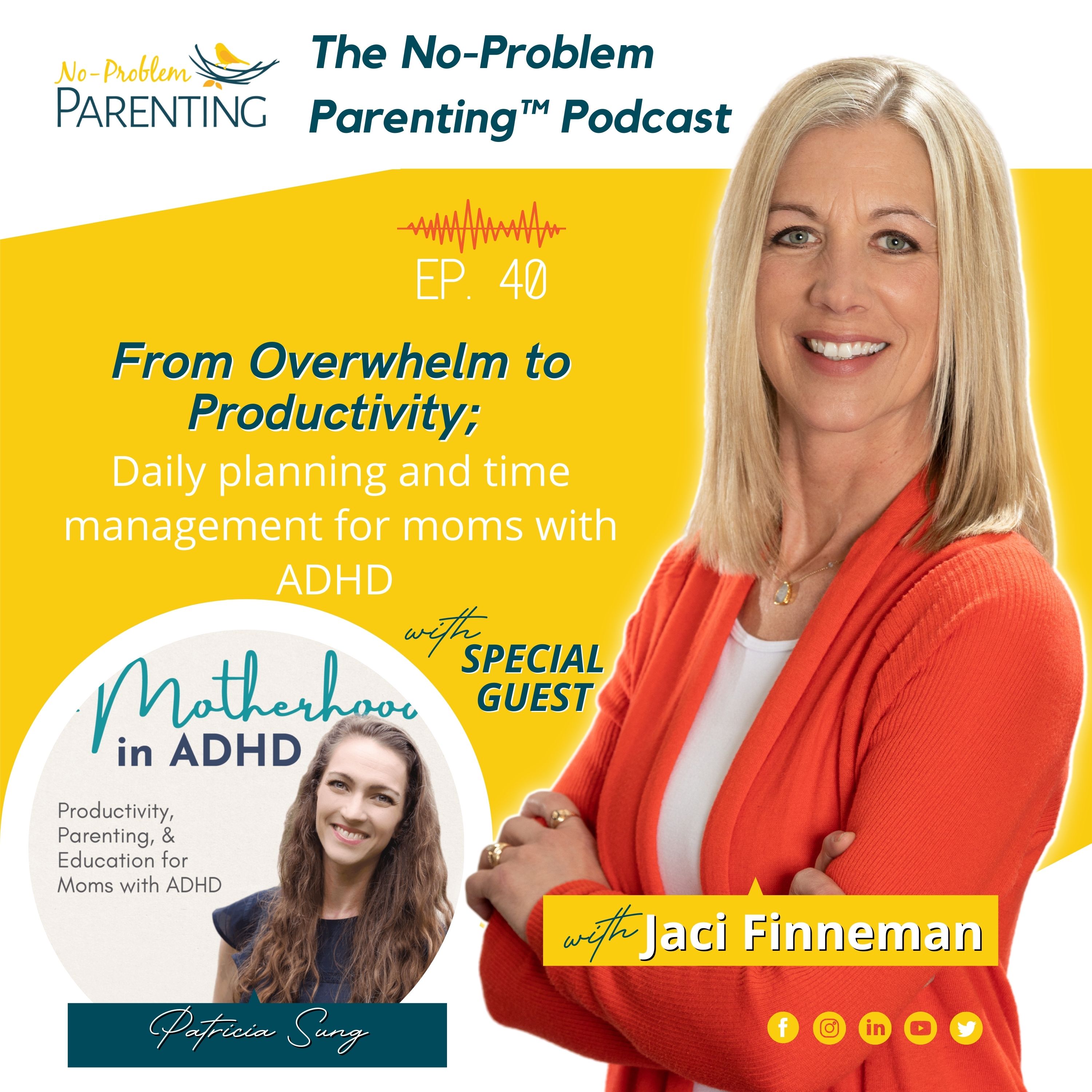
From Overwhelm to Productivity; Daily planning and time management for moms with ADHD with Special Guest Patricia Sung
About this episode
Welcome to The No-Problem Parenting™ Podcast!
What Does ADHD Look like in Girls/Women and How Can you Better Understand yourself and your ADHD Child?
Whether you have a diagnosis of ADHD or you are just struggling to get and stay organized in your family and work life but you just can't seem to get on top of it all, Patricia Sung helps disorganized moms get their crap together one step at a time and feel confident running their family life.
Become a No Problem Parent Today!
Full transcript
Welcome back to the No Problem Parenting Podcast, where we choose to deal with and overcome the parenting challenges in our home. Hey you guys, I'm your host, Jackie Fineman, and today is episode 40. That's right, 40 episodes. With a two-month hiatus in there due to COVID and holidays and all that jazz, we are back.
And following up from our last episode, if you haven't caught that one, three tips, tricks, parenting, mama hacks, I guess you'd call them, for how to bring the calm into the chaos in your life. You're going to want to check that episode out with Heather Steinker from Chaos and Cookies. And today we are talking all things ADHD. And what does ADHD look like in girls and in women?
And how can we better understand ourselves as mamas with ADHD and then our kiddos with ADHD? So let me introduce to you Patricia Sung. Patricia helps disorganized moms get their crap together one step at a time and feel confident running their family life. After years of serial entrepreneurship and teaching middle school, she has a uniquely practical perspective on strategies for building a life that works when your brain is different.
If you're looking for more than theoretical textbook advice, Patricia teaches from a unique viewpoint from her years of effective application in the classroom, as well as her own life. It is her hope that the Motherhood in ADHD podcast is a lighthouse for mamas who have ADHD. An introverted Midwesterner at heart, Patricia has adopted the word y'all and resides in Houston, Texas now, along with her two young boys and extroverted non-ADHD husband.
Welcome to the show, Patricia. I'm just really excited to have you here because I think ADHD is such a normal thing in our everyday lives. Like who doesn't know somebody who's either diagnosed or feels like they should have been or could have been diagnosed. So super happy to have you here. Welcome to the show. Thank you so much for having me. I'm really excited to be here. I mean, you're right. ADHD is so common. It feels like when you have it, it feels like it's not because you feel like the only one who's struggling with these things, but really there's somewhere between five, even upwards of 10% of people that have it. And so, you know, somebody, even if you don't have it yourself, who is dealing with this. And even if this isn't directly for you or your family, the level of understanding, like how much that means to the person who has it when they're dealing with somebody who maybe doesn't fully understand,
but at least has some, some sympathy or understanding is like such a breath of fresh air and like light to the soul when you feel like you're not being judged for the person that you are. So I'm, I can't wait. Like I'm like, Oh, let's jump in. I'm excited. Yeah, exactly. I'm so excited to jump in too. And you're here to tell us just not because you've read about ADHD or you've learned about it. I mean, you were a teacher, you have experience. You're not just, you know, coming off the street and saying, Hey, I think I know something about this, but you're also living with ADHD, right? Right. So I was diagnosed when I was 19, was in college. So it's, um, I shall date myself. I've known for 20 years that I've had it. And, um,
not only have I worked with it when I was teaching, obviously I had plenty of students who had it, but in the last few years that I've had my kids, I realized, whoa, I have got to really dive into my own ADHD because I had figured out how to work life by myself. But once I had kids, a lot of my coping skills just went out the window and I had to totally redo how I approached my life as a mom with ADHD. So really, um, gone like, you know, dived in nose deep for the last, uh, let's see how old was my oldest six. So like almost seven years now that I've really dove in there and been like, okay, this isn't something I can just sweep under the rug and hope for the best. This is something I have to take seriously. When did you think you had ADHD or when did you start to notice that there was something different about you? Even like, cause how,
how did you not get diagnosed all through school? I mean, literally I knew that I had ADHD when the diagnostician said, you have ADHD. That's when I knew I had ADHD. But keep in mind, you know, I grew up in the eighties. And so back then there really wasn't that much information around about ADHD at all, let alone what it looked like in women, which is very, can be very different than how it presents otherwise. And it, and it depends, it really depends on your own flavor of ADHD.
everyone's different so you get the full gamut of symptoms for everyone like everyone's different it's like there is no replica of ADHD my ADHD is going to look different than everyone else's so um that's part of what makes it difficult to diagnose um but truly back then we didn't have the information that we have now and most of the time for the people who were diagnosed at a younger age, they really didn't get much information. It was a lot of like, this is what you have. You can take some medicine. Good luck was pretty much the summary of how things went, which unfortunately sometimes it's still how things go. And I would say the reason I didn't get diagnosed is because I am a classic presentation of inattentive ADHD, which means,
and also back in the day, that was just called ADD. They don't use that term anymore. Now it's everyone's ADHD. And then you have like a label afterward, like a subtype.
So either hyperactive, inattentive or combined, which means you have both. And I always say that although I am inattentive, the H for me presents in my brain. My brain goes all the time. It does not stop.
So while I'm not necessarily outwardly hyperactive, my mind is very hyperactive and I'm also very fidgety. Um, so if you think back in, you know, back then people didn't recognize that they didn't know what to look for. And when you have inattentive ADHD, which is generally speaking, like if I'm going to be very stereotypical, that's how women tend to present is more on the inattentive side. It's not a hundred percent, but just generally speaking, usually what you'll see, um, all of those symptoms can be explained away by things like, oh, that's a shy child. That's a quiet child. She's a daydreamer. She's a doodler. She's a space cadet. She's really lazy. She doesn't pay attention. She's always looking out the window. All of those things are what ADHD outwardly represents. So I wasn't irritating anyone. I wasn't jumping off the furniture. I wasn't talking someone's ear off and driving them nuts because I won't be quiet.
So because I didn't create this outward problem that annoyed others, it didn't get the attention. And that's what you see a lot in women and in boys who have inattentive ADHD is that they're not irritating anyone. So nobody brings it up, which is rough because then ADHD becomes known as the irritating people instead of what it truly is, which is a neurological medical condition that affects every part of your life, not just irritating the others around you.
So, I mean, I'm now I can look back, obviously, you know, clear vision and say, it's very clear why it wasn't diagnosed because we didn't have the knowledge that we had. But if you go back and look at my report cards, you're like, oh yeah, that it's like red flag after red flag. Like, you know, my kindergarten report card talks about how I cried all the time because I had, I mean, when you have ADHD, you have a lot of emotional dysregulation and it's hard to deal with your emotions. And they're kind of like a roller coaster. And, you know, so that you can see like these patterns of, you know, always turning things in late, having trouble with my emotions. Like you seen, see all those flags, but at the time we just didn't have that knowledge.
And part of my mission now is sharing that because that's still an issue now where people don't recognize what ADHD looks like in women. And so many women will go to the doctor and the doctor will be like, well, you know what you did really well in school and you seem to hold down a job. So you can't have ADHD. Yeah. Doesn't that drive you nuts? It's like, well, there must not be a problem if you're functioning well, they don't realize how hard you work at it. Right. And all that behind the scenes stuff that goes into, uh, into just being able to put on a good, sometimes a good show right at your job or with your family or at a, at a family function, especially if you're an introverted person with ADHD, which I think a lot of people don't even realize you can be an introvert and have ADHD. Very much so. And there, the thing about ADHD is that it has the same occurrence across all cultures, all geography, all intelligence levels, all socioeconomic backgrounds. Like ADHD is not like, it doesn't have any prejudice. It doesn't, it doesn't like stick with one group and not the other. It is literally the same prevalence, no matter if you're studying the Aborigines or you're studying inner city Chicago or the country in Iowa,
it doesn't matter. You have the same prevalence across all people. So like I said, when you, you know, a lot of times people get diagnosed because they're irritating people. Well, also, a lot of times you get diagnosed because you're not doing well in school. So like, Ooh, there's a problem here. What do we do? So the people who aren't getting diagnosed are the ones who have figured out how do I make this work for me? Because when you have ADHD and you're little, you don't know, even now as an adult, like you don't know that your brain functions differently than someone else's because you can't see in other people's brains. You don't know what anyone else is thinking. You don't know how they perceive things. So when you are approaching everything in a totally different way. You don't know that. So as a kid, did I know I was different?
Yeah, for sure I did. But I didn't realize the level of difference that it was. And I didn't realize that it was the way that my brain functioned. I always thought it was that I'm too shy and that I worry too much, like I was a very like anxious child, I always thought it was something wrong with me and that I just needed to figure out how to be more brave, how to be more talkative, how to do like that. I needed to like fix something in order to overcome these barriers. And I didn't realize that it was that I have a different brain, a neurological condition and actual learning disability that here I was working my tail off to keep up with.
And I was able, like I was, I graduated near the top of my class. I got a scholarship to college. Like I worked my butt off to get those things, but I didn't realize how hard I was working and how much I was circumventing the normal way of doing things in order to get there. And that is exhausting for people with ADHD. It is so much work to do quote unquote, simple, I'm going to air quotes here, simple tasks, because your brain doesn't do them in the way that everyone else does.
And so we struggle with our energy levels. We struggle because it takes us so much more work to do simple things that when it comes to hard things, that's where you see kids who are so frustrated or like they're, they hold it together all day at school. And then they come home and they totally lose it and have a meltdown because they worked so hard all day to hold it together and pay attention and keep up with everything that by the time they get home, they don't have anything left in the tank. And that's when the meltdown happens. Um, and you'll see it like in adults, it's like, you come home from work and you're like, do not talk to me forever.
that time to like, you know, what do you call it? Like just kind of like reconvene and like pull yourself together because you held it together all day at work that your brain is just wiped out by the end of the day. And when you're a mom, you have, you know, you're dealing with your kids. And by the time bedtime rolls around, this is where moms see, like all of a sudden And at bedtime, like I don't have anything left to give at bedtime and everything turns into like a Royal melt on.
I call it Medusa mom. All the snakes come out and I start yelling and bedtimes this horrible event because I've used up everything I've got all day. And so by the time seven o'clock rolls around, I'm out. So when you don't know that that's why you just think you're a horrible mom because you blow up at bedtime every day.
But when you know, this is why I'm dealing with these things, this is why I'm struggling, then you can start to figure out, how do I make things work for me? How do I set up systems and structures that work for my brain so that I can be a good mom, quote unquote good mom, at bedtime and make it through to that point? But if you don't know, I mean, like, how are you supposed to be successful if you don't realize the struggle that you're dealing with? I mean, it's, it is mind blowing and literally breaks my heart every day when I talk to moms who feel like they're broken and they're awful parents and they're ruining their kids.
and they, they take so much ownership and guilt onto themselves when it's not their fault. And when, you know, you can start to make changes so that life fits you instead of you trying to fit life. Yeah, that makes such good sense. And it's so, you know, it's really a good point too, that, um, because it wasn't diagnosed as much, let's think of, you know, in the eighties and even in the nineties and really even today, depending on the resources you have and the schooling you're receiving and all that, um, or maybe you were homeschooled. And so you were able to do better, but then you are an adult and a mom now, and there's more pressures on you and more demands. And so maybe it's starting to show up more in, in parent, you know, once you become a parent, but you talk about that, there can be other conditions alongside with ADHD. And I know as a counselor for 20 years in the mental health, health, uh, in-home, uh, family counseling services, we saw usually when somebody was diagnosed with ADHD, there was something alongside of it, whether it was oppositional defiant disorder, depression, anxiety, that sort of thing. So tell me what you know about that. Yeah. So when you have ADHD, there's a pretty good chance you've got something else going on too. It's pretty rare to find someone with ADHD that's not dealing with something else. And there's, oh, there's so many. So you have things
like the group of like dyslexia and dysgraphia is all of the, those, that group of learning disabilities is also very common. You see things like anxiety and depression and all, because when you're struggling that hard, yeah, it makes sense that you're anxious because you feel panicked all the time because you keep forgetting things or people tell you stuff and you don't remember. So you constantly have this buzz in the background of like, what am I forgetting?
What did I not do? What did I forget? What did I not hear? Um, and so many people with ADHD have what the, uh, the phrases, um, unrealized potential where we're trying to do things, but it's not coming together. So yes, that leads to depression because you're struggling. Of course you're depressed. Like, why would you not be like, you're trying so hard and not getting where you're where you think you quote unquote should be then. Yeah. You're going to feel awful about yourself.
So a lot of times, especially in women, you'll see women who've been diagnosed with either generalized anxiety disorder, depression, um, bipolar, all those things, because those symptoms are serious enough that you go to the doctor and they say, yes, you are depressed and they give you medicine for that. But in that case, it's like, if you think of a tree, if the ADHD is the roots and the tree trunk coming up and you have all these branches where you have the, you know, anxiety branch, you have the depression branch, you have the PMS branch, you have the dyslexia all these branches coming out and all parts of your life are affected by your ADHD. There's no part of your life that comes out unscathed when you have ADHD. So you can treat all the branches and like prune them and make them look great. But if your roots are unhealthy and you're not treating your ADHD, then you're only going to make so much progress on the branches. But when you dig in and are treating your ADHD at the root, all of a sudden, all these other things start to get better. Like not to say that you're going to solve them all. Um, because some of them are not in direct correlation. Some of them are just, they're just friends. They come along with each other. Um, all of those things will get easier because you're treating the root issue. So you'll see a lot of women have, um, get diagnosed with either bipolar or, um, they'll just say like,
oh, my, my PMS is just really crazy. Well, that's because our, like a lot of women with ADHD have, PMDD, which is premenstrual dysphoria disorder. I hope I remembered those letters right. Basically, it's like PMS and steroids. And we're diagnosed with these mood disorders because when you have ADHD, you have emotional regulation issues. Our hormones greatly affect our ADHD symptoms. So as your hormones change throughout your cycle, you'll see like, okay, I'm doing pretty good at the beginning of my cycle. And then, you know, we hit ovulation. It's like, wow, I'm doing really great.
And then you hit the second half and it all turns to do-do and you start thinking like, there's something wrong with me because I was fine last week. This week, I'm a mess. Next week, I'm fine again. What's going on? It's because our hormones greatly affect our ADHD. Like your estrogen levels have such an effect on your dopamine and your neurotransmitters. Like all your hormones are made in your gut and everything's connected. So here's where women end up with these other diagnoses. And on one hand, it's like, well, you know, I'm glad, I'm glad you're getting treated for your anxiety. That's important, but it also will get a lot better if you're treating your ADHD. And not to say that everyone that has anxiety also has ADHD, like maybe that disclaimer,
but a lot of times we get diagnosed with these other things. So like, for example, a lot of women get diagnosed with chronic fatigue. Well, yeah, we have energy regulation issues. And when our hormones are changing, that changes how much energy we have. And it does really affect how much energy we have in a day. So there's all these, I call them friends. They're really terrible friends. All these friends come with ADHD. And so it is very rare that you'll find someone that's not dealing with all of this other stuff. And like, and you even mentioned like oppositional defiance disorder. Like there's just so much that comes with it. And when you start to unravel it all, it feels so overwhelming. Like where do I even start? But the fact that you're doing something is better than doing nothing. So even if you're just dealing with one of the branches, that's okay.
Keep going, like do little by little, you'll see the difference as you go. But yeah, we can't solve all the problems on, on day one, on visit, just like the way that you, um, the, the way that you describe all of this and even the connected, um, the other symptoms or the other conditions that kind of come alongside ADHD. Um, because I think sometimes in my experience, again, in counseling for that, for that long, oftentimes when people would see the ADHD diagnosis, they'd be like, oh, okay. We understand what that is. That's the hyperactivity. That's the fidgety stuff. That's whatever. So you just, people kind of assume they know what it all means and what behaviors and stuff come with it. And then they move right to the next diagnosis to, to focus on that one. So that's exactly what you're describing here. And in no problem parenting, I talk about the very first step and no problem parenting is to seek first to understand why is my child behaving the way they're behaving? Why am I behaving the way I'm behaving or why am I reacting or responding the way I am getting to the root, just like you're talking about the root of whether it's the behavior, the diagnosis, the event, the emotion, and really identifying what that is and talking to your child with yourself, with your therapist, whatever, about really what that means for you, because the diagnosis is unique to everyone.
This is also good. And I could talk to you forever about this, but why don't you give us your key three tips to success? okay so whenever you if you suspect you do or you know you have adhd i always start with these three things the first one is learn about your brain the more that you understand how your brain functions and how your specific flavor of adhd affects you the more understanding you have for yourself the more grace you have for yourself the more forgiveness you can have for yourself and also then you can start figuring out what makes sense for me what would work for me So that's step one is learning about your brain and ADHD. So both of them, ADHD by itself. And also how does my ADHD affect me? The second one is put on your oxygen mask first. You cannot help other people. If you're suffocating, if you don't have anything to give, you can't give it. So as a parent, we have to take care of ourselves. And that means treating our ADHD as well in order for us to be taking care of our family. Because you as the parent are also part of the family. A lot of times we think about taking care of the family, we think about taking care of our kids. But that also means we have to take care of mom and dad as well. So put on your oxygen mask,
make sure you're taking care of yourself so that you can then be a great parent. And I feel like I need like a little like disclaimer is that you are already a great parent. You are doing your best. You're doing a great job. You were meant to be the parent for your child. So you are doing a great job as you are to continue doing a great job. You need to take care of yourself. Number three is asking for help, getting support. We cannot do this on our own. We have to have support and that's going to look different for everyone, but we need to ask for help, whether that is asking our spouse to take on different things, whether that means we need to outsource some stuff, whether that means we need to be seeing a counselor or a therapist or a doctor or whatever that looks like for you, we have to ask for help. We are not meant to do this job alone and we will not be successful if we try to do it by ourselves. Yeah, that is for sure. Again, it's one of those things just like noticing or seeing the diagnosis, you're kind of like, Oh, I get what that means. And yeah, I know I need this, but we don't do it. It's the simplest things sometimes that we make really hard. You know, that we that we just if we would just do those, you know, pick up the phone, ask a friend, sit down with your husband, go on date night,
you know, talk about and say, this is the topic for tonight. And I want you to be able to ask me all the questions you want about my ADHD or my mood disorder or my, you know, ADHD and mood disorder or my PMSing or whatever, we're actually going to have like a business meeting about them. So that, you know, we don't get too emotional about this and start, you know, dumping on each other or, you know, whatever, but really being intentional about getting the support and the help that we need, but we make it harder than it needs to be. And sometimes really little things make a huge difference. Yeah. Yeah, for sure. So how can you have, you offer such great support to moms who are diagnosed with ADHD themselves, but also support for, for moms that are hurried,
busy, maybe they they're not diagnosed with ADHD, but they have this sort of disorganized brain, or they feel like they just can't keep up. So whether or not they're diagnosed with ADHD, you have some strategies and some systems in place to help them. So why don't you talk a little bit more about that? Yeah. So I love helping moms who are overwhelmed and disorganized and whether, you know, you have ADHD or you think you have ADHD, or you're not sure, and you're just a hot mess. That's fine. Come on over. Um, I have a podcast called motherhood in ADHD, where I share tips and strategies and encouragement on living well with ADHD. And I also have a ton of free resources on my website, so you can download those. And I also teach classes for moms who have ADHD on how to get your crap together. So how do you understand a way that makes sense for your brain to get your life together and feel like you're not failing hopelessly every day. That's what I teach. So I have a class called daily planning for ADHD moms.
We have a class starting called time management mastery for ADHD moms, where we figure out your routines and rhythms and figure out how does, how do we structure the day to make sense for your ADHD brain that you're actually going to stick with it and not feel like you're imprisoned by your structures. Um, and you can sign up for daily planning anytime. And that class goes over calendars and to-do lists and the, like the fundamentals of setting up your day.
My website is my name, patriciasung.com. And you can look at either of the classes there. And the great part about my classes, in my opinion, obviously, is that we continue to meet, even after our class time is over, we meet every week. So one of the struggles we have with ADHD is we get off track and we stop doing things that we know were good for us. And then we feel defeated because we fell off the wagon and say, Hey, that's just how we work. It's fine. Just come back. Like we meet every Wednesday. So if three months from now, you're like, Ooh, I have not been keeping up with my calendar. It's fine. You come back, get back on track. And the, the support and community of these women that are in this class, like it is just amazing to be in a zoom room of women who know what you feel like, how you're thinking, and they don't give you like a side eye when you're like, if I don't write down, eat lunch on my calendar, I don't eat lunch. Like instead everyone's going, yep. Yes. Okay. We've been there. And it's just so life giving. Yeah.
Awesome. Well, so listeners, if you're looking for more than theoretical textbook advice on, you know, the X, Y's and Z's of ADHD and how to, how to, uh, deal with and cope and overcome the challenges, uh, reach out to Patricia and Patricia. I'm so thankful for your time today. I look forward to following you and continuing to learn more about you. And, uh, we'll be adding you to our resource page here at Hello World as well. So thanks so much for being here.
Thank you so much for having me. All right, parents, that's it for today. Be sure to check out motherhoodinadhd.com. Sign up for a class. Just check out her free resources. She is a wealth of information for moms raising kids with ADHD, but moms themselves who have ADHD, or you just feel like you're losing your crap all the time, right? Check her out. Thanks so much again, Patricia, for joining me today. And remember, on particularly rough days when you feel like you can't possibly endure, remember that your track record for getting through those days so far is 100% and that's pretty darn good. All right, hugs and high fives, parents. You got this.
Become the confident leader your kids crave
The method, the community, monthly live Q&A with Jaci, and Celia — your AI guide in the moment.
Start your 14-day free trial Get it on iPhone or sign up on the web