
Miscommunication & Being Misunderstood is Costing Us in Relationships, Time & Money with Special Guest Maija-Liisa Adams
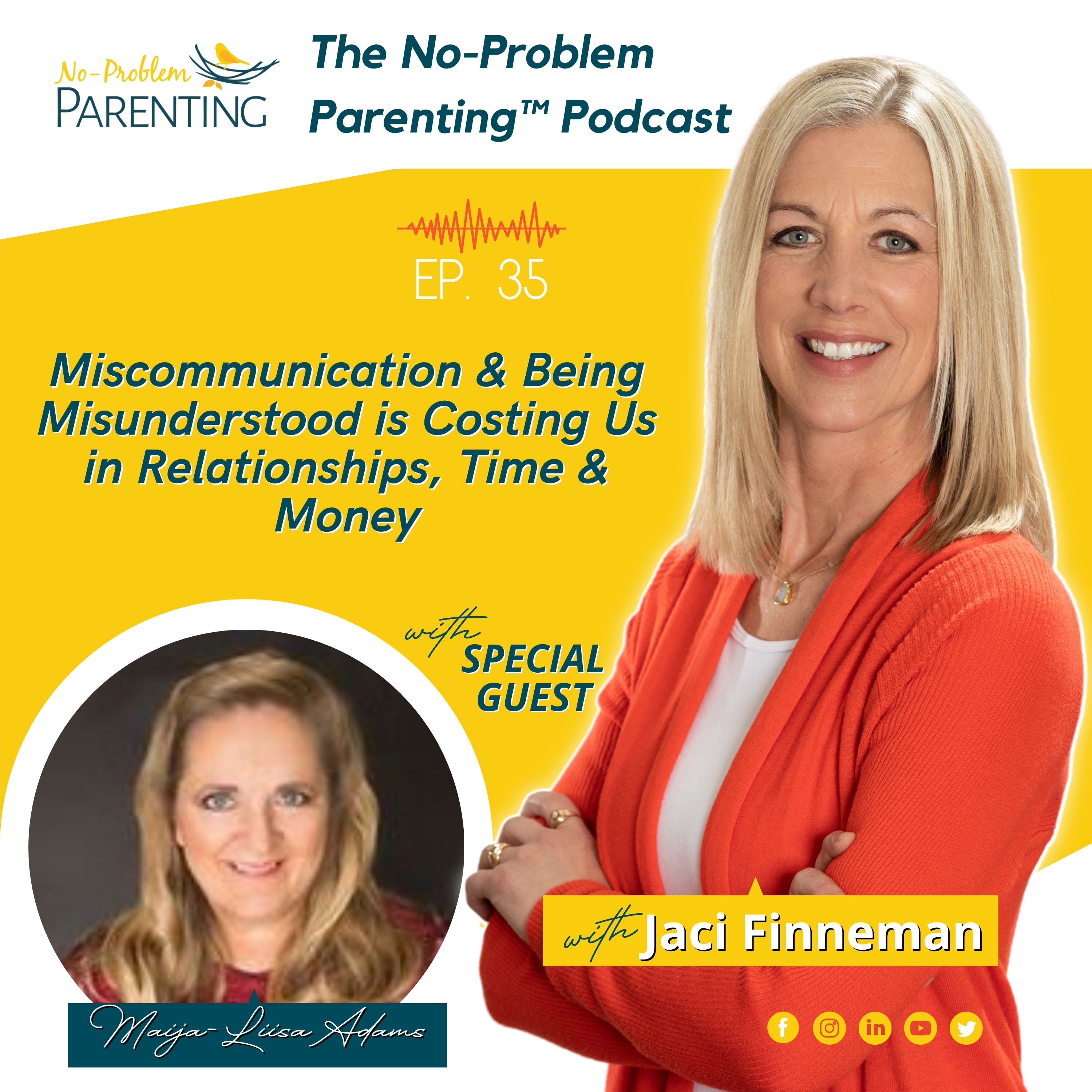
About this episode
Welcome Back Parents! Today's topic is about Changing the Conversation with our kids!
Would you like to know how to communicate so your child understands you?
What are the best questions to ask? What questions should we avoid asking?
Have you ever asked your child a question and then not listened to their answer?
My guest today is Maija-Liisa Adams and she is going to answer these questions and more!
Become a No Problem Parent Today!
Full transcript
Welcome back to another episode of the No Problem Parenting podcast, where we choose to deal with and overcome the behavioral and emotional challenges within our home. I'm your host, Jackie Finneman, and today we're going to talk all things communication. You know, step three of the No Problem Parenting online course and membership community is all about changing the conversation with our kids. What we say and how we say it to our kids can make all the difference in the world.
And today I have a special guest, Maya Lisa Adams. She's the founder and CEO of Maya Lisa Speaks, an Idaho-based TEDx Talk coaching firm. So for the last six years, Adams has helped more than 100 clients understand how to land, nail, and use their TEDx Talk to grow their impact and increase their income. As a keynote speaker, she's addressed hundreds of individuals, including the International Women's Day Conference and the BYU-Idaho, where she serves as an adjunct professor in public speaking and professional presentations.
Let's face it, when you talk, you're often misunderstood. Misunderstanding is costing you. It's costing you in your personal relationships, your relationships with your kids, even in your professional relationships. You can't be successful in parenting or in any area of life unless you are understandable.
What you say and how you say it can make or break your relationship with your child. Have you experienced information overload while seeking answers about how to talk with your child? Would you like to know how to communicate so your child understands you? Well, this podcast today is for parents who want to learn to get specific answers tailored for their children and improve the conversations in your home.
All right, so welcome to the show, Mayalisa. I'm super excited to have you here today to talk all things communication and talking about what you say and how you say it can really make or break your relationship with your kiddos. So welcome to the show. Thank you. Thank you so much for having me. I'm excited to be here. So tell us a little bit about how you got into this world of communication and teaching and preparing both your students at the university and your clients to prepare for TEDx talks, but also just about communication in general.
Yeah, well, when I reluctantly went back to work after being in the middle of raising my kids, I was outdated in what I had studied, and that's information technology. I'd worked in Silicon Valley. I'd been a regional sales manager there. Then I had, we'd moved to, well, we were in California for a while. But anyway, I was at home with my four children. We have four kids in five years, twins in the middle. And that's a totally different environment. I thought I'd go back to work. And when I found I was expecting twins, I'm like, I think it might be a while.
And it was. But then I reluctantly went back to work. And being outdated in IT, I was offered a job in the communication to teach public speaking because I'd been giving presentations in the Silicon Valley. And it's something that I enjoyed doing. And so through that, I attended my first TEDx event here locally in Idaho. And when they and I loved it. And when they heard that I was a speech teacher, I taught public speaking to begin with, they said, Would you come back and and coach our next year speakers, because some of these could have used some help.
And so that was the first part. And then at the university, there was another course they wanted me to teach. And one assignment is how to do a TED talk. So they got to do TED style talks. And so it really became pretty much my life. And over the last six years, I've helped over 100 people take the TEDx stage or help them with their message in some way. And it's just a part of what I do. But along the way, you have to think about how do you communicate? Really working with TED Talks has influenced a lot of this because most of us think of a speech as there's a podium, we're here for 45 minutes, they're going to tell us what they're going to tell us, they're going to tell us and then they're going to tell us what they told us. And there's going to be three main points to it. And a TED Talk is completely different. And I relate that to speaking to a child, to a spouse, to a colleague, that oftentimes we're so misunderstood. Let's face it.
I mean, from personal relationships to political and diplomatic relationships, misunderstanding is at the root of many of today's challenges. But what I found is the number one skill is if we can just communicate that one idea. We are in an information overload right now. especially me listening to speeches all day whether they're client speeches or or student speeches it's like I always have to ask myself later that day or the next day which ones do I remember if any because it just goes out and so we have to remove that distraction as much as we can and just focus on the one thing and make it safe to talk about that one thing this is just also fascinating to me and I of course love TEDx's I watch them all the time I get so much information from those and to actually meet a coach for somebody that's helping these helping people prepare for their TEDx. It's just it's super thrilling for me. It's like, it's like I'm meeting a movie star. So it's so fun. And so you said a whole lot in there about the missing. I want to I want to touch on a little bit of all of it. misunderstanding, you say it's costing you whether you're a parent or a professional or in your personal relationships. And then you really talk about how hard it is to be successful in parenting unless you are understood by your children. And so let's maybe, let's jump into that. So what, what would you say are, you know,
parents will say things like, oh, I asked my kid questions and they don't say anything. They, they say, oh, fine. You know, how was your day? Fine. You know, what was your favorite thing at school today? I don't know. You know, so what are the best questions to ask and maybe what are the ones to avoid? Sure. I think one of the things is, is it safe for your child to answer you? Maybe you were raised in a place where it was more of an interrogation or something like that. And they feel like if they don't give the right answer, they're going to be in trouble in some way.
Or maybe we are kind of distracted. We're asking the question, but while we're waiting for the answer, we're looking at our phone or we're flipping on the water to scrub the potatoes for dinner or something, we're not really giving them that eye contact. And conversely, that's a good point. I got to stop you right there. That is such a good point. Just saying the words isn't enough, we really need to be noticing and being attentive. And and sometimes we're giving too much eye contact where we're looking down with our hands on our hips. And that's like, I don't I don't dare answer you, mom. Because we have that intimidate. And that goes back to being on stage is that body language is about 50% of the message.
And it's the same thing in our interactions. Our words are only 7%, but still those words are important. And they have to match our tone of voice and our body language. Or our kids get confused.
Our spouse gets confused. Our colleague gets confused. Or someone watching us on the stage says, she doesn't really believe that. Or wait, suddenly I feel she's not confident.
and I can watch my speakers and I can say, what went through your mind right there? Because your body language changed and they lost confidence or something. And our kids might not have the confidence to stand there toe to toe with you, with your hands on your hip and answer your question. So there can be not enough eye contact or too much eye contact.
Either one gives a different feel to it. So we have to have it safe. Yeah, that's such a great point. And the tone of your voice, I love that you say that as well.
The tone is so important. And sometimes I'm not just talking about being like really stern or strict in the conversation, but also I coach parents on this all the time. Sometimes our tone of voice is like convincing, like we're trying to convince our kids to do something as if we know what's going to be better for them. And that in and of itself can just turn them off and not, you know, want them to do what we're asking them to do.
It's like, well, if you don't, you know, brush your teeth and, you know, the kid's like, well, if you care more about it than me, you know, I don't need to. And one of the things that helped me the most as a parent, and there's still much that I could learn about that, even though my children are now young adults, is giving them a choice. Instead of saying it's time to get up and get in the shower, it's would you rather have breakfast first or shower first?
and that helps them know that you're teaching them the decision-making skills, but they also have a choice. It does not have to be always the way you do it. Just much like when we're in a family and there are two parents, one parent is going to put you to bed one way and another, another way. And that's okay to see that there are two different ways of doing the same thing.
When my oldest went to college, I said to her, there are certain things that are kind of a of a permanent or eternal consequence and other things that it really doesn't matter. I said, one thing you might find is that when you get to college, the other roommates are going to, and she's, she's a daughter, so this might make more sense, but just if you're going to wash a head of lettuce and somebody else's at another time and somebody else's next time, you're probably going to find if there are six of you, there are six ways to prepare a salad or to wash the head of lettuce or to get it to, and it's okay. Just like parents can be different in the way they've put kids to bed, as long as they're still consistent in what they do and they're on the same page with it. Does that make sense that those things are less important? It's that it's safe and loving. Yeah, absolutely. Absolutely. I totally agree with that. And so it's not always the questions that we should avoid asking, but it's how we ask the questions, I think is what you're talking about, right? And just like we can see when our child rolls their eyes at us,
we can also hear it on the phone sometimes. We can even sometimes sense it in a text. It's harder that way, but it needs to be a safe ground. And this is what I've really come to learn the last few years is that there has to be trust and there has to be a bank account, so to speak. I don't know how many of you are familiar with 30 years ago, Stephen R. Covey wrote the book, The Seven habits of highly affected people. And that really affected my life because my late husband, he worked for him and they had something called an emotional bank account. And so when you tell your kids or your spouse something quick that you don't have time to explain, if you have a really high emotional bank account with them, they're much more willing to do it. But if you haven't, if you have a negative, just like in a real bank account, then they're going to be more defensive. Well,
why do you want me to do that, mom? Understanding that in this case, we just do it. But if we're always telling them what to do, then they have no choice and there's no trust. And when their trust is low, everything takes longer and it costs more. And what I've found with trust is that oftentimes when we're wishing our spouse would do something different or our child would do something different, they're also wishing that we would do something different. And the only one we control successfully is ourself. So in the work environment, I've often will say if there's low trust, which would also be the same in a family, you can think, I just wish this son or this daughter would do this differently. I wish my spouse would do this differently. But what could I do? What's making them feel that way? Only thing I can do is look around at what would they want me to do differently and work on that. And that often changes the energy for a better relationship,
is taking personal responsibility, whether it is that phone that's always in our hand or in our face or anything else. Yeah, that's a really good point. And so maybe before we are harping on them to change the way they're doing things or asking them why they're not doing what we're asking them to do or whatever it is, we first look at ourselves. And then if we can't figure it out on our own and we don't know what we're doing, let's say wrong or to get them to prevent them from from doing what we're asking them to do or participating in something.
Getting in the heads of the organizers. It's the same thing with your, you've got to think of it from your child's perspective, but it really is about in a relationship. The first one is, is making it safe. I think so often we do not feel safe to communicate.
I love that one. And that's perfect because I talk with parents about that all the time, whether they're being super angry or they're being super cautious and the kid can sense the fear or the worry or the concern on the parent. And so sometimes kids won't respond or give you the answer, the true answer to whatever you're asking, because they don't want to hurt your feelings or they don't want you to feel more bad. Right. So they're protecting the parent. And so I love that you talk about making it safe because that, that is, that is so true.
you have these top 10 things that a speaker coach is looking for in a TEDx speaker. And we had met previously and we talked about this. I'm like, I think parents need to learn these things. I think this is really important that parents learn these as well. So even though that's not your focus and your, you know, your job, you are a mom of four kids and you get it and you can, you can equate this together. So making it safe is like the number one.
What's another one? So here's a, here's a story. Let's say that you walk into your son's room and it is a disaster zone in there. And it's so disgusting that even the roaches are packing their bags to get out of there.
And you just simply say, clean up your room. And then you leave for about 30 minutes. So when you come back, you look around, you go, you didn't clean your room. And he goes, yeah, I did, mom.
No, you didn't clean your room. I did, look, my clothes were all over the floor. Now they're all over there. And you look over there and he's basically just kicked his clothes into the corner.
not to mention the last night's dishes on his nightstand or the debate papers strewn all over the floor, right? And you just simply say, I guess he didn't understand what I meant by claim. So the next one is that not only do I have to make it safe, but when we are explaining something, we need to make sure that they understand what the expectation is and that we're in agreement on that. I think a lot of being misunderstood sometimes is the fact that I'm thinking one thing in my mind. And spouse or child is thinking something else in their mind. Same thing with a colleague. So we have to make sure that they understand what we mean and that they're willing to do what we understood or what we're expecting them to do. And I think a lot of times we hear that as like clean the room, their cleaning might be different than our clean. So even if everything is picked up off the floor, and even if the dishes are brought to the sink, we might go in there and see the bed isn't made or it's not dusted. Some parents want to dust it or they want it vacuumed.
So let the child know exactly what your expectation is very matter of factly. Ask them if they have any questions about it. Do they understand? Let them know you'll check back in 30 minutes or, you know, whatever amount of time and that you'll check it out. And I think sometimes kids say, all you see is what I didn't do. What about the things I did do? And making sure that we acknowledge those. As a speaker coach, I focus in on what's missing or what could be added, but I also need to make sure that they realize if I'm not talking about those other things, they're good. Same thing with your kids. We still need to say, great job. Thank you for taking the time. Help me understand what you want to do with the dishes over here. Or what could we do with these papers over here? Because especially, you know, we're teaching them responsibility over 16 years of their life. By the time they're 16, they pretty much need, know how to do everything,
even though they're probably not going to leave until they're 18. So do we have kind of milestones that this is what a three-year-old in our family should be able to do and maybe a five-year-old and a seven-year-old and so forth and add those and give them that responsibility. But we still have to show them in the beginning how to do it, do it side by side. Stephen R. Covey, again, he used to, this one comes to mind about kids, his oldest son, he said, I wanted him to take care of the lawn. So I said, Stephen, M-R is his name, your job is to keep the lawn green and clean. You got it. And then we check in with him again. So it was easy for me to remember, okay, my job is to keep it green and clean. And then if I need help,
dad's going to help me, but dad's not going to step in and do it for me. So again, it's that expectation, but we still need to know what is expected, how to do it and where to go. If we don't know how to do, I think sometimes as a kid, especially, and even as adults, we say, okay i know what the expectation is but i don't have the tool to do that i don't know how to do it how can i keep it green and clean and then that that's okay for them to come and not do it perfect sometimes we're a lot of us are perfectionists we're people pleasers whether that's the parent or the child and that's where that safety comes in it's safe to go ask for help it's safe to say i've done it but i have a problem here what can i do next and we should come in instead of just saying, well, you didn't do this. Well, do you need some help with this?
Do you need some resources? It's both ways. When our child digs in their heels and they don't do, they know the expectation, we've communicated it and they still don't do it. We don't have to buy into all the emotion around that and be all upset and ticked off. We can kind of, sometimes I think we can predict, right? All parents can agree. We can predict when our kid isn't going to follow the direction and isn't going to follow through. So then I often say, why are we getting so mad when they don't? We expect that they're not going to do that. So let's communicate rather than reactionary yelling, shouting, screaming at the kid. Let's take the emotion out of it and be like, huh, you know, funny thing. I didn't expect you to get that done. And I'd be happy to take you to football practice just as soon as your room is clean. Right. And then let them get upset,
but we don't have to. Yeah. And having those natural consequences that if, if you want to have 30 minutes on to game, then the weeding needs to be done first and all of this. One of the TEDx speaker coaches that I coach, she, she talks about how she has two, there were teenage sons at the time she did it and that they were gamers. And she was so upset at that, that they're not going to become, you know, deviance and isolated and all of these things like that. And she'd say, it's dinner time, come down, it's dinner time. And she said, I had to go from being critical to being curious. Well, why do you like to game? What are you doing? Or what are some of the parameters?
And I'll pause here and say, when I was young, and we and you didn't, you couldn't record what was on TV. If mom came and said, it's dinner time. And it was right at the end, if she did like 625, I was in a 630. We're like, no, no, don't do it right now. We've got to see the end of it.
Because in those days you couldn't see the end of it again. Well, she said, I found out from my gaming sons that if I call them at a certain time, they lost points in the game that they were doing. So they had to come up with an agreement. What are your needs? What would you like to do? Okay.
And then mom says, well, I need to do this before you do that. So again, it's that expectation and letting them, she said, if they got all these things done, then they could have the two hours to be in a gaming event. And, but what also happened is I changed my perception. I'm thinking my husband's over here watching four hours of Superbowl, 100% isolated. And my boys are gaming, but they're gaming with people online. Of course, these are teenage kids, not younger kids.
And so it's, it's understanding what's necessary for them to do what they'd like to do. Doesn't mean they don't want to help you or help around the house. It's just, this has to be done before this gets done. I love that example because I think for those of us that are maybe the forties and ups, right? We remember the days of not being able to pause TV and, and rewind or fast forward.
So I love that example because our parents would, that would make sense to them that, oh, it's 625. Your show probably has two, three, four, five minutes left. All right. Well come when it's done and we know the show, they know, they would know the show is going to be done and we'd come in to have dinner. Whereas with the gaming example, I mean, having those conversations, I learned that too with my son and he doesn't do a lot of gaming, but he does. And, uh, and I was like, well, you can just pause it. You know, in my mind, I think you could just pause it or you can just get back to it later, but it's not the case. It's not true. So I think that having, setting that expectation ahead of time, what do you need? What do I need? So that, um, you know,
because unfortunately dinner isn't always at five 30 every night it changes. And sometimes they have to be on hold with us to finish up a work call or, you know, dinner or whatever. So they're getting them, keeping themselves distracted by doing something else. And then we go in and we just want to rip it away from them and say, come here and come here now with no respect for whatever it is that they're, they're doing. So yes, cause I'm the mom and I said, so I also like the idea that, um, being curious, I talk about that in no problem parenting all the time. We need to be curious about why our kids are behaving the way they are, why they're responding the way they are. And also I like to point out to, we need to be noticing them.
So you can say things like, I notice when I am in a hurry and I need you to be, you know, come with me or do something right now. You dig your heels and it seems like you go the other way. Or I notice whenever I call you for dinner, you always want five more minutes. What's up with that and just having that conversation, but also noticing when they're doing something really well.
You know, I noticed the other day when I called you for dinner, you came right away. I really appreciate that. This isn't a long therapy session and a big, long conversation. It's just short and sweet noticing the good, the bad or the otherwise, right?
Exactly. Just this week, university started up again. And as a, as an icebreaker, and we're actually, we're back in the classroom. We'll hopefully that we'll get to stay very masked and socially distanced, but I had them get near someone and I wrote on the board, I want you to pair up and I want you to talk, share your biggest fear. And so, oh my gosh, high energy and then going and going and going as it started to die down. I said, okay, the next one is, we're going to do one more, is what is the greatest piece of advice? Because these are college students that you've ever been given. And suddenly the energy just changed and it went drop down and I let it finish. And as I brought them back, I said, did you guys notice a difference in the energy? And they said, yeah, we went. And I said, why do you think that was? I said, no, right or wrong answer.
I just observed it. What do you think it was? And they said, it's so much easier to talk about negative things than it is positive. And yes, I mean, it was a palpable change between, okay, share your fear and they're just going at it. And then now share your best piece of advice.
And it just went, Oh, and I said, you know, I've heard this, this is the conservative statistic that when we tell our kids something negative, it takes a minimum of six positives to even bring it back to equal, not even to bring it up to positive, just to bring it back. And I've heard even higher statistics. That's the really conservative one. And I think we really just need to notice things more about what went well.
And even as a speaker coach, I've noticed over the years that, because my tendency is, okay, this is what you could improve on, et cetera. That if I sandwich it, like, hey, you did this so well. And you could maybe tweak this and you did this really well too. Because here's the truth.
A lot of us know what we've already done wrong. We don't need to be reminded. We do need- Oh, that's a good point. We do need like be pointed out, you did this well.
And every speaker is different in their own personality, just like our kids are. I have four kids and in the middle are twins. And they're one has dark hair, one has blonde hair, one has brown eyes, one has blue eyes. They're so different from each other.
And even when I would do rewards with them, one was incentivized doing the chores to get the money. The other one didn't respond to the money. And I thought, I wonder why he's like, because he wanted the thing he was going to buy, like the art set instead. So there's different motivations as well with them.
And they're so different. but we have to understand those differences and, and, and speak to the difference, not just to the, everybody's a cookie cutter. Absolutely. For sure. All right. So making it safe, make sure they understand the expectation. What's another one on your top 10 things for TED, TEDx is that you can relate. They're all relatable to parenting in my mind, but what's another one?
So we'll take a great idea over a great speaker any day. So that means we're not looking for perfection. Some people say, yeah, I should get on the TEDx stage because I'm such a great speaker. And I'm like, what's your idea? It's not about serving you. It's about having an idea to share with others. And I think we need to realize that children have great ideas. And so instead of always being the one that comes to the idea, if they have a way to tweak something, we should honor that. Of course, you discuss it and see, is that going to work? So they should be safe to bring up an idea, a way of doing it differently. When my daughter started babysitting, she'd say, mom, I noticed in this house that they do this. And so then I could get defensive and say, well,
okay, well, you know, you have no ideas for when you're a parent. Or I could say, is that something that we should incorporate? So it's how we, are we willing to hear their ideas? And are we willing to honor those ideas and discuss them? Is it free for them to do that?
Cause I will take a great idea over just a, something happened, but the relationship was harmed in the, in the, in the process. That's a really, that is really good. And I think sometimes we don't take the time to listen to our kids, different ideas. It's like, cause there are kids out there and, uh, I know many of them that it doesn't matter what the parent says or does.
They have a different idea of how it should be done or a different way to do it or a different thing. And we just want it done. We sometimes are, there's just so much going on. we just don't even, and, and so sometimes you have to say, okay, that's a great time idea for another time today. I just want to get it done. And I also think we need to let the kids explore those ideas and come up with some of that creativity on their own. They may have a better way of doing something or a more efficient way of doing something than even we have. So our kids will be better than us. That was our parents' hope is that we would be better than they are, at least in some areas. And we do have more opportunities. And so do they. They have different challenges than possibly we did, but they do have ideas and they should be honored.
But exactly what you said is that sometimes it does just need to be done. And so if you have that relationship, you can say, can we explore that for another time? This time we have a time schedule or we don't have time to think about it and test it or whatever. But another tip is that that I give TEDx speakers is be coachable and receptive to suggestions. So, and that can be make it so the kids are okay to be coached and will want to hear receptions, but also as parents that they can, that they can be coachable. One of my kids said to me one time, both you and dad have studied communications and sometimes you really suck at it. And so I love that he felt he could say that to us and we could say, Oh, where are we, where are we, you know, what do we need to improve. And I just wish I could talk to you about anything. And so then what could we do to make that happen? But if he didn't feel comfortable, then he couldn't be that direct with us. So I appreciated that. Even though you and your husband are in communication,
it's true that no matter how good we are at our jobs, right? No matter how well we perform, we sometimes don't perform that well in our own lives and, you know, in our families, because it's sort of like, oh, I'm done with work. Now I just want to relax. And I don't want to have to be on all the time. Right. So an example of that was I had our fireplace cleaned a few years back. And, and so I said to the guy comes to our house and he's notices that there's a crack in the windshield of my car. And he said, he notices the dealer plate on my car. And so he says, Oh, are you, is this a rental loaner car? Is your car getting repaired? Like they shouldn't have let you leave with a crack in your windshield. And I started laughing. I said, actually,
my husband owns a dealership and the crack's been in there probably for three months. And yes, We need to get it repaired. But, you know, it's kind of like he has to service his customers and make sure their stuff is working. And his wife car gets left. And he said, oh, I have a funny story for you.
He said, you know, I'm a chimney sweep. And he said a couple of weeks ago I was coming into my driveway as I noticed the competition was leaving my driveway. His wife had gotten fed up that their fireplace wasn't being cleaned. So she called the competition to get it cleaned. And then and then she he said, and guess where I was the following week?
he went to the competition's house and service their chimney. So anyway, I just think it's a fun story that we're not always so great, but it is good that your child was able to feel comfortable enough, even if it in a joking way to bring it up, but you guys really suck at this, you know, even though that's your, and you, so clearly you created a safe space for him to be able to do that. I think the biggest thing is, um, you know, being forgiving and giving forgiveness, us, you know, being really understanding both ways and saying to them, saying when we're, when we're wrong, that we're wrong and modeling that sometimes it's been really, really hard for me to say, I'm sorry. And that's something I have to really work on. And we have to model what we want as well. And, and honestly, I have to be very honest, my go-to with most people who meet me for the first time, or because I am a speaker coach, I can walk into church and they're like, oh my gosh, you know, or they'll feel like I'm going, they're going to be judged. And it's just, you know, like today, or not today, but this week, when my students gave their first little talk,
it was just to read a children's book, so I could check their delivery and so forth, is I can, I can go right into the correction mode. But then that shuts everybody down. And I have to remind myself not to do that, because that's what I see what to fix. But instead, if I can relate to the fact like, why did you pick this book? And they talk about their mom doing it or their dad doing it with voices or something. And if I really, if they really sense that I care about them, that's the most important thing, whether that's in the classroom, whether that's with the client, or whether that's with your spouse or with your kids. And it's something I still work on, but because I can go right in, like I started with a new client with a TEDx, it was he and his wife.
and I went right into getting to their idea. And he's like, okay, I know how to be prepared next time. I'm like, I'm sorry. Here, let me say, if I don't mention it, it's because it's really good.
And so I've learned how to say that this is kind of how I am so that you can expect this from me and try and work on ways to let them know how much I care. Because these university students, they are so fun. We had so much fun talking about their children's books. And then I stopped and said, okay, let me get some general observations and now try this thing. And then everybody got better and better. So they didn't see it as a harsh criticism, but like, these are all important things, but the number one thing is to let them know that you care. This is, this would be a really interesting resource or, you know, like a alternative resource to what I would, I would, you know, parents go to therapy, right. To learn how to communicate with their kids, but it's not always about that. Sometimes it's just learning how to be a good communicator. I want to go back earlier. I talked about the mother who talked about her teenage boys who are gaming. And at the same time, I was coaching someone who was talking about her three small boys on small devices and how they were isolated. So you have two different gaming talks you're working on, but it's one is age and then what's happening. And I think we have to think about that. Our kids have different privileges at different times, but also we just have to understand what's really going on. So for her, she had to go through a detox completely with the phones for those kids because they were
independent. They weren't playing Legos together. They weren't running around and chasing each other anymore. These were like seven and nine and 11 year olds instead. And they were very isolated.
And she says, I was on my phone. I had to look at it. Just like I said earlier, that sometimes we can point out what our child or spouse is doing wrong, but really the only thing we can control is ourselves. So she had to pull back on her phone and her husband had to pull back on his phone. And then as a family decide, we're going to stop doing this for a short time. She said, we live in technology. I knew I would have to bring it back eventually, but she said, suddenly the UPS man was coming and delivering Legos and my kids were laughing again and doing things. So it's the right type of parenting for the right stage as well. So you could, just because I said gaming's good and be curious, it's also be curious about what's causing, what is causing the isolation with the younger one and do things that match that particular situation. You are a great communicator. You have great ideas, great, great tips and tools for how parents can communicate,
how we can just become better at communication in general, right? So that we are understood versus misunderstood. And it might seem a little odd that I had you come on to talk about, talk to parents about this thing when your, your job is to coach, you know, students and people to prepare them for TEDx's. But I really encourage the parents listening today to go to your website at mlspeaks.com. Check out those top 10 things that a TEDx coach is looking for in a speaker, because I think they'll find, really be curious about that and how that pertains to how you communicate with your kids, you'll probably find some really cool ideas in there. And then also, Hey, we're parents, we're entrepreneurs. We're, you know, yeah, we have ideas. We have thoughts,
we have stories, we have things that we'd like to share. And so who wouldn't want to be on a TEDx? I think that would be just like these two moms and talking about gaming from a different thing. And so TEDx is about taking a topic and putting your particular vantage point on it. What's the greater conclusion that you've drawn. And it can be about parenting, but it can be about anything that you're an entrepreneur with, or that's happening in your life. And there, I put a lot of moms on the TEDx stage. I had one mom who her daughter had was diagnosed with OCD when she was eight years old. And this was several years ago when it was so much of a stigma. And let me tell you, you want to get on this TEDx stage to share your idea and to bless other people's lives. And And then it sometimes comes back to bless your own life.
So let me tell you about this one. Her daughter had such bad OCD that when she was a teenager and coming home from work in the ice cream shop, she went over a couple of bumps. And as soon as she got home, she said, I've got to go back and see how many people I killed. It was that severe.
So she thought the bumps meant she'd run over someone. And then fine, if you don't let me go, I'm going to go to the police station and turn myself in. I'm sure they found these dead people. and it's like so they came up with something called starve the monster and she got was able to like yeah i think you should turn yourself in and and what do you think that they would have you do and yes you do need to get help and anyway the it's not the story as much as the fact that she really got in that community and asked them what they would say and it has blessed so many people's i can't keep up with how many people i have have emailed me about how this message helped them realize that there is hope and possibility that as parents, we can ask them certain questions and help them just stay there like five minutes longer and that, and look at it from a different perspective. And then that kind of stars the monster and the OCD comes down. Now, the way it can blessing her own personal life is from that whole thing. Someone found her and she became a vice president of a company. So the intent is to give, but when we give, we know that things come back to us as well. Oh my goodness. I love that. I'm going to put the link for that episode, um,
of that TEDx in the show notes as well as your links. And, uh, so that people can reach out and get in touch with you. Can I end by giving you three, a three-step process that I use in my personal and professional life? Oh, absolutely do that. So as a mom, when I didn't know what to do, So I was reminded that I should pray and ask because every child is different.
And so I would ask a question, but I had to learn how to ask a very specific question. And then the second thing is I would ask it, but then I didn't stick around for the answer. So I had to really focus on listening intently to see what answer came. And then the third thing is the answer would come and sometimes I didn't take the inspired action.
So I had to learn how to actually take that inspired action. And as a parent, as a spouse, and as a professional, my days go better when I ask specific questions, listen intently for the action and take for the answer and take the inspired action that comes. I absolutely try that. It'll help you too.
That if you take that time to really want to know and want to hear and then, and then adjust according to that, that it will bless your life too, both professionally and personally, because miscommunication and being misunderstood is costing us in relationships, time and money. I just absolutely love that. Great advice. Easy enough to do, right?
Yeah. Often we think we make things much more difficult than they need to be. So let's just three steps, nice and easy when it comes to communication and changing the conversation with our kids. This is great stuff, Maya Lisa.
I appreciate you so much for being with me today. Thank you. You're welcome. Thanks for asking.
Oh, I had such a fun conversation with Maya Lisa. Thank you so much for those three tips on how we can change the conversation with our kids in our home. and if you'd like to learn all 10 tips that my Lisa has she has a freebie for you the top 10 TEDx tips say that three times fast top 10 TEDx tips you can go to mlspeaks.com backslash TEDx tips and get that free download of course I'm going to have that in the show notes for you and if you'd like to have a conversation with her you can schedule a 30-minute path to the TEDx stage strategy call. Go tell your story. We all have a story. We all have something that can help serve and benefit other people in this world. So schedule your 30-minute path to the TEDx stage strategy call with Maya Lisa. And P.S. as I end this episode today, I want to say a big happy birthday to Maya Lisa. I hope you have a wonderful day today. A little birdie told me it was your birthday. So happy birthday. All right, parents, for now, hugs and high fives. You got this.
thanks so much for listening everyone we are just six months into this podcast and i am having so much fun interviewing guests bringing tips tools techniques strategies and resources to all of you parents out there so help me spread the word we're starting to rank we're starting to be shown there's a bazillion podcasts out there right now and we've actually ranked number 430 430 in the chartable podcast global reach for kids and families so let's keep going like this episode share leave a comment are you enjoying it give it a thumbs up i really appreciate all your support with this helping me to reach more parents are you ready to become a no problem parent and kick fear worry and frustration to the curb go to noproblemparenting.com and get started now Thank you.
Thank you.
Become the confident leader your kids crave
The method, the community, monthly live Q&A with Jaci, and Celia — your AI guide in the moment.
Start your 14-day free trial Get it on iPhone or sign up on the web