
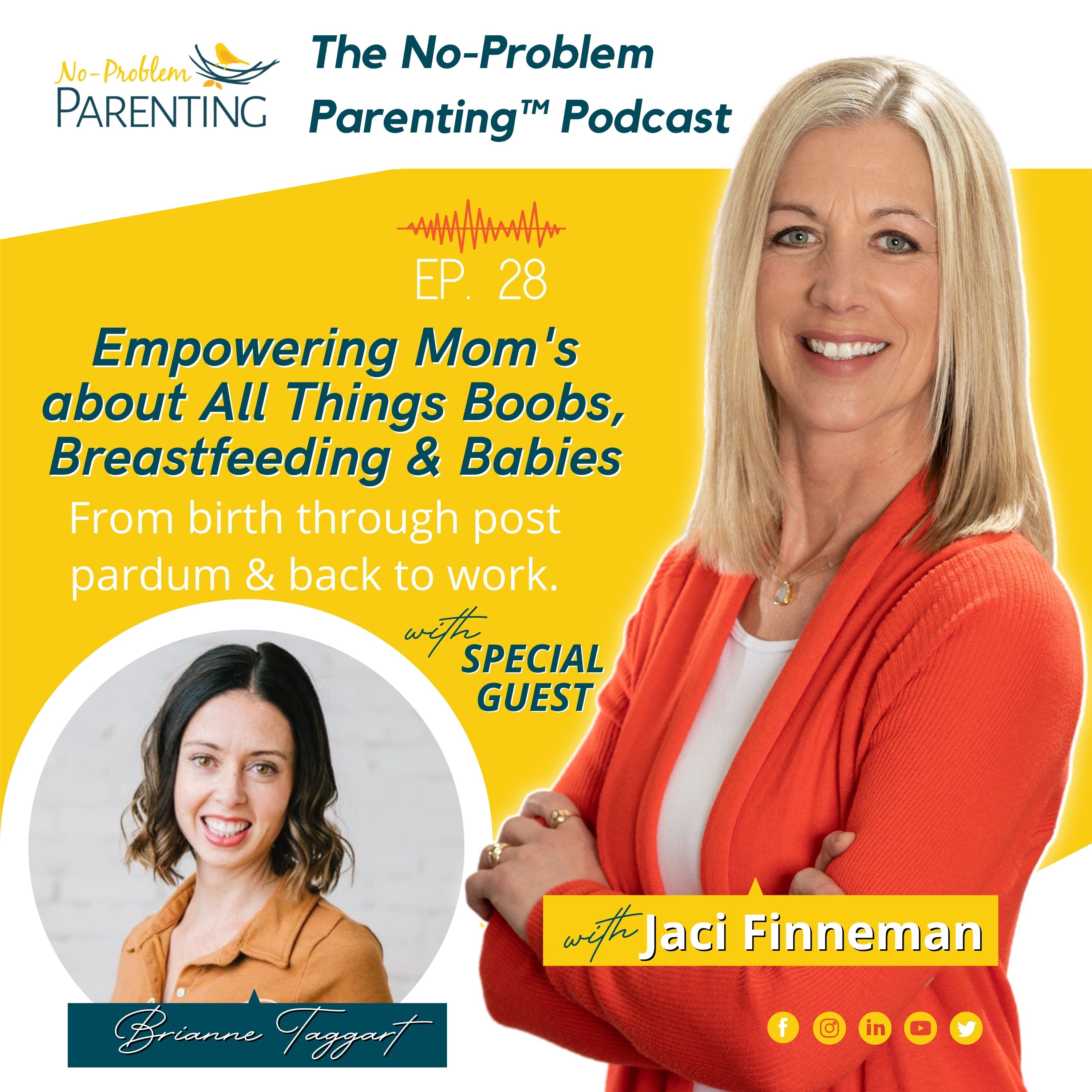
Empowering Mom’s about All Things Boobs, Breastfeeding & Babies with Special Guest Brianne Taggart
About this episode
Welcome Back to The No-Problem Parenting Podcast!
Are you a new momma and preparing for your baby to arrive?
Getting the nursery ready, going to birthing classes, creating your birthing plan?
Have you decided whether or not you will breast or bottle feed your baby?
Everybody’s feeding goals are unique to them, some mommas bottle feed, some breast feed the first few weeks and then transition to bottle while other mommas breast feed for the first year or two or more!
Todays guest is going to bust some breastfeeding myths, give some tips and tools on how to help you and your baby when breast feeding isn’t working so great And resources for moms who plan to breastfeed and return to work.
Become a No Problem Parent Today!
Full transcript
Welcome back to the No Problem Parenting Podcast, where we choose to deal with and overcome the emotional and behavioral parenting challenges in our home. Hey there, soon-to-be and brand new mamas, this episode is for you. Are you a new mama and preparing for your baby to arrive? Getting the nursery ready, going to birthing classes, and creating your birthing plan?
Have you decided whether or not you're going to breastfeed or bottle feed your baby? every family's feeding goals are unique to them some parents will bottle feed some breastfeed the first few weeks and then transition to the bottle while other mamas breastfeed for the first year or two or more well today's guest is going to bust some breastfeeding myths she's going to give us some tips and tools on how to help you and your baby while breastfeeding especially if it isn't working so great and she's going to offer some resources for moms who plan to breastfeed and return to work. Meet Breanne Taggart. Bre loves teaching and empowering families about all things boobs, babies, and breastfeeding. She's a registered nurse, an IBCLC lactation consultant,
a childbirth educator, and a certified instructor of infant massage. She has three kiddos of her own and so she knows firsthand how rocky the road into parenthood can be. She is here for you to help make that transition as smooth as possible. Her specialty is helping families meet their breastfeeding goals from birth through postpartum. And she especially loves helping breastfeeding families transition back to work without having to sacrifice their feeding goals. She makes personalized pumping plans. She's created an online prenatal breastfeeding course, and she offers one-on-one telehealth consults. You can find Breanne on Instagram at breezy underscore babies or at breezybabies.com. And she also has a podcast called the Breezy Babies Podcast. No Problem Parenting is all about creating the confident leader your kids crave you to be.
So I'm super excited to interview Breanne today so that you, all your new mamas out there, can gain the confidence and be ready for that smooth transition from pregnancy to birth and beyond. So welcome to the show, Brianne. I'm super excited to have you on to talk with my audience today about all things, boobs, babies, and breastfeeding. Yeah. Thanks so much. This is going to be so fun. I'm excited to talk with you today. So why don't you start out by giving us a little bit of background about you and how you got to starting breezy babies? Yes. So I am first and foremost, a wife and a mom. And that's why I first started my own journey. I had my first baby 10 and a half years ago. And so that is where I started down this path of figuring out parenthood and how I didn't know what I was doing at all. Basically I was a nurse at the time I had just graduated nursing school. So I was a registered nurse. So I thought, Oh, I'll know what I'm doing.
Um, I don't really need to prepare, take any child birthing classes before going in. I don't really need to take any breastfeeding classes. Like it's all just natural. I'll just go into the hospital.
I'll just do what the nurses tell me to do. And it's going to be all fine. And while it did mostly turn out just fine, nothing, you know, catastrophic happened. And I, um, I still had to learn the hard way of how rocky that transition is into parenthood.
And I still really believe that the transition from zero to one kids is the hardest transition ever. It's just like, here's the baby go home. Best of luck. See you later.
So we kind of just muddled through and we got through and, and, um, uh, I did end up breastfeeding my first baby. and overall things went pretty, pretty fine. Not great, I would say, but like I said, we got through. And then after that, I started working on a postpartum unit as a nurse. So that's where you go after you have the baby. And I thought, oh, I'll be pushing on funduses and I'll be making sure that nobody's bleeding too much after having a baby. And I'll be helping people get up to the bathroom and giving them their medications. But what I didn't expect when I took that job is that I would be doing a ton of help with breastfeeding. And it was so surprising to me because it seems like every single mom and every single baby was having trouble with breastfeeding,
really almost every single one. And so I worked there for five years. And in those five years, I had a lot to learn about how to teach someone else to breastfeed because it's one thing to breastfeed yourself, but to talk someone else through it. Um, because in the beginning, I kind of thought like, oh, I'll just help them position and I'll help them latch on the baby.
And then there'll be good to go. But the thing is that those parents weren't taking me home with them. I was not going to be there with them through the middle of the night and all throughout the day to help them latch their baby. So me latching their baby on is not helpful at all.
So what I really learned is how to talk someone else through latching their baby and positioning and giving them the confidence they needed to do it and help educate them that yes, they did have milk from day one and all these sorts of things. So while working there in those five years, I, I learned a lot about breastfeeding and the crazy thing is, um, in the hospital that I worked at, this was in Salt Lake city, Utah. So it wasn't like a tiny hospital. We had some lactation consultants on hand, but I didn't even know what an IBCLC was. And probably most people listening to this have no idea what an IBCLC is. It's like this crazy long acronym that stands for international board certified lactation consultant. Pretty much. It just means the experts in breastfeeding. And so after working those five years on postpartum, I found out what an IBCLC was. And I thought, oh my gosh, this is something that I have to do because to be an IBCLC, you need 500 hours of helping women with breastfeeding in the last five years. So I already had that working on postpartum, but you also have to do 90 hours of education, learning about breastfeeding.
You have to go to a testing center, the same place I went to get my nursing degree and, um, pass a test and, and it was way more work than I thought, honestly. So I'm just saying this all to say that there's a huge difference between an IBCLC, like someone who's really trained in breastfeeding. And, and honestly, anyone could just wake up one day and just be like, I feel like I'm a lactation consultant or a lactation specialist. And there's actually no laws in place, which say that you can't call yourself that. So if anyone's listening to this and you need help with breastfeeding. I'm just saying all this to say that look for an IBCLC. They are the experts in breastfeeding. I got my certification. I taught breastfeeding classes prenatally and childbirthing classes prenatally. And that was fun because then I got to see families before they came to the hospital. And then I kind of transitioned and started working in home. People would hire me to go to their home and help them with breastfeeding a week after they had their baby,
three months after they had their baby, nine months after they had their baby. So then I really got to see the full scope from pregnancy all the way through pretty much that first year of life. And so that's why I always say that I teach about all things, boobs, babies, and breastfeeding. Cause that whole time span is where my real expertise stands. And I also like to teach families how to massage their babies as well. So I just like to give all the tools of like, Hey, these are things that you can do to help your transition into parenthood, not be quite so rocky because it definitely is a rocky one. It is. And it doesn't matter really how much experience you have. Sometimes like you said, with your nursing background, like you thought,
Oh, okay. I got this. You know, I can, I'll just listen to the nurses and do all that. I remember when we brought our son home and, you know, I'd been in counseling and, you know, parent coaching and serving kids for many years. I was a babysitter growing up, you know, starting at the age of nine. So like, I totally thought I got it too, right? It was going to be a piece of cake.
And we, we brought them home and my husband and I looked at each other and I said like, now what? And he's like, well, you're supposed to know, like, what are you asking me for? I have no idea. So it is totally different when, when you bring them home. It isn't just about that first month there's six weeks or eight weeks or whatever, it really like breastfeeding changes in that whole first year. So I'm excited to talk about this today and get more helpful tips and pointers and tools for the, for the parents listening for all those new mamas out there. So your specialty is helping families meet their breastfeeding goals from birth through postpartum. Also, maybe we'll get into a little bit of that infant massage today as well, but why is it important to prep for breastfeeding before the baby's born? Yes. Um, the time to learn how to breastfeed is not when they hand you this brand new baby in the delivery room. Um, because I mean,
if you just imagine the delivery room, there's a lot of excitement of seeing your baby for the first time. Sometimes there's lots of people in your delivery room. You can also feel really tired and exhausted after all the work of giving birth or having a C-section or whatever it is. And it's just not the best time to learn something from ground zero. And at least, you know, for most people in the United States, breastfeeding is not something that you grew up seeing, right? You didn't see like your mom doing it and your aunt doing it and your neighbor down the street wasn't sitting on the front porch, you know, uncovered breastfeeding their baby. It's just not something that you see. So while it's a natural process, you like don't put so much pressure on yourself to know exactly how to do it. Yeah. When you've never even done it before and you've hardly even seen it your entire life. So learning while you're still pregnant is going to set you up for so much more success. And when I meet with people, um, in consults, I can tell when they have that good base knowledge when they already know like some of the basics. And of course you still sometimes need that hands-on help or like meeting telehealth with an IBCLC kind of like we're chatting right now, but, um, just having that good base knowledge, just think how much more confident you're going to fill in the delivery room instead of, Oh my gosh, what do I do now? How many people I found will
just say like, Oh, they'll tell me what to do in the hospital. A lot of hospitals don't have an IBCLC on staff. They don't have any on staff. And if they do have a lactation consultant, sometimes on a holiday and a weekend, they have nobody, nobody to help you. So you may be completely on your own. Honestly, it just depends on what hospital you're delivering at or birth center, whatever you're planning. Um, but I wouldn't rely on just saying like, Oh, they'll tell me what to do in the hospital. What are some common breastfeeding myths that you can bust for us because I do know that there are some parents out there thinking, I just can't do it. I'm not comfortable doing it. I don't want to do it. Or, uh, I don't want to start because I'm gonna have to go back to work. Yeah. And, um, to kind of say like what you were kind of with your intro,
you're right that everyone has such different breastfeeding goals going into this. And that's okay. If your goal is to just be like, I just want to breastfeed for the first day and see how it goes, then you breastfeed for the first day and see how it goes. And then you're like, okay, maybe let's see if we can make it to a week. And then you can kind of adjust from there.
And that's totally fine. Um, it's definitely not all or nothing when it comes to breastfeeding. It's not like, oh, you're only at the breast exclusively breastfeeding or your only formula feeding. And there's nothing in between. That's totally not the case. But as I was thinking of different breastfeeding myths, like I honestly, I could have made a, uh, an entire book on this.
with all the things that I hear, but some that kind of came to the mind to my mind while I was thinking about this was you need to like prepare your nipples, um, while you're pregnant or you need to like kind of rough them up while you're pregnant. Um, that is a myth. Yeah. There's nothing you need to do to toughen them up. Um, so please don't do that. It's really uncomfortable.
Doesn't feel great. Can open you up for infection. Not a good one to do. awesome good to know yes yeah yeah another one is you don't have any milk when your baby is born I I hear this all the time like oh I'm just waiting for my milk to come in I don't have any milk yet the truth is that around um your second trimester around like 16 weeks you already have colostrum in your breast ready to go and I know colostrum is maybe a word that not everyone knows but it pretty much just means like that first milk that your, that your baby is going to get right after being born. And what's really cool about colostrum is there's not a lot of volume to it. It just comes out drop by drop, but it's really thick and it's really concentrated. And it's so packed with protein and nutrients and everything that your baby needs those first couple of days.
And I also like to think of colostrum as the baby's first immunization. It really is their first immunization that helps to protect them. It coats their intestinal tract. It, it helps them get through those first couple of days as your milk is starting to come in with more volume, but you do have milk coming in. So if you're, if your mom calls you and like, Hey, is your milk coming yet? And you can say, yes, I've actually had milk since I was 16 weeks pregnant. And some things that I teach and people are nervous. Um, you can actually hand express your colostrums past 37 weeks. You just want to check with your healthcare provider first, because sometimes it can start, um, contraction. So if they're nervous about something like preterm labor, you want to,
want to do that, but you can hand express your classroom and save it and feel confident that you have that ready to go after your baby is born. Um, and give them that if they needed any supplementing or any sort of boosting after being born. So I didn't know that. Yep. Yep. So the milk is there. So I, I don't know if you knew, but I am currently pregnant right now. Oh, I did not know that. Yeah. I kind of didn't finish my story, but I have three kids. Um, but I have a fourth on the way. So I'm about 22 weeks pregnant right now. So I like congratulations. Yeah. Thanks so much.
So I already, I'm like, Hey, I have milk. Milk is there ready to go. Like it's there. And I can already start to see it since I noticed these things, right. Since I'm a weird lactation consultant, but, um, but yeah, that is a common one. And then kind of leading into, um, the next one, a common myth is, Oh, your pediatrician can answer all your lactation questions. Pediatricians are really, really smart when it comes to a lot of different things. They know a lot about a lot of things that I could never help you with, but their training, when it comes to lactation and medical school was maybe a day at best, maybe a day. Um, usually it's more of like an hour in medical school, but it could have been not at all when it comes to like, actually like lactation.
And so while your pediatrician is going to be super smart and super helpful, if you need help with breastfeeding, you need to go to a breastfeeding expert. And, and honestly, I could write a book alone, just on the bad lactation advice that has been given by pediatricians alone. I'm not even talking about people like families, moms, I'm talking about pediatricians and again, not a knock against them. They just don't have the training on that unless they have an IBCLC, which some do have that certification, go to a breastfeeding expert. Really cool thing that happened during COVID is that telehealth became such a huge thing. So that's one thing that I do as well. I meet with families all over the United States, even, um, outside of the United States and help them with breastfeeding. So don't just push through the pain or the discomfort or your questions by yourself, reach out to a lactation consultant. Before we started recording today, I had shared with you a little bit about my background or my story with breastfeeding. And I wish I would have had somebody like you that I could connect with via telehealth. When in those moments when I wasn't, when things weren't going well, when I was breastfeeding my child, I, you just a phone call away or actually a zoom away, which is even better. I think that it's like absolutely super supportive and so great for moms these days. What a fun job. I mean,
to be able to meet with these moms without having to worry, they don't have to worry about loading the baby up and getting in the car and traveling or making, you know, time for a face-to-face or physical appointment. They can actually just reach out to you and, and get some support and some of the things that happen in those postpartum during postpartum that really are hard on the mom or some like ways that you can encourage the mom when things aren't going so well with breastfeeding.
Like, do you have some, some helpful advice or support that you can offer moms who are struggling with breastfeeding? Yeah. First of all, starting back at the very beginning, when you're pregnant, think about what you want your postpartum to look like, because so many pregnant women focus on like, okay, is the nursery ready? Um, labor and delivery, right? Like labor and delivery, labor and delivery, labor and delivery, nursery outfits, all the stuff, all the baby gadgets. And I just like to encourage people to think about a postpartum plan as well. Um, what is it going to look like? And mostly it focuses on things like what is going to support you as a mom? Like instead of spending all the money on all the baby gadgets, which you could just drain your bank account on all the fancy baby gadgets that there are, it's just enough to like make your head spin when you look them up. But why not set aside some money every month while you're pregnant for a postpartum doula or for a lactation consultant or for a chiropractor or for a pelvic floor physical therapist to help put you back together?
Um, what about setting aside money for, um, meals to come into your home, like a meal service or a house cleaner, right? Like things that are going to support you is so much more important because then when you're feeling supported, you are going to be more likely to meet not only your breastfeeding goals, but all of your parenting goals as well. So just having some good plans in place beforehand is going to take you so much farther.
Oh, that's a really good point. I think that sometimes we, we don't think of ourselves right. And taking care of our own needs and postpartum depression and things can really sink in. Um, if we're not, if we're not getting that support. So, and it's good to get support from people who have been there and know what they're talking about, as well as, you know, that emotional support from family and friends, but, but it's really, it can help you feel more confident as a mom when you're really getting the the right resources and the right supports from, from professionals. So I think that's a great, great tip. Now let's transition in quick. What can you still meet your nursing goals? If you're returning to work, like those moms out there that are saying, okay, I can only nurse so long,
or I'm going to spend hours upon hours of pumping milk to prepare. And, you know, they just kind of paint this really draining picture of breastfeeding while returning to work. So what advice do you have for that. Yeah. This is one of my huge passions that I love teaching about because the tricky thing about living in the United States specifically is that our, um, maternity benefits really suck and other countries, you know, they hear that moms in the U S go back to work sometimes at six weeks. Um, I feel like moms in the U S are pretty lucky if they get three months off. Like they're like, woohoo, I got 12 weeks. I get three months. If you talk to someone outside of the U S they're going to say what you go back to work at three months, we get two years off. I mean, really it's, it's usually at least a year, but in some like European countries,
they can even take up to three years off. And those first two years are paid. The second to third year could be unpaid. So anyway, um, the point I'm trying to get to is that it can feel really overwhelming because we do return to work very soon in the United States, but you still can get through. And I have returned to work with every single one of my kids before. And like, I've been the mom who's like cried the whole way in as I'm going into work and night shift as a I don't work on the floor any anymore. I work from home now, but it was so stressful, especially with my first, I didn't know how much milk to leave with my caregiver. I didn't know like how much milk I should tell her to put in a bottle because I had just been breastfeeding up until that point. Um, I knew that I should pump about as often as my baby had been breastfeeding,
but I didn't know how to advocate for myself at work. I was working 13 at 13 hour shifts as a nurse and I was in the float pool at first. So I would just move around to different areas and they would say, Oh, I don't know, just go and pump in the staff bathroom. No one uses that one.
And I would, I would go pump in the bathroom. Who wants to eat their lunch in the bathroom? I would never eat in a bathroom. And so now I'm like, Oh, that's so gross that I pumped in a bathroom, like the food for my baby. And the thing is that there's actually laws in place that protect you as a working mom. And it kind of depends on like who you work for and how many employees they have.
If you go to the website, it's womenshealth.gov. That kind of talks about how your employer should provide you with adequate breaks and adequate space to pump. And it should not be a bathroom and it should have a lock on the door. And ideally you should have access to a sink where you're pumping and also, um, a refrigerator to store your milk, you know, all these sorts of things, like I just didn't know about. So I didn't know to advocate for myself and I didn't pump very frequently because I didn't have a good plan in place. So actually a year ago, I had someone message me on Instagram and say, Oh my gosh, I wish that someone could just put together a plan for me. Like, how do I return to work? How much milk do I need to have saved beforehand?
All these questions that I just was kind of talking about. And I thought, Hey, I can do that. I can make a plan for, for you. And so I started doing that a year ago. And it's actually one of my favorite things to do. Families just reach out to me. They fill out information like their working hours, what type of work they do, how much milk they pump, the type of pump they have.
And I put together a whole pumping plan for them and send it over to them. And it's been so fun, just imagining all these families going back to work with this plan in place and then feeling more confident than I did with my first, when I had no idea returning to work. And so that's been really fun and really, you can still meet your breastfeeding goals. And most employers are really willing to work with you because honestly it costs them more to fire you and replace you than it is to just work with you and help you meet your breastfeeding goals. But sometimes you just have to communicate that to your employer because they don't know for sure. They may not know, right? How important breastfeeding is to you for all you mamas out there. If you go to breezy babies.com, you're going to get a link for the free baby belly massage. And if when you click that link, then you'll also get the 20% off discount. Right. And is that good for any of your programs? Yeah, that does count for my personalized puffing plans. Awesome. That's excellent. Okay. Great, great, great, great. Okay. Now, before we wrap up, I want to talk a little bit about infant massage because I have experience with this. I have referred families before, um,
for infant massage. And so I'd like to hear from you a little bit about what that looks like for you. I'm a big believer in that big proponent of that. Well, that's awesome to hear because honestly, most people don't even know anything about baby massage because again, in the United States, like it's just not a normal part of our newborn care of the way that we connect with babies, but in cultures all around the world, they massage their babies every single day.
It's totally normal. Like the baby is born. Mom is massaging grandma's massaging. Like it's all just a normal part of what they do. So the reason that I got into baby massage in the first place is that I was helping families with breastfeeding. And I found that sometimes babies were having like tightness on one side of their neck. So they were having trouble breastfeeding on one breast and the mom's supply was dropping on the other breast, or they were having a lot of like restriction, um, in with opening their mouth, um, or really any family was just having trouble with, um, just like spending time connecting with their baby, having like scheduled skin to skin time with their baby every day. And so when I learned about baby massage, I was like,
oh, this is something I need to get certified in so that I can have another tool to give families, um, so that they're feeling more confident in their parenting journey. So I don't massage babies at all. I only massaged my baby doll, but I teach families like, Hey, your baby's having trouble with gas pain. Here's some simple strokes that you can do on their belly to help them move that gas pain through. And what I love about that is not only does it in parent, uh, empower, um, parents, they're like, Oh my gosh, I'm the one doing this. I'm the one helping my baby, but it's also just so simple. And it uses natural techniques instead of like, you know, giving a medication or, you know, a stool softener or something like that. It just is following natural anatomy, right? It's just following natural anatomy and helping that baby through. And, um, so that's when I first started teaching it. So then I put together an online course so that families anywhere could learn about baby massage. But what I love about it is that even for families who don't want to breastfeed, don't choose a breastfeed,
breastfeeding doesn't work out for them. Um, baby massage is good for every family. It's just good for that connection. Anytime that you make skin to skin contact with your baby, you are both releasing oxytocin.
And I'm sure that, you know, all about this since you kind of told me about it, but it's kind of like that feel good hormone. And that is so, so good for both of you. And I really actually love baby massage for partners, dads, your support person, whoever it is, because especially if you're breastfeeding, sometimes they feel like, Oh, well, what do I do? Like I get to change the diapers and I get to burp the baby, but, but your partner actually also wants to bond with your baby.
And so doing skin to skin is great, but also just telling them like, Hey, here's some baby massage strokes. you just and I feel like they do really well with like you just do this and this and this and this and you kind of follow this video and you follow this little list and they're like oh okay so this is how you do baby massage and it's kind of just a fun way for them to interact and connect with the baby as well skin to skin contact is so important I was gonna say birth is traumatic babies go through a lot you know it's like they're in a safe little womb for so long and it's all you know, cozy and safe in there. And then they come out of this birth canal and, you know, depending on how they're delivered, whether it's C-section or a shoulder comes out first, or, you know,
something like that happens, it would make sense that they might need a massage after birth and, you know, for the next several weeks. And I like that you mentioned chiropractic too. We have some great chiropractors out there that I know we, we brought our son to one right away. He was, he was born C-section. So I learned about all the benefits. That's another podcast, but Right. Um, so yeah, anything, any other tidbits or things you want to leave us with, I will put a link, like I said, to your website. So, um, parents can go access the personalized pumping plan. And you also have a postpartum planner ebook, I think out there too. Right. Yep. Yep.
I have all things to help you do. So I guess the last thing that I would say is that, um, like you're not alone, right? This isn't just something that you just have to go through and figure out and muddle through because like you mentioned, postpartum depression, postpartum anxiety, they kind of call it like perinatal mood disorder now. Cause it can start when you're pregnant and it can last for the first year after your baby is born, where you just feel those like feelings of sadness and feeling alone and feeling like you don't know what you're doing.
and especially, you know, during a time like COVID where you kind of go out and get sunshine and get fresh air and walk around as much, which are all such important things. It's just good to know that you are not alone. First of all, it's tricky for everyone, but there are things that you can do to kind of smooth out that road. Um, so that it's not quite so bumpy. So just, just get, just reach out and get help. And if nothing else, I have so many free tips and tricks on my Instagram. I'm always posting them on there. And that's a great way to just kind of like dip your toes in the water and say like, Oh, this little tweak with positioning can make such a difference. Or this little bit with pumping makes my life so much easier so that I'm not having to wash pump parts all the time. So coming in your podcast and the breezy baby podcast. So you have everything covered and I love that everything is Breezy Babies. So Breezybabies.com, Breezy Babies podcast, like you're easy to find. Makes it so easy, right? If you search for that, you're going to find me. That's awesome. Parents, I hope you go check out everything Breezy Babies related.
And thanks for being on the show today. Great. Thanks so much for having me. All right, parents, that's it for today. Be sure to go over to our parent company, Hello World. So go to helloworldmn.com if you want to sign up for our newsletter and get more tips and tools and techniques on a wide variety of parenting topics. You can also head over to noproblemparenting.com and join us in our new membership community. Hugs and high fives, parents. You got this.
Thank you.
Become the confident leader your kids crave
The method, the community, monthly live Q&A with Jaci, and Celia — your AI guide in the moment.
Start your 14-day free trial Get it on iPhone or sign up on the web