
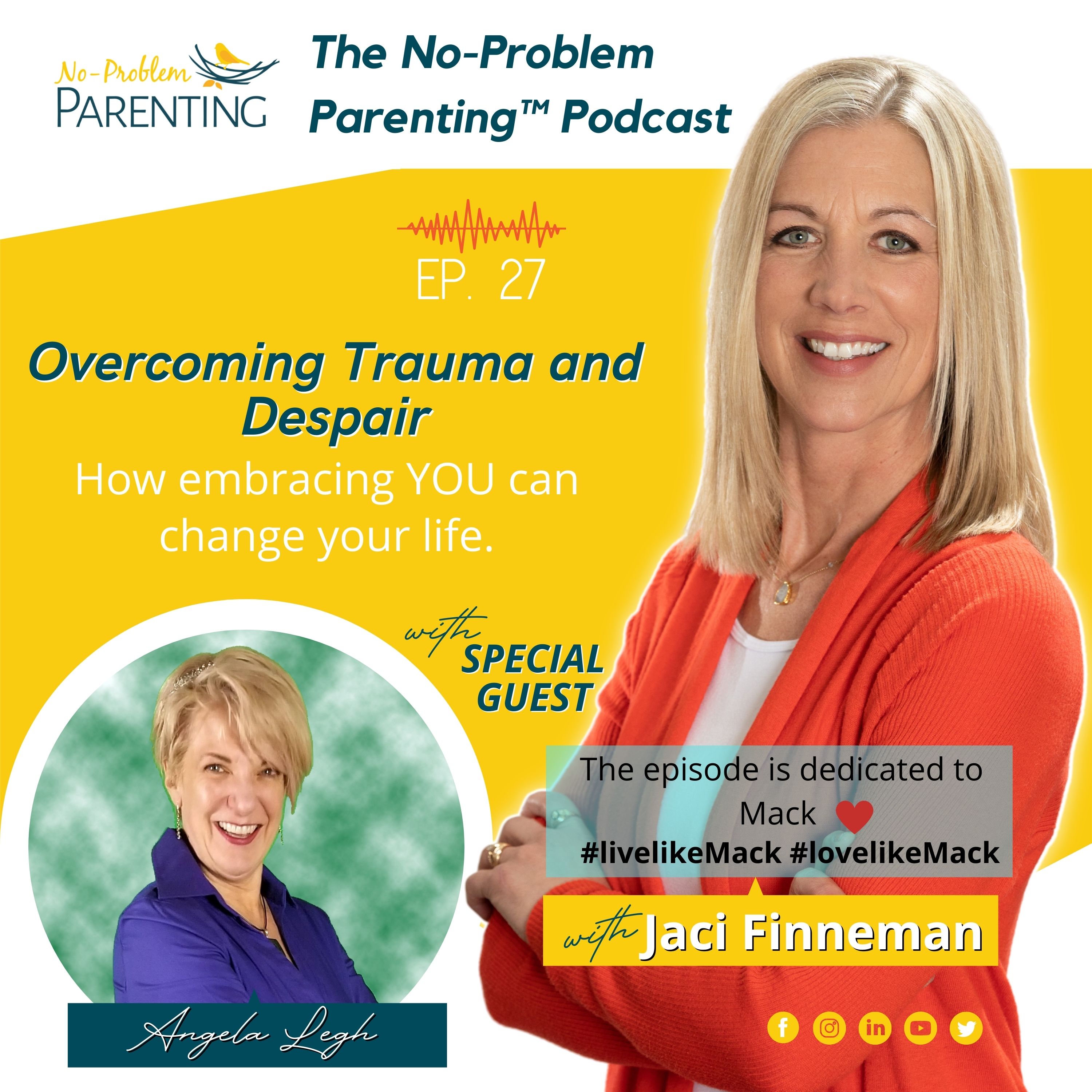
Overcoming Trauma and Despair with Special Guest Angela Legh
About this episode
Welcome back to the No Problem Parenting Podcast, where we choose to deal with and overcome the emotional and behavior challenges in our homes.
Today’s episode is about overcoming trauma and despair. The importance of self-love, and how embracing YOU embracing yourself begins with acknowledging your feelings and tending to them – so that you can create the life you and your children deserve.
My guest today is a survivor of trauma, abuse, fires and a near drowning all of which inspired her to become a writer and advocate for others who have endured tragedy.
She is an author whose mission is to help children thrive in emotional well-being by developing a strong internal emotional strength. Her books include self-help collections, about the power of forgiveness and learning to surrender to life and more recently a fairytale series titled The Bella Santini Chronicles.
Become a No Problem Parent Today!
Full transcript
Welcome back to the No Problem Parenting Podcast where we choose to deal with and overcome the emotional and behavioral challenges in our homes. Hey you guys, today's episode is about overcoming trauma and despair. The importance of self-love and how embracing you, embracing yourself, begins with acknowledging your feelings and tending to them so that you can create the life that you and your children deserve. And my guest today is Angela Lee. She's a survivor of trauma, of abuse, of fires, and of a near drowning, all of which inspired her to become a writer and an advocate for others who have endured tragedy.
Angela is an author whose mission is to help children thrive in emotional well-being by developing a strong internal emotional strength. Her books include self-help collections about the power of forgiveness and learning to surrender to life, and more recently, a fairy tale series titled The Bella Santini Chronicles. Now, did you know that reading the right book to your child can set them up for emotional well-being?
Well, the Bella Santini Chronicles series provides tools and techniques for youth so they can safely navigate the complex emotions of their teen years. and Angela is also a mentor. So while writing the Bella Santini Chronicles, Angela realized that she couldn't help children get in touch with their inner magic without paying attention to the needs of their parents. Helping children thrive in emotional well-being while their parents were overstressed made it harder for children to navigate their emotions, especially throughout those teenage years. So, Angela began helping adults to tap into their own inner magic through an online course and one-on-one mentoring so that then they could help their kids. Angela supports teens and parents by exploring and coaching on complex topics.
Topics like child abandonment, bullying, sibling rivalry, and even good versus evil. Her clients build emotional muscle and set a path of emotional well-being that allows them to navigate the difficult teen years without isolating themselves or even worse, seeing suicide as a solution to their problems. Did you know that suicide is the second leading cause of death for youth ages 10 to 24? The Substance Abuse Mental Health Services Agency, otherwise known as SAMHSA, states that the causes of suicide are complex and determined by multiple combinations of factors such as mental illness, substance abuse, painful losses, exposure to violence, and social isolation, which significantly increased under the COVID-19 lockdown and the effects of that are still prevalent and showing up in our kids today. And Angela understands firsthand the pain and despair of trauma, loss, and abuse. You see, she grew up with an alcoholic father and thank goodness,
an angelic mother. Her family home burned down when she was six years old and because her parents couldn't find a place to live, she was sent to foster care for a few months. So she was literally ripped out of her family and then consequently she believed that she didn't deserve love. And then after high school, she married an older man and things were good for a while, but over time he began to control her. His criticism supported her belief that she didn't deserve love. Angela stayed in that emotional abusive marriage for over 32 years and then she was pushed outside her comfort zone again by a fire. The Tubbs wildfire in Napa and Sonoma County in 2017 destroyed her family home. It was when she was stripped of everything except her marriage that she was forced to examine her relationship. She left the marriage and began the process of healing her inner child.
So now Angela writes children's books and mentors parents and kids, lifting them out of victim mentality and helping them find value in themselves again. I have to ask you, have you been a person that's helped someone find value in themselves? Maybe you've helped a family member or a friend or even a complete stranger by simply acknowledging or noticing them. Every day, each one of us has the ability to be kind and intentional with the people around us.
Saying hello to someone you don't know, striking up a conversation with a classmate that seems shy or reserved, or even getting to know the kid that always seems angry or the one that's tagged as the bully in school. sometimes your random act of kindness or compliment affects that person way more than you could ever know. And so before we get to my conversation with Angela, I'd like to share that we recorded this episode just days after my family learned of the death of our dear friend Mac. Mac was just 20 years old and was killed in a car accident along with his sister's boyfriend. Now to be honest, I wanted to reschedule this interview. I didn't want to get back to work.
But then I thought about who I was interviewing and I figured that if nothing else, even if I fell apart during the interview, I just kind of knew that Angela of all people would understand. And I even thought maybe she'd be able to help me that day. And you know what? She did just that.
before we started recording, I shared my grief and Angela helped me acknowledge the emotions that I was having. She helped me shift from fearing and resisting them. And within just a few minutes, I was able to see that recording this episode was exactly what I needed to do that day. Now, like Angela, Mac was one of those people. He acknowledged and noticed everyone.
so I'm dedicating this episode to him our world needs more people like Mac and in honor of him I'd like to share an excerpt from his tribute that was written by his parents at a very young age it was obvious that Mac was guided by a strong faith and a huge heart he believed and he cared deeply. He often cared more about you than you cared about yourself. He had a spirit and a presence that would pull you in and never let you go. Mack made time for people, especially those whom others didn't. He was that kind of kid. He was smart, athletic, talented, funny, popular, but never while putting himself above others or leaving anyone out. He went out of his way to positively impact all those he met. It was who he was and how he saw the world. He was fortunate to find his purpose and passion very early in life and he knew that it was to help others. As soon as he could walk, he was found most days on skates or with a golf club in his hands. He loved the thrill of competition and the challenge of being and doing his absolute best. Most importantly,
he loved being with and competing with his friends. Being on a team and being a great teammate mattered to Mac. Being a true friend, the kind of friend you leaned on when times were tough and the kind of friend you celebrated with when times were great. Everyone loved Mac because Mac loved them back. So I'm dedicating this episode to Mac and to all of you who take the time to notice, acknowledge and make time for the people in your life that others don't.
Hashtag live like Mac. Hashtag love like Mac. And when the darkness seems to win, look up child. All right, you guys, let's do this.
Welcome to the show, Angela. I am truly honored that you are here with me today. We're going to talk about pushing away fear and how our resistance to feeling can actually increase emotional pain. And before we do that, I'd like you to share a little bit about your journey and how you got to the place where you're now writing fairy tales for children, teaching them those life lessons that you've endured throughout your life so that these kiddos don't have to experience pain in order to develop emotionally.
Wow. That's quite an introduction. Thank you. And I guess I have to start off in my childhood because I had a very angelic mother.
All my good memories involve my mom and I have some really idyllic, beautiful memories of mom. But I had an alcoholic. My aunt says he was overly sensitive, which I think fed into the whole thing. An alcoholic, full of rage father.
and you know there he would abuse us in every way and his rage was palpable him coming in the door slamming the door where's it the thing that bitch and he's looking for one of us and it's just you know even now like my stomach clenches and i feel the terror that we as little kids had. What I realized is after talking to my aunt and she was telling me what a sensitive child he was and what a sensitive man he was, I realized that he was trying to numb his feelings of inadequacy because his father drilled into him that he didn't meet whatever expectations he tried to drown those feelings in alcohol but we can never escape feelings they're always with us and that's why people have to keep drinking or keep doing drugs because the feelings continue to be with us. We carry them.
So what I have learned, discovered over my lifetime is that it's really important for us to face even the painful feelings. And our ego is so wrapped up in keeping us safe. Our ego tries to keep us from feeling painful feelings. And so our ego is what drives us into these escape mechanisms.
But the pain of reaching into those escape mechanisms is so big, not only for the person escaping feelings, but all of the people around them. when you think of substance abuse and alcohol, the pain inflicted on the family is huge. And when you compare that to the pain of facing a feeling, it's like, what the heck? Why would you not face your feeling?
And I think about that all the time. Why do we make it? We're so afraid of the feeling or to acknowledge that. when in fact we make it so much harder on ourselves to not you know get in touch with the feeling and actually acknowledge it and pay attention to it yeah when we can face our own shadows and admit that we have a dark side so for me my dark side was anger I repressed anger my dad was angry, I was not going to be angry. I was always the really nice person. And the problem with that is that when you repress a feeling, you're also carrying it around with you and you become reactive to anyone who expresses that feeling that you're repressing. So I married a man in my youth who, he also had an alcoholic father, but he did not reject the feelings of anger. He made it who he was. And so I didn't know it when I was 20 years old and getting married,
but his go-to reaction when he was stressed or felt rejected was anger. So you put me, who represses and disdains anger, together with him, whose anger is his go-to emotion, and it's a toxic marriage. I rejected his anger and he got angry because I rejected it. All of that pain can be tied back to me rejecting the anger of my dad.
Right. And isn't it amazing that even though you were rejecting that, then you end up falling in love with somebody who exudes that? Well, I think frequently we end up marrying someone. We're trying to fix what relationship we had with our parents. So, you know, for me, there was always the, okay, I got to make this anger relationship right somehow. But I, I failed at that too. Well, and so let's talk a little bit about in the introduction, I introduced your, a little bit of your background and your story. And, um, but I kind of want to get into, to fast forward, uh, how you arrived at the concept that resisting feelings can increase pain. When, when I first drew the line between my father's rejection of his feelings to his alcoholic abuse, to my repression of anger,
to my toxic relationship with my ex, I could all of a sudden see this lifetime of pain that at any point, if my ex or myself or my father had faced the feeling that we were, you know, dealing with, because with my ex, he didn't reject or escape or repress a feeling. He grabbed onto it and he hung onto it. And that is also a problem. So when we can be neutral, if either one of us had learned how to be neutral to a feeling, then all that pain could have been not, you know, none of us had to go through all of that pain. And what I do in my children's book is I teach the techniques, the characters discuss the techniques for being neutral to feelings.
And so I'm just hoping to help the next generation to grow up and come from a place of emotional well-being. And so talk about a few of those things that you teach in your children's books. How do we not repress those feelings? How do we actually, what would the word be?
Embrace them or address them or acknowledge them. Well, acknowledge is actually one of the tools. So you are aware of the feeling. So you notice I'm having this feeling.
You acknowledge the feeling. I feel and put in, you know, the word anger, sad, whatever. And then you allow yourself to feel it because it's in the resistance or the grabbing on to a feeling that we imprison ourselves into carrying that feeling with us. So that's so great.
I years back, I don't remember how long ago it was. So I have a person that's dealt with anxiety. that word is almost like a, it's almost overused these days, I think. But I was a worrier and always, and I worried about things I didn't need to worry about other people's worries. I was worrying about their worries and, you know, and I was such an intuit and a feeler and still am that I really almost would take those other people's feelings on and own them aside, you know, alongside my own. Years ago, I learned of this, a woman who wrote a blog about anxiety and when anxiety shows up, how it's much better to not resist it and try to make it go away and try to ignore it, but rather to really embrace it and acknowledge it and, and think of it as,
okay, acknowledge it and say, thank you for letting me know I care about myself, or thank you for letting me know I need to protect myself right now. Yes. Yes. And that's what you're reminding me of. And, and that's absolutely the truth. Feelings are information. That's all.
So if, and one of the thing, another thing I teach besides how to, you know, be neutral to a feeling is it's in our perspectives. And so I teach children how to shift, for instance, out of victim perspective, which is probably a whole nother podcast going through that. The feeling is information. And when we fear feeling the feeling we're fearing, knowing about ourselves.
Because when we are reactive to something somebody says to us, or does to us. that is revealing within us a reactive space an energy most likely from our childhood that is responsive to that kind of behavior when that feeling of being abused victimized comes up then we know that that is the information telling us hey we've got within us a little bit probably handed to us by our fathers or our teachers or whoever. And that little responsive part can be healed by sending love to that area that is hurt by it. So when we fear facing a feeling, we are almost in fear of looking into our own psyche and and finding that place that shadow that we ourselves can heal through just pouring our own love into the area so that is I totally agree and it's a lot harder I think sometimes because it's like foreign to to us right it can sound really easy so I want to use maybe a few examples maybe one of the reasons why we don't want to address the the fear is because or the feeling maybe maybe one of the reasons why we don't want to address the feeling is because if we do then like you're saying that that message that we received as a child whether it's you know if you're sad that means you're weak right you know if you're angry that means you're not in control or yeah the Talmud states that we don't see the world as it is we see it as we are so when we think about our parents or our teachers or ministers or anyone else who spoke to us and told us,
hey, men don't cry. Don't cry. You're weak. They were looking at the world through their own filters. They don't share the same filters as we have. So we don't have to take their viewpoint as sacred, which when we're a child, we think, well, they're an adult, they know.
But now that we're adults, we can question those viewpoints and we can decide to hold on to that viewpoint if it serves us in our current situation. Or we can say, hey, you know what? I'm 46 years old now. I'm not that five-year-old and that doesn't apply to me now.
There's also a technique that I recommend adults use. It would be to imagine themselves as that five-year-old and imagine the adult telling them that same thing, you know, you're weak. And then imagine either themselves as adults come in and tell their child, their five-year-old, the truth, or maybe even a best friend comes in and counsels the child. and then you make whatever the new filter that's how you you just say this is the one I'm going to follow and so how do you think your childhood experiences affect your adult decisions and then how have you maybe how did they affect them different now that you use these these techniques of embracing the feeling? First off, it's hard, but worthwhile. And secondly, so I, I was living in victimhood, living in, you know, that victim mentality, pointing the finger of blame at my ex-husband because he was the angry one and he did this and he did that. And he yelled at me for seven hours and blah, blah, blah, blah, blah. Once I was able to say, realize my role in the interaction, which was to be very reactive to his anger, which kind of elongated the,
the interaction when I could then say, okay, maybe if I wasn't reactive, maybe he didn't have to be as angry as he was. And so we each played a role. We each have responsibility. I'm not blaming him.
I made the choice to sit there while he yelled at me for seven hours. I have some responsibility here. When I take responsibility, I am not in victim energy anymore. I have the ability to make choices and change my situation.
and so um as as difficult as it is to face and i had i had so many buried feelings that needed to come out and i can't tell you how many days i have um just been like head under the covers crying, allowing those feelings, even allowing anger, which was a hard one for me. Right. Because you had told yourself anger was bad, evil. I was in judgment of his anger, which is a kind of reaction.
I was self-defensive and then I would get pushed to the point where I would get angry and yell back and so I he used to say I never started at yelling and what you did was made me get to that point and I could say the same right right when you got to the point where you were like okay I'm I'm not going to, I'm not going to be the victim. I'm not going to just take all this stuff in. What did that look like? How did you, how did, or, or did that come after you left the marriage?
What I say is sometimes you, when you're in the battlefield, you cannot think with a clear head. And so you can't, you can't like rise above the battlefield and see your part in it. So I did have to leave the marriage in order to begin that healing journey. I probably wouldn't have left the marriage if there wasn't a wildfire in Northern California that destroyed everything.
I had to get to the point of having everything in my life gone except the relationship to look at the relationship and say, boy, this isn't working. what the fire did was knock me out of my comfort zone and from outside of my comfort zone I was able to make scary changes that perhaps my comfort zone I wouldn't know but I know that I am a huge empath and I know that in because I was married for 32 years and it's not like I never thought of leaving but every time I did think of leaving I put his needs first because I didn't want to hurt him. And what I didn't realize was that by staying, I was expanding the toxicity of our relationship. And even though he may not agree with this, I think the biggest gift I gave him was leaving. Now, you know, he can be himself without being judged for what he does.
We don't realize that we're enabling when we're doing our empathic thing. And so, yeah. No, I totally get that. How do you recommend people to safely experience their feelings then?
because it can be super scary. I mean, are you, do you recommend therapy? The reality is the biology of a feeling, the biochemistry is 90 seconds. As long as our mind does not engage in the concept of the feeling. So that neutrality of not grabbing onto the feeling or not pushing it away when we can just allow the flow of the feeling it's 90 seconds but our mind is so good at grabbing on to a concept of a feeling and so what happens is they last longer than 90 seconds but you can go in and you you know just in a quiet space in a quiet room allow yourself to experience that sadness, that rage, whatever. And you can call a halt to it when it becomes too much. If it's just way too scary to do it, absolutely seek someone to hold you in a space of love to help you feel through that feeling. Can you give us an example, just a, you know,
hypothetical or maybe one you've used before where you took 90 seconds and you identified that feeling or acknowledged that feeling. I was speaking with a friend of mine and I know this is going to touch you. So breathe through it. She lost her best friend like two days before we were on a zoom conference and she was in her workplace and trying to put on this good face and, you know, breathe and, and get her work done. And she told me what happened. And I said, Hey, just take a breath and give yourself the opportunity to go into the bathroom and feel five minutes doesn't have to be more than that and she hadn't given herself that permission because of what she thought of the expectations of others but if you think about it if you're in an office environment and someone just lost somebody are you going to complain if they go the bathroom for a few minutes. And so we, our minds create these reasons why we shouldn't.
But if we, you know, kind of short circus our own thought process, because not every thought is for our good. You know, we can, we can say, Hey, I'm, I'm choosing a different thought right now, because I know what's for my good. Right. Yeah, it does touch my heart. You, you know, a little bit of my story here. So I can think about that too. Sometimes getting through when you have just lost somebody really close or a friend of yours has lost someone really close. It, you can kind of try to push that away because you have to plow through and you have to get through the day at work or another, you know, your child's sports event or, you know, whatever it is, but you're supposed to just hold it together. And instead that holding it together can make it last longer.
So taking 90 seconds to five minutes to just acknowledge I'm sad right now. And I'm feeling very, very sad for this person can really can help you acknowledge that and be able to move on or say, and I'm going to, I'm going to come back and pay attention to this later when I have time. And I'm going to grieve to the fullest when I can, when I have time, much like I was talking about with the anxiety earlier. All right. Well, this has been so great, Angela, and I could talk to you forever. You have a very peaceful and a very calming demeanor about you and just, and very loving. And, and so hopefully we'll connect more and we are going to collaborate a little bit, so we will be in touch. But for now, how can my listeners get in touch with you if they'd like to learn more about your books, your children's books, and, and just about the work that you do?
my website is the best way for people to get in touch with me Angela A-N-G-E-L-A Lee L-E-G-H there is no I in it just L-E-G-H dot com all right well I'm going to put that link in the show notes as well as your Facebook and all your different social media sites and I want to thank you so much for being here with me today and I just I love your mission and your work and the work that you're doing to help kiddos. So thank you so much for joining me today, Angela.
Thank you so much for having me on. And I know that, you know, we share a mission. It's about helping parents and kids. And so we will definitely collaborate and have some adventure.
I, for one, am excited about that. For now, be sure to go and check out Angela Lee's website at AngelaLee.com. That's where you're going to find links to get her books and become part of her mentoring program for parents to learn about how they can coach their kids and really have those conversations about emotions with their kids. Or you can book a discovery call with Angela so that you can share with her what you're dealing with or what your teenager is dealing with and maybe what you can use some help on and she can suggest your next best step. Thanks again for listening and I want you to remember that on particularly rough days when you're sure that you can't possibly endure, remember that your track record for getting through those days so far is a hundred percent and that's pretty darn good. All right parents, hugs and high fives. You got this.
Become the confident leader your kids crave
The method, the community, monthly live Q&A with Jaci, and Celia — your AI guide in the moment.
Start your 14-day free trial Get it on iPhone or sign up on the web