
Meals Without Tears and Creating Simple Mindful Moments with your Kids! with Special Guest Katie Hardy
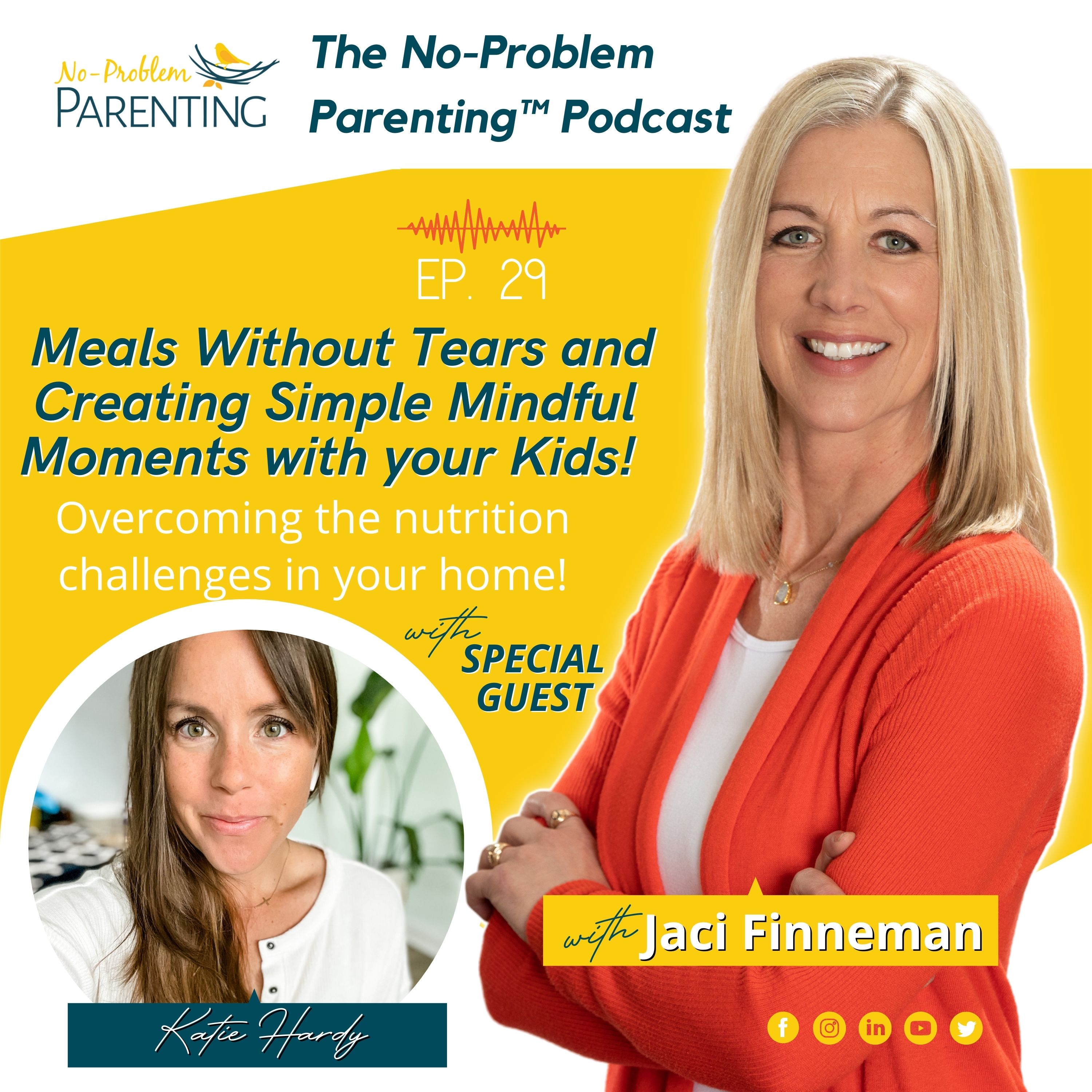
About this episode
Welcome Back to The No-Problem Parenting Podcast!
Today my guest is going to talk with us about all things,
healthy diet and nutrition for our kids,
how to get our kids interested in eating healthy,
why modeling mindful eating is a mature choice that parents make and
she’ll share the hard truth about how stress and hurry – using our busyness as an excuse for poor eating habits
can actually mean you are being lazy!? Say what?
Katie understands that convenience is important so she’s gonna show us how we CAN feed our kids the easy snacks sometimes and feel good about it AND how we can prevent irritability and over active behaviors in our kids by choosing better go to snacks and meals.
Become a No Problem Parent Today!
Full transcript
Welcome back to another episode of the No Problem Parenting Podcast, where we choose to deal with and overcome the behavioral and emotional challenges within our home. Hey, you guys, welcome back. Today, my guest is going to talk with us about all things healthy diet and nutrition for our kids, how to get our kids interested in healthy eating, and why modeling mindful eating is a mature choice that parents make. She's actually going to also share the hard truth about how stress and hurry, you know, using our busyness as an excuse for poor eating habits can actually mean you're being lazy.
Say what? Hey, Katie understands that convenience is important. And so she's going to show us how we can feed our kids those easy snacks sometimes and then actually feel good about it and how we can prevent irritability and overactive behaviors in our kids by choosing better go-to snacks and meals most of the time. And parents, remember that No Problem Parenting is here to help you become the confident leader that your kids crave you to be.
So this episode is actually kind of a twofer because Katie helps parents become that confident leader. She teaches women how to create a healthier mind so that they can build their healthiest body and do so without feeling overwhelmed or over it. So are you a parent who struggles with your own diet and body image? Well, as the CEO and founder of Whole Hearty Health, Katie's mission is to reverse common culture's health perspective from one of basing your happiness and worth on your weight or your size to one of empowered wellness, mental resilience, and body respect. And this is all possible, she says, without restrictive dieting, hour-long workouts, or awkward meditation cushions.
Her proprietary method called the Triple Fit Wellness System teaches you how to get mentally, physically, and spiritually fit using theories and practices that are proven in neuroscience, in biology, and theology. And they're all customized to your unique personality, to your schedule, your challenges, and your goals. So with mind, body, and spirit certifications and trainings from Duke Integrative Medicine, with MindBodyGreen and Fit for Mom, Katie serves up the wholehearted wellness tools that you crave. Be sure to check out the show notes to find Katie on the Inside Out Wellness Podcast. You can find her on social media at Whole Hearty and on her website at wholehearty.com. That's W-H-O-L-E-H-A-R-D-Y.com. All right, let's get into the episode.
So welcome to the show, Katie. I am so excited to have you here today to talk all things easy and healthy meals. Jackie, thank you so much for having me on your podcast. It's an honor. I love this topic. Katie Hardy, I'm a certified wellness coach. I got my certification at Duke Integrative Medicine, and I'm a workshop presenter, a wife, a mom, and also the host of the Inside Out Wellness Podcast. I help women create a body they're proud of so they can take the action they're meant for. So I hear from so many women that they have bold dreams and as big as going for like starting their own business or going for a new job or a promotion, or even taking small steps, just like joining a conversation, right? Seeing another group of moms and just wanting to have the confidence to walk up and talk to them, but they have stories in their head that are holding them back. And a lot of those are around body thoughts. And so I really help them think of their body and think about health in a whole new way. So it's really an honor. And I'm so lucky that I get to help women in that way. My certification at Duke Integrative Medicine really brought a holistic or integrative approach to wellness. So we were tested, trained on nutrition and fitness and mindfulness. And on top of that, when I was meeting with moms,
we would be talking a lot about eating habits. So I then have training by through mind body green in functional nutrition. And what I was hearing a lot from my one-on-one clients who were moms and my students in my online programs was snacking like tons of not really knowing when to eat, how to eat, how much to eat. And that that was then carrying over into their kids habits because they didn't have structure for their kids as well. So when I took really that combination of what I'm hearing from my moms in particular, what I'm hearing from nutrition, functional nutrition, eating habits, and then how that's really passing down generationally from parental habits to kid habits, and then also eating kids snacks, right? Like when we're saying we're going to be clean and healthy and have energy from whole and natural foods, and there's always room for goldfish,
we're eating goldfish or cheese. It's every day because they're in the house for our kids. So one thing that I really, really love talking to women about as well, and moms in particular, is trying to create a home where no food is completely off limits, but having your feeling empowered and having go-tos for your kids, for your family, when it comes to breakfast, lunch, dinner, snacks, travel, because when you feel empowered with what you have in your home and how you're eating, then you pass that down to your kids. And you know, our kids pick up everything we do, everything we say. So I love helping moms with feeding their families as well.
It all kind of starts out with how you were raised and how you have kind of grown into being a mom and feeding your kids. And one of the biggest mistakes I see is convenience is that we're in this hurry and we feel like whether it's in the morning and it's before school or before summer camp or headed to work or at night where there's sports and you're like just feeding them right before, or you're feeding them right after there's this, um, this essence of feeling rushed and just wanting to do what's the most convenient. And another mistake on top of that too, is when you're in the hurry, you often allow your kids, no matter the age, to win. And I've heard from women before where it's like, my kid will only eat yogurt, you know, when they were babies, like that's it. He'll only eat yogurt. That's it. And it's really allowing yourself to come from it as a place of education for your kids and not force, but the more that you are forcing foods on them or just going out of convenience, then you're not going to get the results you want for the kids eating the healthy foods. And again, there's always room for chips and chocolate, but as you know,
you really need the majority of your day for kids who are growing to have those vitamins, to have those nutrients, to support their growth, to support their brain growth, their eyesight, to give them the energy they need, because we all know kids are just bouncing off the walls all day, but we want that energy to come from whole healthy foods primarily and not from, you know, big bleak chew and Skittles. My recommendation when it starts with, if you're trying to introduce new healthy foods to your kids. The first time, make it fun. So if you are going to try to get in the broccoli or, you know, get in the carrots, add a little pizzazz the first time, because if you are giving them something that is just like not, you know, flavorful and you're forcing it on them because I said so, then they're always going to have a negative feeling towards that food. So let's say that we're starting with breakfast, for example. Greek yogurt that's flavored is a great way to start. There's protein in there, probiotics, but having that bit of flavor in there gives them a reason to be excited about it. Because plain Greek yogurt, like I have videos of my kids having it when they're like eight months old and they just have this like sour lemon face. But that has become a go-to in our house. And I always check the sugar content because yogurt can be high in sugar.
But one way to combat that, if your kids are, you know, if you're working with a pediatrician and they are on a low sugar diet, one thing that you can consider is if you buy the plain Greek yogurt, get some berries or even frozen berries and microwave them and put that frozen berries with the liquid from being microwaved in the plain Greek yogurt and mix it up all together. And that'll be a little fun for them too. You can even let them mix it up.
but we love having protein in the morning because that really helps make us feel full and starts our day and gets us going. Another thing is eggs and you can make eggs really fun. If we're going like meal by meal for breakfast, eggs are a great way. Again, there's protein and fat in there, but that's something too that you can make a little bit more fun. And my, I have a six-year-old and an eight-year-old. My eight-year-old has always loved eggs and ketchup. And I typically we put like olive oil in the pan, but we were traveling and my sister-in-law put butter in the eggs for my boys and my six-year-old then ended up eating them because there was butter in the eggs. And so butter, again, I know it has gotten a bad rap back in like the eighties and the nineties, but butter is a fat that is a natural fat and can, depending on the type of butter that you buy. And that can help us feel full, um, and give us those essential macro nutrients that we need. So adding butter and cheese to eggs to get your kids again, starting off with something fun. If you give them plain eggs with nothing on it, they might not enjoy it.
And then they'll always look at eggs as something not tasty. But if you start off making it flavorful, and then you can kind of wean away from the butter and the cheese, it's, it's a strategy that has worked for me. It's worked for my clients, but starting it off fun, and then starting to kind of wean it, wean away from the extras has really, really worked. And I remember when our son was younger too, I don't remember how I came across it. It was a video or something. But I remember hearing that you can have chicken or broccoli with your eggs. In my mind, again, you're talking about, you know, as a, as you're brought up, there are certain foods you eat for breakfast and then certain foods you eat for lunch or dinner. And I was like, who eats broccoli for breakfast, but that actually, he loved broccoli, cooked broccoli. He didn't like the raw stuff,
but he liked the cooked stuff. So it was like, throw it in with the eggs. And it was amazing. I mean, like he ate it and it was great. And we got that in right away in the morning. So I think sometimes it's shifting your mindset. We'll get into that a little bit later on what you're supposed to eat for breakfast and what you're not. Oh gosh. Yeah. I totally agree with you that we are so used to the typical breakfast foods. And I would say to the younger your kids are, the more open they are to having mixed in broccoli with their eggs. Because they they're, they're not accustomed yet to wait, we're only supposed to eat broccoli at lunch and dinner.
So the younger you can start them, I totally agree. So starting them young, introducing vegetables or right, even chicken, whatever you need earlier in the day as even calling it meal one instead of breakfast, then, then that will help too. I agree. And then adding, if you are having the typical breakfast meal, thinking every time, how can I make this healthier? How can I make this healthier? Like, how can I optimize it? If you are doing like a bagel or, or pancakes or a waffle, putting some coconut oil on first instead, or either instead of butter or before the syrup that will get them used to the flavor of coconut oil. And you can use that in other ways.
Um, but again, that's a healthy fat. That's going to help them really feel full and it's going to support their cells. Um, and then with cereal, I never give my kids just a bowl of Cheerios with milk. I'm always like taking pecans and really like crunching them up and putting pecans in there. We'll put some like bananas and strawberries in there. So it's kind of like a powered up cereal so that it's not just, you know, like a, like a simple sugar, basic starch for breakfast. So thinking like, okay, how can I optimize this? And that really makes you feel empowered. And then it gets them used to it. And if they question it, it's really explaining to them the benefits. My kids both play dozens of sports. And this was a while back, my son was playing flag football and they were like doing 10 laps. They're like, the coach was like, if you run 10 laps, then we'll just scrimmage the rest of the practice. And Beau, my son was really able to keep his endurance up. Whereas, you know, as kids you'll run a couple laps fast and then you're like,
oh man, I got like seven more to go. And so we had explained to him like, oh, well, you are eating your green beans and your broccoli and you're getting enough sleep and you're drinking a lot of water. So whenever there is a win, if you can support that with like, oh man, well, what did you have for dinner? You know, what did you have for breakfast that day? It really teaches them in a way rather than eat this because I said so, you know? Yeah, for sure. Help them understand that what they put in their body is actually helping to fuel it longer. So they can be faster and all that. I love that. That's great. So I mean, what are some of the other mistakes that you find that parents are making when it comes to healthy and easy meals and snacks for kids? Yeah, I would say another mistake is having it always be a battle and it's different with every age, right? And the more the older our kids get the more independent they are and the easier it is for them to just go to the pantry and get a pop tart or whatever you might have in there get doritos and I think starting them off at an early age with explaining like the makings of a meal the the sooner that they understand it so really coming at it from an instructional but really like supportive way and really basing it off of their wins and their wants.
So if you connect it to sports or if you connect it, if you have a daughter to, you know, ballet or playing an instrument and how having these nutrients is really good for your fingers to move quickly, whatever it is, coming at it from an empowered stance. And when they understand like, oh, we typically have like a protein and a vegetable and a starch, and then we'll end it with like fruit. my, this was a couple of years ago. I think my eight-year-old was six and he had said, oh, what's the vegetable with dinner tonight? And I was like, I am winning. Thank you for asking me that. So, because he knew that he he's used to that, like, oh, are we going to have steamed broccoli or steamed green beans? Those are typically our go-tos for dinner.
We'll steam it and then we'll put butter and salt on it again, because we started off early like that, we can then say like after, I don't know, a couple months of them saying, oh, I really like steamed broccoli and steamed green beans, then we can go without butter and just put some salt on it. And then they're like, wait, I already, I already have decided, you know, mentally that I like broccoli and green beans. And they might not even register that maybe there's not butter on it this time or the other way around, maybe putting a little bit of olive oil, but not salt.
So kind of going in, you know, it's kind of like the gateway. My eight-year-old has been eating salads since he was two and a half. And I give my credit all to my husband. I, I did not eat salads till I was, you know, at least in junior high.
And he, he just, he rolls with it, but a, we sprinkle cranberries in there to sweeten the deal and be his dressing is ranch. So I don't even eat ranch dressing, but it's the gateway for him to decide, oh, I like salads so that when we do not, when we're out of ranch, like quote, quote out of ranch right now, we have olive oil and vinegar with some lemon and herbs, but he already has it programmed in his brain that he likes salads. So again, kind of starting it off with like sweetening the deal and then being able to kind of step away and really redirect and transition them into healthier ways of eating has really worked. Let's talk a little bit about some of the consequences of the mistakes if you're, you know, just in a hurry and you're grabbing the junk or you're buying the food that really you don't even want your kids to eat. I mean, maybe you are buying pop tarts or Doritos for quote unquote special occasions or something, but then you start to just have them on hand and they, and the kids start getting in the cupboards and they're finding them and they're just, and they're whining and complaining and crying because that's what they want. So what are some of the consequences of the, of the mistakes and where can they lead us?
Yeah. Yeah. And you're right. Like we had never had pop tarts and Doritos in our house. And then when play dates started happening, like between, I don't know, like kindergarten and second grade after school, the boys would want to come over like my kids friends and they would go in our pantry. And they like literally one of those friends was like, where are your Doritos? And I was like, we don't have them.
you know? And so it's, then you don't want your kids' friends to not come over because all you have is, you know, kale and granola. So, which no, we have plenty of fun things in the house, but some of the consequences where you are kind of always succumbing to your kids' desires when it comes to food is A, they're going to start to feel like strong-willed and empowered. And they are going to kind of turn it against you. And then you will start to feel bad. And you'll, you're always going to have that junk in the house and think like, oh, well, just, you know, when the friends come over, if they're saying that that's what they eat, then I guess that, you know, maybe I'm being too strict, right? Maybe, maybe I'm being too strict, but then that goes down a slippery slope because you have to think about your, your kids that they're growing, right? When we're adults, we've stopped growing. However old, between whether you're 18, 21, 26, like the human brain is fully developed at 26. So you have to think when your kids are growing, they need those vitamins,
they need those nutrients. And some of the consequences of just being like, you know what, we're in a hurry, but then that really compounds and you're continually giving them just kind of those like cheap, quick fixes, then they're not getting the nutrients that they need. And they, they're going to suffer. They'll have the consequences too, with education, trying to focus in school, sports, cavities, right?
So their immune system not being as supported, them just feeling down and getting really irritable. We have noticed with my six-year-old in particular that after he has like a treat, if we're going out for ice cream or pizza, he'll start to get real moody. And we're like, there it is, you know, moody Matt coming in because he just ate some junk. So if you're continuously succumbing to their desires and succumbing to just convenience and comfort foods that you're used to giving your kids, then the consequences will be their health and their moods and their irritability, which we know as parents, when our kids are moody, sometimes we just give that attitude right back.
It's hard for us to really like take that mature moment, that pause to say, oh, wait, you are just overloaded with sugar right now. I'm going to respond to you in a calm sense. That can take a lot of work. I think oftentimes we think that sugar means hyper kids and that they're just going to be hyper. Well, that's true. It can be true for some kids, but also that irritability, the sugar can create the irritability. So it's kind of a good idea, right? To look at, you know, what your kids do a little diary and what are your kids eating or what have they been eating for the last couple of weeks when, you know, you're seeing a change in mood or behavior that's not just hyper, but it's actually irritable, right?
So how does that relate to, to, to behavior? What have you found? Oh yeah. And you know, it's funny.
It's even my mom clients will say sugar makes me mean. And I'm like, I see it too. When I have too much, I'll just get irritable. And, and with the kids, yes, it's not necessarily sure.
Maybe like shortly after they have that like birthday cake and ice cream, you might see them like bouncing off the walls. Like, but then when they crash down it, right. They become more irritable. They become much, much more, you know, moody.
And, and from there, it's really hard through the rest of the day to break. That's like, that's, I love saying this when, when you run one red light, that doesn't necessarily mean you're going to run red lights for the rest of the day. So when it's time to, to redirect, and when you feel like your kid has had a bunch of sugar and then they spiked up and maybe they were hyper, or maybe they didn't even get that boost of energy and they're just irritable and they're not responsive and it makes the rest of the day, you know, trying to go places, run errands, the worst, that's where it's cleanup time. You got to get some protein and some fat in there to really combat that spike in blood sugar.
Cause we want our blood sugar levels to be flat, right? We want them to be sustainable. And anytime that we're going to have something that's really going to spike our insulin and produce insulin a lot at a, at one point in time, then when that spikes up, that's where our body is like, oh man, I need to fight this, right? I need to figure out what's going on.
We need to like go all in. Well, then that takes away from other things that like your mental focus and your endurance. So really trying to bring that blood sugar back down when you do see that your kids have like gone up and down and they're crashing, bringing in some really whole foods, macronutrients with some protein and some fat, that's gonna help you get that flatlined for the blood sugar, which is gonna help them feel more balanced and have an attitude of calm rather than crazy or irritable.
Yeah, and what are a couple of quick things that you could add then? If you've noticed that spike in your own insulin level or in your kiddos, what are some quick foods that we can just, that we can grab? Sometimes what happens is we've, as adults, will feel like food is the answer. And it's not always the case.
If you are feeling, you know, if you know you haven't eaten in like six to eight hours, and you're starting to fade, yeah, you probably need a meal, right? But if it's only been a couple hours and perhaps maybe you didn't have something like super sugary, like cake or like a sugary latte, if you did have a meal, food is not always the answer. And so sometimes we think about that with our kids. When our kids are getting irritable, we think, oh, they need a snack. They need a snack.
and sometimes that actually makes it worse. Especially digestively, our bodies as adults need at least like six hours for a full meal to fully digest. Kids are gonna be quicker depending on if they have a smaller meal size, they might not be having as big of a meal as we are. But it's really assessing, A, how long has it been since we had something to eat?
And B, what did we eat last, right? If it was something that was like sugary and spiked our blood sugar and we're crashing from it. Some of the things that you might want to balance it out rather than saying, oh, I just need a quick fix to boost my energy. And from a kid's perspective, pistachios can be really fun because they get to open and crack open the shells depending on which age they are.
Again, younger kiddos, you're not really gonna give them nuts if that's a choking hazard. So you have to really assess based on their age, but pistachios are fun. And mixing in a trail mix, like putting raisins in there too can really like make it seem more appealing. For adults, olives.
I have one friend whose daughter loves like olives and dark chocolate and like virgin mint mojitos. Like it's adorable. She's basically like Carrie Bradshaw. And so my kids like none of those things.
Actually, my youngest does like dark chocolate, but olives, kids aren't a fan. But from an adult perspective, that's definitely like a pure monostrated fat that's really gonna be helpful for your blood sugar as well. Um, cheese sticks. I used to be like totally against cheese sticks because they're highly processed. Um, but in the age of packing lunches and helping kids when they need, if we're trying to cook dinner and I, I try not to succumb to their, I need to eat right now. You know, we try to let them hold off as long as possible, but you know, when you're traveling or when you need something again, convenience, we don't always need to succumb to it, but there's going to be times where we need to choose convenience.
Cheesesticks or cheese in general is a good one too because that helps bring that spike in blood sugar back down with the fat. Peanut butter. So instead of just giving them fruit, adding the fruit, like putting a little, if you have like a ketchup container or something like a small little Tupperware that you could put peanut butter in, then they can dip their pretzels in peanut butter, their apples in peanut butter, even their carrots in peanut butter.
My kids love carrots and hummus. So that hummus has protein and fat in it as well. I mean, even leftovers, right? If you had like tacos the night before, just giving them like some taco meat and some steamed vegetables on the side.
They, just like you said earlier, if you early on can introduce like more of the chicken and the broccoli and the more like dinner-ish foods at different times of the day, right, breakfast and snacks, the more that your kids will see, oh, like I don't have to wait until dinner to eat things like this. Even when it comes to our meals, we don't put the starch and the fruit on the plate. I would say 80% of the time we wait for when we're eating the meal to bring over the starch and bring over the fruit until they've had their protein and their vegetable first.
Because if you have a whole plate, like let's give an example. Let's say that it's like chicken fingers and maybe you breaded them yourself with like tortillas and some eggs. They're like the breaded chicken fingers, like tortilla based. And then you have some steamed broccoli and maybe for your starch, you have like a side of pasta. And then for like, for your like sweet treat at the end, it's going to be like applesauce or something.
Instead of putting the chicken, the broccoli, the applesauce and the pasta all on the plate together, we'll just start with the chicken and the broccoli because they're going to want to eat, obviously the pasta or the biscuit or whatever you're the rice, whatever you're giving them as their starch and the fruit first. So when they finish their protein and their vegetable, then we'll bring over the starch and then we'll bring over the fruit. So for the majority of the time, we really think to do that because we want to make sure that they're getting the, those macronutrients first within the vegetables, all the vitamins in there, in the protein from the chicken. So that's a hack to consider. And then when they are wanting chips as a snack, that's a similar routine there where you can say, yes, you could have chips, but can we have a fruit and a vegetable first? In doing this, trying to do it, again, like we said earlier,
in an educational and empowering way, like coming from love rather than because I said so, Coming at it as a explaining why, then when the days of summer, like my eight-year-old, oh my gosh, he is going to be growing because he's eating nonstop. And we try to make sure that we have designated times for meals. So it's not just grazing all day. We want to make sure that we really get that sustainable meal going so they're full for several hours.
But when we're at home and we're eating lunch and he's like reading a book and he wants to keep eating when we decide as a team, right, together what that next food is going to be after he's finished the meal, but he's still hungry, then he can start to say, if I'm like, okay, Beau, like we've had it all, like what else could you possibly want? Right. What do you want? Now he'll say, uh, some fruit, you know, or he'll say, uh, we haven't had carrots and hummus in a while or cucumber and ranch in a while. And so he, when you decide together as a team, then they're more likely to come up with those ideas, right? Like, Oh, Clementine's we haven't had those since Sunday.
So having them come up with it, but thinking of it like, okay, it's not, I'm not saying you can't have the chips, but let's just front load it with all the vitamins first. So let's talk a little bit about the mindfulness piece before we wrap up today. What mistakes do you see parents? What what do you mean by mindfulness when, when it comes to, you know, healthy eating and what mistakes might you see that parents make when it comes to living more mindfully? Yeah. So mindfulness, I think can, it can get a bad rap, but it can also get a, that's not me rap. Right.
So on the one hand, you might be thinking like, Oh, mindfulness, that's so woo woo. That's so spiritual. You know, that's just not who I am. I don't meditate. Um, that's, That's impossible for me.
And then on the other hand, you might have like the busy badge of I'm too busy for mindfulness, right? I work full time. My job is so important. You know, we are always in a hurry, but a way to flip it is I read this book by Ann Voskamp and what she had mentioned, I think it was the thousand gifts.
And she had said like, is stress in hurry actually lazy? And you think of it as like, oh, I'm so busy. You know, I, I'm so important. I have all these things to do, but is that actually lazy? Because you're not taking the time, taking that like mature moment, I call it with my clients to really assess the proper way, the most like sound and responsible way to respond. So I like to think of mindfulness as a mature choice, right? It's not woo woo. It's not impossible. It's you deciding like, Hey, I want to get the most out of my life, right. From a macro perspective, or I want to get the most out of this moment from a micro perspective. So again, another, another mistake when it comes to, when it comes to eating and when it comes to mindfulness is being in a hurry.
Right. And I think it's Mark Comer, John Mark Comer, who wrote the ruthless elimination of hurry. Because that seems to be our excuse for everything. So when it comes to eating, and when it comes to raising healthy kids, mindfulness can really help you take that mature moment and decide how you want to respond, right? Like slow to respond, slow to anger, quick to listen, and really assess like, what do my kids need right now? What do I need right now?
Because like we said earlier, the way that we respond is the way our kids are going to respond. So when your kid is like talking back to you or yelling and you're thinking, oh, I don't know where he learned that, you know, that must be from, you know, my mother-in-law, right? This is, it's you saying like, wait, you know, if I am really directing my kid and trying to be the boss here and forcing these things, then your kid is going to behave in the way that you're behaving because you're teaching them that.
So, so mindfulness really plays a big role when you are taking responsibility for how you're responding and helping your kids respond in healthy ways. You talk a little bit about that. You can be mindful without having to spend hours on an awkward meditation cushion. I love when you said that it's like, it's not just about that sitting there peacefully on some cushion, you know, and thinking about, you know, your life or whatever.
So better ways to live mindfully with the kids. Give us some examples of that. Sure. You know, it was so cool. This was a few years ago. My eight-year-old, you know, was probably like five or six. And I don't even know what the debate was about. You know, maybe he like hit his brother or something. And I remember when we were like about to debrief on the situation, he like put his fingers together and like took a deep breath and like was kind of processing.
And I like celebrated that right there in that moment. I was like, Oh, you are actually preparing to have this conversation rather than going upstairs, slamming your door and saying like, don't talk to me. He actually like took that like mature moment that I, I don't even know if I taught him how to do that or what, but he kind of like put his fingers together and was thinking. And so when it comes to working with your kids on mindfulness as well, again, what you do, they're going to mirror. And one step that you can take is to let them know, like, hey, let's talk through this before we just like respond and say, you lost the iPad, you lost your treat, you lost the play date, because that is our like knee jerk or gut reaction.
working with them to process through it, I have found is really the most powerful to really take the time to debrief. We really just wanna be like, oh, you hit your brother, go to your room. You lost electronics, right? Because that's easy.
Like we said, when we're in a hurry and when we're stressed, the easy way out is to just not deal with it and just take your time out or you lost whatever privilege you lost. But really making time and seeing that making time with your kids and taking the time to really talk them through and debrief what just happened and what a better choice would be. That's the magic that's parenting, right? And you, you would even know more than I would, but that's where the magic happens is when you can debrief and say what happened because one of the other things that's a mistake is assuming. And especially when you, if let's say you have multiple kids and you know that one might be like a little bit more of a troublemaker than the other,
or one might be more physical and the other more verbal, you might assume that the one kid did something when in fact it was the younger brother that instigated the whole thing. So it really goes back to taking that mature moment and saying, okay, like let's really get the lay of the land and talk through it and allow your kid the opportunity to talk. It's so important when you, cause then they are becoming mindful and they're becoming aware when they get to talk through the situation and explain what happened, why it happened and what they would rather do or what the smart choice would be to do next time. And that goes, I just, on another podcast had a guest that brought up that same thing. And, and it's so true that what happened, I love that you say what happened because I have a technique that I learned many years ago that I use. And I teach parents all the time and it starts, it's called the make it right technique.
and it starts just with that first year pause, right? You don't try to deal with the situation when everybody's upset, you wait until everybody's in a microsecond of a good mood. But then you say to your kid, what happened? You know, what happened?
And when they tell you, then you say, good job being honest. So when they tell you what happened and it is accurate and you can say, good job being honest or thanks for telling the truth. Good job telling the truth. And then you can go into, what are you gonna do to make it right?
Or what are you gonna do to make it up to me or to your brother or to whoever, you know, they harmed and then let them come up with some ideas or give them some suggestions. Love and logic teaches, give them suggestions. Other kids have tried, not what you would suggest because they don't want to listen to us. We're the parent, right? What are some things that other kids have tried that usually helps better. And then you let them, you know, solve it. You let them go do it and you're right there for them. So it's a great technique. And I love that you're suggesting that as well. You use that as well. And that can happen.
those kinds of conversations can happen around food too. You know, when they're eating the cookie and you say, Hey, who said you could have that cookie? What cookie, you know, with crumbs on their face, it's like, you know, you could use that, that same kind of technique with relation to food as well. Or I allow kids to have chips or I allow kids to have cookies when they've finished their meal, when they finish their dinner. And I love your hack about just, we don't have to serve the whole meal all at once. It doesn't have, we don't have to have all the things on the plate right away. We can start with sort of the main course, that protein and, and that vegetable. And then when those are done, then we introduce the next, I wanted,
it made me think when you were talking before, it made me think of, I think oftentimes we don't realize that having the sugar, even if it's natural sugar, serving that up first, actually sugar helps to make your, you feel full. Is that right? It really depends. You know, like I would have to see like what, what it was. Cause I, I, I feel like having just a plain apple of that natural sugar will make you more hungry because it spikes your blood sugar and it's not coupled with a protein or a fat. Yeah. I suppose it depends on the type of sugar that it is, right?
If it's a natural or not. Okay. Yeah. I love how you, like when we're talking through our kids, whether it is their decisions, you know, whether it was a quarrel in the house with a sibling or a friend, or whether it's eating, talking through it. And like those questions that you brought up, that is mindfulness. That's being aware. Mindfulness does not mean like we said earlier, sitting for hours awkwardly on a meditation cushion. It can simply just be aware. And I love how you had said too, of what happened and what are you going to do about it? What, or what can you do to make it better in my certification at Duke health for coaching, asking what and how that's like the basis of like the symphony of questions that we ask, that we ask our clients,
how I ask my clients because those are open-ended right. What and how allows you to really explore how you're going to respond. And like, and I like how then you're not saying, this is what you did. This is what's wrong about it. This is what you need to do.
You're allowing them and then saying good job, being honest and good job, telling the truth, the more that if they tell you what happened and then you give them a consequence, they're not going to want to tell the truth, right? They're associating telling the truth with getting in trouble. So I like how, how you said that too. Yeah, it's, it works. It just works really well. And it helps prepare them to, you know, make it, if they're going to make mistakes, they're going to screw up. They're going to still, they're going to own up to it. And they know there's an end result, which is, oh, that's, that's no problem parenting. That's what we teach, right? Problems are meant to be dealt with and overcome. And so like, if we want our kids to come with us, even when they've messed up so that we can teach them how to make it right or make up for it and keep moving, like move on, life goes on. And I love the idea too, that we don't need to have just talking with your kids doesn't mean having a therapy session. Like we don't have to sit and explain why they did what they did was wrong or how they should have done it different.
Next time, let them figure that out and let, and make it short and sweet. Yeah. You know, Otherwise you're getting the eye rolling and the like, Oh, here we go again. And they're just going to avoid it.
Like they're not going to want to have those conversations with you. So no, that's great. Yeah. I would say like two more quick things when it comes to mindfulness, number one, getting outside, like no matter, no matter the weather, if it's raining, you can grab an umbrella and go for a walk with your kid.
If it's snowing, you can get your boots on and go for a walk with your kid. Getting outside is really a great practice for mindfulness because instead of, again, reprimanding or, or trying to, to force them to, to get something out of them or trying to even teach them something, just being out in nature, maybe even playing I spy allows them to become mindful and aware of their surroundings, right? Asking like, you know, what's, what's the temperature today? Or how does your skin feel like with this type of weather or, you know, like asking them more nature questions, they become more aware and mindful of their surroundings.
And if your kids are too young to have like a gratitude journal, that could be something that like teenagers really like. But with the younger kiddos, even at meals or dinner or before bed, asking them something that they're grateful for or thankful for. I know, I feel like over the past few years, gratitude has really had a moment, but helping them see the bigger picture. And that can help too, when they are assessing their decisions, that the more that you can talk about what you're thankful for and what you're grateful for being mindful and aware of that, then it helps you make choices that are more aligned with, with who you want to be and how you want to live moving forward.
Cause you're programming your brain to seek those things out, right? And remember the things that are important to you. So that would be two extra things to getting outside and talking about thankfulness and gratitude. Let us know what's the name of your podcast again.
Tell the listeners. It's the Inside Out Wellness Podcast. So it's all about working from the inside out to be well, right? Physically, mentally, spiritually.
So we do talk about parenting on there. We talk about really more body respect. We talk about relationships. We talk about exercise, all sorts of things when it comes to total wellness of you as a whole person, integrating how what you eat impacts, how you move impacts, how you connect with your family and your friends, and which then impacts your sleep and your stress.
It's like a big domino effect. So the Inside Out Wellness Podcast. Okay, that's great. You guys check that out.
And then also if people wanted to get in touch with you, either to learn more about Meals Without Tears and just mindfulness as a mom, as a parent, how can they get in touch with you? Yeah. Yeah. I'm on Instagram.
That's where I hang out the most. And Facebook. And both of those are at Whole Hearty. So W-H-O-L-E-H-A-R-D-Y.
And my website is wholehearty.com. So I have lots of recipes up there. I have lots of content on mindfulness.
I have a free download up there as well. The quarantine comeback. So it's the inner boss, outer balance. Sometimes what happens is we feel like maybe at work, we're able to really take control and we're crushing it at work.
But when it comes to wellness or even parenting, we just feel like we just don't have the skills. Like that's just something that we're not good at. So the inner boss, outer balance toolkit that helps you channel your strengths from other areas, whether it is work or even home organization and channel it into your wellness so that you can feel more empowered when it comes to who you want to be, how you want to respond, how you want to react. That's great. Thank you so much for being here today, Katie. I hope all of my listeners go check out your whole hearty.com website and your podcast and, uh, and get some of those freebies from you so that they can get back on track to a healthier lifestyle and also more mindful lifestyle, both within parenting and just for themselves as moms. So thank you so much for joining me today. Absolutely. Thank you so much, Jackie. And when you go to Katie's website,
wholehearty.com, you have the option to receive the quarantine comeback starter kit absolutely free. It's a free download for you. And again, thanks for listening in today. Be sure to take a screenshot, share this on your favorite social media, help me get the word out so that I can continue to bring these guests to you absolutely free. I don't make any commission or anything on the guests that I bring to you today. I'm literally just sharing them with you so that you as a parent have more resources to help become the confident leader your kids crave you to be. And the number one way you can thank me for doing that is to simply rate this podcast, like or subscribe or follow it. I appreciate you. For now, hugs and high fives. You got this, parents.
Thank you.
Become the confident leader your kids crave
The method, the community, monthly live Q&A with Jaci, and Celia — your AI guide in the moment.
Start your 14-day free trial Get it on iPhone or sign up on the web