
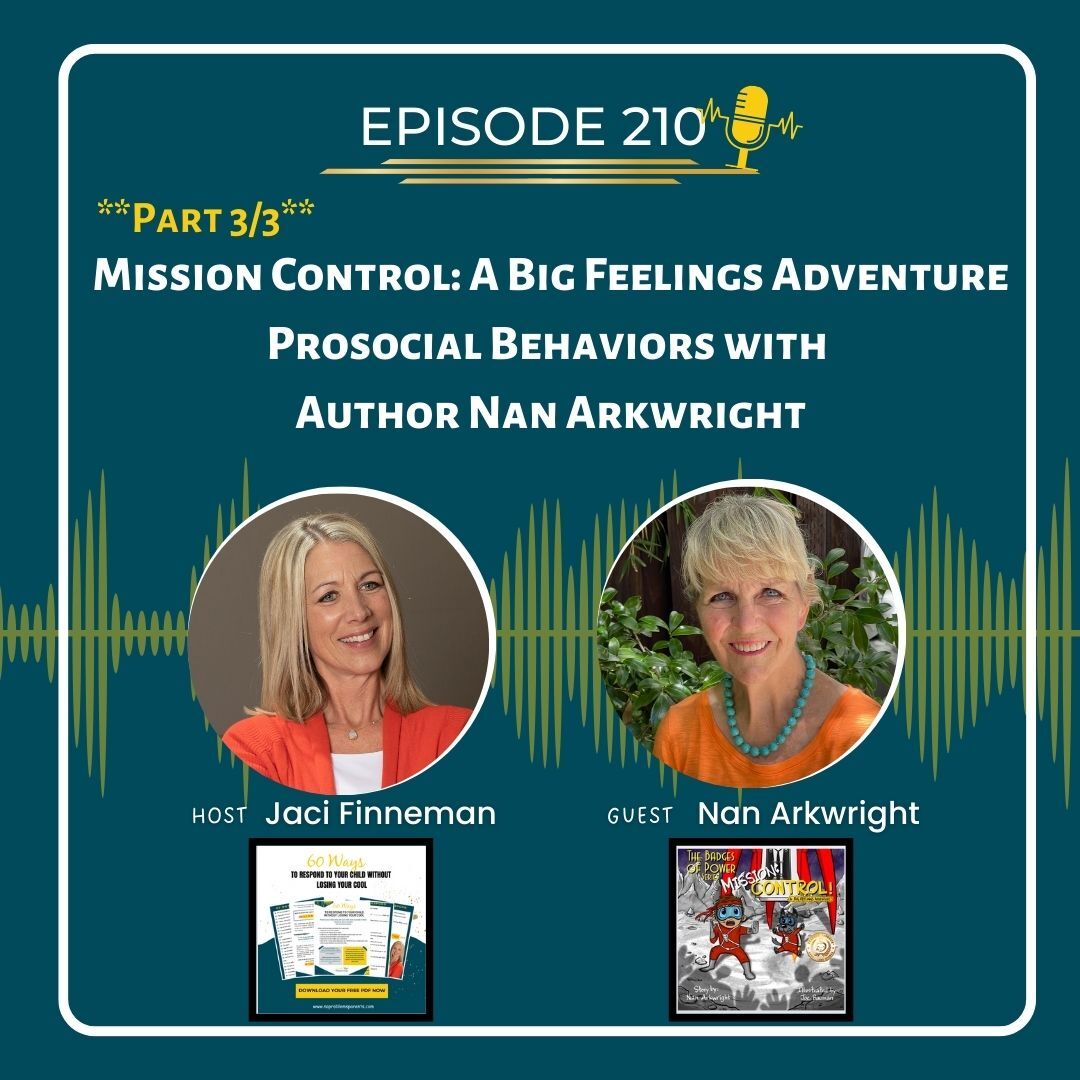
Part 3/3 Mission Control: A Big Feelings Adventure, Prosocial Behaviors with Author Nan Arkwright
About this episode
Welcome Back No-Problem Parents!
In the concluding episode of the "Mission Control: A Big Feelings Adventure" series, host Jaci Finneman and author Nan Arkwright explore the vital topic of prosocial behaviors. Prosocial behaviors involve actions that benefit others, emphasizing the importance of empathy and kindness.
Nan provides insights into integrating these behaviors into everyday life, emphasizing awareness, modeling, and aligning actions with higher purposes and values. The discussion draws inspiration from qualities like love, joy, peace, forbearance, kindness, goodness, faithfulness, gentleness, and self-control, echoing the guiding principles from the Bible.
The series' focus on Joseph's learning journey continues in the exploration of prosocial behaviors, showcasing the role of parental guidance and support in imparting valuable life lessons.
Listen to Part One on Episode 207 and Part 2 on Episode 208
__________________________________________________________________________
Nan Arkwright is a pediatric occupational therapist with almost 30 years of experience and writer who supports families in regulating emotions and solving everyday problems that come up at home and school.
At age 72, Nan is launching her writing career with an explosion of children’s mental health books expected to be published in 2024. Already published is her best-selling, award-winning book, Mission: CONTROL! A Big Feelings Adventure!
Visit www.AHopSkipandaJumpAhead.com to get Nan's book and join Spaceman Sam's Club.
Learn more about Nan by clicking one of the links:
https://www.facebook.com/issioncontrolthebook
https://twitter.com/nanarkwright
https://www.linkedin.com/in/nan-arkwright-51177413
https://www.youtube.com/results?search_query=nan+arkwright
https://www.pinterest.com/thebadgesofpower
https://www.instagram.com/missioncontrolthebook
__________________________________________________________________________________
Thank you for tuning in to the No Problem Parenting podcast - Please take a minute to share the podcast, comment, or leave a review on your favorite podcast app.
Check out our FREE PARENTING RESOURCES:
60 Ways to Respond to Your Kids without Losing Your Cool
Make it Right Technique PDF
Everyday Essential Solutions eBook for the whole family
Better Sleep: Decrease Stress with the 7-Day free trial of NuCalm Enter Code: NOPROBLEM for 15% off all products.
Become the Confident Leader Your Kids Crave you to be! Put the oxygen mask on yourself first!
Become a No-Problem Parent
Book Your 90 Minute Strategy Session
Find More Resources Here
FB - IG - LinkedIn - YouTube - Twitter - Threads
Check out our Books!
No-Problem Parenting; Raising Your Kiddos with More Confidence and Less Fear
No Problem Parenting; Resources and Stories that Create Confidence and Connection
Hugs and High Fives,
You Got This!
Jaci Finneman
30 Year Counselor turned Parenting Advocate and Coach
Full transcript
Hey, welcome back to the No Problem Parenting Podcast. I'm your host, Jackie Finnaman. And today we are here for the grand finale of our three-part series discussing the book, the story, Mission Control, a big feelings adventure with the incredible author, Nan Arkwright. Now in the first episode, which aired just earlier this week, episode 207, we tackled bedtime battles. And then in episode 208, just a day later, we discussed emotional regulation and exploring the importance of navigating and managing emotions for both your children and you parents. And now today in part three, we're wrapping up this series talking about pro-social behaviors. Nan shares insights from her book on how parents can integrate these behaviors into everyday life, teaching children important values that will guide them through life's challenges. I think it's pretty incredible that this one book has been able to address three key issues that all parents struggle with at some point in raising their kiddos. And it is the first book in a six-part series, the Badges of Power series.
Go to hopskipandajumpahead.com. You can order the book, sign up to get on her email list so that you are notified when the next book of the series comes out. And you can also sign up to be part of Spaceman Sam's Club, which there's a club for both parents and for kiddos. Nan Arkwright is a pediatric occupational therapist with 30 years of experience and a writer who supports families in regulating emotions and solving everyday problems that come up at home and school.
At age 72, Nan is launching her writing career with an explosion of children's mental health books. You guys, she has like 18 books coming out in 2024. Before we get into the episode today, let's hear a word from our sponsor kiss naturals who's also raising money for alex's lemonade stand kiss naturals is raising money for alex's lemonade stand charity do you want to keep your kids off the screen and get into some creative stuff have them make 100 natural made in canada lip balms soaps bath bombs and lava lip gloss for every sale between december 14th and December 31st, Kiss Naturals is donating $5 to Alex's Lemonade Stand. At only $24.95 each, please visit kissnaturals.com to get your kids beaming with pride when they complete their first DIY project. Let's raise money together for such an important cause.
All right, welcome back, No Problem Parents. Today we are doing part three of three, although Nan and I were talking, this is going to have to be a regular thing because this is book one. It's available right now. You can get a digital download version or you can actually get the paperback delivered to your home. But this first book is Mission Control, A Big Feelings Adventure. And we've got three episodes just on how this book can help your kiddos in three different areas, bedtime, emotional regulation. And now today we're going to talk about pro-social behaviors. So let's start again with the easy question.
What are pro-social behaviors? So it's an easy question to ask, but it's a complicated answer. So because it's so big, it involves caring for others, helping others, cooperating with others. And it is about kindness toward others, sharing with others, working things out so it feels fair to both parties. It's about making thoughtful decisions and not just in the moment, like I want that toy, but like if I take that toy, what will happen?
Will someone else feel like that was theirs and that's going to cause a problem? So it's thoughtful decision-making. Volunteering can be under this category of pro-social behaviors. Managing conflict, how to do that.
Understanding emotions of others as well as ourselves. And basically contributing to making a better world. So maybe another word might be social good. How do we promote that?
How do we model it for our children and how do we promote it in the lives of our children? So it's to help bring awareness that these are things. Well, these are things that are in the book that I've written that we're talking about today. Not all of those components are in there, but those things are always in my mind when I'm writing my books.
And those are there's one of the books that's coming out. It's going to be a hybrid book of using technology along with the book. And that's the one that has probably the strongest pro-social behaviors in it with the story. All the other books have some variations of all of that.
And it's always in my mind because that's what I'm trying to help in my individual sessions with children as a therapist, as well as in my social skills. But in particular with my social skills, because that's where I have the most opportunity to actually have that life moment. Help kids process when two kids are having tug of war over a toy. How do I help them learn?
Like you can both get what you want. There is enough for both of you. And every once in a while, I'll actually see a child say, not that often, but I love when I see a child say, this is mine, but you can use this. Here's a truck for you.
And that's what I'm trying to promote. And when I see that, I just, I'm thrilled. And I really, of course, give a lot of acknowledgement to that for the child in hopes that they'll repeat that. Like that's a pro-social behavior in action.
And that's what I'm trying to get kids to see. Again, they don't know. I mean, a few kids know every once in a while to do something like that. Somebody probably at home or school or both has shown them, maybe with a younger sibling, Like a baby takes away from a toddler and the parent often teaches the toddler to just exchange toys.
So that may have generalized to that setting by teaching that kind of skill. So what I'm trying to also promote in the books, the messages that I'm trying to pass on is these pro-social behaviors, these values. So they could be called values also. So like a lot of times I think families are so busy with their lives that it's hard for them to like even have the time to think, what are the values?
Like every parent knows basically what they want to see for their children. But have they thought it through and really thought, how can I promote this in my daily life? And that's what I think makes a big difference in helping children to regulate their emotions is a big part of that. But it also helps day in and day out. There are many opportunities to build those skills. So when I'm working with kids, I'll find through the motor activities that I do with them, opportunities to talk about, wow, you persisted at that. You tried three times and it was really hard. And each time I noticed that you did something different, you had a new idea.
I may have helped guide them a little bit to know how to do something differently. But I acknowledge like things don't just happen. Like I said before, you can make things happen. And if you think about, well, how can I change this so I don't get the same result?
I can do it differently. And so when they master it, because they've tried different things and finally gotten it to work out, then I get the opportunity to praise and say, look how you persevered, you persisted, teaching vocabulary too, but it's putting a name to a behavior and a value that that's important. That's how things happen when that's an example. That's a good way to learn about persistence through the activity itself. Well, and what I love about what you just, The example that you just gave about that praise is in step three of no problem parenting.
It's all about changing the conversation with our kids. And I teach a lot about conditional praise before the unconditional praise. So conditional is factual. And then you can pour on the unconditional, which is like, great job.
That's so perfect how you literally said exactly what they did. So the child can't argue that, right? It's something they can believe in because you just pointed out something they legitimately did. so then when you pour on the wow you are really persevering you stuck with it you're a hard worker hard worker it doesn't what what do you mean hard worker you know but you laid that step the steps out for them and told them how they were a hard worker so they can believe that from the inside out right that's exactly right yeah and it's so much better than us just trying to convince our kids that they can do it right that they're good at something yeah then they need the support they need the guidance from us. We go through the day with lots of ups and downs, our own personal lives,
but also our interactions with our children. And they go through their own ups and downs throughout the day. And in the end, like do the ups and downs, like we have those opportunities to do what you just described with the, you're a hard worker example. And when we know what our values are, and we know what our bigger purpose in life is, then those smaller things that are just maybe annoyances throughout the day can be sort of pushed aside because they're not as important as taking the time to teach in the moment about something or to reinforce a message about something because you're looking at the bigger picture of what are your values. You're seeing the blessings in your day, you're aware of what anchors you, what sustains you in your day,
and you're passing those values on to your child. And maybe you're addressing the smaller things, but you're prioritizing. Maybe that's not something, like I do that all the time in a session, something may be coming up that's an interruption maybe to my goal of what I want to teach the child in the moment, but I'm going to let that go in the moment and not get sidetracked by it. I come back to it later. If I think the child has any idea what I would be talking about, because sometimes it's 30 minutes later and they don't know what I'm talking about. But if I think that there's a reason to just mention like, oh, and so next time I bet you'll be able to remember this also, whatever it was, and just throwing in as a quick reminder and not spending a lot of time on it. But there's so many ways to build those skills for children. And throughout the hour that I'm working with children, as well as during my social skills groups, trying to help them learn to think about others reactions to things, and how to how what role they play in that person's reaction. So I often teach a little make a little book with them with four pages to it, just folding the paper into four parts and I teach like here's the situation and then open up the book and on the left side is a panel that says here's what I did in reaction to that with that situation and here's what the other person how the other person responded to that and then the last page is
well what impact does that have on me then so my reaction caused a reaction in someone else and did I like that reaction or was that something that was something I'd rather change and do differently the next time so then I sometimes call them a patch book so then I give them another piece of paper or post-it note and put it on top like here's the same situation what's a different reaction that you could have what would be the reaction of the other person if you reacted that way and put a new post-it note on that. And then what's the outcome as a result of that? So sometimes I'll do that in my social skills groups. Sometimes I'll do it in my individual sessions with kids. And then parents can use that same modeling at home with siblings, like, oh, let's dissect this and see why did your brother have that reaction when you took his toy? So it's just a handy tool to bring awareness to how your reaction to things impacts others. So that's thinking about the pro-social aspect of any interaction with someone. And so I think that's an important tool that's pretty easy to understand how to use. It still can be hard to implement it into the day and find a time to do it. But I really like to find ways that parents are not adding into their day, but being part of their day. So it's not additional effort on their part.
So that is something that it's a specific thing that you can do, but it's in reaction to something that's happening in the moment. It's not something that you have to schedule outside of that. Yeah, that's really key. This is your whole series. I'm so looking forward to the rest of the books coming out. This first book of the series you're helping, it's Joseph is learning about self-control and he's learning about the freedom that comes with self-control.
And his mom is guiding him with calmness and understanding and encouragement. And I like how you say, and probably some prayer. So this is great for the first book. It's covering a lot of things. Bedtime, of course, is tackled in there and the emotional regulation and the pro-social behaviors or pro-social skills. But let's talk a little bit about the full series.
Okay, so to be a little clearer about what the other books are, this book, Mission Control, A Big Feelings Adventure, is the first in a series of six that the illustrator and I have planned. We have started the second book, but it's not done yet. The whole big picture of the series is this pro-social behavior aspect. that's the long-term goal of the series of the books is for joseph to model that through experiences that he has so their experience is similar to the ones that i that i see in my everyday practice individually and in groups with of kids these are the things that are coming up so joseph is put into situations similar to that where he has to work it out and grow from it and And in that process of growing, which is what childhood is all about, and we're still growing as adults, too, it's learning as we go and making adjustments to how we live our lives based on what we've learned and what we've been shown, our values in the family and the society.
and so Joseph in the end is in the series is trying to work through those things and learn from it and then share that with others peers and ultimately with a younger generation so the story is how he does that but the big idea is this pro-social idea of we're all in this together we all can help each other we all have something to contribute we all have something that is going to be helpful to each other. Can we do that? How can we do that? What's our role in making this world a better place? And this goodness that we all have inside of ourselves? How do we find that part of ourselves that is important? So we share it with others, with our children, but also with others in the world. That's the big message in that series. Oh, I just love it. And actually,
And you're making me think of like, you know, a lot of times in elementary schools, they'll have the fifth graders read to the kindergarteners. What a fun series to have that happen, because the fifth graders who maybe wouldn't pick up a book like this because they'll think it's a kid's book. Right. They're gaining from the knowledge of it as well.
Exactly. That's a great point. Yeah. Yeah.
And I've had adults read the book and say, oh, that's really helpful to me. In fact, it stimulated, one person said, I've been thinking about going back to school, but had some doubts about it. And actually, I'm going to go look into that now as a result of reading the book. So it's not just a kid's book. The messages in there are for everyone. And then in the series as well. They're messages that are going, they're feel good messages. They're not easy to do, but they are what I think we're made to be.
it's just not easy getting there. Yeah, exactly. So mission control is one of six come in the series. And so the badges of power, because Joseph will learn, he goes through these different worlds where he learns all the things we're talking about. The next one is a big brain, something I can't remember the whole title right now, but that's, it's about what happens in our brain when we have these upsets and what is because i want children to understand that things that our brain is actually there to protect us and even though our behaviors look like misbehaviors quote unquote and that's how they're often perceived by grown-ups they're actually our brain saying this is a dangerous situation for you even though it's not from our perspective as an adult who's not in those shoes and it feels over uh bigger than it bigger response than you would expect from a situation it's to the child it is a threat and so the behaviors that we see the aggression the shutdown all of that is our brain saying i need to protect you right now so that's what the book's about a lot about how our brain reacts so i do have another book though that is that is about that specifically which is called Tijuana Manana the anxious iguana because our our brains when there's something especially at school where kids are expected to do something and maybe they have lagging skills in any number of ways when they're asked
to do something and they are not ready to do that yet developmentally or whatever reason it can make them anxious and so when our brains get anxious our brains tell us things like this is dangerous and so that's what that story is about and it it teaches the kids this doesn't mean you're a quote-unquote bad kid because that's what they think they're bad or they're dumb that's what they think because they don't know anything else to think so i'm trying to dispel that idea by saying it's just your brain and when your brain feels calmer which is the emotional regulation piece when a grown-up knows how to help you feel calmer then there are actually tools to you that can make doing hard things easier Tijuana Manana is almost ready to go so the Tijuana Manana is in the Galapagos collection that's even good for speech therapy with the kids getting them to say Galapagos.
I want to have videos, parents sending videos of their kids trying to say that word. That one has a book and a journal that accompanies it. The journal helps like Tijuana writes his ideas of how he's going to manage his big feelings, which often much of that means getting help from his mom, his mom being present with him, his mom knowing how to add the extra support and add some fun into the hard task. And so then the child can sort of use that as a model to be able to do their own plan.
So that's not a series, but I do have two series. One is about a giraffe in Africa who always hears no, no, no from his friends because he doesn't know any better. He's learning, but they're sort of impatient with him. And so they teach him along the way. And it changes from no keto, no to yes, keto, net yes. So that's his name, keto. And so that's different social situations. And in those four books, I really try to teach parents the language that they can use, the importance of listening to their child and how they can do that.
and then the other series is the Seymour series Seymour is a blue-footed booby which I went to the Galapagos and I saw these animals and I really really liked the blue-footed booby and so that's why he's the main character and he runs into all kinds of problems with being able to share and not argue with people and be able to wait in line and be able to watch his personal space with others those kinds of things so the things that come up often in my sessions with kids are the topics that are in that series. So they're all about social emotional behaviors or social emotional skills and all about trying to promote that pro-social thinking within kids. It's so incredible. Like I'm just looking even at Tijuana Manana, the anxious iguana, and then Tijuana's journal, which you were just describing,
but I love how you even word all of this, that it's the companion to the book that guides children to discover how they can dance with excitement and believe in themselves. And we're teaching this at such a young age, but I think you're, I mean, this is just brilliant, Nan. And I think what's so encouraging about what you're doing with these books is you're really helping parents. We don't know what we don't know. We don't, I mean, like it's, we're living in a different world than when we were raised and just kind of figuring things out. And we had more, maybe time to play outside or with friends and there was less technology and things were more more social right and their parents weren't as worried about kids playing with each other and being together and now you know we don't know how to necessarily talk to our kids or how to encourage them other than to tell them what to do and what not to do and so this is just really so fun and so exciting and I can just imagine kids being excited to read the next the next series or the next book or write their own little four page book, you know, about how they solved a problem. And of course, at No Problem Parenting, I'm all about that. Problems are meant to be dealt with and overcome. It's right in the definition of the word problem. And this just makes it fun and exciting for kids. So great for daycares, great for preschools and elementary
classrooms. Parents, get them for your kiddos. You will not regret the illustration, like I said, is, I mean, just absolutely. Joe is, Joe's brilliant.
Fantastic. He is brilliant. Well, thank you so much for the time it took to do all three of these episodes for taking the time and sharing this resource with us. I'm super excited to have you in my circle.
Oh, thank you. I'm really thrilled to be part of your circle, Jackie. It's been fun. All right.
That's it for today's episode of the No Problem Parenting Podcast. Hey, thanks guys for tuning in. If you found value in today's episode, click the subscribe button and share it with other parents who might need a little boost. Stay connected on our socials by following at No Problem Parents for more parenting tips and get your free download of the 60 ways to respond to your kids without losing your cool.
Go to NoProblemParents.com. Until next time, remember, your confidence comes from embracing both successes and setbacks. So take a deep breath, embrace the chaos, and remember, you got this.
you
Become the confident leader your kids crave
The method, the community, monthly live Q&A with Jaci, and Celia — your AI guide in the moment.
Start your 14-day free trial Get it on iPhone or sign up on the web