
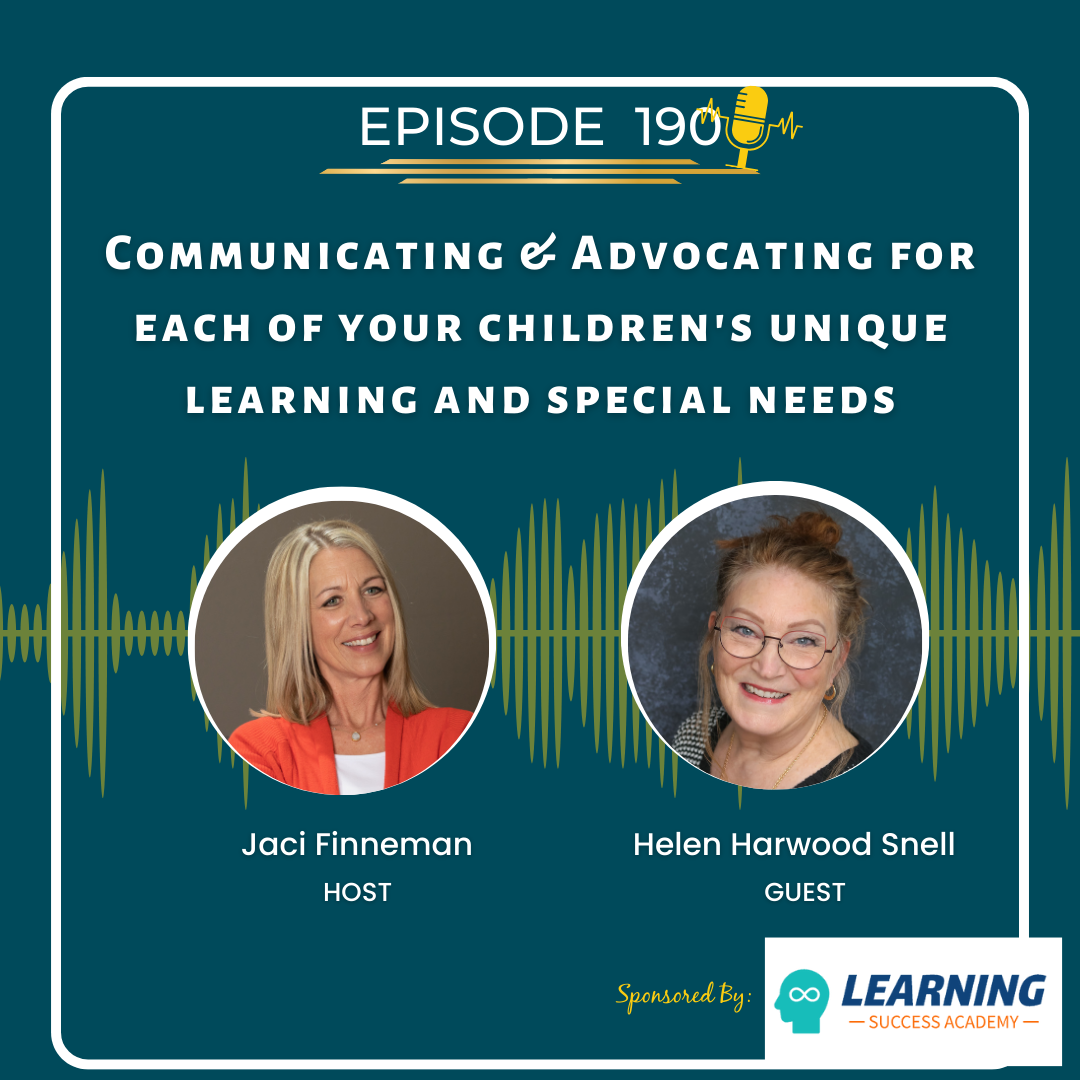
Communicating & Advocating for each of your children’s unique learning and special needs with Helen Harwood Snell
About this episode
Welcome Back No-Problem Parents!
Gain valuable insights, practical strategies, and heartfelt stories to support your child's education and overall well-being. Unlock the power of understanding and nurturing your children's individuality in this enlightening podcast episode.
Meet Helen Harwood Snell, who brings communication excellence to your business. Her storytelling expertise and certified communication coaching work seamlessly to provide you with the spontaneous and fluid or structured and predictable approach you need to optimize your visibility in signature talks, website content, social media strategies, or that book you want to write. Done for you and do-it-yourself services deliver results as you need them. Helen’s quest for clear communication comes from raising three children who didn’t fit the typical mold in school and learning to speak her truth through the challenges of life. She is a life-long learner, a happy dog momma, and a true Canadian, spending time outdoors every day no matter the weather.
Learn more about Helen by clicking on the links:
IG https://www.instagram.com/helenharwoodsnell/
FB https://www.facebook.com/helenharwoodsnell
LI www.linkedin.com/in/helen-harwood-snell-storyteller
https://linktr.ee/helenharwoodsnell
https://helenharwoodsnell.com/optin-30/
__________________________________________________________________________________
Thank you for tuning in to the No Problem Parenting podcast - Please take a minute to share the podcast, comment, or leave a review on your favorite podcast app.
Check out our FREE PARENTING RESOURCES:
60 Ways to Respond to Your Kids without Losing Your Cool
Make it Right Technique PDF
Everyday Essential Solutions eBook for the whole family
Better Sleep: Decrease Stress with the 7-Day free trial of NuCalm Enter Code: NOPROBLEM for 15% off all products.
Become the Confident Leader Your Kids Crave you to be! Put the oxygen mask on yourself first!
Become a No-Problem Parent
Book Your 90 Minute Strategy Session
Find More Resources Here
FB - IG - LinkedIn - YouTube - Twitter - Threads
Check out our Books!
No-Problem Parenting; Raising Your Kiddos with More Confidence and Less Fear
No Problem Parenting; Resources and Stories that Create Confidence and Connection
Hugs and High Fives,
You Got This!
Jaci Finneman
30 Year Counselor turned Parenting Advocate and Coach
Full transcript
Thank you to today's sponsor, Learning Success Academy. Teach your kids to learn to learn. Are you concerned about your child's academic progress? Do you feel frustrated with subject focused instruction that lacks personalized coaching? Well, at Learning Success Academy, they understand the challenges that parents face when it comes to their child's education.
And that's why they're here to guide you in empowering your child as the hero of their own learning journey. Learning Success Coaching is accredited and approved by the International Coach Federation. Click the link in the show notes to take the free academic assessment and discover how Learning Success Academy can shift your child from unmotivated to inspired to learn in just 90 days. All right, welcome back, No Problem Parents. My special guest today is Ms. Helen Harwood-Snell. She is one of the authors in our second No Problem Parenting book, resources and stories that create confidence and connection. You can find Helen's chapter in the book on page 45. It's titled Be In It. Helen is the mom of three children, each of whom had different learning needs. And in today's conversation, we're going to talk about the variety of needs that our kids bring to us, special needs parenting, how children benefit from having a special needs sibling, the value of communication in the family, and how to approach the school system when you don't think they're giving your child enough. This is just a really great conversation with a mom who's not a parenting coach or a parenting specialist,
but has a story to tell of how she navigated all things learning and parenting three very unique children. Helen believes it's important to show up the best that you can in each moment for your child and just be a parent to embrace your kiddos personalities, honor your own flaws, anticipate a vast array of problems, and just be ready to throw love at everything. Every action, Helen says, when flavored with unconditional love, needs no explanation or apology. Just be in it. I'm excited to have you here with us today, Helen. Welcome to the show.
Thank you so much for having me here, and I appreciate you pushing through your cold to record this episode with me today. Oh yeah, every fall it seems like when the weather starts to transition. You know, we're in Moody, Minnesota here, and it's like 80 degrees one day and 50 the next. So I'm not sure if it's allergies or a virus or what it is, but we're just going to plow through.
You and I met through our publisher, Linda Sunshine West at Action Takers Publishing, and she had actually reached out and suggested that we connect and that you write a chapter in the book. And I know you were kind of like, who am I to write a chapter in a book about parenting? I'm not a parenting coach, but you're a mom with three children who have all very different needs. And so when I learned your story, I was like, heck yeah, you need to be in the book.
Tell us a little bit about what inspired you to be in the book and to write the chapter. Yeah, thank you. You know, it's funny, as you said, I was kind of like, what am I doing in this field? But I thought, you know, the title of the book, I think, is what inspired me because it was stories.
it was stories about parenting and I also when I researched you a little bit love this approach that you have to no problem parenting and that it's not all psychology and like all of those things but it just felt like you have a very natural approach and a very natural coaching style and so I thought well you know what I'm a very natural mama so so this is gonna work because I just kind of ebb and flow and do what's needed in the circumstance. And I also love telling stories. And it was just kind of a lot of fun for me to go down memory lane and think of all those things I went through with my kids in the school system and how proud I am of all three of them now that they are adults. So we learn from each other. I think it's, you know, it takes a village to raise a child. One of the things that you talk about in your chapter is that we do our best and,
you know, that we all make mistakes, we're going to make mistakes. And the sooner that we just acknowledge that and almost give ourselves permission, our stress goes down and we parent from kind of a different perspective. Yeah. And I think that was kind of part of the driving force behind, you know, the title of my chapter, which is be in it, because I think if you just try to engage in your children's lives, that's the best thing that you can do, right? They're not all going to be the athlete that you were, or they're not all going to be in the drama club, or whatever that may turn out to be. And there also may be, you know, challenges as well, you know, just beyond the normal personality traits. But I think if you can be in their lives and try to understand them and try to communicate in a way that they need,
And that's kind of the whole thing for me is just showing up and being there, knowing that you're going to do it wrong. Being honest enough with your kids to say, hey, I made a mistake. Like, that's one thing I totally believe in. And unfortunately, my husband did not.
he wanted to always have this we're the adults we're in charge we don't make mistakes and I'm like that's actually not a good representation you know for the for the kids they need to know that people make mistakes and so I just kind of you know like I said ebbed and flowed and figured it out as I've gone along and I did have a parenting group that I used to go to when my kids were small and that was so beneficial. I learned so much there. I had some good, I think, background from my own parents, which helped. But yeah, it's just that whole idea of just show up, right? Just show up, ask the questions, do the crazy things that the kids want you to do, whatever it might be, just to be involved in whatever their world is,
I think is so important. You have three children. So share a little bit about some of the challenges and also the strengths? I'll start with my oldest. She was an adult in a child's body.
She could have a conversation and feel more comfortable with adults than she could with children. And I didn't realize, you know, as my first child, you don't know the signs, you don't know the markers for things, but she was actually put into a special education program that we have here in Canada called a gifted program. So she exhibited all of these signs of being very smart, but socially had some difficulties, didn't really connect with kids her own age.
And so that was helped through the school system because she played a lot of sports. And so she really found a lot of camaraderie that way. But my biggest challenges with her were processing things at an intellectual level, I think, almost beyond her capacity, which caused her a lot of stress and anxiety. And so that was and actually still is a situation that we continue to manage, because it caused her a lot of difficulty. So she wasn't, you know, a clear cut member of the school system, because she went into the gifted program, and then, you know, had some pretty severe anxiety through high school that we had to deal with because of that as well. And my second, so girl, boy, girl. So my second being my only son exhibited all the typical signs I would say of a young boy in that he was restless in school, you know, didn't want to sit still for very long.
And that actually put him very behind in his reading and his comprehension. And that continued to affect him throughout school. Cause when you're behind, it's really hard to catch up, right? When everyone else is at the comprehension level, he was still at the reading level.
So he had some struggles through public school. Again, very different in that he was extremely social. And so having the friends kind of gave him the confidence that he needed to push through. And he actually did push through a lot of those barriers and ended up being like an honor student in high school. But again, very different learning style with the two as well that my oldest wanted to learn everything at a deep level and understand. He kind of, I say that he's probably the closest one to fit the school system. And to me, this is an unfortunate symptom of our schooling is that he was able to memorize, pass a test and then forget the information. And that works well in our school system, but it actually doesn't serve you well in life. So there was a bit of struggle with that. And then my youngest actually does have special needs. She has Down Syndrome. And so she challenged everything in the school system. They had to put alarms on the doors because she would just decide she was finished and she would leave the class. They didn't have curriculum for her because I was a proactive parent. I had curriculum because I had been working with a private tutor. So I provided her curriculum for probably the first two years of her schooling. And then that's amazing. And they, they, they took that in. Oh, heck yeah. They had no idea what to do with her in kindergarten. Um, so we had a big binder, all these things that we
were working on. So she took that with her to school every day because she started then working with an educational assistant at that level. The second year, there was kind of more input from the school and the, and the EA. And then we transitioned out of that into the school system. But for the first couple of years, they didn't know what to teach her. They didn't know what to do with her.
And so she continued to, you know, be a challenge all through school, high school, you know, they kind of didn't want her to learn anymore. They were like, let's just babysit. And I was like, no, she actually can still continue to learn things. So, you know, we pushed her into some classes.
And I mean, she's a little bit of my hero, actually, because she's just such a great kid. She became the water girl for the boys football team in high school because of a fun relationship she made with a boy in phys ed class. And that just, it made her high school career. It just, she had a whole social set outside of her special needs classroom. Yeah. So many good things from that. And I think, you know, they've all taught me a lot. I often tell them that I think they're, they're more my teachers than I am theirs. Oh, I love that. I love that. I think it is so great when as a parent, you can parent from that. Like we do need to be the confident leaders that I say our kids crave us to be. It doesn't mean we have to know everything. And we really learned so much when we pay attention to our kids. Oh yeah. Well, and you know what, I think, you know,
leadership is such an important word because leadership doesn't necessarily mean authority, right leadership means demonstrating the skills to empower other people to lead to empower other people to be their best and I think I think as a as a parent you know having that confidence to lead is is really key even if you don't know what you're doing right I say it all the time that you know we are the experts of our children but that doesn't mean that we have to be the expert in every area or we have to like know everything. But so we do need to seek supports and resources and things like that. But when something doesn't sit right or feel right, then we need to challenge that a little bit or learn more. So yeah, I love it. Speaking of that, we're going to talk a little bit about the importance of communication and you have some ideas on how we can pay attention to the clues that we hear that aren't verbal, that aren't words. I just put out a post on social media this morning, as a matter of fact, that, you know, in the image that I had, there was an image of someone leaning forward to listen. There was the color blue used in the background, which is actually the color of communication. It elicits honesty and peace and is kind of the metaphysical color for communication. And there was also foliage in the image, which again, connecting us with nature also helps calm and that, you know, all of these little things in this image help to drive a
communication message because of that color, because of, you know, someone leaning in means they're listening to you. Someone sitting like this means they're bored or they're tired or whatever, right? So there's all these little signals. Just as an example, you are wearing neutral colors. That's very different from someone who would wear like a bright red or something flashy or a fur that like I can look at you and tell how to communicate with you based on that, as opposed to someone who's very like vivacious, they communicate with a different set of values.
And so you can tell that by looking at people's clothes, by how they speak, by how they walk in a room. Communication is more about listening than it is about speaking. And people don't always understand that. Often we listen only to respond rather than listen to actually hear what people are saying verbally.
But it goes so much beyond the verbal sense. So in terms of children, a perfect example. So my oldest is, she's very quiet. She's a reader.
she would rather be alone in her room with a book than have a bunch of friends over jumping on the trampoline in the backyard that would be more like my son so you know if I'm a parent and I'm a trampoliner I'm the kind of person who maybe wants to be in a big crowd of people love the activity and I try to encourage my daughter who is a reader and likes her alone time to do the things that I think she should be doing because that's who I am, there's going to be instantly conflict, right? So that like, as far as parenting goes, that's just one example, but there's so many examples in, in the words we use in the things that we choose to do in our, for a career, for in our spare time, all of those things give signals to people about what our values are and how we should be communicating to those values to actually make clear communication.
And that, again, back to my book, that's where I'm a big advocate for get in it, see what it is, see what your kids are doing, see what is going on in their world so that you can understand them better. And then you can communicate in a way that says, I see you and maybe the behavior that you're doing isn't right. So I need to talk to you in a way that you're going to understand to move you out of that behavior. And it's, it's all by observation, I think, and listening. That's, that's basically what I, what I call it is listening. Cause there's a lot of different ways to listen. Absolutely. And I think, you know, sometimes that we have to grieve our loss of dreams when we have kids and we have this idea of what they're going to do, who they're going to become, where they're going to go to school, you know, just all the, all the things. And, uh, and And I know with in our family, having one child, you know, we had two miscarriages.
And so I wanted to have a bigger family. And that wasn't in the cards for me. Having the one son, I always say he survived my husband and my parenting. But he, you know, I'm social.
And so I encourage that with him. And he, I mean, anybody that knows him really loves him, gets along with a lot of people, has a bunch of different peer groups, has his friends with a variety of kids and a variety of schools, right? So it's not in just a certain circle in his school with that consistent friendship group of, you know, four to six other guys. He's, he's got a huge, a huge circle. He's social, but he's not extroverted and just out as out there as I am. And so sometimes I'd be like, well, Hey, did you reach out to this person or call this friend to get together? And he's like, he's more like his father. He's going to wait until somebody calls him, not because he's being rude or stuck up or anything, but just, it's not in his nature to just reach out and ask somebody to do something very rarely. He's totally content being on his own, doing his own thing. And maybe that's part of being an only child, but I would sometimes get frustrated with that because I wanted to, you know, hang out with the other moms or I wanted to get into the circle and, you know, do the other things. And he was just not as, as engaged in doing that, sometimes we expect them to do certain things or we want to encourage them because that's what we would do. And when they don't, then we get frustrated about that. Even with like certain sports or extracurricular activities, never in a million years did I
think my son would play hockey. And then first grade, I mean, he loved it since he was little, but we would do like the community ed outdoor hockey. So he'd freeze his butt off and not really want to play. But then, you know, by first grade, it was really something he wanted to do.
And then he wanted to be a goalie. I mean, you know, like all these things not on our radar, but able as a parent to be like, well, this is what they're interested in and letting your kid explore those things and not getting in their way. Absolutely. My youngest did gymnastics for many years when she was quite young.
And we actually ended up putting her in a, in private instruction for a while because, you know, all of a sudden she's nine or 10 and she's in a class with other little kids who are only four or five because of her abilities. So for their sake, I didn't want the other children to be intimidated. So we put her into some private instruction. And she did that very well. Her teacher actually considered going and getting some certification for Special Olympics because we were thinking she's doing really well at this. Maybe she wants to compete. And just that same year that we were having that conversation, her coach and I, at the end of the season, she basically said, I think I'm done and I said what do you mean and she said well I can do a cartwheel and I can do a somersault and that's all she kind of really wanted to do and she was finished she just didn't want to do it anymore and I was like what like we put all these years into this and this was supposed to be the thing and her coach and I had become really good friends and then all of a sudden she was like I'm finished but then what happened is within a couple of years after that she found swimming and that was her thing and she is now like a like national qualified level special olympic swimmer and she's amazing at it never would have thought that either we don't have any swimming background in our house i was never a good swimmer like and that's that's what you have to do is let them find
themselves instead of trying to put your ideas on them and and it's hard to do right like you know like you said, if you're, you want to be in the group with the moms and have your kid hang out with those kids and whatever it might be, or, you know, if I would like, I mean, I was a baseball player. I played a fairly good level of, of ball. None of my kids played baseball. It's like, yeah, whatever. I would have loved for them to, I wanted to like coach their teams and all those kinds of things had all these dreams. And so I love the word that you use grief because we do grieve that a bit, just as we grieve, you know, the loss of a child, as you said, through, through miscarriage, there, there are other griefs that we have with our children that we have to, you know, feel it out, let it go, but then let them be who they are. They're all their own little person and there's not much we can do about it. Yep. Absolutely. Absolutely. All right. So another topic or another thing I wanted to discuss with you too, is your advocation for your kids, you know,
having all different types of learning styles. You've worked pretty closely with the schools, and you were probably pretty bold with your conversations with the school while being respectful. But tell us a little bit about how you approach the school system when you didn't think that they were, you know, offering your child enough. Yeah, I appreciate you bringing that up because I think that's a really tough spot for a lot of parents. Because if you have to working parents, it's pretty difficult to show up for all their sports games, show up for all the school meetings, you know, show up to assemblies when they get awards, volunteer at the school, whatever. But that's hugely important. And that's a lot of what I did. I had made a decision with my spouse that when we had children, we were going to be available for those kids. So that's kind of when I started the whole working part-time from home, working around their schedule when they are really small and continue to do that all the way through their schooling because I wanted to be there I wanted to know the teachers I wanted to have relationships with them I volunteered I was on the student the parent council at our school for many years even when they were in high school I went to all of the meetings they had you know I think you have to show up you have to have a presence so that when there is an issue you can have a conversation you know the person
you know, whether it's the principal, whether it's a teacher, whatever that situation might be. So I was very invested in the school experience for all of my kids. I volunteered, I went on school trips, I did all of those things. And that gave me the opportunity to have a conversation, to be bold, to be able to say, you know, I don't think this is working. I think there's, you know, maybe a problem. So in my son's grade, for example, I don't know if this was kind of something in the water or what it was, but there was a lot of aggressive females in his grade who caused a lot of problems. And I had to have some conversations with the teachers to say, you know, different conflicts, things were happening. This was in around grade four,
five, six. And I had to say to the teachers, like, do you understand that these things that are happening where you think the boys are the problem are actually starting because of the girls initiating whatever it might be. And it was very interesting because the teachers, I don't know if they weren't witnessing it or just had decided that, you know, the boys were always the disruptive naughty ones or whatever, but it was a very interesting situation to navigate through. And as I said, aggression is really the only word. These were very bold young ladies.
Um, and so to be able to have that conversation to say, you know, could you just watch for this? Or did you think this might be a situation or maybe next year I would like my son not to be in the same class with this child to be able to have those conversations is only because you have relationship. And that's, I mean, that's a big thing for me as, as you know, I work in communication and relationship is, is such a huge part of, of that.
That's how you build good relationships is through communication. So I think, again, it's a tricky situation because we can't all do it. But I would just encourage parents to do as much as they can. You know, if there are evening concerts you can show up to, if there are times that you can arrange a meeting before you go to work in the morning with somebody, whatever that might be, be as hands on as you can be in that school experience.
you know even to this the state of as I said I provided curriculum for the first year of school because I knew there wasn't anything there so I was like here you go so grade one through or kindergarten through six she was integrated in a full classroom she always had support with an educational assistant but not full-time that educational assistant was shared amongst other students so there had to be a lot of again conversations they would be doing a certain project. And I would have to have a conversation that said, okay, she can do this, but she can't be expected to that by herself. And, and it was always something in the school system that I struggled with because I felt like, and again, you know, I don't want to criticize because I know there's a lot of pressure and a lot of things that teachers have to do, but I never understood the value of having an individual education plan in writing that was never really carried out.
there was never let's look at the curriculum and reduce it down to something that she can do I was always the one that had to say oh let's have her do this let's have her do that instead of not having her engage at all because that's what they would do is she can sit in the corner and color and I'm like no I actually want her to learn about polar bears but let's just change the expectations right and so um that was a lot of of the whole advocacy well as well was I had to continue to come up with what I felt was a fair representation of what she could do, as opposed to not having her do anything the rest of the students were doing. And that was a tricky one, because literally she would, and I saw this with other students, they would sit in the corner and they'd look at flashcards, or they'd work on some other little project, and it would have nothing to do with what the rest of the class was doing. So if you're going to integrate a class, you have to integrate a class. And that wasn't, that wasn't being done very effectively. Once she got to grade seven and she was able to do a separate class, I, I don't think I regret the experience that she had,
but I saw how much more she could thrive when it was a small class with really intensified learning, lots of support, able to actually, you know, deal with each child the way they needed to be dealt with while they were all in the same learning environment. That's what I would have wished for her all the way through school, but it did make her highly social and it did make her, I mean, still to this day, she doesn't really identify herself as having special needs. We never really pushed the whole Down syndrome label on her, or we can't do this because we're just, you know, whoever you are, that's who you're going to be. And so she's very confident in, in her life and always continues to be that way. And so I think a lot of that is because of being integrated with the other students and, and being able to not really think of herself as, as being different from the others. So, yeah. Right. No. And I, and I love it. I,
I started out my career as a paraprofessional on you guys call them educational assistants, but I was a para. I loved being able to integrate, make sure that they had a circle of friends, but we would accommodate acclimate as much as possible because it wasn't always about the academic learning, which is definitely a part of it, but it was just the socialization, which again, with your oldest daughter being gifted, she still needed the socialization, but she was highly interested in the academics. Right. And then like with your son, the social interactions is actually what helped him get through the academics. So, I mean, it's just kind of all goes together. Well, okay. So I have a question for you then about improving communication with like the school or others, when you are wanting to advocate or needing to advocate for your kid, what is a simple approach that you have that you can share to improve communication? I would say one of the first things always is to find a middle ground.
You know, don't go in guns a-blazing. Again, in the special education system, especially, I've seen a lot of parents do that and it's not helpful. You may have an agenda and the teacher may have a separate agenda and you need to figure out what's, what is the middle ground? Where, where can we commend you for work that you've done that is good? I think you can always start every conversation like that with a compliment and you know, what more can we pull in that I'm, that I'm looking for and being open-minded, we have to be willing to compromise, but I think that only starts when you can appreciate the other perspective. It can't all be about your opinion and your demands and your wants. So I think that that idea of looking for that middle ground is so important. And again, teachers do the best they can. There's a lot on them. I'm not sure what the situation is in America, but I'm sure it's very similar. We have high numbers of students in the classes. There seem to be more and more students with special needs, whether it's, you know, ADD or, you know, even things that aren't labeled. There's a lot of behavioral problems And so teachers have a lot on their plate and I think making it worse for them isn't going to help anyone.
That's, that's always the attitude I had is my child still has to go to school there. I need to figure out how to make this work. Right. Yeah.
I love a good compliment to somebody who you're upset with or put off by. It's so fun. If the listeners haven't tried it, I encourage you guys to do this, but think about that person that you're really miffed with or just super upset by. Think about what's one thing you can compliment them on before you go bring up the heavy heart issue.
It is a game changer. It just, I teach this in my course, resistance creates resistance and defensiveness, you know, butting heads. So it's like when you can be kind first or acknowledge something or notice something about somebody first, it really, it's really hard for them to argue back. Yes.
And I think it also changes something in you, right? Like if you are, if you're very defensive or very angry, but you can, you can look outside of that to find something good about that person. There's something in you that softens a little bit as well. So I think it, it goes both ways in that, in that conversation.
It's hard to be as mad at someone when you found something good about them. The same as it's hard to be mad at someone if they just complimented you. Absolutely. Absolutely.
The last thing I'd like to bring up or talk about is how did your other children benefit from having a sibling in the home with special needs? You know what? That's a great question. I want to address it with the fact that there's actually there's benefit and there's also difficulty.
Often when a special needs child is in the home, the other children can lose out in terms of all the focus being on that child. Right. You know, we have to go to therapy. We have to go to, you know, speech and language.
We whatever, whatever. So I think it's really important as a parent to to always try as best as you can to give time to each child individually. And I know that can be a lot for families, but kids need to know that they're important on an individual basis. I think the benefit is that I think my kids both learned that life isn't always fair.
I would have to say, especially of my son, he became a real advocate for her, which also made him an advocate for other people in his class. If somebody had a learning difficulty, he was the one who would try to help them. He would never bully, things like that. So I think there's really some advantage there.
When you understand your own sibling and the difficulties that they can have, it actually makes you more empathic towards others. I think the other benefits, you know, would be that in general understanding patience and, you know, that people learn differently. Like all of we continue to go through that now. So my oldest daughter who has returned home and is on her way out again is 30 and my youngest is 24.
And they like they still butt heads. Right. Because one is very, very intellectual and the other is very basic in her learning and her understanding of things. And so there's always this effort by my older daughter to try to break down her communication, break down things to the simplest level so that she can actually, you know, communicate well with my youngest.
And I just think that that's a skill when you really have to try hard to communicate with someone else. I think that's such a good skill to learn. And it's I mean, it prompted me, as you read in my bio, to to actually learn more about communication, to the fact that I went out and became certified with with, you know, a communication technology program. And it's changed me as as a parent.
I can't imagine my life without her. Like she's brought us so much joy, but she's just changed the way I look at the whole world. absolutely you are a master at storytelling and helping people to tell their story tell us a little bit about your company what you do and how people can get in touch with you if they're interested in learning about how to write their story a big part of my work is is the storytelling piece and I use that even in business and people get a little confused about that sometimes how do you tell stories in business but that's that's marketing really it's telling your story and it's being able to communicate your values and your story to your audience, whether it's in social media or in a presentation or on your website.
So I believe in the story of who you are in your brand. I also do content writing just in general. And communication is a big factor in all of that. So the certification that I have actually allows me to understand the communication style of the person that I'm writing for, but also to be able to write in a language that actually speaks to values of their audience. So understanding how they're going to hear you. So again, whether it's in business, whether it's in your personal life, this course that I use, it's called Codebreaker Technologies. I'd be happy to share information with anybody who's interested in learning about that. If you're a coach, if you feel that you could use this, you know, to help with your sales, anything like that,
training. It really applies across the board because we all need to know how to communicate better. So you can get in touch with me. My website is Helen Harwood Snell.com. You can also find me on Instagram and Facebook under the name of Helen Harwood Snell. We will have the link in the show notes for, you know, your social media sites, but also your link tree, which is a great way to learn about all the different things that you do. I really appreciate all that you've done from me and your contribution to the second book. Wow. Thank you so much. It was so much fun to write and really appreciated getting to know you and all of the work that you do.
All right, parents, that's it for today. Make sure you head over to the website, noproblemparents.com. Sign up to get our emails. We're going to be giving away tips, tools, techniques, and resources, updates on podcast episodes, round table events, and more. Check out noproblemparents.com. For now, hugs and high fives. You got this.
Become the confident leader your kids crave
The method, the community, monthly live Q&A with Jaci, and Celia — your AI guide in the moment.
Start your 14-day free trial Get it on iPhone or sign up on the web