
60 Ways to Respond to Your Kids without losing your cool Part 1
About this episode
Welcome Back No-Problem Parents!
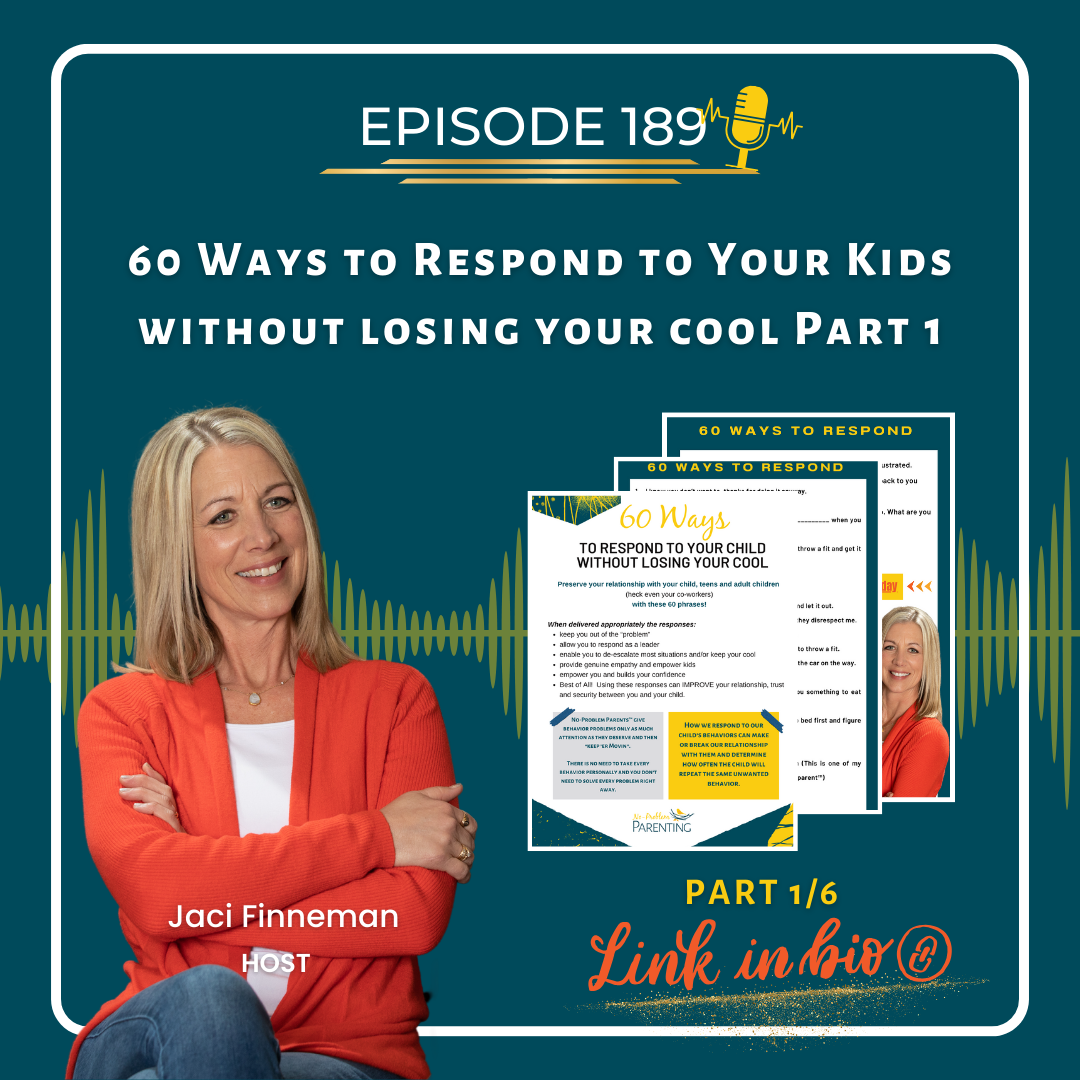
Get the 60 Ways to Respond to your kids without losing your cool FREE PDF and follow along with this 6-part series.
Today, is Part 1 of the "60 Ways to Respond to Your Child Without Losing Your Cool." series.
As parents, we've all been there when our children throw emotional outbursts, become defiant, or have meltdowns. It can be challenging, but it doesn't have to be. What if, instead of reacting with frustration, we were prepared with the right responses?
Our goal is to maintain a positive relationship with our children, no matter their age or behavioral challenges.
Let's get started!
__________________________________________________________________________________
Thank you for tuning in to the No Problem Parenting podcast - Please take a minute to share the podcast, comment, or leave a review on your favorite podcast app.
Check out our FREE PARENTING RESOURCES:
60 Ways to Respond to Your Kids without Losing Your Cool
Become the Confident Leader Your Kids Crave you to be! Put the oxygen mask on yourself first!
Hugs and High Fives,
You Got This!
Jaci
30 Year Counselor turned Parenting Coach
Full transcript
Hey, welcome back. No problem. Parents. Hey, today's episode is just an introduction to our brand new free download 60 ways to respond to your child without losing your cool. And you can get that by going to no problem. Parents.com enter your name and email. We will send you that free PDF. And I want to preface this by saying that many of these responses are not my own.
There are things that I've learned in the last 30 plus years of working with kids and families. Many of them have come from or are adaptations to the Becoming a Love and Logic parent program, which by the way, Becoming a Love and Logic parent is not a sponsor of No Problem Parenting. I sing their praises all the time and recommend them to many parents because their approach and their guidance and direction on how to stay out of the battle with your kids and raise respectful and responsible kids is absolutely amazing. And I learned so much from them starting back in 1995 when I became an instructor. So these 60 responses are things that you could say that are going to help you like legitimately maintain a positive relationship with your child,
regardless of their age or their behavioral challenges. When your kids are melting down or they're defiant or they're yelling at you or they're crying, you know, because they're upset or sad or miss you or whatever it is when they want to do something that they can't do or when they're not doing something that you've asked them to do. It can be inconvenient. It can be embarrassing if you're in a store or, you know, in public somewhere, church, and it can be exhausting.
but does it really have to be? What if instead of dreading the defiance that our kids throw our way, what if we're prepared to respond to it instead? You know, just because our kids get upset or they react or melt down or roll their eyes at us or slam doors, it doesn't mean that we need to join them in that same upset. We don't need to be as emotional as they are. And so what I want you to think about is instead of joining in in the emotion, how about instead you kind of sit back and observe the behavior first. So this is a tricky skill to learn. It's really important for you to learn it before you respond to your kids. Now in my hour and a half training, becoming a no problem parent, I teach you about the pause, putting your hand on your heart and your hand on your stomach.
And I know, I know, I know parents will be like, oh, that's silly. That's weird. All right. It's weird and it works. Put your hand on your heart, your hand on your stomach, almost forces you, pushes you back. So you don't lean in, point your finger and do the, I told you so and stop that, right? It makes you take a deep breath. Now there is science backing this, that when you put your hand on your heart and your hand on your stomach, it forces you to take a breath. It shifts your brain. It calms your amygdala from the warning, warning, warning, incoming danger. I need to react, protect myself. It calms that all down. That can be six seconds. That's it. I'm not asking you to count to 10. I'm not asking you to count backwards from 10. I'm just literally asking you to put your hand on your heart, hand on your stomach, push yourself back a little bit,
take that deep breath and you pause. The 60 responses don't always sound so pretty in the heat of the moment because when we're stressed, when we're nervous, when we're worried, when we're frustrated, when we're dang ticked off, it doesn't always come out as calmly as we would like it to. But in time with practice, you'll get so good at these that you will look forward to your kids misbehavior. That sounds weird. It's not like I want you to egg it on. That's not what I mean, but you won't feel so drained with, oh gosh, what behavior am I going to have to deal with or tackle or handle when I get home today? You won't be feeling like that most days. You'll be like, all right, I know my kid's going to have big behaviors tonight because it's been a long day.
They had a field trip. They had an extracurricular activity. They had a test or an exam. something big happened or something bad happened. It's going to be tough when I get home tonight and I'm ready to tackle it. The first one on the list is, I know you don't want to, thanks for doing it anyway. So when your kid says, I don't want to, and you can't make me.
When you say, pick up your toys, clean up your dishes, get your shoes on, buckle your car seat, go do your homework, whatever. And their response to that, I don't want to, you can't make me. You can say, I know you don't want to. Thanks for doing it anyway. And you pause. Now, of course, are they going to do it right away? Chances are no, but you're going to stop and observe the behavior and wait, wait for them to respond. If they start throwing a fit, if they start shouting back, observe it, pause and wait. Okay. This is one way there are 59 more. So if you're thinking right now that will never work for my kid, no problem. We got 59 more responses and I can guarantee you one of those is going to work. So a kid says, no, you simply pause saying,
what do I want you to do? Number two, what do I want you to do? Well, I don't want to do that because I wanted to, and you said I could do this and I wanted to treat. And you said, and they start going on and on and on. And you just pause and you say, what did I ask you to do?
What do I want you to do? And you just broken record, repeat that. When you're saying these things to the kid, your expectation is they aren't going to do anything else they want to do until they've done what you've asked them to do. When they say no, and you say, what do I want you to do. And they say, well, I'm not doing it. Then you can say something like, I'd be happy to take you to soccer practice just as soon as you do what I asked you to do. And then you need to make sure that they've done the thing before you take them to soccer practice. Now, many parents will say, but the coach is relying on the kid to be there for soccer practice. And I have to take them because I have to take somebody else's kid because we're carpool. Parents will come up with all kinds of reasons why they won't follow through because it inconveniences you, or it makes you feel embarrassed, or it messes with your plans. And we often want the kid to do a certain event or activity more than the kid wants to. So we inject all these other reasons why we give in and we cave.
The first response is, I know you don't want to, and thanks for doing it anyway. A second response you can say is, what do I want you to do? Or what did I ask you to do? Well, I don't want to, and I'm not going to, I know you don't want to, thanks for doing it anyway. I'm still not doing it. You just broken record repeat. What do I want you to do? And the third one on the list, take your time. You can say to your kiddo, take your time. I'm happy to bring you to soccer practice. I'm happy to bring you to piano lessons. I'm happy to go to the park. I'm happy to take you to your friends' house when you have finished doing what I asked you to do, when you have finished insert chore, when you have finished your homework, when you have whatever it is,
I'm happy to. So you're saying no to something by saying yes to something else. I'm happy to have you play on your iPad just as soon as you picked up your toys, just as soon as you've cleaned up your room, just as soon as you put your shoes away, just as soon as you've done your dishes, you know, whatever it is, take your time. So then you wait, if they don't do it right away, you can't force them to, you can't make them do it. Right. I mean, some kids, you can make them do it because they're afraid of you. Is that the kind of parent you want to be? You want to raise kids that only do things because they're afraid of you. Really? What kind of relationship is that?
So instead you just wait it out and life goes on. We don't withhold food. We don't withhold nurture during those times. But what we do is we withhold anything extra special, right? Any kind of extra fun things. And we say, oh, happy to have you do that just as soon as you've done what I asked you to do. Number four, kid gets super upset. They get super mad at you. They start to melt down.
They start to cuss you out, whatever they do. You say, hey, it's okay. I get it. I get mad too.
I'm mad right now you can even tell them I'm mad right now I'm frustrated that we're even battling over this right now you can say feel free to throw a fit and get it out of your system so you're actually giving them permission to be upset about not wanting to do whatever it is you ask them to do you know what buddy it's okay I get it I'd be mad too I'm actually mad right now I'm frustrated that we're even dealing with this I wish you'd just do what I asked you to do right away. So we wouldn't, neither one of us would have to be mad. Feel free to throw a fit, get it out of your system. Let me know when you're ready to do what I asked you to do. And again, I'm saying to do what I asked you to do, but that means let me know when you're ready to get your shoes on. Let me know when you're ready to clean your room, do the dishes, do your homework, whatever it is.
Number five, this is a fun one. When a child says, I don't want to, you can say, thanks for letting me know well I'm not going to I don't care you can get mad I don't care I'm not going to thanks for letting me know and then you pause and you just observe and the kid's like what are you doing why aren't you getting mad and then you just keep her moving as we say in the midwest and you start to do your dishes or you continue to make dinner or you read a book the expectation is that nothing else happens for that child until they do what you ask them to do. Number six, when the child says something like, I'm not gonna, and you can't make me, you can say, good job being honest because that's true. I can't make them. Right. So they're saying something true. And as many times as we can say to our kids that they're being honest, especially if you have a liar. If you have a kid that lies a lot and they make a statement that is a true statement,
an honest statement, it's so super key to be able to say to them, good job being honest. You're diffusing a lot right then and there. And what you're doing, and I should say with all of these responses, is that you're helping your child become curious. When they're curious, they're in the front part of their brain, the logic part of their brain, right? And so they're wondering why is mom or dad saying this to me? Why are you responding that way? This is different than what I'm used to. I am now curious about mom or dad, which shifts them from the back part of their brain to the front part of their brain. The back part is where fight, flight, and freeze happen. The front part is where logic happens. I teach you all of this in becoming a no problem parent. Number seven, sometimes when you have a crier and you ask them to do something and they pour on the tears and they melt down and then they start talking about their feelings and all the bad things that happened to them that day. And really they're just wanting to tug on your heartstrings so that they can get you to give in and get out of doing their chore or whatever task or responsibility you ask them to do. And so one of the things you can say in that moment,
which is not typically what you're wanting to say, right? You're not feeling a lot of love for a kid who is defying you. But one of the things you can do with a crier is you can say, bring it in. You put your arms around them. You bring them into a hug. Yep. Yep. Yep. Bring it in. Sometimes we just need to cry about it and let it out. Now, parents will say, why would I do that? That feels like I'm giving in. No, but you're meeting their need. You're nurturing them. Yep. Sometimes we just need to get a hug, cry it out when they're calm, when you've soothed them with the kids who are a little bit like cunning, right? You'll see them kind of look up at you out of the corner of their eye. Like, Hmm, am I getting away with this? It's okay for them to do that. It's totally okay for them to do that. It doesn't mean you're giving in. You're meeting their need. You're comforting them. And then when that's all said and done, then you can say, now, what did I ask you to do?
You might find in those moments, the tears come back on, just rinse and repeat. Yep. Love them up, hug them in. And then now what did I ask you to do? Redirect them with whatever that was that you asked them to do. And then sometimes that will start to get them upset. And so their tears will now turn into frustration or anger. And so they'll start to get worked up. And so you can bring them back in again, or you can use the yep, throw a fit, get it out of your system. This whole time, you're not getting mad, you're observing, and you're just being very matter of fact with it.
and what did I ask you to do? So kids will test and they'll try and they'll test and they'll try to do all the things, whether it means setting you off and getting you super ticked off and frustrated, and they'll push your buttons to do that because that's what they're used to. They know how to respond to that, or they'll test and they'll try and get you to give in. If you're arguing and when you're defensive and when you're engaging in back and forth conversation, you're actually giving the child hope that they're gonna get their way.
So instead, don't do that. Don't over parent. Don't keep communicating. Just pause. Broken record. What do I want you to do? Feel free to throw a fit. Yep. Cry it out. Give a nice big hug. And what do I want you to do? Key is following through, following through, following through until they actually do it.
And the more you stick with that, the more consistent you are, the more trust your child has that you mean what you say without getting mad and hands on your hip mean what you say. They just know you're going to follow through and your words are gold. All right. Number eight, a kid says something to you like, you never let me do anything.
You never let me go out. You never let me hang with my friends. You never let me buy anything. If that's true, you can say, you're right.
Usually it's not never that you don't let them do that stuff, but they're being overdramatic in these moments, right? But you can say, you're right. Sometimes I don't. And then you can say, I don't let my kids fill in the blank.
I don't let my kids go to their friends. I don't let my kids buy treats. I don't let my kids have cookies or whatever it is, fill in the blank. when they disrespect me. But you start that sentence out with, you're right. You're right.
I don't let my kids blank when they disrespect me. But you start it out with, you're right, because it's hard to be defensive when somebody is telling you you're right. And it is sometimes true that you don't let them do X, Y, or Z. Okay. Got that? Number nine, kid wet noodles, they run off to their room. They say, I'm not doing it. You can't make me.
You can say, take your time. Let me know when you are ready. Now, this sounds like you're giving in, but you're not, you're not giving in. You're just delaying the consequence, which that comes from becoming a love and logic parent. What happens if you don't have time to have these meltdowns?
You don't have time to wait for your kid to do something because you've got to go, especially if it's getting your shoes on, getting out the door or buckling a car seat. You can say number 10, you know what? I need to get to work or we need to get to school. We don't have time for you to throw a fit right now.
You can throw a fit later. You can do your chore later. You can do whatever it is I asked you to do later. I need to get to work and the situation has to stop, but you need to just say those words and then do whatever you gotta do in the moment to get to where you need to go.
And it doesn't necessarily always sound or look pretty, but I want you to start the direction with, you know what, I need to get to work. We don't have time for you to throw a fit right now. Or you can say, you're gonna have to throw a fit in the car on the way to work. Give the child the permission to throw the fit and then turn up some music as they're throwing a fit in the car instead of trying to get them to stop.
Because you know what happens when we try to get a kid to stop throwing a fit or stop yelling at us, what happens? They do it more. They do it more. It's just this tug of war resistance.
I teach that in the introduction of training. It's resistance creates resistance. And why as an adult, are we arguing and defending ourselves with a child? It's an inconvenience for us.
It's not the way we wanna start off our day. We don't have to buy into all of that. We can just be like, raw crap, here we go. It's another loud day on the way to school.
matter of factly, like, I don't want to battle. I don't want to start my day off in defense. We got to get to work. You got to get to daycare. You got to get to school. We're just going to, we're going to go. And I guess we're going to go crabby. He can be crabby. She can be crabby. You don't have to be. And you don't yell that the quieter you get, the more your kids will listen to you, right? They'll have to be quiet to be able to hear what you're saying. The louder you get, the more they want to get louder than you, right? And so then it just amps the situation up.
As calm as you can be in that stressful situation, right? Sometimes it's picking the kid up and bringing them to the car and they're arching their back and they don't want to get in the car seat. That's what you need to do. There are things we can do in the forefront to prevent our kids from having those big melt-ons, but realistically they're going to happen no matter how good your parenting skills are, how much positive parenting, conscience parenting, and all the things that you've done. Like sometimes in the heat of the moment, I think we can all agree. So you just have to get through it. And that's what a lot of these responses are for. All right. That's the first 10. We have 50 more to go. I'm going to share more next Thursday's episode. And until then,
if you want to download the PDF, just go to no problem parents.com. There's a link in the show notes, click on that. And if you want to become a no problem parent, we have updated our website.
So if you've been to the website before, you might want to check it out again. We've updated it with the 60 responses right on the homepage of the website. We've added a new option. So you can schedule a 30 minute call with me. It's going to cost you $50, but you're going to get the no problem parenting training included in that. And if you decide to do any one-on-one coaching with me, we're going to give you $50 off a coaching session or a coaching package. I'm going to be doing these solo episodes on Thursdays, at least through the end of this year. And we are going to continue to do guest episodes on Tuesdays. I am legitimately here to help any problem, any parent is facing, any challenge you are facing. I'm here to advocate and support you in becoming the confident leader that I say our kids crave us to be. And when you don't feel like you're doing a good job as a parent, when you feel like you are failing and you're not connected with your kid and they're not responding to your parenting, that is so heavy. It is just so disheartening. And if you're willing and ready to shift your mindset and you're open to changing some things around in your parenting, I can help you reach out sooner rather than later to me or any parent coach you guys on my resource page of the website. I've got other coaching options for you. Go back and listen to other episodes that have titles that resonate with you.
I truly am here. And so don't get in your own way, you know, waiting too long to reach out. We all have issues and challenges. And if you're not feeling good, your kid's not feeling good and they crave your leadership.
Take the lead and get your child, your family, yourself, the support that you need. All right, there you have it, parents. Another resource that's accessible to you right from the comfort of your home. Hey guys, if you're enjoying this podcast, do me a quick favor and leave us a review of the show.
And if you're feeling super generous, take a screenshot of this episode and share it on your social media with your friends and family. And be sure to tag and follow us at No Problem Parents. Doing so helps us help more families.
Become the confident leader your kids crave
The method, the community, monthly live Q&A with Jaci, and Celia — your AI guide in the moment.
Start your 14-day free trial Get it on iPhone or sign up on the web