
Part 2: 60 Ways to Respond to Your Kids without Losing Your Cool
About this episode
Welcome Back No-Problem Parents!
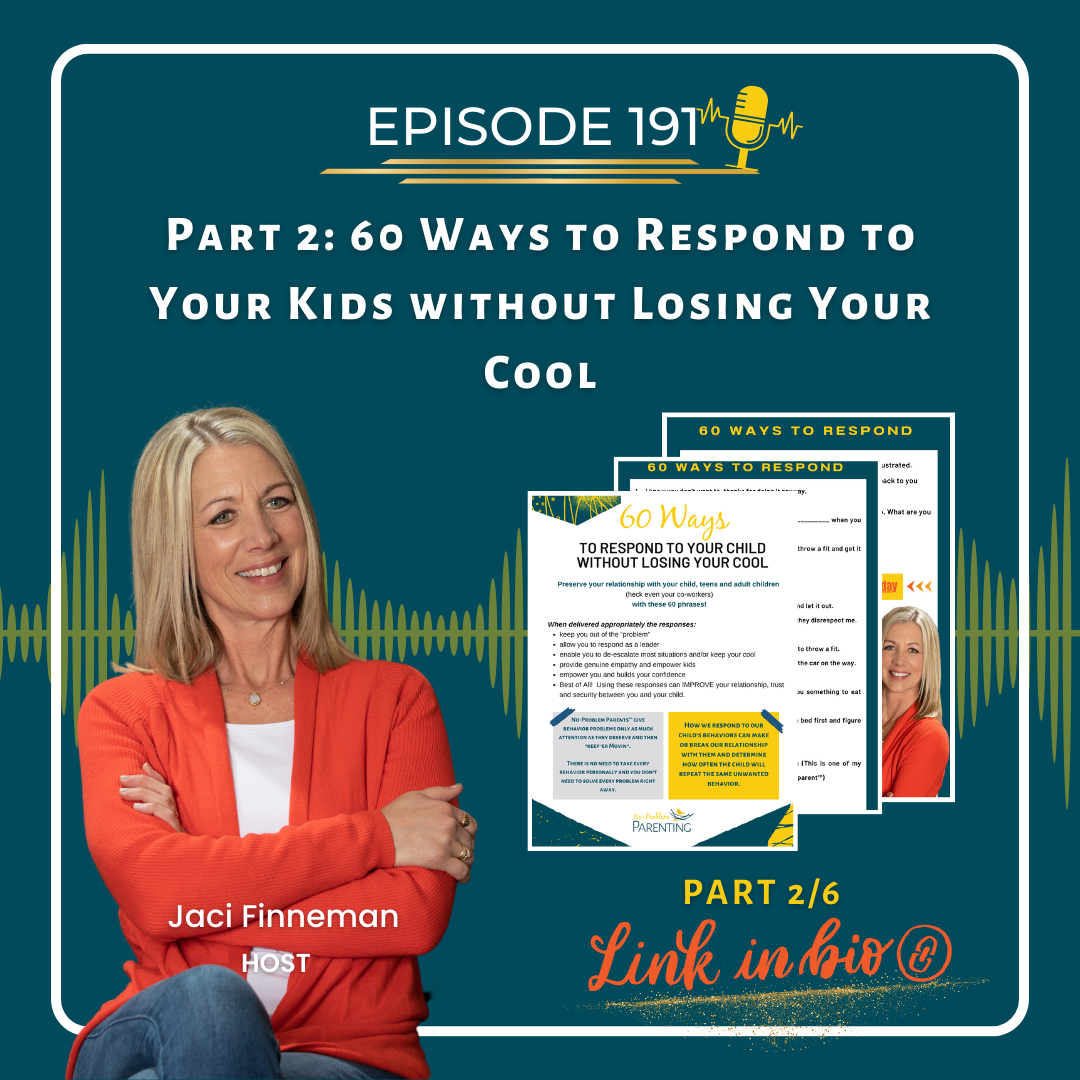
In today's episode, Jaci shares Responses #11 - 20 from the free download 60 Ways to Respond to your kids without losing your cool.
Learn how to respond when your children are defiant, melting down, yelling, or crying. We'll discuss how to prevent these situations from escalating and how your responses can make or break your relationship with your child.
Remember, No-Problem Parents™ give behavior problems only as much attention as they deserve. It's time to take control of these moments and be empathetic, firm, and confident in your responses without joining the battle.
Get the Download here: 60 Ways to Respond to your kids
Thank you for tuning in to the No Problem Parenting podcast - Please take a minute to share the podcast, comment, or leave a review on your favorite podcast app.
Check out our FREE PARENTING RESOURCES:
60 Ways to Respond to Your Kids without Losing Your Cool
Make it Right Technique PDF
Everyday Essential Solutions eBook for the whole family
Better Sleep: Decrease Stress with the 7-Day free trial of NuCalm Enter Code: NOPROBLEM for 15% off all products.
Become the Confident Leader Your Kids Crave you to be! Put the oxygen mask on yourself first!
Become a No-Problem Parent
Book Your 90 Minute Strategy Session
Find More Resources Here
FB - IG - LinkedIn - YouTube - Twitter - Threads
Check out our Books!
No-Problem Parenting; Raising Your Kiddos with More Confidence and Less Fear
No Problem Parenting; Resources and Stories that Create Confidence and Connection
Hugs and High Fives,
You Got This!
Jaci Finneman
30 Year Counselor turned Parenting Advocate and Coach
Full transcript
Hey there, parents. Thanks for listening to the No Problem Parenting Podcast. Are you ready to become the confident leader your kids crave you to be? Are you losing your crap on your kids, yelling, giving in, and exhausted at the end of every day? You are already a good parent, and I'm sure you've sought advice from friends or family. You've read books on your child's specific behavior problem. Maybe you've even signed them up to see the school counselor or an outpatient therapist. But despite your efforts to find the right person or thing that will help, your family is still struggling. You're tired of pretending everything's okay. Well, if your confidence is shot and you feel like you're failing your kids, but you also don't have a ton of time or money, register to become a no problem parent for just $50. It comes with an app so you can listen to the tips and tools just like you're listening to this podcast. You can start building confidence in your parenting immediately, whether your child is a toddler or all grown up and still living in your house. Don't make this parenting gig harder than it needs to be. Become a no problem parent today. Hey guys, I'm Jackie Finnaman. I'm a parenting strategist and coach. And after 30 years and with more than 50,000 hours of experience working with kids and families, I promise you there is a solution for your parenting challenges.
The key to this parenting gig is to guide and lead your kids with less fear and more confidence. You don't have to know everything to be the expert of your child. So let's get to the root of what is going on in your home with you and your kiddos, and then we're going to prepare for the worst and change the conversation. Kick fear, worry, and guilt to the curb. You are exactly the parent your child needs and wants, and you are more capable than you sometimes give yourself credit for. I launched the No Problem Parenting Podcast to reach more parents and share the Cliff Notes version on how to solve a variety of parenting problems in the moment as they are happening in your home. Problems are a part of life and they're meant to be dealt with and overcome.
So I teach parents how to turn any problem into a no problem. All right, welcome back. No problem. Parents. Today's episode is part two of six, sharing the 60 ways that you can respond to your child without losing your cool.
Keep in mind, these responses do take some practice. If you haven't gotten the free PDF download, you can get that at no problem. Parents.com or just click on the link in the show notes and you can print off that PDF and get started. So I'm teaching you how to respond when your kids are defiant, when they're melting down, they're yelling or they're crying. Today we're going to discuss how to prevent these situations from escalating and then I'm going to share 10 more, numbers 11 through 20, on ways that you can respond. You'll notice that some of these are similar to the first 10 responses. There's variations. Choose the ones that make the most sense for you, that come out just naturally for you. Remember, the quieter you say these responses, the less sarcastic the responses will come off and the less convincing your tone. It's all about lilt and tone. So how you say these responses can really make or break your relationship with your child. And remember that no problem parents give behavior problems only as much attention as they deserve. Be empathetic, firm, and confident in your responses without joining in the battle. Remember, we want to make these responses as matter of fact and non-emotional as possible. All right, so let's talk about defiance. When your kiddos refuse to do what you've asked them to do, it can be incredibly frustrating. Instead of escalating the situation, getting in a tug of war, resistance creates resistance, right? I talk about that in
the No Problem Parenting training. So instead of escalating the situation, I want you to stay calm, use the pause, which we talked about in the last episode, and use positive reinforcement whenever possible. Now in the no problem parenting training, I talk about in lesson three and change the conversation. I talk about the difference between conditional and unconditional positives. And we want to use more of the conditional positive reinforcement rather than unconditional praise.
So more about that in the no problem parenting training, which again, you can get for just $50 to get started. Meltdowns are common occurrences in childhood, right? So when your kid's having a meltdown, it's important to remember that they're overwhelmed and they need your support. Oftentimes, especially if you have kind of a cunning kid or a manipulative sort of kid, it can seem like they're just trying to get their way.
And oftentimes they are. Despite all that, they still need your support. So instead of getting upset with them, comfort them first, reassure them best you can, and then use one of the responses. Now, yelling and crying can be challenging, right?
If you've got a kiddo that is just constantly bucky or whining or crying, it's crucial to model the behavior that you want to see. So if your kiddo is yelling, speak to them in a calm and composed manner. If your kiddo is crying, empathize with them. Remember like last episode, we talked about pulling them in, give them a nice little hug and comfort them and then deliver the response.
Preventing situations from escalating often starts with setting clear expectations and boundaries. So again, setting up for all these responses, you must have clear expectations and boundaries. Do your kids really know what the expectation is? do they really know what you're asking them to do? If you say clean your room, what does a clean room look like? Have you gone through that with them? If it's a complete disaster and you've got a kid that's just super overwhelmed by it, or you're overwhelmed, how in the world can we expect our kid to just go in there and clean that room up without having some kind of overwhelm or frustration or meltdown? Be sure you're communicating your expectations to your child in a straightforward matter of fact way. Okay. And when I say that your responses can truly make or break your relationship with the child. I mean that because if you're always reacting with anger or frustration, number one, you look like you can't handle your child and their behaviors. It comes off to your kiddo that you're really not safe enough or trustworthy enough to help them through whatever challenge that it is they're going through. And it can damage the trust between you and your child. Empathy and active listening go a long way in building a healthy parent-child relationship. And again, I always phrase this as matter of fact,
so that we're not putting in the same emotion that the child is. No problem parents understand that the importance of not overreacting to minor problems is key. Children misbehave for attention. They misbehave because they're tired, they're hungry, they're frustrated, they have low self-esteem.
And the best response sometimes, especially if they're vying for attention, might be to just ignore the behavior as long as it's not harmful. And of course, we're always keeping safety in mind. So I'm going to go through the next 10 responses. Make sure that you're firm, not joining in the battle and not getting into a power struggle with your kiddo.
Okay. So the first one, number 11, your child is throwing a fit while getting ready for school. We talked about this in number 10 a little bit where you said, I need to get to work. We don't have time for you to throw a fit, right?
You're going to have to throw a fit in the car on the way. I understand. And then keep her moving, do whatever you got to do to get them in the car as calmly as possible. Number 12, I'll be happy to talk to you when you are ready.
So if your child's coming to you and they're being disrespectful, they're being demanding, they're whining, your response can be, I'll be happy to talk to you when you are ready, when you are calm. Now, maybe your child, you guys just got home from school. It's been a long day. Kids are typically hungry, especially if they're not eating their lunch very well at school.
They maybe are talking too much or just didn't have time to finish and the bell rung and it's time to be done with lunch. They might be super hungry. And or maybe they've been overstimulated. Maybe there's been a lot of stuff going on.
Maybe there's a lot of noise or chaos in the classroom. And so they're just really, really tired or they're just kind of crabby and irritable. You might need to first address that. So you can say something like, hey, are you hungry or crabby or both?
Let's get you something to eat first. Let's get you a drink of water. So you're actually pausing the behavior of it instead of responding with a consequence to the behavior, even though it might be disrespectful. You know, we all have a bad day.
you might need to just say, hey, let's get you something to eat first. You can always delay the consequence. We talked about that in part one. It doesn't mean you're giving in. Let's meet the child's need first. So, hey, are you hungry or crabby or both? Let's get you something to eat first. Similar to number 14, are you tired or crabby or both? So this might be at bedtime, but this also might just be when they've gotten home from school or after practice or, you know, just getting home from an event, whatever it is, you might need to say, hey, are you tired or crabby or both? And then it could be, let's get you to bed first. We're going to figure this problem out tomorrow. We'll deal with this tomorrow. Or it might be, let's get you a 20 minute rest before we start on your homework. Let's get you a 20 minute rest before dinner. And sometimes our temptation is to put them in front of a tablet or an iPad or the TV. And that's, you know, I'm,
I'm totally okay with that. If you have a child that can handle just 20 minutes of that, but oftentimes it's just even putting on some light music. Mozart works really well to help calm everybody's mood and put it on really calm and quiet. Actually, that's a great, another great tip. Here's a bonus tip for you. Play some Mozart music 30 minutes before your kids wake up in the morning and or 30 minutes before they go to bed. Mozart music is actually the closest sound simulation. I believe it's called to what a baby hears in the womb. So it can be very calming. And somebody told me too, that it can actually help your plants grow in your house. So play some Mozart music. If you've been listening to the podcast enough, you already know that some of the things that I suggest seem a little bass-ackwards or they seem a little bit weird or a little bit off. There's a reason for that. I mean, I've learned over the last 30 years, there's so many kind of quirky, fun things that we can do to mix up the day-in, day-out kind of doom and gloom that can come with parenting a child who is not feeling well emotionally, physically, or otherwise.
Okay. All right. So now if you have a kiddo who is just not following your instructions, This is similar to what we talked about in part one, but you can just simply respond, what did I ask you to do? You know, I'm not doing it and you can't make me.
Well, there's sometimes you have a kid that's not saying that. They're just not doing what you've asked them to do. They're not stopping playing with their toys. They're not getting off of their cell phone.
They're not, you know, really paying attention to you. So you go over. It's best if you can get some eye contact with that. But I'm not a big fan of bowing down to their level and getting down on their level when you're actually making a directive.
sometimes in a in a situation where you've asked them to do something and they're not doing it I tend to now of course nothing is a hundred percent stand with confidence you can always lift their chin up a little bit if they're not looking up at you just say hey buddy up here and then say what did I ask you to do instead of getting down to their level because for some kids when they're in defiance mode when you squat down to their level they see that almost as sympathy and some for some kids it can give them an idea that you're going to give in so instead I like to stand nice and firm and tall and just say hey what did I ask you to do and sometimes you want them to repeat what it is you ask them to do so that you can make sure that you're on the same page and they understand you know what you said you don't always have to do that but sometimes you need to say what did I ask you to do if you're saying clean your room does the kid know what the room looks like when it's clean maybe you have to be specific cleaning your room means all the clothes off the floor, toys put away, bed made, you know, and nothing on the floor.
So sometimes we need to get really specific. All right. So number 16, this is a super fun one from Love and Logic. It's one of my favorite ones, and it works really well with the kiddos that are like, I don't know if it's eight and up, could be six and up, I suppose.
But usually the younger kiddos are already up early in the morning. So sometimes this one only works good with the kiddos that want to sleep in. But if they start arguing with you and they're just wanting to battle and you're finding yourself going back and forth and responding to their battle and their questions and their accusations and all of that, instead of joining in on the argument, number 16 is I only argue on Saturday mornings at 6 a.m.
I only argue on Saturday mornings at 6 a.m. Now, here's the catch. You need to not argue once you say that so they can continue to be arguing with you or try to argue with you, but you're just not responding to that.
And then on Saturday morning, you definitely need to go into their room, wake them up at six o'clock and say, hey, buddy, remember the other day when you wanted to argue with me? And if you remember what it was about, you certainly can point that out. And you say, hey, I'm ready to argue with you. I understand that you had some things that I was not in agreement with.
I didn't feel like arguing. OK, are you ready? Now, that can seem kind of like sarcastic or whatever, but it's not. And I've had numerous parents, whether it's been in workshops, trainings, friends, family and clients that have said that this has been a game changer, especially with their teenagers.
So it just diffuses the argument in the moment. And then eventually the kiddos, they like literally catch on to it. And they're like, OK, I'm not I'm going to stop the argument. I got to I got to have a different approach with mom or dad because they are literally going to come in and wake me up Saturday morning at six o'clock.
And I don't want to be waking up at that time on Saturday. All right. So that's a really fun one. Keep in mind, you can have fun with some of this stuff.
It doesn't always have to be so, you know, emotionally draining. We can have some fun and make things matter of fact and we can diffuse the problem. Only giving problems as much attention as they deserve means we're not feeding the problem and turning the initial problem into more problems, right? All right, number 17.
Let's say no matter what you say or do, your kiddo is just engaging and they're arguing and you can't, you know, they're not listening to, they're not stopping whatever it is you ask them to stop or they're not doing whatever you ask them to do. you can totally kind of have like this switch gears kind of moment. And, and it's like the art of distraction, right? So you can say something like, Hey, oh my gosh, I forgot to feed the dog.
Just a second. I'm I'll be right back. And then you go and feed the dog or, oh man, I forgot something in the car. I got to go. So right in the middle of the argument or the big meltdown or the tantrum or whatever it is, you can say, oh, wait, I forgot and run out to your car or go feed the dog or, you know, go down to the basement and check the fuse box, like whatever it is. The art of distraction sometimes when you feel like you're just caught in a tug of war and a bunch of resistance, just kind of pull a Columbo, smack your forehead and be like, oh my gosh, I can't believe I forgot this. Hang on. I'll be right back. And then you can come back and say, okay, what is it we were talking about or what did you need from me? And sometimes that's enough to just kind of diffuse the situation for just a bit, right? Now, another thing you can say if you and the child are both upset or you're really frustrated, you can stop and just say, hey,
I'm upset too. What do you need right now? They're throwing a fit. They're really upset. You can stop and say, hey, wait a second. Hold on. Hold on. Hold on. You're not the only one. I'm upset too.
What do you need right now? What can we do to calm the situation down and both get what we want? And maybe that will work. I mean, again, you have to know you're the expert of your child.
You'll know which of these responses are going to work for you and which ones are you're going to have to throw out the window. And on any given day, one that doesn't work will work the next time. Right. So it's just really handy to to say these and to kind of get used to some of these responses.
And then you'll have them at the tip of your tongue ready to try when things get kind of tense and both of you are feeling frustrated or angry. So just I'm upset, too. I'm stinking mad right now. I don't know what I'm going to do. What do you need right now? Or number 19, you can say, I am way too mad right now to answer you. You're going to have to give me a few minutes and either you exit stage left and, you know, check out to another room or you can't leave because you're the only parent in the room and the kids can't be unsupervised. You might just need to say, I'm going to be really crabby right now. So whatever you ask me is going to be a no.
Now that's a little bonus tip in there, or I'm just too mad right now to answer. I need a minute to think. And then number 20, this is another love and logic. I love, love, love this one. When you've got a kiddo that is just wanting to argue and they need to argue, you know, there's a couple of ways you can do this. You can say, I only argue with kids on Saturday mornings at 6 a.m. But you could also say, you know what, buddy, I just love you too much to argue. I'm happy to talk about this with you, but I love you too much to argue. I promise you I will not be arguing right now. So that's a little bit of a variation that you can you can add to number 20. But I love you too much to argue is a really good one liner. It's a really good way to respond when your kid is in arguing mode and you're just drained and you don't feel like it.
Right. Or you put your hand on your heart, your hand on your stomach. You do that pause. take that deep breath right in front of them. It takes like six seconds, right?
We talked about that in part one and you just kind of say, boy, I just love you too much to argue. We're going to have to find another way. I don't have the energy to argue. Love and Logic talks about the energy drain. So that's another thing. You can go to loveandlogic.com and learn more about their one-liners that they suggest. I tend to use different approaches for different kids.
There's so many parenting approaches out there and tips and tools. I have not yet ever found one that works for everybody. So I'll have people that say, oh, that love and logic, it sounds too sarcastic. It's, it's me. They have, well, yeah, maybe for your kid or your family situation or your parenting approach, it isn't right for you. And then I have another family that says, oh, I use one, two, three magic all the time. And it works. I count to one and then two, and then they do it. And another family might say, I count to one, I count to two, and then I have to say two and a half. Can you hear that lilt in my voice? One, two, two and a half, well, that's not what the founders or the designers of 123 Magic intended for that approach.
So if you're finding yourself saying two and a half, you're going to have to throw that approach out the window or retake their course and learn how to do it appropriately because you don't want to be using two and a half if you're using that approach. So again, see what works for one family and child in their situation doesn't work for another. So play around with it. And I'm here to bring all kinds of resources, tips and tools so that when you're finding that nothing's working, or if you just need some new skills or tools in your toolbox, I've got a bunch of them for you.
So reach out, grab the course and the downloadable workbook so that you can get yourself back on track, feeling like that confident leader that your kids crave you to be. It doesn't always feel like it. It does not always feel like they want you to be a confident leader. They challenge, they push buttons. That's their job. So buck up, get yourself feeling confident and not underneath the issues, not frustrated all the time and not worried and coddling, convincing and giving in.
All right. So we're going to do another 10 responses next week, Thursday. Be sure that you're following the show so that you get the alert when the episode drops right away. And if you could do me a favor, please share this episode. If you haven't already subscribed to our newsletter, do that. You get the 60 responses right there in the newsletter. For those of you who are already subscribed, we sent an email last week so that you had the PDF attached the 60 responses attached in that email. And if you have any questions, you can always schedule a call with me. Go to no problem. Parents.com there's a schedule button, get yourself set up.
All right, there you have it. Parents, another resource that's accessible to you right from the comfort of your home. Hey guys, if you're enjoying this podcast, do me a quick favor and leave us a review of the show. And if you're feeling super generous, take a screenshot of this episode and share it on your social media with your friends and family. And be sure to tag and follow us at No Problem Parents. Doing so helps us help more families.
Become the confident leader your kids crave
The method, the community, monthly live Q&A with Jaci, and Celia — your AI guide in the moment.
Start your 14-day free trial Get it on iPhone or sign up on the web