
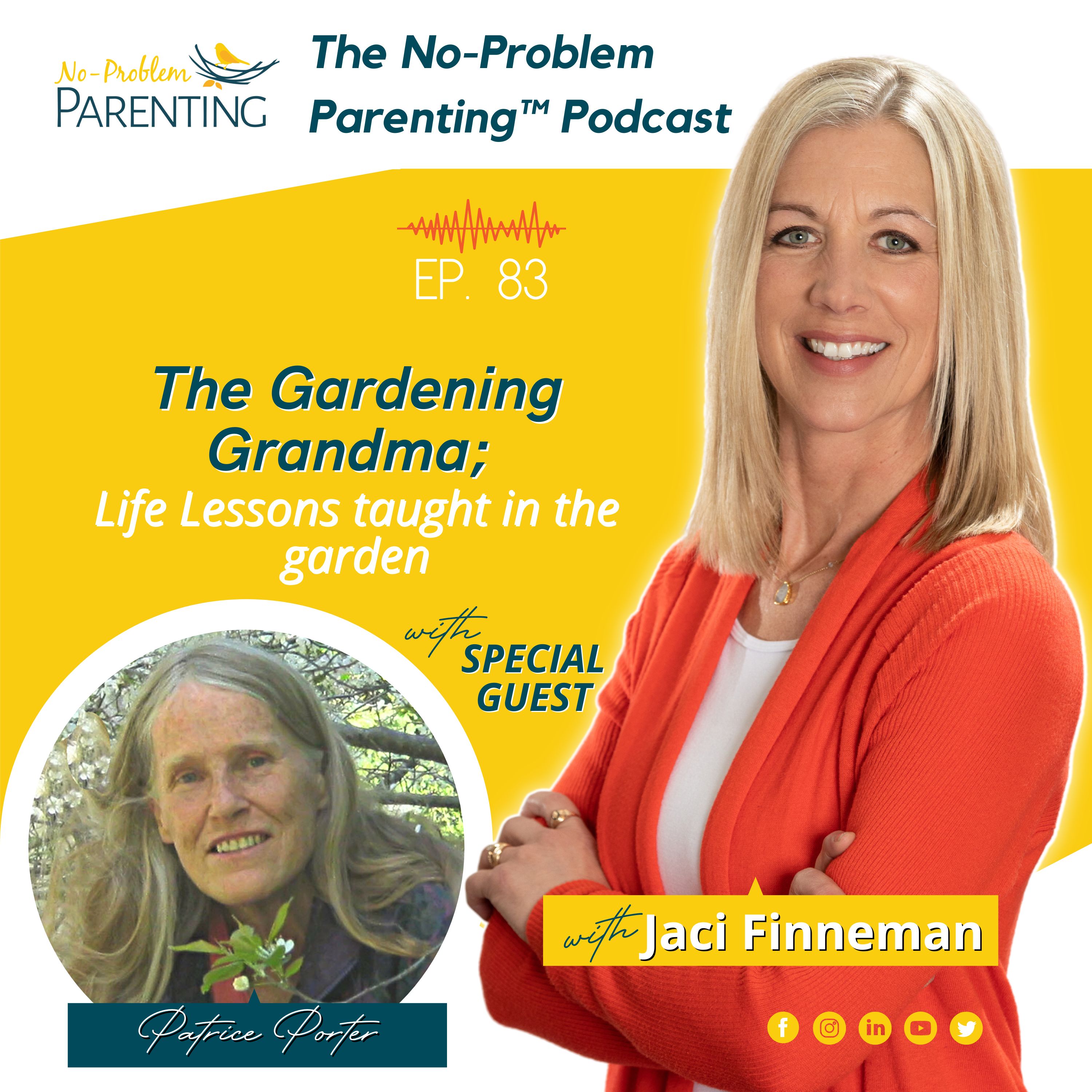
The Gardening Grandma; Life Lessons taught in the garden, with Special Guest Patrice Porter
About this episode
Today's guest is going to share another way we can get our kids out of cyberspace/off their devices by getting back into the natural world by exploring and starting a garden.
Patrice Porter, endearingly referred to as, The Gardening Grandma, teaches life skills through gardening.
Become a No Problem Parent Today!
Full transcript
Welcome back to the No Problem Parenting podcast. This podcast is full of tips and tools, services and resources that can help you in the day-to-day behavior struggles with your kiddos, from infant to adult. Want more? Check out the No Problem Parenting three-step perspective that will lay the foundation for solving behavioral issues with your children and family.
This 96-minute audio-video program is educational, simple, and easy to navigate. Go to NoProblemParenting.com to get started. Welcome back, parents. I have another fun guest.
You'll remember from a few episodes ago, we talked about the importance of play with kids. And today, my special guest is Patrice Porter, who has a heart and a passion for nature. and kind of getting back to some of those basics. So I'm very excited to have you.
Welcome to the show, Patrice. Thanks for having me, Jackie. And yes, I do have a passion for nature, gardening, working with kids. It's what warms my heart to get kids back into nature and free play and exploring. You are what people consider the gardening grandma. Yes, I am the gardening grandma. So if you don't have someone to show you how to garden and grow your own food, I'll be that person. I worked as an educational associate for 15 years, and it was with the play and exploration program. And that's where you're setting out invitations and, you know, to get the kids interest and then you scaffold them to new levels and it it was like I love opening new worlds to kids and especially the world of gardening you know you really opened my eyes to gardening as a way to teach kids about life lessons and there's so many life skills that can be learned by gardening talk about those lessons and then give us a little example of what that looks like. For me, the world of gardening can teach you so many other things than just being able to grow your own food, which is a wonderful thing in itself that you,
if you can have that, I call it a survival skill of being able to grow your own food. And when kids can become, start to become, so that they're contributing to the family food supply, food that they've grown themselves, harvested, and they're contributing to the family food table. And the confidence that brings, they start to feel more valued because they're contributing members now. and with that when with the the gardening and and and growing their own food it's they learn responsibility and that you've got to take care of your plants you know and there's there's a commitment there that if if you don't follow through make that commitment and you don't follow through there's a cause and effect if you neglect your plants you're gonna most likely wither and die but if you take good care of them they're going to produce an abundance of food for you and it it teaches you except disappointments you know things don't always with nature there's the different forces of nature you might have hail you might have bugs coming in and and your crop just doesn't produce the way you want it to and so it teaches you to to deal with some of that disappointment and and also problem solving so that if you see the bugs are moving in and starting to to eat your your plants is you don't just throw up your hands and say oh the bug's got all my plants and what am I going to do it's I like to teach kids like to step back
a bit look at what you consider a problem look at it from all different angles and and inquire start to ask questions like so why is it there the bugs are only picking on that one plant or have I made it so that you know I'm welcoming bugs into my garden start inquiring and looking at different angles and then let the kids actually go and do the research why is this picking on on my tomato plant or what kind of bug is that and what is it that the bugs like or or why why are my leaves turning yellow on my plants or things like that let them start doing the research and and it's great for uh teaching that skill and and the confidence it builds in the kids and and that it makes them feel more valued.
They're contributing members. Right. And, you know, and on with that, like if you get them gardening and let them really take part, even have a garden of their own or do whatever they're capable of in the garden, it teaches them responsibility. Like they're taking on the responsibility of caring for those plants.
and the big one like patience but also like delayed gratification and and I listened to your podcast and he was describing how his experiences of a delayed gratification working on the farm and it's that same thing when you're growing food in the garden and it's you've got to have the patience and perseverance sometimes but then you get to rewarded with all these garden goodies and that's a big thing for the kids these days that delayed gratification they're so used to that instant you know gratification from again from their devices and you know social media and and things like that you know if you can develop that love of nature in kids it makes a really different big difference of when how they respond like they're often just bombarded with all these messages about the environmental crisis and and uh you know climate crisis and every and it can be really um concerning to them and and sometimes a bit overwhelming but if you can build that love of nature then they can actually from that love of nature they can let that love direct their actions And it brings about better environmental behavior and just makes it for better environmental stewards.
Right. I love what you're saying about how if you just teach them, let them experience it, help them learn to love it from the inside out, they're naturally going to want to take care of it. They don't need to be told. Yeah, and it was funny. We took a group of grade six kids out for a trip into the forest, and we're having a nature walk and everything. And the only thing they wanted, they said, when can we get home? They wanted to get back home and onto their devices.
And it was so odd to me because, as I said, as a kid, I loved going on those field trips and exploring in the woods. But they just, when can we get home? I want to go back and play my game. And it wasn't until I could actually start pointing out the different foods that you could eat in the forest, the wild plants, that I piqued their interest.
And they started, oh, oh, that's interesting. and uh it's something about you know teens and growing youth like and food i mean that's a great a great draw you know and also gardening has been a great way for getting kids connecting with nature sometimes parents are a little bit fearful to let them go out and you know exploring in the woods or whatever and and but if if you can let them explore you know in your backyard have a garden plot or whatever and and uh that addresses that security issues we have with with our kids a lot these days that and yet still let some explore and and make that connection with nature and And it was that food draw appealing to the kids' taste buds that I found was a really great way for getting kids interested in gardening and starting to grow their own food.
And let them be a total part of the decisions there of what kind of foods would you like to grow in the garden? and let them taste those fresh picked tomatoes or peas was always my big thing fresh garden peas and and uh yep I loved the snap peas those were those were always my favorite I love how this works so you bring a group of kids out to the forest and they're like oh this is so boring and I just want to get back to my screens or whatever right and then you piqued their curiosity showing them that there was certain there were certain berries and things they could eat in the forest so that got them interested in that and then from that you piqued their curiosity about gardening it's good for having kids make a commitment that if you're going to you know grow some food for the family it is a commitment and and and if you learn to follow through and it's also those things like it's learning disappointments too because there's there's going to be things that don't work out like hail comes along and wipes out a crop or something, you know,
or bugs move in. And, and, but again, it teaches problem solving. And like when you something's happening in the garden. So, and, and just instead of like, Oh, you know, the bugs got my garden.
It's like, so why, why are the bugs going over that plant or why did it take out that one there? It starts to get the kids inquiring. and and then let them do the research find out why is it that you've got bugs coming in and I like problem solving with the kids like if you can step back a bit from it like just don't like oh my goodness the bugs are eating all my plants step back from a little bit and look at it from all different angles and start to see like is it is it a particular plant that they're going after what have I done that that's made bugs want to come into my garden like am I am I welcoming them and into my garden or what can I do to make them so that they're not so welcome in my garden and No, I love it. Those are all so good.
Yeah. So if you want to get gardening with your kids, and I would suggest actually that parents get in there and get gardening with your kids because it's a great bonding experience. And it can open up so that for having conversations with your kids when you're working alongside. And so I've got the Gardening with Kids playbook, which will lead you all the way from picking your garden spot to harvesting and bringing in the harvest with some recipes put in there.
And it's a practical book, giving you the step by step, getting it all the way from planting your plants, weeding, taking care of your pests and bringing in the harvest. I've downloaded the book even though I don't have littles at home anymore but you have some really cool ideas some hacks that maybe you learned from your father or some other people that are this is a really fun book I just don't even want to give it away what would you say the age group is for this for this free book that you're offering actually it's good for any beginner gardener so if the parents are just beginning gardening take that book use it and get your kids in the garden right away. You might at the beginning be doing most of the gardening and everything, but let them be involved. Let them just dig in the dirt a little bit. Let them explore a bit. Come and pick some peas with you or, you know, be a part of the harvest. So start your kids as early as you can. Get your kids in the garden. I bet a lot of you right now, your kids are playing in the dirt. They already love dirt playing in the dirt. Why not throw in some seeds and get a garden happening? Yeah, that is so great. I'm excited. The first ever No Problem Parenting compilation book is going to be coming out this September. And you are one of our authors in the book. You're going to have some more tips and tricks and tools for parents in that book as
well. So I'm so excited to share that to be authoring that book with you. Thanks for being on the show today. It was my pleasure. I really enjoyed it. Thank you for tuning in to the No Problem Parenting Podcast. Join Jackie next time for more tips, tools, and resources that will help you become the confident leader your kids crave you to be. Who do you know that we could support on their parenting journey? Like this podcast, subscribe, share, or leave a review of the show.
Your support of the No Problem Parenting Podcast pays it forward and helps us help more families. Thank you.
Become the confident leader your kids crave
The method, the community, monthly live Q&A with Jaci, and Celia — your AI guide in the moment.
Start your 14-day free trial Get it on iPhone or sign up on the web