
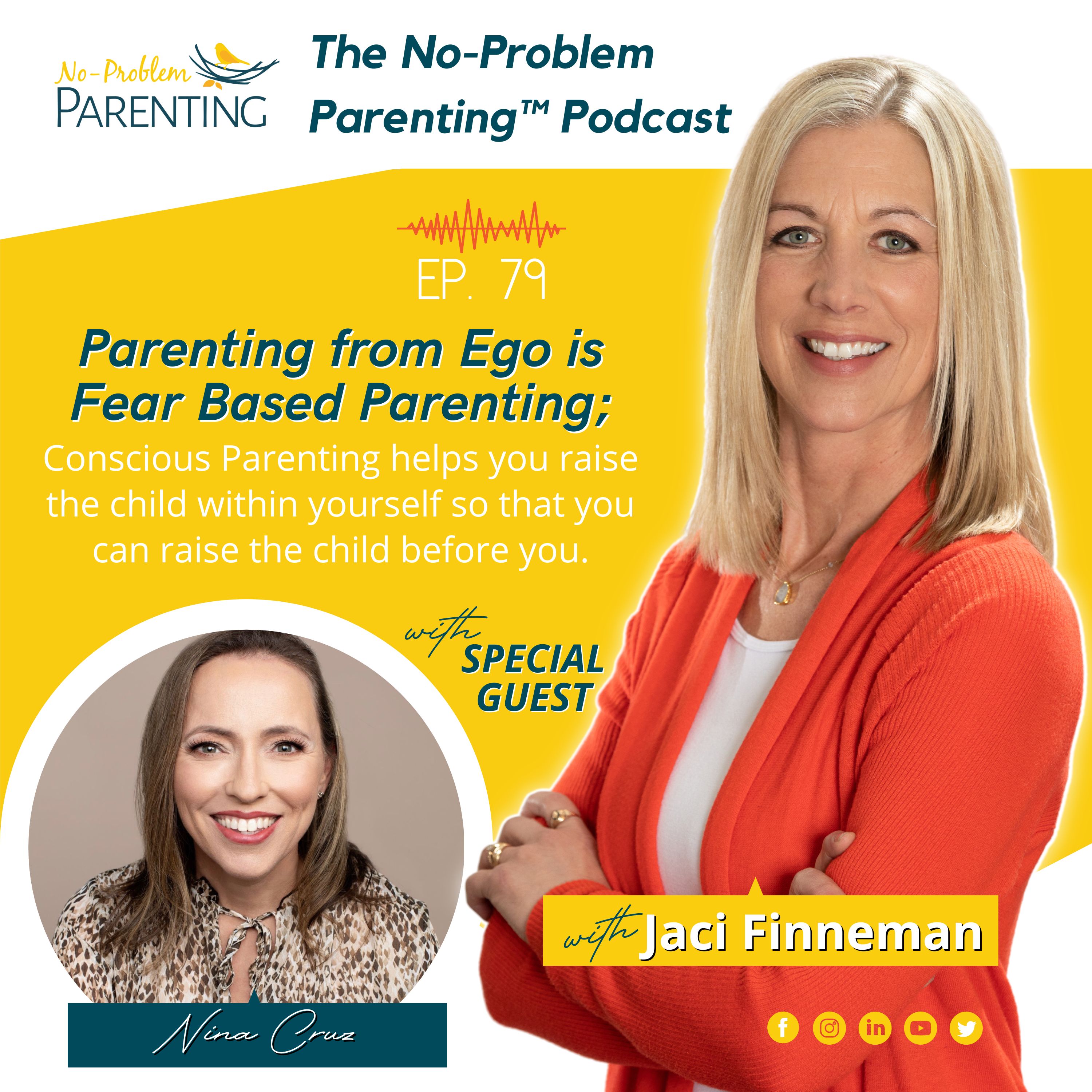
Parenting from Ego is Fear Based Parenting; Conscious Parenting helps you raise the child within yourself so that you can raise the child before you. With Special Guest Nina Cruz
About this episode
Do you feel as though you are constantly demanding respect from your child? Does it seem as if your child could care less about your relationship with them? Whether you have a young spirited child or a teenager who is preparing to leave the nest today's guest is going to help you recognize how your ego is getting in the way of your relationship with your child.
Become a No Problem Parent Today!
Full transcript
Jackie Finneman is a 30-year family counselor turned parenting coach with more than 40,000 hours of working with children and families. She is thrilled to share behavioral strategies, supportive resources, and parenting stories from her own real-life personal and professional experiences. Parenting is a roller coaster, not a merry-go-round. We can deal with and overcome the behavior challenges within our home and set ourselves and our kids up for a successful ride.
Has your roller coaster derailed? No problem. Listen in to get you and your family back on track. All right. Welcome back parents to the No Problem Parenting Podcast, where we choose to deal with and overcome the emotional and behavioral challenges within our homes. And today I brought on a very special guest, Nina Cruz, to talk to us about all things conscious parenting.
Have you heard about conscious parenting? I mean, I think who hasn't nowadays, But what is conscious parenting? What does it mean? We're going to dive into it today and she's going to give us her background and her experiences and some tips and tools for how we can really parent our kids with empathy and be present for them.
So welcome to the show, Nina. Thank you, Jackie, for having me. I'm excited to be here today. And I love that you're from Australia.
I love the Australian accent. Us Midwesterners don't have the prettiest of accents, but yours is very fun. It's funny. You never think you have an accent, really.
Right. Of course, none of us do. Although when I'm anywhere, people say you're from the Midwest, aren't you? I'm like, yeah, pretty sure. So tell us a little bit about you, Nina, and how you got into the business of parent coaching and why you chose conscious parenting or why that was a good fit for you. Yeah. So I have two beautiful, wild, free-spirited children, eight and 11. And I was basically led to conscious parenting.
when I became a parent, I really was challenged. I struggled. I tried to control everything. And when I stumbled on conscious parenting, it was just that, you know, that body knowing that, oh my gosh, is, am I the problem? Am I the one that's really causing all the drama and all the chaos and in my mind? And, you know, from that, that moment on, I started to really, really take note of what was going on inside me. I'd always done a lot of work. I was quite of, you know, doing a lot of self-help work. And I was always interested in learning and growing as a person. But obviously when I became a parent, the dynamic totally shifted. And I just surrendered at that moment when I came to conscious parenting and started to understand myself better, what was really going on inside of me and not pointing the finger at my child anymore.
And you had history as a social worker working with kids and families and things, right? So it's so interesting how same with me. I did that for many years and I'd always surrounded myself with kids, working with kids and helping kids and felt like I was understanding. Right. And, and all of that. And then, you know, my husband and I brought our baby home. And that first day we kind of looked at each other and went, now, what do we do? And he's like, I thought you knew like you're the kid expert. And I'm like, but this is, it is a totally different thing when you have your own.
yeah it's personable it's it's it brings up your stuff your stuff is erupted inside you and there is no you know kind of manual or blueprint to to say this is how we do parenting because your child is unique and they come with their own unique temperament and they come with their own energy and you come with your energy and you know it's really uh learning about getting curious and starting to understand yourself so you can better understand your child and conscious parenting is really turning the spotlight on the parent not the child and if you look at the behavior of what's going on say with your child it's turning the mirror on the parent and understanding what's the parent experiencing in that moment when the behavior arrives and for the child it's understanding that there is a need that your child's trying to meet beneath the behavior like the tip of the iceberg is the behavior and below the child is trying to meet a need.
Yeah, that is, I love that you say that because oftentimes we think the behavior is like the problem and we focus all our energy on trying to correct the behavior, but we kind of have to get underneath there and be like, why did that behavior even happen? What else is there? Tell me more. There's more going on, right? Exactly. And, you know, there is a lot going on under the surface.
what we see is not necessarily what's really you know when you see anger really below that anger is sadness there's a deep sadness going on or something maybe the child's felt hurt or and there's a reaction so just as we can react in our parenting life our children are reacting and so conscious parenting is about becoming responsible for our own energy and ourselves and starting to be that example be the guide for our child and there's certainly no perfect parenting when we have our own upsets and our meltdowns we learn but we we repair it with our child and they see oh this is how we do challenging moments or this is how we do upset and this is how they see a model a blueprint of how you know we work through it and so then they know that they can work through it and also shows them that you know not to be scared of emotions you know many people I know myself as a child emotions were sort of squashed and pushed down and you couldn't be angry you couldn't express yourself so now is the time to allow the emotions to have their space but we hold the space for our child in a safe way and we we show them by our example how we move through the wave of emotions and how we come back to neutrality which is exactly what they do if we get out of the way. If we don't add fuel to the fire, you will watch your child have an upset and come back to the shore, like to neutrality, to balance. And they've forgotten about it. And
we're still dealing with what happened. Oh my God, we're feeling guilty. We're feeling bad. We yelled. We're the ones trying to figure out what's going on and they've moved far beyond it.
Yes, for sure. And when we added fuel to the fire, when they've gotten upset and then our fight or flight you know rise raises up and we're defending ourselves or we're saying don't talk back to me or you know watch your behavior watch your words or you know you will not disrespect me or you know we're engaging in that when maybe they just had a reactionary moment and if we would have just paused and let them kind of get it out and get through it that we wouldn't have to do anything. Exactly. And the, the, the, the moment in time would be a lot less, the more we add to it, the more, the longer the episode becomes, but that what, when we have to be right. And when we have to say, be respectful and do this and do that, this is our ego that's showing up. So,
you know, it's this rise of the parental ego that a lot of the time we're parenting out of ego, not out of our authentic nature, our intuition, our beautiful heart, we're reacting from ego. And when you get one ego and then your child's reacting and another ego going on, you just have more of a mess to clean up. So a lot of the work is starting to realize when am I in my ego and when am I, you know, and taming it and breathing, as you said, and having those conscious breaths and slowing it down so you can meet your child in the moment with neutrality and deal with what is not what you desire the fantasy of the fantasy child that you may have in your head that they shouldn't be doing this and they shouldn't be doing that deal with what is and meet them with empathy with understanding compassion so you can move through that together and then there's no mess to clean up there's no repair need required and and it takes time to work on this we're going to have our mess ups we're going to repair but um you know looking at how how am i coming to my child because when we're charged coming to our child like they shouldn't be doing this they shouldn't be having this meltdown i just gave them something they wanted what i gave them and now they're still complaining they're not grateful and we have this whole story going on in our mind and this is the energy that we bring to them and they're like energy you know absorbers you don't
have to say a thing and they know exactly what is happening they just so attuned it's us the parents that have lost that attunement because of all the layers we've added on so they're quite attuned to our energy they know and um the with conscious parenting we're really starting to see our child as our teacher and so that flips the whole model that we're a bit greater than they're lesser than to okay we're all learning we're all on this same continuum whatever journey and what could my child be teaching me you know what are they actually showing me about me that I need to look at and spotlight kind of what's happening inside of me so this is where they the whole lens and dynamic shifts because you see your child as your teacher and you you start to see the moments and go okay they have a point you know yeah often they have a point but the ego swoops in and then i know they're wrong i'm right and connection this is also uh connection cannot be fostered because when you're in ego there's resistance so we need to come to them with connection and an open heart to in in a way be able to influence them and that's the connective piece with parenting that's really important. Yeah. You have said so much. So I'm like making notes. So I make sure to go back to some of these. I want to see the child as the teacher. I want to get back to that.
First, I want to go to the anger. Usually if a child is showing you anger or anybody, an adult, anyone. Yeah. Sometimes they're just mad about something, but if it's a very passionate kind of anger and it's happening a lot, there typically is a sadness underneath in some way, shape or form. And I think the reverse is true. Oftentimes times kids who cry a lot and they're easily brought to tears over things. If we get to the root and the underneath of that, oftentimes there's anger. They just don't know how to, they don't want to be angry. They don't like anger.
They're fearful of anger, or they just don't like, you know, they just really don't like it. So they don't want to be an angry person and we need to teach them how it is okay to have anger. It is okay to be upset about things and how to express that yeah how to move through that because often if depending on the temperament of the child and also depending on whether anger hasn't been accepted in the house and been shut down and said go to your room you can't do that go to your room then there's that fear of of actually you know opening up and that's where children become can become scared of their emotions because they've been labeled as bad that's bad to be angry you can't be angry you can't be upset that someone took something from you and you didn't or you can't be upset that you don't want to share something I mean we've got this big thing about sharing when at certain developmental ages they shouldn't be sharing they really can't not ready to share right they want what they want and that's okay um but we're like push them into sharing and then they're upset and we're like no you know you're not allowed to be upset so the the upset when when there's any reactivity especially if we're talking about the adult and you know if we look if we go in inside the adult inside inside the the uh the parts that make us ourselves that we grew up with that we created we have the the core which is the inner child so what's really
it's like if you imagine like a cage kind of like an egg maybe or a cage the external is the ego and the internal is the inner child so the inner child is like you know want to be seen heard understood this is do i matter and the ego sweeps in to protect so um really deep down underneath the layers is the little girl the little boy inside of us you know us parents as well as inside of our children that's created in childhood and the inner child's being created due to unmet needs now it's not like we purposely can't meet their needs it's just how it happens we can't be there all the time we can't um you know fix everything and we shouldn't be actually fixing things um but this little little child inside of us is is needing something and so the ego comes into swoop and might get angry and push someone away and throw something or and and this is how it happens so it's really starting to understand within ourselves what does our little child inside of us need and especially when we're trying to meet our needs through our child like you're not listening to me you're not seeing me you're not hearing me this is because we were never seen and heard and maybe understood as a child so we're trying to get it from our child now but we're not now we're an adult we've got to be giving it to ourselves we've got to be going okay and this is the piece of reparenting our ourselves so we start to meet the needs of our
little child so they're not rattling the cage and the ego's not swooping in to protect and tell them to go their room um and we're meeting that need we're showing up for ourselves so we can meet meet our child's need and not because it's kind of dysfunctional where we're trying to meet our need through our child and they're trying to be seen and heard from us and we just got like everybody's trying to be seen and heard and understood and do we matter and it just becomes like very mesh so there's this enmeshment that goes on this entanglement absolutely of then we don't know what's ours to hold what's our child's and we're all just tangled up in energetics and in in um you know mentally as well there's no clarity in the mind um so yeah there's there's a lot going on but it's really becoming aware that's the piece of conscious parenting and understanding what is mine because because as parents we take a lot of things or everything personal when the child is just being the child the child's going to be do what the child does so it's starting to understand what's mine what's my child's and get that clarity uh and understanding in that order in our mind so that when we move to the moment of upset of this of that we know what's really going on and we can actually parent from that mutual space instead of that reactive space because i just love this so much yeah that was that was my next my next note that i wrote
yeah parenting from a place of ego to some people other people notice this right we notice this in our parenting, our friends and our family, we can tell when we ourselves shift and start parenting out of ego, right? It's, it's noticeable. We might think we're good at hiding it. We're not.
When you're saying things like my kids don't respect me, they have no respect for me. You're parenting out of ego. And I love that you point this out, that it is that person, that person did not feel respected as a child, like nine and a half times out of 10, when you're saying my kids don't respect me and you're demanding respect and you're being, you were not respected as a child. Go back. You don't have to go to do therapy or work through that on your own. Think about in your life, when were you disrespected or not even respected or noticed as a child? Yeah. That's where I think a lot of that is coming from. See, I'm learning about conscious parenting too, because I've never taken a conscious parenting program. I've never actually learned all the way through and studied it. I've had people say, well, you do conscious parenting.
I'm like, well, I don't say I do because I don't have a certificate. And so I have a lot to learn in this model, but it makes perfect sense to me. Yeah. And so that like when you look at like your child's not respecting you, then the model is like conscious parenting is becoming aware.
So where am I not respecting myself? Where do I disrespect myself? Where do I not do this in my life? because we can't give what we don't have and we can't expect our child if they if we're not you know they they sense there's this disrespect they they're only going to do it really if there's a match an energetic match like you know I could pop into your family and what's triggering you has nothing nothing on me it doesn't bother me at all because it's it's what we've learned we've we've got these patterns of behavior that from childhood that we've learned patterns of behavior or coping mechanisms. So we've learned to be certain ways. We've learned certain dynamics in our childhood. And then we come to our children and unless we become aware of these patterns,
we just play out the same pattern. So often we come to it like, Oh, I'm not going to do what my parents did. And unconsciously we do because we haven't looked at the pattern that was set up in childhood that we're playing out and we play them out in our work we play them out with our partners we play them out in everything we do and and you may notice like sometimes you're like maybe you're raising your voice at child and you're like all of a sudden you're noticing you're doing it and there's this other part of you going watching it yeah you're like having this moment so um this is the ego that jumps in to protect you because it wants to shut down or it doesn't want conflict or it doesn't want we learn to feel we to feel safe in childhood we learn not to speak up so we became a people pleaser and we have to be good we have to be a good girl we have to do this so when we have our child and we need to set boundaries very hard to set boundaries we want to be nice we want to be kind we can't have conflict well boundaries if we're trying to hold a boundary with our child there's going to be resistance there's conflict so we learn conflict bad and so that plays out with our child and then we don't hold boundaries and then we feel guilty and then we go through this loop of feeling thinking feeling taking action and we have this looping going on constantly and that's why you feel so stuck as a parent we're like I'm stuck
in this same pattern I'm stuck in this same dynamic because we're stuck in the pattern of the loop until we disrupt the loop and go, oh, I'm doing that. I'm saving and rescuing my child because that's what I did in my, you know, relationships. I used to save them. I used to make it better because anytime I don't feel okay. And if they're not okay, then, oh, I've got to make everything okay. My child, I'm okay when my child's okay. And we learned that. So then we realized, oh my God, I'm rescuing. I'm dropping the lunch to school. I'm buying them something when they lose it all the time and they haven't gone to the lost property or they haven't there's no consequences going on i'm just saving them right and then what happens is our child doesn't learn that you know the the impact the feelings that when something happens or or say um you know they are having an upset about you know something something at school maybe like they a friend and we go in and sweep because we can't deal with the emotion we can't feel the emotion we can't have confrontation our child we can't let them feel it because we can't feel it um and so we'll sweep in and go oh it's okay they were just doing that i'll you know i'll get someone we'll get you to the party say they weren't invited to the party um i'll find out if if uh you can go to the party i'm sure it was a mistake or we try and rest you try to make everything better yeah and then we're
doing the same pattern we're just transporting it into their childhood yeah and so until we become aware of ourselves of what is really playing out underneath the surface um and get that understanding then we can see it because when we when we see the pattern we're not the pattern we're looking at the pattern we're that awareness behind the pattern we're like oh my gosh i'm doing it again and then we can choose again we can go you know what i'm not gonna be pleasing all the time my child isn't doesn't need to like me doesn't need to love me that's not their job my job is to guide them and be there for them and support them and love them and be compassionate they owe me nothing and so then we can when we know that they owe us nothing they don't have to do all the things that the boxes that we want them to tick of course it's lovely that they you know we want that stuff but that's not we we didn't sign up for parenting we basically signed up for parenting for us to have children is about us really yeah if we really look at the truth we had them because we wanted them right not not because of them really right I mean yeah that we wanted them and they arrived but a lot of it is our ego is because you know maybe we wanted to feel loved by someone maybe we wanted to we had so much love we wanted to share it but it's still about us. So there's that, you know, there's that saying, I'll, I brought you into this world. I
could take you out. And then there's a picture of the little kid going, I didn't ask to come here. Exactly. Exactly. You didn't even invite me to come in or, or kids who were adopted, you know, oftentimes parents will say, how could you, I, you know, you could be living in a, in an orphanage or in a foster home. And, you know, we did these horrible things that parents good well-intentioned parents don't start off thinking that way but when they're rejected by their child or disrespected or nothing seems to be working and there's no connection those are the harsh things the harsh reality is that a parent would say something like we brought you here we wanted to give you love we wanted a better life for you so we adopted you to bring you just and it's still that's ego parenting yeah because that child did not ask for you to do that for them exactly exactly and that's that's also like that you know wanting something when we give we need to get something back. And that's, you know, learned in childhood that, you know,
our child's, our child should be doing something. They should be appreciative or they should be, but do we want them to be, you know, it's like saying, sorry, do they, do we want them to do it unauthentically or do we want them to feel it? And this is where it comes back. We want them to feel it. We want them to feel authentically sorry. So I don't make my kids say, sorry.
oh I love you how have we not ever met before you are this is so great that we got connected I love this podcast I have to say yeah I like I was we got to get back to that in a second but I just have to sidetrack here again yeah I started this podcast thinking I would share a lot of my tips and tools and you know stories and things like that and as I shared with you before we started recording for the first month I did that and then all of a sudden I was getting all these requests for people to be on my show. And, and now like you reaching out and it's, I'm so grateful for this podcast to be able to be in a company in, in community with, you know, other parenting coaches and people who support parents. So anyway, you, when you said that you don't make your kids say,
sorry, I'm like, oh my gosh, we are sisters from another mystery because I did a whole episode on that one. And that was actually the next thing on my list is the when you talk about making it up to them later, if you do fly off the handle or you blow up and modeling that for your kids, I have a, I think called the make it right technique, which is all about not saying, sorry, sorry. He's like, you know, if a kid says, oh, they hit, they hit their brother. Oh, you take them and you say, you say, sorry.
Well, okay. Wait a minute in that moment. Is your kid sorry? No, chances are the brother did something that upset them so yeah yeah now are we saying it's okay to hit no but in that moment saying sorry does nothing except for tell the victim the kid who was hit not only have you been hit you've also been lied to yep exactly and then we as adults say oh just okay now it's all better because we said sorry now move along yeah but that's for us that sorry is for us is to make us feel better. Like, okay, everything's okay. Now we've back to balance. Like that's okay.
He's apologized. We're good. Yeah. Yeah. But I mean, even if my son has actually said, sorry, not with me telling him to my daughter, she'll go, I don't believe you.
So it's not until, you know, authenticity and authentically they pick up. They're like, the sorry, doesn't make a difference. Like it's just the action. The action speaks louder than words it's always you know it's told that's always been said actions show us your actions yeah so what are they learning from this you know it's always that learning process um you know i'll talk to my son about like red flags coming up like to the point where they do fight a lot and you know are there red flags coming up and we need to look at that because they escalate into a big ball and then you'll want to lash out um so it's supporting the kids to become aware of also what's going on inside of them and how they're feeling. And, you know, it is hard, especially, you know, in my generation, growing up when feelings were not talked about, feelings were squashed, everything was thrown under the carpet. And, you know, now we have kids that are emotional, that are highly,
can be highly emotional, can be highly sensitive. And if we don't know how to feel and move through our emotion it's very hard to parent and connect to the child when they're emotional and and we want to shut it down so that's a lot of the work just really you starting to feel your feelings as well and not act out on them that's feeling you can have a feeling it doesn't mean you enact it you react and act it out you just allow the feeling to come and go and then it's off um and not set or process it or work it through with somebody else if you need to another adult or whatever but not with your child no and that's that's where you know with a lot of the episodes we have um also understanding that any kind of time you react it's never about what's outside of you so if it's never about your child never about the job never about your partner if something inside of you then you can actually release all of these people and everything and go and because when you're you're blaming them and you're a victim you're just giving that your power away to everything, everybody and everything. So when you know, okay, it's never about my child,
it's never about the job or the work or the money or whatever. It's something on it with me, it's empowering to go, okay, what is it about me? What is this showing me or saying about me? You know, and then you can see through that illusion, because the blame game and the blaming the child and, you know, it just keeps keeps you giving your power away to them, really.
Yeah, for sure. And, you know, I'm sure you've experienced this too. There are some parents who just can't seem to grasp that it's not about the child. Yes, the child has their behaviors and all that, but their ownership in that.
parents often there are some parents that just can't take accountability for anything of their own because that means there's something wrong with them which again just shows that there's something more going on with your inner child and feeling like you could never be right or you could you know like could never be heard yeah and and often that a person with that inner child really they weren't um nurtured they weren't um they didn't feel nurtured and nourished and really held right so that can happen um it's hard to you know accept that but you know that when you do unlayer and move through the layers and and realize that you're just perfect divine the way you are and it whether you get it right or you don't or the washing's done or not and everything is okay um you know it can shift the energy can definitely shift absolutely so i'll say to parents to another The last thing that I had on my, on my list here was, well, I guess there's two things,
but seeing the child as the teacher that can be hard for parents because we're supposed to be the leaders, right? And we're supposed to have all the answers and we're supposed to be guiding and doing all that. So it doesn't mean that if your child is the teacher that you're just letting them make all the decisions in the home, right? It's just being paying attention to the things they have to say and letting them enlighten you a little bit.
sometimes they're so much smarter than we give them credit for because there's so much innocence there too they don't have all that logic pounded into their brain yet so they come up with the most brilliant solutions they come up with the best consequences for themselves if we allow them to say hey what are you going to do to make this right what are you going to do to make this up to me or to the person you're wrong or to repair the damage you caused or whatever nine times out of They will come up with a much better consequence, more factual that they will then learn more from the inside out and feel more. So that increases the odds that they're less likely to cause that same problem again, whatever it is.
Oh, yeah. I mean, look, your child is your teacher. This is more to do with the mirroring of what they're mirroring to you about you. So what are they showing you about you? Are they showing you that you're always trying to control and micromanage? Are they showing you?
Oh, that's good. You know, like because children just as we would like and want to be empowered and we want autonomy, they want that too. They're powerful beings. And when they're your teacher, it's just they're showing you where you need to do the work.
So they're going to just spotlight exactly where you need to grow up basically and adults because often we're parenting out of our inner child out of our ego um that powerless space that um space that's needing to be seen and heard when when we know it's not our child's job then we can release them and we can let them be in their true authentic self and their essence and we're not trying to change them and mold them and make them something else because they arrive divine and beautiful and perfect so when we let go of of all the stuff we're trying to you know oh we've got to teach them this and we've got to take them here and we've got to do this lesson when we let go of that and we follow their lead and we attune to them then we can go oh they want to do this oh they like playing with rocks I wonder you know maybe we'll take them to the museum we follow their lead more they're unfolding instead of trying to create some super super child and um have this big plan and have them yeah have it all figured out I like what you say too it's not just about, so it's like, let them direct their play, for instance, or certain things like that. That's one piece of conscious parenting. What I'm learning today from you is that's also that the child being the teacher is mirroring. So when you see your child trying to control the situation, control you control, does that mean then that that's possible? And that bothers you,
whatever they're doing, that's actually bothering you and causing some resistance in you that you, that's a good indicator that you need to look at yourself and be like hey what what what are they mirroring of my behavior that they're actually learning from that and and is that am i understanding that also more so what's it what's the feeling inside of me because if they're trying to be in charge and you're a control freak that's going to trigger you yeah so why do i have to feel like i always have to be in control control generally down beneath is anxiety and you you need to be in control because there's an uncertainty and you don't feel safe if things aren't you're not controlling things so allowing your child they're not they're just being that because we label them controlling or this or that we we're the ones that label it and then when you label it then you've got a feeling attached to that and then an action you know you start to you know my child is defiant will define against who like am I controlling because they don't want to be controlled like they want you think of a child's life they're controlled with everywhere they go to school they have to do this they have to do that so much of their life is contoured what they should or shouldn't do and we need to allow them at home to have some space and some freedom and some expression to be in charge okay maybe they want to pick what's for dinner tonight but when you're controlling
you know you're coming from that controlling energy and your child wants to be in charge with things you're gonna butt head you're gonna butt with each other so it's starting to understand why why am i trying to control everything well there's there's a fear because when you're really controlling everything you're it's fear-based parenting you're fearful like if you don't control it then maybe things will fall apart or your child there's a fear there's a lack kind of of um energy coming yeah towards your child because the child just wants to say they want to make something i don't know i mean my my kids move furniture like my son basically if it's not nailed down he'll be moving it um and i had to learn to let go a little bit okay it's safely he doesn't move things that are unsafe but you know if he wanted to move a mattress he wants to move a mattress and my controlling i'd be like oh god you know more mess to clean up more this to and then I started to see that, wow, my daughter and my son are playing together happily. If that means moving a couch or moving a mattress to do somersaults or whatever they're doing,
I'm staying, I'm backing away, I'm backing out. And then I would look at why, why was I trying to control, you know, why am I trying to, you know, make everything perfect and control the house and keep it all tidy when the reality is children are messy and chaotic so it was really me letting go of that trying to control that was just anxiety because I needed certainty and needed everything to be okay and everything was okay when the mattress and the chaos when the house I sat in the house in a mess and I used to sit with the blinds all the way down or up and cushions all over the place because you know I used to go and put the cushions in the right spots I used to sit there going just trying to breathe and go it's okay I'm safe I'm fine the cushions aren't you know the way I want them or the house is pretty messy but I'm still fine yeah and I used to have to condition myself because I used to want everything to be perfect I used to be a kind of reformed perfectionist and controlling um and kids come with mess so then it's really accepting you know this is a spiritual kind of law the as is of the moment the as is is that my my kids are melting down right now the as is is that the house is a bomb the school holidays it's mess okay and it's starting to accept the as is and what is instead of what you know what you're trying to be or yeah i say that in my exactly in my no problem parenting to it tell parents yeah
We need to stop shooting on ourself. Exactly. Yes. Because it is from conditioning.
That's, that's the conditioning of what we should be or shouldn't be doing. It's not necessarily what we authentically desire to do or not do. It's the conditioning. Yeah.
A very good point. I think, you know, if we look at parenting and we get really real about it, we're not here to win a prize for my child. They're not here to give us prizes and go, oh, you're the best mother. Oh, you did that.
Oh, thank you. You know, thank you. You know, bowing down to us. We do it for us.
You've got to pick what's most important because there's so many things that we can focus on. And what we focus on we feel. So, you know, if they're not doing this and they're not picking up and they're not cleaning up, There's so many things that just build a mountain of resentment and build a mountain of anger and towards our child. And that builds that a gap like that, like a wall that we can't connect with them because we see them and we're thinking about they weren't grateful for this and they did that.
And I went the extra mile to do this for them. And they don't even say thank you because that's not their job. They don't always see it. They don't not thinking about they're in the moment.
they're not like thinking oh mom asked me this day and then she said the next day and then oh she did it for me and they're in the moment like I got to go to baseball I got my clothes I'm going to baseball they're not thinking about all that stuff we we have these great expectations of what our child should be doing and we we just lead into disappointment we disappoint ourselves basically because we're expecting all this great stuff from my child and it may not happen yeah you may have a random child that is that it does right that it all goes perfect right i i really would love for people to get in touch with you how they can do you do one-on-one coaching i do one-on-one and i also do a six-month kind of program that shifts beliefs and subconscious programming and um i also have a private facebook group called conscious creators collective that's really becoming a you know a conscious in your life as well as creating you know the parent you want to be the life you want to live and uh then i have that book i mentioned co-authored book coming out called dear mama um next month and i have the link for that and i have the link for how people can get in touch with you and do even a free call to learn more from you to see if you're a good fit for them and then for you and all that so we're going to have all of that in the show notes. And then once this episode is aired, you'll be on our resource page
too. So parents, you can go to no problem parents.com and check out our resources page. You can find Nina there along with the link to this episode. If you'd like to share with your friends and family, I am so excited to have met you. I know we'll be doing more collaborating in the future. I'll be sending people your way. Thank you so much, Nina, for being on the show today.
Oh, thank you, Jackie. It was awesome. Great to speak with you. Thank you.
Become the confident leader your kids crave
The method, the community, monthly live Q&A with Jaci, and Celia — your AI guide in the moment.
Start your 14-day free trial Get it on iPhone or sign up on the web