
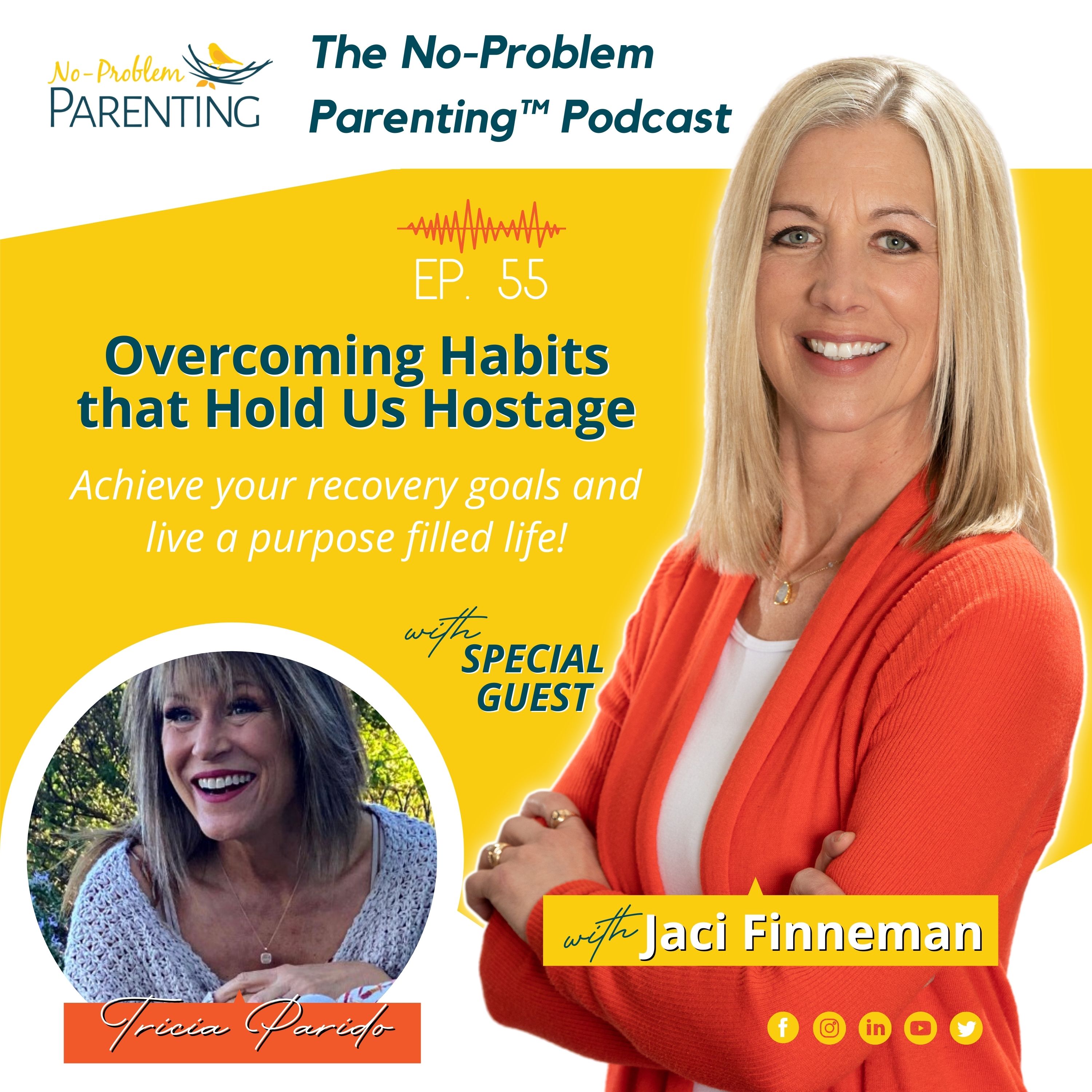
Overcoming Habits that Hold Us Hostage with Special Guest Tricia Parido
About this episode
Welcome Back No-Problem Parents!
Addictions, Negative Attachments, and Habits that hold us hostage are all seated in a pressure to perform and a reliance on something outside of ourselves to provide peace, joy, comfort, relief, value, validity, and worthiness.
Tricia Parido, founder of Turning Leaves Recovery, is a Recovery Lifestyle Enthusiast, Speaker, and Published Writer. She is a Nationally Certified Life Coach, an International Master Addictions Specialist, and a Professional Life Interventionist with a Psych Degree in Process Behavioral and Chemical Addiction who loves to help change lives!
Become a No Problem Parent Today!
Full transcript
Welcome to the No Problem Parenting Podcast. Turn behavior problems into no problem with Jackie Fineman. Are you ready to become the confident leader your kids crave you to be? Do you want to learn how to make parenting easier and more fulfilling?
Whether you are at your wit's end or you want to have more fun as a parent, you're definitely in the right place. Now here's your host, Jackie Fineman. All right, welcome back parents to the No Problem Parenting Podcast, where we choose to deal with and overcome the behavioral and emotional challenges within our homes. I am so excited today to have a really good friend of mine on the show talking to us all about addictions and recovery and lifestyle.
Let me introduce you to Tricia Peridot. Tricia is a recovery lifestyle enthusiast, a speaker, and a published writer. She is nationally certified as a life coach and an international master addiction specialist and a professional life interventionist with a psych degree in process behavioral and chemical addiction, who loves to help change lives. specializing in life transitions and post-treatment journeys, Tricia is ever committed to serving her clients worldwide to find the emotional intelligence they need to conquer their life challenges.
As an active business owner of a thriving coaching practice, Turning Leaves Recovery, seated in evidence-based practices, she's not only teaching her clients how to live the life they desire and live free, but she also teaches those that aspire to become professional coaches how to do so passionately and professionally. Yes, that is a new part of your company, and I'm so excited about that. So without further ado, welcome to the show, Tricia.
Wow. Thank you so much for, well, even saying all of that stuff, right? I don't always give the full bio, but I really, I highly admire you and commend you and just absolutely love all you're doing for parents around addiction and recovery. So thank you.
Absolutely. Thank you. I, I, it is, it's truly, it's truly a blessing for me. It's become a gift that I didn't know that I possessed until, until I started taking a look at, you know, my own life.
Um, and, and so in my journey, I have been able to just really capitalize and create some really beautiful processes for us to actually apply the things that we learn that can be life-changing. I mean, we all can read a self-help book, but if we don't know the practical application in our lives, because everybody's life is different, we really don't know what to do. Yeah. And that's why I love you so much. You're so realistic. It's not just about the emotion and the steps and the therapy and the, all the things, all of that is great and needed, but then what do you do after treatment, let's say, or after a therapy or how do you make it practical in your life?
So we're going to talk about that. And before we get into that, I want you to just give, I know this about you, give my listeners an idea of what, when you talk about addiction, people often go to drug and alcohol, right? That's all it is. And that's, that's enough, right? And I mean, and it definitely is drug and alcohol, but there's much more, so much more to addiction. And I'd like you to just give us that overview of the types of addictions that you're talking about and that you're helping people with. Right. And so I could talk about it forever. So if anybody needs deeper understanding, you know, reach out to Jackie, she knows how to find me. But so here's the deal. Society does hold a very narrow perspective around the words addiction and recovery. Our mind is going immediately to the down, the out, the ill,
the poorly functioning, the people that need to be removed from their environment so that they can be fixed. Okay. This is the very small part of the population. It's just the one we tend to look at because a recovery journey is so much more. Addictions are so much more. They are process and behavioral as well as chemical in nature. So we have, we have what I call sneaky snacking.
We have impulsive shopping. We have people pleasing codependency, right? We have the all in the all out of our dieting. We have all in all out of the physical fitness. So it's anything that, you know, we're either indulging in or not indulging in. It's kind of likened to say the person that, you know, binges when they go on vacation and then come home and they're knuckling down. There are just so many different negative attachments and habits that hold us hostage that we just don't generally associate with needing a recovery journey.
yeah it's so interesting you don't think of hiring a recovery coach for instance unless it's a drug or an alcohol related um addiction but there is the the person that just has to work out every day and they can't they have to run and they have to run i have friends that this has happened to before where that has led them even to uh drugs or alcohol but the the root was their need to to work out and i thought that was just so amazing i was like where did that right so it controls their life so now now especially in today's the way we are you know we're functioning in today's world work from home now when when say mom is is home and you know generally leaves to go to her 6 a.m spin class but one of the kids are sick or you know whatever when that that schedule needs to change because of some you know one of the kids needs now they their whole day is derailed. They're irritated, agitated, annoyed, frustrated, bothered,
resentful, whatever it is, you guys pick your own adjectives, but your whole day like, oh, now my whole day is thrown off because this, this spin class couldn't happen for me. Instead of being bendable, flexible, pliable, and saying, I'll go to the 6 PM when my hubby comes home and can take over for me. Right? Like we, and so no, at no time am I saying, Hey, we shouldn't be exercising, we absolutely do need to be connected with our potty and, and be working out, you know, at the level that we need for ourselves, but it needs to be lifelong manageable and maintainable, and it cannot rule your world. It can't, it can't have that much control. So it's that external locus of control. So anything outside of you that you rely on for some emotional something or another, you've given it a job, whether it's your gym, your bottle of wine at the end of the day to relieve your stress, the shopping spree on Amazon, because I don't know whatever reason, right? There's an emotional purpose that we give to things outside of ourself that we ought to be able to regulate on our own. And how do you, you have a couple of really good stories about why you even got into this. And I do want to get to those, but before I do, I want to ask how do you have just, and I know your programs are vast. What are some key,
maybe one, two, three things that you first look at, or somebody, a parent would look at and say, you know what? I need, I need to seek some help. I don't need to go put myself in detox. I don't need to join a recovery program. I just think I've got an issue with this and I need to seek help.
What are those things that would make us think that, or maybe some things that you would say, these are my clients. So we want to take a look at, and I use a tool it's called the whole health survey. You know, so we take a look at, so socially, socially, do I rely, you know, what does that look like for me? Does my social anxiety have me, do you know, do I binge on the buffet? You know, am I constantly like nervously eating? Do I disappear into the wall? Or, or do I, you know, do I, you know, need to, you know, have some drinks so that I don't feel socially awkward?
um you know that's something that you can be looking at um if if your if your day activities of daily living and the stressors that you allow that you choose to hold on to accumulate and you have a daily routine of what you do to decompress those things and that looks like a reliance on something outside of you, alcohol, Ben and Jerry's, brownies, whatever it is like, oh, I deserve this. If you ever tell yourself, I deserve to go out and have some drinks. I had a really long week.
We need to take a, we need to have a conversation because our reward system can't be seated in childhood where we got, you know, gold stars, lollipops, and popsicles to soothe our wounds when we scraped our knee, got a shot or had to go to the dentist, right? Like that reward, that hand to mouth reward, we need to, we need to not have that as adults. That's an interesting topic as well. And how that starts out when we're kiddos, right?
We could talk for hours about this. So, you know, you want really want to look at, you know, asking yourself, why, why am I opening your refrigerator door? you know why am i opening the refrigerator door right now am i getting like food to nourish my body or am i you know looking for again the ben and jerry's the the beer the wine the whatever it might be for you or why is it that i so much need to just you know go and and and exercise whatever it is like that attachment to something outside of you that has a purpose um and so let's to bring you peace, joy, comfort, relief, value, validity, worthiness, right? Like if you rely on something outside of you for those things, we got to have a conversation. And I'm going to put all your information in the show notes to make sure that people do you offer so many things. And so let's talk. I'm so intrigued by that. And I know you have a story from childhood about what you saw and the mimicking of our parents, so much of what we learn from our parents is not taught,
it's caught. So it's not said it's observed. And that's as kids, a lot of our learning is not just in the lessons our parents teach us, but in what we observe them doing. And so I know you have a story about that. I'd love for you to share with our audience. I do. I do. So everybody that's listening parents, you know, I'm going to give you this so that you get into the headspace that, that I'm coming from here at, you know, especially in my age group, right. I'm in my fifties, whatever my parents didn't know what they didn't know. Right. I was raised to sweep things under the rug, always get up, get dressed, put your best face on. And, and, you know, we just don't talk about, you know, things out, you know, outside of the home that may be, may be difficult are hard. So even at the age of four, I already had internalized that message and did not share with my parents as a sexual assault that happened inside of my own home while everybody was there.
But, but so, so we, we are leading by example. And I, and I want you guys to hear that the example you lead by is, is really what they're going to be internalizing. So what we don't know is the level of emotional intelligence that we didn't know we weren't getting from our parents. So we don't know to teach it to ours and lead by that example. And I'm talking impulse control, emotion regulation, distress tolerance. And there's a whole list of things that actually create that ability. So here's what I'm here's, here's what I want to say is, you know, we want to be paying attention. We want to be paying attention to how we are leading by example, because do as I say, not as I do, or you're, you know, this is okay for me because, because I'm an adult, you can't do this because, because you're not an adult, but because I am, I can doesn't work anymore. It really wasn't effective then either. Um, you know, but it really doesn't work. So my story is this,
or one of my stories is this, um, you know, my father was killed at, in a tragic accident when I was 12. And before that, I had already witnessed, you know, daily drinking. And in fact, the year prior, my dad had actually left and gone to a 90-day treatment program for his drinking. My mom packed me up and moved me, you know, to the Midwest for three months. And then we came back.
And then within that year, he was killed in a tragic motorcycle accident. So at 12, I was devastated, you know, all the things didn't even want to talk and just anything. And the story's kind of long in, in some of the other ways that it affected me. But the one, I think that is really important about what we're talking about here is as a 12 year old, I couldn't understand why during the funeral, pre the funeral, during the funeral, after the funeral, people were able to like talk, then they, then they were happy or, you know, able to smile and laugh and be, you know, sharing all these fun memories. And I could not, I could not even grasp it. I was like, I just want to curl up in a ball right now and just not even, not even be functioning.
So I looked around the room and I was very observant, very mature for my age. And everybody had a drink in their hand and I'm not talking soda pop. I'm not going to, all the adults had a drink in their hand and cigarettes, right? Midwest, everybody drank and everybody smoked.
And so what did I do? Well, heck, if it's working for them, I'm going to check it out. Nobody was paying attention to me. Grabbed a six pack, grabbed a pack of cigarettes, took off around the corner.
And guess what? It worked. My mood got elevated. I didn't even get intoxicated.
Well, drunk the first time because I didn't want to get caught. But I got that whoosh at 12 years old and it was on. it became from 12 years on my way, like it worked like, Oh, you're feeling down, have a drink, feeling stressed, have a drink. You're sad, have a drink, smoke. I smoked for 30 years.
I also drank for 30 years. So, but so they were, they were leading by that example in that very important period. Plus you add that into the daily drinking and the fact that they would give us kids half and half wine and seven up at the dinner table on occasion. It wasn't every day, but you know, on special occasions. And, and I remember even knowing that communion at church on the first Sunday of the month was real wine, right? Like I wanted to go to, I always wanted to go to church on the first Sunday of the month because we got communion and it was real wine. I got to have what the grownups were having is all it was about. Like I never was, you know, I wasn't somebody that aspired to become addicted to alcohol. Don't get me wrong. Like I didn't raise my hand on career day and say, Hey, I'd like to be an addict. It sounds like a great idea. That happened way down the road. Cause I never developed a physical dependency until much later in my life. That's a whole different, that's a whole different episode. And that had to do with lack of knowledge and,
and the combination of prescription medication. So tell us a little bit about that, how, um, Society holds that the question that you have in there that society holds a narrow perspective around the words addiction and recovery. And if it's like, you have to be super bad or it has to be super obvious to your friends and your family and whatever otherwise it's really not a problem. right you're like a functioning yeah you know addict or or whatever and but how does that that actually like our kids are smart and they they see it oftentimes before anybody else does or they know it you have you know I do have a lot of clients that are in a quiet hell if you will um and and this was part of my story also, because at the end, that physiological attachment, right? Like,
you know, like sugar is highly addictive and you know it, you crave it. It calls you. You could be downstairs doing laundry and those cookies are calling you that refined sugar is calling you. And then you toss in like being a little bit emotionally off and, and not having that, that those skillsets and tools, those tactics to use that allow you to say, Hey, why is it calling me? Right. What, what is that emotional attack? What is that thing that I'm expecting to get from it? Because when we eat a cookie, if it's for a self-soothing measure, it's only going to soothe you while it's on your tongue. And then as soon as it gets into your stomach, what happens? Okay, great. Now, now I'm going to start the self-loathing, the regrets,
the, you know, then the images in the mirror, you know, maybe change, you know, because I did it again. I ate the entire gallon of Ben and Jerry's, you know, like, and, and then what is that negative impact? So we want to always be able to look at that. How does that, what does that relationship look like? What is that level of severity? And, and, and so it depends because if you feel trapped in it and you're quietly trying to like get it under control. So nobody knows and nobody, you know, you're not telling anybody. Um, especially if you're sneaking, if you're hiding candy in the bottom of your purse or, or small bottles, you know, either those single serve wines or, you know, the little airline bottles in the bottom of your gym bag, in the back of your closet.
And that's where you go to sneak a drink or grab a, you know, grab a snack. Like we got a problem, Um, but you know, and, and nobody else may notice it, but you're in this, in this perpetual, right? If every time you go to target for three things for your kids, you come back with 25 items that were not on your list and you find yourself going, how am I going to get the bags in the house? Or if nobody's home, where am I going to hide them so that I can, you know, sneak them out?
like if if you're operating this way in your life like it's time to take a look at that but you know if you don't feel like it's a problem however it's a daily it's something again that is I used to say it all the time it's just who I am it's just part of who I am and you know wore it like a badge yep I'm a highly functioning alcoholic I drink three to five beers every day right? Like that was just, and it was fine because it wasn't actually causing negative impact in my life for that period of time. 12 to 26, absolutely negatively impacting.
26 to 43, not so much, or 38, should I say? Not so much, but 38 to 43 was again, that derailing space for me. But so if we're, if we're like every, you know, every day I drink, And then some days I drink more than others. There's a, there's a problem. Our bodies are not even physically built to process more than one alcoholic beverage on any occasion.
Upset one, not too many people. Well, if you're having, you know, if you're out at dinner and you're having wine with your dinner, if that, if the purpose for the wine, isn't because it compliments your ribeye really good. And that's the only reason that you're having it. Then you want to take a look at your relationship with alcohol. If you know, constantly eating refined sugars, like you want to look at the relationship anyway, we could go on. I mean, really it boils down to anything that we are craving, addicting, reliant upon, reliant upon. There you go. Yeah.
is to make us feel better. Right. So what do you enjoy comfort, relief, value, validity, worthiness, whatever it is, if it, if it serves that purpose for you, there's an issue. So what are just a couple of things that we can do to get started to meet our need without going to the crutch? Okay. So I'm going to do this in twofold because I do want to circle back around and again, talk about that leading by example. And I have an example of, you know, how I know I was negatively impacting my children with my relationship with food and my body and my body image, because way back in the day, I did, I struggled with anorexia and body dysmorphia.
And, and so, so what we're doing with our kids, especially when we're talking about dietary practices, fitness, body image, what is fit, what's not fit, you know, like how we're talking to them about food is going to be impacting. I remember standing in the kitchen with my girls and, you know, taking turns and measuring the size of our legs and this and that. My daughters are stepdaughters, so we're not even built the same. And so, so negatively impacting on their lives just in guessing, you know, second guessing like their own body shape and size. Even though I wasn't in active anorexia, I still was in that early recovery process from it.
And so, you know, it was all, all the time talking about, you know, you know, I, I overate, you know, last week, I got to restrict this week. No, we have to change that. Like we have had to change our dialogue so much over the years so that I could re lead by example. Right. I had to start over and do it better because I, I, you know, I feel like I failed them. They don't necessarily feel like I felt failed them, but you know, we really had to, I had to really work on restructuring that, you know, a few things that you can do now that I'll, now that I've given you that last bit to like continue looking at right yeah um and shopping i also led by poor example with shopping because i had a really bad shopping addiction um anyway really really bad you just had like all the things you got like i did i quadruple whammied with all the different did you go from one to the next to the next or did they kind of all meld into each other no i just uncovered that they were all, you know, individual situations and issues. And I started to learn that that's how I figured out that addiction is so much more than just drugs and alcohol. Because it's an attitude,
it's a behavior, it's a way of living, it's a way we function. And there are better ways to do it, we can shift, we can still shop. But it has to be it has to be restructured, we have to restructure that emotional peace. So self-observation, huge, huge. Slow things down, learn the art of pause so that you have that opportunity to ask yourself why. And then maybe ask yourself why a few more times as you answer it, right? Why do I want, why do I, why am I putting this in my cart?
Because it's super cute. I want it. Is it a need or a want? Well, it's a want. Okay. Why do you want? What are you hoping to get from it? Right. How impulsive is it? Is it, you know, is it something that, and I forced myself to actually go home before purchasing, go home and look at my closet to see how many things I had identical to it. How many times could I replicate this outfit with what I already have in my closet before buying it? Right. But so there's a whole training process, but it has to start with self-observation. Am I, am I hope, am I doing this and hope for some sort of emotional relief? You know, what example is this going to be leading by for, for my children? You know, do I feel trapped by this? Do I feel held hostage? Is this attachment negative or positive? And some people will say, oh, it's positive. You know, my, my,
my fitness routine is positive. Well, if it controls your world and it's not lifelong manageable and maintainable, meaning that you can sustain it throughout the remainder of your life, it's not lifelong manageable and maintainable. I get it. Sometimes we need to lose 50 pounds, but we don't have to do it quickly. We can do it properly over time. And then we have young children that we are leading by an example for what is going to be better to teach them how to what? Incorporate things into their life effectively so that we can do what works and be effective and have our lifestyle versus things we put in our life to fix something.
Absolutely love that. You really identify and you take the time in your programs and in your coaching. And I'm going to put the link for people to take you up on your free coaching call that you do because you do take the time. One of the things you said at the beginning of this episode is, I mean, it's, it's individual, it's unique, everybody's situation. And it needs to, with all the wealth of training and knowledge that you have and all your credentials and all the things, you know, that everybody's situation is unique and different, and it has to be able to work for them in their day to day lifestyle routine and their situation. How do you help them with that? I mean, how do you, how do you help them take the information they're learning and actually implement it and make it applicable to their, to their life. That's why I don't do the one to many and I don't do, you know, it's not, Oh, here it is. Here's my, here's my system. Here's my processes.
And, you know, because it is all pre, you know, most of it is prerecorded. Um, and, and that's just to save people time and money. Um, because when I started it, it wasn't like, I was literally like engaging with people at high levels in their, their life for three solid months. And it was, could be quite expensive week after week after week.
Right. Teaching them the, teaching them the, the skillset, checking in with how their observation was going and then processing everything that happened. That's like three hours a week. That's a lot, right?
So I have to help them look at their life and then take that, that psychological skillset or tactic and, and add, edit, delete, change, shift, morph it to fit into their life, which means I have to teach them how to do that with each one by giving them examples, by helping them, by helping them pull out areas of their life. So I can't just say, Hey, listen to this and, and go, go do it. That would make me no different than any other self-help book that's on the shelf that doesn't teach you how to apply things in your life.
I love self-help books. Don't get me wrong. I'm not bagging on them. I'm just talking about this is a hugely important way to change the way you experience living without changing everything about you so that you can see yourself inside your environment the way that you desire to see yourself so that you can experience your environment the way that you desire and also so that you can be received by all things in your environment, the way that you would prefer to be received. And that means by your children, by your spouse, by your coworkers, by your boss, by your, by your community members, by everybody, like, how do you want them to receive you? And, and so it, this is not something that can just be,
you know, here's a worksheet. Yeah. Right. Right. No, but I do love, and you have, so you do have coaching where people can go on and you have videos and, you know, kind of, you walk them through a whole program so they can learn all of that. And then you, they can also, I mean, just with that, it might be enough, right. For them to take it and do it on their own.
There's a daily touch point, whether it's listening to a lesson, looking at a worksheet, working on a milestone. And so these are either recorded presentations, recorded videos, worksheets. We have a digital coaching corner that is a secure platform where you can communicate with your coach back and forth, i.e. me, at this point in time.
And so everything is there. We can share documentation. But then we also do have a live weekly skillset group that people can come to if they want. It's not mandatory.
So there's a way to connect with other people doing the same walk and journey as you. But then there's also, I generally meet with my clients twice a week, at least for the first month while we're learning, how do I shift without making drastic change, right? Like what does that look like? That is amazing.
Twice a week. That's, yeah. Yeah. That's a lot of attention from a coach.
And everybody has my cell phone number and I text with people almost daily. So it's literally, I have to become part of your life for a period of time. And we negotiate, everybody is different. Some people need more, some people need less.
And so it's very, it's very customized. And I like that you say touch points too. So it doesn't mean you're meeting twice a week for an hour or two hours. It could just be a, it's 15 minutes.
I'm going to listen to that. It's 15 minutes. I'm going to do a check-in it's 30 minutes um I may be having you know a situation is coming up I'm going to do some text communication if we can't hash it out that way or on the platform then then we're going to hop on a really quick call just so that you know but a lot of times I'll just do voice recordings back like hey try this you know yada yada problem solved that way and then we generally just have one one hour session and some clients just prefer to have I don't know like I said we we just tailor it to the client and I think that's awesome so I'm going to put a link in here because one one of the best first steps is for people to do that whole health survey and review and then to get on the phone with you before they jump in anything you want to make sure that they're ready for this that they're committed to you know starting something new right and that it's a good they don't even need it they do a health survey and there's not anything significant right I mean of course I'm happy to talk to anybody that that doesn't score right. I have a lot of people are like, Oh, my scores aren't so bad. And I'm like, well, let me help you understand what they, what they mean, what, yeah. Um, so we definitely want to share the answers and we definitely want to have a conversation about it so that we can talk about where I see the trained professional, because the whole health survey is actually
from, I mean, it's, I didn't even create it. It's textbook psych. Um, and it's just in a really palatable form. Yeah. I just love this as that, you know, one of my favorite things about the no problem parenting podcast is that I can bring resources to people that, um, are accessible to them no matter where they live. And, uh, and this is one of those things where it's like, sometimes in your local area, there aren't a lot of resources for recovery, for addiction, for habit to, you know, forming behaviors and that sort of thing, unless you're, unless you're going to therapy and you can find that, but you're like, I don't really need weekly therapy. I want to figure this out in my house, in my home, in my day-to-day, what do I need to do to stop having wine every night or to stop feeling like I need to binge and all that sort of thing. So that's why I really love that. You're, you're just a really accessible resource difference between therapy and coaching. Absolutely. Yeah. And we can identify that as, you know, you know, our therapists,
we go and we go talk to them and we, you know, we pour our hearts out, et cetera, where my clients do that with me as well, but I'm still a coach. I'm going to say, okay, how would you prefer this to look? Let's, let's dig in and let's make those changes. Let's make those shifts. Let's, you know, do those. It's very forward moving. So I do work with a lot of therapists in tandem where there'll be working on the trauma or, you know, the distressing things like, you know, divorce, divorce is a big one. And so we have, you know, maybe we have our marriage, you know, LMFT that we're working with. That's great. But how are you going to learn how to continue living going forward. And in a lot of divorce situations, I do find that whether it's a negative attachment,
a habit, or an actual chemical addiction, there's generally something embedded in that, in that relationship, that if we could tweak it might actually improve the relationship and keep us from actually going through with that, that divorce situation. We just don't know that we're being rigid in some, you know, in an area that, that we, if we softened, we could, you know, repair some things. So conflict resolution is a big one, whether it's conflict internally, or if it's conflict within a relationship. It's a big, it's a big part of emotional intelligence that we all need to be working on. Absolutely. Well, thank you so much for agreeing to do this and taking your time to be with me today, Tricia. I'm so excited that you were willing to come on and give us a different look into addictions and habit forming kinds of, what do you call them?
Habit forming. Negative attachments. Negative attachments. That's what you are.
Habits that hold you hostage. Habits that hold you hostage. That's what I was trying to think of. I've heard you say it a million times and it's like, yeah, they are.
When they're holding us hostage, it's time to shift, figure it out and release that. We want to experience living the way that we desire. So good. So thanks so much for being here.
All the links are going to be in the show notes. And I hope that my parents, anybody that's, you know, just kind of on the fence or struggling or unsure, talk to Tricia, give her a call. She is the most down to earth, realistic coach, especially around addictions and recovery that I have ever met. And I so appreciate you.
Thank you. I appreciate you also. It's been, it was a blessing for me to be invited. Thank you for tuning in to the No Problem Parenting Podcast.
Join Jackie next time for more tips, tools, and resources that will help you become the confident leader your kids crave you to be. Who do you know that we could support on their parenting journey? Like this podcast, subscribe, share, or leave a review of the show. Your support of the No Problem Parenting Podcast pays it forward and helps us help more families.
Become the confident leader your kids crave
The method, the community, monthly live Q&A with Jaci, and Celia — your AI guide in the moment.
Start your 14-day free trial Get it on iPhone or sign up on the web