
What Shy Kids and Mean Kids Have in Common; Create Confidence through movement with special guest Michelle Tremblay
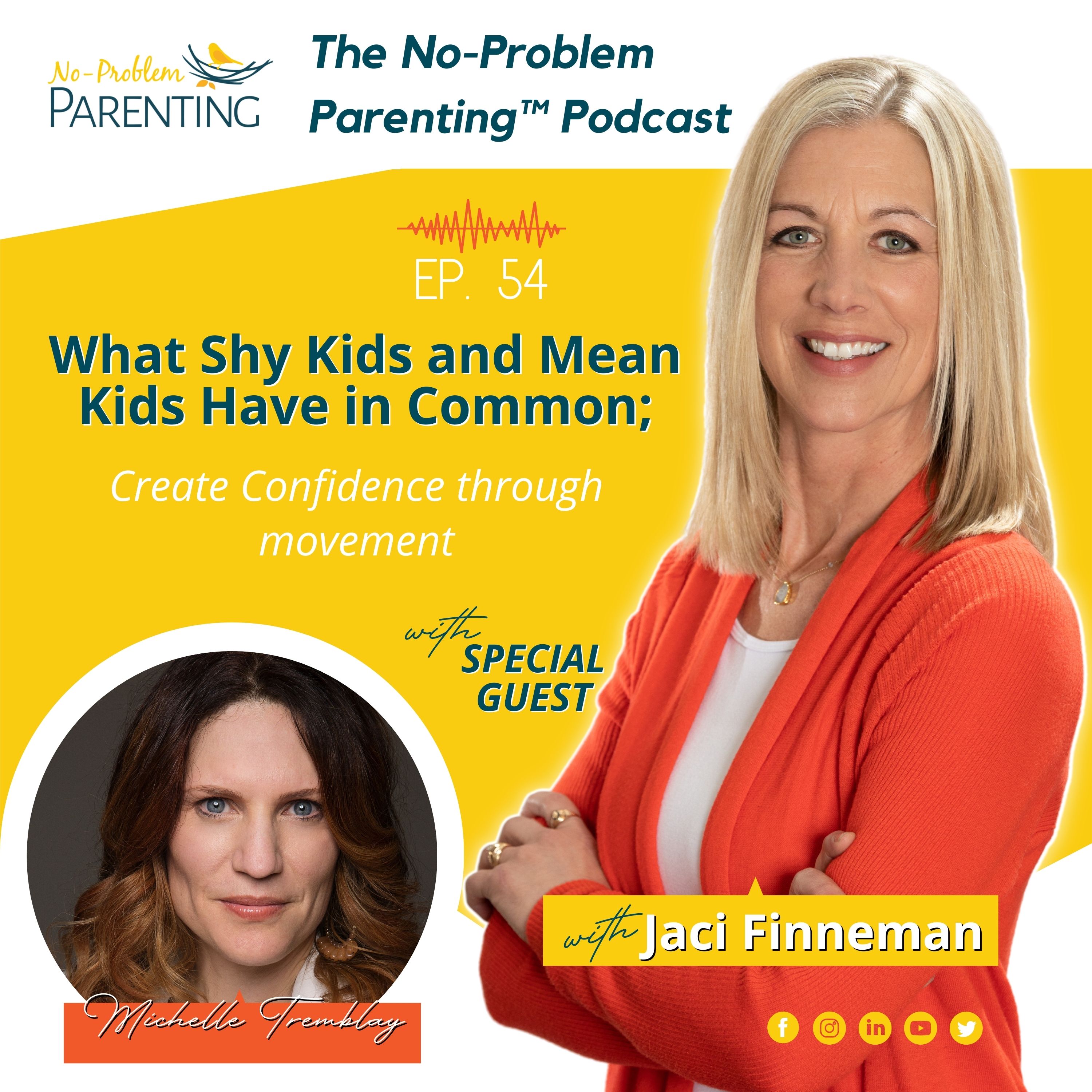
About this episode
Welcome Back No-Problem Parents! Are you raising a shy kiddo? Do they get picked on by other kids and just "take it"?
Or maybe you are raising the "mean kid" and it seems as if they feel like they're better than the other kids but deep down, their self-confidence is no greater than the shy kids.
When a child or teen feels confident about themselves and their self-esteem is strong, they stand up for themselves and/or they don't feel the need to put others down.
My guest today shares how martial arts, yoga, acting, dance, and other forms of movement build confidence in kids.
Become a No Problem Parent Today!
Full transcript
Welcome to the No Problem Parenting Podcast. Turn behavior problems into no problem with Jackie Fineman. Are you ready to become the confident leader your kids crave you to be? Do you want to learn how to make parenting easier and more fulfilling?
Whether you are at your wit's end or you want to have more fun as a parent, you're definitely in the right place. Now here's your host, Jackie Fineman. Welcome back to another episode of the No Problem Parenting podcast, where we choose to deal with and overcome the behavioral challenges in our home. And today I have a super special guest, Michelle Tremblay.
Michelle is the founder of Empower Lives, located in the Tri-Cities area in Vancouver's Lower Mainland. mainland. She's worked with over, get this people, 15,000 participants nationwide and is highly recognized as a powerful speaker, a great motivator, and a compassionate leader. She's dedicated, committed, and inspired to empower change. I love that M power, just the letter M. Empower change in the workplace, in schools, and communities through mental and physical health and wellness strategies, through mindfulness, social and emotional learning, and resiliency strategies. So I'm so excited to have you here today, Michelle. Welcome to the show. Thank you. It's great to be here today.
We are going to focus on bullying today and the difference even between bullying and just being mean. So I'll let you just start in with a little bit of history on you and how you got to the spot today? Sure. So I'll just tell you a little story about myself, though. I was one of the most shyest people you would ever have met. And I didn't have a lot of confidence. And through school and life, I was one of those kids that would get picked on. And and it was because of how I felt about myself on the inside, but what I was giving off to as well. And later on in life, I started taking martial arts and it completely changed my life and I became this powerhouse in what I do and what I'm passionate about working with children and also adults and seniors too. So my passion,
my work is about empowerment. It's about taking the things that we're struggling with and finding ways to get a solution to that. So with what I do with teaching and the excitement of like the programs and the talks I do, it's all about the body. And when we move the body, and when we feel good in the body, it changes the dynamic of how we show up. And we're also learning some really cool things. We're talking about, you know, issues that happen in the schools with friends, the dynamic of, like you said, bullying and being mean, and just being able to feel good and feel good about who you are and confidence right and just really being confident in your own skin yes and being able to know that you know no matter who you are where you've come from that you can get the support and the guidance and the coaching around your own struggle and it could be how to deal with your anger it could be the fact that you're you know you're very very shy like I see kids too, when they come in and, or you're full of anxiety and you don't know how to manage any of that. You don't want to take any risks. You don't want to try anything new. Right. Let's talk about the difference. There's the silent bully. And then there's like the outward, like everybody knows who he, who he or she is that kind of bully. That's just picking on people all the time,
making fun of people, you know, physically picking on them and verbally picking on them. But then you also have that silent kind of bully. And my history with working with reactive attachment disorder and kids who have had that early life trauma didn't bond in the first three years, didn't trust adults, didn't come to know that they could trust adults to meet their needs. Oftentimes there's, you know, that's like a spectrum, but there are those silent bullies that are behind the scenes picking on people, but they're not misbehaving outwardly. And so they often go under the radar. Right. So yeah. So let's talk about some of the differences you see with those bullies. Well, I think the biggest thing is, you know, the definition of what bullying is. And sometimes it's so easy for kids to just say, Oh, that person bullied me. And really they're just being mean. And have we all been mean for sure. So in life, getting kids to understand that they're bullying behaviors that repetitive behavior so they're doing it over and over and over and they're doing it because you know they're getting something from it their power struggle in that they may just be you know thinking that they're the jock or whoever they are in the class that they can just push people around um then also too they're doing it silently like passive aggressively where they're kind of like and it's coming down to that communication of
like, well, how are we treating each other? How do you, how does it feel to be like that? And knowing how I, as a child to be able to stand up for myself and say, stop, what you're doing is not okay. And how does it make me feel? Going back to how does it make me feel? And how does it make that person feel? And to be responsible for how we, how we hurt and how we can damage someone just by those words or what we're saying and doing. But the cause of that is the anger. The cause of that is being able to recognize that if I'm blowing up, what's really, really going on underneath me? I'm frustrated. I'm scared. I'm lonely. I'm jealous. I'm confused. And then I can understand that, yeah, I might watch what I'm just going to say the next time, or I'm going to watch,
you know, how I, how I'm dealing with and interacting with another person. So do you think kids that are actually the bullies or adults for that matter, typically the bully comes off, you know, very confident, very ego-driven or very just secure in who they are and they they're power hungry, or they have this power that's often really not internally the case. They often don't have a high self-regard or a high self-esteem. They aren't feeling good about themselves, but they have to sort of save face or protect, right? Yes. And it's overconfidence. And that's also a sign of it's a weakness. Exactly. Because you see it and you're like, okay, I see what's going on here. And they're trying to hold it together as well.
So what's going on underneath that for them, they've got insecurities, there's something that's happening, but their their wall of protection, as you said, is just like they'll come out being aggressive. And sometimes they don't even know they're being aggressive or being a bully. They think, well, I'm fine. And this tone of voice is fine. And I can just, you know, and meanwhile, there's a lot of, you know, there's a lot of causes to that.
And it's getting to the root of it, you know, the sense of feeling powerless. Right. And somewhere else in their life, that they could be lashing out. Martial arts was such a great way for me personally being so shy to be able to come out of that shell and understand how to be respectful, how to speak my words and be responsible for that. And even in my class, I did see people that were quite aggressive and ego driven, as you said. And I can tell you, when you have an incredible instructor and teacher that can see that, and then they know how to still give that person the attention they're looking for, but make them understand how to respect them and, you know, the other people in the class, then the dynamic of all of that starts to shift. And they're getting that need met by feeling cared for. And they understand that if they go too far, the door's right there. And you're, you know, you'll be gone out of the class.
So even with the work I do with the kids, they understand that the parameters of that boundary. So it's still it's still a lot of fun for them, even though they know that, you know, they're not going to be able to get away with stuff. Right. And they want to be there because it's positive and it feels good. And they feel that, you know, they're as I said, they're being cared for in that way.
so let's talk about your classes what does that look like how do kids get involved in the work that you do so when I go into the schools I either go into the schools like during the school day but teaching after school programs and what that looks like is a kid will come into my class and we'll start our class off first off with the rules about what we're when we're using self-defense and it's never meant to use unless you're in a situation where someone crosses your physical boundary and you need to protect yourself but the sneaky part about that is really when they're coming in thinking they're going to learn martial arts it's not about fighting and it's never about fighting it's about being a good person in the world but it's channeling the energy of anger and the things we get upset with and stuff that happens so they'll come in they'll learn how to meditate, right away, we'll sit there and close our eyes and focus on our breathing and understand how to calm my thoughts down, and be able to see how after a period of time,
I won't become as reactive. And then we get up and we get moving, and we're playing games, and they're learning basic techniques, you know, how to defend yourself, a strike, a punch, a kick, and using the body for that. Then we'll go into some deeper discussions on how do I regulate my emotions? So you may have seen that thermometer of where I am at, where I'm super angry and I just want to, or I want to, you know, scream and yell. Well, it's my responsibility to deal with how I'm feeling. And I need to get from here down to this place of feeling green in the calm zone again.
So what do I do? I can take a deep breath. I could listen to music. I could go for a walk. I could color. And as you see a child start to recognize that no matter where anybody's at, when I flip my lid, I still have to find a way to do something without saying something to someone to hurt them or physically doing something to someone to hurt them.
And so kids start to get that message. And over a period of time, the program usually runs about eight to 10 classes, they start to understand, you know, how they're responsible in any aspect of how they're either not communicating or communicating. Obviously, these kids are coming to you already interested, right? Yeah. Sometimes they are. Sometimes they have no clue what this is.
So my mom just signed me up. My specialty is yoga, is martial arts and yoga. And I have other instructors that come in to do the dance, the acting, the other martial arts too as well. And they are trained in the process of what we just spoke about self-regulation mindfulness so they're all taking their expertise but using their body medium and then using the self-defense component of it or sorry the self-regulation component of it right pretty dynamic and you're getting a combination of students at any given time that could be the bully and or the person being bullied yes right and i have had i've had powerful things happen in my class where we'll talk about stuff and I'll say you know it's never too late to say I'm sorry to do it differently to know that we're doing the best we can in every moment I've had bullies stand right up in front of the whole entire class and apologize and that was a group of teens and the tears were it was like everybody had felt that and knew what it felt like. And they had shared that they had a whole bunch of stuff going on in their life at that time. And they were just lashing out. But it's like, when there's a safety net in a class or in a student's connection that they're feeling, there's like, I would see like,
I say miracles can happen, you know, with them and anything. So they just, you know, it just needs to be brought, we need to talk about those things. We need to find this, we need to have the solutions to help. Right. And I absolutely love that. And I think more of this could be brought into the schools. I think some schools do bring in some, you know, bully prevention or bully awareness or that kind of thing. But this is different. This is more about the person and not labeling a person, you know as a bully or a victim even um but really getting the education in there about seeing people differently and rather than assuming that because they're mean that they're just bad people that instead you think about them having something else going on in their life and this is a self-protection not excusing the misbehavior anything that's inappropriate is not okay and we always want to recognize that you know being able to say to stop to someone is that's a message to say you can't treat me like this but then how do we deal with what's going on with this and we can say okay well you know and I don't know if you guys have but we have a pink shirt day for and it's so it's great for us to wear that to have awareness about you know anti-bullying day and everything. But if we're just wearing the pink t shirt, and I'm not recognizing anything about myself about the dynamic of how I'm dealing with my anger, my emotion, or what's causing me
to lash out, then I'm not we're not solving a problem. Right? Not giving solutions, as you said, so it does have to be deeper. And I think when you do encounter the bully, and of course, schools need to address that and they need to, there needs to be consequences when there is, there is a bully or the workforce needs to as well. Right. At the same time, more can be done.
It's not just, okay, let's consequence the bully and then put them in this category. And then, well, they're just, you know, sort of screwed the rest of their life, you know, good luck to you. Yeah. And then they end up in, you know, you know, juvenile or they're, you know, stealing or whatever else is going on. Like we didn't solve the problem. And I know in our district here even if a kid is expelled they don't they don't want to you know they're changing that too they're taking a child now that are a teen and they're putting them in a program so that they can get educated on what's going on not just like we're cutting you off it doesn't solve anything it's the behaviors it's what's going on so we've come a long way and it's recognizing how can we help and I even asked the kids like why do you think someone bullies well maybe they got you know maybe they don't have a lot of money they'll say at home and they're struggling or maybe you know they're being treated not correctly in their life by their parent a parent or something's happening so there's they're recognizing that let's let's do the favor and taking a little bit of a deeper approach but as you said you don't want let people walk all over you either and I think there's there's two important things that come up with that the assumption of what a bully is and their background whether it's an economic background or you know social background also
the person like you who was more quiet shy reserved not willing or able to speak up just not comfortable with that and so it's not just about the bully but it's also about the person that's being bullied, gaining the confidence to standing up for themselves and protecting themselves and knowing how to do that. Because the other thing is it's not okay to just like make excuses for the bully or be like, Oh, you need to be nicer to them. I remember when my son was younger and there was a couple of kids who were being mean. And I would say, you know what chances are, but they need a hug, but that's the last thing they want right now. Exactly. But it was just sort of reframing in his mind, like he, instead of him taking on this, like there's something wrong with me or they're making fun of me or I'm, you know, I'm not cool or I'm wrong or I'm bad or whatever. And be like, no, no, no, this isn't about you at all. This is about them projecting something onto you to try to feel power or control where they don't otherwise have it.
And so my son's job was to either not just stand up for himself, but just to recognize and be aware of that, that this is not about you, bud. And you can set your limits, but I didn't want him to feel like he just had to go fight and stand up for yourselves. Although there is nothing wrong with that either. I did want him to be able to show his power and that he couldn't be plowed over by somebody.
I try to, you know, I try to get the connection to kids having the awareness about themselves and then not pointing fingers, like you said, to this person and that person. Let's look at me and my part in it. And I think all of this sounds great and sounds good. And a lot of times kids in school will be like, yeah, yeah, we've heard that. And we know we can stop. We can do, you know, we can take the deep breath. We can tell them, no, we can do it. But sometimes in the moment, they really can't because the kid's going to bombard or talk over them or make fun of them or embarrass them or do something really harmful. So in reality, in the moment, it doesn't always work so slick, does it?
And then I think kids think us adults are just like, see, you don't know, you know, I also see kids that when they've come in and they've been bullied, that their self esteem and their confidence starts to rise. And then what happens is that the dynamic will shift just with their own energy in the setting where that person won't even be around them anymore. It's quite magical in how that shifts because they're not, their body language is different.
They're speaking different. They're putting off. They won't even bother with it anymore. And a bully is not going to pick on somebody that isn't going to cower or put their head down or act scared or too shy or whatever and walk away.
It's no fun to bully somebody who's super confident in their skin and is like, what are you doing? Yeah. They'll push back. Right away, they're less likely to get picked on with someone like you said that feels good about themselves so how can we raise because the aggression the bully has low self esteem to have their own stuff so how do we, you know, we actually have to talk about those dynamics of power.
You know, I had an incredible mentors and teachers in my life that modeled what leadership was. And I emulate that in my life and want to pass that on to kids and how to show up and how to be to be kind is not weak. To be kind and caring and respectful is a sign of, you know, true leadership. I think a lot of it, like you're saying, has to do with self-esteem and self-regard in that person, in that child.
Kids that don't feel they add up. Yes. That aren't as good as someone else. And or they're just trying to overcompensate for not feeling loved or connected with their parents or paid attention to.
Yes. I think we need to dispel this like picture in our minds of just what, you know, what a bully is a little bit. It could be anybody that doesn't feel good about themselves inside or doesn't feel like they add up. And if we could change the idea or the thought about the bully, maybe there would be less bullies because like I teach kids, when you see a bully, don't think of power and control.
Think about, like you were mentioning earlier, there's a weakness in there somewhere. There's there's something that they're not feeling good about in themselves, whether they'll deny that to all get out, obviously that a bully would never admit to any of that outwardly until they had some sort of relationship or connection with you, but it is truly what it is. So if we could shift the mindset on that a little bit, I think more kids seeing a bully rather than being afraid or backing down would be like, Oh, that kid has not that it's their responsibility to help the bully or to do anything. Find an adult or somebody else that can help with that. But just so that they don't, it doesn't break down their confidence that there's something wrong with them because this kid is picking on them. I can understand why you're reaching kids the way you are. Let me just ask,
why is physical activity so important to gaining confidence? So being able to move the body and connect the mind and body together is how we're able to deal with the emotion. Finding something that makes me feel good is shifting that energy. Being able to take dance and movement and music and move can shift my state to not even know what just happened 20 minutes ago.
I'm like, oh, yeah, I'm feeling good. And then I'm starting to feel good because I'm moving. And I also start to feel my body shift in how I start to stand taller, how I start to feel stronger. So specific to martial arts, martial arts is a lot about feeling your power, feeling strength, and being able to use that when you hit a focus pad, when you kick, when you punch.
but you're always doing it in a place of self-control you're not physically hitting someone we don't do full contact my martial arts is very um traditional and the beauty of that is being able to take the anger and you know hit a focus pad or kick it and punch it i'm releasing it out and i'm moving it and then afterwards i'm starting to feel so much better 20 you know an hour after the class, I'm going, yeah, so this connection that, you know, I'm releasing this stuff, I'm like a different person, because I'm starting to feel good. And when you feel good, you feel strong. And when you feel strong, you feel confident, and your body is different, your mind is different. And you're not even thinking about what what that was before. So it's like that instillment of that strength and being able to like move it so sometimes kids will release they'll cry in my class for doing yoga and even in martial arts they'll get their own experiences where you know they're holding on to so much but it's got to come out somewhere yeah I love that book the body keeps the score by Bessel van der Kolk keeping all those emotions in And sometimes the, the, the things that have happened to us, even especially if they've happened to us early or pre-verbal or whatever, we can't verbalize them.
We don't know what to do with the emotion or the negative feelings or the bad feelings we're having inside. So absolutely getting it out through movement is super and, and sweat and physical activity and all of that is super key. Yes. And understanding that's so positive for us to do that at a young age to start, because as we get older, there's more stress, we'll find there's decisions, there's more on our world of responsibilities that we have to find an outlet that's healthy. And that we're going to feel good to still regulate our emotions, and be able to feel good and feel that sense of Okay, yeah, I know what I need to do for myself right now, I need to go for a walk. It's, it's the same at any age and so with specifically with getting kids at that young age is that it turns into that level of confidence that they start to feel in their physical body then it turns outwardly into the rest of their world and when they feel that too it's like they stand as i said they stand differently and they they connect with others differently and the the energy of just who they are as a being in the world you can see them start to i want to help other kids and they want to like empower them too and some of the kids i've taught are now kids that come in and they volunteer for me and they're the leaders and they're like feeling all proud of themselves because they oh yeah we know what she's gonna do now okay just a minute you know and they'll get out there and
they'll show the kids and it's just it's full circle as you continue to help mold them and guide them and gauge, you know, the things that they need to work on and the positive reinforcement and, you know, how to give feedback. It's all important, important cues in that. Getting up, getting kids to be comfortable in their own skin will, would prevent a lot of problems. Creating confident kids. That's what we're all about. I help create confident parents so that the parents can help create confident kids. How can the parents listening get in touch with you. I know while you're in Vancouver, which is not going to be accessible to everyone, your court, your classes won't be accessible to everyone. You, you are a speaker and you do some online stuff too. So why don't you share with us a little bit about that?
Yes. So I'm in the midst of just launching my online coaching platform. So I'm going to be doing parent coaching too, as well. Cause I do have parents come to me and say, this is happening with my kid but I feel like I need this and they'll sit in my class and they'll watch and they'll be like oh my gosh I'm learning so much it's so important and I think it's so another stigma is to like and you know this it's like oh yeah I'm a parent I have it all figured out well you don't you know and they need help too so in that I also have like workshops I do with parents and the kids do this martial arts stuff. And it's amazing. When I'm offering, I'm able to do most everything now online, and I can actually teach my programs online.
So I can do, you know, the work I do through workshops and programs online, if a school is interested, even in me having a speaking opportunity, it can be done all online in the school. And I also do the one on one. So it's also for the workplace. And it's also people that are looking for even their career transitions, I have like a whole gamut to things that I love.
Maybe the best place to send them is to empower lives.com your website. Yes. Yes. So I also have other instructors that are doing teaching in the schools. But if it's you know, if you have your, your listeners are all over the states like they can reach me through the online platform I also have like events I do I have a boys event coming up and it's boys all the grade threes the fours and the fives and it's going to be big groups of kids coming in bus through through the district and they do half an hour segments we're not able to do it in person they've decided not to do it even though it's May and we're going to do it online so you might have 100 kids in a in a group all connecting online through the school and I'll be teaching them these things let's and I do some crazy stuff on the online which is you know so much fun for me to teach and still make the connection so yeah how do you keep them engaged when you're doing that just well they're physical with me and it's fun like I use pool noodles I make them jump they've got a block and I use it with the camera and they're doing jumping jacks or stretching I'm asking questions in the chat I get them engaged the music so you know I've had to learn a huge thing being an instructor and still be being able to do this reach which is so important because kids need their physical and their mental health and if they're on their screens anyway they might as
will be on an online class learning something and interacting with some people at the bright sides of things too. And so hopefully more parents will connect and go to your empower lives.com. You also have, Oh, and I should say M the letter M not E M yes. The letter M power lives.com.
And then you're also on Instagram and LinkedIn. I have a new Instagram. So I'm doing a lot more Michelle and it's Michelle with an extra E dot Tremblay. And I do reels every day. I've got lots of great messaging. And I I'm and I also have, I have such a love for fashion, music, my martial arts, my fitness. So that's all in there. Lots of great stuff. All right. Well, thank you so much, Michelle, for being with us today. Parents, be sure to go to Michelle with two E's. So M-I-C-H-E-L-L-E-E dot Tremblay, T-R-E-M-B-L-A-Y, her new Instagram.
Check out all the fun stuff she's got going on there. And thanks for being here today, Michelle. Thank you, Jackie. It was awesome.
Thank you for tuning in to the No Problem Parenting podcast. Join Jackie next time for more tips, tools, and resources that will help you become the confident leader your kids crave you to be. Who do you know that we could support on their parenting journey? Like this podcast, subscribe, share, or leave a review of the show. Your support of the No Problem Parenting podcast pays it forward and helps us help more families.
Thank you.
Become the confident leader your kids crave
The method, the community, monthly live Q&A with Jaci, and Celia — your AI guide in the moment.
Start your 14-day free trial Get it on iPhone or sign up on the web