
Safer Childbirth Strategies: Expert Advice from Attorney Gina Mundy & Jaci's High Risk Pregnancy
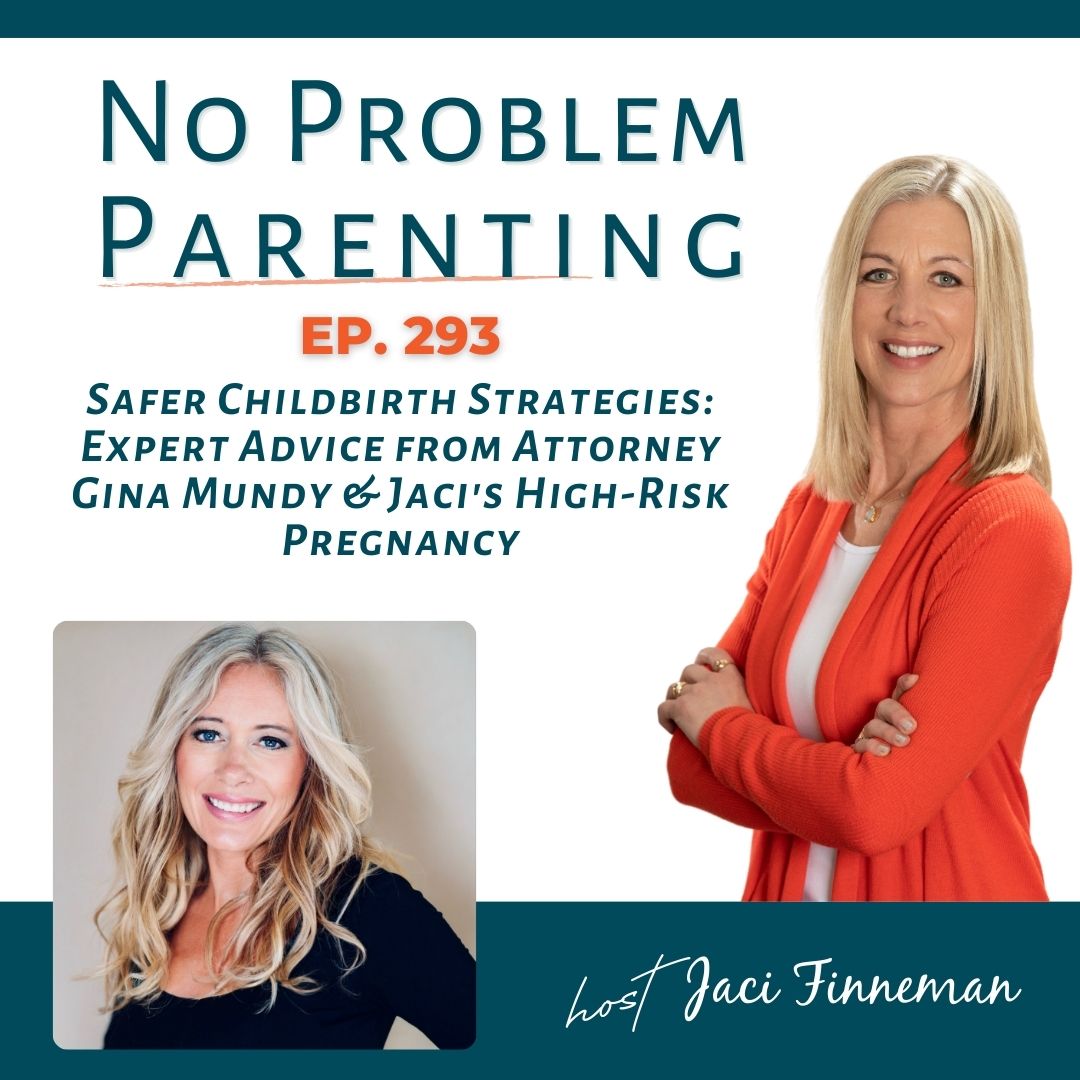
About this episode
In this powerful and informative episode of The No-Problem Parenting Podcast, host Jaci Finneman welcomes attorney, bestselling author, and childbirth advocate Gina Mundy to discuss how parents can take proactive steps to ensure a safer and more informed childbirth experience.
Jaci also shares how she "prepared for the worst" when she was told her baby would need to be delivered via C-Section.
Gina brings over 20 years of experience specializing in childbirth cases, analyzing labor and delivery practices, and working with healthcare professionals across the U.S. Her book, A Parent’s Guide to a Safer Childbirth, has helped countless families prepare for one of life’s most transformative moments. Tune in to learn how to advocate for yourself, ask the right questions, and feel confident about your birthing plan.
Topics Covered in This Episode:
The most common mistakes made during labor and delivery—and how to avoid them.
How Gina’s expertise in analyzing labor and delivery cases helps parents make safer decisions.
Practical tips for preparing for childbirth and advocating for yourself during labor.
The importance of asking questions and understanding your rights in the delivery room.
Become a No Problem Parent Today!
Full transcript
Hey, welcome back parents to the No Problem Parenting podcast. I'm your host, Jackie Finneman. I'm a parent coach and author, a speaker and the creator of Becoming a No Problem Parent. And if you're here to gain tools, strategies and confidence to take the drama out of parenting, you're in the right place.
Today's topic is super important to me. It's personal, impactful, and I know it resonates with many of you listening. As a mom, I've experienced both the heartbreak of losing two babies and the challenges of navigating a high-risk pregnancy. When I was faced with unexpected bed rest at 25 weeks and an eventual C-section with my child, I learned firsthand just how critical it is to be informed, prepared, and supported during pregnancy and childbirth.
And it's because of my experiences that I am so passionate about bringing you resources and conversations like the one I'm having today. Birth is a miraculous and life-changing event, but it does come with complexities and risks that many of us don't even think about until we're in the middle of it. So my guest Gina Mundy is here to help us take a proactive approach to childbirth, to really be prepared for quote-unquote the worst step to have no problem parenting and be as confident as we can be. Now before we get to our guest today, I do want to share something really exciting for all of you parents. Our new parent support network called The Nest is officially launching in January of 2025. This is a one of a kind community where you can connect with other parents, learn from experts and build confidence in your parenting. And we have a special promotion going on from now until December 1 of 2024. When you register to become a no problem parent, you're going to get the no problem parenting training, but you're also going to get one month of the nest starting in January, absolutely free. We're in preparation right now to launch the nest. And so the best way to stay up to date and be included in all the updates and the information as it happens is to sign up for our emails. Go to no problem. Parents.com.
You're going to get a free download of the 60 ways to respond to your kiddos without losing your cool. And you're going to get so many other resources that have been game changers for the families that we've worked with the past 11 years. Yep, you heard that right. Our 11-year anniversary of Hello World and No Problem Parenting is coming up on November 26, 2024.
I'm really excited for 2025. We can truly deal with and overcome the parenting challenges in our home. Get connected with us and become a No Problem Parent today. I have a really special guest joining us, Ms. Gina Mundy. Gina is not only an attorney, but also a bestselling author, wife, and mother of three kiddos. She specializes in childbirth cases and has authored the groundbreaking book, A Parent's Guide to a Safer Childbirth. Gina, I'm so excited to have you here.
Welcome to the show. Oh, thanks, Jackie, for having me. I am excited for our conversation today. Well, you know, you just fall in line with that step two of no problem parenting, prepare for the worst, in helping moms really feel as confident and empowered and prepared as they can be going into birthing a child. And so I'm excited to learn some tips and some things from you today on how we as moms can really prepare for delivery. I think I'd like you to start with telling our listeners just a little bit about what inspired you to pursue this path.
You know, I wish I had a better story. They do not teach you in law school, high school, college. We didn't know anybody who, you know, they were childbirth attorneys. So I literally just graduated law school and I stumbled on this job. I was hired in, but the scary part is I was hired into a team of over 20 people and all we did were childbirth cases. And just so your audience understands, when there's a childbirth case, that means baby is not born healthy. Baby may pass away during childbirth or mom may pass away during childbirth. As the attorney on the case, I would come in, find out what happened, what went wrong, why. But most importantly, what should have been done so baby was born healthy, mom around to raise their baby. So when I was hired into a team of 20 people, over 20 people, you know, I was concerned. I was like, this is a whole nother world I had never heard of. Not only that, having a baby was on my radar. I had just gotten married. So I wanted to make sure what I had been seeing in my cases didn't happen during the birth of my kids.
Your book definitely fills a really critical gap, I think, by empowering parents with knowledge. So give our listeners a sneak peek into what they can expect to learn from your book and really why you were drawn to write it. Oh, absolutely. So I've done this now 21 years. The first 19 years, I was just getting involved in the aftermath of something going wrong as the attorney. And then we had basically like a near tragic family event where my niece was giving birth to the first baby of our next generation, and it went sideways.
and I remember I was it was March 17th 5 p.m. I was in my kitchen surrounded by my kids it was one of those moments you'll never forget where you are and we picked I picked up the phone it was ringing and we were expecting to hear that a good news that my niece Sam had her baby and instead it was my sister hysterically screaming at the top of her lungs Sam's mom how the baby had crashed, the baby had crashed. I run away from my kids. I don't want them to hear this.
And of course, attorney brain kicks in and I'm like, what happened? What went wrong? But then as I listened to her cry, I went from attorney to analysis, almost like a human analysis thinking this is how the families feel. Because I'll tell you, the hardest part of my job always has been sitting down with the families and going over the day their baby was born, the day they lost their mom. And so it was like, oh my goodness, it was almost like a human connection. Like this is how they feel. They have described this moment to me for 19 years at that point. They always describe life before baby, life after baby. And so we were lucky though, we did get the news that the baby was going to be okay. It was about 20 minutes later.
and but that moment stuck with me and I started to think of my own kids my two older girls 20 almost 16 and I have my little man who's nine years old and I can tell you how I prepare them for childbirth based upon what I have seen it's completely different than how a normal family prepares so it was at that point I'm like okay I have to start writing these things down that day I was 1,100 miles away from Sam. Sam, her story is the introduction to the book because that is how it all came about.
I'll tell you, writing a book was never on my radar until that moment in time. And so basically, I started to write everything down because in these cases, there are reoccurring issues. There are reoccurring facts that people do need to know and understand so they can prepare and make sure what I see in my cases doesn't happen to them. So as I started to write it all down, I realized pretty quick this was information that will not only help my kids have a healthy baby, but families everywhere.
So basically, I spent a lot of time writing the book, and I structured it in a way where chapter one, those are all of the lessons from the baby cases. As a lesson, we can learn from it to prevent it from happening in the future. Each lesson then is a subsequent chapter and it will elaborate more on what parents need to know and need to understand. But one of the, you know, I'll give you the first lesson because I know you'll appreciate it.
Lesson one, you must prepare for childbirth. The families in the cases are one decision or minutes from a healthy baby. Being ready for childbirth and having an understanding of the decisions you may have to make is so incredibly important because it is almost impossible to prepare for childbirth, which is exactly why you need to be ready. And that will help you. It's like anything in life. You're going to make better decisions if you're prepared. So then you go to chapter two. Okay. This is the information that me, Gina, as a childbirth attorney believes that every parent should know. It's not what you're going to find in a normal pregnancy book. It's things that I know. If I'm looking at the care that a mom received during labor and delivery. These are like the facts that I rely on to say, okay, were these good decisions, bad decisions? Was this good care, bad care? But I put these in the book to give families almost like a good foundational base to make those good decisions. And then fast forward, another super important lesson, and I just touched on it a minute ago, there are reoccurring issues. There are reoccurring facts in these cases. And if parents know this, it will give them a heightened sense of awareness. It'll help activate their intuition again so they can make those good decisions. So you go to chapter one. This is,
you know, I just don't think a childbirth attorney ever thought to write a book because people are always like, why is this information just coming out? But chapter 11, the number one most common fact and issue in a legal baby case is the drug Pitocin. Pitocin is the drug that is used to induce mom's labor. And I'll tell you, the bulk of my cases since February 2003 involve that drug. These days, Pitocin is very, very common. So I wrote then, it's one of the lessons, Pitocin's number one most common fact in legal baby case. So of course, there's a chapter on how to have a safe Pitocin induction because I have traveled the United States many, many times meeting with different delivery teams, hashing out, you know, Pitocin, the usage, the dosage,
actually hashing out every aspect of labor and delivery with a huge focus on Pitocin. You know, research the drug, I mean, you name it. It's been a long, it was a long, many, many years of analyzing that drug. So here's how to have a safe Pitocin induction.
So things like that, but there's, I put the top 10 in there, the common issues, common facts, in hopes that, again, if parents know this, they're going to understand, they're just going to be able to make better decisions. And it's important to understand that when you're in labor, mom's the decision maker. Doctors, delivery team, they're more like medical advisors. So it's really, they'll advise you, they'll give you options, but a lot of times they leave it to mom to make those, you know, really critical decisions. Now, obviously they'll give recommendations based upon their training and experience, but they'll be like, you have this option or this option. Right, right. What I love about the book too, and just your work and your mission behind the book, is that number one, communication and informed decision-making are super critical aspects that can help us endure a safer childbirth. Your approach aligns perfectly with steps two of no problem parenting, prepare for the worst, because it's not fear-based. It's not a fear-based approach. It's a, hey, let's take the fear out of this as much as we can and prepare for the maybe unlikelihood or likelihood, depending on your history, of a tough labor or difficult labor and doing what we can to be as prepared as possible so that we are equipped and not deer in the headlights if the delivery doesn't go as well as we expected. It's not that you're saying
don't use Pitocin. It's saying there are ways to safely use Pitocin. And then there are situations where you maybe wouldn't want to. Oh, absolutely. Listen, Pitocin may be a great option for a mom.
And so definitely my focus is more on how to have a safe Pitocin induction. So that's definitely the focus. But I will say this, that with especially like Pitocin and elective inductions, meaning mom's choosing to have an elective induction versus a medical induction where maybe there's a medical reason to have an induction. But it's just more like if you use Pitocin, just understand there's an increased risk of a complication or a mistake that may be made. But the other side of that is that natural vaginal birth, spontaneous, those cases are few and far between. So if you take that route, there's definitely less chance of there being a mistake or complication. So back to Pitocin, here's the deal. Doctors across the country believe it is a safe option. Where they disagree and everybody gets into trouble is how the drug is administered. Conceptually, it's super easy. Pitocin, it starts at one. Usually a doctor's order goes to 20. Doctors can increase it by one, they can increase it by two. So they could increase it, you know, two, four, six, eight. And then they can increase it at different intervals.
They could increase it, you know, some do it for 15 minutes, 30 minutes or whatnot. So basically, based upon my research and whatnot, I like the slow and steady approach because Pitocin is a very individualized drug. How your body responds to it, nobody knows if you've never been on it. And how you respond to it may be completely different than how somebody else responds to it.
So as long as it's medically okay, the slow, steady, let it hit your sweet spot is definitely the way to go with Pitocin. Well, and also, I don't mean to interrupt, but also how your baby responds to it, right? Oh, that's huge. And it's because also keep in mind, you know, baby's inside mom.
You know, when their mom's in labor, there's two patients, mom and baby. Mom's easy. They look at mom, mom, you're in a bunch of pain. Let's talk.
They communicate, diagnose, plan. Great. Baby's inside. So the way that they have to figure out if baby's doing okay during a Pitocin induction is to look at their heart rate.
And I've had doctors testify and I included the testimony in my book. Gina, the only way a baby can talk to me during labor is through their heart rate. So I find the heart rate to be just extremely important as a childbirth attorney, reading a baby's heart rate was the first thing I learned how to do. And that's because, again, it's going to tell you so much about how your baby's doing in labor. So, and if you're having a Pitocin induction, I highly recommend that you understand how to read your baby's heart rate. And look at it, you look at it at first, it might seem intimidating and it might take an hour. And I thought they probably took me like an hour and a half to figure out how to read the baby's heart rate. But I do, that is actually one of the lessons is learn how to read your baby's heart rate. Now, the medical community has wanted to keep that baby's heart rate kind of the interpretation to themselves. I am like, nope. So nope, nope, nope. It is the basis of so many decisions in labor and delivery that you have to understand it before you go into labor. And that way, again, it'll help you make those good decisions. So that's a lesson. And then in chapter nine, I go over what you need to know about the baby's heart rate. Again, things that I find important as the childbirth attorney to help each parent make those good decisions so they have a healthy baby.
Well, I love everything about this. When I learned at 25 weeks that I needed to go on bed rest for our son, I had had a miscarriage the year before. It was very scary to learn, uh-oh, you know, there's a problem here. You're on bed rest at 25 weeks.
I watched a ton of, at the time, oh, I can't even remember the name of them, but these shows about C-sections, specifically about C-sections. because I was going to have this baby naturally. I was, you know, I had my plan all in my mind and the rug got pulled up with that plan. And so I was like, I need to educate myself.
And it just so happened there was a show on TV, on TLC or something about C-section deliveries. And so at first it was really scary to watch some of those episodes, but it was so informative at the same time. And I didn't realize it until the actual day of our son's birth that things that were happening in the delivery room, I was aware of. I was like, oh, they're doing this. They're doing that. They're doing this. This makes sense for this or that. When our son was born and they had to whisk him off to the NICU because his lungs were wet and so he was having some difficulty breathing, I didn't panic. I said to my husband, go. Go stay with him. Follow him. I'm good. But make sure that you don't lose sight of him. And I wasn't afraid. I was informed. So I knew that this was a thing that could happen when you deliver C-section. Your baby can have wet lungs and they can recover and all that. But what I love about your book then, again, and why I'm bringing this up, is that your book really helps to give examples of different situations and scenarios.
It's not saying you're going to go through that, but if and when it does happen, you do feel some almost security, just in empowerment or a little bit more at ease that you're informed and you don't have to be so scared or panicked. Right. Because when you are, like you just said, deer in the headlights, it's because you're having a surprise conversation with your doctor and you're on labor and delivery. It's so hard to focus. Another one of the lessons in chapter one is to prepare a birth plan. It's not the birth plan in and of itself. It's the act of preparing the birth plan. And while writing that chapter, I actually was getting a text, and this is actually in the book because I found it so ironic that I was writing this chapter and I have a mom that I do not know in labor and delivery texting me because her doctor had told her something and she clearly could not focus on what was happening, what was going on. Again, the story's in the book.
It's a good outcome. But she didn't know what to do to the point where within maybe a half hour, she's on the phone with a childbirth attorney. Somebody had just referred her to me. And I do get a lot of calls from labor and delivery. And it's funny. Now, I include a lot of those stories in the book, not so much the ones with bad endings, but I include the good ending ones.
And I think that those stories also carry valuable lessons in and of themselves based upon the not so good ones. The point of that is she just did not understand. She could not follow what her doctor was saying. And that element of surprise just caught her so off guard that, you know, I kind of had to bring her down, explain a little bit to her. Mind you, again, I do not know this person. So getting ready and preparing. So if the doctor does say something that you've thought about it. And in my book, chapter six, I'm like, these are the really important things to think about that can be life changing. And, you know, a lot of people, you know, they'll do a plan and then I'll hear from the labor and delivery nurses. You know, they want these candles,
these music, the scents. Listen, that stuff is great if it helps you relax. That's not what you're going to find in my book. I'm totally for it, though, because I do believe a mom that is relaxed is going to have an easier time with labor. You want to avoid this fight or flight mode because that's going to delay labor or childbirth and whatnot.
But yeah, so my, again, I go over, this is what you really need to know or consider or whatnot. So you're ready. And then taking that plan to your doctor during pregnancy and you guys going over it, making sure everybody's on the same page. And then the day mom walks in to, you know, give birth, if she wants to give the plan to her delivery team, you know, that's great.
And if she doesn't, that's great. Again, the act of preparing is the most important thing. Yeah, I absolutely love it. It's empowering and it's really a mom's decision.
It's difficult for a mom to make a decision when she's not informed and caught off guard, much less in the process of delivering a baby. I find that interesting that you get text messages during labor. Yes, many times. Yes.
my nieces labor, like everything that had happened, I actually knew we were expecting the phone calls. I knew she was close. I was not expecting that phone call, but no, I get pictures. I get calls. I get, oh yeah, I get a lot of it. And a lot of it, sometimes it's moms. So moms really need to focus on following their intuition, following their instinct. I believe when you have a baby inside you, it's like on overdrive and mom will have instinctually want to do something.
and a doctor is like, that's not a good option. Somehow again, mom gets directed to me. And again, it's not even, it's not medical advice. It's not legal advice. It's, you know, hey, if it was my baby, you know, that's what, this is what I would do is typically what I say, or these are the risks.
You know, I had a mom, it's a longer story, but I'll keep it real short, but it was a VBAC, vaginal birth after C-section. She wanted her second baby to be born by C-section, like her first baby, the doctor pushed her for a vaginal birth. And she's like, no, I want my C-sections. Like she knew. And she did, she called me and I'm like, just take your C-section, follow your instinct. That's a good choice. I'd say that's what I would do. Doctor goes in, cuts her belly open to deliver the baby. And it's like, thank goodness we did not try this vaginally.
This could have resulted in, you know, harmed a baby and her. Longer story again, that's chapter, I think that's chapter seven of my book. So yeah, I do get a lot of those calls and text messages. Follow your intuition. That's really key too. So does the book cover at all? What happens if you disagree with your doctor and you have that intuition or you've done your research or you've prepared and your doctor's making a medical decision to, I don't know what it would be, but that you disagree with, then what? So mom is the decision maker. Nobody can do anything to mom without her consent. So that's number one. Number two, the doctor, tell them to chart it, stick in the chart. Be like, I disagree with your decision. This is what I want. I'm the decision maker. You're my medical advisor. You make recommendations, chart it. And that's it. And then you do what you want to do and they will advise you accordingly and whatnot. So it's very important though, just on the chart it. Listen, they're going to chart it anyway. But I'll tell you, your delivery team, your doctor heads the delivery team. The delivery team is responsible for bringing your baby safely into this world. In the legal baby cases, it is their care that is at issue and analyzed more than any other aspect of the case. So if you think that they're making recommendations that are not safe for you or not safe for baby, then yes, you have the
autonomy to be like, nope, not doing it. And if you don't like it, just chart it. I understand my body. And it could be for whatever reason. That day, that doctor wanted vaginal births.
She did not want to do a C-section. So it's like, turd it. I want my C-section. And that ended up probably saving the baby's life.
Again, it's a longer story. It's in the book, but that's definitely, it's a very eye-opening story. And so I like the idea, too, that you've got the plan in place and then carry that with you. Have it in your hospital bag for when you go just in case there is some sort of an emergency and you don't get your doctor.
Then you have that plan in case you do wish to share it with whoever's the team that's delivering your baby. So I think that's also a really good point, too. I love all of this because, again, it's preparing for, quote unquote, the worst or just being prepared. So I love everything about you, Gina. I'm so excited that we were connected. Before we wrap up, let's tell the listeners where they can find your book and how they can connect with you and learn more.
Oh, thank you, Jackie. The best way is always GinaMundy.com. G-I-N-A-M-U-N-D-Y.com. And then in terms of the book right now, the best place is Amazon. If you put my name Gina Mundy in the search bar, it pops right up. And then if you're social media right now, I love Instagram at Gina Mundy.
All right, we'll have links in the show notes for all of that. I really appreciate you coming on the show to share your expertise on how we can ensure a safer birth and how moms can feel empowered and prepared for the birth of their child. Thanks so much for being with me today. Oh, thank you, Jackie, for having me.
It was a great conversation. All right, parents, that's it for today. Thanks for listening to the No Problem Parenting Podcast. Remember, with the right tools and a confident mindset, every parenting challenge, every parenting problem can be turned into a no problem.
If you're ready to lead your family with clarity and confidence, consider joining us in The Nest. Kicking off in January of 2025, our Power Hour calls, our resource library, and supportive network are designed to help you handle any parenting challenge. Early bird pricing is available now, so learn more at NoProblemParents.com, and let's keep building that confident, no-problem parenting mindset one step at a time.
Thank you.
Become the confident leader your kids crave
The method, the community, monthly live Q&A with Jaci, and Celia — your AI guide in the moment.
Start your 14-day free trial Get it on iPhone or sign up on the web