
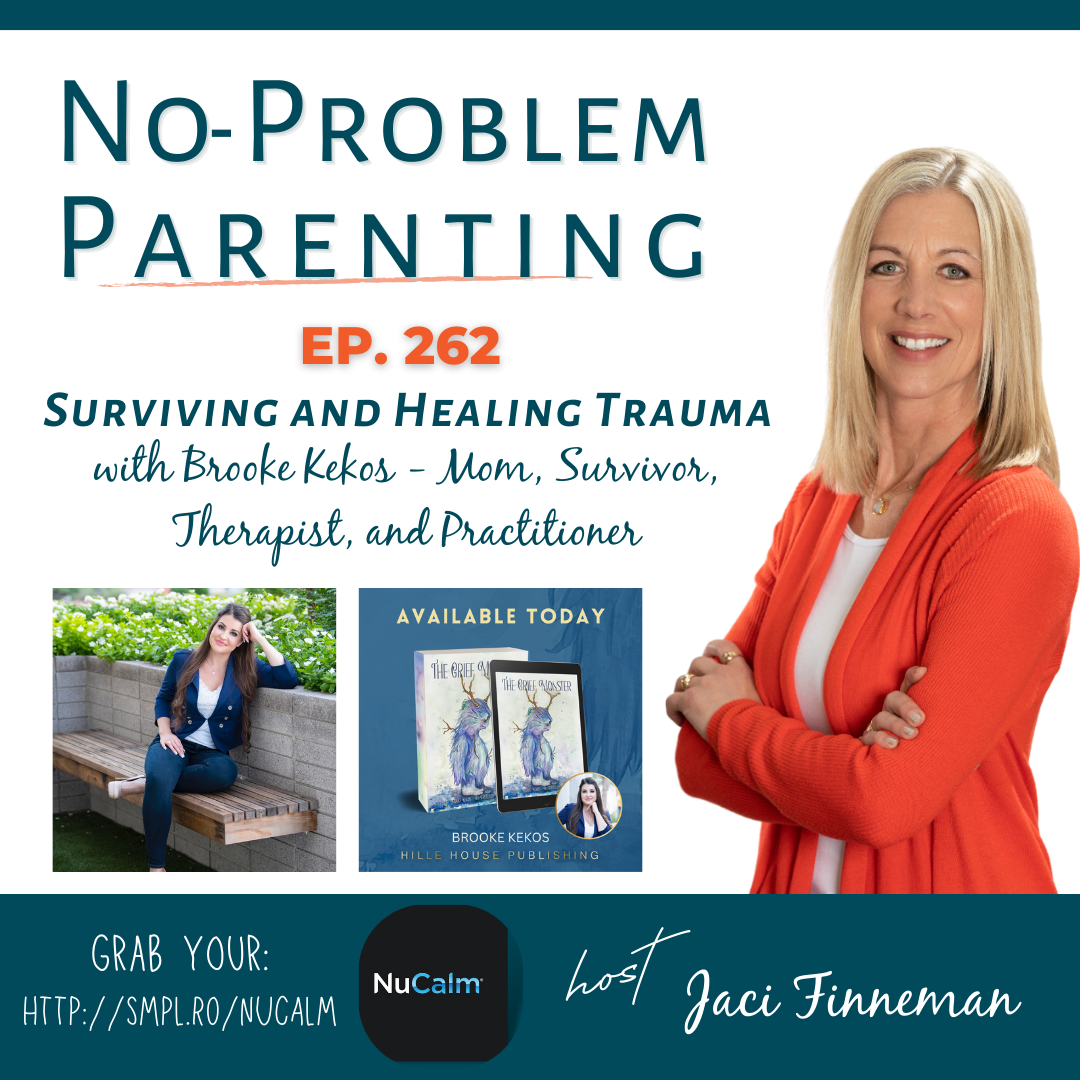
Surviving and Healing Trauma with Brooke Kekos - Mom, Survivor, Therapist, and Practitioner
About this episode
Welcome Back No Problem Parents!
Today we welcome Brooke Kekos, a compassionate mom and professional helping women on their trauma recovery journey. As a devoted Trauma Recovery Coach, Rapid Transformational Therapist (RTT), and NLP Practitioner, Brooke specializes in empowering survivors to rewrite their stories.
Today we talk about resources to support you in healing your trauma. Including CBT, NLP and Rapid Transformational Therapy (RTT), and we celebrate the launch of Brooke's new childrens book, "The Grief Monster."
Become a No Problem Parent Today
Full transcript
All right, welcome back, No Problem Parents, to Therapeutic Thursday's episode. And today I welcome my guest, Brooke K. Coase. She is a compassionate mom and a professional helping women on their trauma recovery journey.
As a devoted trauma recovery coach, a rapid transformational therapist, and an NLP, neuro-linguistic programming practitioner, Brooke specializes in empowering survivors to rewrite their stories. Today we're going to talk about resources that are going to support you in healing your trauma, including CBT, NLP, and RTT. And we're going to celebrate the launch of Brooke's new children's book, The Grief Monster. There's a link in the show notes for you to order your copy of The Grief Monster and support Brooke's mission. 50% of the proceeds are going to be donated to the Hope Foundation in Arizona, supporting children in the foster care system who have endured abuse and neglect. The Grief Monster tenderly navigates the complex emotions of loss through the eyes of a young boy, Finn, who grapples with the death of his dad.
Join Finn on his journey filled with poignant moments of laughter, tears, and healing as he encounters a unique companion, the grief monster. In episode 261, we talked about NLP. In episode 225, I share more about what cognitive behavioral therapy, CBT, is. In episode 239, we talk more about DBT, dialectical behavioral therapy.
So many options out there for you as the parent and also for your kiddos. Stay tuned as I welcome Brooke to the show and learn more about her work with women who are surviving trauma and her new book, The Grief Monster. Hey there, parents. Thanks for listening to the No Problem Parenting Podcast.
Are you ready to become the confident leader your kids crave you to be? Are you losing your crap on your kids, yelling, giving in, and exhausted at the end of every day? You can start building confidence in your parenting immediately, whether your child is a toddler or all grown up and still living in your house. Don't make this parenting gig harder than it needs to be.
Register to become a No Problem Parent. It comes with an app so you can listen to the tips and tools just like you're listening to this podcast. Click the link in the show notes or go to NoProblemParents.com.
Become a No Problem Parent today. All right, so welcome to the show, Brooke. I'm super excited to have you here today. Oh, I'm so excited to have this conversation. Thanks for having me.
for The Grief Monster. So let's just start right there and tell us about The Grief Monster and what motivated you to write the book. Yeah, of course. So obviously, I love the topic of emotional intelligence for children. This book, The Grief Monster is really for a child that's between the ages of three and eight. And this story is inspired by the fact that I saw my children have to grieve their father. So we tragically lost him in 2020. And that grief just really was a struggle for all of us to kind of navigate through. I didn't even, you know, it's just like something you just don't expect in your life. And it's just such a surprise.
And then watching your children grieve, the loss of a parent is like, man, that mama bear comes out and you're just like, oh my gosh, how do I heal this pain of theirs? And I just recognized that it was really hard for me to find books that explained grief for a younger age. Cause my youngest child was, I believe six at the time. And so it was really hard for us to like find something that we had, there was books out there of course, but I just thought, man, there's just not enough out here for this. I'm like, we don't even know what to do with this topic of grief and this loss of a parent. And so that's really what ignited me to sit down and write this book along with some other books that is going to be released in the coming year about children's emotional intelligence and really getting connected with this grief monster. And I don't think it's just for children. I think us as adults have a grief monster. I was just going to ask about that.
Tell us about the grief monster and how you came up with that, that name even. So, you know, it's kind of funny, but I always, I adored monsters Inc. When that came out. I mean that obviously I was an adult when that came out, but I absolutely loved that.
And so when I was kind of feeling into this and kind of getting into my own like inner child and being like, oh my gosh, if I was a child, what would, how would I connect to this emotional space? and it was monsters. I was like a cute little grief monster that you can't even hate, like that you can't actually be afraid of. Like maybe he's scary at first, right? Maybe he looks a little scary at first, but actually he's warm and endearing and he's there to kind of hold space for your grief and your sadness. And so that's what I really connected with.
And in the future books, that's also going to be how kids can connect. that's amazing so it'll be like a series or different topics on emotional intelligence yep it'll be a series it'll be different topics of emotional intelligence my next one that's in the works is the fear monster so really helping kids kind of understand okay what is the fear and what does that feel like in my body and why does this happen to me and to really connect with what fear is really saying and how the brain operates right the brain is here to keep us safe and this is what fear is for. And maybe sometimes this fear is not really meant to be here. Maybe it's, you know, you know, your fear response, maybe it's too active. And that's why you're so afraid to like go and try new things or be social. So it's really wanting to speak to that because I think so many kids deal with shyness, you know, feeling like they got to hold themselves back or not belonging. And so it's just really, I'm wanting kids to connect to a different part of themselves to be able to understand emotion. Well, and it sounds like through the books too,
you're able to help parents know how to have conversations or help their kids identify emotions, but even for themselves and, and how to regulate their emotions. So it's like, yeah, the books are children's books, but the adult is learning right along with the kiddo. Yeah, pretty much, honestly, because I mean, I don't know if you've met an adult that cannot regulate their emotions, but it happens more often than not. It's funny, we think the kids can't handle their emotions, but we as adults are not the best either. And a lot of the times it's because we're under high stress, our nervous systems are dysregulated, because we're juggling so much, right? As parents, we're juggling a job, we're juggling a relationship, we're juggling our kids.
and we're just like surviving. We're not like really being able to connect even with our own emotions because we're so busy. We're putting all of that stuff to the side. And so it's funny.
It's like, it's really, you're right. It is meant for adults too. I mean, you can connect with it just as much as your kid can. Well, and then add grief on top of that.
All of the busy and all of the daily to-dos and the events and all the things. And then as a wife, you know, grieving the loss of your husband. And now how do you, how do you, how do you help your kiddos through that at the same time? So I think this is just a really important topic for one. And, and I'm so glad that emotional intelligence is becoming more known and talked about like in previous episodes with Dr. JJ, we're talking about, you know, a thought versus a feeling.
And that if you say, I feel like chances are the words following that are not a feeling, they're actually a thought, you know, and so really determining that. And I think so often we're taught like to teach our kids how to identify their feelings and we go kind of overboard. Like everything becomes a feeling when it's really not. And so after saying, I feel an emotion should follow basically rather than a thought. So how do you kind of teach the emotional intelligence skills and things to adults? I specifically do trauma work with women mostly in helping them to heal from abuse. So that's really the line of work I do. So it's a lot deeper work, but, you know, often more often than not, these women are really disconnected from their emotions as well, because they had to be in order to survive abusive environments. So, and that really can happen to, to children, right? If they're in a dysfunctional family or they're in a chaotic environment or even an abusive environment, they're going to be disconnected from their body and their emotions. And so I often find that when people have suffered these types of things there,
you ask them to say, well, how does that make you feel? And they'll say, I don't know, because they're so disconnected from their bodies that they have, you know, like, I don't even know what you're talking about. And so it's about reconnecting people with their felt sense of what is going on in their body when they're feeling anxious, when they're feeling anger, when they're feeling sadness, like really connecting to how the body state is feeling.
And this helps them really to connect more to the present moment and to their own bodies. So they can be more connected overall rather than being really disassociated or numbed out. So let's talk a little bit more about that with your life coaching work. Moms are coming to you or women are coming to you who have been through trauma?
Yeah, so my story comes from having really serious trauma. You know, everything from, you know, sexual abuse to abusive relationships to being a cult survivor. So like there's a lot of deeper layers of trauma and this is why I got into this work. So I'm really trauma-informed in coaching, but I'm also an RTT therapist.
So what that is, is cognitive behavioral therapy, psychotherapy, and hypnosis. And that's really helping people access these memories and really rewrite the narrative for them so they can allow the body to express the trauma and move through what they didn't get to process at the time of the original trauma. So when we are in abusive environments, a lot of people have this PTSD and sometimes complex PTSD because there's so many layers of healing that needs to happen.
And this is just the work that is really able to move women through things quicker. So they have more awareness of, oh, okay, this is why I'm operating this way. This is why I act this way. And this is why I feel this way.
So they can start to kind of rewrite their life. They don't have to believe that the story that they were told, that they were not worthy, that they were not enough, it's not true anymore. And so it's going to really stop them from getting into relationships that are going to harm them again. Yeah, this is super important.
Now let's break down what RTT is. Rapid Transformational Therapy. Specifically, it's a combination of hypnosis and CBT? Yep, CBT, also NLP, so Neuro Linguistic Programming, and psychotherapy and hypnosis.
So it's really a combination of all of these things into one modality. and it's used really efficiently and it's wonderful how it can help you process an event or a story so quickly rather than traditional therapy is wonderful but I found in my own journey I kind of got stuck in traditional therapy when I was healing because I would just go in and talk about the same thing over and over again and it wasn't getting me anywhere I was still having the same triggers. I was still suffering from anxiety. I was not getting anywhere. And replaying, right?
Replaying those events through your mind time and time again, that's got to be super hard to go back to therapy each week to do that. Yeah. It just wasn't, it wasn't serving me anymore. It got me to a point. And then I was like, I was searching for more. And that's when I found RTT. And it really helped me to break through some of my wall, my blocks on my walls that I had up and helped me get a lot of awareness of why I felt the way I felt. And I think that was the biggest key to kind of unlocking my journey into deeper healing. Hey parents, real quick. Are you struggling with anxiety, depression, or excess amounts of stress? Can neuroscience solve anxiety without drugs or side effects? I've been using the new calm app for just over six weeks now, and I am finding my day in and day out stress levels have decreased substantially. Anxiety or depression can cripple a person's ability to live a healthy life and often makes them feel out of control, confused,
and helpless. New Calm use can alter the psychoneuroendocrine regulation of the immune system to improve the immunosuppressive status of people battling anxiety and chronic stress. Click the link in the show notes or go to newcalm.com for a free trial. And if you do decide to try it out for a month, use the coupon code NOPROBLEM for 15% off your first and all purchases of NuCalm. Magnus Johnson, a former Green Beret combat veteran and president of Mission 22 said, I use NuCalm because I have post-traumatic stress. With as little as 20 minutes a day, I get to respond to my feelings and thoughts instead of react to them. When I have the ability to respond, I can be humble, thoughtful, patient, and kind. When I react instead of respond,
I can be aggressive, irritable, and fearful. New Calm aids me into being the version of myself that is genuine and real. It is who I am without post-traumatic stress. Give New Calm a try and be sure to let me know personally. I have been talking with Jim Poole, the president of New Calm, and we're going to be airing several episodes discussing the multiple benefits of New Calm's technology. So stay tuned. Be sure you're following the podcast so that you get alerted when new episodes drop. All right, let's get back to the conversation with Brooke and the benefits of rapid transformational therapy. And so the rapid part of rapid transformative therapy is like what how quick are we talking? So I actually see women in just three to six sessions,
move through things that, you know, from like having really severe fear and anxiety, to being like, oh my gosh, I finally feel safe in my body. And I'm a totally different person, like able to start to like really feel more connected to themselves and understand that they don't have to live there anymore. And that, and that fear and uncertainty. So it's, that's why the rapid part of it, right. It is a quicker transformation. And I think if every woman knew about something like this and, and it's not woo woo recognizing it's literally science. It's literally, you know, you're in this state of mind all the time. It's just easier way to kind of get straight to the root cause and, and feel it to heal it. I love it because at No Problem Parenting, step one in our three-step process is seek first to understand. And typically I'm talking, you know, why is my child behaving the way they're behaving? And why am I responding or reacting? Because a lot of times it's the reactionary stuff, right? The way that I am.
Oh, I think that the most important piece of this is being able to really connect with your own emotions, to be regulated in your own emotions, because you're going to show up as a completely different parent. If your nervous system is regulated, and you're dealing with your own emotions, you're not going to lose it on your kid, you're not going to immediately react, right, you're going to respond to life, because you're going to be able to come from like this safe, calm place, and be like, okay, even if my kid is wigging out right now, I don't need to act just like him. I can just be like, okay, I can sit here. I can be in, you know, empathy for him and be like, okay, he's experiencing some big emotions.
Let me help him guide him through these things rather than being in the emotion with him and losing it yourself. It's, you see this all the time with parents, they lose their composure and they're not able to handle their children's big emotions, that says to me, the parent is not dealing with their emotions. Absolutely. I love this. I'm all about this. I teach how to pause and kind of six seconds is all it takes to shift your amygdala from that fight or flight part of your brain to the prefrontal cortex and use logic. It takes that pause to get our own self in check, our own emotions in check, and then figure out how much emotion do we need to put into our child's emotional behavior or situation right there, right? We can kind of see it from the outside and be like, Hmm, is this something I really need to get emotional about just because my kiddo is. Yeah, exactly. We can take a step back. I always tell everybody stop, challenge,
and choose. I say this to my children as well. Stop, challenge, and choose. And it's like helping him to recognize he doesn't have to go down the same story that he always goes down that same pathway that is always refired when you're in your stress response. And so he's starting to recognize that and have his own awareness of, oh, okay. This is what's happening. And you're right, mom, I am going down this story. And usually his story is like the same stories that really come up for him. And now he knows why they come up because I've hypnotized him before too. And we back to the stories, but it was helpful for him. So now he knows, okay, I don't have to believe that story. It's a thought, right? It's a thought that's coming in and thoughts are not always facts,
right? Exactly. Perfect. Why do you think that mental health and regulation for the parents is so key in parenting? Well, as a trauma survivor and a woman that works with trauma survivors myself. The key here is let's not keep the generational trauma cycle going, right? If you do not teach your child how to be able to deal with their emotions, to actually respond to them in a healthy manner, then we're going to continue with this generational trauma cycle of having really emotionally unregulated individuals around that cause mayhem and chaos in our society. So this is why it's a key that we be the change, we learn, and we don't repeat cycles.
I absolutely love it. And our own trauma can come through if left unresolved. Even if our children aren't going through trauma, we can kind of impose our traumatic experiences on them based on our reactionary responses to them, right? Oh, completely. We definitely do. And that's really what that's really what happens to be honest because we're not coming from a space because we don't have awareness about how we're acting how we're treating individuals because it's outside of our conscious awareness it's part of our subconscious programs of autopilot where we've been conditioned to react and perform by what we learned in our environment and this is how we create change is understanding okay what am i doing that's not serving the greater good of my family and my children? And how do I now change those and rewrite those programs so that I can come from a really healthy space, a healthy perspective, and really what's ultimately going to be, not only it's going to make you a better person, but it's going to make you a better parent.
You're working one-on-one with women or is it like group stuff? Yeah. So I work one-on-one mostly doing that deeper trauma work. And then I do have women coaching programs as well. So once they've done a lot of the deeper, deeper work, then we kind of move into this coaching space where women are kind of in like-minded space and they're on the healing journey as well. And this year I'm also bringing in healing retreats. So this year I'm doing a healing retreat in Sedona in April to hold space for a large group of women doing the healing journey and the healing work. And book launch day, February 22nd, The Grief Monster is available.
we're going to have links in the show notes for that and I just really appreciate you coming on the show and sharing your service that parents have access to right from the comfort of their home and that's what we're all about here with the no problem parenting podcast is bringing you resources parents that you do have access to that you don't need to drive to an appointment to get to how can we get a hold of you what's the best place to find you go straight to my website lifecoachinggoddess.com and I'm also on all the social media places as life coaching goddess you can find me there and and if you want or sure I'm open to chatting if you have questions but yeah if you guys can all support me in the grief monster um that would be beautiful I'm also putting the proceeds to foundation of hope here in Arizona that's where I live and it's for foster children of abuse and neglect so I didn't know that that's incredible I work with many families who have foster have foster children foster to adopt reactive attachment disorder attachment issues. That's my specialty. That's my jam. Some of the most misunderstood kiddos and also misunderstood parents, because often these kiddos don't respond to traditional therapy techniques and or traditional parenting. They have their walls up, right? There's a lot of fear and caution and lack of trust in there. So those are my favorite families to serve and to work with.
I will definitely be referencing your book and sharing your book with all of them. I think it's just amazing resource I really appreciate you Brooke thanks so much for taking time to be with me today thank you for having me on all right that's it for today's episode of the no problem parenting podcast hey thanks guys for tuning in if you found value in today's episode click the subscribe button and share it with other parents who might need a little boost stay connected on our socials by following at no problem parents for more parenting tips and get your free download of the 60 ways to respond to your kids without losing your cool, go to noproblemeparents.com. Until next time, remember your confidence comes from embracing both successes and setbacks. So take a deep breath, embrace the chaos, and remember you got this.
Become the confident leader your kids crave
The method, the community, monthly live Q&A with Jaci, and Celia — your AI guide in the moment.
Start your 14-day free trial Get it on iPhone or sign up on the web