
Rella B Books: Nurturing Imagination, Self-Love, and Play in Childhood + Tongue Tie, Breastfeeding, and Elimination Communication Insights
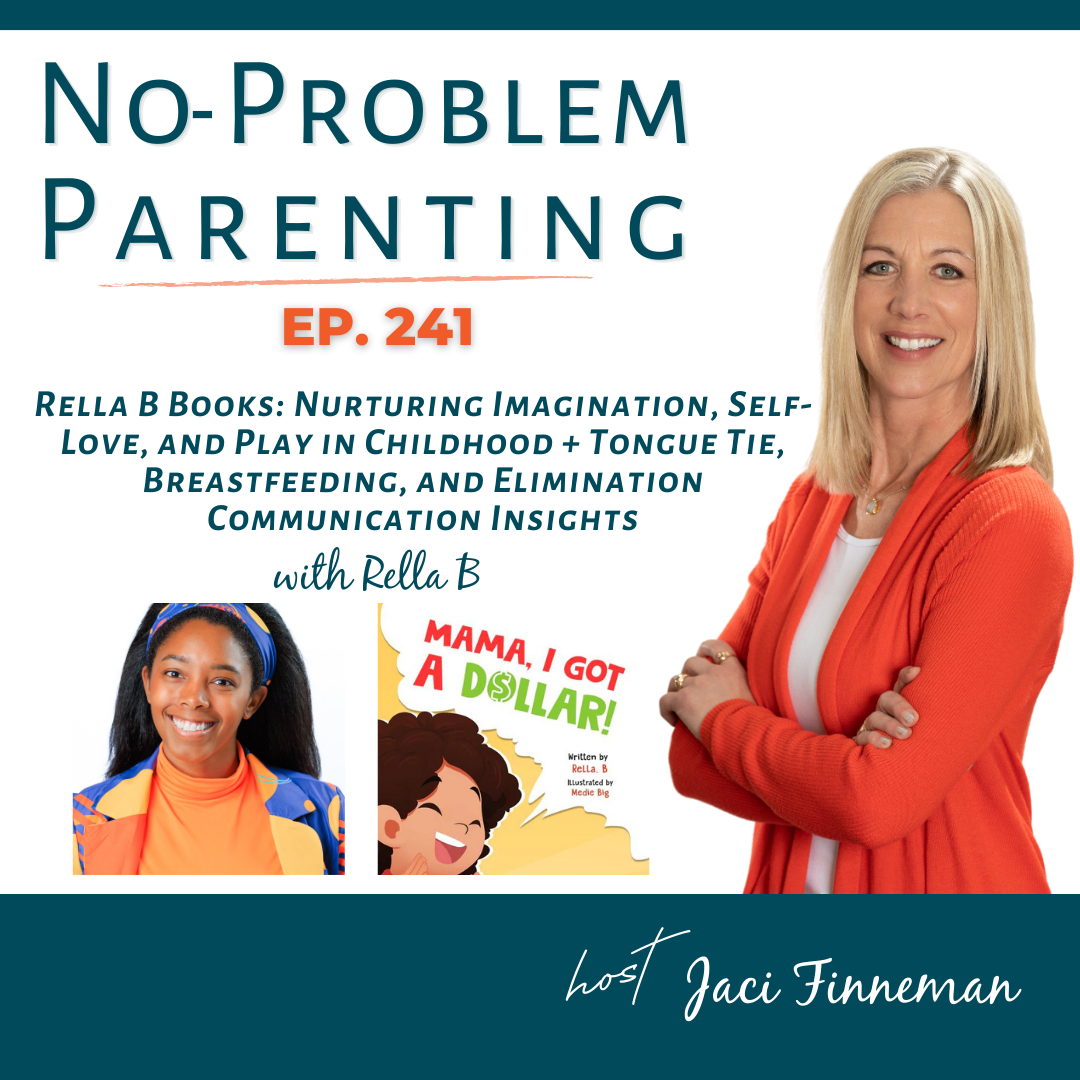
About this episode
Welcome Back to Social Saturday on the No Problem Parenting Podcast!Childhood at Rella B Books is a magical journey filled with imagination, adventure, and valuable life lessons.
Rella B's journey began with a shift from conventional adult aspirations to the joy of inspiring young minds. With a background in education, business, and technology, she realized the importance of merging work with play.
Her platform manifests this philosophy, emphasizing values like self-confidence, self-expression, self-love, and self-care for littles. Rella B advocates creative thinking and cherishing childhood, encouraging kids to explore, learn, and grow in a fun and imaginative environment.
Jaci and Rella B share parenting stories, touching on topics like overstimulation from content, tongue tie challenges, extended breastfeeding, and untraditional potty training through Elimination Communication.
Get ready for a delightful exploration into nurturing imagination, self-love, and play in childhood and some candid mom talk.
Topics Covered:
-Overstimulation from content
-Tongue Tie [Listen to EP 144] http://smpl.ro/TongueTie
-Extended breastfeeding
-Elimination Communication - Untraditional potty training
Learn more about Rella by clicking the links below and purchase books using coupon code [NOPROBLEM] for 10% off:
https://www.youtube.com/@rellabbooks
https://www.pinterest.com/RellaBBooks
https://www.instagram.com/rellabbooks/
https://twitter.com/rellabbooks
https://www.facebook.com/rellabbooks
https://www.linkedin.com/in/rella-b-ba892a298/
https://www.amazon.com/stores/Rella-B./author/B0CL9C4VFL
https://open.spotify.com/show/02kdy7hepEGLmT202aTa0h
https://feeds.buzzsprout.com/2258355.rss
https://www.tiktok.com/@rellabbooks
https://www.goodreads.com/author/show/45702623.Rella_B
Thank you for tuning in to the No Problem Parenting podcast - Please take a minute to share the podcast, comment or leave a review.
FREE PARENTING RESOURCES:
60 Ways to Respond to Your Kids without Losing Your Cool
Make it Right Technique PDF
Everyday Essential Solutions eBook for the whole family
Better Sleep: Decrease Stress with the 7 Day free trial of NuCalm Enter Code: NOPROBLEM for 15% off all products.
Become the Confident Leader Your Kids Crave you to be!
Become a No-Problem Parent
Book Your 90 Minute Strategy Session
Put your oxygen mask on first:
Find More Resources Here
FB - IG - LinkedIn - YouTube - Twitter - Threads
Check out our Books!
No-Problem Parenting; Raising Your Kiddos with More Confidence and Less Fear
No Problem Parenting; Resources and Stories that Create Confidence and Connection
Hugs and High Fives,
You Got This!
Jaci Finneman
30 Year Counselor turned Parenting Advocate and Coach
Full transcript
Welcome to the No Problem Parenting Podcast. From toddler tantrums to teenage eye rolls, this podcast is your go-to for updated and old school tips and tools that are gonna help you become the confident leader your kids crave you to be. Do you ever wish there was a specific manual that came with each one of your kids? I mean, what works for one often doesn't work for the other, right?
And let's face it, we don't know what we don't know. And even if there was a manual, well, it probably wouldn't be able to keep up with all the changes in our world. Well, this podcast is the next best thing. I'm your host, Jackie Finnaman, a 30-year counselor turned parenting coach.
And I've got a lot to share, including hundreds of resources that you have access to right from your home and strategies that are going to boost your confidence and energize you. So whether you're knee-deep in diapers or navigating the tween years, or you're launching your child into adulthood, subscribe and share this podcast with your friends teachers and daycare providers we're going to turn your parenting problems into no problem one episode at a time all right welcome back no problem parents i have a super fun special movie star guest on the show with me today i'd like to introduce you to rela b her journey began with a shift from conventional adult aspirations to the joy of inspiring young minds. With a background in education,
business, and technology, she realized the importance of merging work with play. Her platform is a manifestation of this philosophy, and it emphasizes the values of self-confidence, self-expression, self-love, and self-care for littles. Rella B represents an advocate for creative thinking and cherishing childhood, encouraging kids to explore, learn, and grow in a fun and imaginative environment. So excited to get into so many different topics today with you.
Welcome to the show, Rella. Thank you so much for having me. I'm so happy to be here. I am so excited to have you.
You're full of energy and creativity and just a fun person to hang out with. Before we get into all the things, let's start with more about Rella B, how Rella B was born, and kind of what you're doing for kiddos in the creativity space. Yes, I'd love to talk about it. So ultimately, I had been writing children's books for a long time because my day job was a flight attendant.
After I did education for three years, I was really burnt out and I didn't want to be in an office anymore. So I went and I become a flight attendant, but then flying for hours and hours each day, not having any connection to, you know, the ground or Wi-Fi. I didn't have anything productive to do with my time. So I started writing, journaling, and then writing children's books as well.
So I did that for years. And then five years went by and I was doing this on my work iPad. So one day there was an update on my work iPad and all of the books that I've written were gone. So I was like, you know what, I actually need to like get up and start doing something with this.
I was like, this is what I get for not backing it up, not taking it seriously. So I'm like, I'm going to rewrite books. I'm going to get them published. I'm going to figure out how to do this.
But how do I market it? So I decided that I would start a podcast and a YouTube channel to read books. But I didn't just want it to be the pages on a screen and me reading them to kids. I wanted to have the kids get up, stretch a little bit, do a riddle that has to do with the book, and then read the book, show facial expressions, do fun little voices, animations, and then talk about the lessons in the book.
So I just ultimately wanted to create the type of entertainment that I wanted my daughter to consume because there's a lot of amazing shows that are out there, but you watch it and then it doesn't really impact your life. You don't really think about the lessons too much that you just saw in a show maybe or in a movie. So I wanted to include all of that in my content. And a lot of content doesn't have kids get up and move.
they're sitting in front of a TV for so long. So ultimately, Relibee came from wanting to provide the type of entertainment that I would like my daughter to watch. And in doing so, it's healed a big part of my inner child, which has been absolutely amazing. My heart sank when you said you lost all of your content.
Yes, it was very sad. I tried reaching out to everybody in the company. I was like, how do I get this back? How do I get this back? But I mean, ultimately, it was just a lesson, you know, back your stuff up. It was a signal that you needed to, like you said, take it more seriously and really turn this into your career, which you have successfully done. And you have a number of books out. Can we just kind of talk about the books for a quick bit and share the, some of the stories that you've written? Yes, of course. So I've written two books so far that are published and one is called Mama, I Got a Dollar. And that goes along with the story of a little girl that finds a dollar and then her mother and her family start talking to her about all the different things she can do with the dollar. She can save it. She can spend it. She can share it.
And then she talks to her uncle and her uncle is like, okay, I'm going to give you this dollar, but you're going to have to give it back to me. And then he explains the concept of debt and interest to her. And so she just like going along, it's a very short and sweet book, but I want it to be a conversation starter for parents to start talking to their kids about finances and all the things that they can do with money. My second book is called If Shapes Could Talk. And that book is about a little rhombus that has a triangle for a mom and a square for a dad.
And she goes to school and then she sees families that are different than hers. They have different colors, different patterns. Some of them have bigger houses. And she's like, well, why don't I have these things? Like, I don't have a pool. And she starts to compare herself and she wonders, is it okay that I have these thoughts and what should I be doing with these thoughts?
And then she goes to one of her friend's houses and finds out things about her friend. And she's like, you know what? Like, I love my friend, but I didn't know those things. And I'm very happy for everything that I have. And I'm grateful for my life. So it's just a small reminder to be thankful for your family, no matter what you have, bringing it back to, you know, the grass is not always green on the other side. Oh, good. Absolutely. So good. Was the books that were born first, let's talk a little bit about your YouTube channel and you're really encouraging imaginative play every day, but how are you doing that? Right now I mainly do the sing-alongs and the read-alouds. With the read-alouds, I try to get the full body engagement with getting up, moving, and then doing the small riddle. Another segment that's going to be coming out a little bit later is just purely Rella's riddles. 10-minute segments of me just talking in riddles to kids and having them think about,
you know what is that what is it going to be it'll be three-part riddles like it is in the show and then they can guess I'm also going to have this on my podcast as well as quizzes so then when people go to let's say every 15 episodes there'll be a quiz and then they can go back through the different podcast episodes and listen for different lessons that were in the story so that they can be reminded or maybe they'll just remember so I just want people to be more conscientious and actively think throughout my content, not just watch it, but engage with it as well. That's what I'm trying to do with all of this. Well, and podcasts are becoming more and more popular with kids. Kids are learning and it's great because you have the YouTube channel,
but you also have the podcast option for kids to just be listening to. So maybe they're in the car for the long ride and they can be staring out the window, but they can just be hearing this on a long car ride to grandma's house. So I just love that you have the different platforms and it's all in development right now. You started with the books, you have the riddles, you have the YouTube channel, but you're slowly building and adding more content. And so your listeners and your followers can kind of grow with you, grow with the show. Yes, that's exactly what I want.
Because even if they're in the car listening for a long time, I do stretching on the podcast as well. And that's what I say is, hey, you know, if you're in a small space right now, just be conscientious, but we can still stretch and we can still move a little bit. And parents, when you hear Rella on these shows and you see her on her videos, you are just going to be so excited to share this with your kid because you do. You're so intentional and you really are encouraging and it makes you want to move and it makes you want to just be like all in, like you are right in that room with you. That's what I hope. That's what I hope. It's so funny to see people record their kids and show me like, oh, you know, they love this or they're up and they're doing a little movements because when I see myself doing it, it's just, I'm like, man, I should have done the lunge more properly, or maybe I should have done the squat in a better form, you know, so that they're doing it more or at least correctly. But ultimately it's just about getting up and moving.
Like it doesn't have to be perfect. So it's cute. Yeah, it's really good. And I love that you make that central to what you're doing is it's not just about listening to the story. It's actually get up and move your bodies. On top of it, having a riddle segment, there's going to be a recreational segment, I'm going to be working with a professional trainer to go through and help me come up with some fitness routines for kiddos. So that'll be, that's going to be farther down the line, but I have big hopes and dreams for all things Relibee. It'll be cute.
Another thing that's really central to your, to the books and to your YouTube channel is that you're helping kids build self-confidence and self-expression. How are you doing that? And What are maybe some tips that you have for parents? So my biggest thing, just when I'm talking to my daughter, when I'm talking to anybody's child at all, is I try to be very conscientious of what I'm saying so that if someone said the same thing to me, it wouldn't be something that's repeated in my head as negative self-talk.
I try to talk to children very positively and I try to talk to anybody around my child really positively and then keep a strong barrier between things that they may say to my child that I know may affect her more than they do because I know her. So that's what I would encourage parents to do. Even if you have to slightly correct someone, just do it respectfully because I've had people say like, oh, your daughter is shy. And in her head, if she's like, oh, I'm shy, that might be something that becomes self-fulfilling. But instead, if I gently correct and say, hey, you know, she's actually not shy.
She's very rambunctious and she is super awesome to get to know, but she just has to feel comfortable in her environment first. So she's just a little bit more conscientious of where she's at. And it's not disrespectful to say that to them. And she understands that I'm gonna stand up for her.
And so I try to do that with all little kids. I don't stand up to other people's parents about what they're saying to their child necessarily, but I do that for my child. And then I'm always very respectful when I talk to other people's parents and their children and just make sure that I point out wonderful things about them too, because I want them to love themselves. I know that I'm very self-deprecating at times and you're always your worst inner critic. So that's something that's really helped me is just making sure that I show children that because you need to have self-love for yourself. It's super important. And I don't think that it's talked about enough in children's content. And I think there's a lot of kids now that are more self-aware about things that they may or may not like, and they're more self-conscious at a younger age, I want to get them to stand up for themselves and just believe in what they're doing and themselves.
So I try to promote that in my content. That's all. And words do matter. They do.
And sometimes we don't even realize that saying to somebody, oh, she's really shy could be perceived as a negative thing. Right. And it can be small things. It doesn't necessarily, you know, sometimes dad will say, oh, you're being X, Y, Z.
Now, they could take that as just, oh, you know, it's been a bad day. That's how I was today. Or they could internalize that. Like if you say, oh, you're being mean or you are mean, then they're like, oh, well, I'm mean.
I try to correct dad sometimes. I try to correct myself because I'm not perfect either. So I just try to be really conscientious of how I'm talking to my daughter and other people's kids. And then especially on the YouTube channel, because I don't want things to be perceived negatively ever.
I will re-say things a lot because I'm like, oh, maybe they think about it not the way I intended. So that's a hard space to be in with kids, you know, treading that wire because everybody perceives things differently. and even in my books I've had some people say you know I didn't like this page because I have a specific page in my book that references adoption but it doesn't go deep into the topic or anything like that it just talks about the little girl she was adopted because she lost her mom and dad and that's why but people are upset that I didn't go more into that topic but I'm like that's not what the book was about. I might write a book about that later. But that wasn't my intention to make this an adoption story. Right. And you know, the other thing that I love that you're saying is our responses when we're met with like a negative, the way we respond to the person who did that can still be respectful. And I'm all about that at No Problem Parenting. We talk about resistance creates resistance. And you're just like changing that whole story and being like,
No, we don't have to be though. No, we don't. And I try, I try really hard. I mean, with every, all the content you have, oh, Rella, you are doing.
Definitely not just trying. Let's talk about like overstimulation of content right now. Kids are, it's our reality. We talk on the Tech and Teaching Tuesday episodes.
We're sharing a lot about technology. And then, you know, the AAP has all these guidelines for how much screen time kids should have. And that's great for a guideline, to have those guidelines at the same time. We want to be realistic. It's not just about getting our kids away from the screens, but it's about what is the content that they're watching when they are on the screen.
And I think that's really interesting, especially coming from me, because I didn't want to have my TV on when my daughter was small. I rarely had it on, but grandma had it on a lot and she would play Coco Melon and she would play these shows that I really didn't want my daughter watching. I wanted her to, if she was going to watch TV, I had specific things that I wanted her to watch. And lots of it was real people like Miss Rachel. And there's actually two Miss Rachel's. The one that does my signing time, loved her. So my daughter did the baby signing time lessons with her. And then she also did Miss Rachel with the, my baby can talk things. And I liked things that were real people showing real emotions, talking to the babies, showing them something, teaching them something, singing to them, singing with them. And that was a big priority for me. My mom decided to just put Cocomelon on because my daughter would be in a paralysis mode of just staring at these colors, flashing scenes, and she was overstimulated. And so I tried to build really strong boundaries. But then if someone's watching your child for free, you can't really police everything that they're doing. So it becomes really hard when you try to make sure that your child isn't overstimulated or isn't consuming the type of media that you don't want them to ultimately like I have a list of shows that I like for her to watch and don't like for her to watch
and I try to distribute those to the babysitters and people that are watching her but you can only protect them so much for so long so I do try to keep my content in between engaging and calm like the scenes don't change very often there's some extra stimulus but it's not overwhelming you don't get lost in it. Your kid will probably walk away, go get a snack, come back and finish watching it. And that's the type of content I wanted it to be. You don't have to be glued to the screen and your child is not overwhelmed by what's happening. You know, when you're like trying to snap your fingers and they're not snapping out of it, they're just hypnotized by the TV. Yeah. My content is not like that at all. Nope. I love it. And I love that you are really intentional about that. The other thing that you talk about is limiting screen time and creating like tech free zones because it does help your kiddos be calmer. So again, you're encompassing all of this. You've got the books,
so that's no screen. You've got the YouTube channel, so that's a screen, but you're being really intentional about not having like a bunch of flashing colors and lights and it's like too crazy and chaotic and overstimulating. And then you also have the podcast just for the audio piece of it. Yes. And I think that the podcast is really nice because you can do it in a car. You can do it while you're doing arts and crafts, you know, just listening to stories, maybe doing a little stretch and thinking about a riddle, but also having a conversation at the same time. It doesn't have to be, you know, it's not trying to get your full attention. It doesn't need all of your attention. It could just be background noise. That's really nice because, you know, I like to listen to music with my daughter and just have something going on while we're painting. So I would like it to be something like that, you know, just have it on, listen to it. You can zone in and out and just enjoy it with your family. And it is uplifting, upbeat, calming, but yet exciting.
Do you have other topics that you share about when it comes to raising kiddos? And so there's two more that I want to kind of cover with you before we wrap up today. And one is the topic of extended breastfeeding. And you have a little bit of a story behind that. Do you want to share that with our listeners? Yes. So I was very gung-ho, like I have to breastfeed. I have to at least attempt to breastfeed. I wanted to do it so bad. And then when I had my daughter, she latched kind of, but not very well. And then I found out she was tongue-tied and lip-tied. And there's a really big controversy with parents, dental professionals, and pediatricians, and lactation consultants about whether lip ties or tongue ties are even a thing. And I personally really believe they are because we got hers corrected. But before we got her tongue tie and lip tie corrected, she was drawing blood. Like she was not able to latch very properly. And she was pinching the nipple of the bottle completely closed. Like she was not able to feed herself properly. So we ended up breastfeeding through all of the struggles. It got a lot better after the revisions around five months. And then she did some feeding therapy, which is something that she still has to do now.
Then she just never wanted to stop. So we kept breastfeeding until she was about two years and nine months. And even to this day, she was just like, mama, I just want to hold milk. And I'm trying to navigate that. I love the bond that we have through breastfeeding.
and it was beautiful and I don't mind you know physical touch is still a love language and so she'll just sometimes want to lay on my chest which I think is beautiful but I don't know at what point I need to create stronger boundaries because I do remind her like this is mama's body you cannot just decide to come over and you know try to lift up my shirt or something like that if we're cuddling in bed then yes we can have like some skin to skin time but there's a time in a place. It's been really interesting because it goes into like body autonomy and then also privacy. And she'll ask me like, well, why is that private? So it's been a really interesting journey as far as breastfeeding goes. And it was beautiful while it lasted. I do not miss it.
First of all, I'm in the school of thought that tongue tie and lip tie are real things. In fact, there is a link inside the no problem parenting training. I had a guest on Sheree Words, and we also have a podcast episode about this, and she talks about tongue tie and how when babies back in the day, when babies were born, the nurses would just, with every baby born, take their fingernail, literally slice underneath the baby's tongue because it's so fine and that it would just, if there was a tongue tie, it's just going to cut that and make it not a thing.
And now the other thing is there's four different types of tongue tie. And so if it's not really prevalent, your pediatrician might think, no, it's not a big deal. We're not worried about that. But there's still a stage where it's not very noticeable, but it is a big deal and it's a big issue and it causes lots of feeding problems for kids.
And so we did a whole episode with Cherie. She's an amazing and she's in the dental field and just an amazing resource that she even herself in the dental field for like 30 years didn't realize this was a thing until about five years ago. Wow. Or how prevalent this was.
Okay. So we don't know what we don't know. Right. Right.
The other thing though, Rilla, is that there can be like behaviors and attachment issues and things that come along when kids do have problems feeding. I saw it in my own son when he was born and one of my breasts wasn't producing enough for him. And he was a big boy. He was five weeks early, seven pounds, two ounces.
He'd have been a big baby if he'd have went the full term. And I was, of course, the attachment specialist. So of course, I'm going to breastfeed my kid and I'm going to do all the things. And it was like, God has other plans for you or your body does because within about four weeks, he was not getting enough milk.
He just, I wasn't able to give him enough. And I saw him slowly getting depressed. His little eyes just weren't, I was looking at him. I was like, you're not in there.
Where'd you go? You know? And we had to start supplementing with formula. And then we had to find the right formula and the starchy one that would help sustain in his tummy because otherwise he would just throw it up right away.
It was just like water coming back up. It was such a process to figure that out. And as a new mom who doesn't know, and my mom had passed away the year before and like, I didn't have that. And like, what do I do other than the lactation consultants?
And they can freak you out sometimes. And, you know, just all the negative things that I was saying to myself about that. But anyway, long story short, we ended up getting it figured out and I could just definitely within a matter of a week, I saw the change in his eyes and I was like, oh, you're in there. Like you feel better.
and he just calmed and settled, right? But even just that little short period of time, as he grew, he had some anxiety and he at four years old became anxious. He was born C-section. That played a role in anxiety with him as well.
So yeah, I get it how you learn so much by your own experiences with your kids. I'm glad for you that you were a confident enough parent to be like, nope, I think there's something more to this tongue tie thing and this lip tie thing. I know my kid best. I'm the expert of my child. I may not know, have all the answers, but I'm going to find them.
And then the cuddling like, and her wanting to be on your skin. First of all, let it happen as much as you can and you're comfortable with. She will eventually stop. Okay. Okay. So don't be like, oh my gosh, it's inappropriate. Or she's too old for this. You do you. And if it's too hard on you to continue to do it, then yeah, we figure out ways to get, you know, to transfer that need of hers to something else so that she's not relying on it. But just don't, please don't beat yourself up. If you feel like she's wanting it and you're like, not supposed to do it anymore or give it to her. It's like, there is no one right way for everybody. You are a great mom. Thanks.
To see Cherie Wurtz's webinar that I did with her. She has amazing links and free stuff. It's going to be so validating for you. Okay. Yeah. The next topic, I guess I want to talk about that you have some experience in is elimination communication. So untraditional potty training, you have some, some experience with that. And I have no idea how parents do it. I did not with my son. So I'm super curious. Yeah. I mean, I absolutely loved it. If I had another one, I would do it again and I might do it a little bit sooner, but my daughter was 20 pounds at four months. So she was a sumo baby and she could sit up. So at that time, which is a little bit later. Some people start elimination communication at birth. I started it when my daughter could sit up. So four months, she was on the potty thick enough to sit on one of those little toddler potties. And she sounds like my boy. He was 30 pounds at 12 months. So yeah, he was a Michelin baby. I call him. So, I mean, I loved it. I put her on the potty every morning. I just made sure that she had a routine. So every morning I put you on the potty before nap time, I put you on the potty. After nap time, I put you on the potty. And then before bedtime, I put you on the potty.
And that was regular. Before we leave the house, I put you on the potty. And before we leave wherever we're at, I put you on the potty. And so she would get really used to that. I had her in diapers.
When we were at the house, I would give her about two hours, maybe a day that were just diaper free. And then we would just play. And because of the routine, and then when she was on the potty, I would signal to her so I would do baby sign language of like potty and pee and then I would make sounds for her like and when she whenever she did number one or but I would just signal to her I provided her with a good routine and then she was potty trained by the time she was 14 months which is a little bit later for elimination communication but she was nighttime potty trained and completely potty trained by 16 months and out of diapers in little, you know, training panties. And that was amazing. I saved so much money. I had so many diapers left over and it was amazing to watch her grow. She started asking for privacy at 12 months because she had started learning, you know, she asked me to turn around. Basically, I was trying to figure out what it was that she wanted because, you know, baby gibberish is so, so strange sometimes, even if you're their parent and she wanted me to turn around so she could have privacy. And I was like, wow, okay.
But it taught her a lot about her body and her bodily functions and how different things feel. So after, I would say the first month, she started peeing and going number two in the potty every morning. And then it was a little bit harder to catch everything else throughout the day. But as she started getting older and older, she realized like, okay, you know, if I sign this, she started signing at 10 months, I can go to the potty. And, you know, if I make these sounds, then I get these things. It was really interesting. And it was a lot easier than I thought it was going to be. It's just communicating with your child. Once you have a routine with them, they can trust that you're going to do those things all the time. So then they can base,
you know, their wants and desires off of what you're always showing them that you're going to be able to do. So I think that really helped our bond too. And so you were a stay at home mom. So you were able to do that throughout the day, right?
Yes. This was during the pandemic. So I was working from home. Some people will do it hybrid.
So like when they're home, they will do it with their children. I know it can be a little bit harder because you don't have them all the time when you go to work. But if you have a routine with them where even they're only going to the potty at night and when they wake up, then they still know that they can go during those times. and the same thing happens, even if it's not throughout the day.
Yeah, that's really important. It doesn't always have to be all day long that you're with your kiddo. Like you said, set up that routine and they just, it becomes familiar to them. Right.
And she was never afraid of the potty or anything like that. She had a small regression when she started walking because she started walking at about nine months and then talking and signing it about 10 months. So during those months, I just backed off and we didn't really use the potty as much. I offered it.
and sometimes she just didn't want it. So we just stayed in the diaper and that's fine too. If it starts stressing you out or stressing your child out, take a break, revisit it in four to six weeks and see if they're interested again. Yeah, and that is so key because I think sometimes parents, it's like with sleep training too, parents will get really frustrated because things aren't working or they regress.
And then you try harder and actually with littles, it's best to exactly like you said, back off, give it a break for four to six weeks. They might be just going through their own little growth spurt or transition or something. And it's okay to just pause and take a break as you, the parent are getting frustrated. That's the indicator. Stop, slow down. Like don't push yourself through those moments because it's not good for either one of you. Right. A hundred percent. Yeah. You're so you're a wealth of all kinds of knowledge. I can't wait to see all the other books. You're going to, you can be doing like parenting books too, on all these different subjects and talking to the parents with compassion. That's one of the things that I love about all the work that you're doing is you're building self-confidence in kids,
helping them to talk to themselves and others just a little bit kinder and really emphasizing the power of imagination, creativity, movement, and play. So you're a wealth of information. You're a bright light for this world. I cannot wait to see all of your books getting into the hands of families and for kids to watch that famous show that's gonna be happening by the end of 2024.
for. So what's the best way for people to find you and to learn all about you? Right. So you can go to RelibeeBooks.com and there I have links for my podcast, my YouTube channel, and my books.
There's also merch there, which is fun and cute. It's Relibee style. And then if you just type in Relibee Books into Google, you'll find everything. The podcast, YouTube channel, some of my books as well. I then make it really easily accessible. So it's all broken up into playlists on my channel too. And you're giving us a special coupon code, a link to get your books and the merchandise, the Relibee merchandise. It is so fun, all super great colors and fun stuff in your shop. And so we're going to have that link in the show notes today with the coupon code, no problem. And parents, you're going to receive 10% off. And the other thing I'm going to ask the No Problem Parenting community, the listeners listening in today is to please share Relibee books with your friends, with your daycare, with your schools, with your churches. Let's spread the word about Relibee because it is such a great resource for our kiddos from birth and up.
Thank you so much. I appreciate it. Look forward to our continued connection and having you back as a guest another time. Thanks so much for being with me.
Yes, thank you. I appreciate all the tips and advice and just encouragement. You're so great. All right, that's it for today's episode of the No Problem Parenting Podcast. Hey, Thanks guys for tuning in.
If you found value in today's episode, click the subscribe button and share it with other parents who might need a little boost. Stay connected on our socials by following at No Problem Parents for more parenting tips and get your free download of the 60 ways to respond to your kids without losing your cool. Go to noproblemparents.com.
Until next time, remember, your confidence comes from embracing both successes and setbacks. So take a deep breath, embrace the chaos, and remember, you got this. you
Become the confident leader your kids crave
The method, the community, monthly live Q&A with Jaci, and Celia — your AI guide in the moment.
Start your 14-day free trial Get it on iPhone or sign up on the web