
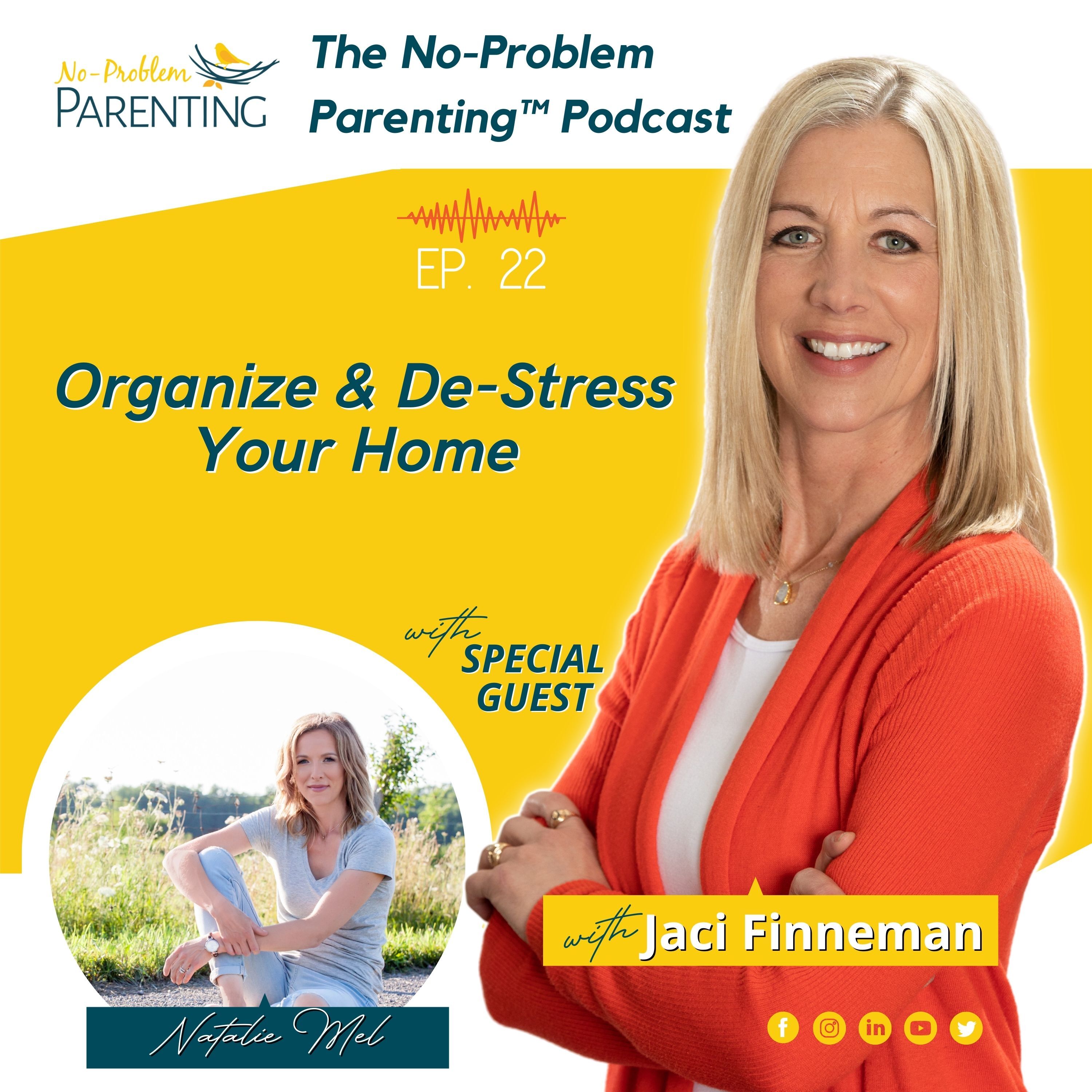
Organize & De-Stress Your Home with special guest Natalie Mel
About this episode
Welcome back No-Problem parents! Hey, has your home become a source of stress and disorganization?
Did you know that your environment has a direct impact on you and your kids wellbeing?
My guest today is Natalie Mel, she’s a Certified Holistic Health Specialist, Transformational Nutrition coach & Organizing Maven.
Her mission is to help break the cycles & patterns of generational dis-ease and she believes that every child has the right to grow up in a healthy home, and that starts with healthy parents.
Become a No Problem Parent Today!
Full transcript
Welcome back, No Problem Parents. Hey, has your home become a source of stress and disorganization? Did you know that your environment has a direct impact on you and your kids' well-being? Well, today my guest is Natalie Mell. She's a certified holistic health specialist, a transformational nutrition coach, and an organizing maven.
Blending her passion for organizing and health and wellness, she founded Her Holistic Space after realizing that people's health were not being taken into consideration when it came to organizing. Parents hire Natalie to transform their homes into health-supporting sanctuaries so that they can confidently raise healthy kids and feel amazing while doing it. Her mission is to help break the cycles and patterns of generational disease, and she believes that every child has the right to grow up in a healthy home, and that starts with healthy parents. So if you're ready to kick out the toxins, get organized, and create a healthy living space for you and your family, listen in to today's episode. And be sure to grab Natalie's free guide to better sleep using the link in the show notes. So welcome to the show, Natalie. I am so excited to have you here to talk all things nutrition and holistic health and wellness. Before we get started, why don't you just tell us a little bit of your background and how you got to where you are today?
Oh boy, okay, I'll try to condense it. There's that quote that says you can only connect the dots looking backwards. Well, my zigzag, I can kind of see it now how today came to be. I guess it started when I was eight years old, there was a traumatic event to my family, my younger sister had passed. And of course, that completely changes the family dynamic. My refuge, my soulless place was my bedroom. And of course, growing up, yeah, I was a messy kid. That's normal. But as I grew up, that awareness came around of that space being that comforting blanket. So I really took care of my space. So I kind of went from messy kid to neat freak and moving around the furniture. And I just, I could sense that, that give and take that feedback from the space. So then fast forward to my early 30s. I'm married, two kids, you know, everything on the outside seems like it's wonderful, you know, married to my best friend and healthy kids. And I remember I was just sitting there folding laundry one day, I think my son was about eight, nine months old at the time.
And I just had this moment of, is this all there is, you know, like everything looked good on the outside. And I even had a weight loss journey that I had successfully lost 50 pounds a few years before. On the surface, I felt like I should feel better, but I didn't. So the next morning, I hopped on YouTube and I just started looking at videos, anything that just caught my interest that I could just be open to whatever.
And the next thing I know is one video after another, but I was being more and more attracted to the health and wellness and nutrition and things like that. And the more I learned, the more I realized how much I didn't know, but I learned all these cool things like food is medicine and how the body can heal itself. And I also learned that there's a very dark side to the food industry. ill health is being promoted and that's just a harsh reality but you know you try not to get weighted down by that part so I look to the positive so I come to realize something that I kind of already instinctively knew as a child was that your space affects your health and vice versa so pairing that realization with what I had learned about the food industry I kind of flipped my perspective and my intention of being the gatekeeper to my home. So I did this huge purge of anything and everything, whether it be food or cleaning products that was going to harm me or my family went to the curb, it was gone. But again, it wasn't an overnight thing. It was a slow progress,
you know, making changes and stuff, but over time, but I didn't revert back to it. But that's kind of how it started. And I am fanatic for organizing, cleaning, things like that. That's my my happy plays my my zone of genius, I guess you could say. So I was watching on TV, this organizing show, and I was watching and and then I was looking, yeah, it was very beautiful what they were doing.
But I was looking at what they were organizing. And I'm thinking, like, what's the point of organizing stuff that's going to make you sick. And that's when I realized this is an even bigger problem than just my home and my family that, you know, these are many families that are experiencing this, but they just haven't been given the education. You know, we think we're actually giving something healthy, but it's not. And it's designed that way. That's when I said, okay, I got to do something about this. So I wanted to help other people, but I wanted to make sure that I had the best information possible. So I enrolled at ITN, which is one of the premier coaching schools and got my certification as a certified transformational nutrition coach. And I went on to get my certification or specialty in holistic health,
because that was really my zone of genius was the foundation looking at the whole piece, including the home and I kind of sat on it for a year because as you know doing your profession but starting a business is a whole other beast so I kind of sat on it for for about a year and then fast forward again actually when my daughter was born my firstborn I always had this inkling that I kind of wanted to homeschool she was about two and I was like I think I'd like to homeschool but I didn't really do I sent her to school and then January 2021 came around and in our area they issued the mask mandates for the kids. And I said, Nope. So I pulled her out of school. And we were homeschooling from one day to the next, you know, I was getting into the homeschooling groups and seeing that, you know, there was everything and anything for the kids for the curriculum,
but there wasn't support for the parents. So I thought, I think this, this is the mom that I'm supposed to help because I had all my foundation in place at home. The transition to homeschooling was so easy and I was able to do it with energy and we had a you know yeah there was a lot of trial and error but I didn't feel bogged down by it and I said I think this is the missing piece because a lot of moms talk about you know not having the energy to do it feeling burnt out trying to do all the things and so that's where I created her holistic space that's where it was born out of it's basically the approach to the title like her holistic space so when I talk about space I'm not just talking about home space it's the three pillars the foundations of health which is your mind. So mind space, body space, spirit space. But I also incorporate the home space because I do believe the home is like a feedback loop. How we feel on the inside is reflected in our environment and what we bring into our environment, whether it's the clutter that we see or the toxic cleaning products that we use, the food that we eat, it will affect us as well. So I think just keeping that in check and balancing those spaces, I think just sets a really good foundation for healthy families overall. And I have a podcast. It's also called holistic space. So we're touching again on the four spaces, mind, body, spirit, and home. But I
also talk a lot about mindset and habits, because I think we put so much pressure on ourselves and we have that fall off the wagon mentality and things like that. But we don't understand that really it's all about habits. So my goal is to help get this message into the ears to as many moms as possible so that they can create their own healthy spaces. They have the most important jobs in the world. They're educating their littles. They are the teacher. They are the mom.
The goal is they can be confident in their decisions, raise healthy families and feel amazing while doing it. Wow. That is so great. Talk a little bit about how we're influenced by our environment and as it pertains to homeschooling. Yeah. So one of the biggest factors for me was the fact that our home is kind of, I'm not minimalist. I like to say minimalist-ish. So there wasn't a lot of distraction. Whether we wanted to homeschool in the kitchen or the living room, if we wanted to take it outside, there wasn't stuff around like that could pull their attention away and that we could focus on the task at hand. So that was a big one. We have toys limited to one room in the home. So that's the living room. That's our shared space, our communal area. So while their toys were in the living room, we did homeschool there. It was always assigned to one area. My goal isn't necessarily to have it all clean home all the time because that you're going to just set yourself up for, I don't want to say failure, but you're going to stress yourself out even more. So my end goal is, can I pick up in 30 minutes or less? So I know at the end of the day,
they can play as much as they want, but at the end of the day, they can put away fast. So then in the morning when we wake up and it's time to homeschool, there's nothing pulling their attention by maybe a toy on the floor or Legos here. It's not limited to just the physical aspect of the space. So physical, we think clutter. So we see it, it's a visual distraction. And every time we look at something, we are forced to make a decision. Whether we choose to pick it up or leave it, we're forced to make a decision. So that's essentially what this decision fatigue is and where it comes from. And it's not limited to us. It's for the kids too. They see it. They might know, oh, I should pick that up. I don't want to pick it up, but then mom's going to yell if I don't pick it up. So it's all like these things that are running in their heads and it happens at a very subconscious level. So we don't even realize it, but bit by bit, it does play at our subconscious and we don't even realize it. So that's why I think the minimalist ish aspect really helps homeschool or non homeschool or just in general, as for another area is just energetics.
If you walk into a space, like I came from a home where she, my mom was like, I don't want to say borderline hoarder, but there was a lot of clutter and just things. And when you walk into that space, it just felt heavy. I didn't have to say anything, do anything, but it's just that, that energetic feeling. You can just feel it weigh on you. And our kids are even more sensitive to that. So we just have to kind of think, what is our space saying to us? Like when we walk into our home, do we feel like it's giving us a big hug or does it feel like it's pushing you away? And that's a big piece because especially if say kids are going out into school and they had a rough day and they come home and they just need a space where they can just, just exhale. But if they can't have that in their own homes, I think it's to their detriment. It's, it can be very overwhelming. A lot of information coming in, right? A lot of stimulus and there's just stuff everywhere. It It can, it can be hard for those highly sensitive kids, much less any one of us, right?
Just to feel that heaviness or that weight of there's so much going on. There's just so much in here. You can't, your mind, like you said, I love that you point out that you're just constantly thinking about, should I pick that up? Should I play with that?
It can be very overwhelming and stressful for the kids as well as, as well as us. You also talk about why sleep is so important. So how can a kid's bedroom, you talk about a kid's bedroom, enhancing their sleep quality. We all kind of know what that means, but you talk about it a little bit differently and you have some good ideas about how to make that bedroom really a safe haven.
And this can be really hard, but my rule of thumb is it's the one room in the home that I think should be absolutely minimalist, not ish minimalist for children and include my own. That means no toys in the bedroom. And I can hear the moms, no, what? Yeah, because when they go to bed, you want to make that neuro association that when I come into bed, it's time to sleep.
But if they come into room, even throughout the day, and okay, well, sometimes I'm playing, sometimes I'm reading, sometimes I'm going to sleep. The brain's not going to know what they should be doing. And that extends to the moms too. Are you bringing your phone into your bedroom?
Are you bringing your laptop? And are you working from bed? Do you have clothes all over the floor? Do you have bills, paper, like all this stuff, when you walk into your room, you immediately want to make that neuro association.
But if your brain doesn't know what it's supposed to do, it's going to be much harder to fall asleep. And with our kids, they need much more sleep than we do. Depending on the age, it could be 10, 11 hours. So you really want it so that when they get into bed, they know it's sleep time.
A rule of thumb, especially for my son, who's four, he has no toys in his room except for books. I will allow a little bit of book because it's like quiet, unwinding time that if he wants to be quiet in his room, he can. There is an exception. my daughter is allowed some things toy-like because her younger brother goes and steals everything and destroys it. So she works really hard on the Lego tower and she leaves it downstairs.
If you're not watching, he will take it away from her. So I said, okay, you can bring that up to your room. But I mean, I want to say case by case or child, but you know, your child. So if I know that my daughter will keep it in her room and when it's bedtime, it's bedtime, she journals or she reads. So she's responsible like that. She's older, she's going to be nine. So it's a little different, but had they both been younger, there'd been no toys in the bedroom, especially if they're used to it and you slowly start to have to do. So there might be like, get the child involved, say, okay, well, what things can, do you not need to have in your bedroom and kind of slowly start that way. But because I started both my kids from day one, they don't know any different. So it was easier in that sense. So then you talk about how waking up in the morning matters and maybe some simple changes that can be made that would make getting up easier for kids and parents. So tell us a little bit more about that. So the biggest and easiest one to fix is the alarm clock and it's in the name it's alarm. So when you hear that buzzing and your, your, your body is automatically waking up in fight or flight and you don't know where in the sleep cycle you're going to be. So it's normal that when that alarm goes off, of course, you're going to feel groggy and tired because maybe you didn't finish that, that sleep cycle. So there are alarm clocks that you can get
that actually use a light to wake you up. So say if you set your alarm for 6am, well at 530, a light is going to come on first and it's going to be slow. It's not going to be as bright. And then over 30 minutes, it's going to get brighter and brighter and brighter. And the light is going to wake you up. And if you're not up by that 6am wake up time, then it can be that alarm sound, but it doesn't have to be alarms. Like mine is set to birds chirping. So if I, if the light doesn't wake me up, I hear birds to tweet, tweet, tweet. So I'm not waking up and Oh, the blast from the alarm. So I finished my cycle. And now I'm waking up. So when I wake up like that, it's like, okay, I'm ready to just get up. And most of the time that alarm doesn't even come on,
I wake up with the light. So in the summer, it's easier for me because I sleep with being out in the country, I do sleep with my blinds open, I don't have light pollution. So I don't have like light streetlights coming in. So I can I can sleep with my blinds up. So I also have natural light waking me up early in the morning. That's the first thing I would change because it's just the state you're waking up in is going to make a big difference. Whether you're coming from that alarmed, panicked feeling, because that's what it is versus just a gradual natural wake up from a sleep cycle. We had as a rule of thumb, we had darkening shades, like on our son's bedroom and no lights, you know, no little light. And then that darkening shade, because the darker it is,
the more melatonin you produce, right. And then melatonin is what helps us sleep. So and you brought up a really good point about the the curtains and getting it dark everywhere, because, you know, a lot of times we see our TV movies or even for us, we'll put like, oh, the light mask and think it's enough. But what most people don't realize is we have photoreceptors all over our bodies.
So they did this experiment, a sleep study experiment where they shined a light the size of a quarter behind someone's knee. And just that light was enough to disrupt their sleep cycle. So it's not enough. Yeah.
So it's not enough to just use a mask. It's it's your body. So you need darkness as much as possible. And that's the other option on the alarm clock is you can turn the numbers off so they don't even show up.
So it's completely dark. So blackout curtains, no lights coming from anywhere, nightlights, things like that, that make a big difference in the quality of sleep you get. I know nightlights is a tricky one because parents will say, my kid has to have a night lighter. They won't go to sleep.
If you're, if you have a newborn and you can start them without a nightlight, they gradually get used to it. My daughter, I think she had started with a nightlight. she was a little older before I realized all this stuff. So I kind of slowly weaned her to a very, very softer light or one that goes on a timer. So like you said, they can fall asleep and then it goes off. And so when my son came around, he didn't need one, but then as he got older and he saw his sister had one, well, then he wanted one. We kind of had to, you know, make it fair for him.
So we found one again, that was very, very, very low light and that we could turn it off too when he fell asleep. Right. It's all about punting, right? As a parent, we're constantly, there's no, there's no, this is just the way and stick to it. We always have to have to shift a little bit. So let's get into some of the nutrition tools that you have to share with us. How obviously we know that sugar amps can amp kids up or can be problematic. Can you tell us how is sugar problematic for behavior? How does it actually affect our kids' behavior? Yeah. Sugar, there's this very interesting, but alarming study they did with the lab rats. It's, it's the addictive component too, because it lights up the same dopamine centers in the brain as cocaine does.
So they did a study with these mice and they gave them free choice sugar water and free choice cocaine water. And they went to the sugar water every time. So it's sugar is 10 times more addictive than the drug and it lights up the same center. So basically, so that's one part of the equation, but the other part is even when we want to do well and give them healthy food, there's a lot of hidden sugars in the foods that we don't, we're not aware of. And it's so in our culture to be like, this is part of a normal breakfast and they're busting their daily limit in one meal in the morning. So they're literally high when they're going to school. And I worked in elementary school prior to starting the coaching business. And I could see a lot of it firsthand, you know,
they were giving kids like these chew toys and rubber bands on the chair so they can bounce. And it's not to say that's not bad, that it doesn't have its place, but part of me questions how much can be helped just by lowering the quantity of sugar that they're getting in the morning to kind of curb that. And how insidious I guess you could say is if you read any nutrition label on any food, there's always going to be a daily percentage value on the side. If you look at sugar, it doesn't have one. So you don't know how much that they're getting is really for the day because our body does need sugar. But I'll give you an example. An adult female is roughly like there's no set hard and fast number of what we should be getting during the day, but we'll say about 56 grams of sugar in a day. If a child is having their normal breakfast, so cereal or toast juice or yogurt, they're almost busting in that meal for their whole entire day. And another culprit is that juice. See the juice. It doesn't matter if it says no sugar, because we think,
okay, no, but it says no sugar added. It's sugar-free it's organic. So I'm getting good. The thing is, is you're taking away the fiber from eating the whole fruit, which slows down the sugar absorption to give you a steady blood glucose level. So you're stripping all that away.
So it's basically like a shot of sugar. So it doesn't matter, you know, the source of it's organic or stuff. It's that hard and fast shot of sugar that they're getting. And from that quantity, even if it's like half a cup or a cup of orange, it would take you say maybe, well, I'll just throw out a number, but say five oranges to get that amount of juice. I don't know about you, but I can't eat five oranges. I think that equivalent to a child in a shot. So yeah. So that's a, that's another big culprit if we look at just breakfast in the morning before we're sending them off to school. And so they did, I don't want to call them, they're not, I don't think there were official studies. I think a school's, I think it was one in Texas, if I'm not mistaken, they just did an experiment with the parents participation that they would pull all sugar or added sugar from the children's diet for two weeks. So at school, they made sure that their meals were sugar-free and at home, the parents who participated, make sure that they didn't have like the added sugar breakfast. And in that time span of two weeks, the behavior completely changed. Their test scores increased and they ended up after their, their experiment,
their study, they didn't go back. They kept going because they just saw how, how good it was for, for the students and the parents notice the difference too. So that's amazing. That's awesome. I think one thing that's really tricky is time. And then just all those go-to meals that are quicker and easier if we're pressed for time or we're rushed, or we have too many things going on. So do you have suggestions or ideas for parents on what they can do to prepare or make sure that they're bringing in those healthy foods versus just grabbing the pop tart?
I think the first part is just rethinking breakfast foods for like at home for breakfast. There's nothing saying you can't have spinach for breakfast, sweet potatoes. If you cook sweet potatoes the night before, just put some outside and you just have to heat them up in a pan. They can still have yogurt, but just watch for your sugar content because some of them it's a dessert.
So you can get whole Greek organic yogurt, very low sugar, and then you can just add whatever you want, frozen berries, things like that. You can prep that the night before. Another breakfast item you can prepare the night before is oats. You can soak them in like almond milk or things like that, add your berries, and just pull them out of the fridge in the morning, ready to go.
So there's so many things that can be prepped the night before that you can literally grab and go. You can already take what you're eating, and you can also just swap it for higher quality ingredients. So it's not saying that they can't have the thing, but sometimes just changing it up. I just think that the most important part is to be gentle with yourself because it's not a change that's going to happen overnight.
We always say over time, not overnight, because we didn't get to that point overnight either. And so sometimes it just starts by making little changes, but by making it little changes one after the other, by doing a one degree pivot, you're going to be in a whole different other sphere a year from now, six months from now, two years, whatever. So just by making these little changes will have a cumulative effect. So just start small, be gentle with yourself. It's not about perfection. Nobody's perfect. I'm not perfect.
I'm still learning every day. I'm still tweaking, but I can definitely say that where we are now compared to where we were is night and day. And so you actually do some one-on-one coaching with parents to help them make that transition when maybe their home has been full of clutter or, you know, they're not on a good diet with their kids and family, you actually do some coaching. And so how can people get ahold of you and get in touch with you to, to work with you and help make that transition?
Yeah. The website, it would be the easiest place. So that's herholisticspace.com.
Such great tips and pointers and just awareness. I think too. I really love your mission and your passion for helping moms and dads get their families back on track. So thanks so much for being with me today.
Oh, thank you for having me. I really appreciate it. All right. Thanks for tuning in today, parents, and be sure to leave a review of this podcast.
You know, the number one way you can thank me for bringing these resources, tips, and tools into your home is just by simply liking the episode, leaving a review of the podcast, or commenting on what you're finding helpful and useful as you listen to each of these different episodes. Are you enjoying the topics and the resources? Maybe you have a question or a suggestion for a future subject? What will support you in becoming the confident leader your kids crave you to be?
I'd like to hear from you and remember on particularly rough days when you're sure that you can't possibly endure, remember that your track record for getting through those days so far is 100% and that's pretty darn good hugs and high fives parents Jackie Thank you.
Become the confident leader your kids crave
The method, the community, monthly live Q&A with Jaci, and Celia — your AI guide in the moment.
Start your 14-day free trial Get it on iPhone or sign up on the web