
Wellness Wednesday: How to create healthy food habits and encourage a well-rounded diet with Jaci Finneman
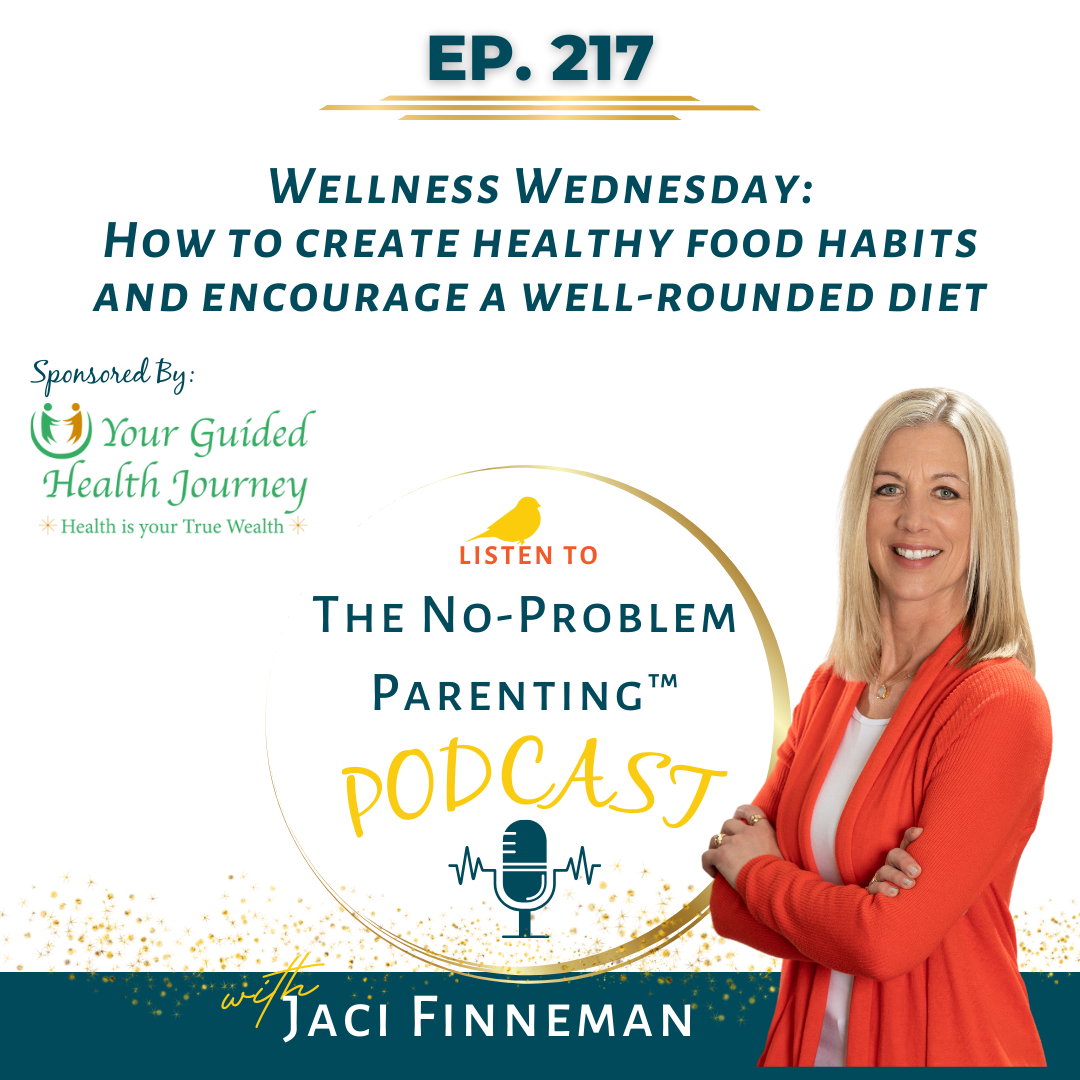
About this episode
How do I create healthy food habits and encourage my children to eat a well-rounded diet?
Short version of tips:
make mealtime an enjoyable experience
create a relaxed atmosphere, wherever you are eating your meal
gradually introduce a variety of foods, flavors, and textures into their meals.
experiment with different cooking methods
avoid being too nice or too mean regarding meal time
avoid the battle of kids not eating the meal that is served
stay out of food battles as much as possible
just because your child is upset about the food doesn’t mean you have to be
Become a No Problem Parent Today
Full transcript
Hello, No Problem Parents. Welcome to the first episode of Wellness Wednesdays on the No Problem Parenting Podcast. I'm your host, Jackie Fineman, and I'm excited to kick off this Wednesday series. Each Wednesday, our topic is related to wellness, including physical, emotional, and cognitive health.
And I'm going to share resources and products that support your family's overall health and wellness. Before we dive into today's questions, I want to extend a warm thank you to you, our incredible listeners. Your support in consistently listening to the No Problem Parenting podcast has made us a top 2% podcast, and you brought us to this moment where we're able to do these daily episodes. So we're thrilled to be your companion on your parenting journey.
Thank you for tuning in and being a consistent listener. We really appreciate it. And today's question is number one of 52 Wellness Wednesday questions that we'll be answering throughout the year. How do I create healthy food habits and encourage my children to eat a well-rounded diet?
We're going to answer that question and give you a couple of tips that you can use right away today. Are you ready to become the confident leader your kids crave you to be? Are you losing your crap on your kids, yelling, giving in, and exhausted at the end of every day? You are already a good parent, and I'm sure you've sought advice from friends or family.
You've read books on your child's specific behavior problem. Maybe you've even signed them up to see the school counselor or an outpatient therapist. But despite your efforts to find the right person or thing that will help, your family is still struggling. You're tired of pretending everything's okay.
Well, if your confidence is shot and you feel like you're failing your kids, register to become a No Problem Parent. You can start building confidence in your parenting immediately. Don't make this parenting gig harder than it needs to be. Become a No Problem Parent today.
All right, parents, let's create some healthy food habits and encourage our kids to eat a well-rounded diet. And before we do that, I want to talk about a couple of previous episodes that actually set the stage for today's discussion. In episode 131, we defined the differences between a picky eater and a problem feeder with Aaron Gonzalez. So if you're unsure which of these is your child's challenge or problem, I recommend you go back and listen to episode 131 because identifying whether your kiddo is a picky eater who might be selective about certain foods or they're a problem feeder, which is a kiddo who might have sensory issues or aversions to certain foods is really crucial. It's crucial to identify which of those issues or problems or challenges your kiddo's going through. Knowing if your kids are struggling with one of these feeding challenges is going to allow you to tailor your parenting approach and also help you respond instead of react to those challenges. And you can support your child's unique needs. This would be considered step one of no problem parenting,
seeking first to understand. Let's understand what are the food issues in our kiddos. And then next, what do sensory issues have to do with eating? Well, listen to episode 144 with Cherie Wurtz.
She teaches us about the connection between sleep and sensory issues. Quality sleep is crucial for your kiddos' physical, emotional, and digestive health. And there are a variety of sensory challenges that go unnoticed because parents, we don't know what we don't know. Left undetected, sensory issues are often misdiagnosed as mental health issues and sometimes kids are unnecessarily put on behavior plans. Isn't that interesting? I found this time and time again with families that we're putting kids on behavior plans, bringing them to a therapist, and then we get to the root of the problem and there's a sensory issue. It's like, who knew? So with these two episodes in mind, let's tackle today's question and get into some actionable tips that are going to create healthy food habits over time in our kids. Tip number one is to make mealtime an enjoyable experience as much as possible, right? Are you rushing through your dinners? Are you multitasking as the kids eat? Maybe you're eating in the car or scrolling on your phone while you're at the table watching your kids eat their dinner. Well, can we take just 20 minutes of screen-free time with our family to eat. And even if your norm is eating dinner in the car between activities, no judgment here. I did that with my kiddo. It's kind of the price we pay for wanting them to be in sports and extracurricular activities. But even when we're in the car, we can take 20 minutes without a screen
or a speaker adding white noise to our meal. Also, it's okay to be bored while eating dinner. In fact, it's better to be bored while eating dinner. You take smaller bites, you breathe more in between bites and maybe you even converse for a bit or just pause and allow your digestive system to relax. This sounds like a simple tip but it's truly one of the most effective ways to encourage healthy eating habits. Make mealtime a positive and enjoyable experience. So whatever you can do to create that relaxed atmosphere wherever you're eating your meal, free from stress and from pressure and hurry up, hurry up, right? Be intentional about slowing down and focusing on the meal itself. Set the stage for a positive association with food by talking about the food you're eating, noticing it, the textures, the colors, and even what you like or dislike about part of the meal. Now, if and when possible, involve your kiddo in the meal preparation.
Allow them to choose some ingredients or assist with simple tasks. And if they're older, have them cook the meal. Now remember, the goal is to make mealtime a place for connection and discovery through conversation or even just remembering the pause. So when you're at the dinner table or in your car eating, wherever it is, think beyond asking questions like, how was your day? Instead, volunteer something that happened to you that day or during the week. Share a gratitude like we discussed on Mindful Monday's episode or review the next day's schedule or maybe the upcoming weekend plans. Now, if someone in your family is crabby during dinner, or if the conversation begins to turn sour, you can say, hey, let's table this discussion until after dinner,
and then just intentionally enjoy the meal for the moment. Like we talked about on Mindset Monday, we can be intentional and choose when and how we engage or not engage in battles with our kids. All right, tip number two, introduce a variety of flavors and textures. Create curiosity about the foods that you're eating.
So children, just like us adults, can have preferences when it comes to flavors and textures. To encourage a diverse diet, gradually introduce a variety of foods and flavors and textures into your kiddos' meals. Start with small portions of the new foods alongside with familiar favorites. So in other words, if you have a picky eater or a problem feeder, be sure to have at least one option that you know your child is going to enjoy rather than creating a full meal of all new foods or foods that you're pretty sure your kiddo isn't going to like.
And experiment with different cooking methods to discover what resonates with your child's taste buds. So does your child prefer raw or cooked veggies? And remember to be patient and persistent. It might take several attempts before your kiddo develops a liking for a certain food.
Providing a variety not only provides essential nutrients, but it also expands their palate and it sets the stage for a lifetime of healthy eating habits. So remember in episode 212 with Shirley Billigmeyer, we talked about mindful bites and rethinking or relearning the purpose of food and why we need to ditch the clean plate club mentality. Check out episode 212 for more information on that. And now the last thing that I'm going to say, and I guess you could consider it tip number three, is to avoid being too nice or too mean regarding mealtime.
Now, I want you to know, I don't expect and I actually don't even encourage you to be a restaurant or to wait on your kids during dinnertime any more than I would encourage you to yell your kids into finishing their dinner. There can be a slippery slope if you're having your kids determine every menu. And I actually am going to encourage you to avoid making more than one meal when possible. But, you know, now that many of us know that gluten, for instance, causes stomach issues and I might add behavioral issues, why would we serve spaghetti to the family with only a gluten-filled pasta?
You know, sometimes I get it. Sometimes accommodations are necessary. And if that's the case, then just matter of factly acknowledge that and don't feed that problem or turn it into something it's not. If you know you've got one or two people in your family that are gluten intolerant, you're going to need to make a gluten-free pasta.
And maybe the whole family eats gluten-free pasta because you're not going to accommodate both. Or it's okay to say this is how our family's mealtime works. And so we have a pasta with gluten and one that's gluten-free. That is not catering to your child in a restaurant style kind of way.
That's just your reality. So in other words, you wouldn't say, I'm just sick and tired of making two different kinds of pasta. This isn't a restaurant, right? But if you've made a meal in the past that no one is allergic to and everyone has previously eaten the foods that you are serving, and then you serve that dinner and one of your kids say, I don't want that.
I want pizza. Your response can be, hey, thanks for letting me know. and this is what we're having tonight. Get enough to hold you over to breakfast. Now another trick to avoid the battle of kids not eating the meal that is served is to allow your kids to eat what is served or make themselves something else like a peanut butter and jelly sandwich or a bowl of cereal or something that's easy and inexpensive that doesn't require cooking and that they can prepare themselves. So this helps avoid the trap of defense and arguing. You can just very matter-of-factly say, hey, here's what we're having. Feel free to make a PB&J or a bowl of cereal.
Or if that's not an option for you and you know your kid and that's just going to cause a bunch of tug-of-war with them, then just simply say, hope you get enough to hold you over till breakfast. like this is what we're having tonight. Remember a kiddo going without one meal is not going to harm them. Well, at least not for most kids. But again, you have to know what you are willing to live with and what their needs are. Just try not to be too nice or too mean. Everything in moderation and remember to stay out of food battles as much as possible. Also remember that just because your child is upset about the food doesn't mean you have to be. You can matter-of-factly, empathetically understand their frustration without giving in or getting mad. A big thank you to our previous expert guests from episodes 133, 144, and 212. And also a big thank you to Melissa Dealy from Your Guided Health Journey. She was actually on episode 45. There are links to everybody's websites and resources in the show notes of those episodes. And in today's show notes,
there's a special offer from Melissa. If you're wondering whether you or your child has an allergy or sensitivity to food, and you'd like to have a food sensitivity test that is sent directly to your home, you can test your child without having to go to an appointment. And when the results come back, Melissa is going to help you read the results and determine next best steps. Now, a side note, there's also a metals and toxins test. And for all you mamas out there, there's an at-home hormone test too. I've done the metals and toxins and the hormone test personally. And when I showed those test results, those labs to my doctor, she was impressed with how thorough the hormones test was.
So check it out or schedule a free call with Melissa to learn more. Again, her info is in the show notes. But as we wrap up today, remember that each child is just as unique as are you. And finding what works best for your family might take a little bit of time. Do your best to be optimistic and kind to yourself. And please don't hesitate to reach out for support when needed.
Thanks again, listeners. Your engagement and feedback inspire me to continue bringing you more meaningful content each day of the week. And if you have specific topics that you'd like me to explore in future episodes, follow at no problem parents, send us a message on social media. You can do at no problem parents or hashtag no problem parents. We'll see those messages and we'll take your feedback and suggestions into consideration until next Wednesday, hugs and high fives parents. You got this. All right. That's it for today's episode of the no problem parenting podcast. Hey, thanks guys for tuning in. If you found value in today's episode, click the subscribe button and share it with other parents who might need a little boost.
Stay connected on our socials by following at No Problem Parents for more parenting tips and get your free download of the 60 ways to respond to your kids without losing your cool. Go to noproblemparents.com. Until next time, remember your confidence comes from embracing both successes and setbacks. So take a deep breath, embrace the chaos, and remember you got this.
you
Become the confident leader your kids crave
The method, the community, monthly live Q&A with Jaci, and Celia — your AI guide in the moment.
Start your 14-day free trial Get it on iPhone or sign up on the web