
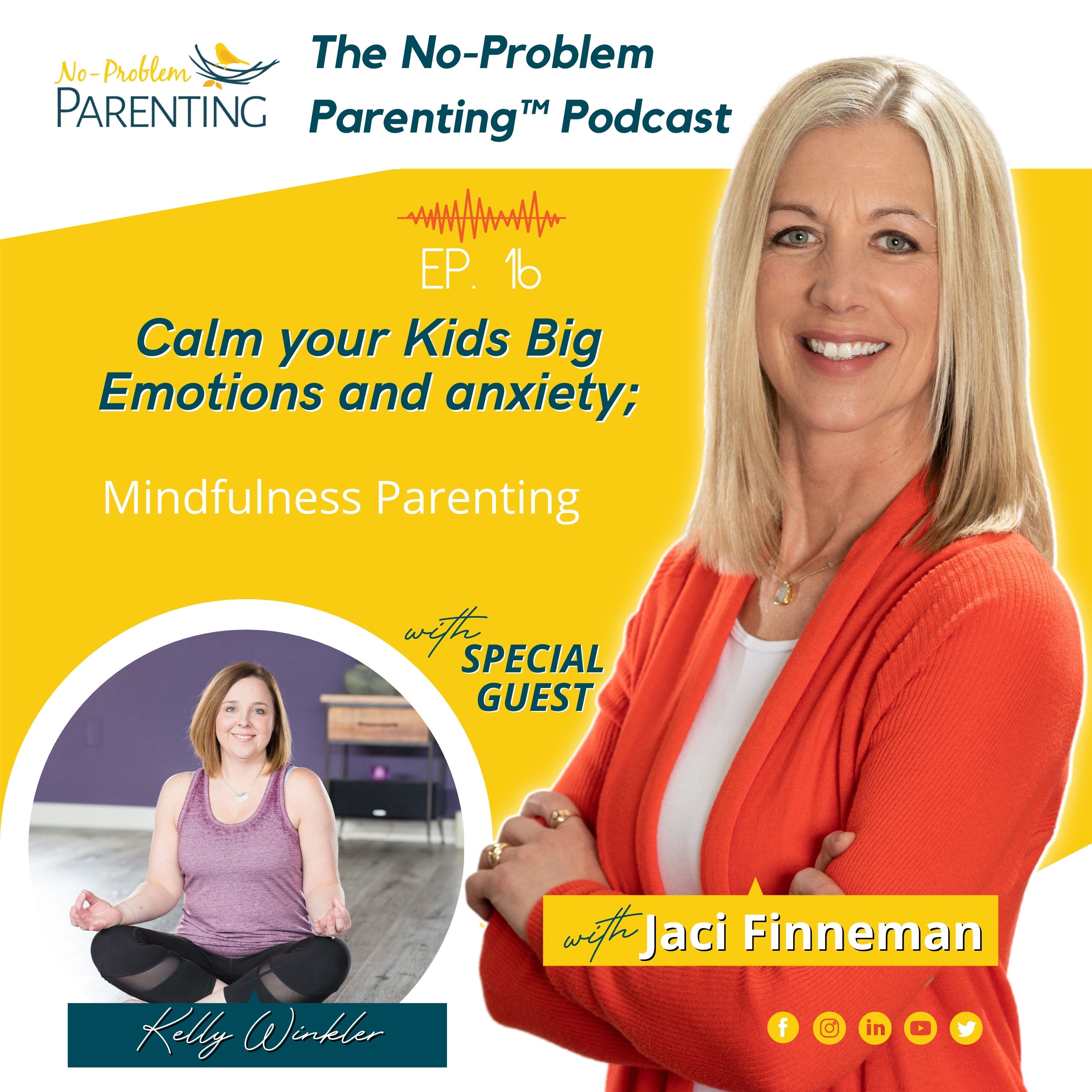
Parenting Kids with Anxiety and Big Emotions with special guest Kelly Winkler
About this episode
Welcome Back Parents! Today's episode introduces us to the benefits of becoming a mindful parent and getting ourselves prepared to respond to our kid's big emotions. My special guest Kelly Winkler shares how her inspiration to become a yoga instructor for children and parents came from watching her preteen daughter fall in love with yoga and use it as a tool to deal with anxiety.
Become a No Problem Parent Today!
Full transcript
Welcome back to the No Problem Parenting Podcast where we choose to deal with and overcome the behavior challenges and emotions in our home. Say today I have a special guest Kelly Winkler. Kelly received her degree in human development and family studies from Penn State University. She has an extensive background working with children starting her career as a child life specialist in the hospital setting. She then obtained her elementary teacher certification and has taught children ranging in age preschool through fifth grade. And she's also the mother of four children. She began her journey with yoga 16 years ago when she was pregnant with her first child. However, it wasn't until 2017 that she began to find a strong pull toward a consistent yoga practice. Her inspiration came from watching her preteen daughter fall in love with yoga and use it as a tool to deal with her anxiety. As a former educator and child life specialist,
Kelly became inspired to bring yoga to children. Over the years, the environment in which she worked with children changed. However, one thing remained constant, her belief that the most important thing she could bring a child was self-confidence, strength, and the power to create their own inner peace. This led Kelly to become a certified yoga instructor. Kelly obtained her children's yoga certification through Kidding Around Yoga and now has gone on to become a Kidding Around Yoga trainer. She gives professional development for educators to incorporate mindfulness and yoga into their classroom. Kelly believes the benefits of mindfulness are so powerful, she's created a podcast for parents and teachers where she shares these tools. She strives to educate and engage children and their families in these practices and is now offering parent coaching to help families have a more calm and connected home. Welcome to the show, Kelly. I'm so excited to have you here today to talk all things mindfulness and anxiety in our kids.
Thank you so much for having me. I'm excited to come on and share. I started out, I always wanted to work with children. I started out as a teacher and I was so excited to become a mom. I'm now a of four kids that range in age from 17 down to seven. I, my oldest daughter really influenced where I ended up going in my career because I took some time away from the classroom and to be a stay-at-home mom. And she was a pretty anxious child. It took us a really long time to get an actual correct diagnosis for her. We struggled on and off and some of it, I was a new mom. So I didn't really know that, that it wasn't normal, quote unquote. And she had lots of different struggles, lots of separation anxiety, but lots of repetitive question asking and, and since she was a toddler, so we, it took us a long time, but finally, when she was about 12 years old,
the anxiety really increased. I had just gone back to work part-time in the classroom and she was in middle school and she just could not make it through a school day without a full blown panic attack. She was spending most of her day in the counselor's office, lots of phone calls home. I was having to pick her up and eventually she just started refusing to go to school at all.
So we were back at trying to find out what was really going on. She ultimately ended up being diagnosed with OCD and panic disorder. And she was in therapy and we were trying all the things we were doing acupuncture and whatever we could do to try to give her some tools and some resources to help her. And her therapist recommended that she start yoga. And so we found a teen yoga class and it was just incredible. She just took to it right away. And all these things that we were trying to have her do before, like the deep breathing and the meditation and, and exercising just came together and made sense to her after she experienced this yoga class.
And she began to just use these tools all the time. She began meditating every day, sometimes twice a day, she was moving her body. And she really found that these tools gave her a sense of control when she felt out of control with her anxiety, because she had all these intrusive thoughts, especially with the OCD. She found that using meditation that she could be in charge of her thoughts. And so she started to use these tools and we just saw such a transformation.
And as an educator, I just was thinking to myself, wow, like at this time, at the time I was a preschool teacher. And I was thinking if she had had these tools when she was in preschool, when she was three and four years old, what a different trajectory maybe this had gone, she could have avoided a lot of struggle. And so I just started researching, how do I bring yoga to children, because I just never thought of even that as an option. And I found a training that was about 20 minutes from my house, like a month later. So I signed up right away. And I got trained to teach kids yoga, I started using it in my classroom, the kids really took to it. And it's sort of just snowballed from there, I ended up going back and going getting my 200 hour yoga, yoga certification.
So now I also teach adult yoga, eventually left the classroom. And now I'm doing this full time working with families, children, parents, to teach them these yoga and mindfulness tools to help them with things like anxiety, but honestly, just the the day to day parenting and the stresses that we all have as parents and the stresses that our children have, these tools can be so incredible and, and life-changing. So that's so great. How do you define mindfulness then? And why do you find it an important tool in parenting? Cause my, it's a big, it's a broad subject. Mindfulness is a really broad subject, right? Yeah. It's become a big buzzword. And I think there's a lot of confusion. Sometimes people confuse the word meditation and mindfulness. Sometimes they think that they're interchangeable. But mindfulness is really defined as just being in the present moment, paying attention to what's happening around you, paying attention to your body,
just being in the moment and with no judgment. So paying attention to your feelings and your physical sensations and whatever your physical environment is, but with no judgment, just noticing. That's really the general definition of mindfulness. Whereas meditation is more of a, it's a type of mindfulness practice, but it's more of paying attention to your thoughts and then sort of trying to quiet those thoughts down and quiet the mind down. So in parenting, I really think mindfulness is sort of like the groundwork. It's really should be the foundation of every parenting course or any, anything when once parents, you know, once people start to have children, they really should start well before everyone should practice mindfulness, but especially when you're going to have children, because it's really stressful and our children are going to have behaviors and they're going to trigger us. And we have all of this internal stuff going on as a parent, it brings up, your kids are going to bring up a lot of stuff in you that,
you forgot was there. And being mindful and being able to stay in that present moment does so much. First of all, it allows you to be connected with your child, which is so important because we can't teach our children anything or give them a lesson on anything if they're not connected to us, right? They always say connect before you correct. So you need to be connected to your child. And if you're not in the moment and right there in that present moment with your kid, then you're not going to connect with them on that level. It's also really important because if we're not paying attention to our own stress and our own emotions, we're bringing that to the interaction with our children. It is not just about our child's behavior. It's also about what we bring to that interaction. So for example, you know, my youngest is seven and she has some sensory issues. So she struggles getting dressed in the morning, you know, and if I wake up in the morning, like, oh, this is going to be terrible. She's going to fight with me. We're going to have a battle. I already have that energy and that sort of, I bring it with me and she can sense that she can sense I'm ready to like battle it out with her. And that gets her going faster than if I just stay calm and sort of ground myself before I go in to get her dressed. And I sort of like check myself like, okay,
I'm going to do a few deep breaths. I'm going to ground myself and I'm going to take this one moment at a time, get myself, my, my stress level down so that I don't overreact when she's struggling to put her socks on or whatever that might be. So important to remember to, to notice and be curious about our kids, but also to be prepared ourselves before going into start the day for one, because you never know, maybe your kiddo is going to not want to get out of bed or not going to get their clothes on. So if you're in a place of already feeling overwhelmed or stressed for the day, or, and you're just thinking I have too many things to do, you're probably going to come off more reactive than responsive. How can someone begin a mindfulness practice?
What are some things that a parent can do? I think people get a little bit overwhelmed sometimes with starting any new routine or any new practice, right? Some people, you know, people be like, oh, I want to, I want to start an exercise practice, I want to, you know, start a mindfulness practice. And sometimes it can feel overwhelming, like, where do I begin? So I always tell my parents that I work with, start small, bite sized pieces, choose one type of practice, there's many different types of mindfulness practice, right? We can use breathing as a mindfulness practice, we can use meditation, we can use movement, you know, doing yoga, any any form of exercise really can be mindful, mindful, just really tuning into your senses is a mindfulness practice. So there's so many options. So my first recommendation is for people to look at all the different options and try out different things and make it small. So you're not going to start a meditation practice right off the bat, sitting down and meditating for 20 or 30 minutes, like we're going to start small, we're going to start with just five minutes, start with five minutes, or maybe you're not even ready to do to have a seated meditation, maybe it's just you wake up in the morning. And before you get out of bed, you say three things that you're grateful for. Or while your coffee's brewing,
you just stand there and you take three full deep breaths, nice and slow and steady and wait for your coffee to brew and just sort of instead of running around the kitchen, unloading the dishwasher and this and that, that we're usually always rushing around, just settle yourself, do three deep breaths and attach it to something that you do every day. So like I said, getting out of bed, making your coffee, or maybe it's brushing your teeth. When I first started practicing mindfulness, like I said, I'm a mom of four. Pre-COVID, we had a bazillion activities that we used to do. And so I spent a lot of time in the car and I was always really stressed trying to get kids to different activities, making sure I wasn't late picking somebody up. So I attached my mindfulness practice to getting in the car. Every time I got in the car, I took three full deep breaths. I just, before I turned the car on, before I backed up anything, I put my seatbelt on and I took three deep breaths. And before I knew it, it became part of my routine. I didn't even notice I was doing it anymore. And when my kids were in the car with me, they noticed, and they all kind of also paused and like, okay, we're going to set. And like, at first they were asking me like, what are you doing? And I'm like, you know what? I'm just calming myself down before I pull out of the driveway. Cause sometimes it's stressful rushing around and I just want to be
calm before we, we leave the house. So, and then they notice, and then they kind of all just sat in silence, like, okay, like she's taking her deep breaths and you know, they were breathing along with me sometime, but they were just noticing. And that's important, you know, to model that, that behavior for your kids too. Yeah. That is so good. And it seems like, I think sometimes when we hear things like that, we're like, oh yeah, that sounds so, you know, easy. What can that really do? Most of us are not taking full deep breaths. We are breathing very shallowly, which is not going to help our nervous system to relax. And people notice once they start practicing that deep breathing, that throughout their day, they're just breathing deeper normally, like it's it like increases your breath. Once you start noticing that and practicing it, then you don't that close attention to you're just naturally breathing deeper and taking those nice slow exhales. So, which is super important to calm down our nervous system. What are some ways that parents can then utilize mindfulness to help in dealing with their kids' challenging behaviors? So yeah, this is really an important piece of parenting. First of all,
the first step is your mindset around the behaviors. We have to really think about our child's behavior, just as communication, even though many times it's very frustrating when they're having difficult behaviors, we're trying to either get out the door or cook dinner or whatever it is that we're trying to accomplish. And they're having a tantrum or whatever that might be. We're just looking at often, we're just looking at their behavior. We just want the behavior to stop. But the mindset, the first mindful practice is thinking about that behavior, You're like, okay, not that my child is having a difficult behavior, but my child is having a difficult time with something.
They're struggling with something. That's why the behavior is coming. So the behavior is just the tip of the iceberg, right? We have to look deeper.
Why is my child, you know, crying over a broken crayon right now, right? It's not really about the broken crayon. So we have to kind of first calm ourselves down, kind of put aside like, oh my gosh, I'm going to be late, get into this whole like stress reaction. We just have to like take those deep breaths and say like, okay, let me think about this for a minute.
Like maybe they didn't get enough sleep. Maybe they're hungry. You know, maybe they're anxious about leaving the house. Maybe they're sad about something, whatever it might be.
There's always a reason behind the behavior. Kids don't wake up just to have difficult behaviors. They don't wake up saying like, I'm going to give my parents a hard time today, right? That's not their goal.
So that's the first step is kind of being mindful to not overreact to the behavior and kind of look a little bit deeper. And then it's really regulating your emotions, because sometimes you're just going to have to sit with your child and say, you look like you're feeling really sad right now. sometimes we're going to have to say like, I might be a few minutes late. But the thing that happens often is when we do that, we actually end up deescalating the behavior a lot faster than if we try to fight it, right? If we try to just say, stop crying and put your shoes on, you know, if we just sit there for a minute, like, you know what, you're having a hard time putting your shoes on right now. Like, how could I help you? Do you need a hug? Do you want me to just sit with you?
Would you like me to put your shoes on, you know, give them some options. But if we're not calm and regulated, we're not going to be able to do that because we're just going to be yelling. We got to go, come on, put your shoes on. So that's kind of like really the whole basis behind it is keeping ourselves regulated so that we can see our child and not the behavior. What does anxiety look like in kids to you? What have you found? That's the tricky part because it can look different for everybody, kids and adults. Anxiety presents itself different for everyone. So in my daughter's case, it presented itself, like I said, with her always seeking lots of reassurance, lots of questions.
Am I going to be okay? Is this going to be okay? She would get kind of stuck on a question, you know, when she was four, her great grandfather passed. And so that's a difficult time. Of course, you know, you expect the child to struggle for a bit, but she was like a year and a half, every single day she would ask me what does heaven look like do you know what where grandpa is what can he see me um you know and she just sort of perseverated on when am I going to go to heaven when are you going to go to heaven like and she just couldn't let it go and so you know for for a long time every single day she would whether we were driving in the car at some point throughout the day these questions would come so that's kind of what it looked like for her she had a hard time separating from me is another clue. But for some kids, it might look like lack of focus, they can't they can't focus. And that maybe is because they're thinking about the worries in their head.
You know, for some kids, it might look like hyperactivity, because they're just moving their body because they have this extra nervous energy that they don't know what to do with, they might be look like they maybe have ADHD, that that could be a misdiagnosis sometimes, because sometimes It's actually anxiety. So it's really difficult, but it looks different for every kid. For some kids, they're very quiet. And those kids are just classified as maybe what we call introverted or shy, but they probably really aren't.
They're just nervous or anxious. So it's really tricky, especially with the younger kids. And then it gets hard when the kids who don't want to talk about it. luckily, my daughter, eventually, when she got to a certain age, did start to voice her worries to us. And so we kind of started to get a better picture. But you have those really quiet kids that are keeping everything internal. So that makes it difficult sometimes too. So I would just say really pay attention to a change in your child's behavior. If you know, they didn't used to have a hard time separating from you. And now all of a sudden, they're, they're struggling, because I think with COVID and coming out of this past year, I think we're going to see a lot more anxiety than we had in the past.
And it was already there and prevalent in the past, but I think we're going to see a lot more kids presenting with anxiety. So look for that change in behavior. If they were a social kid and suddenly it seems like they're not reaching out to friends anymore and they're, they're just seem like they're isolating themselves. Look, look for those, those tips and then start exploring. Being aware of the anxiety part of it. And then what are some things that maybe some practical tips that you can share on how we can use mindfulness in parenting our kids when they experience big emotions. So this is one of my favorite things to teach parents.
You're not going to be able to use these mindfulness practices for your child when they're in the heat of feeling anxious or having a meltdown or tantrum. You're not going to be able to teach them these skills. My best tip is do this stuff with your kids when they're happy and calm and in a good mood. Practice these skills, but do it in a fun and engaging way because all of these skills, like our deep breathing, right?
We're not going to necessarily expect our three or four year old to sit down and put their hand on their heart and their belly and sit with us and do deep breathing. They might, if we pretend we're blowing up a big balloon or we get some fuzzy pom poms and we have a little catch and we put the pom pom on our hand and they blow it to us and then we blow it back. We blow bubbles. I mean, our great way to, to get those little ones practicing their deep breathing.
So you want to practice these things with your kids when they're happy so that when they are having a hard time, they can recall that you can say like, oh, let's do our balloon breathing because they've already practiced it. They know it already. It's sort of like muscle memory. Their body will remember to be able to take those deep breaths.
Doing deep breathing in fun ways with your child is a great tip. Another tip is to let them be aware of their bodies. So using some like yoga poses. So you would have them maybe like put some music on and play freeze dance, right? Have them dance, move around, jump, and then pause the music and then have them get into a yoga pose.
And you don't have to practice yoga yourself or even really know too much about it. There's so many things out there. You can get yoga cards or there's books and things, but just look up even on the internet, three or four yoga poses and that you could do. And then teaching them that opposite of moving their body quickly and that dancing and jumping and then finding stillness in a yoga pose, draw their attention.
Oh, take a nice deep breath while you're standing in star pose or whatever it is. and reach your fingers up really tall to the, you know, see if you can reach up to the clouds and kind of stretch out your arms and just sort of bring their attention, get them into their body. Let them, because that's another tip when they're struggling and having a tantrum. If we can draw attention to their body, draw attention to those senses and the things that they feel and see, that's going to help them to regulate. We can co-regulate with them. And then eventually they'll be able to do that on their own and they'll be able to self-regulate. Doing the deep breathing and in a fun way, getting them to move their body and then find some stillness is a great way. And then tune into those senses. Play I spy. If your kid has trouble with coming to the dinner table, this is always a fun thing I like to do. So I like to play a dinner detective. So I don't tell them what we're having for dinner. And then I tell them to use their nose and they sit at the table and take deep breaths with their nose and see if they can smell and figure out, or are we, what are we having for dinner tonight? And then they make some guesses and sort of make it fun and engaging. You know, they're using those skills and they don't even realize it because they think they're just playing a fun game. Those are great ideas. Awesome ideas for the little ones.
What about those teenagers? Now your daughter's older as well. And I'm pretty sure if you try to have her catch a bubble or blow up a balloon, she's going to roll her eyes at you and be like, Get over it, mom. Yep. She's not having that for sure. But yeah, for the teens, you know, it's really more about, they like to know the science behind it. Right. So teaching them, I mean, even for the little ones, it's great to teach them about their, their brain and how things work, but, but really, especially for the teenagers, teaching them about their brain and how there's different areas of our brain and this lower part of our brain, I'm holding up my hand, But this lower part of our brain down here is where we have our, it's our fight, flight,
and freeze response. And, you know, our thumb is our emotions. And then this top part of our brain where we fold our fingers over in our hand model is the part of our brain that makes good decisions and can think clearly. And when we're feeling stressed and anxious, this lower part of our brain is in charge.
And that makes it that we can't really make good decisions. So then we teach them, okay. So how can we engage that upper part of our brain, quiet down the lower part of our brain, and get that upper part of our brain thinking? We can use deep breathing. And so when they understand sort of the reason you want them to utilize these tools, then it's a lot easier for them to want to do it because they're going to want to be able to calm their body down and feel better and be able to make better choices.
So I think really getting into the science behind it. I mean, another really great tip, you know, I could talk forever about this stuff, but the vagus nerve is a huge piece. It's a big nerve that starts at the base of our brain. Some people call it the wandering nerve because it's so big. It goes down, it wraps around our heart, it wraps into our respiratory system and all the way down into our digestive system.
But when we stimulate that vagus nerve, it sends a message to our brain that we're safe and we're calm. It activates our rest and digest part of our nervous system instead of our fight, flight and freeze response and different things that help to, um, they call it vagal tone. So, so your vagal tone, if you have good vagal tone, your vagus nerve works better and ways that you can increase your vagal tone are through deep breathing, but also through singing and humming.
So especially for my daughter, she's really into music. So sometimes I just tell her like, throw on a song and sing it out, you know, like, that's gonna help you to kind of relax. And so most teenagers can really probably get into music. Right. So that's another great tool that you can say, even if they don't want to sing, just actually listening to the music alone can can really help them to sort of regulate and calm themselves down.
That's so good. How can my listeners get in touch with you or learn more about you? I have a podcast called mindful moments for families and schools. So you can always find me there. I released two episodes a week. One, one episode is a solo episode where I'll give tips like I've been doing today. And another episode is an interview with other experts in the field, therapists and teachers, counselors, yoga teachers, all different people. And you can also find me on Instagram under mindful moments for families and on Facebook. I'm under hitting around yoga with Kelly. All right. Excellent. Yeah. You guys be sure to check out Kelly's podcast, mindful moments for families and schools. If you're just looking for a few, you know,
a variety of ways to help you and your child get into that place or that space where you're just kind of like prepared to respond versus react, I highly recommend her podcast. All right. Thanks so much for being here today with us, Kelly. I really appreciate it. Thank you so much for having me. All right, parents, I hope you found some benefit from today's episode and you gained a few tips and tools and things that you can use with your kiddos when they're having those big emotions, those worries or anxieties, and also for yourself, getting yourself in that place of calm so that you're prepared to respond to your kids versus react to them. And hey, if you're liking this podcast, do me a favor and hit the subscribe button, like the episode, or even leave a comment or review. It's the number one way that you can thank me for putting this information out there and sharing these resources with you. Thanks so much, you guys. Hugs and high fives, Jackie.
Thank you.
Become the confident leader your kids crave
The method, the community, monthly live Q&A with Jaci, and Celia — your AI guide in the moment.
Start your 14-day free trial Get it on iPhone or sign up on the web