
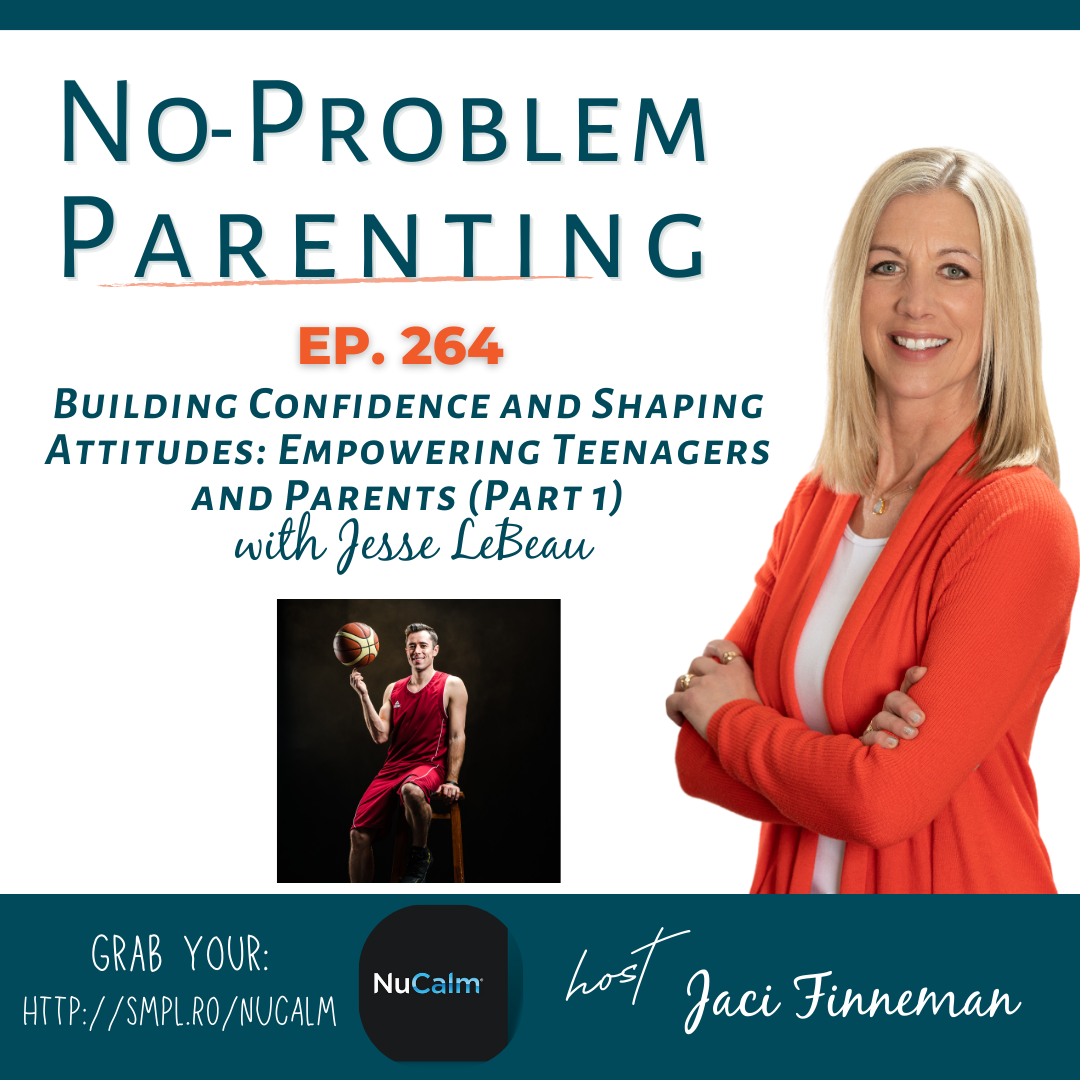
Building Confidence and Shaping Attitudes: Empowering Teenagers and Parents with Jesse LeBeau (Part 1)
About this episode
Welcome Back No-Problem Parents!
Today I'm joined by the incredible Jesse LeBeau, a renowned youth motivational speaker and teen coach. Jesse's journey from underdog to success has inspired millions, and he shares his inspiring story, from his humble beginnings to becoming one of today's most sought-after motivational speakers. His experiences in basketball trick artistry and Hollywood add layers to his story of resilience and success.
In Part 1/2 Jesse introduces the 5 Key Shifts Every Parent can make to strengthen their relationship with their teenagers. From creating open communication to setting boundaries, you can start changing the conversations in your home today!
Become a No Problem Parent Today
Full transcript
Welcome to the No Problem Parenting Podcast. From toddler tantrums to teenage eye rolls, this podcast is your go-to for updated and old school tips and tools that are gonna help you become the confident leader your kids crave you to be. Do you ever wish there was a specific manual that came with each one of your kids? I mean, what works for one often doesn't work for the other, right?
And let's face it, we don't know what we don't know. And even if there was a manual, it probably wouldn't be able to keep up with all the changes in our world. Well, this podcast is the next best thing. I'm your host, Jackie Finneman, a 30-year counselor turned parenting coach, and I've got a lot to share, including hundreds of resources that you have access to right from your home and strategies that are going to boost your confidence and energize you. So whether you're knee-deep in diapers or navigating the tween years, or you're launching your child into adulthood, subscribe and share this podcast with your friends teachers and daycare providers we're going to turn your parenting problems into no problem one episode at a time all right welcome back no problem parents to the no problem parenting podcast where we choose to deal with and overcome the challenges in our home this podcast is here for you to become the confident leader that i say our kids crave us to be and it doesn't always seem like our kids crave our leadership or our discipline, but they really do, parents. And today, my guest agrees. He believes that we need to stop shielding our kids from making mistakes and instead allow them to fail and then guide them in picking themselves up, becoming great, and enjoying the journey. So it's with great pleasure,
parents, that I introduce you to teen mentor and motivational speaker, Jesse LeBeau. Welcome to the show, Jesse. Hey, I'm excited to be here. We got a lot to talk about. We sure do. And before we get into the five shifts that I really want to highlight today, your journey started from humble beginnings to now being one of the most sought after youth coaches and speakers. Your passion, your perseverance, and your sheer determination has touched the lives of over 1 million teenagers through your electrifying events, your best-selling books, and your programs. So your impact extends far beyond the stage. You're one of the world's premier basketball trick artists, and you've graced the Hollywood big screen. You starred in commercials alongside legends like Kobe Bryant. You share the screen with NBA superstar Kevin Durant.
You've even had a surreal experience of being hand-fed cheeseburgers by supermodel Heidi Klum. Is that right? Yeah, pretty good day. Oh my gosh, you've just done so much. And I wanted to get it all in here. You've most recently launched a new reality series, The LeBeau Show, giving viewers a firsthand glimpse into the profound impact that you're making on today's youth, particularly teens that are struggling to find their footing in our ever-changing world. Tell us a little bit about your underdog story from childhood and maybe what were some of the biggest challenges you faced?
How did all of this lead you to speaking to all of these kiddos? Yeah, it's so funny. As you were saying all those things, I just never would have planned or expected for any of that. So far, my dad's a logger, a retired logger in Alaska.
And my mom was a fourth grade school teacher, also retired. So I just was a kid on a little island in Alaska that took a boat every day to get to school. There was no roads or stores on our little island. And every day that was the routine.
And town was one road going left, one road going right, four stoplights, and then 15 miles of road and you were trapped there. So there wasn't a lot to do. And my big dream ever since I was little was to be a basketball player. and which is great.
You know, it's great to have a dream, but the thing that you can't see if you're listening to this right now is that I was by far the smallest kid, smaller than all the boys, but also smaller than all of the girls. So when I told people that I wanted to be a basketball player, it was not received very well. People weren't very enthusiastic about my chances for success. As can be with kids, you know, they were very cruel. And I was told very directly that I wasn't big enough. I wasn't fast enough. I wasn't strong enough. And I would never have what it takes to be good at basketball.
And so that led me to a variety of bullying situations. And at a young age in the seventh grade, I, I had this incident with a, with an older kid and he basically said, you're not even going to be big enough to ride ponies, you know, so, so being a horse jockey, I wasn't even big enough for that, you know, and I just remember exactly how I felt. I was totally embarrassed in front of all the other kids. I got angry and more than anything, I just wanted to disappear.
And I felt this loneliness in this isolation and wanting to do something that, that didn't seem possible. And I think that's something that's really relatable to kids today. Right now in the world, I feel and I see that there's an epidemic of loneliness. And despite us being more connected than ever before with the phone and social media, there's never been more kids that feel disconnected and feel lonely and feel like they don't belong to a group of friends, of tribe, of sport, an afterschool program, a youth group, and all of these different things.
And I totally get it because that's how I felt. I felt kind of hopeless. And so if that is your child, if you're listening to this right now, just know you aren't alone. This is something that's happening on a mass scale. And what I encourage all parents and all kids to do is to team up. And that's exactly what I did with basketball. Even though I didn't really realize that's what I was doing. I said, you know what? I'm not going to listen to this bully. I'm going to go for it and I'm not going to get bitter. I'm going to get better. I'm going to be the master of my attitude and I am going to become the best at basketball that I possibly can become. And so that's the same thing that I encourage any person today, young or old, is find your tribe, team up,
find your group, find your community, find the people that you can have a sense of belonging to in person, not through a screen, that you can belong to something that's bigger than yourself. And if you can do that, it's going to help you with all those mental health issues, stress, anxiety, depression, being connected with a group of people that can be there for you during your hard times. And you can be there for them during their hard times.
And then you guys can be there for each other when things are going great to celebrate your wins. That's what life is all about. The quality of life comes back to the quality of your relationship. So, yeah, all of that with basketball, I went on to have a fun little basketball career.
And you kind of shared some of it. I got to go to college and get my education paid for. And then I broke into entertainment and pretty quickly into it. I booked my first commercial with Kobe Bryant.
And it led to commercials and movies and TV shows. And then, like, okay, this is very cool. I'm getting to do all these things and play in these games on TV. But I found my why moment.
And that was for me connecting with kids because they would all come up to us after these games. I was literally playing with my childhood hero, Allen Iverson, famous NBA basketball player. And it hit me when we went back to my hometown of I could do more than just entertain with a basketball for an hour. I could share my story. I could write a book. I should start speaking.
And that's what I've done the last 10 years. So I always tell kids, hey, my dream was to be an NBA basketball player. I came up very far short of that, but I pivoted and I found something where I could still use basketball, my passion, the thing that I love to do and make a living from it. So, you know, I could have been a referee.
I could have been a basketball coach. I could have been a trainer. There's all sorts of different things. And this just happened to be the thing that it turned into for me.
But don't be afraid to pivot from your dream because you might find something that's bigger and ultimately even more than what you were searching for in the beginning. It's just absolutely incredible and amazing that it started with the fact that you said, I'm not going to be bitter. I'm going to be better. And you took some initiative.
How'd you even find the motivation in yourself to do that at the time? I think a little bit is innately my personality. And I think that you see that with people who are shorter is like, you want to prove people wrong. And this is what we see in life all the time is people will be in these desolate, unfair circumstances, but then they turn into Oprah Winfrey.
and they go from rags to riches. And so some people, they give in and they say, you know what, you're right. I'll never be Taylor Swift. I should never sing a song again, which is something a teen girl told us last week that just broke my heart.
Or you have people that go, you know what, I'm gonna prove you wrong. And they have that hunger. So I think a little bit was, if I'm being totally honest, it was just kind of my personality and hardheadedness and how I was raised. and the second part was my parents.
I had two awesome parents and my dad, the logger, he would have me go and watch the older kids play sports and we wouldn't watch who would win and who would lose. We'd watch how they would respond to adversity with their attitude. So did they blame the umpire and their teammates when they struck out and made the error or missed the game winning shot or did they hustle, encourage their teammates and take away the lessons that were going to help them in the bigger game, which is life.
And my dad really taught that to me at a young age. Attitude is everything. And if you look at my phone, the back screen of the computer I'm looking at right now, the side of our bus, it's all about attitude. I try to live that every day in its heart and I struggle with it.
But that is such a big lesson that I learned as a 10, 11-year-old. I love it. And attitude is everything. And it doesn't mean that every day you're going to have the best attitude.
Recognize it when you don't. Consider it. It's just a tough day or a bad day. And then get at it again the next day.
We're all going to have those negative thoughts and feelings that kind of come in every now and then. But that's OK. That happens. And we just pay attention to them, put them aside, and then keep her moving, as we say in the Midwest.
Keep going. The next day is a new day. You know, speaking of parents, though, you're talking about your dad, your mom and your dad and the things that they taught you at No Problem Parenting, we're all about helping parents become the confident leader that I say our kids crave us to be. And we have a three-step parenting mindset.
That's a mindset shift for parents. And then sharing resources, programs like yours, speaking engagements like yours to help parents and support their parenting journey. But you have five key shifts that you believe that every parent should make, which is going to help them support and guide their teens effectively. So can we talk about those?
Yeah, well, you just kind of led into it there as we were talking very organically, because you talk about being that confident leader as a parent. And that's the biggest takeaway. And, you know, we work with lots of parents as well. And so if you are someone who's listening to this, a couple of things you said were so awesome. I love that.
of like, we're going to come up short with our attitude, right? I'm like the person who's literally has made a living for 10 years talking about having a good attitude. And I struggle with my stinking attitude every single day. And in the best thing that ever happened to me was going and speaking about it in front of other people, because it holds me accountable to it. But with that being said, you're still going to fail. So as a parent, if you can use those situations, when you come up short, whether it's your temper, whether it's how you handle a certain situation in the home, outside of the home, whatever it is, hey, I messed up. This isn't how I should have handled this situation. And I want to do better next time. And I just want to let you know that I know that I could have done this better. That is one of the most powerful tools that you have, not when your things are going great and everything is perfect, but what do you do when you mess up. And so that's the very first thing that you're talking about is when it comes to these five shifts is it starts with you. As the parent, it starts with you. I went to, I left Alaska for two years and went to California for my freshman and sophomore year of high school.
And I sat in this classroom and it was a Christian school, private school. And I remember looking at the wall and there was a poster in Mrs. Bones class. And it said, everywhere you go, evangelize the gospel. And when necessary, use words. And I never forgot it so much that I'm still talking about it today. It's not this thing of the, a lot of parents like to say, you know, do as I say, not as I do. Unfortunately, it doesn't work like that. They're going to do as you do. So you better choose wisely what that's going to be. So many of the kids that we work with, like whether it's like, let's say they're dealing with anxiety. Well, when we look into it and you dig a little deeper, they're in a home where one or both of the parents are anxious and struggling with that themselves. So the thing is be the kid, the person that you want to be like they're watching and they're always watching, even when you don't realize it, you know? So it's like, Hey, you're not supposed to be on the phone all the time, but then you're there on the phone doing your thing.
They're looking at that. I mean, you know, the biggest thing is it starts with you. Do you see that with the parents in what you're doing there with parenting as well? Absolutely.
And like we're talking about with the mistakes and when we mess up as adults, as the parents, when we mess up, we can make it right. There is a link, parents, in the show notes for the make it right technique. We want to say, hey, I messed up. I'm sorry.
But even more than that, how can we make it right? Which is making it up to the person that we wronged, that we hurt, that we harmed. We can make it right. And we want our kids to be able to do that. We don't need to go in and rescue them from making it right. And step one or shift, shift number one of your five shifts is leveraging failures strategically.
Yeah, that's such a big one because today so many people are afraid to fail. And I think it's always been like that, but it's just been absolutely exacerbated by social media. So like I said, there's a girl that we were talking with last week. She's like, has this beautiful singing voice, but she heard Taylor Swift singing and she realizes like, oh, like I'll never be as great as Taylor Swift. So now she doesn't want to sing anymore.
So it's this thing of comparison and you're comparing yourself a lot of times to other people's highlight reels that are exaggerated and aren't even true. So whether it's the way they look, how much happiness they are, you know, I always get a kick out of the relationships as people post their relationships online. The more they post about how happy and great they are, I'm like, oh, they are miserable. If you're happy, you don't have to post about how happy you are.
If you're rich, you don't have to post about how rich you are. You know, it's, it's this thing where you're kind of like, Hmm, I suspect there's maybe a little bit more under the surface there, but to leverage those failures, the people who succeed the most in life, in my personal experience, oftentimes are the people who failed the most. You know, you, you were, you were sharing about your son and about what's going on with him in sports.
I don't know if you talk about that. Is that okay to talk about? That's okay. Sure.
Yeah, like the fact that he is like, I am not happy with the situation of me getting enough playing time and starting, I'm going to go and I'm going to knock on doors until I find the right fit that I like the coach and the other players and I can get that time and get that experience to play my position. that is a successful recipe for success in his life. In every other area that's going to spill over because he's gonna go, oh, I keep getting told no.
But every time I get told no, I'm that much closer to the yes that ultimately changes my life. And as someone who was in the acting world for a long time, it's like you're just one yes away from your life completely changing overnight. So you need to learn as a parent how you can leverage those failures. Like it sucks when they don't make the team.
It sucks when they don't get the grade. It sucks when they don't get invited to the birthday party or they invite people to the birthday party and no one comes. Like these things aren't fair, but that's the world. And so to shield them from that is to do them a disservice.
Your job as a parent is to prepare them for the road ahead. So it's not to go in front of them on the road and clear it out and get rid of the speed bumps and get rid of the rocks and the debris. There's gonna be all of those things. And so they need that grit.
They need that resilience so they can stand on their own two feet and have confidence. And the only way that they can do that is through experiencing life, going through trials and tribulations, going through struggles and seeing that it's not the end of the world and they can get through it and they have toughness. And that's how they get confidence as well is they have to get a stack of undeniable proof that they can accomplish and do things.
And you can only do that by trying things and not succeeding many times. So that's kind of the myth when it comes to confidence of like, just give your kid confidence, like say positive things. Great, I'm all for encouraging your kid, of course. But if it's not based on anything, if they aren't actually going and making the team and finding that coach, then getting in the games and playing the position well and winning some games and saving the puck from going through the net now all of a sudden it's based on something and he can step onto whatever ice and go like, no, I'm can, I can do this because I've done it before. And it took a lot of failure to get here, but that's life. Yeah. Yeah. Yeah. For listeners that don't know what we're talking about,
Jesse knows a little bit of the story with our son who left his senior year of high school to play on a junior's hockey team because he knew he wasn't going to get the starting spot his senior year. And he really, really wanted to play. And so he did, he researched, he found a team, dad and I said, Hey, we'll support you, but we don't know how to help you get there. We could have probably talked to other parents and figured out, you know, hired a scout or hired somebody to, to try to make this all happen for him. But it wasn't our goal to be a goalie. It was his goal to be a goalie. And so we said, Hey, if you want it bad enough, we'll support you in whatever way we can, but you got to make that happen for yourself. And it turns out he did find a team.
And fortunately enough, a local, a brand new local team that came to our area. He didn't get the starting spot. He didn't care that he played every game. He wanted the coaching. He wanted the ability to get better and not just sit because it's something he wanted to pursue. And so good on him that he did that and continued. But I love that point of not paving the way for the kids and making it all okay. And also not pouring on the unconditional praise, trying to pump them up as if they're better than they believe they are. Oftentimes we're pouring on all this unconditional praise like, oh, you're so great and you're the best. And it's like, if they don't feel it and believe it from the inside out, we're just hot air and we can't be trusted. It's a disservice to kids because they're smart enough to know when you're saying things that aren't based in reality.
So, you know, you want to pick them up if they're going through a hard thing, if they're going through something difficult and they're trying, but there's some awesome new research that shows when you praise effort, not the outcome, but the effort that they put in to make the team, to prepare for the game, to get that grade, whether there's someone who struggles and it was a ton of effort, or there's someone who it comes easy to. So like to be like, oh, way to go get that A on the test. Like for some people, that's not really that much of achievement because they're super smart and it comes easy. But for both demographics of kids on both sides of the spectrum, it absolutely increases their results when you praise the effort and time that they put in to prepare for whatever that thing is. Yeah. And then I would just add that the praise should be conditional first, factual. Conditional praise is factual praise. So give them that factual praise about the effort, and then you can pour on the unconditional. You have four more shifts for parents to pay attention to. We're going to talk about the other four shifts in part two of this episode. So in the meantime, parents, you can visit Jesse's website,
theattitudeadvantage.com backslash welcome. The website offers lots of resources and support. You can also follow Jesse on his social media channels by searching for at Jesse LeBeau.
No, this was awesome. I had a lot of fun. I think, you know, one thing, because I spent the last couple of years talking about 10 to 15 moms a day, and they come and share the situations that they are going through. So I've heard just about everything.
And if you're a parent who's going through something difficult right now, I would just leave you with this last thought, give yourself some grace. You know, we're telling you all these things. If you're listening to this podcast right now, you are one of the 1% of the 1% who is taking your free time to learn more because you love your child or children so much. So I see so many parents, specifically moms, putting the weight of the world on their shoulders for everything that's not going perfectly in their kids or their families' lives.
But just know that you aren't alone and there is hope and to offer yourself some grace because it does get better and there are awesome resources like you're listening to here on this podcast and what Jackie is doing with you guys. So I just want to leave you with that last little thought and know that you got this. I love it. One of my favorite quotes is that on particularly rough days when you feel like you cannot possibly endure, remember that your track record for getting through those days so far is 100%.
And I say that's pretty darn good. Mic drop. There it is. All right, parents.
That's it for part one of this two-part episode with Jesse. Next week, he's going to share all five key shifts that every parent can make to strengthen your relationship with your teenagers. And he's also going to share the details of the Attitude Advantage program. Now, that program was designed by teen experts to be a comprehensive approach to helping teens build incredible confidence, grit, and resilience through social emotional learning.
And he's going to share how you can bring the Attitude Advantage program to your school. Stay tuned. Be sure to follow. Click that little plus sign on your podcast.
app or download the episodes. That way you'll be alerted when part two of this two-part series airs. For now, hugs and high fives, parents. You got this.
Become the confident leader your kids crave
The method, the community, monthly live Q&A with Jaci, and Celia — your AI guide in the moment.
Start your 14-day free trial Get it on iPhone or sign up on the web