
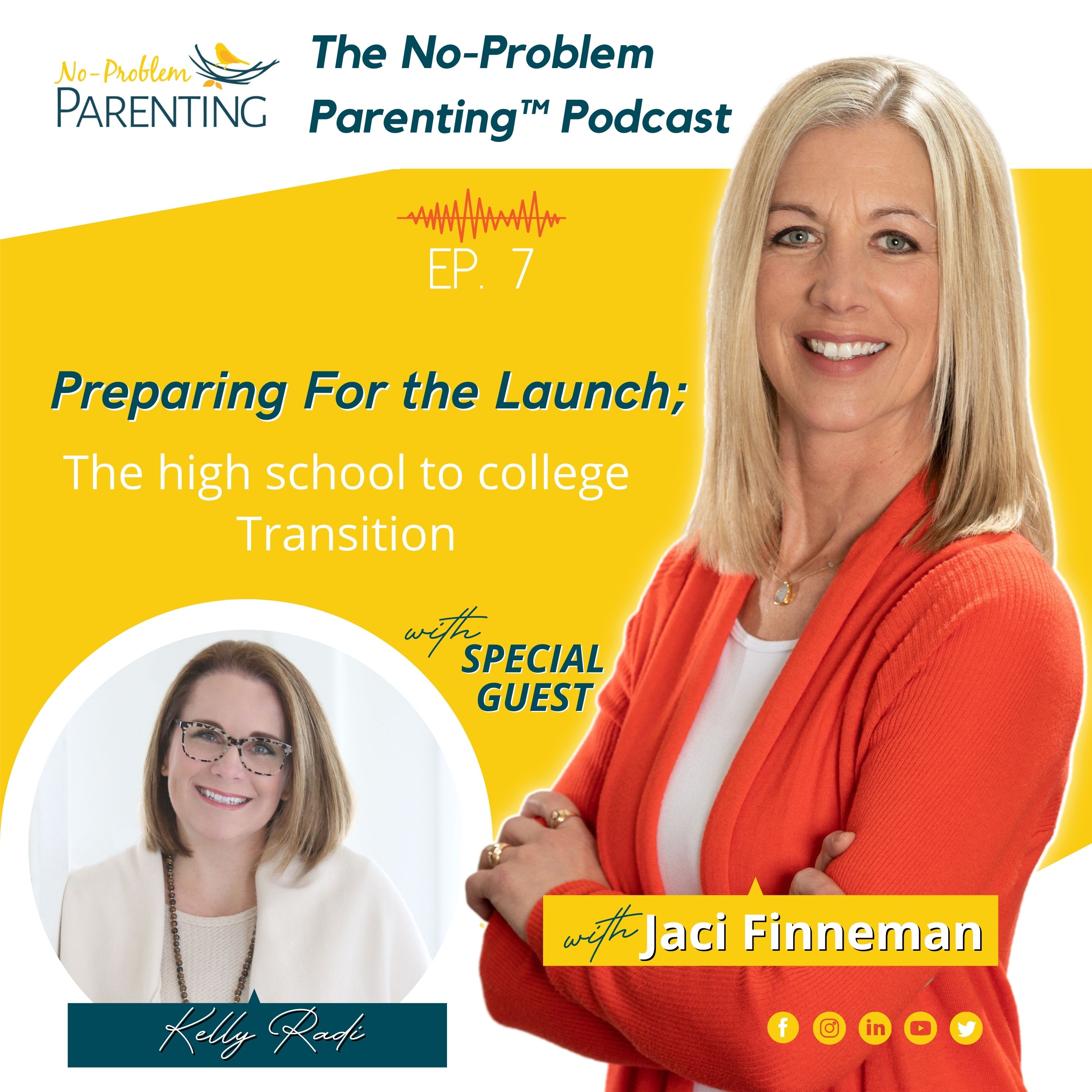
Preparing your College-Bound Student with award winning Author, Kelly Radi
About this episode
Welcome Back Parents! Do you have a teenager that's just starting to talk about college? Maybe your kiddo has already been accepted to college and you're both excited and a bit anxious at the same time? Kelly Radi, award winning Author of the book Out To Sea; a Parents' Survival Guide to the Freshman Voyage, is joining me today to talk about how to prepare your high schooler for their successful launch to college!
Become a No Problem Parent Today!
Full transcript
Welcome back to the No Problem Parenting Podcast. And today, parents, I have a very special guest for you. Her name is Kelly Ratty, and she's here today to talk all things kids and college. Kelly is a sought-after professional speaker with a passion for helping parents navigate the teen and college years.
Her powerful, relatable messages focus on personal accountability, healthy communication, and nurturing relationships. Parents leave her presentations reassured in their abilities to successfully launch their college-bound kids. Attendees describe Kelly as authentic, relatable, and a masterful storyteller. Kelly intertwines real stories, relevant research, and useful takeaways.
And today, Kelly's going to talk to us all about her book, Out to Sea. It's a parent survival guide to the freshman voyage and is the go-to resource for parents as they navigate the high school to college transition. So stay tuned. Kelly's going to talk about what inspired her to write the book, Out to Sea.
She's going to share some specific things that you can do during the high school years to prepare your student for college. And she's also going to answer the number one most common question she gets asked from parents, which probably will surprise you. It sure surprised me. Welcome to the show, Kelly.
Thanks so much for being here today. Thank you. I'm so excited to be here. Talking about the launch is one of my passions and my favorite things to talk about.
It's not for the faint of heart, parents. If you're feeling anxious or worried, you're not alone. never forget it. Yeah, I love that. And I have a we have a 15 year old. And so, you know, as a sophomore, he is we're talking about college, it's it's just a couple of years away. And I've heard from everybody, it goes really quick, or it comes really quick. So I'm excited to learn some tips and some pointers from you about preparing him for his launch. And then also, I have families who have several kids and some of them are just starting college. Some have just currently right now they're accepting their invites to college, right? They're making their decisions to have done their college tours. And so you also talk about how to support your kids in that first year of college. So I hope to get into that a little bit today too. Good. Let's cover it all.
All right. So first I want to ask you though, what inspired you to write the book out to sea? Oh, it's so crazy. So I should give you a little backstory. We are the parents of two daughters. And it was when our oldest daughter, Brooke, was in high school, about the same age as your son. And the conversations were starting and what's it going to look like? And where does she want to go? And does she want to do college? Does she want to do a two year, a four year? All the decisions that your parents are going through right now.
Right. And it was at that time, I'm like, okay, where's the guidebook? Because I was the mom who read the what to expect when you're expecting series, you know, I read it. Before we had them, I read the toddler years, I found the parenting your teens books. I mean, that was where I got a lot of my information. And I'm like, okay, where's the law, like the book for launching my, my child off to college. And it was kind of crazy. I started looking and I found some books.
They were generally two different sides. One set of books was very soft, feel good, emotional, relational, oftentimes faith-based, devotions for moms of teens, that kind of thing. Lovely books. On the flip side, I found lots of books written by retired president of XYZ University on the East Coast, college administrator on sabbatical kind of books, full of facts and figures and stats and data.
And again, all good information. None of the emotion, all of the stats. Very academic. And again, good books.
Some of them just felt like they were talking above me. yes or oh there was a hole so you have the emotional books and you have the facts figure stats books I needed a book that that spoke to me as a mom as a parent parent to parent face to face the good the bad the ugly right yeah that didn't just cover the emotions that didn't just cover the the statistics but that covered the practical that that was missed in the middle and I have a background in writing and the light bulb went on and it was like, write the book you're looking for, write it while you live it because it's going to be more authentic, more relatable.
And that's what I did. I started taking notes and it was neat to be able to write it while we were living it because I could interview people real time, asking questions that were top of mind from me and my peers as parents. And it was just a great idea. So I did, I talked to admissions counselors, high school counselors, professors. I talked to psychologists. I interviewed active parents. I interviewed students and that's where I got the best information for the book was from absolutely right. Get it from the mouths of the people who are doing it. And at first it was hilarious. I would go to these campuses and I would be sitting, I'd be the lady in mom jeans sitting in the student union. Right. And I talked to some students and kids as they went by. And I did set up some appointments with RAs at some of the places and would sit down with them.
And at first they were a little skittish, like whose mom is here and what does she want? And then I explained what I was doing and what the project was and ask questions like, what did your parents do well that set you up for this what do you wish you would have known before you got here what do you wish they would have known so I really I poise the questions in a way that we can help the next generations of students coming through and parents to be equipped to maybe not hit all the speed bumps or the roadblocks or the hiccups on their way in so that is really how it happened. How it happened. That is just, that's amazing. And how long did that take you?
How long was it until your first daughter then went into college? I researched and wrote for, it was a year to 18 months, depending on when you consider me officially starting. And then obviously the actual publication process took a little longer, but it was under two years from when I officially started to when the book launched. And thrilled to tell you it's had good reviews. It's embraced by a lot of college parent and family program coordinators and have great relationships with so many of the universities. And I keep getting terrific feedback from parents saying, I refer to it still. And my son or daughter is a junior in college and I still look back on your chapter on communication or whatever the case may be. So yeah, let's get into that a little bit.
Can you tell me a little bit more about what's this anchors and sails theory that you have? So a lot of people have heard about the, we give our kids roots and then wings concept. Give them wings and let them fly, right? You do the best you can while you got them and then kind of got to set them free.
Yes. It's the same idea. It's the same concept. But since the book was called Out to Sea and it's all about the launch, of course, I had to make the roots and wings be anchors and sails. But really it comes back to parents, you will have job security. They will come back. This is not making you obsolete. It might feel like it, but you're not. It's just going to look different. So we still, if you consider your student a new sailor, let's use a nautical story analogy here. If your student's a sailor, they have been living in, you know, first they started out in the dry docks where we've prepared them and taught them life skills and, and given them a foundation, a family of faith of education, whatever it is. Right. And then they move off there in high school. And, and, and that's still pretty protected. That's barely dipping your toes in the water. You're still by the shoreline college. You want to look at it more like the safe Harbor. They're they're launching. They're off on their own. You're not tethered anymore. But they're going to be exposed once they get their feet wet to new situations,
new ideas, new theories, new people. But they're also going to be given new skills, new communication skills, new relationship skills. Education obviously isn't at the point. And it's great all together. So hopefully, and I always have to say hopefully, in four years or so, they're ready to take that next step and, and hoist those sails all the way up and head out into the open sea, the ocean of real life. And it's always, always a ship needs a place to anchor.
And that is where you come in as parents. I will tell you, I just spent a long weekend with our oldest who is adulting by the way, with a job and everything down in Des Moines. And it is just remarkable to see all the work you've done as a parent throughout the years in action. And, and would I do everything the same way? Oh no, absolutely not. But she's doing it and she's, she's flying, she's sailing, you know, that right. She's out doing everything we've worked to, you know, to strive for. Right. I love that. And I love that family can be the anchor back at home, whether they're in town in college or they're, you know, in another state or overseas or wherever they are. So tell me about that anchor a little bit, what kinds of things, because I know it can get tricky as parents who want to continue to help and you want to support and you want to rescue and you want to make things easier for the kids. What's your kind of take on that and your experience?
Oh, I really, we were at our oldest parent orientation and somebody brought up the concept to us of mentorship parenting. And it was the aha moment for me. So if you think of a mentor, what does a mentor do? You know, in business, you provide guidance, you can help illustrate next steps. But generally, a mentor is approached and asked. And it's a relationship, a back and forth. Or a coach, if you're a sports fan, what does a coach do? The coach isn't on the court, playing for the player, the coaches guiding the coaches, the coaches instilling skills and confidence so that the player can go out and execute the play. And that's really what mentorship parenting. We're there to give them that, that anchor, that foundation,
the skills, which will, I think we'll get into it a little bit here in specifics so that they can go out and execute it. Perfect. I love that. So what are some of the specific things then that parents can do maybe during the high school years to start preparing the students and actually the parents themselves too, right? To prepare themselves. So letting go on both sides. It really is.
A couple of things that come just top of mind in no particular order. My kids get so sick of me using the words life skills, but life skills are a real thing that we need to adult. And I know, obviously when you think of college, so many people make jokes about laundry, you know, but that is right. Full actual life skill. Now my kids couldn't seem to get dirty socks and a hamper. I had no idea how they were going to go off and live in a dorm and actually wash their own clothes and show up and clean whatever, but teaching laundry, teaching life skills, like how to make a doctor's appointment. How often do we naturally call the eye doctor, the dentist, the hair salon for our teens? Sometime during that sophomore, junior, senior year,
start encouraging your student. Okay, great. Even if you're still driving them, go ahead and call and make the appointment. Right. Good point. The other thing that you don't think about is doctor's appointments when you get there and you have to fill out all the insurance information and medical history. I don't know about you. I did it for my kids forever.
We just started. We just had an appointment not too long ago. And I said, Hey buddy, this is yours. I gave him the clipboard and said, here you go.
You're creating knowledge. You're teaching a life skill by doing that. And you'd rather have them there with you saying, okay, what does this mean? Do we have a history of this? What's that on the medical form than on his phone texting you the first time he's got to go to the ER as a college student, you know, let's try to remove some of the drama while we're at it. Yeah. Perfect.
Good idea. So life skills is a really big, important one. What's another thing that I'm encouraging more personal responsibility in terms of and taking care of business at home a little bit backing up and encouraging them to take a little more responsibility. It's, it's letting go a little, I don't want to scare parents. We're not just throwing them out into the wild, right? It's letting go just a little bit. And it really depends on your personality type and your parenting style. Are you more, I'm a control freak. I will admit it, but letting go and letting, letting them make some decisions and, and then not getting out in front if there's consequences to the decisions. Oh, right. So what's a good example of that?
Alarms is a good example. Okay. How many parents are waking their 17 year olds up three times because they're not getting out of bed so that they can get ready and making them breakfast so they can get to school on time. Now, if you love to make breakfast for your kids, I'm not going to take that away from you. It's not about stripping your parenting joys, but really when they go off to college, nobody's going to wake them up three times. At least I hope you're not calling your son or daughter three times to wake them up once they're on their own. That would probably be a miss in my book, but encouraging them to set their own alarms. Simple. Yeah. And that's just one of the things I loved about your stuff right away, Kelly, is the fact that just like no problem parenting, it only usually takes once or twice when you don't wake your kid up and they're late to something, but you want them to really feel that when they're in the comfort of your own home, right. Versus when the first time it happens in there. Yeah. They're out of home.
So we really comfortable. Yeah. It's uncomfortable. And you know, you could have prevented it and save them the pain and our instincts is to save them from, from pain and challenges. But think about your own life. When have you learned your biggest lessons? Right. It's been from your mistakes. You learn more from your speeding ticket. You don't do it. Oh, for sure. Right?
A couple of things I thought about. Modeling the behaviors you want to see in them. And I know you cover this in your classes and in your parent groups, but it's this launch season, this high school to college transition is an emotional time for parents, for students. We handle it differently and there's enough anxiety to go around, but your students don't need you to project your anxiety onto them. They have enough of their own. Right. It's intentionally modeling the behaviors you really want to see from them. That makes sense. Yeah, absolutely. And actually it absolutely does.
one big life skill concept that I must mention, I can't forget. And it goes along with communication, but it's talking about things that are obvious to us. Like I said earlier, insurance, all that talk about money, money management, day to day money management, the difference between a credit card and a debit card, how to use them, your expectations, student loans. Unless you teach your student, your child about these concepts, they're not likely learning them in school. It's just a thing. And I've seen, I've had more parents reach out and say, wow, I wish I'd have read this before I first went off because she didn't understand that only paying the minimum on a credit card and and these students get application after application after application sent their daughter came back with a handful of credit cards maxed out because they never talked about the long-term impacts of loans and and and just the responsibility that goes along with that and day-to-day money management as well so it is think about your student and as teens how often we have such a different idea about something than our kids do. Right. Same goes with money,
unless you actually sit down, show them what a credit card statement looks like if they haven't seen one. Right. Have them look through the FAFSA with you, you know, that kind of stuff. How to budget for their food or their, you know, different books and what are all those things going to cost?
Exactly. I do have a whole chapter on money management in the book and I don't go into financial aid and applications and that kind of stuff. There's plenty of great books written by financial aid specific experts, but mine is just more about communicating expectations and, and kind of letting parents know things that have cropped up for other parents over the years. Yeah, good. We can, that's the best way to learn, right? Is hear it from the, from the people that have been through it already. No, that's, that's great. I love it. Can you talk a little bit too about behaviors? I've heard this now, our son is a sophomore in high school, but from friends and family who have kiddos going off to college. And I think it seems to me that about six months or so,
maybe even nine months before they launch and they go off, there seems to be this push away kind of behavior or this tug of war behavior, you know, or attitude. So what can parents do if their kiddo is actually kind of struggling, whether it's before college or once they're at college and they're kind of becoming maybe more distant, or I suppose it could even be more reliant, but what are, what are some of the things that parents can, can notice?
Oftentimes there is this push away or push back and, and there's a really gross analogy that goes with it. Somebody told me it's called soiling the nest. You're getting ready for your empty nest. They want to soil it before they go.
Oh my gosh. I love it. My theory on it is they're scared. They can't admit it. They maybe aren't even equipped to identify or articulate what they're feeling because what are they told? Oh, this is so exciting. Good for you. You you're living the dream. These are going to be the best years of your life. Let's set them up to be anxious. Right. Right. People mean well, but what if everybody's telling you this and you have a 17 year old brain, 18 year old brain, and you are so nervous and you're not sure you can do it and you don't want to let your parents down and and and eat just the the emotions that are going through their heads sometimes my mom told me this once when I was a girl sometimes it's easier to leave mad than sad yeah right and I think there is a little bit of that pushback and then society tells us well they're 18 they're adults. Like, like the calendar turns over on their 18th birthday and magically they know how to adult. And again, it just doesn't work that way. So as parents, I think communicate, I mean,
really it all comes back to communication. Every single topic we talk about comes back to effective communication and, and maybe just rephrasing to them, Hey, you know, I sense you're, you're, you're stressed or you're tense. And, and I know it's really easy to push me away right now. Just know we got your back. We support you. We're here no matter what I know. I got you. Right. Right.
And I think it's a lot of words of affirmation and you still will get the eye roll and the huff. Yes. And I know there are parents of teens right now, nodding, going, uh-huh. The huff and the eye roll. They've got that mastered by the time they hit about 15, 16. So, um, but let the huff and the eye rolls bounce a little bit, let go just a little, but that doesn't mean you don't encourage respect and, and again, the personal responsibility, but just having an understanding as a parent, the, the anxiety we can articulate, they might not be able to. And so it might come out in a lashing out, you know, in a more mean vibe than it's probably even intended.
right right and I think maybe with sadness like so I can watch for you know signs of depression we had a it was when one of our girls was getting ready to launch so my my coping as a mom was I'm a planner I'm a like I said control freak I'm a planner I'm a checklist gal and so my therapy for her going was well let's outfit your dorm I can help you let's go to target um check this list and make sure you have shower shoes and a clean set of matching towels and the girl things probably but um I was doing that and for me that was coping and I felt like I was doing something to help in this launch process right yeah I was just gonna say what how did she respond to that stressed her out. Talking about it was good therapy for me. But I talked about it to an extreme. And one day we have a spare bedroom. And we had kind of just started piling it looked like a volcano had erupted in there with all you know, her, her bedding and her dorm supplies and books and notebooks and this and that. And I walked in and there is my my baby girl who is pushing 18 sitting on the floor the summer before her freshman year sobbing holding a pair of royal blue flip-flops her shower shoes and it was like those flip-flops just put it over the edge and having that pile of stuff made it so real and here I'm all excited and let's do this and here she's stressed and so there was a disconnect she didn't she could tell me about her fears
because I was too busy making sure we checked off number two lead pencils on the list you know and your intent was just I'm going to get her all prepared I'm gonna this is gonna make me feel good because she's gonna have everything she needs and I know she's gonna be safe and she's not you know gonna be worried about forgetting something or whatever and then and then she's like hey wait a minute mom I'm having a hard time I overwhelmed her I don't know how to tell you to stop because I appreciate you at the same time.
Don't want to sound ungrateful, but too much. Yes, freaked out and you're turning it on a little too hot there, mom. What would you say is the most common question or topic that you get asked from parents? Oh, from parents, it's consistently on how often can I call my kid?
How much is, what's the normal amount of times I can reach out or how often should I call my child? Anything on like that connection. Really? I wouldn't have, I wouldn't have guessed that.
That's interesting. Yeah. Because they don't, are they worried? Safety comes up.
Okay. But definitely, how often can I talk to him? I want to do it right. But so what's the magic number?
Well, it's a trick question. Cause as you can imagine, there is no magic number. I suppose it's kid to kid it just depends on kid to kid family the family I can't give a number I would say probably reaching out to your student three or four times a day is on the extreme side on the excessive side but I come back to talk about an issue with your student before it becomes an issue and set some parameters or some boundaries because you can see extremes if I gave a magic number there'd be extremes on both ends I had one mom though I I'm gonna back up I think it's important to stay connected with your student for both of you however experts that I've talked to say if what you're doing is getting in the way of their development. If you are interfering with their growth and development, it's too much.
And the gauge I give parents with that is we have a common parenting goal. It's the ultimate goal of parenting. You have it, Jackie. I have it. Everybody listening, we actually have something in common and that's our ultimate goal. The ultimate goal is to raise healthy, happy adults equipped to function in the real world. Right. Love it. Yep. That's what I say too. We want to be respectful, responsible, and confident, right? Bingo. Bingo. So if you use that as your gauge, it helps you to make your decisions as a parent. I love that. Making them up is me checking in at lunch and is me tucking them in at night to make sure they got supper too much. Is that interfering?
Yeah, probably. But if your family's used to a lot of connectedness, a little, hey, good night text isn't so bad. Now, I'm so old that we would line up in the basement of the dorm building on Sunday nights after eight for the pay phone because the rates were cheaper. Oh, my gosh, I love it.
It dates me. But if I think about my college years, if I was lucky, I talked to my parents once a week on Sunday night. Right, right. I survived and I had to learn some skills without calling and asking mom or dad how to do it.
And I think that's another thing to apply today. We're a different generation. We are, the good news, we are the most connected generation to date. Right.
Probably the bad news is that's because they walk around with us in their back pockets. Yes. On their phones. Right.
And we're a speed dial away. it can backfire that speed dialing because what happens is then the student you know what i can tell you a story we have good friends whose daughter was a college student studied over in europe lived in a small village had to take a train into the next city over for her classes okay and super smart bilingual amazing young woman and she missed her train one night for whatever reason and and there she is in the dark in a train station in rural France going oh shoot now what so she's got some options you know does she pick up the the phone and call the university to let the professor know what happened no does she figure out the schedule to see if there is another train or you know does she problems no you know what she did called her mom yeah yeah And I don't falter for it because we train them to do this.
We're all guilty of it, if you will. We've set them up for this. And with that technology right there, it's natural. And so we want to give enough space that they have to problem solve because the knee-jerk natural reaction is to phone home.
And then what do we do? We engage. right we help fix and tell them what to do not ask them what they're doing too right and that brings up another question i've had this come up um as well um you get the your kids grades maybe after the first uh quarter or semester or something like that and you notice they're not very good and so what does a parent do um and i'll just i'll just throw it out here i've had parents who actually call the university themselves. And what are your thoughts about that?
I'm gasping. Yes, I figured. You know, it's a natural response. And actually, well, first of all, college is not high school.
And that's a message I want to get out loud and clear. Parents, when you're listening, college is not high school. It doesn't look or feel or taste the same. It doesn't smell the same.
it's not high school. And if you don't believe me now, if you're still in the high school world, you will a few months into college because actually you won't get a report card. Right. Won't get any missing assignment reports. You won't know what they ate for lunch.
I don't know about your schools, but I know in high school, I could actually go online and see what my kids ate for lunch. Yeah. There's that option now. No, that information, unless your student shares it with you. And that is done for a couple reasons. One is to encourage them to adult and to be responsible and to communicate and to share that with you. Now, I know it doesn't seem fair because as parents, you know, you've raised them. Some of you have stretch marks from birthing them. You've funded them and are possibly or likely helping fund this college adventure as well. So it doesn't seem fair. You feel like you should have access to all that. And there's a thing called FERPA, which is a federal law that basically restricts your access. It's about protecting the records of students. And so FERPA prevents them from sharing that with you. Now,
there are ways your students can sign waivers to give you access. And that is something that is a very personal and often debated topic amongst families. I can imagine. I go into pretty good detail in the book on that. I have mixed feelings about it. I went into it because, you know, I wrote this book, so I wanted to do it all just so, and we did not have our kids sign the release because I wanted them to take the ownership of this. Right. And I can imagine that for in high school then too, it's already a good idea to be setting the stage for that and kind of starting to back out of the high school, you know, even conferences you can attend, but your kiddos should be there, your teenagers should be in those conferences. And I do, I teach with No Problem Parenting too,
that if the kid's grades are more important to the parent than they are to the kid, kind of setting the stage that they're not going to maybe be as invested in their college experience or after school, you know, even, even work experience, even if they decide not to go to college, I guess. But so how can you help them even when they're struggling? How can you help them while still following those mentor parenting guidelines that you talked about? Well, number one, the communication, set up the communication expectations on the front end. We know we won't be receiving this. I know I'm not going to receive your grades, but I would like you to share them with me. Maybe we could have our own little midterm report because I'm invested in you. I care about you. If you're struggling, I want to know it. If you're succeeding beyond your wildest dreams,
I want to know it. And I want to know what if you fall somewhere in the middle, right? Not because I'm here to be judgmental, but because I'm here as your anchor, I'm here as your support. And so communicate that. And then the other thing is as parents, and this goes beyond just grades, but in overall student well-being, I always say know your resources. Know their resources. Let me rephrase that. Know your students' resources. As parents, if you are offered a parent orientation session, take it. If you have a chance, get on the school's website and find the parent and family support page and see what they have to say. You'd be amazed at the resources out there for parents.
get to know who you know the resources on their your students campus there are tutoring centers on every campus I have ever talked to and they are included in student fees for the most part understand the role of an academic advisor don't call your students academic advisor but know the role of an academic advisor understand all the people in place to help your student. So then when you get that phone call after the first, maybe really ugly test score or calling saying, oh my goodness, I'm going to have to drop out because I just failed French and you know, so you can say, okay, take a breath, honey. Tell me about it. And so let, don't tell them, have them tell you and say, well, okay, have you talked to the professor? Have you gone into office hours. And first of all, you're going to wall them because they're not going to think you know what office hours are. And for those of you who don't, a professor has to have posted open office hours. Now, obviously right now they're virtual. You schedule a Zoom call, but if your students on campus, they can actually show up at the door and meet for a conference. Now they can't go in there and go, gosh, why are you failing me? But they can go in there and say, I struggled with this concept clearly I'm not understanding it can you recommend for me what I should should I study differently blah blah blah yeah right needs to take that initiative as a parent you can say well
what did the professor say did you go during office hours what does your academic advisor think you should do have you called the tutoring center and then the big question are you getting enough sleep? Oh, of course. Sleep is the underrated key to success. I've been told that by countless experts in higher education. Yeah. And that makes perfect sense too. How can people get your book, Kelly? I really want to promote this and get this in the hands of as many parents, no problem parents, especially as possible. So where can they find your find your book thank you for that that's my goal too is I just want this book in the hands of parents and so they can avoid the the the hiccups that we faced well and to start preparing them in high school as well I'm I'm just so excited to start using some of the things that you suggest I think we're saying don't wait until August of course you know right before they go off like get it the sophomore and junior years and just start applying it in baby steps and then reread it again the summer before they go. But the book is available at most booksellers. It's available at all kinds of indie booksellers. You can ask for it by name and they can order it. I always like to mention that because I'm a big believer in supporting the independents. It's also available at the big ones, Barnes and Noble, Amazon, and certainly through me. I'm happy to ship them out
to you as well. My website is ratty to write.com. It's r a d i, my last name, t o w r i t e.com.
And if you order from me, I'll sign it for you. Oh, how fun to you. But otherwise, it's available through through the major book channels and all the major Okay, and we're going to also put in the narrative part of the of the episode we're going to have your website and also Facebook LinkedIn Instagram pages right you're on all of those right so people can help share the news too with their friends and family I just want more and more people to find out about you Kelly because I think you're just absolutely authentic real down to earth and I love having people like you on my show and to just to help parents. I think parenting is one of the hardest things we can do.
And just about the time we think we've got it figured out, we're sending them off to college and we're like, oh no. I know, and then you worry about doing that? Yeah, a whole other set of challenges, right? We're in it together. That's one thing that I know between what I do and what you do with No Problem Parenting is we're not alone. We can support each other and learn from each other and we will all come out ahead and help our kids anchor and sail is that how you say I always say I always say so they can they can not just survive but thrive yeah love it absolutely love it and then we can be the confident parents that they crave us to be right they really need that all right well thank you so much for joining me today Kelly and uh I look forward to hearing from some of the parents that have read your book and learning about the tips and tools and takeaways that they got from it. All right, parents, if you'd like to learn more about Kelly, I've listed all of her contact information in the show notes of this episode. Be sure to go grab your copy of Out to See. And if you're interested in learning more about becoming a no problem parent,
you can check us out at noproblemparenting.com.
Become the confident leader your kids crave
The method, the community, monthly live Q&A with Jaci, and Celia — your AI guide in the moment.
Start your 14-day free trial Get it on iPhone or sign up on the web