
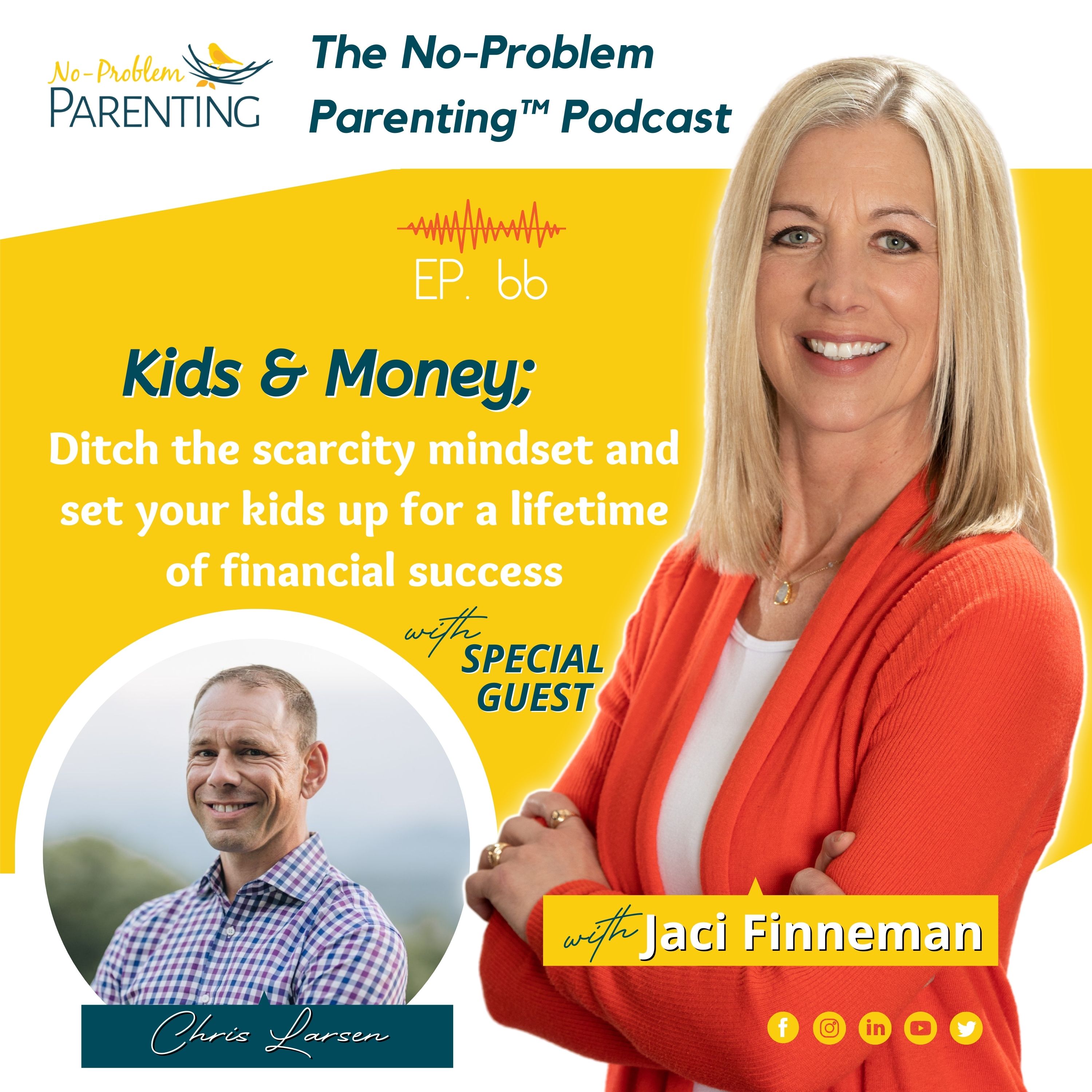
Kids & Money; Ditch the scarcity mindset and set your kids up for a lifetime of financial success. with Special Guest Chris Larsen
About this episode
Welcome Back No-Problem Parents!
Are you paying your kids an allowance? Do you pay them for chores? How's their savings account looking?
You May Ask Yourself "How Do I Teach My Kids About Money?"
What Do You Personally Do With Your Children To Set Them Up For Financial Success?
Become a No Problem Parent Today!
Full transcript
Welcome back to the No Problem Parenting Podcast, parents. Hey, are you paying your kids an allowance? Do you pay them for chores? How's their savings account looking?
And I'd like to know, what do you do personally with your kiddos to set them up for financial success? Well, today's guest is Chris Larson, and he's gonna walk us through five things that you can do starting today to teach your kids about money and set them up for a lifetime of financial success. Meet Chris Larson. Chris is the founder and managing partner of Next Level Income, through which he helps investors become financially independent through education and investment opportunities. Chris has been investing in and managing real estate for over 20 years. While completing his degree in biomechanical engineering and MBA in finance at Virginia Tech, he brought his first single family rental at age 21. During his subsequent career in the medical device industry, Chris expanded into development,
private lending, buying distressed debt, as well as commercial offices, and ultimately syndicating multifamily properties. He began syndicating deals in 2016 and has been actively involved in over $400 million of real estate acquisitions. In addition to real estate, Chris has invested in equities, oil and gas, and small business lending, as well as being active in Venture South, one of the nation's top 10 angel investing groups. Chris lives with his wife and two boys in Asheville, North Carolina, where he loves spending time with them in the outdoors and enjoying the food and culture that the region has to offer. I am very much looking forward to this interview. Let's get our kids set up for financial success. Welcome to the No Problem Parenting Podcast. Turn behavior problems into no problem with Jackie Finnaman. Are you ready to become the confident leader your kids crave you to be? Do you want to learn how to make parenting easier and more fulfilling?
Whether you are at your wits end or you want to have more fun as a parent, you're definitely in the right place. Now here's your host, Jackie Finnaman. Well, welcome to the show, Chris. I'm excited to have you here today to talk all things money and kids and how parents can help their kids learn about money and grow their bank accounts at the same time rather than just doling it all out, right? Raising kids is expensive, but I want to welcome you to the show. I'm so happy to have you here today. Yeah, thank you. I mean, look, we were talking before the show. I have problems with my children just like, you know, all parents, except for the ones that go through your program, obviously. Yeah, right. Well, they all have problems because we all do. In fact, it's my only guarantee. Everybody says, you know, when you become an entrepreneur, you have to have a guarantee. Well, my guarantee is I guarantee you're going to have problems raising your kids. It's just fact of life, but it's what we do with those. We can create more problems or we can deal with and overcome them. So yeah. Yeah. Welcome to the parenting club, right? Absolutely. And look, money, not having money creates problems,
having money creates problems and, you know, having children that don't know how to deal with money or make money is a big problem as well, depending on what the age is. So I'm excited to talk about this topic here today. Yeah. And I'm excited to hear what your take on it and like, how early should we start teaching money and, you know, how do we set our kids up for success with money? And also how do we, how do we help secure our money or just, you know, make sure that we have enough because yeah, kids are expensive and sometimes we're, we're not allowing them to do anything. And other times we're giving them way too much, you know, reign and freedom. So let's just talk a little bit about how you got into into this field. Yeah, I think and look, I'm going to I'm going to touch on a lot of stuff here today. But if you're listening, you can get a free copy of my book at our website, next level income.com. And for your audience, Jackie, if you click on the book link, you put your address and I'll send you a copy as well. So it talks talks a lot about my story, kind of the blueprint. So if we gloss over everything, anything, or you want to learn a little bit more, I'm happy to share that link with you here. But yeah, so I look at my father died when I was five years old and he grew up in the, in the green Bay area, not too far from you.
And it took me a lot of years to kind of figure this out, you know, talking to different therapists and reading different research. And I remember reading something one day, I talked about how children who lose parents tend to be more successful. I was talking about this correlation with presidents and leaders and, you know, CEOs. And I thought, well, that's interesting.
And, you know, as I kind of thought about it and researched it, I'm, I'm an engineer by training, My education is in biomechanical engineering, and I also have an MBA in finance. So I'm a numbers guy. So I think of it like an equation. So if you think about the value of time, whereas you have the number of days on the bottom of that equation, and the overall value of time is what that equation produces.
If you're young, you think you're going to live forever. So if that bottom number is infinity, the value goes down, right? It's basically zero. You know, and I think everybody listening that's helped their kids with math, you know, recently knows how to do that equation. But as soon as you assign a value to that denominator, the value or a number to that denominator, the value of your time goes up exponentially, right?
So if I said to you, you have 10 days left, you're going to live life much, much differently. So I think as a child, when you lose a parent, I also lost my best friend in college, which I think probably had even bigger impact, but it makes you realize the value of time. So not until I was 41 years old, the same age as my father when he passed away, and I achieved all these things very close or right during that year that I realized that I had this ticking clock in the back of my head, if you will.
So I think that really drove me towards financial independence, Jackie, because unfortunately, live your passion, do what you love, you'll never work in a day in your life, all of these things. The fact of the matter is, if you want to live life to the fullest, you want to spend time with your kids, if you want to provide them with medical care, if you want to send them to the best schools, feed them the best food, all of these things.
if you want to give your children all the best opportunities, you need money. Right. Absolutely. And I got to say that there's this oftentimes, I don't know if it's scarcity mentality. I don't know if it's, I wasn't born into a rich family, so I'll never be rich.
You know, rich people are bad. I mean, there's just all this negative stuff around money, depending on maybe how you grew up. If you didn't grow up with money, you definitely don't don't feel like you deserve it or you can achieve it, right? Yeah. And there's a lot psychologically around that. And you can go back most people to when they were younger and their relationship with money. And that's what we're here to talk about.
But you mentioned the word scarcity. And look, I tell people, if there's one thing that you can do to be more successful in life and live a more abundant life, you have to eliminate scarcity minded people from your life. You have to. And look, the problem is we're inundated with these mess, these messages, you know, politicians use this to pit, pit people against one another, you know, the pie isn't fixed. Okay. You know, and if you look at, you know, you have, you know, billionaires are bad. Donald Trump didn't pay any taxes. Elon Musk, you know, has too much money.
Warren Buffett, Jeff Bezos, like all these, all these things that we hear about, it's like, okay, why are we hearing these things? One of the great things about America is we do still celebrate abundance and success. I think it's amazing. Unlike Australia, they have what's called the tall poppy syndrome, where they basically cut off the heads of the tall poppies. And that's how it is culturally in a lot of different societies. I think we still have a leg up. But yes, if you want to be successful, especially when it comes with money, that's probably a great place to start is eliminate anyone with a scarcity mindset. And what I mean is people that say, hey, look, if you have this, I can't have this too. The opposite of that is abundance. And that's what we practice at Next Level Income. We give away so much stuff. I was asked by a regulator one time,
they said, well, how do you make money with your website? I said, we don't make money with our website. And they're like, that doesn't make any sense. I said, well, our mission isn't to make money with the website. We have another business that makes money. Our website is there to educate people. And we believe that with education, financial independence, we can empower people to do big things. I love that. And I love the idea too, that I'm in order, if you're a giver, like I am in order to give it away or I have to earn it, I have to make it. There's got to be something in there to be able to give away. And I did grow up with the work harder kind of mentality.
It was like the harder you worked, the better person, kind of a person you were. Right. One of the things that we're going to talk about today are kind of focused on is what parents can do to help their kids and themselves? Yeah. So Jackie, we have a template that we put together.
Again, this is on our website. It's free next level income.com forward slash kids. And what it is, it's five tips that you can use to help educate your children, to help move your children towards financial abundance. And these, we can go through these. I can talk about kind of some different things. But the thing is, in America today, we do not teach financial literacy. And we actually teach the opposite of what rich people do. So if you listen to Dave Ramsey, and he's got great advice, if you want to be poor, and this is what I mean, pay off your house, invest in your 401k, buy term life insurance, you know, all of these things, you know, invest in mutual funds, all these things, they work okay. If you want to work till at least 65 and you're, you're okay dying with not a lot of money, but if you want financial freedom in your thirties, like I had it with the family, this I'm not, I'm not the guy that's like, Hey, I'm financially independent.
Look at me. I don't have any kids. My wife still works. And we're financially independent because you see that you see these people that are quote unquote retired, right? I retired with more than six figures of passive income. We live in a wonderful home. We drive new luxury cars. We have two children. My older son goes to private school. We live an abundant life through the financial decisions we made. So the question is, how do you accelerate this thought process so you don't have to be like me and get an MBA in finance and spend 15 years figuring it out?
I bought my first investment property at 21. So the first question I think that we need to answer, Jackie is when do we start talking to kids about money? Like that's the first thing. And the answer is as soon as possible. And what I mean, it's very easy to have these conversations when you go to the grocery store, and you pull out your credit card, or you pull out cash or however it is you're paying, tell your kids what you're doing, tell them how much money it is explain the differences, you know, the the thought process behind the financial decisions you're making. You don't have to tell people like my children do not know how much money I make. They do not know how much money we have in the bank. We don't have those conversations. But let's say, for instance,
they say, hey, how much was the car that we bought? I'm going to tell them how much the car is. Because look, they can look it up on the internet today. My boys are 10 and 12. They can look up on Zillow how much your house is worth. So anything like that, I'm not going to hide from them.
I'm going to make it very comfortable for them to have financial discussions with me. And then if you want to really start engaging them, what we do is we pay our children a salary. So this is number two, actually number two on my list. And what we do, we give them a dollar a day and that's their salary. Some people call it an allowance, but we call it a salary. Before you start paying your kids though, start a bank account. Okay. Take them to the bank, actually take them to the bank, you know, and that, and set up an account. If your kids don't have an account, that's the first thing that you can do. And then what we do after we start paying them, the way we initially started teaching them about investing is that we would go to the bank and if they made $30, you know,
30 days in a month, um, and they made a dollar a day, assuming they didn't disrespect their mother and get a dollar taken away or leave the lights on to get a dollar taken away. Cause by the way, in the real world, if you don't show up, if you don't do your job, if you waste money, you're not going to get paid. Right. So, you know, they have to do their own laundry.
They have to make their own lunches. They have to do the dishes. They have to clean the house. All these things are part of being part of our family and they're responsible for that. And then they get to participate. But then when we go to the bank, whatever they deposit, we match that.
So it's kind of like a 401k. So I know how I said, don't invest in your 401k, but how do you teach kids how to invest? Especially, let's say you're like, Chris, I don't have an MBA in finance. I don't understand how the stock market works. I'm not sure even what to invest in. That's okay.
it's the concept of compound interest and earning a return on your money that's important. So what we do is we match what they put in. And our rule is save 50%, whether that's if they get $100 for their birthday or Christmas, or if they put $10 in the bank. I'm sorry, if they earn $20 and they put $10 in the bank, we match that. We do that. So we match that.
I love that. That's the first I've heard of that one. I'm a big fan of not paying for chores or not paying for what I would call family contributions, which is like all the things that you had just described. I love the matching idea. I hadn't heard of that. That's a great idea.
Yeah. And again, you know, it teaches, it teaches two lessons, right? It teaches one, the importance of, of paying yourself first. You know, I call it a savings tax. I have a whole web, I have a whole blog up on that on my website. I call it a savings tax. So it works for, for adults as well. But how do you get, you know, how do you get somebody used to doing that? You know, so when they're making a bunch of money, you know, they're already, they're already doing them. And then you can actually start teaching them about investing and educate yourself after that point. And we started Roth IRAs for our boys because they do some work in our businesses. You can start to pay your children if you have a business, which is great. All those things are really good lessons that you can help out with your kids. Look, a lot of things that I say are kind of opposite of what conventional wisdom teaches. And one of those is I say, stop investing in your 401k. And people are like, what? So look, if you get a match in your 401k, then great.
Put in the amount that you get your match, because that's free compensation. Now it's locked up. You have to do the math on that. But here's a question. If you have $100,000 today, and your tax rate is 20%, and you invest that money, you get 10% a year for 30 years. And your tax rate in the future is also 20%. If you chose to put your money into a 401k or IRA today, not pay tax and let it grow tax-free at 10% and pay the 20% in the future, would you have more money then? Or if you just paid the 20% today and then put it in an analytic compound after tax, which would give you more money? The answer is the same. So if you invest, quote unquote invest, if you put your money in a qualified plan, like a 401k or an IRA, you're inherently betting that your tax rate is going to be lower in the future. And there's only two ways for that to happen, right? One, actual tax rates are lower in the future. And if you're listening, put your hand up. My hand's not up,
by the way. Put your hand up if you think tax rates are going to be lower in the future. It can't be. And you know why? Math. You just mentioned math. It can't be lower in the future.
We can't pay for our obligations today with the current tax rates, okay? And you can blame this party or that party or do all that. It doesn't matter. The fact of the matter is we need more tax revenue. Okay. Or two, you make less money, which puts you in a lower tax bracket. So again, raise your hand if you want to be poorer in the future than you are today. So if you raised your hand to either one of those questions, continue to invest in your qualified plans. Okay. That is what, because those are the assumptions. Now, remember, I'm an engineer. The way we solve problems is we look at the assumptions. I looked at the assumptions. I said, well, this doesn't really make sense to me. So I stopped contributing to my 401k several years ago. So then the question is, what do you do? What do you do with that money? And this is where, again, I'm in the opposite.
We tell our children, hey, take risks early in life. Take risks early in life. That way you can recover from those risks. That doesn't sound good to me. I want a plan that's going to give me a high probability of success. Think about it like a sports analogy. If you lose a bunch of the early games, you don't even make it to the playoffs. You're never going to make it to the championship game. You want to win as many of those early games. That's why I call my investing strategy, the money ball strategy of investing. I want to hit consistent singles, doubles, get on base, get a triple every now and then, a home run if you got a little luck thrown in, everything goes well.
But people that hit the most home runs struck out the most typically. I don't like that. I want to get on base as much as possible. And I want to make it to the playoff rounds of the championship series. So in life and financial world, what I do is I put together a plan to increase our passive income to cover our basic expenses. Now, once you have your basic needs covered, what can you do with your life? What risks can you take? You know, do you want to volunteer your time? Do you want to donate the money that you make to a charity? Do you want to go work for a company where you can, you know, the company can, you know, 10 X, you know, it's, it's stock when you work for it.
Like you can take those risks later in life. But if, if you get to that point, you basically have an almost unlimited risk tolerance, which is where we are today. And that's the problem. We teach children, Hey, you know, take these risks early. What people are forgetting is money is a store of your life time, the time in your life. Okay. So if you gamble with your money, you're gambling with your time. And most people would agree, hey, is a day or a year when you're in your 20s or your 60s worth more? Young people waste their lives. And if you can increase the amount of money, if you can double your money every five years, that means a day you waste today is worth two years in the future. So think about, if you start thinking about money like that,
And this is why I tell my boys, you have to respect money, because if you waste money, if you lose money, if you do that, you're literally wasting whoever's life made that money. And we have to be very respectful of that. That is a very good point. Okay, so then number three was teach them about investing by matching their savings.
And then what's number four? Yeah, so number four, now we're starting to get into kind of like, you know, kind of like the next level type ways of teaching your children. Have them start a business, okay? So we don't teach children about money.
We also don't teach children entrepreneurship, most people, okay? And entrepreneurs, look, the number one way, I had a gentleman on my show, DJ Van Kern. He works with the Marriotts. He works exclusively with families worth $250 million or more, so a billion dollars or more.
He also surveys these families. And most people wouldn't be surprised to hear this, but the number one way that people enter this ultra rich phase is through starting a business, not through inheriting wealth. It's through starting a business. Number two, real estate. So teach your children about starting business. And also we can talk about real estate, which if you get my book, I talk a lot about it in there and kind of the strategies that I used, you know, starting at 21, when I bought my first piece of real estate, but, you know, teach your children, look, you can start businesses online.
There's a lot of great resources out there. We started a jump rope business. So my wife and I started going to CrossFit several years ago. And you've probably already rolled your eyes at me if you're listening to the show.
So feel free to roll your eyes again if you don't like CrossFit. But in CrossFit, people jump ropes a lot. And the problem is, you know, like there's never the right length jump rope. So it's a real pain in the butt to learn how to jump rope.
And one day I was like, man, I wish I had my own jump rope. And, you know, we started talking. My boys wanted money. like, you know, we were talking about Jackie and, you know, you said, well, Hey, figure out a way to make it or figure out how to get it. And I said, all right, well, I want, I want you guys to come up with 10 ideas of businesses that you can start. And of course they're like, how about a lemonade stand? You know, how about, um, one of my boys said, Oh, we could sell like, like gems or rocks.
And I was like, that's a cool idea. Like the, you know, things that don't cost a lot of money, but we were at the gym and on the way home from the gym, I said to him, what if you start a jump rope company. So we bought jump ropes direct for two bucks a piece, sold them for $10 and they're making $8 profit. So they got to learn how to invest because they had to borrow money from me.
They had to learn how to start. And this was several years, this was probably four or five years ago before the pandemic. Wow, they were little. Yeah. So they were like six and eight, I think they were. And look, it's almost impossible to resist a cute little six-year-old selling you a jump rope for 10 bucks. There was a lot of guys walking out there with pink jump ropes that, you know, I don't, that's all that they had to sell that day. But my point is, you know, it's not hard to teach them about a business. Or if your children ask you like, hey, what, you know, my older son, he's, he's an athlete, he's not, he's not a real academic kind of guy. And it's like, well, what are you going to go to school for?
My younger son says, I'm going to be an engineer, I'm going to design cars, he loves cars, he's, he knows how much a Bugatti costs. And he knows more about cars than I do. My older son knows more about sports than I do. But he's kind of struggles with thinking about a career.
and you know I said well what are you going to do and he's like I don't know I was like well you could start a business you could do sales sales is very entrepreneurial so you can just talk again if you're not familiar with these concepts you can also talk to your children about these concepts or you know go read a story together about you know a famous entrepreneur like what they did how they started the business it's not all glamorous and that's part of the other you know part, like, you know, starting a business is hard. Being an entrepreneur is hard. Um, you know, so teach, teaching them about business is very important. Oh, I love that. Yeah. I think I shared with you earlier too, that our son, since he was about, I don't know, five or six years old,
he was looking at real estate properties, mostly because he wanted to find a place for us to stay in Florida. We're in Minnesota and you love to travel there. And so, um, when we finally said, I think it was around age 10, we're like, okay, buddy, you got to stop texting us during school hours. He might've been 12. I don't know how, I can't remember how early he had his smartphone.
If he texts me a good deal, I'll accept his text. Yeah. Yeah. It was funny. He started bugging my sister, you know, and texting her during the day and stuff. Cause he knew mom and dad wouldn't want, you know, let's, let's, let's get this property. But then he also was learning about, you know, um, timeshares and about, uh, gated communities and like, you know, all the, what's the word for it? Um, the fees, the association fees and things like that, and homeowner fees.
And yeah, yeah. So he was diving into learning all about those things. So I think it's fun. And I love that you say talk to your kids because even if you don't know something, you share something with your kids.
They oftentimes they're smarter than us, right? They all go research it or look into it. And it's amazing what they come up with. So yeah.
That's the great thing with the internet. You know, they can go on and they can learn this stuff. And, you know, kind of going back, like my son and I walked to the bus stop and he gets picked up about a half a mile from here. And he's like, wow, that's like this house was on the market. He's like, I was like, he's like, oh, it's sold. I said, yeah, we, you know, he's like, well, how much did it sell for? I said, well, let's, let's look it up. Let's see.
So we looked up how much the house sold for and it gives him an idea. It's, you can talk to your kids about these things and learn with them because you don't have to know everything. Just like you were saying, um, Jackie, like knowing where to get the resources is just as good. You don't have to know it all. I don't, I certainly don't know it all, but I have a lot of connections to help figure these things out. Right. Right. Well, and you know, the learning, the value of money. I mean, the, the, like when they're asking you for things that they want, you're in the store and they're, they want something. And it's like, well, I used to say to our kiddo, if you have the money, you can, you can buy it. Well, I don't spend my money. And I'm like, now, you know how I feel, you know? So, but just learning it, number one, how to earn it. And then once they have it,
you know, breaking it down for them and being like, okay, and in actual cash dollars, this is how much you want this $50 item and you have $64 and here we're taking this much away. This is what you're left with. It's like, Oh, Hmm. So now they have to think about it a little bit. So I think that goes into your step number five, maybe. So, um, let's, let's circle back to that. Cause that's a really big topic. I think with, um, you know, something that everybody has to think about, which is, you know, there's the problem of not having money. And then there's the problem of having money. And what I mean is, if you're in either one of those categories, you might not enjoy the money that you do or do not have. And that's a big issue. But yeah, real quick before we touch on that, another controversial topic I say is, I don't know if my children are going to go to college. And if you think about this, you as a parent need to take responsibility here. So this is me challenging you as a parent. You must understand how to calculate the return on investment in college. If your child says, hey, I want to go to college, they don't know what they want to do. They want to go to a private school. You've got to figure out, are they going to actually make more? So you hear the statistic. I actually had this. I had somebody want to be on my podcast. I interviewed her. And I declined. I said, no, I don't think you're a good fit.
She was kind of shocked. And the reason is she taught children, she taught parents how to get money, like how to get funds for college, like how to pay for college. And I said, well, that's great. I said, but who do you think should go to college? And she basically said, everybody.
And one of the statistics she quoted was that you make a million dollars or more, a little bit more than a million dollars over the course of your lifetime, if you go to college, and if you don't. And I said, well, yes, but at the average cost of college, if you just invested that money at a low rate, it was like eight, I think it's 8% is in the calculation, if I recall correctly, you'd have like 1.3 to $1.5 million. And I said, so actually what you're telling me is it's not worth it. And she just, she's like, I don't know. She just said, I don't think that's true. And I said, it's okay. It's just math. You know, I was, I was trying to be, she thought there'd be no math as well. I was trying to be polite, but here's the worst thing. She didn't even take into account the fact that that child would waste those four, five, six, seven years of their life for no financial gain. So I'm not, listen, I'm not saying your children should not go to college. Don't get me wrong. I'm not saying you should not take advantage of all these resources out there. My point is you need to educate your children so that they can figure out what choices to make when they go to college. You know, should they get a scholarship? Should they go to a state school? You know, if you go to in-state versus the school, right. You know,
that has the best football team right across the state line. Are you going to make better connections? Are you going to have a better chance of getting a job or making more? What about the careers you study? Her example, this lady that I spoke to was talking about a student that wanted to study art. And I said, yeah, but that person could go, you know, start a business or do other things and in their free time, paint or study art and do those things. And again, that's kind of controversial. So, you know, some people are like, well, yeah, but what if they don't like to do that?
Well, okay. I, I don't like to go to the gym every day, but I do it anyway, because I know it's good for me. And I like the results that come after there. I didn't love every day of my career, but I liked the results of my career and the connections. And I enjoyed way more days than not. So these are, these are really important lessons that we need to teach our children, you know, having money, not having money, but enjoying it. Okay. And this is, this is part of the magic. So, you know, if you're able to put together a plan where you're able to create passive income, which is that's, that's our, you know, our mission at next level income is provide education opportunities for financial independence. Okay. So take advantage of all the resources that we have, but if you can put a plan in place where you actually are financially independent,
you have this freedom where you can take it a different job, where you can work less, where you can be like, like you and me, Jackie, where you spend more time with your kids, where you coach their teams, where you take them to school, you make them dinner, you have all these moments. There's also the flip side of having money and not enjoying it. And that's the scarcity mindset that we started our conversation with. There's a great book called Die With Zero. And it's written by a hedge fund manager. And again, he bucks the conventional wisdom. But you also need to learn how to spend and enjoy the money that you have. Because I've known people that they don't spend their money, they make millions of dollars a year, and they don't enjoy it. And that's no way to live either. It really isn't. You know, I crave the experiences that that I expose my children, my family to, you know, try to do different things. And you know, life is it's it's out there to be lived. If you're born in America, I feel like you have the duty to make as much money as possible,
but also enjoy your life as much as possible. Because there's people all over the world that don't have that opportunity. So don't be, don't be guilty. If you have money, be respectful of it and look for those opportunities, because I think, you know, whether you say it's your God-given, you know, right, but also your duty, you know, if you have those resources to do it.
Absolutely. So, you know, at No Problem Parenting, we, our whole mission here is to deal with and overcome the problems. We're not saying that in life, we don't have problems, right? And No Problem parenting says, Hey, problem. I see you over there trying to put a wedge in my relationship with my child. You know, I've got this no problem. And we're here to help create confident leaders, confident parents, right? So there's two problems and they're, they're, you know, opposite, but the same one is not having money. And the other one is having money and that being a problem. So I encourage all the parents out there too, to, to take a look at which problem is yours, not having it because it's out there to have. And a lot of people will say, Oh, it's not out there for me,
or I can't, you know, I don't, I don't have the resources or the education, or you can learn how to make it and how to, how to create it in your life. And then also having money can be a problem and like you're talking about, and, and it's not that you have to, you know, just to spend it to spend, but why are some people making money a problem? Yeah. And there's, it's, it's just all over the spectrum, right? So let's say, let's say you're a VP who's making $500,000 a year and you don't take all your vacation, you know, to, to spend with, with your family.
Like that's, that's a problem, right? Um, your workaholism can be a problem. Um, you know, what about, uh, let's say you, you take a trip, you know, and you're like, well, I don't want to, I don't want to pay for that first class ticket, even though I can afford it. And, you know, it's, it'd be really cool to experience that, you know, like that's okay. Maybe that's not important to you. And that's okay. So then the question is, how do you prioritize in life? So for us, like my wife and I, we're not we're not big on things. She likes she likes she's an architect. She's, you know, very kind of design oriented. So she likes nice clothes. She doesn't spend a lot of money.
But we like to travel. We like experiences. We like good food. So if we go to the grocery store, we're probably going to go to Whole Foods. And maybe it costs us $50 more than if we went to grocery store around the corner, but that's, that's really important to us. So I don't feel any guilt when it comes to that. So there's this overlying feeling of guilt, right? Like I feel guilty. If I spend this money, figure out what's important to you and then teach yourself to be comfortable spending money on those things. I took my boys to the world series last year.
Oh my gosh. It was, it's, it was crazy how much the tickets cost, but my best friend grew up watching the Braves. He was going, he's like, you should go and bring the boys with you. We all did a road trip down there. It was, it was an experience of a lifetime. How often are you going to get, you know, to take your, your young boys, you know, to the world series. I will never forget that experience ever in my entire life. So that's, that's something else there. Then the flip side is, you know, not having, let's say you do not have money, right. And you can't experience life the way you want it. You have to get out of the habit if you're in that situation of saying, oh, we can't afford it. We don't have the money to do that. We're looking at other people that do it. So if you listen to the story that I just told, then you're like, wow, I don't like this guy because he's kind of rubbing this in my face. You got to get away from that. You have to start asking, how can I do that? Who can I learn from to figure out how to make that happen? Those are the things that's the change and shift in thinking. And the problem is if you have a scarcity mindset,
when you start to have money, you're afraid of losing it. And it's like the team that's afraid of losing the game when they're, you know, they're a couple runs up. You don't want to be in that position because now you're playing not to lose. You want to continue to play to win the game of money. And more importantly, the game of life. I love it. This has been so great. So much great information you have, not only will we have the link for the free book, but then also the five ways to set up your kids for a lifetime of financial success. That's a different, that's a little hard to find. So the book, there's a big link on the website, nextlevelincome.com. If you want the five tips that we talked about today, Jackie, it's nextlevelincome.com forward slash kids. And I have that pulled up. So I've got a link. I'll put that in the show notes as well.
any parting words for us today? Yeah, look, I, I, as I mentioned, you know, my father passed away when I was young, we were raised in a very middle-class neighborhood existence. I didn't have money to invest. I had to go make money. So the first step in all this is to figure out, like you said, it's okay to work hard. It's okay to make money, but then you got to figure out what the rich do, how to keep it, and then ultimately how to grow it. So as you teach your kids, these lessons and you help to set them out on a better life, do the same for yourself.
Help teach yourself these things because the more successful you are, the easier it is to help teach your kids these same rules of success. Love that. Well, thank you so much for being on the show today, Chris. This has really been educational, insightful, informative.
It's been a blast. We love teaching people about financial literacy and what better way than to start with our next generation. Absolutely. All right, parents, you've got a couple of great resources here free from Chris. Go to the show notes, click on the free download, and you can get that Next Level Income book absolutely free. You can send him a message and he'll send you the hard copy as well. And then click on the link to the five ways to set up your kids for financial success. You're going to get a free download so you can get started right away.
Thank you for tuning in to the No Problem Parenting podcast. Join Jackie next time for more tips, tools, and resources that will help you become the confident leader your kids crave you to be. Who do you know that we could support on their parenting journey? Like this podcast, subscribe, share, or leave a review of the show. Your support of the No Problem Parenting podcast pays it forward and helps us help more families.
Thank you.
Become the confident leader your kids crave
The method, the community, monthly live Q&A with Jaci, and Celia — your AI guide in the moment.
Start your 14-day free trial Get it on iPhone or sign up on the web