
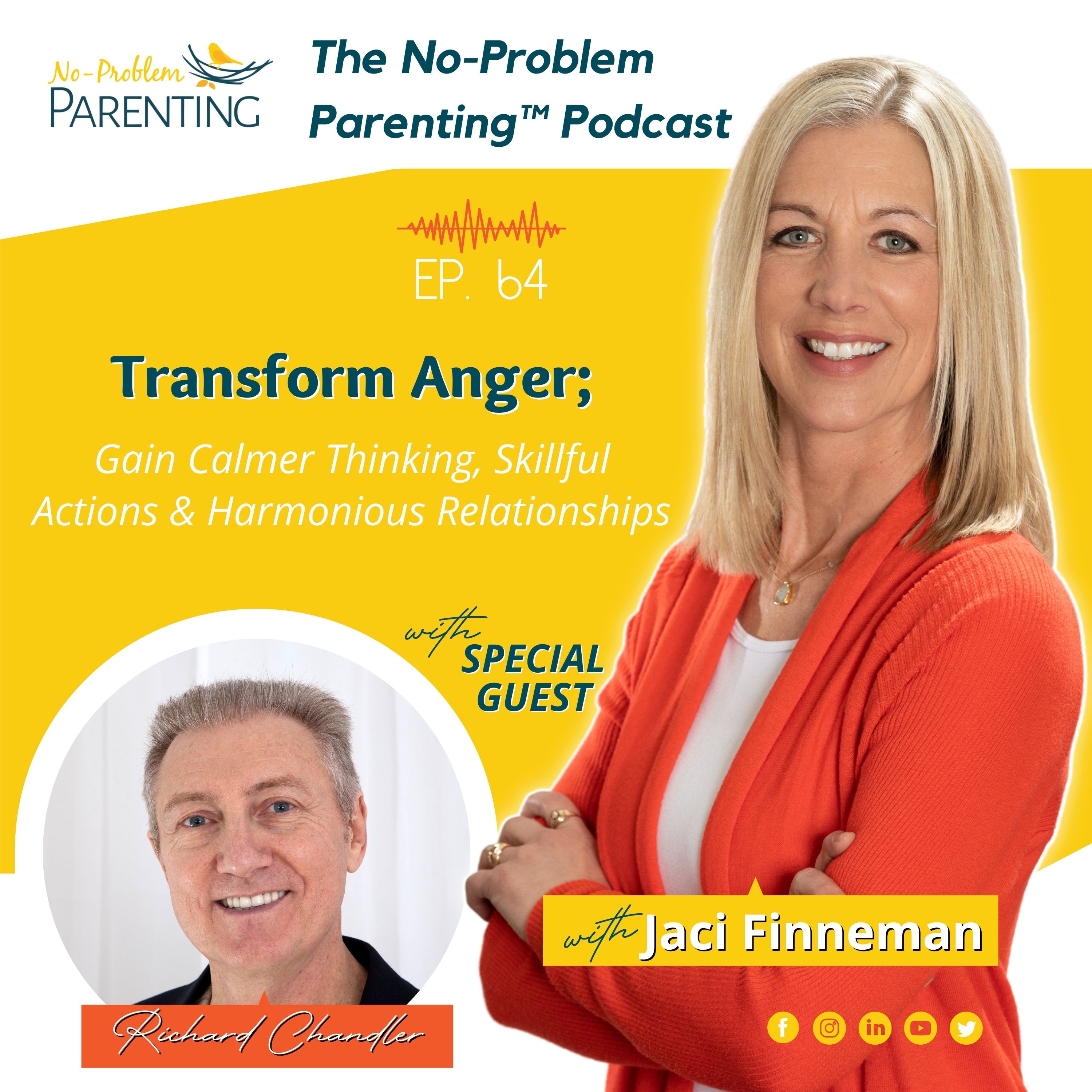
Transform Anger; Gain Calmer Thinking, Skillful Actions & Harmonious Relationships with Special Guest Richard Chandler
About this episode
Welcome Back No-Problem Parents!
Do you notice yourself, or someone you love:
Becoming frequently upset?
Wishing to have more control and quit saying hurtful words or actions?
Despite doing your/their best to be calm, continuing to have outbursts?
Experiencing anger as a rapidly rising torrent of emotion?
Targeting hurtful words or actions at others before even realizing you’re/they’re angry?
Struggling to comprise without getting angry?
Becoming violent when consuming alcohol?
Richard's approach to anger management counseling is different than traditional anger management programs. "I seek to understand your unique anger pattern, interrupt that pattern, and even replace your habit with a new way of responding tailored to you".
Become a No Problem Parent Today!
Full transcript
Another one has to do with household. When people aren't agreeing with the household, too many men, and I was, you know, in this camp to some extent myself up until maybe the last eight, 10 years. Too many men have this notion that they're glad to help, which means the woman has all the mental burden. And then the man says, well, if you just asked, I would have helped.
But really, it should be equal burden mentally where both people are scanning the house for what needs to be done and just doing it. Welcome to the No Problem Parenting Podcast. turn behavior problems into no problem with Jackie Fineman. Are you ready to become the confident leader your kids crave you to be? Do you want to learn how to make parenting easier and more fulfilling? Whether you are at your wits end or you want to have more fun as a parent, you're definitely in the right place. Now here's your host, Jackie Fineman.
Welcome back to the No Problem Parenting Podcast, where we choose to deal with and overcome the emotional and behavioral challenges within our home. Today, listeners, I have a special guest with me. His name is Richard Chandler. Richard and I have known each other, I think, for over 20 years when he had his massage practice. And you're in the field of therapy now, or have been for quite some time. And I wanted to have Richard on today to talk about anger. You know, that's a hot topic these days. Many families are dealing with frustration and agitation and irritability.
and all those things. And so I wanted to bring Richard on because he really is going to help us learn how to practice the skills to stay calm and communicate effectively without those angry outbursts. And it kind of starts before you're in the, in that moment, right? So let me introduce you to Richard real quick. He's an MA and holds an MA and an LPC with a master's degree in Adlerian counseling and psychotherapy. He's a licensed professional counselor in the state of Minnesota.
Richard applies his expertise, his training and counseling experience to help you communicate more clearly, to harmonize your relationships and enjoy a happier and more successful life. By enrolling and fully engaging in Richard's anger management courses, you can transform your life and Richard is there to support you. He has moved into the world of online courses and has an anger management course that includes a certificate of completion.
So welcome to the show today, Richard. Well, thank you so much, Jackie. Just a treat to see you again. I remember I grieved a little bit when you left the massage therapy field because you were definitely a pro at that.
But I'm so happy that you are in the therapeutic world right now. Before I go into the subject of anger today, how about you just tell us a little bit about where you're at now, how you got to this place, and what you enjoyed doing as you serve your clients? Yes, certainly. Well, there's a real, it seems maybe a little like, how do you get from a massage therapist to be in a psychotherapist?
Actually, the skill set is not as different as people might think, because one's capacity to settle and be calm and relaxed and have a sense of presence with people. you know that was really the a lot of what i used that that skill set in when working with body work massage therapy for all those years and i i recognized i really need to move on to maybe making even more significant contribution to people's lives way before i even thought about being a psychotherapist i had people on my table doing massage therapy work that were just telling me everything about their lives. And many of them were psychotherapists themselves.
So that was a pretty good indicator that perhaps I should transition to this kind of work. So I kept both practices going. And then at some point, my practice with psychotherapy was certainly built up enough. And by that time, my body had kind of had it in terms of hands and arms and shoulders. And so I made kind of a sudden, I just one day I said, this is it, I'm not doing anymore. And that was about four and a half years ago. And I've transitioned now into a completely online practice for over two years. And that's gone really well. I'm not going back to an office. I really like this. And talk about that a little bit. I know some people I've been doing the online meetings with parents for about five years now. So pre COVID. And the reason I switched was I was getting all these clients, two, three, four hours away from me or in other states, which is more popular now than it was, you know, five years ago. But it's the time saving,
right? It is, you don't have to find daycare for your kids. You can meet right, you know, from your home or from your office on a lunch break or something like that. So it's time saving, but it's also cost saving because you're not traveling or paying for someone to travel to you.
So what benefits are you finding? Every benefit you've already described, I find all that. and in addition to that is that people's perception of what it might be like is not necessarily accurate because people are oftentimes quite reluctant they say oh my god i don't want to i want to do in person i don't want to do online because their perception is that somehow the experience will be far inferior to being in an office but actually that's not the case. I know years ago, we thought it was so impersonal to do an online session. And now it's actually less, you're less vulnerable. You focus on counseling for couples. That's been a major thrust along with anger, working with people with anger has been a major thrust. Right. And so,
so talk to us a little bit about for parents out there, the benefits of making sure that your couple, your relationship as a couple is really paid attention to and nurtured and that you're doing well? Yes. A mistake that many people make is they have things too enmeshed and mixed together. So if their couple's relationship hasn't been going as well, it adversely affects how they parent.
And if this happens so often, one person's really struggling with their couple relationship, they might, in fact, almost distance from not their romantic partner, but from the family. And it just messes up the kids. It's not fair to the kids. And so as people can have a much more clear, separate track and think of your romantic relationship as being quite separate from your other two major roles, one being running a household together, and the second one being co-parenting. So you have these three different tracks. Think of them much more separately. It's actually way healthier. And then if you're not doing so well, maybe you're not agreeing on the financial stuff. That's kind of in the household area. You know, one has a different idea of finances than the other. That doesn't mean that has to completely mess up your romantic relationship or interfere with co-parenting cooperatively together. Yeah, that's a really good point. I love that. I no problem parenting. We talk about the three steps seek first to understand, you know,
step two, prepare for the worst and step three, change the conversation. And oftentimes, you know, we're giving problems too much attention, like the one problem, whether it's behavior problem, or it's an argument you had, we have problems too much attention, more attention than they deserve. And so I like that you're saying, yeah, you could have a disagreement about finances and how you're managing the finances, but that doesn't have to take over the romantic relationship.
Yes, that's what I'm getting at is that if you treat it more separate in those three arenas, your romantic relationship, the kind of relationship you have that has nothing to do with kids or nothing to do with sharing a household together. You know, just, you know, go out with your baby doll and have a little fun, you know, that kind of feeling of, hey, my girlfriend, my boyfriend, not my husband, not dad, not mom, but my girlfriend, my boyfriend, that kind of quality will heal the romantic relationship and see it more separate from the parenting, the co-parenting and from the running the household.
It really helps. You know, I just had on episode 56 of the podcast, I had a guy come on who has the, a podcast called dad up and he and his wife, he had shared with me that he and his wife, they do couples therapy on a regular basis once a month, not because they're having problems, but so that they don't end up having problems. He likened it to like you have a coach for a number of things, you know, prevent it's preventable, but we should be taking care of our relationship and nurturing it. We can prevent a lot of other problems within our home when mom and dad are on the same page, when they're feeling cared for about each other and they're nurturing their relationship. Right. Yeah, absolutely. And I actually have a tip that I give to my couples clients. What I suggest to them is that when they're around their kids and the kids are within earshot, they stop referring to each other as mom and dad so much and start to referring each other as my boyfriend, my girlfriend, or my husband, my wife. And what it tells the kids is that mom and dad have this other thing going that has nothing to do with me. And it helps the kids to be less self-centered because they don't feel that mom and dad's only role is to be mom and dad. They get an experience of these two adults here. They have something else going on. I'm not sure quite what it is, but it doesn't have to do with me that I'm sure of. And that actually helps them
to be less self-centered. It also reaffirms to the couple that they have a romantic relationship too. And they also happen to run this household and they have these kids. And so that's really actually a very, very beneficial to refer to each other in terms of endearment that have nothing to do with being mom and dad. I love that. So you're creating some online courses and your newest course is called Transform Anger. Tell us more about that course. Sure. Basically it includes everything I've learned from doing anger therapy for clients over these last, you know, 10 years or so, it's really the best practices. It's the kind of basic things. And what is different about this course than other courses out there? Because I bought most courses give people kind of head information. Like if you, you know, anger causes these kinds of problems, it's like statistics and help head information, but it doesn't necessarily help people to change their behavior. And what I wanted is a course that helped people change their behavior. Because many people, even if they understand stuff, it doesn't mean they're able to change their behavior in the moment of frustration.
So my course is really designed to help people gain insight early in the process. So as soon as they can feel something, they say, oh, am I in the pattern? The pattern being their anger pattern. And they've had a, so I work with them identifying what are all the components?
What do I notice in terms of the kinds of thoughts I'm having? Many people have a lot of righteous thoughts or kind of they're puzzled, but they're also righteous. Like, why is this happening? What's with this person?
Why is she doing that to me? Why is he saying that? It's kind of righteous, but puzzled. So they have those kinds of thoughts.
They'll have emotions that tend to be more like tightening emotions. Like, you know, it's like frustration. It's like, you know, or it could be some sadness. They're feeling some grief or hurt or embarrassment.
But those are harder to identify. The easiest to identify of all is physical sensations. I'm feeling something in my chest. It's tightness.
I'm feeling heat. And so they learn to identify that. And then even behaviors. Maybe they start tapping things other people can observe, like they're tapping their fingers or they're pacing or they're talking much faster.
So you help them identify their unique, as you call it, your unique anger pattern. So it's something to learn about why we get angry or all those kinds of things. But you're saying it's really individualized. Yes, it is.
It's really interesting. You know, more people get hot than cold, but some people turn cold when they get angry. Some people feel tension in one spot. Others will feel it in other spots.
I've had some people that say, I'm not feeling any muscular tension. Oh, but I am noticing nausea. And so whatever it is, I help them identify their own unique anger pattern. And so if they're therapy clients, they would, we talk about this and we'd write it out and I do all this in a therapy session. But I found out by asking good questions in the course, and they write out the answers, they're able to do it.
so my course isn't I do have a few questions and answers that people have to do because many people are required to take a course because they've gotten in trouble with the law you know they've had a you know some kind of court order or their attorney they're going to have a court order if they don't get their attorney doesn't get them going in therapy or something so I do have you know some questions and answers so they learn the material but most of what people do on their own is they they're going to answer these questions in a thoughtful way and really identify for instance their own unique anger pattern. And then when they feel something's happening, what's happening?
They can ask the question, am I in the pattern? And then they'll tune into their body and say, well, I'm feeling these sensations. I'm having these kinds of thoughts. I'm tapping my fingers, all right? Yes, I am. And that's different than all other anger courses. Anger course is just a bunch of information. But this is about really understanding you at a deeper level and then being able to do something about it early on, not waiting until you're already awful things are flying out your mouth directed at your partner or your kids. Right. And so you're identifying the anger pattern and then you have different approaches, right? Does everybody go through the same approach? Do they have a, you know, a pool to choose from? There's basically two basic approaches. They ask, am I in the pattern? They tune into their body. They've already outlined the pattern so they know what the pattern is. And the answer is going to be yes or no. If I'm having these thoughts, these kinds of emotions, these physical sensations, or these behaviors, the answer is yes. Then there's a second question. The second question is, is it at a low enough level that I can stay? And here's what that means. If it's beyond 25 or 30 percent from nothing to terrible things flying out your mouth or worse, if it's at a low enough level, the answer is,
Yes, I can stay. And then they have to do grounding down techniques, which I also teach in the course, how they can ground down into their body and very quickly settle so they can stay and continue the conversation. If it's not at a low enough level, off they go. They exit. They exit.
Yes. And they just say, oh, off they go. And that way they're not going to say things they regret or have it escalate. and I have them work with their spouse if they're in a romantic relationship to tell the spouse, I can leave at any time.
Either of us get overwhelmed, we're going to just leave, but we'll get back. It's not going to be leaving and not get back to this conversation because that's what happens. Sometimes people leave and they never get back to it. And the spouse thinks, God, every time we talk about something hard, they won't talk, they'll leave and they never want to talk about it.
No, they- And nothing gets resolved, right? And talk about it. They've got to settle first because it doesn't do any good to keep a conversation going if you're agitated. Yes, for sure.
I teach that with my parenting, too. When kids are in their fight, flight, or freeze part of their brain, right, that back part of their brain, there is no reasoning with them. I don't care how much you dig your heels in. Unless you have a very fearful or compliant kid or something like that, you might get them to listen to you when you're being demanding or threatening or whatever.
But typically nothing's going to get resolved in that moment. And oftentimes parents won't want to let it go for the time being because they're going to think their kids, they think their kid's going to think they're getting away with something. It's like, no, no, no. You can just handle it later.
You can deal with it later when everybody's in a microsecond of a good mood, right? Yeah. You're teaching the best practices and it applies just as much to adults as kids. It really does.
It's a good point, though, that we need to, as parents, be modeling this for our kids as well. So when we are the ones getting upset or angry or triggered, that we are modeling, you know what, I'm not in a good spot right now. I need to exit stage left and I'll be back when I can be kind or when I can be calm. Yes. And I often think that parents, when you have a child who's very challenging, they're misbehaving, they're backtalking, they're, you know, all those things. If you're not in a good spot with yourself and those kinds of things are triggering you, I'm going to say it to everybody today, reach out to Richard, go get this course, because even if you're not a violent person and you're not having, you know, explosive outbursts all the time, but you're still being agitated by your child's behavior.
deal with and work on your own triggers of becoming angry and frustrated so that you can parent more confidently. And you're not acting as a peer to your child, right? You're acting as a confident leader. You're able to be a confident leader and not join in on the battle with your kids. So that's why I really love that you're putting this program out there, you know, along with your therapy. And I encourage or recommend that couples, when they are in challenging situations in their relationship that they do seek out a therapist, even if it's only for a few sessions to get on the same page. Or maybe once a month or every other month for a check-in, say, here are the things that have been weighing on me. Here's the conversations where we didn't get back to them and we didn't come to some kind of an understanding or an agreement. So tell us some of the things that the hot topics or concerns, actual examples of what parents are struggling with when they come to you? I'll just give it a little quick laundry list, and then we might just focus on the parenting one a little bit. A big issue is intimacy, and it's quite common, and oftentimes what it is about is other things. It's like they're just not getting along in other arenas, and so they just don't like each other that much enough to have sex. Right. So it's often that. Another one is boundary issues. Maybe one of them has had loose boundaries. And so a lot of
people that have seen me, infidelity is in the mix. And by infidelity, it doesn't mean necessarily that one or the other had their clothes off having sex with somebody else. It could be much lower level than that, but it's still infidelity. An inappropriate relationship with somebody, overly revealing, overly emotionally involved. So we can work with boundaries to make sure that both people in the relationship feel safe. And you can't feel safe if somebody has loose boundaries.
Another one has to do with household. When people aren't agreeing with the household, too many men, and I was, you know, in this camp to some extent myself up until maybe the last eight, 10 years. Too many men have this notion that they're glad to help, which means the woman has all the mental burden. And then the man says, well, if you just asked, I would have helped.
And then, but really it should be equal burden mentally where, where both people are scanning the house for what needs to be done and just doing it, not waiting it for it to be told by, in most cases, the woman. And by the way, I've had this reversed too, by the way. So it's not, yes, of course it always gets, yeah, I've had this. So it's not, but more typically that The woman saying, well, why do I have to keep telling you?
You know, it's too much mental burden. And then it feels she feels like, well, am I just being honest case? In fact, it puts the person that's telling them too much in a parent role. And you can't have a good love relationship of one of them using the parent role.
Right. And I think too often as couples, we don't sit down and figure out who's responsible for what, who's paying attention to what. If we do have that conversation, it's one or the other that's saying this, this, this, and this needs to be done. And then you do feel like you're being the mommy telling the kid what the expectations are.
And again, that's, yeah, really good point. You want to teach even your kids to scan the house and say, what needs to be done? Oh, I'm putting trash in and it's so full. It's like throwing itself back out.
Take out the damn trash. You don't have to wait for anybody to tell you. And put the new garbage bag in. Yes.
Put the new garbage bag in because nobody wants to throw stuff in and realize, oh, now I've got to take it out again and maybe clean up a mess down there and then put the garbage bag in. Yeah. And so the idea is that it doesn't have to be one person's exclusive domain. Everybody can kind of chip in and do what needs to be done. And teaching, you know, first modeling that as parents and then doing that with your kids too, especially as the kids get older.
What kinds of things, suggestions do you have for parents who are off track, who have not been nurturing the relationship as, you know, co-parents, there's one dominating over the other, you know, how do you suggest they start? If you have a situation where primarily one person has more power in the relationship than the other, you really do need to get into marriage therapy because it's going to be hard for people to change that, that pattern. It's really hard because people are used to, they're used to a certain way of relating with each other. And if one person has more power, the person that's saying, I will leave this relationship, or they walked out before, that person is holding the power in the relationship, and it's unfair.
It won't work. You have to have equal power in a romantic relationship for it to work. So that's the first thing. You have to have equal power. And then if you have another situation kind of related to that, if one person is playing a parent to the other partner, because the other partner maybe isn't being as responsible as they can by looking around and doing things that need to be done and waiting to be told, or because the person that's telling them what needs to be told, the parent role is I know best. Yeah. It's not even a good role for your own kids, by the way.
I was just going to say. Not a good role for your kids. You don't want that role. So, so I, you know, the people need to get to the point where they're not behaving as if I know best, especially with their partner, probably not even with their kids.
instead you want to have a different relationship so people need to learn how to relate with each other in ways that are adult and not like one person's acting in a child fashion another person's acting in a in a parent fashion are parents coming to you soon enough or are they coming when things are just like so out of control the most frequent comment i've heard over these years of doing couples counseling is I wish we would have started with you sooner.
Most frequent comment because people often wait way too long. And oftentimes they wait so long that there's no repairing the relationship. One person's really already out the door. They're only coming to couples counseling because, because they, they said that they would.
So they, so they're not blamed for not being willing to try. yes right yeah that's the honest truth there so parents when they start when they're already feeling like they don't want to have an intimate relationship with their partner it's it's all right i mean that's a huge warning flag right that is that's often usually if they didn't have problems with with with sexual stuff before before they started not getting along then then that's what that's about probably. And, and then it's really not having, not having a sexual relationship with your, with your partner is a symptom for all kinds of other things, not being quite right.
Cause it's hard to have, you know, feel open and confident to have, you know, to have that kind of experience with somebody else. If you're not liking them. And when we're just, when parents are disagreeing about the, about the discipline with their children, that's another reason to, to start marriage counseling, right? Yes, it's really very important. They have to be a united front with the kids. Otherwise, the kids will take that little, that little wedge, and they'll drive it deeper, and they'll actually split off the parents. And then one parent, oftentimes will say, I'm going to be the good parent with these kids, I'm going to, I'm going to make sure I just give the kids more what they want, when they want it, which forces the other person into kind of the bad parent role. And it's just, it messes up the kids and certainly messes up the relationship with the two adults. Yeah. You can't be doing that. You have to decide together, not in front of the kids. How are we going to handle the situation that's best? And oftentimes people have to give up some of their notions of what they thought was right and move more towards the middle. Both people often do. You do need a mediator for that. So even if it's not a therapy,
that that's where I love the how uh coaching and therapy can kind of go hand in hand right and you offer both well well in Minnesota I do I do therapy which includes a lot of just basic coaching things too but it's therapeutic because it's not enough to say okay you need to do it more like this you need to do more like that because there's there's reasons that come from maybe that person's background how they were raised that it's very it's been very difficult for them to do healthy things like with discipline, because maybe when they're a kid, this is how they had it. You know, they got slapped around and they think that they're much more modern and advanced and, and evolved as a parent because they don't slap their kids around anymore. They just shout shitty things at them. But, but that you see what I'm saying? So we,
so that the therapy mode, when we're in therapy mode, we're really trying to uncover and discover why is it difficult for me to do the right thing? But, but that's, that's therapy. That's counseling is more like, here's the right thing. Let's move towards it. Yes. Yeah. That's a good point. People often don't understand the difference between that. There is a difference between therapy and counseling for one. There is truly a difference. Yeah. And then that there is a difference between therapy, counseling and coaching. Yes. Yes. Yes. Coaching is extremely straightforward. Here's the best practices to use in your circumstances. That's coaching.
Okay. Counseling is more like, here's the best practices to use, and here's why it might be difficult for you based on a little bit of, I know of your background. Therapy is, I know you want to do the right thing, and you've been trying to do the right thing, and you've been failing. We need to go deeper into why that's been so difficult. And to do that, we have to really look at how you grew up and and what happened and and how you were handling things and what didn't work so well for you and and so we can kind of heal some of those things so you then can do the right thing without sabotaging yourself and other people right yeah much deeper much deeper work yeah a lot more feeling stuff it's not that we don't address feelings in in counseling or coaching uh we're just not really going deep into those and uncovering the deep kind of wounds and things like that. So yeah, I love it. Tell us what's the best way for people to reach you and to learn more about either doing couples therapy with you, couples counseling, and or to get your access to your online courses and how that all works, Richard. Yes. Well, if you're a Minnesota resident,
I can do therapy with couples in Minnesota, and I can also do anger management therapy as a therapy. Then contact my website, MN, as in Minnesota, the initial is mncounselingtherapy.com, mncounselingtherapy.com.
And then the other thing that I'm doing more and more of, and I'm really moving forward in this direction, is my website, Relationships, plural, RelationshipsCommunication.com. RelationshipsCommunication.com right now has just the one course, the anger course, which is a certification course of eight hours.
In other words, you'll get a little letter when you start and you get a certificate of completion by doing all those things that are in the course to do to really help you transform anger. I'm working already on my second course which is called stop arguing it's a course for couples to help them to literally learn how to talk about difficult things without arguing and having disagreeable conversations that is brilliant yeah and that's going to be so I'm excited about that one I've taken a look at your anger course and it's really set up to be manageable so that you can watch it on demand and the videos seem to be between maybe two and 10 minutes a piece or 15 minutes a piece yeah um and so that's set up much like mine which I think it helps parents that you don't have to spend an hour at a time on anything or two hours or three hours at a time you can kind of take this in bite-sized pieces and then or binge watch it and then you know go back and and re-watch right yes you whatever you want to do it's just fine it's it's you can take it at your own pace. What most people do is watch a little section and it's really helpful to then do the, they're called reflections, the reflections right away where I'm asking questions and you're reflecting on your own life and the things that you learned in the video. How do you apply those for your own situation? And as you do those, then it really takes that knowledge you heard,
lets it really absorb and become part of you. Oh, I love it. Well, you have to be motivated or interested in doing this or it's not going to work. Nothing works if we're not like, self-mortality than to do it, right? Too often people are taking an anger course because either the criminal justice system made them take it, their wife or husband made them take it, but the idea is to do it for yourself. And most people I found really want to do it for themselves.
They don't want to keep having, they feel bad when they continue to lose control. They felt bad. Most feel very remorseful after they've had some kind of an outburst. Problems don't have to be super severe in your home right now when it comes to anger. If they're not, this is really the time.
I highly encourage parents to go check it out. It's affordable. And it's something that if you're feeling like you're flying off the handle, if you feel like you're agitated, you don't even want to want to talk about the issues with your spouse because they're going to get upset or you're going to get upset, purchase the course and just, you know, save yourself months and years of heartache by nipping this in the bud and being proactive and not letting it get to the point where you're feeling like you have to do it.
I so enjoyed having you on the show and getting caught up and I'm sure I'll have you back on when you have your future courses already set to go. And so thank you so much for being with me today, Richard. Thank you so much for having me. I really appreciate it, Jackie.
It's been just a real treat. Thank you for tuning in to the No Problem Parenting Podcast. Join Jackie next time for more tips, tools, and resources that will help you become the confident leader your kids crave you to be. Who do you know that we could support on their parenting journey?
Like this podcast, subscribe, share, or leave a review of the show. Your support of the No Problem Parenting podcast pays it forward and helps us help more families. Thank you.
Become the confident leader your kids crave
The method, the community, monthly live Q&A with Jaci, and Celia — your AI guide in the moment.
Start your 14-day free trial Get it on iPhone or sign up on the web