
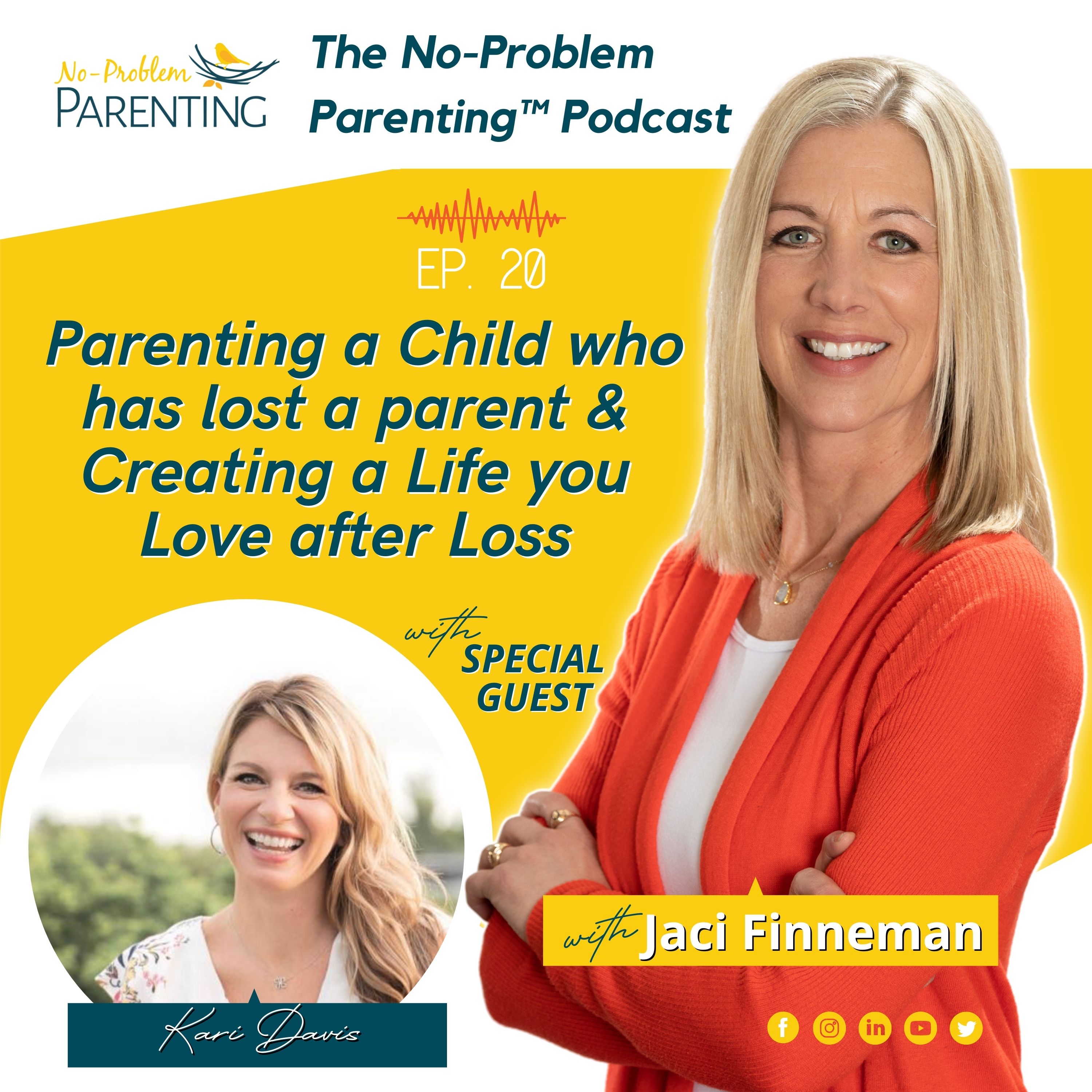
Parenting a Child who has lost a parent& Creating a Life you Love after Loss with special guest Kari Davis
About this episode
Welcome Back Parents! Have your or someone you know lost a family member to death or divorce?
Today, my special guest Kari Davis shares a little bit of her family’s story.
Kari’s husband and father of her 3 children died suddenly of a massive brain hemorrhage on March 28, 2015. He was a healthy 39-year-old man and an amazing dad.
Suddenly, all of the control and good choices Kari made as a mom didn’t matter as much.
She didn’t have the energy to cook. Family time was the most painful parts of the day.
Sports and dinners and school functions were the loneliest reminders knowing that she would always raise these kids without their dad. Kari didn’t know what long-term consequences would result from the trauma they had endured.
And then, Kari found hope and confidence in herself and she began to dream again.Become a No Problem Parent Today!
Full transcript
Welcome back to the No Problem Parenting Podcast, where we choose to deal with and overcome the problems and challenges in our home. And today I have a special guest. Her name is Kari Davis. Kari lives in Naples, Florida with her blended family of five kids and her husband, Bobby.
After being suddenly widowed at 38 years old, Kari is passionate about self-care, natural living, and creating a life you love after loss. She loves to coach other women who've been derailed by life but still desire to chase their dreams, find love again, and raise amazing kids. Her collaborative online space, thewellteam.com, is her passion project and she's just begun the Find the Beauty podcast. So tune in to be encouraged to dream again and create a life you love.
Welcome to the show, Kari. I am so thankful for you being here today and I'm just wondering if before we get into our whole conversation, if you could just share with our listeners a little bit of background about you and why you believe that self-care is really the best first step in helping to raise our children who have suffered a loss. Yes, and thank you so much, Jackie, for having me. I was the mom that thought everything would stick to a script. I planned my kids, what years I would have them. I really wanted a boy first, a girl second. I was always trying to control everything. Well, life got derailed. When my kids were 11, my son was 11, my daughter was nine, and my little guy was four. He was about to turn five a week later. We came home from a birthday party, and my husband was laying on the floor right in front of the bathroom. And actually,
my youngest was actually there. He was playing a game in the hallway. So it really must have just happened. And he suffered from a massive brain hemorrhage. The neurologist said they had never seen more blood in a brain. So it was sudden we could have done an MRI seconds before and we wouldn't have been able to tell. His name was TJ. We were high school sweethearts together since I was 15. That's not always as magical as it sounds, but he had been kind of preparing me in a way. He had always told me, I just don't feel like I'm going to live a really long life. And some really strange things. One day I looked at myself and I, and I ought to like, I thought in my brain, you're going to miss that when he's gone. So I think that there was just something that was kind of preparing his heart and mine, but it was very, very sudden and just calling 911 and the kids,
my nieces were with me. They're really similar ages of my kids. And it just all, everything changed in a minute. My kids grew up in one day.
It's just unimaginable. And Kari, you and I spoke before recording the podcast today, But, you know, just the shock that you were put into, much less your kids. And here your little guy was there with him, but he really didn't know. He didn't understand what was going on.
No. And I, I honestly, so then he came over to him with me, you know, and was like, Daddy, you're being so silly. It was like playing with his face. He thought he was teasing him and, and honestly seemed unaffected by, by the trauma of it.
It was like God veiled his little heart. It was just amazing. He truly didn't. And even for days, he would say, is my daddy still dead today? You know, he was just, he could not wrap his brain around it. They were able to revive him. He was a marathon runner and did get his heart beating again when, but they worked on him for a really long time.
So when we went to the hospital, they did run all the tests all day. So I think the kids thought that there was a chance a lot during the day, but then they came later to the hospital in the evening. And we were so blessed to have, you know, so many people around us. The first thing that the kids thought was like, I was a stay at home mom, like, mom, how are we going to eat?
Right. Their immediate, just core needs started racing through their minds. Like, what are we going to do? and a good friend that was our financial advisor was right there saying, your dad took care of all of that. You guys are going to be fine. You know, my dad was our pastor was right there. Our good friend. I mean, the, the community coming around the kids immediately was so, so powerful, but they changed that day. I remember looking at my nine-year-old daughter and she started rubbing my arm and my back. And I remember thinking, no, you are not, you're not going to start taking care of me. I will still be taking care of you. And I remember telling them in that moment, you know, God gives you the word sometimes that you just don't have. But I just remember telling them,
we are going to get through this. Your dad loved you. You had more in your short little lives from your dad than some people have in a lifetime. We're going to have bad days at different times, good days at different times. But we are in this together. And, you know, it was a really rough couple months. With the hope of heaven, the kids were really, really resilient.
And how old are the kiddos now? So they are 17, 15, and 11, and six years. Yeah, six years of navigating the waters of grief, as you call it, or as you speak about navigating the waters of grief and finding peace again. And so today we're going to talk a little bit about your experience parenting your children through their grief. And let's start with just talking about how grief has shown up different for each of your children and what that's looked like, what you've experienced with that. My older son, you know, was just constantly playing sports with his dad, was with him all the time. And Callie, my daughter too, had a lot of time with him where the little one did not have tons of time. You know, he has some really specific memories,
but he doesn't have tons. So that's kind of the issues that we're having right now is just that fear of, I think I'm forgetting him. Cole is the youngest. He'll just say, mom, I just didn't have enough time. You know how people, oh, people just say the dumbest things. With my oldest son, people told him he's the man of the house now, which I'm like, no, you're not. You're 11. He felt really responsible for me. He felt very, he just always needed to know where I was.
they would tell people, you know, they just wanted to hear me at night. So I would like not be able to go to bed because they wanted to hear me. He definitely just kind of typical boy things. He really needed to burn energy. My brother would come over and just play basketball with him. The first time we went to the grave, like he ran the cemetery, you know, he just, he had nothing. It just wasn't able to come out his emotion. So like moving helped a lot. And unfortunately that kind of changed years later. He got less involved in sports. I think different things that he did with his dad and did less of that. And so that is kind of a regret I have. And also it's just kind of a sad part that he let go of some of that activity that he used to have. And my daughter is just,
she was so wise about it. I would say stuff like, I would say, I'm just sad that dad's not going to be at your wedding? And she would say, mom, he's already been there. Oh, she was, she was just so wise. I think that we learn death from movies, right? So I would like take them to the cemetery and say, does anybody want to talk to dad? And they were like, why would we talk to dad here?
There's nothing here. This is rocks. If we want to talk to dad, we talk to God. Wow.
out of the mouths of babes right absolutely Callie was probably the most like emotional you know like had the most crying nights but she also was just really trying to take care of me that's kind of one suggestion that I have for anyone who is parenting children that are grieving is just to not hide the grief I think the kids thought I was hiding it she would say mom I know you cry when we're at school. Right. It was kind of like busting me, but it was so hard because we all grieve differently on different days. Right. So if I was having a bad day and they had something good going on, usually as a single mom, your bad days are when things are really busy and when there's stuff going on. So I just never wanted them to, I guess, just feel my pain. I wanted it.
I wanted them to just have bad days when they were having bad days, but to just be really honest about it. I say this all the time, but there's the beautiful bell curve of grief. You know, you start out in shock and then denial and anger and all the things. And the actual picture of grief is like a big squiggly line, like up, down, all around, up, down, you know, it's just, it's crazy. It's like riding a roller coaster in the dark. You never know when it's coming.
You never know when certain behaviors are from grief or from anger or repressed anger. And what as just being a disobedient kid or having a temper tantrum. Right. I can see that. That would be true.
Like does everything happen because they miss dad or they're sad about dad being gone or is it just a normal age appropriate behavior? Exactly. Yeah. So yeah, Callie was definitely just more sensitive, talked about it a little bit more where Cole, you know, was kind of, he definitely talked about him.
he really held on even as a little, little boy, really held on to the memories of running with his dad, playing the Wii with his dad, epic fail moment. I got rid of his Wii. I upgraded it to the Wii U and he was devastated. I felt so bad. But overall, I would say it's just really important to teach about heaven and to just keep that line of communication open about talking about him.
You know, we celebrate certain days, you know, he with TJ's mom, they go away for TJ's birthday every year, but I also, I don't want it shoved in my face all the time. And I also don't want that for them. You know, I feel like a lot of widows will almost keep it in the forefront of everything. Well, your dad would have done this. Your dad would have done that. And nobody wants to be just slapped in the face of grief all the time. How does that work for you guys? There's, I think a fine line for people who are supporting their friends or family who have lost somebody close to them. And so there's this, I think sometimes a nervousness of, should I be talking about him or not talking about him? Should I be asking about him or not? You know, like you just really don't know sometimes as the support person, right. Or, or the friend or the family member.
So were you able to have conversations with your family about? Yeah, I think it's just important to try to not make it weird. You know, like if something comes up that is about that person, you talk about them just like if they were still there. I mean, it's just not to always bring it up in a sad way. It's funny because my son is going to be a senior in high school and he's writing his college paper about laughter and I haven't seen it yet. So maybe he's changed his mind. And he was going to talk about the fact that we had a dance party at the funeral and that using laughter, even in times where people don't think it's maybe appropriate, you know, I got some flack for that, but it was really important for me to teach the kids that death is not the worst thing that betrayal and leaving. I mean, their dad didn't leave them. He's in heaven and that they'll see him again, right. That they still have this amazing relationship with their dad. Nothing can take that away because he's not there. And what would you do with your dad, but have a dance party? I mean, that's what they would do. And so it wasn't to make light of death or to, you know,
to minimize the pain, but that you do have the hope of heaven. We're a faith-based family. And I wanted them to know that there there's worse thing. There was no betrayal here. There was no abandonment. There was no, there wasn't all of those negative emotions. So unfortunately, people that have truly been betrayed by someone, I mean, I really feel like that is a deeper pain than when you have the hope of heaven and that he's still with you. I mean, they still have him.
I don't know if that's right either, but I really, especially Cole, I just, I made him feel like his dad was a superhero. He was in the presence of God. So he had to be holy. And I said, how cool is that? That your dad is like with God and he, he, you can't be in the presence of God unless you're holy. So maybe he knows tons of things. Right. And he's.
oh that's so that's so great I love that I love that and how does he respond to that like as a little guy now he is would you say 11 yeah he's 11 yeah yeah so we don't talk about it as much anymore but um but yeah I mean it seemed to make him feel better in the moment of course he was just like yeah but but I want to talk to him now you know but I miss him now and I said you know of course you do and I am you know I'm so sad that that happened to them so it's not trying to find the silver lining of death. I don't mean to belittle it or, you know, but it's just, it's keeping it in that perspective where I want them to just show up for people and to live like life is short. You know, their favorite song is live like you were dying that Tim McGraw song, because when you get a taste of death at a young age, that is, you just know that lesson that that is what matters. It's not something that you're going to get over. I don't know what your belief or your thoughts are, I lost my mom at 30. So I was very fortunate to have her the first 30 years of my life. And I know a lot of people aren't that fortunate. And it was like one of those things where sometimes people would say, you know, well, it's been two years, you know, aren't you kind of over that or over? And I'm like, I'm never getting over the loss of my mom. Like she was, her and I had a really great relationship and you know, she's my hero. So I'm never going to get over it.
I do get through it and it's been 17 years now. And so it doesn't sting as bad when I think about her and talk about her and I'm still grieving her. Absolutely. Yeah. I'm you're grieving that you can't call her today. I mean, it's a different, I just saw this quote the other day. I just pulled it up. Grief is like carrying a backpack. You never take off some days. It's heavy and almost unbearable to carry some days it's light and almost unnoticeable, but it's always there can suddenly shift around and catch you off guard. Give yourself permission to feel it all. I love that. I love that too. Last weekend, I, I had went to a, like a flea market and we're walking around and seeing all the junk everybody's selling or the new things. And there was a woman at one little spot and she had this plaid shirt on that was literally the same color, the same plaid shirt that my, and she was probably about the age my mom would be now. She was selling little chickadees and some other things or whatever. And I, and she just kind of had this, she didn't look like my mom,
but she just kind of had that presence like my mom would. And plus was wearing that shirt. And I started tearing up. It's kind of like, to me, I call it God winks.
I mean, and it's something my mom would have loved to do is walk around that flea market with me. And so it was just a good little reminder. I'm wondering what kinds of things did you do? And maybe what would you do differently for your kids if you knew then what you know now?
Oh, that's such a great question. I have major shame and guilt about one thing. And that is, so for the first six months, I think I was just in shock. And the next six months I was kind of trying to do it all.
And then I sold my house and I was building a new house. That was kind of my therapy project. But when we kind of in the old house, and then when we got into the new house, I heard this term and it haunts me that we were all silos, that we spent way too much time in our rooms, all of us kind of individually, you know like binge watching shows I was I think depressed I think I was I was sleeping a lot and I just remember the kids being at school and I just would say to people like yeah I'm dead inside I feel nothing and I don't want I just didn't sign up for this I just I'm not up for it this is not what I planned and the kids would come home and we would all just be silos and I just regret that so much. I remember looking at families because we were like an active family together. We always ate together and yes, we ate, but I like quit cooking. We had our sushi night,
our rotisserie chicken night, our taco night. You know, it was just, I was really going through the motions and I was taking care of myself, but not really like I wasn't, I just hadn't kind of dug deep. I just really regret that year. It was probably like a year, year and a half, but it's when they quit being as active in sports and different things. And I just, I really regret that. You know, my husband, Bobby is so amazing. He's like, you've got to forgive yourself for that. Like nobody expected you to do all of this perfectly. And I've really worked on it, but I really regret, I guess, just that time of just not just checking out.
And yet you survived it, right? Yeah. Yeah. For whatever reason it was, it was what was supposed to happen or how things are supposed to happen for you as part of your ability to be able to continue to move through it or with it, that's what you needed or, you know, it's imperfectly to be able to do to get through that particular year or year and a half and maybe your kids as well.
Yeah, I know. And there has to be some grace for it. It just, well, you just wish it wouldn't have happened that way. Yeah. I just, I remember like friends coming down and just having active family life. And I was like, Oh, yeah, supposed to be doing that. Just I just forgot. I forgot like going on a family walk and just being active and and just eating together. I when I built that house, I needed like minimal like it was like blank. It was gray and white. It was the color of my heart. It was just so like, boring. I didn't have a TV in the family room. You know what I mean? Like I just really needed like minimalist but then that made us all that made us all just be in our rooms by ourselves. And I'm so when I met my husband, he was you need a TV. You need some family time in this house. And we've absolutely been able to to bring that back.
And it's such a I didn't realize how much I missed it. That was a really kind of dark year and a half for you guys. And then how did you start to get out of that? Or how did you shift to I listened to the first episode of your podcast, and you talked a little bit about being able to dream again and sort of re-identify yourself, you know, reclaim yourself like, okay, this I'm gonna, I'm ready. Tell us a little bit about how that happened. I started to do personal development.
I mean, for lack of a better word, I, I don't love that term. It's kind of like life coaching, even though I'm a life coach, I don't like the term because there's so many different ways that people choose to do that. But I, I had my foundation of faith, but I just didn't have habits. I hadn't, I hadn't really established my purpose. I had started an essential oil business kind of by accident and didn't have a business plan was just kind of rolling with it. And so I just I read a lot of books, I put miles on walking shoes, I mean, miles would stand at the end, like my halfway point was at this canal, and I would stand and just almost scream. I was, I had so much emotion that needed to get out and just listened to a lot of books and just started taking care of myself, putting that good information in and pushing the junk out. I didn't know how to ask for help. I found myself lonely because everybody thought that I was always okay. And here I wasn't,
but I had no practice in asking for help or allowing other people to be there. And so just finding the purpose. I did some coaching programs. I developed thewellteam.com. That was just a huge passion project for me because after TJ died, I was betrayed by a really close family member and also a business partner. And it just set me in a tizzy. And so I set out to really partner with people that we just have the same value systems and want to serve other people and are not self-serving. And so the wellteam.com was born from that just to create this safe place for wellness, for people to tell their story and to be able to really dig out the junk, not just put a bandaid on the cancer. So you, you talk about self-care being an overused term or self-development, that kind of thing. Well, so how do you define self-care then?
So I think self-care, I think that it has to be holistic. I think that there has to be things for your body, but who, I mean, usually when you ask women, what is self-care? They say, I get my nails done. I go to a massage, right. And I work out. Well, okay. Workouts can actually create more toxicity in the body. So there has to be stuff for your body, but like moving your body, getting endorphins flowing, eating real food. I had friends that would just have to tell me like, are you taking your supplements? Are you eating? I mean, I would just, I was eating and I had even gained weight just from being like stressed out, but I was not, I wasn't giving myself nourishment.
So we take care of our body and we kind of think that that's it, but taking care of your mind, just putting good things in, spending quiet time, learning about yourself, learning about how you actually recharge and what your personality is. I mean, I had to, this is my number one tip for my coaching is that other people need to know how you expect to be treated. We don't teach people how we work. And so we're constantly pouring from an empty cup, pouring, pouring, being all things to all people, I think, especially as moms. And I had to tell my kids, I need quiet time right now.
I'm going to be in my room for, you know, an hour. It's when I started listening to tons of podcasts and this is what I need. Maybe you need that taking care of your mind and then also taking care of your soul, like deciding who's on your little card of the trusted tribe in your life. They get to speak into you and you get to lean on them, but also lift them up there, your trusted tribe, scheduling in time to be with them, to take care of setting boundaries with people that don't deserve to be there. Why would you say you feel self-care is the most important thing that any mother can do when she finds herself suddenly single?
maybe not just through death, but also divorce. I mean, there's sometimes it is, it's really quick and you're, you're suddenly single and you're like, wait, what just happened? Yeah, I definitely, everything applies for, for divorce as well. In fact, a lot of times you have that betrayal component, that abandonment component that is even worse than death.
Your body is going through immense trauma when you have experienced, I mean, there's PTSD symptoms, even if it's not a sudden death whenever your role has changed and you're taking on the burden of so much more work as a single mom your body is in trauma I was clenching my jaw I was in my sleep you know my dentist could tell that my teeth were rubbing I mean the physical trauma that my body went through I wasn't able to release weight until I had gotten my cortisol my stress hormone under control I think that so many times when you're going through something hard you're still taking care of everyone else and to set that boundary that you have to take care of yourself.
I had to like put reminders in my phone to eat and to, and to take my supplements and to drink water. I mean, I, it wasn't coming naturally. And so it sounds so silly to need to hire a self-care coach. But a lot of times when I go through the list of holistic self-care, people are like, I've never done that. And I mean, it sounds like an overused term, but I still think that it's being misused. I wish I could coin like a new word for it. That's what it is. It has, you have to take care of yourself and you have to model that to your children that you don't just pour out all of the time and to teach other people how you need to be treated. How did you use the emotional aromatherapy to support yourself and your kids? I had started using essential oils and started sharing with other moms for, you know, boosting the body's immune system and green cleaning. And it was really all the physical properties of the oils. Well, the fall that TJ passed away, my company came out with an, with an emotional aromatherapy line for all the different emotions. And I was kind of like, it just, I'm like a science-y person. I'm not, you know,
I thought that there was a little bit more hippy dippy, the actual aromatherapy part. I loved the medicinal compounds of the plant. But then when I needed them, it is now my absolute favorite way to teach people. It is the only sense, your sense of smell completely impacts the way that you process emotion. And so you can hijack that part of your brain and feel different in that moment.
I mean, it, it elicits different hormones and completely bypasses every other sense in the body has to go to the brain first and then to the sense, but this is an immediate, immediate benefit. And so I used a lot of, it's a blend called Elevation. There's a blend called Forgive. And I really coach my clients to combine that with affirming truths. I'm not a big fan of just affirmations. Like you are enough. You are good. Like your brain in the moment is like, I know I'm not being enough. I know my kids are sitting in their rooms right now on screens. I'm not enough.
I'm, I'm a mess, but to find affirming truths that are rooted in the actual truth from God, from what you know, to be true, that I'm doing the best that I can do today. So you're changing the way that your brain processes emotion at the same way that you're speaking truth into your life. And your brain knows the difference. We can't fool ourselves.
And so I remember diffusing in my bathroom and putting makeup on and just saying, you just need to get through today. So all we're going to do today is just feed the kids dinner and make it to bedtime. And it just made a really huge difference as well as, you know, just eating real food and just holistic care. I mean, it's absolutely life-changing.
Your cells know the difference. You're in trauma, so you have to take care of yourself, but emotionally, especially. Yeah, I like that. I teach in my no problem parenting course, I teach the difference between unconditional positives or unconditional praise and conditional praise.
And so you're kind of that you reminding me of that when you say that your brain knows the dip, like, you can say all the positive things in the world. But if you if you're not actually believing it in the moment, it doesn't really matter. And it's almost as if you're lying to yourself, or we lie to our kids, if we praise, if we praise them, and they don't believe the praise. So we, the conditional praise needs to be in there as well, meaning factual, why are you saying you're a great kid? Or why are you saying you're doing a good job? You know, we need to define that, you know, and really point out what that is so that they can like, Oh, okay. I get why you're not just trying to make me feel good. Right. Absolutely. Yep. What were those things that people could do for you in your family or in your community that, that really did support you? What did they do for the kids? Cause one of the, one of the things I I'm always curious about is how can we in the community support families who have lost a parent and or a spouse? Absolutely. For the parent going through it. I think just to the, the shame compounds. I remember telling people that I'm dead inside and they would say, no, you're not, you know, you're still the same. And I'm like, I'm not the same person. So just ignore, like truly listening to what they're saying. They, they feel like they're losing it a little bit, but for the kids just to spend that quality time with them, like one-on-one
and not to like ask about their parent that passed away. There's, there's this label put on all of us that, you know, you know how it is, even when something traumatic happens, the kids at school, you know, you, you just know that people are like, Oh, there they are, you know, their dad just died. And so the kids kind of felt that I think, so just to spend that quality time with them where they don't have to talk about it. And my family and friends did really great at this. I mean, the kids were just treated the same and meals were really great early on. I mean, we ate for like three months. I mean, it really did make a huge impact because that was just, just figuring out the life insurance and all the passwords to pay all the bills was like a 60 hours a week job. So just not having to worry about food was huge. You know, we had like a certain New Year's Eve party and we did certain vacations with friends and the fear for them is that they're going to lose all of that too. Well, but dad always did that. So what are we going to do? Right? Like dad always set off the fireworks and some things you can't do because sometimes you can't put another person into that role. So that, you know, those are some hard lessons.
The families that you hung out with, the stuff that you still did, it's just really important for them to still see those people so that they don't lose more people than just their parent. That's a really good point. Before we wrap up, I want to talk a little bit about your business and the work that you do. You guide women through self-care sessions. And is it always, Is it just women who have suffered grief and loss or is it any?
Yeah. So no, it's not just for, it's, it's not just for women who have been derailed, but I would say that we've all been derailed in some way, even if we have not experienced death or divorce that, especially during this year of COVID to really just design your life with intention is what we do at a self-care session. So when we talk about who is getting our time, who maybe isn't going to get as much of it, I really believe that you schedule your success, that if you're not in your calendar, then you're showing what you care about.
And sometimes we're not in there at all. And so I have a program that I do about finding your purpose. A lot of times that is a direct next step after we start to implement some self-care. We're like, oh, I'm kind of starting to feel some energy in my body, right?
when you start eating real food and moving and changing the way that your, that your body is processing those emotions, you start to dream a little bit. And so the next step is to find your purpose. And then a lot of times you're ready to start either a passion project or a business. And the rise up coaching that I do is the most fun. It's a branding program, but you also just really get to the heart of who you want to serve and how you want to show up in this world. And it is the most fun. It's six calls and it's the most fun thing that I do. Oh, that's so great. So you were a person that was not used to asking for help. Like your life, your husband took care of a lot of things and, and you just, and you had your plan, but together you kind of had, I mean,
you were working as a team and it was all mapped out and it was all planned. And then he passed and it was like, you weren't used to asking for help. You weren't used to needing other people or allowing other people to help you out. How did you handle that? Or what did you like, how did you finally open the door to let others help you? And, and yeah, well, and to be honest, I didn't really ask him either. I hadn't, I hadn't, I just hadn't told anybody really what I wanted to do ever. I was just more comfortable, you know, taking other people's kids, doing other, just doing things for everyone else. Not that I was the selfless saint by any means, but I think that once I, and see, and I still kind of put it in a negative slant, which I shouldn't,
but I made myself a little high maintenance. There's certain morning routine that I have to do, get a workout in, have some quiet time, have my coffee, schedule out my day. I mean, there's just, there's a lot of things that I do in my morning routine. I'm a big fan of time blocking.
My best friend and business partner does an amazing time blocking program. So everything is kind of scheduled in. So that just doesn't leave a lot of space for running around for everyone else. And I, I think that you outsource and ask people for help for swapping for getting what you you know, you have to set your intention of what needs to be done. And then what does not fit in, you ask your kids to have more responsibilities, you can hire certain things.
And, you know, my the partnership that I have with my husband, Bobby is, I think, just being really clear about the expectations that you have for your business, but also for your day. And we just work really, really well together. And so we should probably fast forward a little bit or get people up to speed. So you met Bobby a few years ago when you started to dream again and you started to your footing again, I guess, right? Absolutely. So part of that kind of personal development was doing some soul searching about my marriage with TJ. You know, it's, there's unresolved things in any relationship. And when you don't have the opportunity to resolve those, you have to do some marriage counseling on your own, right? So in in that process of just that personal development and self care, I made a list of non negotiables for if I was ever to find somebody again, I have a podcast episode about this. And I was really picky and kind of ridiculous. And there's no other reason but God that I was on a dating app. And the only reason why Bobby even popped up on my app was because they were redoing the ice at the hockey rink that he usually plays at and had to go to a different rink. And it's the only reason why he popped up. I was only on there for two days when we met and we just didn't try to impress each other. We were like, here's me. This is what I'm going to do. This is my life. This is what I believe in. And he not only was my list of
non-negotiables, but is a better husband and friend than I even knew was possible. So what do you mean he had to switch hockey rinks and that's why you found him? I don't get it. Okay. So he played hockey kind of by where we live now, but they were redoing the ice over the summer. So he joined a league up by my old town because on a dating app, you put in the radius of where you're willing to meet somebody. So he popped up on the app only because they were redoing the ice for the first time in like 25 years. Wow. There's a God wink. Yeah. It's like working as magic there. Yeah. Oh, that's awesome. I love that. Cool. And so you guys have been married now three years, almost two years. We met almost three years ago or three years ago this month. Yeah. And then joined kids, right? You each had, you had three kids. He had two,
is that right? Yeah. Yeah. So that, that's a whole nother podcast.
Yes. Having a wide range of ages in your home is quite interesting. There's a different strategy for every one of the five of them. It's hilarious. Well, I got to thank you so much, Kari, again, for joining me today. I hope that people will, I'm going to put all your information in the show notes. I hope that people will reach out. I'm sure there are moms out there listening that could use the support that you and your team offer. You know, I love that you say that many parents who have behavior issues with their kids are typically pouring from an empty cup. And so mamas, go get your cup filled, reach out to Kari and so that you can help your kids. You know, we've got to put that oxygen mask on ourselves first, right? Absolutely. So thanks again for joining me today,
Kari. Thank you so much for having me. So great to talk to you. All right, parents, make sure you go check Kari out at thewellteam.com. She has lots of resources and information for you. And you can even schedule a connection call with her to learn more about how you can do some self-care so that you can become the confident leader your kids crave you to be. For now, hugs and high fives, Jackie.
Thank you.
Become the confident leader your kids crave
The method, the community, monthly live Q&A with Jaci, and Celia — your AI guide in the moment.
Start your 14-day free trial Get it on iPhone or sign up on the web