
Part 5/6: 60 Ways to Respond to Your Kids without Losing Your Cool
About this episode
Welcome Back No-Problem Parents!
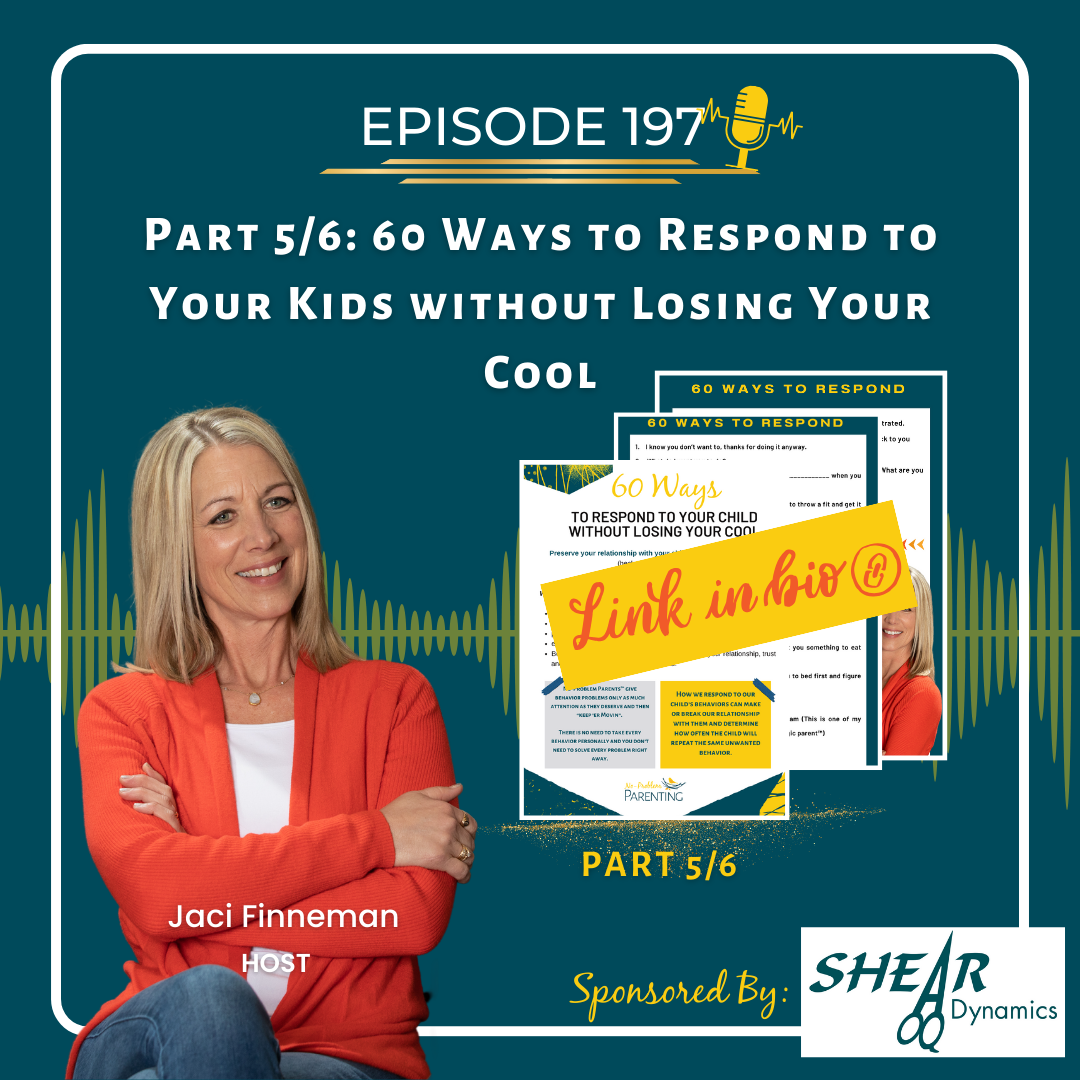
To access the full list of 60 responses, visit noproblemparents.com, enter your name and email, and we'll send the PDF to your inbox.
Today I’m covering responses #41-50 ~
When kids are defiant, melting down, yelling at you, or crying because they are upset, want to do something they cannot do, or aren’t doing something you’ve asked them to do, it can be inconvenient, embarrassing, and exhausting. But does it have to be? Instead....
We can observe the behavior as simply that! A behavior. And behaviors pass unless we feed them by giving them too much attention which often causes the child to repeat the behavior. How we respond to our child’s behaviors can make or break our relationship with them and determine how often the child will repeat the same unwanted behavior.
No-Problem Parents™
give behavior problems only as much attention as they deserve and then life goes on. We understand that behaviors are just that—behaviors. They pass, and we don't need to give them more attention than they deserve. By responding in a matter-of-fact yet empathetic way, without sarcasm, criticism, anger, or convincing tones, we can maintain a positive relationship with our children.
Parenting is a journey with its ups and downs. These responses are your tools to handle challenging moments while maintaining a positive relationship with your child. Remember, you've got this!
Thank you for tuning in to the No Problem Parenting podcast - Please take a minute to share the podcast, comment, or leave a review on your favorite podcast app.
Check out our FREE PARENTING RESOURCES:
60 Ways to Respond to Your Kids without Losing Your Cool
Make it Right Technique PDF
Everyday Essential Solutions eBook for the whole family
Better Sleep: Decrease Stress with the 7-Day free trial of NuCalm Enter Code: NOPROBLEM for 15% off all products.
Become the Confident Leader Your Kids Crave you to be! Put the oxygen mask on yourself first!
Become a No-Problem Parent
Book Your 90 Minute Strategy Session
Find More Resources Here
FB - IG - LinkedIn - YouTube - Twitter - Threads
Check out our Books!
No-Problem Parenting; Raising Your Kiddos with More Confidence and Less Fear
No Problem Parenting; Resources and Stories that Create Confidence and Connection
Hugs and High Fives,
You Got This!
Jaci Finneman
30 Year Counselor turned Parenting Advocate and Coach
Full transcript
Hey guys, I'm Jackie Finneman. I'm a parenting strategist and coach. And after 30 years and with more than 50,000 hours of experience working with kids and families, I promise you there is a solution for your parenting challenges. The key to this parenting gig is to guide and lead your kids with less fear and more confidence. You don't have to know everything to be the expert of your child. So let's get to the root of what is going on in your home with you and your kiddos. And then we're going to prepare for the worst and change the conversation. Problems are a part of life and they're meant to be dealt with and overcome. So I teach parents how to turn any problem into a no problem. Thank you to today's podcast sponsor, Shear Dynamics. Hey there,
talented stylists, barbers, estheticians, and massage therapists. Are you looking for a fantastic opportunity to showcase your skill and grow your clientele? Well, look no further. Shear Dynamics upscale salon and spa is now offering booth rental. In a great location behind Crossroads Mall on 3rd Street in Waypark, Minnesota, they have large custom stations and a fun environment.
Enjoy the freedom of being your own boss. If you're interested or know someone who might be a great fit, call 320-251-5009, 320-251-5009 and ask for Linda or head on over to their website, SheerDynamicsMN.com. All right, we are on part five out of six of the 60 ways to respond to your kiddos without losing your cool. You know, when our kids are defiant, they're melting down, they're yelling at us, they're crying because they're upset, or they want to do something that they can't do, or they aren't doing something that you've asked them to do. It can be inconvenient, embarrassing, and exhausting. But does it really have to be? What if instead of dreading the defiance, we're actually prepared to respond to it. Step two of no problem parenting is being prepared for the worst. Well, just because our kids get upset or reactive, it doesn't mean that we have to join them. We can observe the behavior as simply that, a behavior. And behaviors pass unless we feed them by giving them too much attention, which can cause the child to repeat the behavior, right? It can actually feed the problem. So how we respond to our kids' behaviors can make or break our relationship with them and it can determine how often the child will repeat the same unwanted behavior. No problem parents, you guys, we give behavior problems only as much attention as the problem deserves and then as we say in the Midwest, we keep her moving and life
goes on. There's really no need to take every behavior personally and in fact, when parents do take every behavior personally, we're unintentionally teaching our kids that their behavior controls the health of our relationship with them. So in other words, if they're behaving well, we feel better about ourselves and our worth as a parent feels good. When our children are not behaving well, we feel responsible or embarrassed, which can cause anger and resentment or feelings of hopelessness and defeat. I will say just as a reminder with these 60 responses, they're intended to be stated or said in a matter of fact, yet empathetic way. So we don't use sarcasm, criticism, anger. We're not trying to convince our kids to do what we ask them to do. And it all comes down to the lilt in your voice. How are you phrasing these responses? Like if you do this or you better,
we don't want to be using those kinds of tones. And they can tell, they can just tell when we're trying to convince them to do something. It feels like a trick sometimes to them. So then they just dig their heels in even more. All right. So let's dive in. Number 41. If they're arguing, you've got a couple of kids that are, you know, sibling rivalry, right? And they're just bantering back and forth. They're being really loud. You can say, hey guys, take it to another room. Your arguing hurts my ears. So if they're in a heated argument, instead of letting it escalate and adding to the chaos with your stop yelling at each other, you know, injecting yourself into it, you can just use this response to guide them to a more suitable place to express their feelings. It actually sets a boundary without escalating the situation. You're not telling them to stop arguing. You're just saying, hey, take it to another room, guys. You're hurting my ears. So a response can be, hey,
I can see you guys are upset, but your arguing hurts my ears. Why don't you take it to another room? When you're ready to talk calmly, you can be here by me. Sometimes what happens when you're not trying to make the behavior stop, you know, you're not like they're used to you yelling at them maybe to stop fighting. And instead of doing that, you're like giving them permission to argue with each other, but just in another room, it makes them curious. And we all know when our kids are curious, they're in the front part of their brain, which is the logic part of the brain.
And it shifts them from the back part of the brain. So we want to get our kids to be curious. So, hey, take it to another room where I can't hear you. Now, of course, safety in mind. If you've got a power differential with your kids and one kid's going to get hurt, then of course you need to step in. But this is for those kids where they just need to work it out. They need to figure it out with each other and there is there isn't like a physical power differential in that just let them let them work it out just in another room where it's not hurting your ears all right number 42 sometimes when your kids throw in a screamer having a meltdown instead of trying to get them to stop you can say hey do you need a minute do you just need to be mad for a minute and asking that question yes sometimes they'll say yes i just want to be mad and that's okay. We want to teach them that sometimes we just need to be mad and we can vent. You know,
sometimes all our kids need is a moment to process their emotions. So this response actually acknowledges the feelings and gives them the space they might need. So the parent can say, hey, I see you're upset. Do you just need a minute? Or do you need some time to be mad?
When you're ready or if you need me, I'm here for you. Which leads me to number 43. You can say to your kiddo, hey, it's okay to be angry about this. Would you like my help? Do you just need to be mad?
validating your kids' emotions and letting them know that you're there to support them is super helpful for your relationship. You're not trying to get them to stop. You're just acknowledging they're ticked off or they're frustrated with something or they're upset. And hey, it's okay to be angry and I'm here for you. Let me know if you'd like my help in figuring this out, which leads to number 44. I wonder, I wonder if you need some help. See how these responses are kind of flowing in with each other. Now you don't want to use a bunch of them at one time because that can be actually annoying to the kid. You know, you know your kids best. So you can lead into, you know, first it's okay to be angry about this and then say, I wonder if you need some help. You know, if they're frustrated with tying their shoe and they can't get the laces tied,
or maybe the zipper stuck on their coat, or maybe they're overwhelmed with all the toys they have to clean up in the room, you know, whatever it is, you can say, it's okay to be angry. I'm here for you. would you like some help in figuring this out do you need me do you want me to help i just wonder if you need some help right now so when you notice your kiddo's struggling express your willingness to help it can make a big impact they might say no i don't want any help you can say hey thanks for letting me know i'm here if you need me you can say i see you're having a tough time i wonder if you need some help let me know if there's something i can do and then if they're still battling it they're struggling but they don't want your help you can go into number 45 let them wrestle with the problem a little bit and then you can say hey I noticed that you were trying super hard to tie your shoes and it isn't working would you like some help now or maybe your kiddos in an argument with one of their friends at school and they've been struggling so it's not always about like a misbehavior that we use these responses it can be they're just kind of down in the dumps and they're having a hard time because they're arguing with a friend or they're having a riff with somebody at school and you can tell they're really bummed out about it, but they're not really coming to you for anything. You can just say, hey, I noticed you've been kind of sad
lately or you've been bummed out about this fight that you had with your friend or this disagreement or whatever that you had with your friend or not being invited to the birthday party. You know, I've noticed that you're kind of struggling with this and it seems like things aren't really working out. Would you like some help? Would you like some support? Love and Logic has a great one-liner of, would you like to hear what some other kids have tried? So instead of you giving the advice or the suggestion, you can say, would you like to hear what some other kids have tried or how some other kids have dealt with a situation like this or how some other kids have solved a problem like this? And then acknowledge their efforts, letting them know that you see that they're really trying to work this out. You see that they're working hard on figuring a solution out for whatever the behavior is. So you're acknowledging that and then you can say, hey,
if you need my help, I'm here for you. All right. Now, sometimes we get in this back and forth battle with our kids and we both flip a lid, we both lose our cool and it blows up. And then later we're both like, maybe your child and yourself, or you just are going to model this for your kid.
You're like, I don't even know what hit me. Like I, I was just obviously overwhelmed or overloaded and I blew and I wish I wouldn't have. And maybe your kids feel in the same way, but they just don't know they have the permission to actually have a do-over. So number 46 is you get to say, let's have a do-over I don't think either one of us wanted to get so upset I mean sometimes a fresh start can make a world of a difference instead of consequencing the behavior or having them do a make it right we talked about the make it right technique there's a link in the show notes for that again that's a little bit different technique than just a child or somebody saying I'm sorry we actually figure out what we can do to make the situation right with the person that we harmed and so just simply saying can we do a fresh start and can we just have a do-over I don't think either one of us wanted things to get so intense. Let's just try again. And it's almost like a truce or waving a white flag, right? So the do-over can work in a lot of situations, especially if you as a parent don't really want to have to deal with following through with the consequence.
And it seems like you're in, you're stuck in a rut of like constantly consequencing your kids' behaviors saying, Hey, let's have a fresh start. Let's do a do-over. Truce, shake their hand, give them a hug, whatever it is. All right. You both are in agreement and life can go on.
And sometimes your kids, after you've done this with them, they'll come to you and ask for a do-over because they just lost it and they didn't mean to, right? It was just like this kind of explosive thing. And then later they're like, oh my gosh, I did not mean to yell at mom or I did not mean to snap at dad. If there is a need for you to step in and help with the behavior because it's become aggressive, because they're hurting someone else, there's a power differential, they're not being safe.
then you can do number 47. Step in and say, hey, thanks for letting me know you need me. I don't need you. I don't need you. And you're like, well, actually, you're doing something unsafe. And when there's a safety risk, I feel like a better mom, a better dad when I know my kids are safe. So I'm going to step in and I'm so glad that you're letting me know that you need me.
I'm not telling you I need you. When you become aggressive, when you become out of control, When you do something dangerous, you're letting me know without your words. And remember, we just had episode 196 with Dr. Maisha where she talked about words are only 7% of our communication.
This is a good way to model to the kids. Your body is telling me that you need my help and I'm right here for you. So this can work really well. If your kid doesn't want your help, they'll pull themselves together because they don't want you to help them.
So they'll stop the dangerous or the unsafe behavior just because they don't want you there. But if they are not intentionally being unsafe or not intentionally being dangerous, but they're just, you can tell they're just totally out of control and you step in in those situations to make sure things are safe. You can say, hey, buddy, thanks for letting me know you need me. It works super well, you guys, especially if you have like kids who have had trauma, experienced trauma.
And when they go into fight mode, they become super aggressive. and when they're triggered or set off and they get super aggressive, this one works really well to just say, hey, thanks for letting me know you need me. If they don't need you, they don't want you to help them, they'll stop the behavior. So it works a couple different ways. Not all parents will get this, but because it depends on the child that you're raising. But if you have any questions about that, make sure you book a call with me and I'll help you through that situation of when your kids are being super out of control and aggressive and how to use number 47. All right, Number 48, when your kiddo is completely melted down and you can tell they're really distraught about something, you can step in and say, hey, buddy, you're OK.
This is frustrating, but you're OK. And I'm right here for you. I'm here for you when you need me. Now, in episode 188 with Dr. Gila, right about the 26 minute mark, she gives examples of some other responses.
So I'll call these bonus responses where you can actually model this with your kids so that they'll learn to use it as well. But your hand on your heart and you say, I'm having a hard time. Like when you're super frustrated, angry, intense, upset, you know, I teach the pause hand on your heart, hand on your stomach, pause for six seconds. So you can shift your brain from that back part, fight, flight, freeze part of your brain to the prefrontal cortex, which is your logic part of the brain or your thinking cat.
Well, Dr. Gila was sharing with us that you can actually just put your hand on your heart or hand on your chest and say, I'm having a hard time. That will help you calm down. Or you can say, I am safe.
Or you can say, this is not an emergency. And the hand on your heart is part of that grounding, like helps to kind of ground you and relax your central nervous system and it helps you regulate. so when a kiddo is in number 48 super frustrated out of control freaking out you know throwing their toy down kicking their legs arching their back screaming you know just total wet noodle or they're ticked off as a teenager flying off the handle they whip their hat across the room they go to slam their door whatever it is you can just go in there and say hey you're having a hard time hand on your heart and just say it i'm having a hard time or reminding them yep you're upset right now and it's okay to be upset and put your hand on your heart and say I am safe.
We can teach this to our kids at a really young age. It's a great reminder for parents too when you're feeling like very overwhelmed with whatever the behavior is. If you're in public, if you're feeling rushed, if the kid's screaming in the car and you're trying to drive, put a hand on your heart and just say this is not an emergency. This too shall pass.
I'm having a hard time I am safe just absolutely love that one Bennett and making sure to say to your kids this is frustrating and you're okay or and we're gonna be okay really grounding that locking that in and retraining that muscle memory of our brain that says that we have to fly off the handle when things don't go our way okay number 49 and I actually probably should to put number 49 more like at number 45-ish because it would flow nicely with that. But you can say, sometimes we just need to vent. Sometimes we just need to be mad. Sometimes we just need to be sad and get it out of our system. So allowing your child to be sad, to be mad, instead of trying to shut that off right away, let them feel that emotion. Acknowledge that they need an emotional release. Crying is not bad and neither is being upset. And sometimes we need to vent. If you're venting all the time, you're actually training your brain that that's the appropriate response. And so we want to, we don't want to be venting all the time. You ever have that friend that calls you all the time and all they want to do is vent and it's fine after, you know, the couple of times and eventually you're just like, oh my gosh, I'm not even answering the phone because I just know she's going to take me down right along with her. We don't want to train our brain to go automatically to venting and give ourselves permission to be venting all the time.
Instead, I just love that, you know, it's okay. Sometimes we need to vent, get it out of our system. And then we want to keep her moving and letting our kids know that, you know what, I'm here for you if you do need to vent. And then we want to be solution focused with that.
And we want to only give that venting, that problem as much attention as it deserves. And we want to come up with some sort of a solution or positive way of being like, hey, I can handle this. I got this. We want to empower our kids so that they don't get caught in that. I'm just, everything's doom and gloom all the time and everything's negative. And we can teach them that, yep, stuff happens. Life happens and crappy things happen and we can deal with and overcome those. All right. And then the response number 50, when you do have a kiddo that is super upset and frustrated and mad and maybe totally out of control, you can say to them, you know what, I'll stay with you while you get this mat out. Because sometimes we have kids where they become really unsafe and they become dangerous and they totally flip. And if you have a child like that,
parents, you know who you are. They're the child that when you attempt to go to them and comfort them or help them get control of their behaviors, it flips them out even more. And they're just, they're just out of control. So we want to get them to a safe place, whether that's a small room, not a wide open space with lots of distractions around it or things that they could destroy or wreck. Maybe it is their room. Maybe it's just a smaller room in your house.
Maybe it's outside where they can safely run around a yard without getting, you know, out of your, out of your sight, but wherever it is, you can just say, Hey, it's okay. I'm going to be right here with you while you get this mat out. And then I don't want you here. I don't want you. I know, but I need to make sure you're safe. So I'm just going to stay right here. And it's kind of interesting. Those situations, it's really good to have like a book or a magazine or something that you can grab and sit yourself down on the floor. You're just right there, maybe by the door to say, hey, I'm going to let you get this out and I'm going to be right here if you need me. And then when they're done and when they finally do calm, oftentimes I say to them, oh, that was a big one.
Remember we talked about that in part four. That was a big one and you made it and hand on your heart, you're safe and you did it and now you're calm. Letting your kids know I can see you're really mad. I can see your body's out of control. I feel like it could be unsafe and I want to make sure that I'm here for you. I'm going to stay here with you while you get this out. When you're ready to talk or if you need a hug, I'm right here. Sometimes it can be helpful to put on some soft music. Do something else that involves other senses. Sometimes kids need a bath or a shower.
Sometimes they need, you know, just a different scent in the room or they need some fresh air or whatever it is, just letting them know, hey, buddy, I can see you're really mad. And instead of trying to stop it, you say, go ahead, get it out of your system. I'm going to be right here with you while you get this out, whatever it is, the mad, sad, frustration, whatever it is. Okay.
Remember, we only give problems as much attention as they deserve. So no need to fuel the fire when your kiddo's upset and join in on that same emotion. All right. So that was responses 41 to 50. Remember to download the PDF of the 60 ways to respond to your kiddos without losing your cool, there's a link in the show notes, or you can just go to the front page of our website, noproblemparents.com. And then also make sure that you're following the show. You can either click the follow button or the plus sign on whatever podcast app you're listening to today, and then you'll get notified when the next episode drops. Next week, we're actually having a special Hello World and No Problem Parenting anniversary episode. So we're going to finish off part six of this six-part series on November 30th. All right. Oh, and then if you haven't yet heard the story of Hello World and how a song inspired the name and why the goldfinch is part of our company logo, you can listen to episode 32 where I share how my at the time eight-year-old son made obvious to me that God was answering my prayers for guidance and direction as to whether or not that I should leave my 20-year career and start my own company. It's a really fun story. It's actually a goosebumps kind of story, like a no way, are you kidding me kind of story. And so it's super fun. That's episode 32 of Hello World rebranding to No Problem Parenting. So it's just kind of a
fun episode. All right. Till next time, guys. Hey guys, if you're enjoying this podcast, do me a quick favor and leave us a review of the show. And if you're feeling super generous, take a screenshot of this episode and share it on your social media with your friends and family, and be sure to tag and follow us at No Problem Parents. Doing so helps us help more families.
Become the confident leader your kids crave
The method, the community, monthly live Q&A with Jaci, and Celia — your AI guide in the moment.
Start your 14-day free trial Get it on iPhone or sign up on the web