
Part 4/6: 60 Ways to Respond to Your Kids without Losing Your Cool
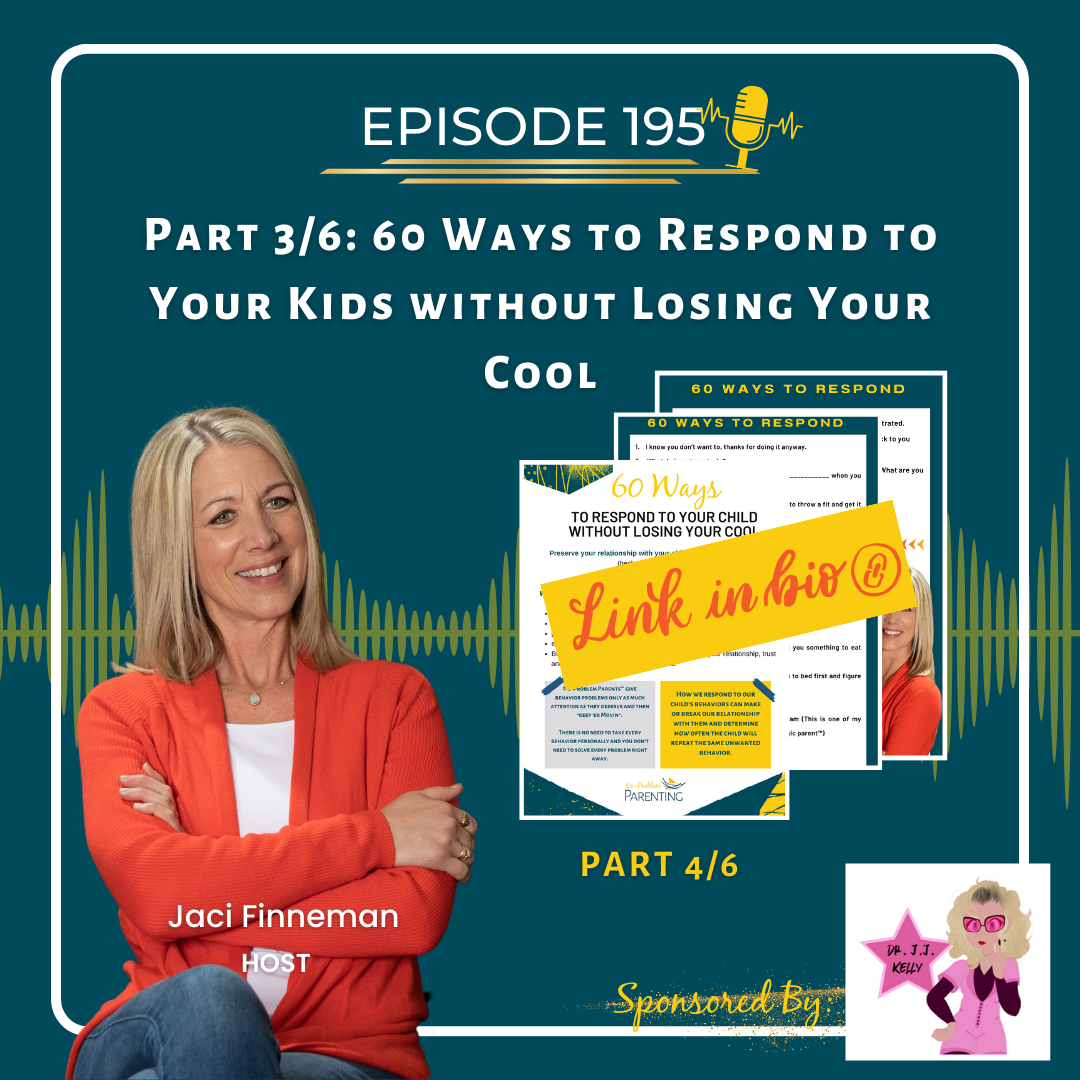
About this episode
Welcome back to the No Problem Parenting podcast, where we turn behavior problems into no problems! I'm your host, Jaci Finneman. Today, we're delving into responses #31-40 of the 60 ways to respond to your kids without losing your cool.
Parenting is no cakewalk, and we all face challenging moments. The key is maintaining a positive relationship while addressing these situations. Remember, you're not alone in this journey. It's natural to feel upset at times, but how you respond makes all the difference.
Dealing with Unwanted Behaviors: Kids can be defiant, meltdown, yell, or cry for various reasons. But what if we approached these situations with preparation rather than dread? Our responses can either escalate or de-escalate the situation, influencing the frequency of repeated behaviors.
No-Problem Parents™ Approach: No-Problem Parents™ give behavior problems only as much attention as they deserve. It's about responding as a leader who understands the child's emotions without getting entangled in the battle. The goal is to be empathetic, firm, and confident without letting every behavior affect the parent-child relationship.
Empathy and Understanding: These 60 responses are designed to be shared in a matter-of-fact, empathetic way. The aim is to respond as a parent who understands the child's struggles, venting, or sadness. There's no need for sarcasm, criticism, or convincing tones.
Handling Your Own Emotions: Parenting can be emotionally challenging, and it's okay to feel upset sometimes. The key is modeling appropriate behavior even when upset. The responses provide tools for expressing your emotions without hurting others or losing control.
In today's episode, we're covering responses #31-40. To access the full list of 60 responses, visit noproblemparents.com, enter your name and email, and we'll send the PDF to your inbox.
This episode is brought to you by Dr. J.J. Kelly and The Get Real Program your guide to navigating the challenges of parenting teens and young adults.
Parenting is a journey with its ups and downs. These responses are your tools to handle challenging moments while maintaining a positive relationship with your child. Remember, you've got this!
Thank you for tuning in to the No Problem Parenting podcast - Please take a minute to share the podcast, comment, or leave a review on your favorite podcast app.
Check out our FREE PARENTING RESOURCES:
60 Ways to Respond to Your Kids without Losing Your Cool
Make it Right Technique PDF
Everyday Essential Solutions eBook for the whole family
Better Sleep: Decrease Stress with the 7-Day free trial of NuCalm Enter Code: NOPROBLEM for 15% off all products.
Become the Confident Leader Your Kids Crave you to be! Put the oxygen mask on yourself first!
Become a No-Problem Parent
Book Your 90 Minute Strategy Session
Find More Resources Here
FB - IG - LinkedIn - YouTube - Twitter - Threads
Check out our Books!
No-Problem Parenting; Raising Your Kiddos with More Confidence and Less Fear
No Problem Parenting; Resources and Stories that Create Confidence and Connection
Hugs and High Fives,
You Got This!
Jaci Finneman
30 Year Counselor turned Parenting Advocate and Coach
Full transcript
All right, welcome back parents to part four of the 60 ways to respond to your kids without losing your cool on the No Problem Parenting podcast, where we choose to turn behavior problems into no problem. I'm your host, Jackie Finneman, and today we're covering responses number 31 to 40. To get the list of all 60 responses, go to noproblemparents.com, enter your name and email and we'll send the PDF right to your inbox, or you can just click on the link in the show notes.
Hey guys, I know, parenting is no walk in the park, but dealing with challenging moments is part of the journey. And it's crucial to maintain a positive relationship while addressing these types of situations that we're going to cover today. Remember, you're not alone in this, and it's okay to feel upset at times. We're going to talk about that today.
The key is to model appropriate behavior and guide your child through their emotional and behavioral challenges. today's podcast sponsor is dr jj kelly at drjjkelly.com and her get real program dr jj offers courses through her get real program which is an emotional skills training program based on dialectical behavioral therapy dr kelly makes learning a complex set of concepts and skills fun and funny she says you're going to laugh yourself right into healthy through the get real program you're going to build awareness of your emotional experiences build a vocabulary of emotion words that's going to enhance awareness and competency to communicate your emotions.
You'll build a framework for increasing your chances of getting what you want when you ask for something or saying no to something or someone else. Increase your capacity to experience joy and calm if you have a teen or young adult experiencing ongoing conflicts in relationships, intense and rapid mood changes, inability to relax, trouble recognizing choice, holding in your anger and then blowing up at others or numbing out in response to fear or anger, Dr.
JJ Kelly's Get Real program is going to help. So go to drjjkelly.com for more information. And thanks again, Dr. JJ for being a sponsor of the No Problem Parenting podcast. All right, let's jump right in to responses 31 to 60. Number 31. Let me know when you're ready. So let's say that your kiddos upset or overwhelmed and you've just asked them to do something and they're just, they wet noodle on the floor or they start talking back to you or throwing some sort of fit. You can say something like, I understand you're upset. Let me know when you're ready. And then you just pause and kind of let them work it out. You can even go back to response number one and say, I know you don't want to right now. Thanks for doing it anyway. Or you just simply say, let me know when you're ready. And for the most part, life goes on while you're waiting for them to be ready to do what it is you ask them to do. And you don't have to be upset by anything, but you're also not responding to any of the requests that they have in the meanwhile. So if it's, I want you to do the dishes, I want you to clean up your room, whatever it is, they throw a fit. You say, let me know when you're ready. They're kind of, sometimes they think they're getting away with it and they don't have to do it. Then they come to you and they want to watch TV or something else. And you're like, oh,
hey, happy to let you watch TV. Just as soon as you do what I ask you to do, let me know when you're ready. See how these responses can kind of work together hand in hand. And the whole point is you're not engaging in the battle. All right, number 32. Now let's say your kid totally melts down. They throw this big, huge screamer. You can say when the screamer is done, whew, that was a big screamer. Are you okay? So if they have a loud outburst or a tantrum, maybe you're even in the store or a public place, you're going to want to observe the tantrum or the fit. Don't worry about being embarrassed or anything like that, trying to make them stop. It rarely works to try to get them to stop, right? Unless you give in, which you don't want to be doing. You can ride the screamer out. You can just observe them, watch them, let them have their feeling, their big emotion.
And then when they're done, you say, whew, that was a big one. Are you okay? Acknowledging their emotions, checking in on them and their wellbeing. Instead of engaging in the emotion or mirroring that same emotion by getting upset or frustrated, you're diffusing the tension, showing empathy, checking on them, and then you can follow it up with, now what did I ask you to do or what did I want you to do and get back on track. When we try to stop the meltdown, the screamer, the tantrum, whatever you want to call it, our kids actually learn, especially if you're in public somewhere and we're trying to diffuse it by, you know, giving in and shushing them and or yelling at them to calm down. You're actually giving that screamer attention and signaling to them that there is some hope that if they scream loud enough or they throw a big enough fit that they're going to get what they want. So instead, sit back, do your pause, observe, and let them have their screamer. It's going to show them that, you know what, throwing a screamer does not get them what they want. All right, so that leads me into number 33. What happens if you do get engaged in the emotion and you're starting to share the emotion and you're super frustrated. And now there you got into this tug of war, this resistance, this defensive, this back and forth kind of conversation. Do number 33. You can say, hey, let's get back to this later or let's talk about
this later when we're both calm. So this is more if you're into some sort of an argument about something and it's just you're not nobody's going to win because you're both in your fight or flight part of your brain. So if you're in that heat of the argument or a disagreement, suggesting a pause until both of you are calm. Say, hey, you know what? Both of us are too upset right now. Let's get back to this later or let's talk about this later when we're both calm. It's okay to delay the conversation. Just like we delay consequences, it is totally okay to delay a conversation. If you are not in your right mind and you are so overwhelmed or upset by something that the child did, the time to talk about it is not when number one, you're frustrated, but also when your kid is frustrated. Because oftentimes we end up giving idle threats and you know, oh you're grounded and giving these idle threats that we're not really going to want to follow through with are actually going to give the problem more attention than it deserves and cause even more problems for us. So in the long run, it is just best to say, hey, let's talk about this later when we're both calm.
which leads me to number 34 because hey what happens sometimes we do kind of engage too much during the heat of the battle and our kids will shout back to us something like you're so frustrating I just can't take this anymore you just never you always yell at me or you don't understand your response can be you're right I can be frustrating you know it's okay to acknowledge your own imperfections when your kid points them out to you that models humility and it creates a more open parent-child relationship. So if your kiddo is pointing out a mistake or a frustration of something that you did when they're upset, acknowledge that and say, yeah, you're right.
I can be frustrating. And we need to get back to this later. We need to talk about this later when I'm calm. It's just really good modeling to say, yep, this is not a good time for me to talk about it. And then the next time your kid gets frustrated, they can use those same words. Mom, I can't talk about this right now. I'm too frustrated. We need to talk about it later.
When your kid does that, make sure you're going back and talking about it later. But instead of saying, nope, we're dealing with this right now because you want to, especially with teenagers, it's like not an opportune time if the kid's really ticked off. You just have to make sure you follow up later. That's key.
And you can use those first couple of steps in the make it right technique, which again, if you haven't gotten that, there's a free download. I'll put the link in the show notes for that one as well. But just simply coming back later and saying what happened. And when they say what happened, you follow that up with good job being honest or good job telling the truth. And then what are we going to do about this is step three. So we can tailor that make it right technique a little bit as a follow-up. All right, number 35. So what happens when you can see your kiddo is struggling, you know you can help them, or at least you think that you could be of some assistance to help them get through whatever problem or challenge it is that they're struggling with, and you want to offer your help and they are clearly not going to accept it right now, you can respond with, I'm right here when you need me. Oftentimes we want to engage and we want to inject ourselves into the challenge or the problem that our kid is experiencing and they're not ready for our help or they just don't want it. Sometimes we want to offer our assistance because we know we can help or we really believe we could make it easier for our kid, but they're struggling and they just kind of want to struggle because they want to figure it out on their own. All you need to do is, hey, I'm right here when you need me. That's reassuring your
kiddo that when they're ready, if they're ready, when they're wanting your help, you're available. But if we inject ourselves too soon, we can send a message that we don't think they're capable of figuring the problem out themselves. And or sometimes we just want to do it because it makes it resolves an issue sooner and we don't have to deal with it. So it's kind of selfish sometimes, right? So instead of giving all the advice or injecting yourself into trying to do the thing for your child, pause and say, hey, I see you want to handle this on your own.
I'm right here when you need me sometimes our kids are just venting to us and that's exactly what they want to do they want to vent they want to get it off their off their mind they want to say it out loud they're not necessarily asking for us to help so you can say I'm right here when you need me and then you just kind of be quiet and wait for your child to come to you to ask for the help all right real quick parents are you ready to become the confident leader that your kids crave you to be? Do you want to get to the root of the behavior challenges in your home, prepare for the worst, and change the conversation with your kids? Parenting doesn't come with a manual and with so much advice out there, it's easy to feel overwhelmed. Too many parents end up shitting on themselves, grappling with guilt and fear about whether you're getting it right.
Well, that's where No Problem Parenting steps in. I built this platform to help you kick parenting fear, guilt, and frustration to the curb. Step into your role as the confident leader that your kids crave you to be. It's time to ditch the shoulds and lead with confidence. Become the parent you've always wanted to be. Join me on this realistic matter-of-fact parenting journey applying the unwavering confidence that you and your kids deserve. There's a link in the show notes to get started today. All right number 36. So what if your kiddo's just super frustrated and maybe they're getting down on themselves or maybe they're getting down on you. So they're saying things like I can't do it. This doesn't work. You know nothing ever goes my way. You're mean. You never let me do anything. I never get to whatever it is that they're frustrated about. Your response can be,
I bet it feels that way right now. Clearly it does. It's the nevers, the I can't, the you don't, you won't, all those kinds of things in that moment. It feels that way to them right now.
So you can just simply say, I bet it feels that way right now, instead of arguing with them or trying to prove your point or convincing them that they're better at something than they are. Just simply acknowledge, I bet it feels that way. If they're mad, if they're frustrated, if they're sad, I bet it feels that way. Sometimes our kids are expressing emotions that we might not fully understand.
We might not even agree with. Your response of, I bet it feels that way right now, is showing empathy, validating their feelings, even if you can't completely relate. All right. So what do we do when our kid is screaming at us or when they're whining or complaining or in defensive mode, verbally defensive mode?
One of the things you can say is number 37. I'll be happy to talk to you when your voice is calm like mine. Instead of saying, don't talk to me that way, calm down. And we all know how well calm down works when somebody isn't calm.
Saying calm down is probably the last thing that's going to work. It's going to actually fuel the fire. So instead of getting into this like demanding, controlling, dominating, like don't talk to me that way attitude, you can just say, hey, I'll be happy to talk to you when your voice is as calm as mine. So if your kiddo speaking in a very elevated or disrespectful tone, your response can be, I'll be happy to talk to you when your voice is as calm as mine.
And then you just keep her moving. You keep doing whatever it is that you were doing. They may be poking and prodding you. Their voice might be getting louder.
They may be whining. You're just going to keep her moving and then broken record repeat. I'll be happy to talk to you when your voice is calm like mine or you can use one of the previous responses Try again. That's a good one in these situations as well All right number 38 and I included this one because it's a hot topic in my parent coaching with families I don't know what it is about the dinner table but I have families who actually can't go out to dinner or bring their kids to restaurants because They're climbing all over the seats or the booth and they're being loud or they're fighting with each other and the parents are just like, it's just too much.
And so a great place to start to prep your kids to be able to go out to a dinner is to prep them at home and model respectful behavior and table manners. So number 38 is feel free to come back to the table when you find your manners. If your kiddo isn't sitting still in their seat at the table, and kids can do this. Kids with ADHD can do this.
There are still, you know, we wanna teach them. If you have a child with ADHD and they're really restless, we want to teach them how to be able to sit, you know, because society isn't going to allow our kids to just be disruptive wherever they go, right? And our kids are capable of sitting. If they are using any type of technology or they like to watch TV and they can sit still while they're using that technology or watching TV, they can sit at the table and use table manners, all right? And this doesn't mean drill sergeants sit. It just means sit down, be respectful at the table, have your body in check, using please and thank yous, chewing with their mouth closed, or being polite, being respectful, taking turns in conversations, and making sure that they're not whining or begging or being disruptive while you're having your family dinner. That's a really basic skill that our kids really need. And it can be tricky at school because it's so noisy during lunchtime and kids can just be super loud. But can you imagine if all kids were taught at home how to sit down and have a calm, peaceful dinner. Can you imagine how that tone could be different in schools? There's no need for kids to be super loud during lunchtime. It drives me crazy when I go into lunchrooms and it's super loud and chaotic, especially in those elementary lunchrooms. How can you digest your food when you're in that much chaos? But anyway, that's another podcast episode.
Making sure to say to the kids when they are being disrespectful, they're being rude to a sibling, or they're just being loud, or they're being whiny. You can just simply excuse them and say, hey, feel free to come back to the table when you find your manners. Setting that clear boundary of respect at the dinner table is not only good for you and your family at home, but it really helps the kiddo no matter where they are at the church brunch, at the restaurant, and at school. All right, number 39. Well, that was embarrassing. Now, some of you might be wondering, why did I even put this one in here? And it's because I think it's super important to teach our kids about how to handle embarrassment. And so it's not just about letting the kid know that we were embarrassed by their behavior, but it's also teaching the kids how to recover from being embarrassed. So if you're at the grocery store or you're at a restaurant and your kid's behavior embarrasses you, it's really important to model and show them how you are recovering from embarrassment or how you handle embarrassment. So I remember when my kiddo was just a toddler and throwing a fit in the department store,
wanting a toy or wanting whatever it was that he wanted. And he started to throw a fit and they get really loud, right? And then you have all the different people looking at you, especially the people who don't have kids, right? Usually another mama in the store is like, oh, I feel your pain.
You know, she's there for you. But oftentimes you feel the judgment even if the other person's really not judging you, right? And so we kind of beat up on ourselves. But I used to say things like, and this is another one of those things that I got from Love & Logic, when my son would put some candy or something on the conveyor belt in the store, I would put all my things ahead of his.
I'd pay for my stuff. And then instead of putting the candy back on the shelf and saying, no, you can't have that, I would just simply let it sit on the conveyor belt. And then when my stuff was paid for, I would say to the cashier, this little guy wants this candy bar. I'm not sure if he has any money or how he's gonna pay for it.
Maybe he'll do some chores for you or something, but I'm not getting that today. And so I'm not saying it directly to my child who already knows they're not getting it because number one, they didn't ask for it. I'm not buying something just because he put it up on the conveyor belt, right? So he would get so upset when he knew I wasn't paying for it, but I didn't battle while we were waiting in line.
I waited until all my stuff was paid for in the cart, the candy sitting on the conveyor belt. He thinks he's getting it. So he's not throwing a fit because he thinks he's getting it. And then just as I'm done paying for everything and I'm about to leave the store, then he could throw his fit.
And I would say things like, I know, I know you really want that. and I'm not getting it for you today. So then we'd get to the car and I would say, oh, well, that was embarrassing. And I was teaching him that his behavior was embarrassing. It's good to acknowledge what was embarrassing and to teach that to the kiddo. I would notice my little guy, he would then get this little bit of embarrassment because I wasn't paying for it. And I would say, I don't know if he's going to do some chores for you to the cashier who he doesn't even know the cashier, right? So he would feel this little bit of embarrassment. And then of course, throw his fit or start to cry. Sometimes it wasn't even about throwing a fit. It would just be he'd start to cry. And then we'd leave the store. You want to teach your kids about embarrassment so that you can help them navigate those awkward situations, which develops resilience. So embarrassment is a universal experience. Everybody gets embarrassed. Some of us more so than others, or some of us are better equipped to respond to the embarrassment more than others, but we all have embarrassing moments, right? Knowing how to handle it can build emotional intelligence. Plus, it's a great way to show your kiddos that everyone makes mistakes and that it's okay to laugh at yourself sometimes.
Modeling how you recover from embarrassment is one thing. So in this example, I'm saying I could have been embarrassed by my child's behavior, but I chose not to be. And I just parented through that moment of him putting the candy on the conveyor belt. But sometimes I'm embarrassed at something that I did. Maybe I tripped. I'm walking through the store and I tripped. Maybe I asked a question that was really silly and I should have known the answer to. And people looked at me like, oh, really? How do you not know that? Maybe I had a booger in my nose. Whatever the embarrassment is. So when I'm embarrassed as a parent, I say, oh my gosh, that was embarrassing.
And I model that and I model how, and then you have a little humor to it. Like, oh, what are you going to do? Everybody farts and kind of modeling the recovery of that. I think that's really key. So learning how to respond to embarrassment includes developing coping skills and a sense of humor. It's about embracing imperfections and realizing that mistakes happen. It's a part of growing up. And when we can encourage kids to handle embarrassment gracefully, we're actually fostering resilience and self-confidence. Okay. So, and, and when you can model for your kids how to recover from embarrassment, it actually can create a connection between the two of you. So when we've made mistakes and we're embarrassed by those mistakes and we kind of model for our kids how we got through that, you're building connection,
creating trust and more open, honest communication. So if I'm embarrassed or if the child did something that embarrassed me or the child was embarrassed in some way, shape or form, we can just simply say, well, that was embarrassing. And it's a very matter of fact, not super emotional response. Ultimately, teaching your kids about embarrassment is a way to help prepare them for the ups and downs of social interactions and building the skills that they need to navigate through the embarrassment successfully, right? And this really helps with peer pressure, you know, just that awkwardness in school. If they're embarrassed super easily and they don't know how to recover from that, often then you'll see a lack of confidence with their peers. And that's actually a good topic for another episode. Stay tuned. I'm going to have to add an episode in there about how to handle embarrassment and how to teach our kids how to handle embarrassment. Okay, I went a little long on that one. The last one, number 40. I can blank when I'm done with my chores. So I've already shared the one about feel free to blank when you've done what I asked you to do or when you've completed your chores, but this is about us.
So I can take you to the park. I can watch that show with you. I can do arts and crafts. I can whatever it is when I'm done with my chores. So balancing responsibilities with your kids' requests is going to demonstrate time management and fulfilling your commitments. So if you've made a promise to do something or if you have a responsibility to do something like make dinner for your family, you need to fulfill that obligation. And so it helps teach the kids delayed gratification. So we use this when a child has a want, not a need, right? So we're always meeting their basic needs and always keeping safety in mind. But if it's just a want, I want something from you, mom and dad. It's teaching delayed gratification. And delayed gratification is a crucial life skill that is not just about being a kid. Delayed gratification is something that we all need, especially into adulthood. We can't always have what we want when we want it, right? So we want to teach our kids, help them understand that not everything can be instantly obtained and that patience and persistence are valuable virtues, right?
So when you can emphasize your own obligations and responsibilities, it sets a positive example for your kids and it helps them grasp the concept that there are priorities and commitments that take precedent over their immediate wants or desires. Okay, so this is really going to help lay that foundation for a strong work ethic as they grow older, for responsible decision-making skills as they grow older, and for the ability to wait and be patient. It seems like such a simple thing, but it's going to help contribute to their overall well-being as they age. So you see, I don't think we always realize the importance of some of these responses or skills that we're teaching our kids as children, the benefits that it provides them as they grow older and they age and, you know, become independent and self-sufficient.
so if you've got a really demanding child when they have a want they are just in your face and they scream and throw a fit or they're constantly begging for stuff you could say hey I can fill in the blank when I'm done with fill in the blank all right so that's it that's that's responses 31 through 40 for this week I hope these examples are going to help you navigate the challenges and the conversations and the behaviors of your kiddos remember it's all about fostering a positive connection with your kiddo while guiding them through their ups and downs of their behaviors.
Remember, these responses can be used and tweaked for all ages. And the intent behind the responses is for the parent to respond to the situation or the unwelcome behavior as a leader who understands that the child is upset, sad, struggling, venting, but you're not going to join in on and match that emotion and become upset or demanding right along with the child. Keep in mind the 60 responses are intended to be shared in a matter of fact yet empathetic way without sarcasm, criticism, anger, or convincing tones. Be sure to follow the show by clicking the follow, subscribe, or download icon on whatever podcast app you're listening to right now. And next week, we're going to cover responses 41 through 50. Feel free to leave a comment on social media or wherever you're seeing this post. Let us know which response is your favorite and that you've had the most success with. All right, until then, good luck in turning your problems into no problem. Hugs and high fives,
parents, you got this. All right, there you have it, parents, another resource that's accessible to you right from the comfort of your home. Hey guys, if you're enjoying this podcast, do me a quick favor and leave us a review of the show. And if you're feeling super generous, take a screenshot of this episode and share it on your social media with your friends and family.
And be sure to tag and follow us at No Problem Parents. Doing so helps us help more families. you
Become the confident leader your kids crave
The method, the community, monthly live Q&A with Jaci, and Celia — your AI guide in the moment.
Start your 14-day free trial Get it on iPhone or sign up on the web