
Part 3/6: 60 Ways to Respond to Your Kids without Losing Your Cool with Jaci Finneman
About this episode
Welcome Back No-Problem Parents!
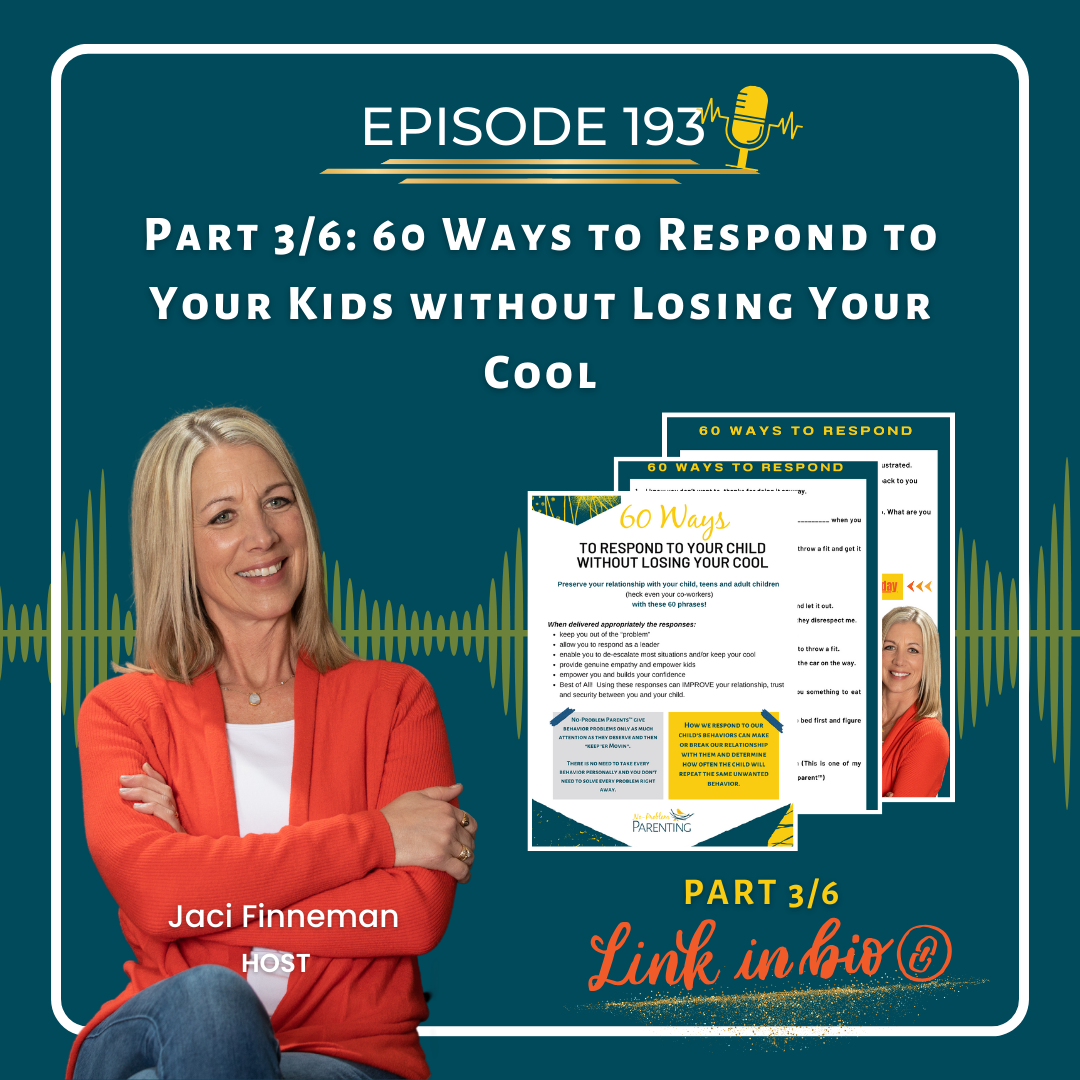
Get the 60 Ways to Respond to your kids without losing your cool FREE PDF and follow along with this 6-part series: http://smpl.ro/60WaystoRespond
Part 3/6 - Today Jaci shares #21-30 of the 60 Ways to Respond to your kids without losing your cool.
Dealing with children's unwanted behavior can be challenging, and it's important to maintain a calm and empathetic approach. These responses can be used for children of all ages, even infants. We'll explore how to respond when your infant or toddler is upset, refusing diaper changes, or resisting being buckled into the car seat to Kids and teens who are talking back or disrespecting you.
When kids are defiant, melting down, yelling at you, or crying because they are upset, want to do something they cannot do, or aren’t doing something you’ve asked them to do, it can be inconvenient, embarrassing, and exhausting.
Does it really have to be? What if instead of dreading the defiance we are prepared to respond to it? Just because our kids get upset or reactive doesn’t mean we need to join them. We can observe the behavior as simply that! A behavior. And behaviors pass unless we feed them by giving them too much attention which often causes the child to repeat the behavior.
How we respond to our child’s behaviors can make or break our relationship with them and determine how often the child will repeat the same unwanted behavior.
No-Problem Parents™ give behavior problems only as much attention as they deserve and then life goes on. There is no need to take every behavior personally and in fact, when parents do take every behavior personally, we are unintentionally teaching kids that their behavior controls the health of our relationship with them. In other words, if they are behaving well, we feel better about ourselves, and our worth as a parent feels good. When our children are not behaving well, we feel responsible and often embarrassed which can cause anger and resentment or feelings of hopelessness and defeat.
These 60 responses are intended to be shared in a matter-of-fact yet empathetic way without sarcasm, criticism, anger, or convincing tones.
Let's learn how to be empathetic leaders in our children's lives without losing control.
__________________________________________________________________________________
Thank you for tuning in to the No Problem Parenting podcast - Please take a minute to share the podcast, comment, or leave a review on your favorite podcast app.
Check out our FREE PARENTING RESOURCES:
60 Ways to Respond to Your Kids without Losing Your Cool
Make it Right Technique PDF
Everyday Essential Solutions eBook for the whole family
Better Sleep: Decrease Stress with the 7-Day free trial of NuCalm Enter Code: NOPROBLEM for 15% off all products.
Become the Confident Leader Your Kids Crave you to be! Put the oxygen mask on yourself first!
Become a No-Problem Parent
Book Your 90 Minute Strategy Session
Find More Resources Here
FB - IG - LinkedIn - YouTube - Twitter - Threads
Check out our Books!
No-Problem Parenting; Raising Your Kiddos with More Confidence and Less Fear
No Problem Parenting; Resources and Stories that Create Confidence and Connection
Hugs and High Fives,
You Got This!
Jaci Finneman
30 Year Counselor turned Parenting Advocate and Coach
Full transcript
Hey guys, I'm Jackie Finneman. I'm a parenting strategist and coach. And after 30 years and with more than 50,000 hours of experience working with kids and families, I promise you there is a solution for your parenting challenges. The key to this parenting gig is to guide and lead your kids with less fear and more confidence. You don't have to know everything to be the expert of your child. So let's get to the root of what is going on in your home with you and your kiddos. And then we're going to prepare for the worst and change the conversation. Kick fear, worry, and guilt to the curb. You are exactly the parent your child needs and wants, and you are more capable than you sometimes give yourself credit for. I launched the No Problem Parenting Podcast to reach more parents and share the Cliff Notes version on how to solve a variety of parenting problems in the moment as they are happening in your home. Problems are a part of life and they're meant to be dealt with and overcome. So I teach parents how to turn any problem into a no problem. In this podcast, you're going to find down to earth practical, fun, no nonsense, and sometimes best backwards tips and ideas for how to navigate this thing we call parenting. You're going to learn about resources on a variety of parenting topics and increase your rock star parenting moments. All right, welcome back. No problem parents. We are on part three of the 60
ways to respond to your kiddos without losing your cool. Today, we're going to go through numbers 21 through 30 of the free download, the PDF download. If you haven't gotten that yet, you can go to noproblemparents.com or click the link in the show notes. So you can print that off and maybe jot some notes and practice these responses. Now there's a number of situations, behaviors, conversations, things where you're going to use these responses. And as I mentioned on the PDF, I mean, you can use these responses even with an infant that's refusing diaper changes or doesn't want to, you know, get in their car seat.
It's not always so much about the child understanding your words as it is you keeping yourself calm so that you're not matching the emotion that your child is having at that time. You're being the confident leader. You're staying in control, keeping your cool. And a lot of times that's what these phrases are doing.
They're there for you to stay calm and not join in on the battle. Just a reminder that these 60 responses are intended to be shared in a matter of fact and empathetic way without sarcasm, criticism, anger, or convincing tones. They're there for you to provide empathy, understanding, and effective communication with your kiddo while at the same time addressing the challenging behaviors. We're just not joining in on the battle and we're not putting the same emotion into the situation as the child is.
And it's okay for them to have a big emotion. And it's okay for us to model there's a different way to get what you want. And so you want to model that you're not going to engage with them when they're not being kind. Right?
So a lot of these responses kind of go hand in hand. You can use a couple of them at the same time. They're interchangeable. Some of them have the same end goal in mind.
It's just saying things a little bit differently. All right. So let's go through some of these. Number 21, the response is, I'll help you even though I don't feel like it right now.
So do you ever have those times when your child is just kind of being a grump and they need your help and you're like, OK, your behavior is not very friendly right now. And I don't really feel like helping you. At the same time, you know that if you do help them, things are going to go a little bit smoother. So it's OK to say out loud, you know what, I'm going to help you, buddy, even though I don't feel like it right now.
So maybe they're asking for help with their homework, but they've just been super disrespectful. Maybe they're asking for you to help them get their shoes on or their coat or something. And it's like, but they've just been kind of a snot. It's okay to say, I'll help you even though I don't feel like it right now.
And that's good modeling too. So even when you're tired or busy, you're going to help them anyway. And then hopefully what's going to happen is the times when you need help and they're not feeling like it, they're going to do it anyway. And you can even sometimes say, you know, remember the other day when I helped you with your homework and I was really tired and didn't really feel like it.
I did it anyway. You'll remember from last week's episode, we talked about thanks for doing it anyway. I know you don't want to, but thanks for doing it anyway. This is one of the opportunities where you get to say, I'm going to help you even though I don't feel like it right now.
All right. Number 22. I agree. This is frustrating.
So maybe your child is struggling and they're just really frustrated. They can't get their shoes on. They can't have what they want. They're not going to get what they want.
They're struggling to finish something or do whatever it is that they're trying to do. Just simply say, you know what, bud, I agree. This is frustrating. And then sometimes that's all you need to say.
instead of having some kind of a conversation about how it's going to work out and convincing them that it's just let them know. Yeah, you agree. I think this is frustrating too. All right. Number 23, let me know if you need some ideas. So maybe your kiddos coming home and they've got a challenge or a problem. Maybe their friends were mean to them at school today. Maybe they've caused a problem. They made a mistake. They need to solve a problem. They need to fix something.
and you know sometimes our tendency is to to solve it for them to give them all these ideas of things that will work and and if they just did this it would turn out well instead how about offering first let me know if you need some ideas so you can acknowledge that they've had this problem or this challenge and then you're like hey bud let me know if you need some ideas instead of just injecting your ideas and your advice just pause and say hey that sounds like a big problem sounds like you're struggling let me know if you need some ideas all right number 24 I bet it feels that way how can I help so maybe your kiddo's upset they say something like I don't have any friends I'm not smart enough I'm not good enough at this they're putting themselves down they don't know how to solve a problem that they cause for themselves or for somebody else so I bet it feels that way how can I help so if your kiddo's upset about something and they're being really negative you can validate their feelings and offer some assistance but first recognizing whatever it is that they're saying I don't have any friends you never let me do anything you don't like me you don't think I can do it you don't love me sometimes kids when they're really mad you don't love me you never let me this that or the other right you can just acknowledge first that I bet it feels that way right now in that moment just acknowledge that to your kid I bet it feels that way let me
know if I can help. I don't want your help. I don't need your help. And you can simply say, all right, just so you know, I'm here for you if and when you do. Simple as that. And then you just kind of be quiet. A lot of these responses are designed to help you stay out of this back and forth, defensive, resistant kind of battle with the kids, right? Oftentimes we over parent. We get in there and we think we've got to come up with the solutions and we've got to help them straighten out their mood or we've got to help them feel better. And it's not our job to help them feel better. Let that come from the inside out. All right. Another way that you can say this is, is there anything I can say that will help you? So instead of just saying the things you think are going to help them, calm them down, trying to convince them that things are going to be okay. Instead, why don't you just ask, is there anything I can say that will help you?
And, you know, oftentimes when our kids are upset or they're struggling, they don't want our advice in that moment. In fact, sometimes when we give our advice, they'll say, you don't understand. Things are different now. You didn't deal with this when you were younger. You can just simply say, well, you know what? Is there anything that I can say that will help you? Sometimes you just have to say, what do you need to hear? Hey buddy, what do you need to hear right now? So it's just another good way of letting them know that you're open to providing emotional support and advice, but you're not just going to freely offer it. You're going to wait and see if they're ready to even hear it. All right. Number 26. Do you need me to help you right now or do you just need to be upset. So do you need me to help you or do you just need to be upset right now? Because guess what guys, it's okay for them to be upset. We get upset. Sometimes you just need to be frustrated and upset for a while and you don't need anybody to come in and rescue you or solve it. It's okay to be upset. We want to let our kids know that it's okay if they're struggling. And this way,
when you offer that to them, you can say, hey, do you need me to help you? Or do you just need to be upset right now? You're letting them know that that's okay. And if they want your assistance, or maybe they just need to vent and let you know their feelings or what's, you know, what they're frustrated about.
Just, just be there and just allow them to do that pause and, and sit back and be like, it's okay to be upset. And sometimes you're saying, Hey, do you just need to be upset right now? Do you need a minute before you, if it's a directive you've given them and they're not doing it and they're really frustrated that they have to do whatever it is you asked them to do or told them to do first, they might need to be upset.
It's kind of like we talked about in number nine, take your time. Let me know when you're ready. Feel free to be upset right now. Just take your time.
Get it, you know, have a nice little fit, get it out of your system and let me know when you're ready. All right. Number 27, maybe your kid's asking for something that they can't have. They want to do something that it's just not okay.
It's a non-negotiable and they cannot do. And this again, any age from like two year old up to 18, right? That it is a non-negotiable and they're still digging their heels in and asking for it. You can say, I understand you want blank, fill in the blank, and I'm not getting it for you.
So this works really well when you're in the grocery store or somewhere and they pull out a toy and they want it and they want it and they want it. And you say, yeah, I understand you want that. And I'm not getting it for you. No need to join in on that emotion.
It's okay for them to be upset right now. I know you're upset about it and I'm not getting it for you. I know you really want to go to that party and you're not going. And it can be just as simple as that.
And let them be upset. you don't have to join in on it. Number 28. So let's say your kid's being super disrespectful or rude and you need to set a condition for your assistance. They want to do something. They maybe need your help. They're really frustrated right now, but they're being disrespectful or rude to you. You can say to them, hey, I'd be happy to help you when you're being kind to me. I'd be happy to help you when you're treating me with respect. And then you just kind of have to wait it out until they calm. Let them kind of get it out of their system. Let them shift. And then when they're being kind and when they've kind of calmed down, you know, they might still be a little miffed or ticked off or something, but they've calmed down a bit. And then when they're being kind, you offer your assistance and your help. Number 29, try again. Now, of course, try again.
Typically when we say try again, it's, you know, if your kiddo is trying to do something and they fail at it and they didn't get it right, you can encourage them to give it another try. But what I'm talking about with try again is when they are disrespectful to you, they're back talking, they're saying something to you that is just not okay, and they're not being kind, and they're being disrespectful, you can say, hey, oh, try again.
You just kind of give them that look like, you know what, try again. So when your kid's being really demanding, you can say, oh, try again. How can you say that differently, bud? You can go back to, I'd be happy to help you when you're being kind to me.
sometimes after you said that and they're still being disrespectful you can just simply say try again but you don't meet that need or respond to their demand when it's demanding all right and number 30 this is a good one pop off to your room see you when you can be kind so this is a little bit different than a timeout i've used this so much with parents that sometimes we think we have to time them out in their room and we have to have them in there for one minute per year of age or, you know, for 10 minutes or 20 minutes or whatever it is.
And it's like, you know what? How about trying to say, pop off to your room, see when you can be kind. And sometimes that means taking them by the hand and helping them get to their room. You can get to your room by yourself or I can help you.
That's a good way to say that. But when they're just kind of wet noodling, throwing a tantrum, disrupting the rest of the room, just being defiant or snotty or sassy or whatever, all you have to do is say, hey, pop off to your room, see when you can be kind. Sometimes we say, see you when you can be sweet. And the idea is that they go to their room, they get themselves together, they kind of pull it together, and then they come out on their own when they can be kind.
For some kids, they'll come out right away. I am kind. I am kind. Oh, try again.
Bring them back into their room. And yes, it can be this back and forth, bringing them to their room. Nothing else happens until they have chilled out, switched from the back part of the brain to the logic part of the brain. They pulled themselves together and then they come back out.
There is no time limit on this. Some kids will pull it together right away, like 15, 30 seconds because they've done it enough. They know, oh, okay, I better get it together. And they can shift.
The goal is to get them to stop being disrespectful, right? So once they've done that, great, come back out. They don't need to be in there for a long time. And the flip side is some kids will go in their room and they'll be all miffed.
And then all of a sudden, 30 minutes go by and you're like, where did they go? What are they doing? And you go in there and they've shifted and they're playing something else. Totally cool.
Absolutely fine. So it's kind of like a timeout. The difference is you're not upset by it. You're just like, I see you're frustrated.
You're struggling right now, being disrespectful, whatever it is. I'm not having it. And so pop off to your room, come back out when you can be kind. It works really well, you guys.
And you can use this in a number of situations and scenarios. All right. So that is number 21 through 30 of the 60 responses. and if you'd like to become a no problem parent worry less and keep your cool with your kids gain your kids respect and trust without having to teach them a lesson and you're really willing to step up as a leader for your family with the confidence that creates curiosity in your kids and gets them to pay attention to what you say you're going to want to grab the no problem parent training which is just an hour and a half worth of videos and a downloadable workbook and it's going to help you learn how to support and guide your kids specific to your family's morals and beliefs. You get to tailor all of this to fit your family's lifestyle. And No Problem Parenting teaches you how to improve and preserve your family relationships by getting to the root of the problem and then dealing with and overcoming the problem. So we have a link in the show notes.
You can get the on-demand three-step parenting course. And in just a few minutes a day, you're going to see a difference in the dynamics of your family, how you respond to your kids. There's a downloadable app so you can listen to the videos as an audio just like you're listening to this podcast here today. You're going to see a difference immediately in your kids and in yourself.
Literally the day you start implementing these techniques, you'll notice a difference in your confidence. Confidence is key and no problem parenting is all about helping you become the confident leader that I say our kids crave us to be. All right, that's it for today. Be sure you're following the show. Next week I'll be sharing responses number 31 through 40 in part four of this six part series following the show will help get you notified when the episode drops.
And if you haven't already head over to no problem, parents.com download the 60 ways to respond to your kiddos without losing your cool until next time, hugs and high fives. You got this. Hey guys, if you're enjoying this podcast, do me a quick favor and leave us a review of the show.
And if you're feeling super generous, take a screenshot of this episode and share it on your social media with your friends and family and be sure to tag and follow us at no problem parents doing so helps us help more families
Become the confident leader your kids crave
The method, the community, monthly live Q&A with Jaci, and Celia — your AI guide in the moment.
Start your 14-day free trial Get it on iPhone or sign up on the web