
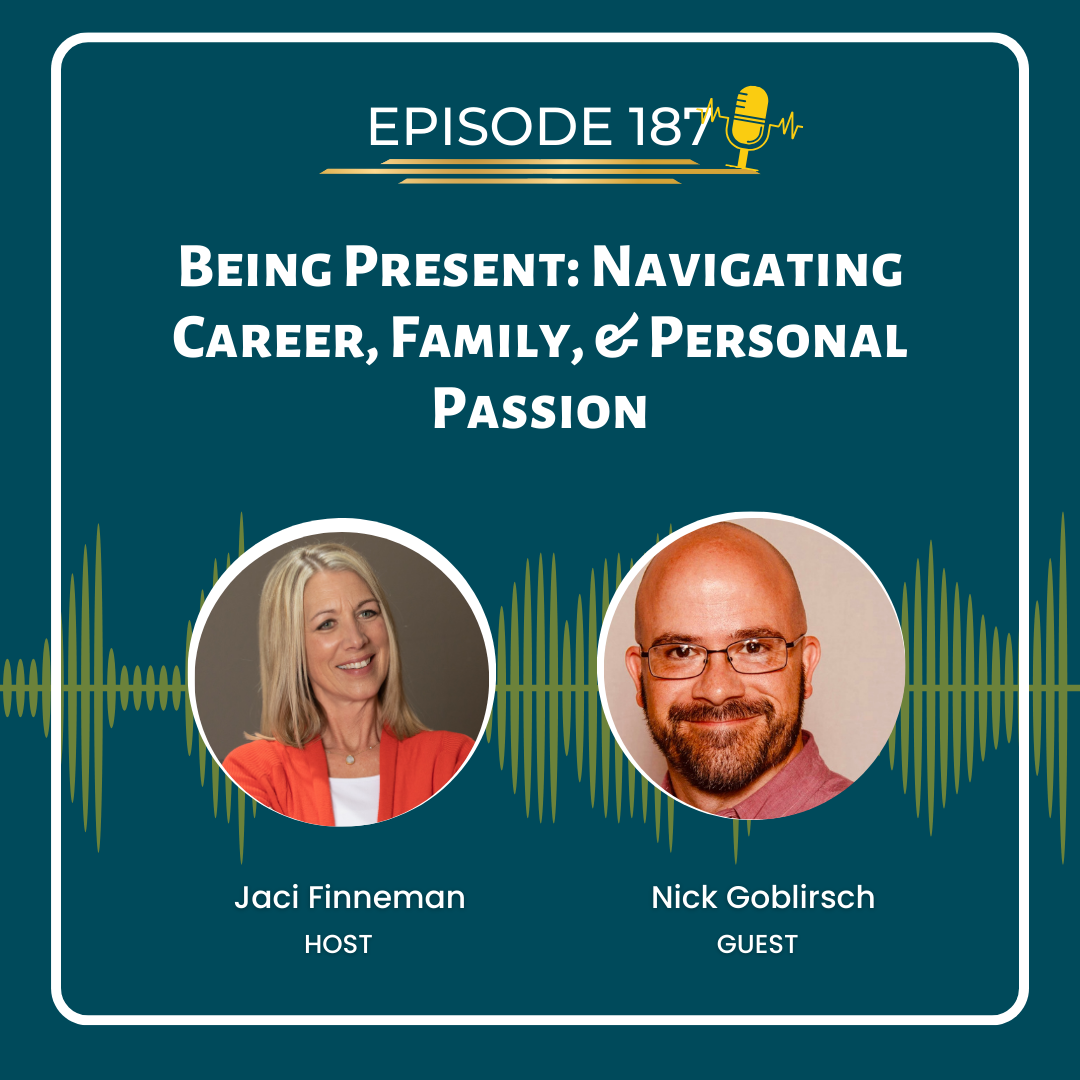
Being Present: Navigating Career, Family, & Personal Passion with Guest Nick Goblirsch
About this episode
Welcome Back No-Problem Parents!
Are you a parent who is driven by your career but feels stuck on the "corporate" path? Are you working a job that demands more than full-time hours, leaving little time for yourself and your family? Do you want to change direction but are afraid to make a move?
If you've been considering leaving a successful career to pursue your passions and to become a more present parent, my guest today has a resource that can help you carefully consider your options.
Meet Nick Goblirsch. In a remarkable journey of self-discovery and reinvention, Nick, a seasoned HR executive, embarked on a transformative transition at the age of 43, leaving behind a successful corporate career to embrace a new canvas as a professional house painter.
As a professional house painter, Nick found fulfillment in every meticulously painted wall and every transformed living space. The transition not only illuminated Nick's courage to embark on a new path but also revealed the undeniable connection between creativity and personal satisfaction. He became a better husband and father as his new line of work fulfilled and energized him.
Today, Nick stands as a testament to the transformative power of embracing change. The transition from HR executive to professional house painter showcases Nick’s resilience, adaptability, and unyielding commitment to creating a life that resonates with authenticity and purpose.
Learn more about Nick by clicking one of the links:
Email: nick@bucketsofchange.com Add Subject: PAINT to get your Buckets of Change Free Assessment to determine whether you are ready for a career change.
Instagram: https://www.instagram.com/iheartpaintingnj/
Biz Facebook: https://www.facebook.com/iheartpaintingnj
Personal Facebook: https://www.facebook.com/nick.goblirsch.52/
Podcast: Buckets of Change Podcast
https://podcasts.apple.com/us/podcast/buckets-of-change-podcast/id1661731617?i=1000629969492
__________________________________________________________________________________
Thank you for tuning in to the No Problem Parenting podcast - Please take a minute to share the podcast, comment, or leave a review on your favorite podcast app.
Check out our FREE PARENTING RESOURCES:
60 Ways to Respond to Your Kids without Losing Your Cool
Make it Right Technique PDF
Everyday Essential Solutions eBook for the whole family
Better Sleep: Decrease Stress with the 7-Day free trial of NuCalm Enter Code: NOPROBLEM for 15% off all products.
Become the Confident Leader Your Kids Crave you to be! Put the oxygen mask on yourself first!
Become a No-Problem Parent
Book Your 90 Minute Strategy Session
Find More Resources Here
FB - IG - LinkedIn - YouTube - Twitter - Threads
Check out our Books!
No-Problem Parenting; Raising Your Kiddos with More Confidence and Less Fear
No Problem Parenting; Resources and Stories that Create Confidence and Connection
Hugs and High Fives,
You Got This!
Jaci Finneman
30 Year Counselor turned Parenting Advocate and Coach
Full transcript
All right, welcome back, No Problem Parents. Hey, are you a parent who's driven by your career but feels stuck on the corporate path? Maybe you're working a job that demands more than full-time hours, leaving little time for yourself and your family. Do you want to change direction but you're afraid to make a move? Well, if you've been considering leaving a successful career to pursue your passions and to become a more present parent, my guest today has a resource that can help you carefully consider your options. Meet Nick Goeblers. In a remarkable journey of self-discovery and reinvention, Nick, a seasoned HR executive, embarked on a transformative transition at the age of 43, leaving behind a successful corporate career to embrace a new canvas as a professional house painter. As a painter, Nick found fulfillment in every meticulously painted wall and every transformed living space. The transition not only illuminated Nick's courage to embark on a new path, but also revealed the undeniable connection between creativity and personal satisfaction. He became a better husband and father as his new line of work fulfilled and energized him. Today, Nick stands as a testament to the transformative power of embracing change. The transition from HR executive to professional house painter showcases Nick's resilience, adaptability, and unyielding commitment to creating a life that resonates with authenticity and purpose. In today's conversation, we're going to talk about
how and why Nick made that transition. I share a little bit about my transition, leaving a 20-year career to start Hello World and No Problem Parenting 10 years ago. And towards the end of our conversation, Nick is going to share his buckets of change framework and offers a free assessment so that you can decide if now or when it's time to make that career change. We did it. We hit number one international bestseller with our second No Problem Parenting book, resources and stories that create confidence and connection. Make sure you head into the show notes and grab your Kindle or paperback version today. Hey guys, I'm Jackie Finnaman. I'm a parenting strategist and coach. And after 30 years and with more than 50,000 hours of experience working with kids and families, I promise you there is a solution for your parenting challenges.
The key to this parenting gig is to guide and lead your kids with less fear and more confidence. You don't have to know everything to be the expert of your child. So let's get to the root of what is going on in your home with you and your kiddos. And then we're going to prepare for the worst and change the conversation.
Kick fear, worry, and guilt to the curb. You are exactly the parent your child needs and wants, and you are more capable than you sometimes give yourself credit for. I launched the No Problem Parenting Podcast to reach more parents and share the Cliff notes version on how to solve a variety of parenting problems in the moment as they are happening in your home. Problems are a part of life and they're meant to be dealt with and overcome.
So I teach parents how to turn any problem into a no problem. In this podcast, you're going to find down to earth, practical, fun, no nonsense, and sometimes best backwards tips and ideas for how to navigate this thing we call parenting. You're going to learn about resources on a variety of parenting topics and increase your rockstar parenting moments. Since starting the podcast in April of 2021, we have over 150 episodes, more than 140 guests. So go back and look through the episodes and find the topics that resonate with you. And if you want to fast track to my solo episodes, you can head on over to noproblemeparents.com, click on the podcast tab, and you'll see the 15 episodes or so that I've done just with my favorite techniques and talking about no problem parenting, attachment disorders, remembering the pause, making it right technique,
some of my favorites. So you can head on over to noproblemparents.com and find it there. And you can subscribe to our emails as well. We are already a top 2% podcast. The more followers and subscribers and listens that we get, the higher up we rank and the more parents that we're able to reach. All right, for now, let's get into today's topic and meet our next guest.
so welcome to the show nick hi jackie this is a true treat to be on your show today we're going to focus on the challenges of being present with your family indeed when you're engulfed in work whether you have a stressful corporate job you're working a nine-to-five or you're working a weekend gig but you're just not feeling like you're really present with your family. And even when you have those moments of being present, you're maybe not allowing yourself to turn work off, right? Exactly. So I'm just really curious about your corporate career as an HR executive. And then when you decided to leave that career and become a painter.
Awesome. So yes, I think the idea of being present is something that I think a lot of people take for granted. I think now that people on the socials and just in content in the world in general are talking a lot more about mindfulness and being truthful and being present. But when I grew up and as a Gen Xer, I don't know if that was ever a topic of discussion. I don't think anybody ever talked about that, right? For the two of us, I don't think that's not something our parents really talked about. And as growing up in a single parent home, my father raising my twin sister and I, my father worked for the U.S. Army for 25 years as an optometrist. It wasn't home a lot, but provided as best he could. And in growing up, in seeing a lot of, it's funny, Jackie,
I think I was raised by sitcoms. Usually the father of the family, the patriarch was the one that went to work and provided. And growing up, it creates an identity where as the patriarch of a family, my job is to provide. So I knew as I entered my career following college, I needed to figure out how to make a living, how to do well.
And but also, I always wanted to do things I'd like to do. So when I probably should have took a path in college of being an engineer or an architect, my wife and I always joke about that. I decided to be an art major because art made me happy. I enjoyed creating things, painting things, doing things.
And I thought how amazing it could be to be an artist. Now, no one told me that being an artist was very difficult in finding a job, at least back then in 1998. It was a little bit different than it is now. I was a door-to-door salesman after college, which was crazy, but taught me a lot about leadership and management.
And then as a salesman, I didn't really make a lot of money. I could teach, but I couldn't really sell. So my first HR job was in, I remember, January 2nd, 2001. And then over the years, for nearly 20 years, I built this established HR career and I thrived.
But I just found myself, even when I had kids, thinking that the only way to be successful is to put more time in than others and get more results than others, ironically. And rather than working a 40-hour week or 45-hour week, I felt that if I'm there 55 hours, that would mean you'd look more successful. I can relate to that. organizations and got bigger jobs in HR and human resources, I just found out that you get paid a lot of money, you get a high salary because you're required to work a lot more and put a lot of time and thought. And I found my weekends disappearing and my vacations disappearing. I just wasn't there to enjoy anything. On a Friday when I was coming home, Saturday, I was thinking about the one o'clock executive meeting on a Monday.
and it got challenging. And not only as an HR partner, and you know this based on some of your experience, certain organizations where you have to support people, you're not only someone who's there to serve others, but you're also one of those individuals that needs to be served. And it's really hard to juggle that, especially when you're in that type of position. Yeah, right.
You get kind of lost. And once I hit my 40s, something changed. Something changed. I started just kind of getting out of my HR world and trying new things. I started podcasting in 2014.
Actually, even before that, helping a friend of mine launch his business, utilizing my art background and my video and radio minor. But realizing it was very exciting for me. I felt fulfilled. I felt it was more of a recognized purpose. I know if you're someone listening to the show and you were someone who was in HR during the Great Recession, I'm sure you were tasked like I was. However, you weren't the most popular person at your organization. Later in my career, Jackie, I became very good at reorganizations. I was very good at making portions of organizations go away. I was very good at sitting across the table from someone and telling them that they're losing their job today and mitigating litigation and doing it the best way possible, which is ironic because later in my career, I became sought out from organizations that were going through organizational change. Someone has a new CEO, that CEO needs to make changes. Nick's the guy we want to bring in to not only reorganize our HR department, but help us reorganize the organization. People knew what I was capable of and people sought me out and it was great. And I realized that I can serve others, tap a passion of mine, something it's exciting to do, but also might be able to create opportunities that I might not be able to have on my current path. So in 2017, 2018, some of my podcast guests, the Dependent Independent podcast,
which was this like midlife experiment, this personal journal of a podcast. I started interviewing a lot of entrepreneurs because in the podcast space, like you, there's a lot of entrepreneurs that use podcasting as an extension of their brand and who they are. And I started seeing a world that I wasn't ever exposed to. Our generation was given this idea that success is making a high salary, a big position.
In my former role, I was flying on private jets and going to meetings and sitting with CEOs and navigating the company and making suggestions and guidance on decisions, significant decisions that needed to be made. And I just kept pursuing that. But when I started in the podcast space, in the content space, I realized that I could still get that purpose, that fulfillment or tap into that childhood love of it all and make a living.
Like I could do this, but then again, that part of my brain was telling me, nah, why would you, why would you do that? Why would you throw away a 20 year career that you've built that anyone would, would kill for this position that you've earned with hard work? Nothing was easy. Nothing was ever handed to me. And so why would you throw that away? And then sliding into 2018, I went with my wife and I and my family and actually our whole family with my mother-in-law and my late father-in-law.
and I went on this cruise and it was an eye-opener because one, cell phones don't work in Alaska when you're looking at glaciers. So suddenly I was forcefully disconnected. So my company couldn't reach out to me. My CEO couldn't check up on me or micromanage something I was doing.
And it was the first time, I will tell you, the very first time I felt present with my family, like truly present. There's an image I shared on my Facebook personal page a while back about my son and I talking. My sister-in-law took the photo and it's me just leaning on a railing with a hot, I think it was spiked hot chocolate. And my son's sitting there and he's talking to me, he's mid-sentence. And it's such an important picture because I felt present. I know that, and it's a confession, that when I would maybe vent to another peer in my corporate life where I had to go home early or something because of an engagement or something we were doing with the family, my peer would say, well, you know,
family comes first. And the unfortunate thing is I have to say that I didn't believe that. I felt my career comes first because without my career, I can't provide, I can't fulfill the purpose of being a patriarch. So I lose my purpose. But that moment and a few other things that happened along that cruise allowed me to rewire my brain and think, is this it? Is this the path that you're destined to do? And I read this amazing book by Mark Manson called The Subtle Art of Not Giving an F and changed my life about really understanding what do I really care about?
What do I need to choose to care about? And it was brewing in my head and I made a decision on that boat that I no longer want to do what I've done for a living anymore. And I didn't realize how scary that thought would be. And eventually getting off that boat and the most heaviest walk I've ever done in my life. And when you make a significant decision like that, Jackie, I didn't tell anyone. I didn't tell my wife. I didn't tell anyone that I no longer wanted to be who I thought I was like, I've created such an identity to what I was doing for a living that that was me, um, created all these rules. Like I mentioned before, these rules of, of this is what you're supposed to do. Uh, and why would you stop doing it? Right. Why would you stop doing something that you've done so well for so long? And eventually when the trip was over, um, I went to a dark place, a very dark, depressing place where, uh, a lot of, I mean, real heavy,
I remember sitting in my office at work alone, just getting emotional, saying out loud, how come I don't care? I don't care about any of this anymore. And I reached out to ex-CEOs. I worked with other podcasters just to process it. It's very helpful.
We talked about loneliness before when you venture out to do something very important that you realize you have to make a conscious effort and take action to reach out to confidants, people that will listen to you but not judge you. And sometimes those people aren't your – they're not your family. That's not – it's not like I pulled my wife aside and said, honey, I'm not – I don't know if I want to pursue my lucrative career anymore.
I think I want to stop. you know my wife obviously would look at me and say well you're crazy because look at this is a life we've grown accustomed to living and and and it's amazing and and all this and and it's you kind of peak but i'm basically telling somebody nah i don't want to do that anymore and you see that in hollywood too where people have these amazing careers acting careers and then suddenly 10 years from now you find out that they open up a bakery and they're as happy as they've ever been And then you're wondering, whatever happened to that person?
So I'm going through this fall of 2018, actually approaching five years now. And I didn't realize, but I was going through a midlife crisis. Everything that the internet told me a midlife crisis is, was everything other than cheating on my wife and buying a Corvette. Everything from apathy to things that I enjoy doing, I no longer enjoy doing.
wanting to run away. There were so many moments where I just wanted to get in my car. And I thought if I drove away, I wouldn't have to deal with it. And it was not until my son really snapped me out of it. Two or three months into that, that he said to me, we were driving in town and he said, dad, why are you so unhappy? And it killed me because you're trying so hard to protect your family from you. You're trying to not let them see you weak because you're supposed to be this strong person that has everything figured out. And that's when I made a commitment that I really have to start to be honest with myself. So I reached out, I'd spoke to a confidant at work and eventually a month and a half later realized not only was the career that I didn't,
And I don't think I, at that role, at that high level role, that high responsible role, I wasn't destined to have that forever. That the organization I worked for, we worked it out where I just wasn't right for that role. And you know, you're a mature HR person, Jackie, when you can actually go to your company and say, you know what? You don't need me anymore.
I'm not the right person for you anymore. And that was eye-opening to be able to do that. And the gentleman that I worked with, I'm still friends with to this day. He's unbelievable.
I love the guy. He was great at working with me to slowly move me out of the organization. Now, I did know that I thought I'd try. Maybe I can go for a smaller role, less responsibility, and coast my way through it.
But that wasn't the case. I was only lying to myself. So I decided that I wasn't going to do what I did, but what can I do? Started a little podcast production business, did some consulting.
And then at a networking event, five months later, I was handing out business cards for my podcast production company. And a gentleman looked at me and we were chatting and he said, yeah, move into town, just bought this new house. It's really hard to find a painter. now i know we didn't talk about this before but i've been painting since i was 14 years old it was it's something i've always drawn a lot of joy out of it's something you can see it's work you can you know change you can visibly see and and and with your eyeballs it's it's it's extremely rewarding it's something you can be very proud of and my wife would farm me out to paint people's nurseries and paint people's bathrooms and things like that but the moment that guy said that something clicked in my head. And at the time I was looking for any way to make money. And I said, I'll paint your house and immediately regretted it. I was, I was like,
what did you just do? And I never painted a house before. And, uh, he said, I gave him my card. He said, I'll reach out to you tomorrow. And I was hoping he didn't reach out to me, but he texted me the next day and said, are you serious? And I went and took a look at his brand new house and 2,600 square foot home in this 15 older community in town. And I put a bid together. It was drastically underbid. Like I look back drastically underbid, but over nights and weekends and days before he moved in, I painted his home and did a lot of things that I would do much faster and more efficient. Now I was a roller and brush guy up till then. I learned a lot in being a professional. But the moment I did that, I realized, you know what, this could be good.
If one person's willing to pay me and I decided to launch a painting business, freaked everyone out. Everyone thought I was crazy. It definitely hurt my wife, Megan, and our relationship because I was withholding from her. Grown a lot since then and understanding.
And I incorporate a lot of that in my Buckets of Change framework of really understanding how we communicate how we're changing and how to gain buy-in and those types of things. And as I started to do that, I just used what I knew how to do. And the ball just started rolling and being who I am and using Instagram and Facebook, I was able to build a successful I Heart Painting brand, which is the name of my company. And I don't have to worry about work anymore. Because I can do what I enjoy doing, I'm able to bring that joy and energy home.
When I was a corporate executive, there were days that were dreadful, anxiety and stress and the weight of the world on my shoulders, which a lot of it was just fabricated by my own head. I brought that home. So if my son wanted to talk to me and I was at home or my wife was telling me what the weekend schedule was, it was in one ear and out the other. I just didn't, I didn't put a lot of value on what we were, the time we were spending, because again, the stereotype was my time is valuable.
Like my work is valuable because it provides for the, for the family. But I didn't realize that time is way more important and money comes and goes. I was able to paint, do something I enjoy and love doing and be able to bring that joy and energy home. now even though i picked a different career there were a lot of things that i needed to fix inside i needed to really work on who i was when i mentioned earlier that the last 10 years of my career i kind of moved around in organizations and people found me but i was the same nick i went through the same cycle of working for a company doing all the heavy lifting in the hr world when things calmed down i would get bored and then i would go somewhere else and i just realized that sometimes changing a career or changing a position may be a good thing, may be a good thing to help you in the right direction. But I think changing who you are and your mindset and how you think and how you deal with yourself, your own ego, everything can really help you tenfold in moving forward. So not only did I change careers and actually change lanes,
significant lanes, I spent a lot of time over the last eight to 12 months at that time, really working on mindfulness, meditation, really understanding how my ego is triggered by certain things, how I react to my family and what happens at home, how I react to money issues. And that really, really helped. I'm not only a better father and present, but I feel I'm also a better person, more compassionate, less judgmental, less, oh my God, judgment is the antithesis.
And judgment is a dangerous thing because all that is, is a projection of your own insecurities. And I'm sure that now that I'm much more secure and much more confident in what I do, there's no need for it. There's no need to make myself feel better by doing that. In my experience, I've never seen people struggle with something as much as change. And I'd like to be the catalyst in being able to help people kind of get out of their own way and not only try something new and expose their world to something different where they can excel and be happier and more fulfilled and more present, but also they can become a better person.
It's much more fun to wake up every day knowing that even though today is going to be hard, it's still something you enjoy. It's fulfilling a part of you. But you truly love yourself because I didn't love myself before, and I've learned to do that. I've really learned to do that.
I see people struggle, whether they project their insecurities with judgment or they look heavy because you're searching. It's that weird way of how our brain tries to survive in this stimulating environment, just wants to feel safe. A lot of it is just created by our own stuff. At the time that you were in your corporate job and working so many hours and constantly thinking of the next day or, you know, on Friday, you're already thinking about Monday.
Yeah. You said that you didn't really value your time. You weren't taking the time to be with family. You weren't checking out of work.
But also I wonder if it's just that you didn't even have the capacity. Jackie, think of it this way. If you build a career and you've created, I'm a big fan of the four agreements. So you create these commitments in your head.
I'm going to be the utmost professional. I'm going to treat people with respect and kindness, even when I have to deliver the worst information they've ever heard. I'm going to dive into conflict as much as I can and do the things that other people don't want to do because job security is doing the work that no one else wants to do and they will pay you for it which is ironic because now i climb 32 foot ladders and paint eaves on houses sometimes i'll be painting and going who wants to do this so i create all these commitments and when you live by that for nearly 20 years and you become successful with those commitments it is risky to change those commitments because the moment you decide i don't give an f about this anymore. Suddenly the whole house of cards falls. There is no sure thing. There is nothing that, that will I be successful? Will I be desired at other organizations? And when that was scary,
you know, when I became a house painter and even now launching a speaking and coaching career, I don't know what to expect. I'm much wiser now. I'm much more confident that I'll figure it out. But when you start off making that first step, you go from safety to not safe or unknown, let's say, Oh yeah. I totally get it. Your brain will play, your brain will do exactly what it's supposed to do. Its goal is to protect you for survival, to keep you, whether it be failure of success, because you have to take on response, more responsibility if you become successful.
Right. When I started painting, I only booked jobs two to three weeks out, which was great. You know, it's now I'm two to three months out. Suddenly I have to take on that responsibility.
I asked for that, but you don't know that when you start, you don't know what demand you're in. And you're taking me right back to 10 years ago when I left, I was excited. I was nervous. Planned, right.
Didn't happen overnight. Finally leave the job. I'm celebrating. I'm excited.
I have this overwhelming sense of freedom and, and I'm, I'm relieved. There was so much relief. And then within a month, almost to the day, panic set in and it was like, oh my God, what did I do? I don't even know how to do this now. I almost had too much time on my hands and I didn't even know how to rest. It took me a good three years to grieve the 20 year history that I had with the company. Cause I was at the same company for 20 years.
Wow. Wow. So grieving, they were second family to me to grieve all of that and really kind of process and work through the last six or seven years that I, I wasn't fully happy or not really enjoying the job. Yeah. It took a good two to three years. I actually stayed with the company, much like you were talking about, you know, could you do a smaller role or a different role and still stay with the company? I did that for a year and a half part-time to make sure I could pay for the health insurance and, and, and things. And then after that year and a half, that was one of the hardest year and a half stints I ever did because I was out, but still a toe in and it, and it just didn't feel authentic to me. And, and so then, uh, and so a year and a half later,
I finally just completely left. I think I was looking for that validation too, or I was looking for that, almost like for the company to say, no, we can't do without you. We'll give you whatever you want. Oh, wow.
You know, because I was super, I was super scared to go off on my own. And yet, no matter how hard I tried in the last seven years I was with the agency, it was not authentic to me. It did not feel right. And so it wasn't working.
I had, I really had to get out. And it doesn't mean the company was bad. you know i think i think that's a lot of times but what we need to be thinking about is you know when you're starting to be upset with the company that you're working for when you're blaming others for everything and and some of that can be legit stuff you know like there was definitely legitimate stuff that was not sitting well with me that did not fit for me but that company that i worked for was they had every right to be the company they wanted to be And it's my job to decide, do I fit in there or not?
Does that work for me or not? And then so listeners, if you're at the point where you're like blaming everything, then it's not a good fit for you is most likely the case. And I'm not saying jump ship right away. Like giving yourself permission to say out loud, I don't think I want to do this anymore.
No matter what noise, Jackie, your family, the world, society, your upbringing is telling you that you shouldn't do. Like me, you know, being a successful HR, having, being on an executive team that, that it's okay to say you don't want that. Like, it's really okay to say that. I don't know why you wouldn't, but the world unfortunately judges you when you do that. They look at you, family. I think a family member actually said to me, why would you stop doing something you're so good at? That's stupid. But I thought, why not? In my experience over 20 years, I've seen so much change that if only I could take all the things I've learned and just spell it out for people to follow, to provide that guidance and be a resource to help people along the way to not get in their own way and help them manage that part of their brain that keeps them from just being something or doing something different. So I created these buckets of change to basically spell out that framework. And the connection that I've always think about is I can't paint a house without emptying buckets of paint. Each bucket needs to be emptied one at a time. So the way the framework works is there's five buckets that have to be emptied each time in order to be able to do that in a specific order. Because to go from zero to a hundred, there are steps along the way,
And you can be jarred if you go to the end too fast. And I wanted to create this framework in order to do that. The first one being permission. It's a big portion of the steps in doing that, of realizing that from our upbringing, we're limited to figure or to believe that we can make a choice to change the path that we're on. We're afraid that we'll hurt someone. We're afraid it'll be risky. We won't make the money that we're accustomed to making. And especially when you've peaked in, let's say you're someone who you're at a high level in your career and you've just realized that everything will go away if I make a change. So I have to keep doing something that makes me miserable and takes me away from my family and doesn't allow me to be present.
And I don't think that's fair to you or the people that you love. So getting that permission and then moving on to the next bucket of action. A lot of that is the steps we take in order to do that. Not only the action we need to take externally, but also the action that we need to take internally, who we are, how do we manage our own triggers and manage our limiting beliefs? And how do we really understand the world around us and how it affects us? Because going through the cycle of making changes, but having the same baggage over and over again, will only lead you down a path.
It's like driving a car with air that's leaking out of the tires. You can keep doing that, but eventually you'll just fall flat every time. There are signs that happen in the world that you sometimes ignore. And if you're someone who is in a position where there are signs, but you can't see them, especially if you're in a career or in a position where you feel maybe a transition may be beneficial at that time.
I'm going to ask you to do one thing. Part of my framework is, I call it the buckets of change assessment. It's a quick two minute on your phone quiz to really ask yourself, is now the right time to think or make a change in my career? You've been grinding it out and the anxiety is just getting so heavy or the stress or everything is keeping you from being the best you and being the best person you can be. So if it's okay with you, Jackie, I'd love to share some info to your listeners. If you email nick at bucketsofchange.com and in the subject line, write the word paint, P-A-I-N-T. I will send you a quick link for my Buckets of Change assessment. It's absolutely free. All it does require you to look at yourself and ask yourself several questions about your current situation in your career and your position. And it may open up some insight of whether or not maybe now is the right time to maybe take a first step to change something, or maybe there's some signs out there that may lead to future change that will benefit you and the people around you.
Bucket number one is permission. Bucket two is action. Bucket three is imagination. It's really thinking a little bit bigger than how you currently are, thinking outside the world you've grown accustomed to, to really think about what opportunities may be out there for you to take advantage of. The fourth bucket is navigation, really understanding how to guide oneself and how to find the path through that new adventure of yours that change, because it's like I said, it's not always a direct line down a highway.
You may have to change a few lanes. And then the last bucket is transformation. It's really understanding what does that change? What do I want it to look like? And then realizing when it happens. So P-A-I-N-T are the buckets of change. And within those, it's exciting. It's really exciting. It's so much fun. I would love to be able to go back and share with my past self, kind of walk myself through that. It would have been so much more beneficial to have that with me so I could have gotten to where I want to get to a little bit more efficiently and have a lot more meaningful steps in that process.
Oh, I hear you. There's so many, so many of us that could say that if we only knew then what we know now, and at the same time, the reason we know what we know now is because we had the opportunity to endure what we endured. Stumbled and made mistakes. Yeah. Yeah. These things you've listed out here, I think I've got the P, the A, the I, the N, and I'm going through T right now. The N, sometimes my navigation is a little off course.
And I think as an entrepreneur, that tends to happen, right? You can get kind of on off course when you're trying to do something alone. Which is okay, by the way, Jackie. I mean, before you and I, before we had GPS, we had maps. I mean, sometimes you took wrong turns. Sometimes you learn a lot when you take a wrong turn. Oh, even with GPS right now, you take wrong turns.
It doesn't, it takes you to a lake and you're like, I can't drive straight through that. So I love that you're taking your experience and putting it out there to help, help others. If you are in a place in your life where you're feeling, you just cannot be present for your family. You know, you want to be. And even when you try and you attempt to be present with your family, you're still focused on work. I'm going to just recommend that people reach out to you and do this reassessment and see if you know there's there's something more for you out there is it time to make a change well it was a pleasure spending this time with you jackie thank you for giving me the opportunity to tell my story to a different audience and i hope it connects with your listeners all right there you have it parents another resource that's accessible to you right from the comfort of your home hey guys if you're enjoying this podcast do me a quick favor and leave us a review of the show and if you're feeling super generous, take a screenshot of this episode and share it on your social media with your friends and family. And be sure to tag and follow us at No Problem Parents. Doing so helps us help more families.
Become the confident leader your kids crave
The method, the community, monthly live Q&A with Jaci, and Celia — your AI guide in the moment.
Start your 14-day free trial Get it on iPhone or sign up on the web