
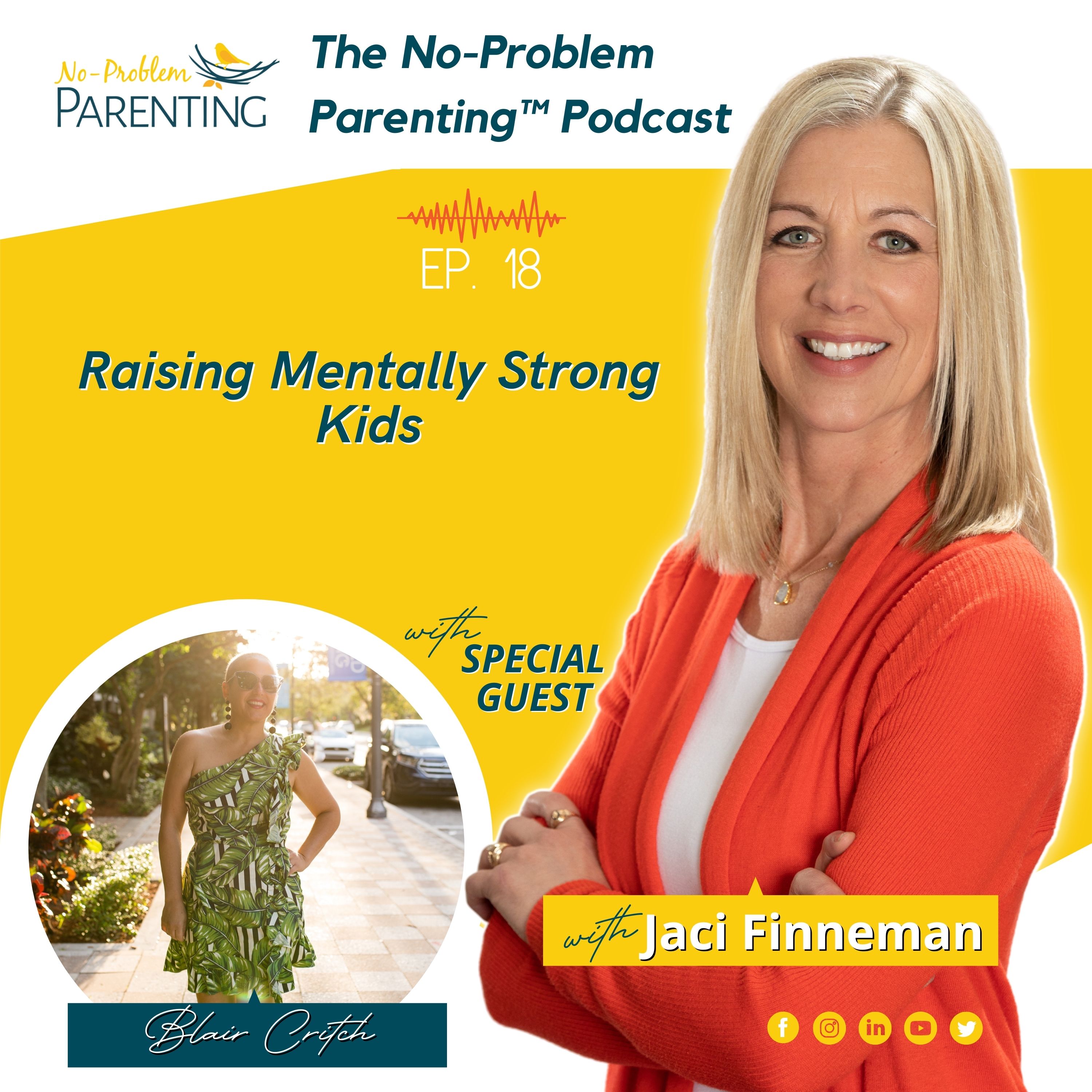
Raising Mentally Strong Kids with Special Guest Blair Critch
About this episode
HELLO PARENTS! Todays topic is on how to raise mentally strong kids – even in the midst of tough times.
My special guest, Blair Critch is going to talk about how even when you, the mom or dad are faced with adversity and when you’re in the midst of dealing with your own hardships and problems….you can show your kids and teach your kids how to become mentally strong right along with you.
Become a No Problem Parent Today!
Full transcript
Welcome back to the No Problem Parenting Podcast. Hey parents, today's topic is on how to raise mentally strong kids. My guest today is going to talk about how even when you, the mom or dad, are faced with adversity and when you're in the midst of dealing with your own hardships and problems, you can show your kids and teach your kids how to become mentally strong right along with you. Meet Blair Critch.
Blair is a success coach for moms in business and the co-creator of Blessed Mama Bosses, a company that helps ambitious women achieve financial success without sacrificing time with their family. But Blair's achievements haven't come easy. Listen in as Blair shares how bankruptcy, her husband's addiction, and her own battle with cancer has brought their family closer together. She's going to share five key things that she teaches her kids to become mentally strong and how they deal with and overcome problems in their home as a family.
Welcome to the show, Blair. I'm so excited to have you today. Before we get into how we can raise mentally strong kids, could you give us a little idea about how and why you decided to start the Blessed Mama Bosses podcast? Yes. Well, first off, thank you so much for having me on here. And Thank you so much for having a passion for parents and for children and wanting to serve them so that they can achieve, you know, what their dream is for their children, right?
We all have bumps in the road. So I know we were catching up before this podcast started and talking about why you started what you started. And I love that you said everyone's going to have problems. So being ready for those problems.
Well, I've had my fair share of problems. It's a big reason why I started Bless Mama Bosses. In the past, I was a kindergarten teacher, stayed home for five years with my boys, created an amazing rental business with 10 properties and had to file bankruptcy. My husband and I were, everything that we did was wrapped up in the mortgage industry. And when we had that huge crash and multiple hurricanes here in Florida, we just had to let go of it all. And it was heartbreaking. And as we were going through that hard transition, I also found out a year later that my husband was addicted to oxycodone, which is a pain pill. And that was a really hard time in my life because I had two little boys and I had to pull up my big girl panties and go make some money because we had none. And I wasn't sure if my husband was going to get better or not.
Thank goodness today he is sober doing amazing, but I didn't know. And I know a lot of you out there listening to this and you don't know, we don't know what's going to happen tomorrow. So I fell into network marketing, direct sales at that time. And within the first three months, I was making more than I ever did teaching. And I thought this will give me the flexibility to be home with my kids, hopefully help my husband get sober and still be able to make money. And it did exactly that. And then I was with that company for about five years and transitioned to my current company, which is a health and wellness, which fits more with my heart and my passion for helping others. And I've been with this current company for seven years now and earned over a million dollars in less than two years with them and have gone on to do that multiple times. And I truly believe it's because I have a heart and passion for helping others. And when I switched over to the current company that I'm with now, I really got focused on being organized and putting things in my life in the right order. So like God, family, then my business. And when I did that,
I saw a huge success. And so my partner, Kelly Hoover, and I created Blessed Mama Bosses, really because we both have a heart and passion for helping other women to earn six figures and beyond without sacrificing time with their family. And we could only help the women on our team when we were doing that. And we both were like, there's so many people that are asking us, How are you doing it? How are you building this freedom? And we just felt like it was what we were supposed to do is help more women, no matter what business they were in network marketing, direct sales, franchise, small business, whatever. Right. We wanted to help all the women. And so we created this group. And I truly believe that freedom is when you don't have to be tied down because of money or time or those kind of things.
And so that was really where it came from. And then we launched our podcast last fall in October because we wanted to be able to reach more people. And literally the day our podcast launched, I found out I had ovarian cancer. So there was a big journey through the last six months, even with us, with Bless Mom and Bosses.
And I just feel like all those things that hit, there's a purpose, there's a reason. And it's so that we can help more people and be able to relate with more people. So in a long story, that's where Bless Mom and Bosses started. I just absolutely love it.
And I love that, like we were talking about before we started recording for the show, that dealing with and overcoming problems, you know, no problem parenting doesn't say that there's not problems. We don't just like, oh, no problem, you know, and get through. There are problems, but the goal is to learn how to deal with them and overcome them. And you have certainly done that time and time again in lots of different ways.
And the reason we chose the subject today for, you know, how to raise mentally strong kids is because you went through all of those different trials and made it through and overcame those, but so did your kids, right? So let's talk a little bit. You have two children. I do. Yes, I have. My oldest is Jeremiah. He's 17. And my youngest is Noah, and he's 14, about to be 15. So I have two boys, and we are very open in our house. Like we have never hidden any of the hardships that we've gone through. We work through it all together as a family.
and I will say the last eight months of me going through chemo and all of that was just another thing that we could use as teachable moments for our kids. And it was honestly, it's crazy. And those of you out there that have been through something hard, you'll get this, but I feel like we are even closer today. Every time we go through something hard, I feel like we get so much stronger, so much closer and so much more real with each other. I don't try to be the perfect parent. Like my kids know that, right? So today, when you hear these five things that I do with my kids, you're going to hear things that I'm teaching myself and teaching my kids at the same time, because we don't try to pretend like we're perfect in our house.
We just try to teach them the skills of what to do when you do mess up, fail, or don't hit what you want to hit. So I hope these help you guys today. I'm excited. I am excited too.
So like you mentioned, you're going to get into five things, five things we can do to have and to raise mentally strong kids. So why don't we just jump right in? What is, what's the first thing? Awesome.
Well, the very first thing, and if you're listening today and you're driving in a car or whatever, you know, you might want to come back and take some notes. Tip number one is fail and try again. So one of the most important things that we have to do for our kids is teaching them how to fail, right? It's not a negative thing.
Failure can be embarrassing. We all get it. But if you don't help your kids learn how to take risks and make mistakes while they're at home under your roof, then they're going to grow up and not be able to handle it. Fail and try again and allowing your kids to do that inside of your home.
Point number two, help them learn to adapt. And I really believe that this one goes along very well with the fail and try again, because the pandemic showed us, right, that our kids had to adapt. And it was a great lesson for them to learn this last year. I mean, how many of you guys had kids last year in the spring who all of a sudden it was like, boom, they had to be online. They had to learn to pivot and adapt immediately.
And so one of my all-time favorite books is Who Moved the Cheese? And in that book, it explains that we're always adapting. And those who can adapt the fastest will win. So one of the best ways to help teach your kids how to adapt or to pivot is to allow them to name their emotions.
This was something really new for me when my kids were younger. I read a lot of books on this because I didn't grow up in a home where we talked about our emotions. And so in having two boys, I wasn't sure, like, where is that line? How do I teach them these things?
So teaching them how to name their emotions. How are you feeling when something changes? What's coming up for you when that happens? And now how can we move those feelings into a positive space?
That's teaching you how to adapt because you're really, as our kids get older and they ended going to college and getting jobs, if they can't pivot and adapt, they're going to be left behind. So helping them to learn and adapt is my tip number two. And I think it's vitally important. Number three, this is an important one.
I know. I'm sure this is one that you're going to be talking about a lot on all of your podcasts because it is important. So it's know when to say no. It's about boundaries, right?
And boundaries are a thing that if we're all being honest with ourselves, we all struggle with even as adults, but it's having that conversation with them. What will you give up if you say yes? So even, I mean, this goes even for little kids. I mean, I remember when my kids were little and they wanted to do everything right.
They wanted to say yes to every single sport. Say yes to every single play date. Say yes to every single party. But the reality is you have to also know that when you say yes, you're giving up something else.
So is it worth it in the moment? And if you can teach them this, it will go into those teenage years where they are being offered alcohol, drugs, speeding on the highway, all the, you know, sex, all these other bigger, important issues. Sorry, moms of young kids, this is what you deal with when they get into high school. And so it's setting that up from the beginning of boundaries.
What will you give up if you say yes to this? Is it really worth it in the moment? Is it the right thing to do? And then helping them with the words, right?
Because one of the biggest things that I have seen here in South Florida, where I live with social media being so prevalent in our kids when they were in elementary and middle school is feelings getting hurt or feeling like you have to say yes to everything you're invited to because you might not be in this picture. You might not be invited again. We can help them with the words. So the way that I do this with my children is I'll say, okay, let's decide.
Is this something that you want to do? If you say yes, what are you going to have to give up? Is it worth it? Is it the right thing to do?
Does it align with what you want in life? Then I help them figure out if the answer is no, they don't want to do it. I help them with the words. They are not mature enough to know that.
It's like even at five and six years old to 16 and 17 years old, it's very difficult for them to say no to somebody and say it in a way that doesn't hurt the other person. So we work on that in our house, like saying things like, thank you for inviting me, but I have other plans, or I'll have to check and get back to you. and then getting back to them in the right amount of time. Or I don't feel like that today, but I really appreciate you inviting me.
Giving them that confidence of being able to say no to things is okay. I think that a lot of us, our peer pressure becomes built up. It actually starts when you're a kid because we teach our kids to say yes to everything. If we could teach them how to say no and learn the language of how to say no without hurting other people's feelings, they're more likely to say no when they get older and they get put in those positions.
Super, super important. And I think there's a time, you know, when we allow our kids, like if they don't want to say no, cause they don't want to hurt somebody's feelings. Then we say, well, you can use mom and dad as an excuse. You can say my mom won't let me or dad won't let me or something like that.
And that's great. However, once they start getting into those teenage years, they really need to be able to do that for themselves. Yeah. I can think of this really great example.
When you were saying that this is what came to my mind when my youngest was in sixth grade, he was in this like text message group. Okay. He was in a varsity sport. We have a private school that our kids are part of.
So sometimes they'll take middle schoolers to the varsity sports if they don't have enough kids. So he was in this varsity text chat. Well, those are high school kids. And the things they were talking about were very inappropriate.
And I saw it. I said to him, you can either tell them that your mom is watching. And so you need to be out of this text group. And if they need to let you know about a practice or a game, they can message you privately.
Or you can say, I'm going to bail out of this group. and if you guys need me for practice or to let me know about a game or any information, please text me privately. And he decided in sixth grade to say, mom. A couple of years later, he again was put in his position like that and he took ownership.
He said, hey guys, I'm failing out of this group. Too many messages coming through, which was 50% truth. The other 50% truth was he didn't like what they were talking about. They were very degrading the things that they were saying about other girls.
It was inappropriate. And he said to me, mom, if somebody screenshots this, I could probably get in trouble. So by teaching them that in sixth grade, then they take ownership over it in eighth grade. And so that's kind of what I'm trying to share with that.
It's really important, you know, and as they get older, they're just going to get more and more situations where they have to make their own decision. Absolutely. I love that. All right.
And so then going into step four, when you do make a mistake, right, and taking ownership for it. So let's transition into that one. Yes, I love this one. So learning how to accept your mistakes and take ownership over it, because let's be honest, None of us want an entitled child, right?
But entitled kids are the kids that can't own their own mistakes. That's when you become entitled. It's when you think that everything is owed to you. And so it's really important, number one, that we like that you said in tip number one, that you let them fail and try again, but then that you help teach them to take ownership over that mistake.
So kids are often tempted to hide their mistakes because they don't want to get in trouble. But owning your mistakes actually builds character. Chapter one of my all-time favorite book, Success Principles by Jack Canfield. If you've never read it, I love it.
Chapter one is called Accepting Responsibility. And so we have actually made our teens read this. When there have been instances where they didn't take ownership, we still make them go back, read chapter one and report back to us on it. Because it is one of the biggest things that I see right now in a lot of young professionals is that they can't take ownership when they mess up.
Everybody wants to blame somebody else. So teaching them, how can you take that ownership? And one of the biggest things that I also really do in our home and that we truly believe has helped is discussing how to express when you're wrong. So how do you take ownership over that?
How do you accept responsibility? And how can you demonstrate this as a parent when you are wrong? So we're very honest. Like when something happens, an example that I can bring up to my kids, we do at the dinner table or the breakfast.
Hey, hey guys, yesterday I did this. I mean, there was an example a couple of months ago where I told a friend something I shouldn't have. And even as an adult, right, we get caught up in gossip and I shouldn't have shared that story. It was inappropriate.
It was not right. And I, a friend got really upset at me about it. I had to go back, apologize to each one of those people. I had to take ownership over it.
And those relationships are hindered now. And so I brought that to my kids and I told them, I was not afraid to show them that I make mistakes too, and that they're going to as well. We're all human. but here's how you go back and take responsibility for it. So that one, this is a big one. We can probably do a whole podcast episode on this, but it is really important that we show our kids the best way in my opinion is by demonstrating it and not using other people as examples.
Got to use yourself as an example. That's so true. I also talk about the make it right technique. So when somebody does mess up, you know, what happened, you know, it's just, it's real quick.
What happened? And when they tell you honestly, what happened? The next thing you say is good job telling the truth. I love that. It's a technique I learned years ago at a family bonding camp for kids. And I, and I was just like, this is so great. You know, like good job telling the truth reminds our kids that they can be truthful, even if they're chronic liars. We definitely want to use this if they're chronic liars. And then step three is what are you going to do to make it right? Or what are you going to do to make it up to that person? And then let them come.
They might need some ideas of some things to do. And then when all of this kind of works out and we do all of things, all of these things, we get into your fifth point, which is, yes, my fifth point is celebrate others wins. So jealousy is normal, right? We all have jealousy, but learning how to use your EQ, your emotional intelligence to congratulate and truly be happy for somebody else allows your kids a huge lead in life because others are more likely to want to tear each other down. But if you can teach your kids how to build other people up, what will that show, once they get into a job later on, their bosses will recognize that. And they'll be like, wow, he's really a team player. She's really a team player. I can tell you, my kid has made teams. One of my children has made teams that I'm not really sure he was even qualified to make because he is such a cheerleader for the whole team. He is so excited when anybody else does something. He's at every single practice. He shows up at every single thing. He cheers on the wind,
even if he doesn't get into the game. And so coaches want that player. They want that person. So teaching them how to be happy for others. And, you know, that's, it's something that we're all still learning, if we're being honest, right, we're always still growing in this. I know the first week of school, I do this with my kids every single morning, I say, I want you to report back this afternoon, either a win for somebody or that you introduce yourself to somebody new, right. And so it's you have to teach it like you were just sharing, it's positive reinforcement of the things that you're trying to teach them. And so doing that time and time again is so vitally important. I love that. I used to pay my kids. This is hilarious, but we used to pay our kids $25 when they were in elementary or middle school, if they would sit with a new person at lunch the first week of school. So each new person that they would come home and tell me about now,
my kids go to a small private school. So for me, it was twofold. It was, I, the reason I want you to do this is because I want you to make somebody else feel comfortable. You guys have not known each other since you were little at this school. And it is very scary for somebody new. But the second part of it was I wanted them to report back home the person's first name and last name.
Then I went and found out that person's phone number. And I reached out to that parent because I wanted them I wanted to show my kids I do the same thing. You're new at our school, you don't know anybody yet, I'm going to invite them to coffee with some other girls from the school, so they can meet some other moms. So again, I'm not just teaching my kids, I'm also mocking the behavior so that they can see that this is a lifelong thing that we want to teach. Oh my gosh, That is so great. Let's see. All right. So now we've got the five tips, fail and try again, adapt when to say no, accepting mistakes and ownership, and then celebrating others wins.
Let's talk about some of the books and other resources or things that you do with the kids to learn these five points. Yes. Well, I'll tell you guys, my top favorite books are success principles for teens. So I, and we actually, like when I was talking about chapter one of success Principles by Jack Canfield. That's his, you know, regular version. So we do make our kids read chapter one of the regular one, I still think it's better. But we have had summer readings in our house where my kids have had to read Success Principles for Teens. I highly suggest Seven Habits of Highly Effective Teens as well by Stephen Covey. But we have also had our kids when they were younger, read some of the children's books that are out there right on boundaries on celebrating others, on learning to love others, on kindness, on sharing. I mean, there are so many great books out there for young kids. But then another thing that we do in our house that I think is wildly helpful is vision boards. So if you guys create vision boards, maybe you're in business and you created vision boards for yourself. Have you ever thought about doing it as a family? You learn so many things about your kids. When you create those vision boards together, you see their wants,
their desires, their needs, the things that they're trying to achieve, right? And by having that time together. And we have a whole course, Bless Mama Bosses, we put together a course on vision boards, but also on how to use it with your family. Both is included in our vision board mini course. And we even give you these graphics. So we made a graphic where they have to write down three goals that they have for school, three goals that they have for themselves personally, and three goals that they have as a family. And so then they write those three goals, then they go and find the pictures that go along with them. And we have more details about all this in our course. But what I love about it is the fact that you really do get to know your kids on a deeper level. And as you continue to grow and peel back the layers of who they are and get down to really learning their heart and their passion, that's when you really have, in my opinion, a better relationship with them and more things to talk about. Because I can guarantee you,
those of you that have young kids right now, your conversations are easy, but as they get to middle school and high school, they don't want you to say, how was school today? What's going on with your friends? What are you doing? Like those are questions that annoy them. So you've got to find different things to talk about with them. And if you do things like this, like a vision board, it's not only setting them for success when they get older, we know from Harvard studies and Stanford studies that setting goals and visualizing them gives you a higher chance of achieving them, you have a 10% higher chance of somebody who doesn't, it also helps you to get to know your child better. And that is where in my opinion, true growth happens in your relationship,
when you can truly like serve them in that way. That is such a great idea. And so I'm going to put the link to that course, to your vision board course, the information on that. I'll put that in the show notes as well.
Oh my gosh, so much great information in such a short time. Thank you so much, Blair, for being on the show today. I really appreciate it. It was my pleasure.
So great to meet all of you guys and hope that you will connect with us on social media and find Blessed Mama Bosses. We can't wait to meet you. all right that's it for today parents be sure to check out Blair and her business partner Kelly at blessedmamabosses.com you can also join their free community at blessedmamabossesgroup.com and if you want to learn how to master your time click the link in the show notes to access the free time blocking and calendar planning worksheet thanks so much for joining me today everybody be sure to take a screenshot of this episode and share it with your friends and family on your favorite social media. For now, hugs and high fives. You got this.
Become the confident leader your kids crave
The method, the community, monthly live Q&A with Jaci, and Celia — your AI guide in the moment.
Start your 14-day free trial Get it on iPhone or sign up on the web